
For Complex Media, How Do We Develop Customized Industrial Pipelines?
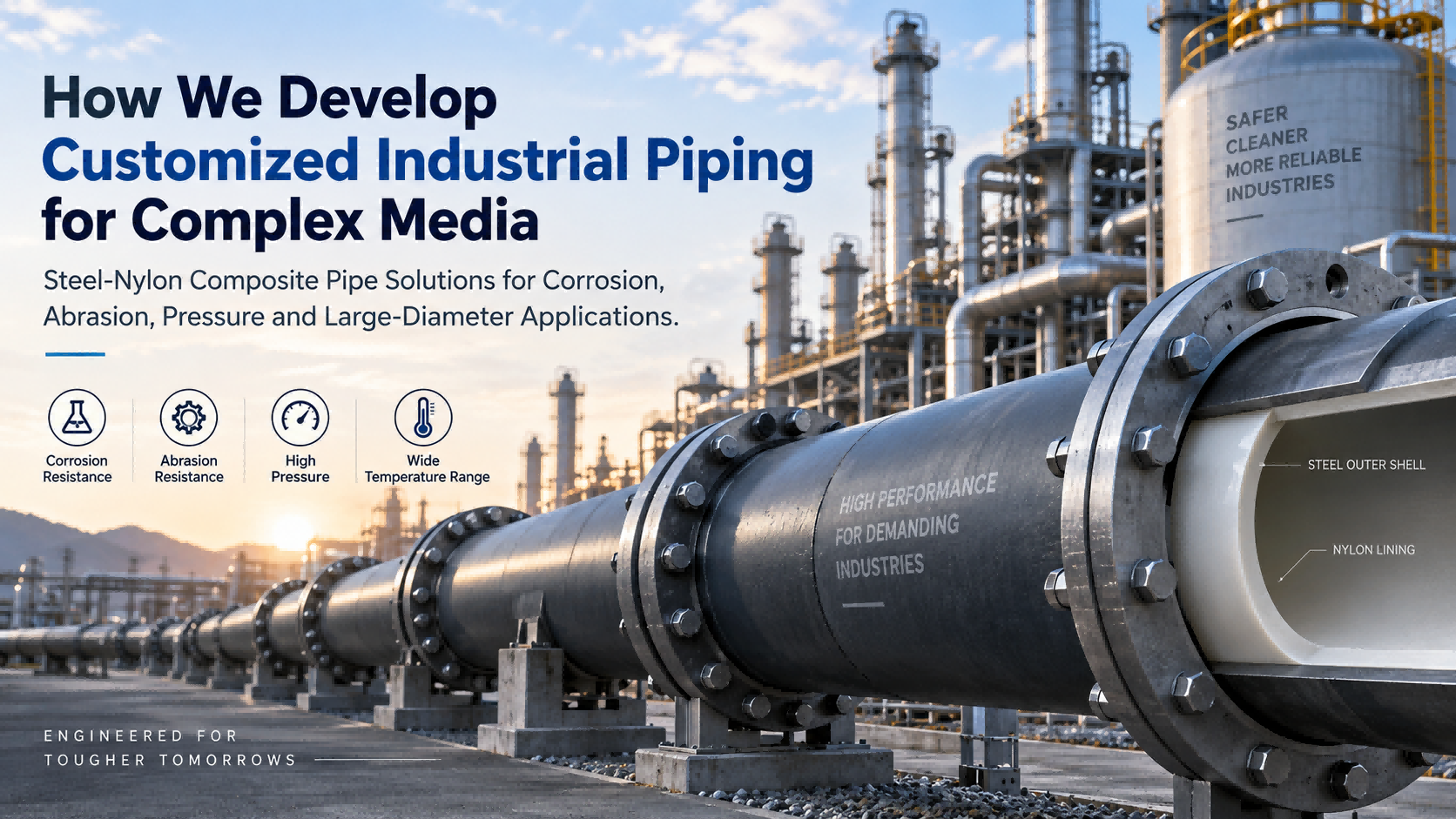
The Real Challenges Complex Media Pose to Pipeline Engineering
Carbon steel and stainless steel remain the default options in most industrial scenarios. But when the medium contains high concentrations of chloride ions, hydrogen sulfide, carbon dioxide, aromatic hydrocarbons, or high-hardness solid particles, traditional metal pipelines face not only rising corrosion rates, but also runaway maintenance costs and cascading risks of unplanned shutdowns. Industry data show that corrosion-related unplanned downtime directly affects operating profits in the chemical and oil and gas sectors, and problems caused by the failure of anti-corrosion coatings over long service lives are often more troublesome than the initial corrosion itself.
This is exactly where customized pipeline engineering begins: not by selecting from an existing product catalog, but by reverse-engineering the pipeline structure from media analysis.
Structure Determines Performance: The Engineering Logic of Steel-Nylon Composite Pipe
The core design idea of steel-nylon composite pipe is to **let each material do what it does best**.
The pipe uses a three-layer composite structure: the inner nylon layer directly contacts the conveyed medium and provides corrosion resistance, wear resistance, and low friction; the middle layer is a lightweight spirally reinforced steel pipe that provides pressure-bearing capacity and structural rigidity; the outer nylon layer provides external protection and aging resistance. The three layers are tightly bonded through a special process. The inner wall of the steel pipe is textured to enhance adhesion to the inner nylon layer, while the corrugated spiral reinforcing ribs on the outer wall improve overall strength without significantly increasing weight.
The performance combination this structure delivers is difficult for single-material pipes to achieve at the same time:
**Pressure capacity**: burst pressure up to 10.2 MPa, working pressure 4 MPa, material yield strength 97 MPa;
**Weight advantage**: product weight is only 1/7 that of steel pipe of the same specification, and underwater weight is 1/45 that of steel pipe. This directly reduces installation loads and transportation costs in scenarios such as offshore platforms and deep mining conveying;
**Wear resistance**: under the same working conditions, wear resistance is 8 times that of steel, providing a significant service-life advantage for conveying media such as slurries and tailings containing solid particles;
**Temperature range**: long-term service temperature covers -36°C to 130°C, adapting to a wide temperature range from cold regions to high-temperature process sections;
**Chemical resistance**: resistant to corrosion by most alkalis and salts, with good performance in aromatic hydrocarbon media; methane permeability is about 30 times lower than that of polyethylene.
Customization Is Not Just “Changing Dimensions,” but “Matching the Medium”
True customized pipeline development requires design inputs established from multiple dimensions, including the chemical composition of the medium, solids content, temperature, and pressure fluctuation characteristics. Take the polyamide (nylon) inner layer as an example. Nylon 11 and nylon 12 perform well in weak acids, weak bases, oils and fats, and aromatic hydrocarbon environments, but their resistance to concentrated acids and halogenated hydrocarbons is limited. This means that for media containing high concentrations of acidic components, adjustments are needed at the nylon formulation level, or a barrier layer must be introduced through multilayer compositing.
For sour oil and gas environments containing H₂S and CO₂, nylon materials have already been validated in practice. In offshore applications, polyamide 12 shows high resistance to hydrocarbons, hydrogen sulfide, and CO₂ aqueous solutions. This performance was verified in a biomethane project, where steel pipelines could not handle the service because of H₂S corrosion. For “sweet” oil and gas wells (with low corrosive impurity content), nylon is the preferred choice; for “sour” wells, a fluoropolymer barrier layer may need to be introduced to form a complementary structure with nylon.
Customization of the steel pipe layer is equally critical. The wall thickness, pitch, and reinforcing rib geometry of the spirally reinforced steel pipe must be calculated according to the pipeline’s working pressure, diameter, and installation method. For pipelines below DN150, traditional extrusion wrapping processes are difficult to apply, while a spiral steel skeleton structure can overcome this limitation and allow customization to cover a wider range of pipe diameters.
From Oilfields to Mines: Validation in Real Scenarios
In a pilot evaluation at Shengli Oilfield, the research team compared FRP pipe, steel skeleton composite pipe, PE-lined pipe, glass enamel-lined pipe, and nylon composite pipe through one year of application and dissection tests. The conclusion was clear: steel skeleton composite pipe and nylon composite pipe had the best corrosion resistance and overall performance, making them suitable for internal corrosion protection in oilfield gathering and transportation systems; FRP pipe was not suitable for higher-pressure applications; PE-lined pipe was not recommended because of poor lining adhesion, and glass enamel-lined pipe was not recommended because of insufficient corrosion resistance.
At the practical application level, reinforced nylon pipes have been put into use in oil and gas gathering and transportation pipelines and sewage lines at Shengli Oilfield’s Shengli, Binnan, and Gudong oil production plants, as well as at the Karamay Oilfield in Xinjiang. The mining sector is also validating this technical route. A flexible composite pipe project applied at Chile’s Codelco mine proved that the mining conveying environment has extremely high requirements for corrosion resistance, lightweight construction, and installation efficiency, and the structural characteristics of steel-nylon composite pipe match these needs precisely.
Connection and Installation: The Last Mile of Customization
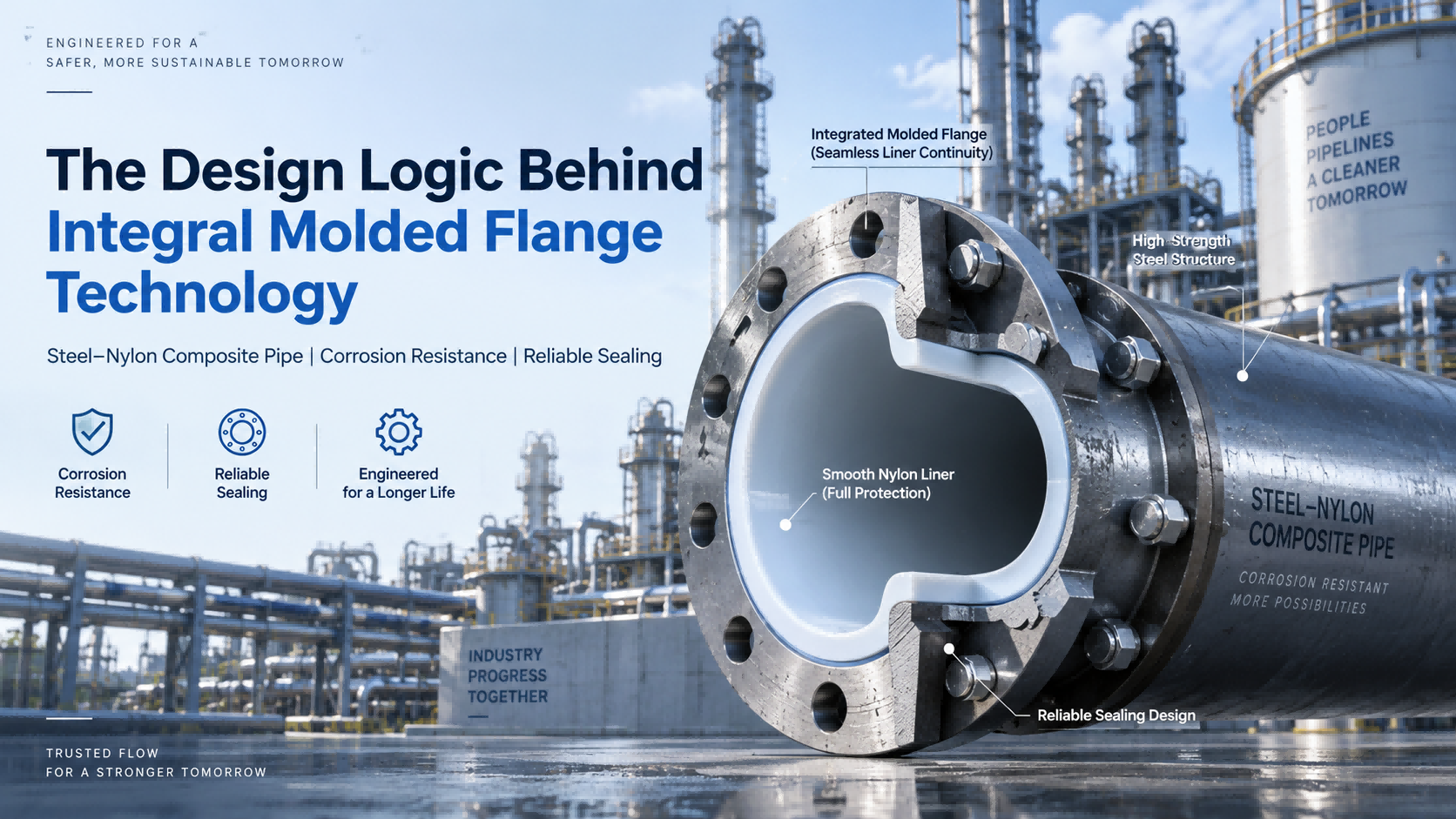
If the performance advantage of a pipeline is compromised at the connection stage, its overall value is discounted. Steel-nylon composite pipe can be integrally formed through a casting process. The pipe body can come with flanges, and the flange face is provided with an annular boss and sealing structure to ensure sealing reliability after connection. For scenarios requiring connection with existing steel or plastic pipe systems, the composite pipe can also adapt to multiple connection methods, reducing interface compatibility risks in retrofit projects.
Installation convenience is also worth noting: because the weight is only 1/7 that of steel pipe, the manpower and machinery required for on-site handling and positioning are greatly reduced; the smooth inner wall creates low friction resistance, making pressure loss only about 2/3 that of metal pipelines. At the same pumping power, this can improve conveying efficiency or extend conveying distance.
The Starting Point for Customized Pipeline Development
Complex media will not change their chemical and physical properties just because pipeline selection is difficult. A reasonable approach for engineering teams is to use media samples, operating parameters, and installation conditions as design inputs at the early stage of a project, and work with the pipeline manufacturer to determine the material combination and structural solution. The value of steel-nylon composite pipe does not lie in the simple narrative of “replacing steel pipe,” but in providing an engineering choice that **balances corrosion resistance, wear resistance, pressure-bearing capacity, and lightweight construction**—a balance that is difficult to replicate with single-material pipelines.
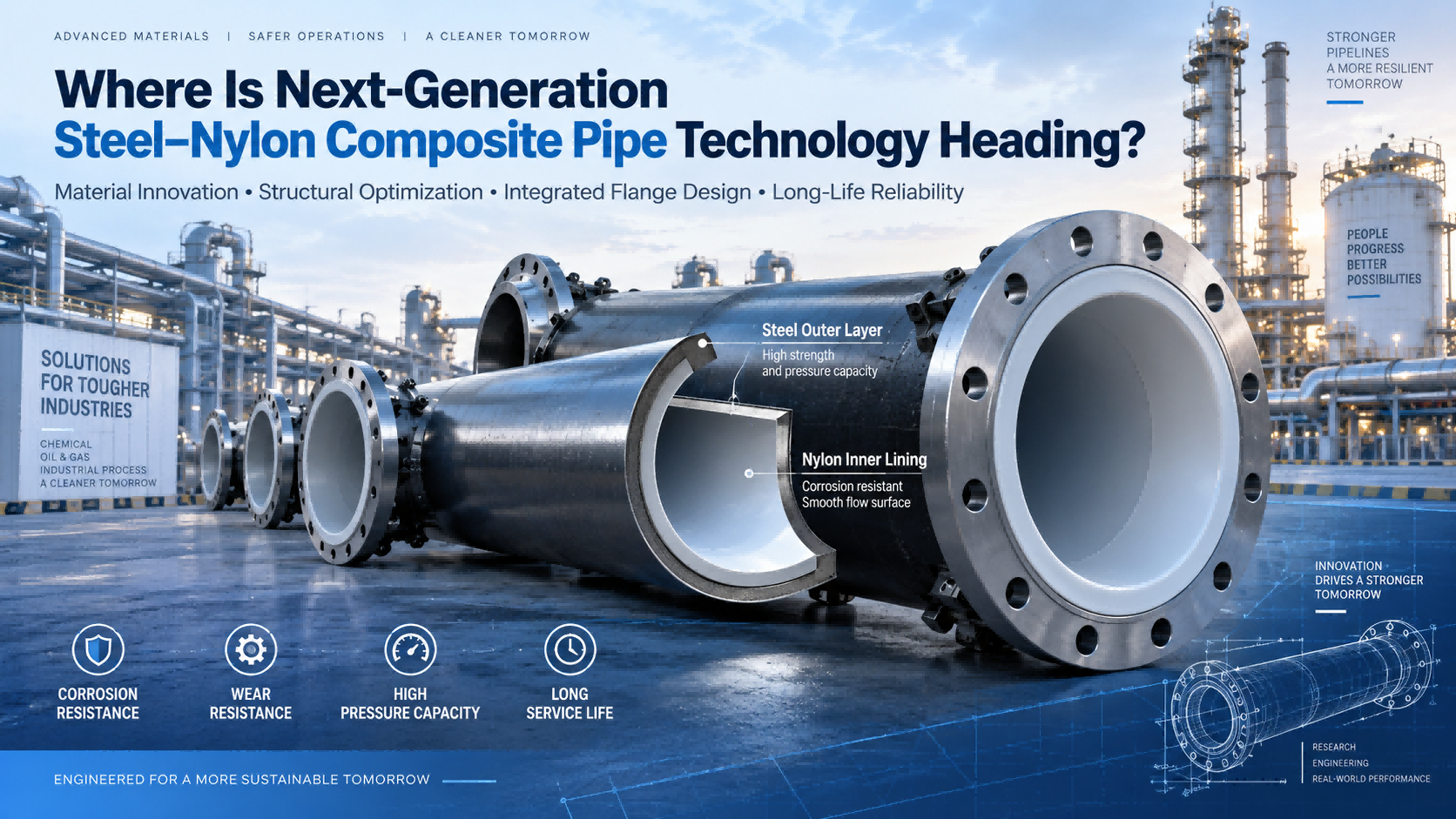
Where Will the Focus of Next-Generation Steel-Nylon Composite Pipe Technology Shift?
Can Wear Resistance, Corrosion Resistance, and Pressure Capability Be Achieved at the Same Time?
Related blog
SEND MESSAGE