How Structural Optimization Improves the Stability of Large-Diameter Pipelines
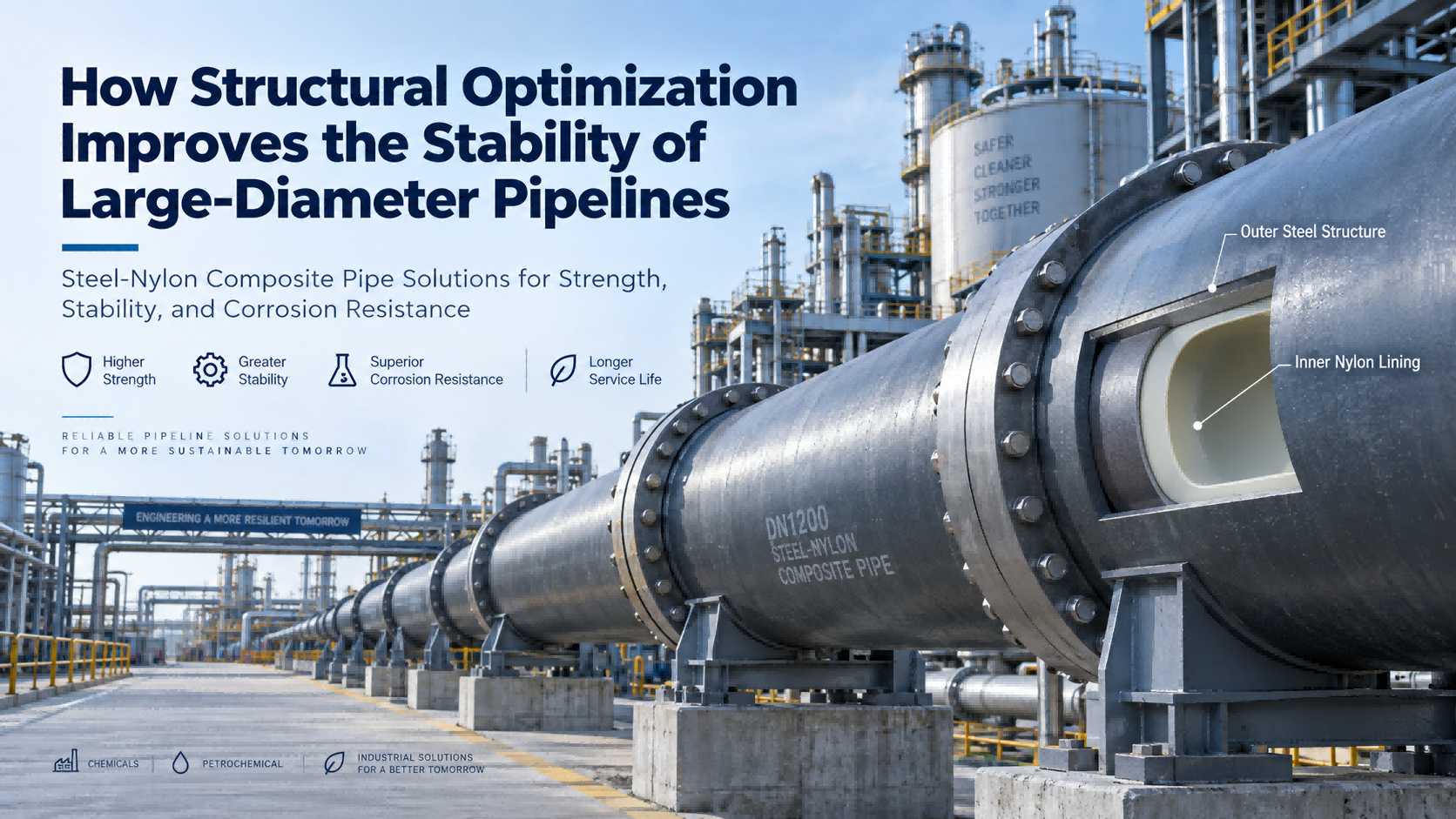
As chemical, mining, oil and gas, salt chemical, phosphate chemical, and industrial water treatment projects continue to expand in scale, large-diameter industrial pipelines such as DN800, DN1000, DN1200, and even DN1600 and above are becoming increasingly common.
However, increasing pipeline diameter does not simply mean scaling up a smaller pipe proportionally.
In fact, the larger the diameter, the more significant structural stability becomes.
For large-diameter industrial pipelines, engineers must consider much more than corrosion resistance, operating pressure, and flow capacity. They also need to evaluate:
-
Circumferential stability
-
Axial rigidity
-
Local deformation
-
Vacuum and negative-pressure conditions
-
Support spacing
-
Stress around flange connections
-
Thermal stresses caused by temperature changes
-
Long-term structural fatigue
For this reason, large-diameter pipeline design is no longer simply a material-selection problem. It has increasingly become a systems engineering challenge involving material properties, structural design, manufacturing capability, and connection reliability.
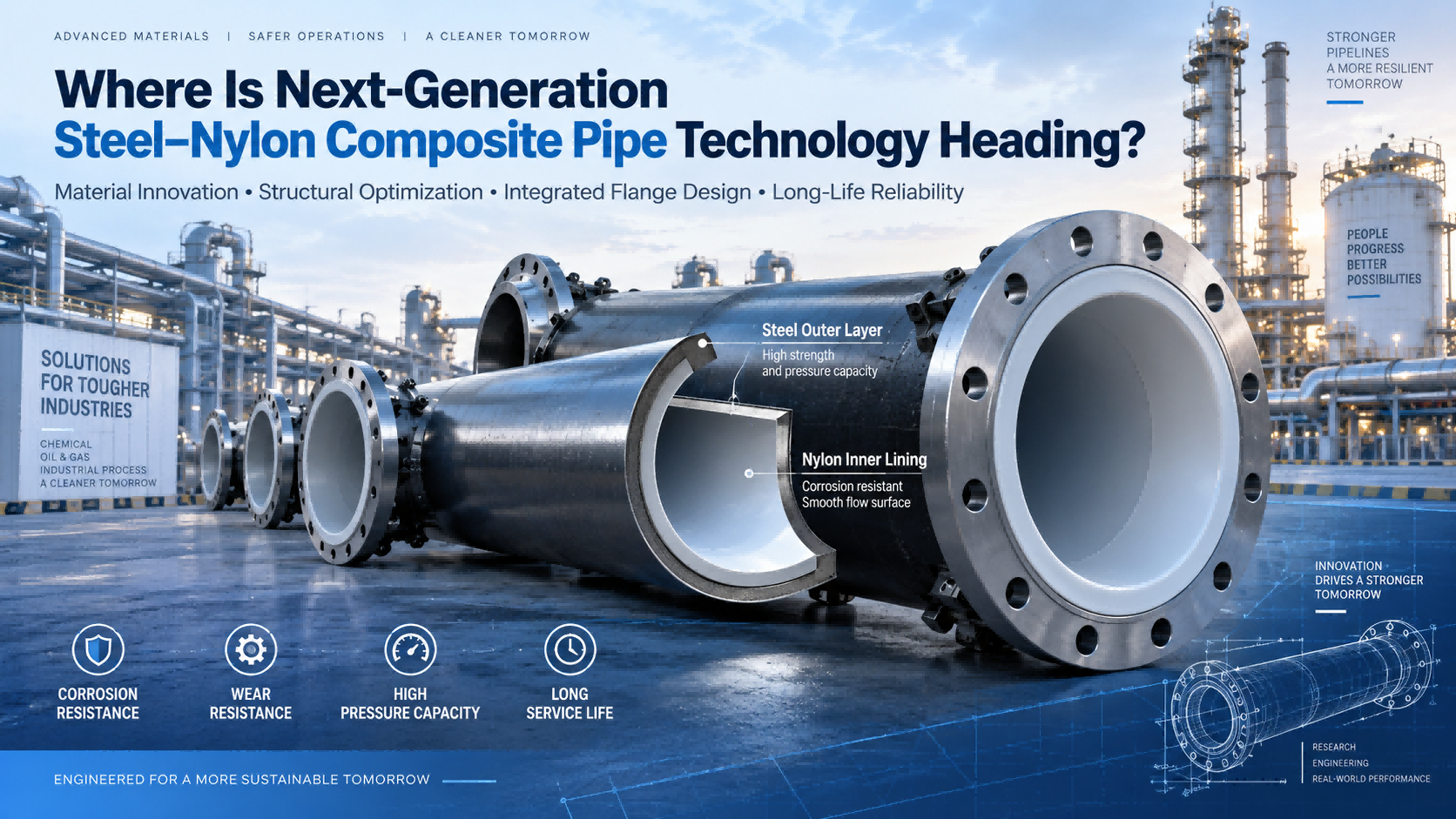
Steel-nylon composite pipes combine a load-bearing steel structure with a corrosion-resistant nylon lining, providing a different technical approach from conventional single-material pipelines.
1. Why Are Large-Diameter Pipelines More Vulnerable to Structural Instability?
For pipelines made from the same material and with similar wall thicknesses, increasing the diameter significantly changes their ability to resist external loads, localized forces, and deformation.
For example, a few millimeters of localized deformation in a DN100 pipeline may have little impact on its overall structure.
However, in a DN1000 or DN1600 pipeline, proportional deformation can potentially lead to:
-
Pipe ovalization
-
Misalignment of flange sealing surfaces
-
Uneven loading at supports
-
Localized stress concentration in the lining
-
Deflection of long pipe sections
-
Local structural instability under vacuum conditions
Therefore, large-diameter pipeline engineering must answer three separate questions:
Can the pipeline withstand the required pressure?
Can it maintain its designed geometry?
Can it remain structurally stable throughout long-term operation?
These are not the same question.
A pipeline that successfully passes a short-term hydrostatic pressure test is not necessarily guaranteed to remain stable over years of operation under support loads, temperature fluctuations, vacuum conditions, and complex mechanical stresses.
2. Circumferential Rigidity Is Critical to Large-Diameter Pipeline Stability
Circumferential rigidity is one of the most important structural parameters affecting large-diameter pipeline stability.
A pipeline may be subjected to:
-
External soil pressure
-
Concentrated support loads
-
Vacuum conditions
-
Mechanical loads from connected equipment
-
Deformation during lifting and installation
If circumferential rigidity is insufficient, the pipeline may gradually become oval or locally deform.
The larger the diameter, the more important this issue becomes.
Simply increasing polymer wall thickness is therefore not always the most efficient solution.
As diameter increases, relying exclusively on thicker polymer walls may create additional challenges, including:
-
Significantly higher material consumption
-
Increased pipe weight
-
Rapidly rising manufacturing costs
-
Greater forming difficulty
-
More difficult dimensional control
A composite structure offers another engineering approach.
3. Why Combine Steel Structure with a Nylon Lining?
The fundamental design philosophy of steel-nylon composite pipe is not to force one material to perform every function.
Instead, each material performs the task for which it is best suited.
A typical design philosophy can be summarized as:
Steel provides structural strength and dimensional stability, while nylon protects the flow surface against corrosion, wear, and scaling.
This functional division becomes particularly valuable as pipeline diameter increases.
What Does the Steel Structure Provide?
Steel offers relatively high:
-
Elastic modulus
-
Structural strength
-
Circumferential rigidity
-
Axial rigidity
-
Flange connection strength
It can therefore serve as the primary load-bearing structure of a large-diameter pipeline.
Especially in DN800 and larger pipelines, a properly designed steel structural layer can improve resistance to:
-
Ovalization
-
Local deformation
-
Support loads
-
Transportation and lifting loads
-
Axial bending
What Does the Nylon Layer Provide?
Another major cause of industrial pipeline failure is not insufficient mechanical strength, but internal corrosion and wear.
Typical aggressive media include:
-
High-salinity water
-
Salt slurry
-
Process slurry
-
Alkaline solutions
-
Oilfield produced water
-
High-water-cut crude oil
-
Certain weak-acid media
When these media remain in long-term contact with conventional carbon steel, they may contribute to:
-
Electrochemical corrosion
-
Pitting
-
Erosion-corrosion
-
Wall-thickness loss
-
Perforation and leakage
A nylon lining helps isolate the transported medium from the load-bearing steel structure.
The design philosophy therefore becomes:
Steel manages structural loads; nylon manages the internal service environment.
This separation of functions is particularly useful for large-diameter industrial piping systems.
4. Large-Diameter Stability Requires More Than Simply Increasing Wall Thickness
When discussing large-diameter pipeline stability, wall thickness is often the first parameter considered.
However, real-world structural stability depends on the coordinated optimization of multiple design parameters.
These include the following.
4.1 Optimizing Diameter-to-Wall-Thickness Ratio
The relationship between pipeline diameter and wall thickness strongly influences structural stability.
As diameter increases, inadequate wall thickness may reduce resistance to ovalization and local instability.
Structural dimensions therefore need to be determined according to factors such as:
-
Nominal diameter
-
Operating pressure
-
Design pressure
-
Support spacing
-
Operating temperature
-
External loads
-
Installation method
For steel-nylon composite pipes, two separate functional requirements should also be considered:
The load-bearing requirement of the steel structure
and
The corrosion resistance, wear resistance, and service-life requirements of the nylon functional layer.
Total wall thickness alone should not be treated as the only design criterion.
4.2 Optimizing the Steel Load-Bearing Structure
For large-diameter pipelines, the steel structure is much more than an external protective shell.
It forms the primary structural framework of the pipeline.
By optimizing:
-
Steel wall thickness
-
Flange configuration
-
Welded areas
-
Reinforcement structures
-
Local high-stress areas
the overall stability of the pipeline can be significantly improved.
In large chemical facilities and long-distance industrial piping systems, some pipe sections may also require relatively large support spans.
The pipe must then carry not only internal pressure, but also:
-
Its own weight
-
The weight of the transported medium
-
Local external loads
Proper steel structural design can reduce the risk of excessive deflection across long unsupported spans.
5. Flange Areas Are Often Overlooked in Large-Diameter Pipeline Design
One of the most critical yet frequently underestimated areas in large-diameter pipeline design is the connection point.
In many piping systems, the main pipe body remains intact while leakage eventually develops around the connections.
Why?
Because flange areas may simultaneously experience:
-
Bolt preload
-
Internal pipeline pressure
-
Axial pipeline forces
-
Thermal stresses
-
Installation misalignment
-
Additional loads from connected equipment
As pipeline diameter increases, flange diameter and bolt quantity also increase, making uniform load distribution across the sealing surface increasingly important.
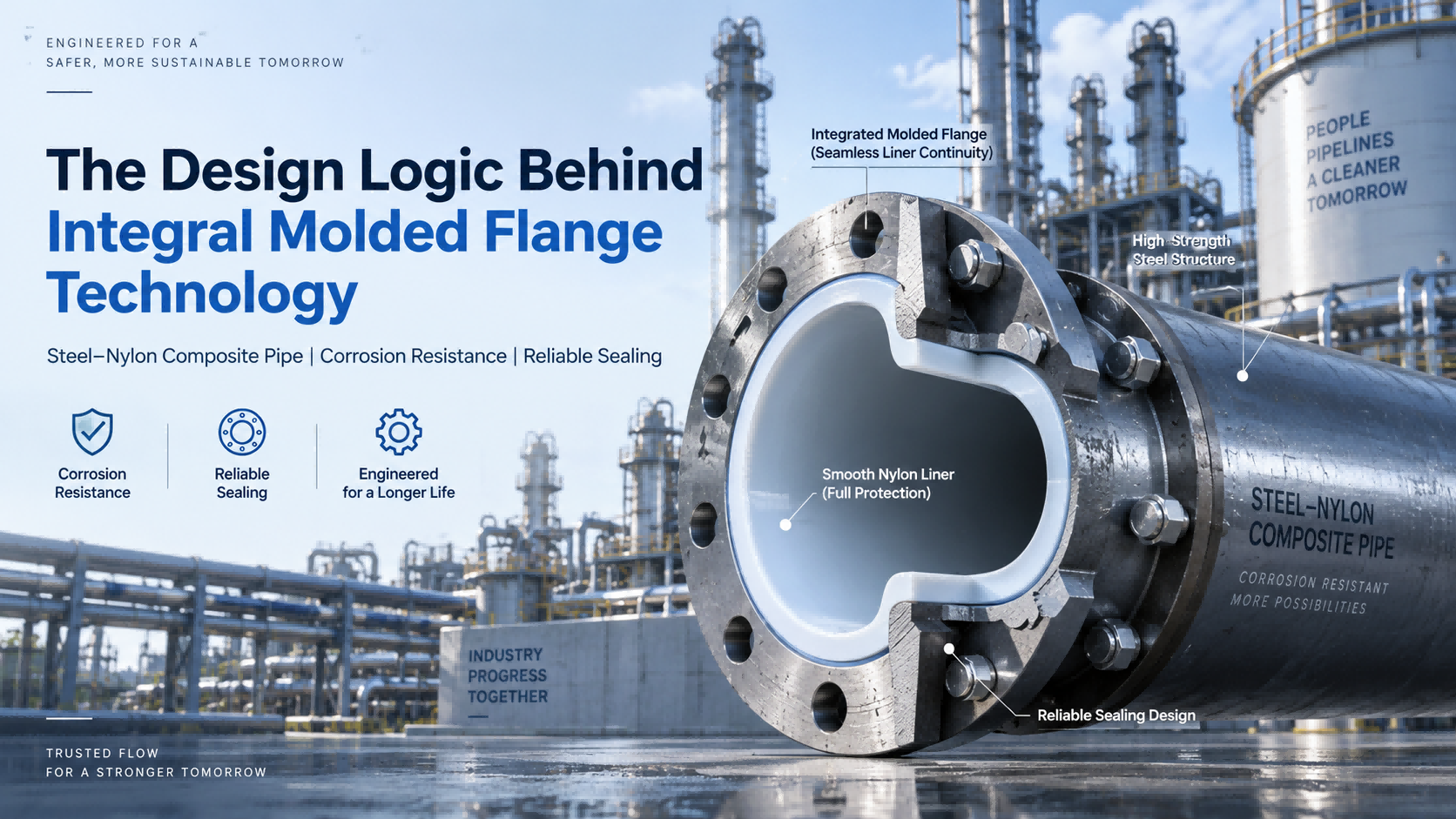
For this reason, flange structure is an important part of our steel-nylon composite pipe design philosophy.
Flanged connections can support modular installation of large-diameter pipe sections while reducing the need for on-site welding.
For chemical plants, oil and gas facilities, and operating industrial plants, this approach may also help reduce the amount of hot work required during installation and maintenance.
6. Why Integrated Connection Design Matters
For lined and composite pipelines, another commonly overlooked issue is structural continuity between the pipe body and its connections.
If the main pipe body is protected by a corrosion-resistant layer but that protection is interrupted at the connection, the connection may become a new corrosion weak point.
Large-diameter composite pipeline design should therefore consider not only the pipe body but also whether corrosion protection remains continuous across:
-
Pipe ends
-
Flanges
-
Sealing surfaces
-
Reducers
-
Elbows
-
Tees
From an engineering perspective:
The reliability of an entire pipeline system is often determined by its weakest connection.
Large-diameter composite pipeline design should therefore move beyond individual pipe sections and toward complete piping-system engineering.
7. Negative Pressure Is Another Test of Large-Diameter Pipeline Stability
Industrial pipelines do not always operate under positive internal pressure.
Temporary negative pressure may occur during:
-
Pump shutdown
-
Rapid draining
-
Sudden temperature drops
-
Rapid valve closure
-
Suction or vacuum processes
Under these conditions, the direction of loading changes.
Large-diameter pipes with insufficient circumferential rigidity may deform inward under external atmospheric pressure.
The larger the diameter, the more important vacuum stability becomes.
Because steel has relatively high structural rigidity, a properly engineered steel-nylon composite structure can use the steel load-bearing layer to improve resistance to deformation under complex pressure conditions.
This demonstrates why pipeline selection cannot be based exclusively on one question:
“Is the material corrosion resistant?”
A more complete engineering evaluation needs to consider:
Corrosion resistance + mechanical performance + operating pressure + structural stability.
8. Large-Diameter Pipelines Must Also Address Axial Stability
In addition to radial deformation, large industrial pipelines can experience substantial axial loads.
Temperature variations are particularly important in long-distance pipeline systems because thermal expansion and contraction accumulate over longer pipe runs.
If a pipeline system does not properly incorporate:
-
Anchor supports
-
Sliding supports
-
Expansion compensation
-
Suitable piping layout
thermal stresses may concentrate around:
-
Flanges
-
Elbows
-
Tees
-
Equipment connections
Large-diameter pipeline design therefore needs to consider the entire piping system rather than individual pipe sections alone.
In steel-nylon composite pipes, the steel structure provides stable axial mechanical performance while the nylon lining continues to provide corrosion and wear resistance.
The two materials perform clearly differentiated functions.
9. Why Manufacturing Consistency Is Especially Important for Large-Diameter Pipes
Good structural design is only the first step.
The ability to manufacture consistently is equally important.
As pipeline diameter increases, dimensional deviations become more difficult to control.
Potential issues include:
-
Out-of-roundness
-
Wall-thickness deviation
-
Flange flatness deviation
-
Flange concentricity deviation
-
Uneven lining thickness
-
Pipe-end dimensional deviation
These issues may be relatively insignificant in small-diameter pipes but can have a major effect on field installation when pipe sizes exceed DN1000.
For example, if two large-diameter pipe flanges have excessive alignment deviation, the result may include:
-
Difficulty installing bolts
-
Uneven gasket compression
-
Excessive localized flange stress
-
Leakage during long-term operation
For this reason, the real challenge in manufacturing large-diameter industrial pipelines is not simply:
“Can it be manufactured?”
The more important question is:
“Can products with consistent dimensions and performance be manufactured repeatedly and reliably at scale?”
10. DN1600 and DN2000-Class Pipelines Require a Different Manufacturing Approach
Once pipeline diameter reaches DN1600 or even DN2000 class, conventional manufacturing methods may face completely new challenges.
These include:
Forming Equipment Capacity
Large-diameter pipelines require larger:
-
Molds
-
Forming equipment
-
Lifting equipment
-
Processing equipment
Roundness Control
As diameter increases, the influence of gravity on pipe geometry becomes more significant.
Flange Manufacturing
For ultra-large-diameter flanges, parameters such as:
-
Flatness
-
Concentricity
-
Bolt-hole accuracy
directly affect field assembly.
Lining Formation
For composite pipeline structures, the internal lining needs to remain:
-
Continuous
-
Uniform
-
Free from significant defects
-
Structurally compatible with the pipe body
Large-diameter pipeline production therefore tests the comprehensive capability of a manufacturer.
It is not only a material technology challenge.
It also involves:
-
Equipment
-
Tooling
-
Processing technology
-
Inspection capability
-
Quality management systems
11. Why Steel-Nylon Composite Structures Are Suitable for Large-Diameter Industrial Pipelines
From a large-diameter pipeline design perspective, an effective material system needs to address several engineering requirements simultaneously.
| Engineering Requirement | Steel-Nylon Composite Design Approach |
|---|---|
| Internal pressure resistance | Steel structure carries the primary mechanical load |
| Dimensional stability at large diameters | Steel structure provides high rigidity |
| Internal corrosion resistance | Nylon lining separates corrosive media from the steel |
| Particle erosion resistance | Nylon provides wear-resistant flow surfaces |
| Reduced scaling tendency | Smooth internal surface helps reduce deposits |
| Long pipeline installation | Flange connections support modular installation |
| Large-diameter manufacturing | Steel structure provides a stable structural framework |
| Long-term maintenance | Reduced corrosion-related wall thinning and replacement |
Steel-nylon composite pipe is therefore not simply a combination of “steel pipe plus plastic.”
Its real engineering value comes from:
using structural and functional materials in the roles where they perform most effectively.
12. Structural Advantages Become More Important When Corrosion and Wear Occur Together
Many industrial applications do not involve corrosion alone.
Media such as mineral slurry, salt mud, oilfield produced water, and certain chemical slurries may create:
Corrosion + erosion + wear
simultaneously.
With conventional carbon steel, corrosion may first reduce the pipe wall thickness.
Solid particles can then accelerate material loss through erosion and abrasion.
This creates a typical:
corrosion-wear synergistic failure mechanism.
This combined mechanism is one of the reasons industrial pipeline service life can be significantly reduced.
Steel-nylon composite pipes address these challenges through functional separation.
The steel structure maintains mechanical integrity, while the nylon inner layer isolates the steel from corrosive media and provides a wear-resistant flow surface.
Instead of asking one material to solve multiple conflicting problems, the composite structure addresses them separately.
13. Large-Diameter Pipeline Selection Should Move from “Material Selection” to “System Selection”
Historically, industrial pipeline selection often began with the question:
“Is this material resistant to the medium?”
For large-diameter industrial piping, that question alone is no longer sufficient.
A more complete evaluation should ask whether the pipeline can simultaneously meet requirements for:
-
Chemical compatibility
-
Operating pressure
-
Design temperature
-
Circumferential stability
-
Vacuum resistance
-
Long support spans
-
Flange connection reliability
-
Installation requirements
-
Service life
-
Maintenance cost
Only when these factors are considered together can engineers determine whether a pipeline system is truly suitable for a specific industrial project.
14. Future Trends in Large-Diameter Industrial Pipelines
As industrial projects become larger and more complex, large-diameter pipelines are evolving beyond the traditional objective of simply achieving:
sufficient strength.
The new objective is increasingly:
high reliability + corrosion resistance + wear resistance + low maintenance + long service life.
This is one reason composite piping systems are receiving increasing attention.
Future large-diameter industrial pipeline systems are likely to place greater emphasis on:
-
Multi-material composite structures
-
Separation of structural and functional roles
-
Modular flange connections
-
Weld-free or reduced-welding installation
-
Long-life engineering
-
Total lifecycle cost control
In other words, future competition in industrial piping will not simply be about which material has the lowest initial price.
The more important question will be:
Which piping system can provide more stable, reliable, and economical performance throughout its entire service life?
15. Our Design Philosophy for Steel-Nylon Composite Pipes
We focus on the development and manufacturing of corrosion-resistant and wear-resistant industrial piping systems.
For demanding industrial media, our steel-nylon composite structure combines:
the mechanical strength of steel
with
the corrosion resistance, wear resistance, and smooth internal surface of engineered nylon materials.
Our piping solutions can be applied in industrial environments such as:
-
Oil and gas gathering systems
-
Oilfield produced-water pipelines
-
Water-injection systems
-
Chlor-alkali plants
-
Soda ash production
-
Salt chemical industries
-
Phosphate chemical plants
-
Slurry transportation
-
Industrial water systems
For large-diameter projects, particular attention is given to:
-
Pipe-body structural design
-
Flange structural design
-
Lining continuity
-
Roundness control
-
Wall-thickness consistency
-
Flange dimensional accuracy
-
Batch manufacturing consistency
Our engineering principle is simple:
A truly reliable large-diameter industrial pipeline is not merely a pipe made larger. It is a pipeline that continues to maintain structural, dimensional, and performance stability at a much larger scale.
Conclusion: Large-Diameter Pipeline Performance Is Ultimately a Structural Engineering Challenge
As industrial pipelines move toward larger diameters, material properties alone cannot solve every engineering challenge.
DN1000, DN1600, and even DN2000-class pipelines place higher demands on:
-
Structural design
-
Material combinations
-
Manufacturing processes
-
Connection technology
-
Quality control
A reliable large-diameter pipeline solution should achieve several objectives simultaneously:
Corrosion resistance on the inside and structural stability on the outside.
Pressure resistance together with long-term deformation resistance.
A reliable pipe body together with reliable connections.
Compatibility with today's operating conditions while also considering lifecycle costs.
Steel-nylon composite pipe follows this design philosophy by combining the mechanical strength of steel with the functional advantages of nylon, creating a more balanced solution between structural strength, corrosion resistance, wear resistance, and large-diameter stability.
For industrial projects involving large diameters, severe corrosion, abrasive media, or high long-term reliability requirements, the most important comparison may no longer be the initial purchasing price per meter of pipe.
The more meaningful question is:
Which pipeline system can deliver safer, more stable, and lower-maintenance operation throughout its entire lifecycle?
Can Wear Resistance, Corrosion Resistance, and Pressure Capability Be Achieved at the Same Time?
The Design Logic Behind Integral Molded Flange Technology