Can Wear Resistance, Corrosion Resistance, and Pressure Capability Be Achieved at the Same Time?
In chemical processing, oil and gas fields, mining, salt chemicals, chlor-alkali, soda ash production, and slurry transportation systems, pipeline selection often involves an apparent engineering conflict:
Materials with good corrosion resistance may not provide sufficient pressure capability, while materials with high mechanical strength may be vulnerable to corrosion. When solid particles are present in the medium, severe abrasion and erosion can create an additional challenge.
For complex industrial projects, therefore, the real question is no longer:
“Which pipeline material has the best corrosion resistance?”
A more important question is:
Can one pipeline system provide wear resistance, corrosion resistance, and reliable pressure capability at the same time?
From an engineering perspective, these three properties do not necessarily have to conflict.
The key is to stop expecting a single material to solve every problem.
Instead, different materials can be combined through composite material engineering and structural design, allowing each material to perform the function it handles best.
This is the fundamental design philosophy behind steel–nylon composite pipe.
1. Why Are Wear Resistance, Corrosion Resistance, and Pressure Capability Difficult to Combine?
Industrial pipelines rarely operate under a single stress factor.
A pipeline carrying chemical media may simultaneously face:
-
Corrosion caused by chloride ions, salts, or alkaline media;
-
Erosion and abrasion caused by solid particles, crystals, or slurry;
-
System pressures of 1.0 MPa, 2.5 MPa, or higher;
-
Pressure fluctuations caused by pump startup and shutdown;
-
Partial vacuum or negative pressure;
-
Temperature fluctuations;
-
High-velocity erosion at elbows, tees, and around valves;
-
Long-term fatigue and interface aging.
This means engineers are not simply selecting a “corrosion-resistant material.”
They are selecting a pipeline system capable of withstanding the combined effects of chemical attack, mechanical loading, and fluid-induced wear over a long operating period.
Carbon Steel: Strong Under Pressure, but Corrosion Can Become the Weak Point
One of the main advantages of carbon steel is its mature engineering performance, high mechanical strength, and reliable pressure capability.
However, in environments involving:
-
High salinity;
-
Chloride ions;
-
Oilfield produced water;
-
Mother liquor;
-
Chemical process liquids;
carbon steel can be vulnerable to:
-
General corrosion;
-
Pitting;
-
Erosion-corrosion;
-
Weld corrosion;
-
Under-deposit corrosion.
When the medium also contains solid particles, corrosion products can continuously be removed by erosion, exposing fresh metal surfaces.
This can create a classic corrosion–erosion synergistic effect.
In other words, the problem is sometimes not simply:
Corrosion + wear
but rather:
Corrosion accelerates wear, while wear further accelerates corrosion.
2. Can Stainless Steel Solve All Three Problems?
304 stainless steel, 316L stainless steel, and duplex stainless steel generally offer better corrosion resistance than conventional carbon steel.
However, “stainless” does not mean immune to corrosion in every industrial environment.
In chloride-rich, high-salinity, or complex chemical media, engineers still need to evaluate factors such as:
-
Chloride concentration;
-
Temperature;
-
pH;
-
Oxygen content;
-
Flow velocity;
-
Stress conditions.
These factors may influence the risk of:
-
Pitting corrosion;
-
Crevice corrosion;
-
Stress corrosion cracking.
At the same time, when large-diameter, higher-pressure industrial pipelines are manufactured entirely from high-grade stainless steel, material and fabrication costs can increase significantly.
This leads to another engineering question:
Does an expensive corrosion-resistant metal really need to provide both structural strength and corrosion protection at the same time?
Composite pipeline structures offer another approach.
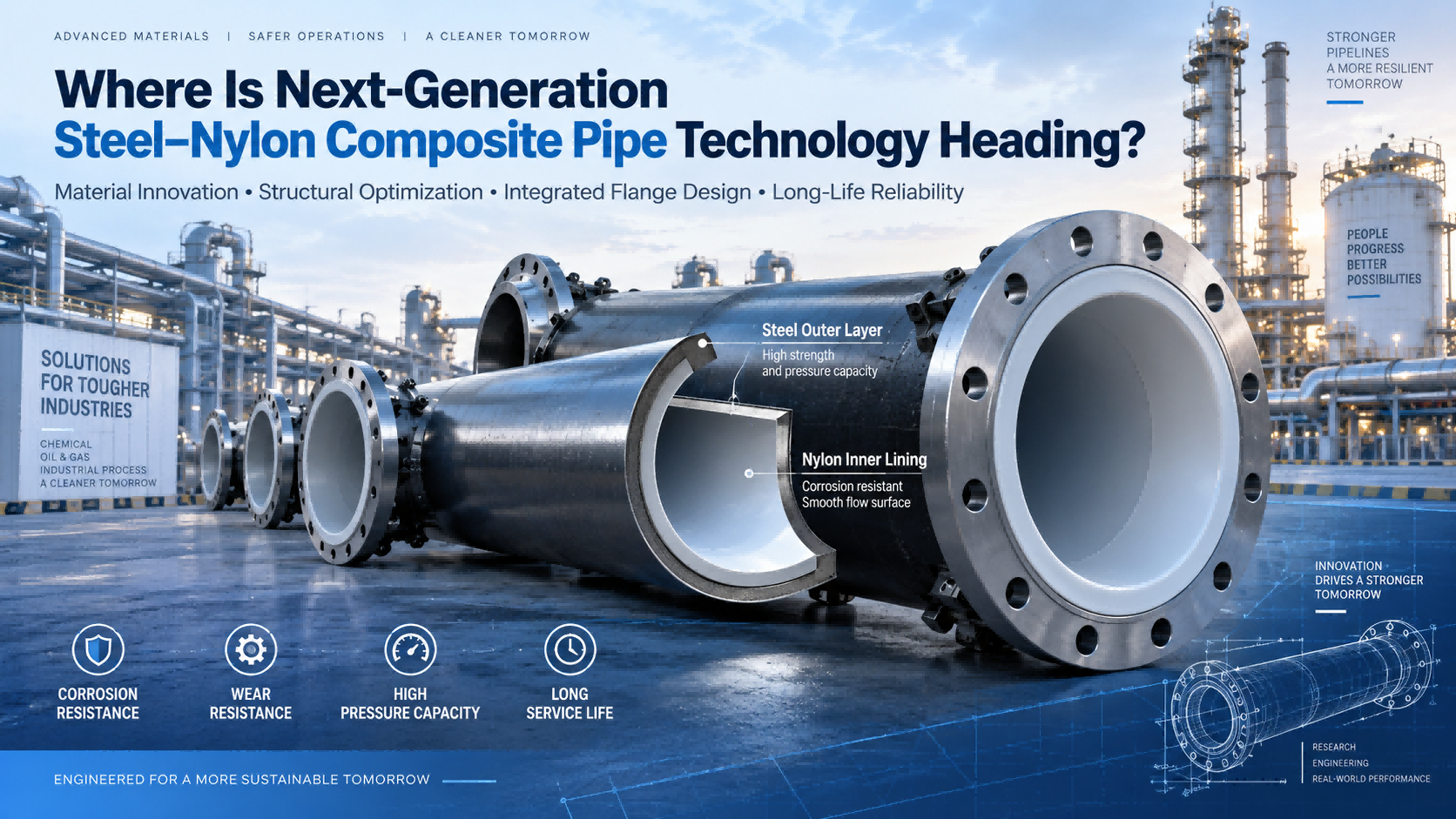
3. Steel–Nylon Composite Pipe: Separating Pressure Resistance from Media Resistance
The key concept behind steel–nylon composite pipe is not simply adding another layer inside a steel pipe.
Its real value lies in functional separation.
In simple terms:
Steel provides structural strength.
Nylon provides the media-contact surface.
Through this structure, each material can perform the role it is best suited for.
4. First Capability: Steel Provides Pressure Resistance and Structural Rigidity
An industrial pipeline must first maintain structural integrity.
This is particularly important in:
-
Large-diameter pipelines;
-
Long-distance transport systems;
-
Higher-pressure applications;
-
Pipe racks with long support spans;
-
Valve manifolds;
-
Pump discharge pipelines;
-
Heavy-duty chemical installations.
The pipe must withstand not only internal pressure but also:
-
External loads;
-
Support loads;
-
Equipment connection loads;
-
Mechanical stress.
A steel outer structure provides high rigidity and mechanical strength.
For this reason, steel–nylon composite pipe can be designed for different pressure classes according to operating requirements.
Our steel–nylon composite piping systems can typically cover pressure ratings of:
1.0–4.0 MPa
with available diameters ranging from:
DN100 to DN2000+
This allows the product to enter large-diameter and medium-to-higher-pressure industrial applications that may be difficult for conventional plastic pipelines to cover.
5. Second Capability: Nylon Isolates Corrosive Media from the Steel Structure
Once the structural and pressure requirements are addressed, the next question is:
How can corrosive media be prevented from directly contacting the steel?
One of the main functions of the steel–nylon composite structure is to separate the steel substrate from the conveyed medium through a nylon media-contact layer.
As a result, the internal surface exposed to the process medium is no longer conventional carbon steel.
Instead, it is an engineered nylon material system.
Under appropriate chemical and temperature conditions, it can be considered for media such as:
-
High-salinity water;
-
Oilfield produced water;
-
Oilfield injection water;
-
Salt chemical process fluids;
-
Alkaline media;
-
Mother liquor;
-
Industrial wastewater;
-
Certain low-concentration acidic or mildly acidic media.
In particular, properly engineered nylon material systems can offer significant value in alkaline environments.
However, one principle must be emphasized:
Every polymer material has its own chemical compatibility limits.
We do not describe nylon as universally suitable for every acid service.
For hydrochloric acid, sulfuric acid, phosphoric acid, and other acidic media, compatibility should be evaluated based on:
Concentration + temperature + pressure + flow velocity + exposure time
Our nylon piping solutions are more suitable for certain low-concentration acidic or mildly acidic conditions and should not be assumed to be suitable for concentrated acids without engineering verification.
6. Third Capability: Why Wear Resistance Is Equally Important
Many corrosive industrial fluids are not clean liquids.
Examples include:
-
Mineral slurry;
-
Phosphate chemical slurry;
-
Salt mud;
-
Mother liquor;
-
Oilfield produced fluids;
-
Sand-containing wastewater;
-
Desulfurization slurry;
-
Crystallizing process fluids.
These fluids may contain solid particles of different sizes.
When particles continuously strike the internal pipe surface at high velocity, erosion and abrasion occur.
Wear is often especially severe at:
Elbows > Tees > Reducers > Valve Areas > Pump Discharges > Straight Pipe Sections
As a result, an otherwise intact pipeline may first fail at an elbow, reducer, or section immediately upstream or downstream of a valve.
7. Why Is Nylon Suitable for Combined Corrosion and Wear Conditions?
When metals are exposed to erosion-corrosion, one major problem is that protective corrosion films can be continuously damaged by solid particles.
Once the protective layer is removed, fresh metal is exposed to the corrosive medium.
This creates a repeating cycle of corrosion and erosion.
Nylon behaves differently.
Within an appropriate material formulation and operating range, reinforced nylon can provide a combination of:
-
Wear resistance;
-
Impact resistance;
-
Resistance to various corrosive media;
-
Relatively low friction;
-
A smooth internal surface.
For this reason, steel–nylon composite pipe should not simply be understood as a “corrosion-resistant steel pipe.”
A more accurate description is:
A steel pressure-bearing structure combined with a corrosion-resistant and wear-resistant media-contact layer.
This is one reason why it can provide value in applications where corrosion and wear occur simultaneously.
8. The Real Challenge Is When All Three Requirements Exist Together
Solving one performance requirement alone is relatively straightforward.
If only pressure resistance is required, steel pipe is already a mature solution.
If only corrosion resistance under relatively low pressure is required, many plastic and non-metallic pipes can be considered.
If only wear resistance is required, various wear-resistant materials are available.
The real engineering challenge occurs when the operating condition involves:
High Corrosion + High Wear + Medium-to-High Pressure
For example:
Corrosive mother liquor + solid particles + 1.6 MPa
or:
High-salinity produced water + sand + 2.5 MPa
or:
Chemical slurry + high velocity + large-diameter pipeline
Under such conditions, a single material may require significant compromises.
This is where composite pipeline structures become particularly valuable.
9. Why High-Pressure Applications Cannot Be Evaluated Only by Corrosion Resistance
One common mistake in industrial pipeline selection is to focus exclusively on corrosion resistance.
When engineers see a corrosive medium, the first instinct may be to select a plastic or non-metallic pipe.
However, actual industrial design must also consider:
-
Design pressure;
-
Surge pressure;
-
Water hammer;
-
Vacuum conditions;
-
Temperature;
-
Pipe diameter;
-
Support spacing;
-
External loads;
-
Valve weight;
-
Pump vibration;
-
Flange loads.
Structural stability becomes especially important for large-diameter industrial pipelines.
Steel–nylon composite pipe uses steel as the primary load-bearing structure, providing greater structural rigidity than systems relying primarily on polymer wall thickness for mechanical support.
This structural design can therefore provide practical advantages in industrial systems requiring higher mechanical strength.
10. Negative Pressure Is Another Frequently Overlooked Requirement
Pipeline engineering should not consider positive internal pressure alone.
Negative pressure may occur during:
-
Sudden pump shutdown;
-
Rapid draining;
-
Cooling and contraction;
-
Rapid valve closure;
-
Elevation changes;
-
Certain process operating conditions.
For some flexible pipes or certain lined structures, vacuum conditions can contribute to:
-
Pipe-wall deformation;
-
Liner blistering;
-
Local delamination;
-
Liner collapse.
A steel–nylon composite structure relies on its steel outer body to maintain overall rigidity.
This can provide greater structural stability in industrial applications where negative-pressure conditions must be considered.
It is another reason why pipeline selection should not be based solely on corrosion resistance.
11. Temperature Is Often the Fourth Hidden Variable
When wear resistance, corrosion resistance, and pressure capability are all required simultaneously, another factor often becomes decisive:
Temperature.
Increasing temperature can affect:
-
Material strength;
-
Chemical corrosion rate;
-
Polymer properties;
-
Connection systems;
-
Sealing materials;
-
Allowable pressure rating.
Many conventional thermoplastic pipes require significant pressure derating as operating temperature increases.
Steel–nylon composite structures use steel as the primary structural load-bearing element, allowing them to cover a broader range of industrial operating conditions when properly designed.
Our steel–nylon composite pipes can typically be engineered for an operating temperature range of:
−36°C to 160°C
Actual suitability, however, must always be confirmed according to the specific combination of medium, concentration, temperature, pressure, and service duration.
12. Why Does the Integrated Flange Design Matter?
Even when the pipe body performs well, a pipeline system is still unreliable if the joints repeatedly leak.
Connections are among the most critical areas of industrial piping systems.
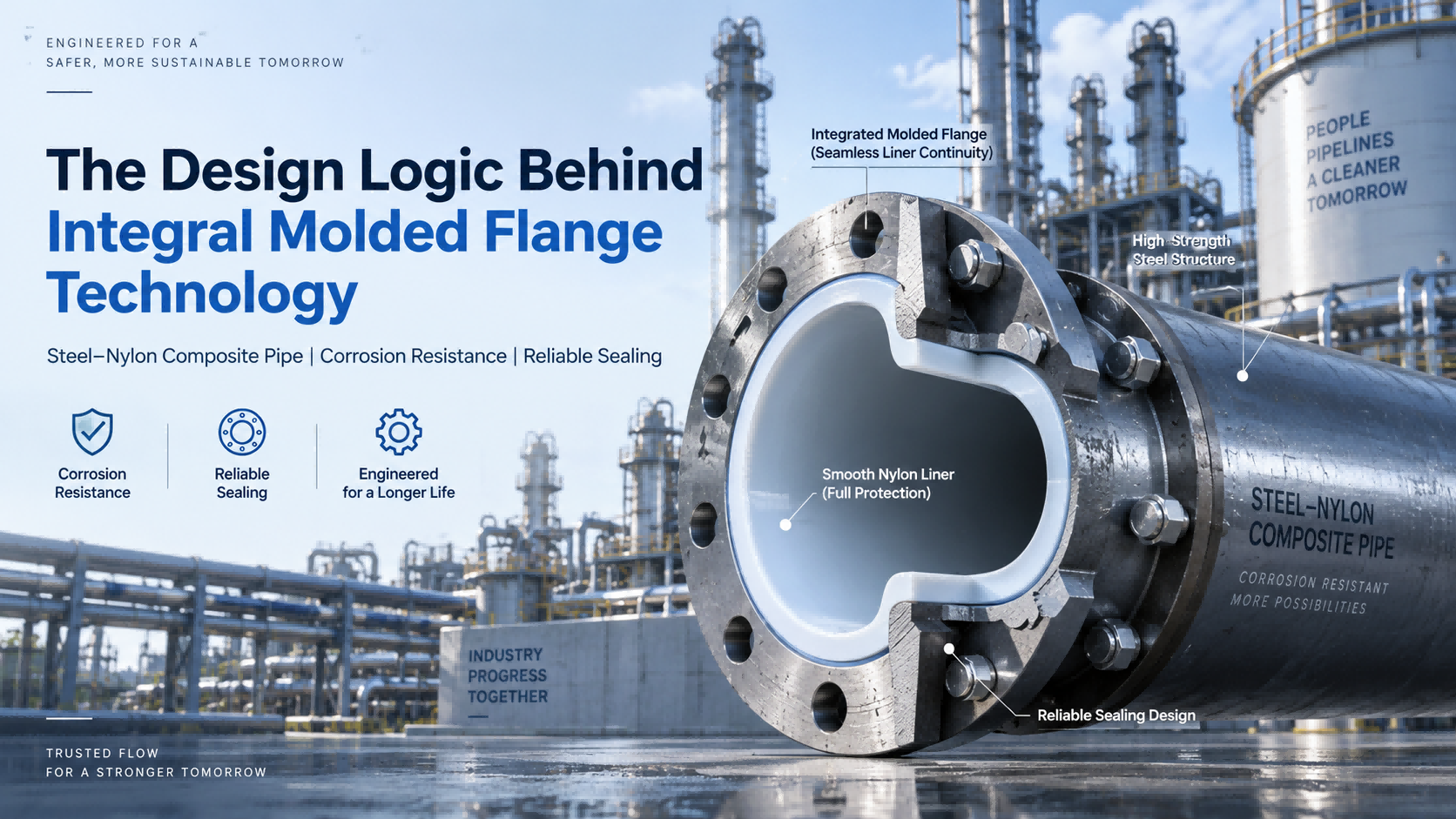
For this reason, our steel–nylon composite pipes use an integrated flange connection design.
One of the important advantages of this approach is the reduced need for field welding.
Pipeline sections can be assembled using flange connections.
For chemical plants, oil and gas facilities, and pipeline retrofit projects, this can reduce the complexity associated with hot work during installation.
The system can also include a complete range of fittings and special sections, such as:
-
Straight pipes;
-
Elbows;
-
Tees;
-
Reducers;
-
Pump discharge sections;
-
Upstream and downstream valve sections;
-
Manifold piping.
This allows project engineers to evaluate not simply an individual composite pipe, but an integrated piping system.
13. Different Pipeline Materials Solve Different Engineering Problems
From an engineering perspective, no single material is ideal for every operating condition.
| Pipeline Material | Corrosion Resistance | Wear Resistance | Pressure Capability | High-Temperature Capability | Large-Diameter Structural Stability |
|---|---|---|---|---|---|
| Carbon Steel | Depends on medium | Moderate | High | High | High |
| 304 / 316L Stainless Steel | Good, but medium-dependent | Moderate | High | High | High |
| HDPE | Good in many media | Good | More common in low-to-medium pressure | Limited | Design-dependent |
| FRP | Good in many media | Structure-dependent | Design-dependent | Resin-system dependent | Structure-dependent |
| Rubber-Lined Steel | Good | Good | High | Liner-dependent | High |
| Steel–Nylon Composite Pipe | Suitable for various corrosive media | High | 1.0–4.0 MPa | −36°C to 160°C | High |
The most important message from this comparison is not that one material is “universally superior.”
Instead:
Every material has its own optimal application range. The key value of steel–nylon composite pipe is that it expands the overlap between wear resistance, corrosion resistance, and pressure capability.
14. Which Industries Particularly Need This Combination of Properties?
14.1 Oilfield Produced Water and Gathering Systems
As many oilfields enter high-water-cut development stages, the fluid transported through gathering pipelines is no longer simply crude oil.
The medium may contain:
-
High-mineralization water;
-
Chloride ions;
-
CO₂;
-
H₂S;
-
Solid particles;
-
Sand.
As a result, pipelines may simultaneously experience:
Corrosion + erosion + pressure fluctuations
This operating environment is particularly suitable for the design principle of using steel for structural strength and nylon for isolation from corrosive media.
14.2 Soda Ash and Salt Chemical Mother Liquor Systems
Mother liquor is a typical example of a complex industrial transport medium.
Its characteristics may include:
-
High salt concentration;
-
Complex ionic composition;
-
Crystallization;
-
Solid particles;
-
Scaling tendency;
-
Continuous long-term operation.
The pipeline therefore requires more than corrosion resistance.
It must also address erosion, deposition, scaling, and long-term operational reliability.
The smooth inner surface of steel–nylon composite pipe can help reduce deposition and scaling tendencies, while the nylon layer provides wear resistance and compatibility with suitable process media.
14.3 Chlor-Alkali and Caustic Soda Systems
Strong alkaline media impose specific requirements on pipeline materials.
A steel–nylon composite structure can use the nylon layer to isolate the metal structure from the process medium while retaining the overall pressure capability and rigidity of steel.
For larger-diameter or medium-to-higher-pressure alkaline transport systems, this structural combination can offer significant engineering value.
14.4 Phosphate Chemical and Slurry Transportation
The primary challenge in slurry pipelines is often not corrosion alone.
It is the combination of:
Particle erosion + chemical corrosion + high flow velocity
Elbows and reducers are especially vulnerable to accelerated wear.
For this reason, many slurry applications do not simply require a “corrosion-resistant pipe.”
They require a composite piping solution that also provides strong wear resistance.
15. A Steel–Nylon Composite Pipe Is More Than Just a Pipe with an Internal Liner
Reliable composite piping must address a critical engineering issue:
How can different materials work together reliably over a long service period?
If the stability between the internal layer and outer structure is inadequate, problems may include:
-
Local delamination;
-
Blistering;
-
Displacement;
-
Thermal cycling damage;
-
Instability under negative pressure.
For this reason, a high-performance composite pipe should not be evaluated simply by asking:
“Does it have a plastic layer inside?”
More important factors include:
-
Material modification;
-
Composite manufacturing technology;
-
Interface stability;
-
Thermal cycling performance;
-
Pressure testing;
-
Flange structure;
-
Dimensional consistency;
-
Integrated fitting design.
These factors help distinguish an engineered industrial composite piping system from a basic lined-pipe structure.
16. The Real Engineering Goal Is Not the “Strongest Material,” but the “Most Rational Structure”
Pipeline technology is gradually moving away from a traditional assumption:
In the past:
Find one material capable of solving every problem.
Today:
Allow different materials to perform different functions.
This principle is already widely used in modern engineering.
For example:
Reinforced concrete combines steel reinforcement and concrete because they perform different structural functions.
Composite materials combine fibers and matrix materials to handle different loads.
Steel–nylon composite pipe follows the same engineering philosophy.
Steel Provides:
-
Pressure capability;
-
Structural rigidity;
-
Mechanical stability;
-
Support for large-diameter piping.
Nylon Provides:
-
Isolation from corrosive media;
-
Wear resistance;
-
Lower friction;
-
A smoother internal surface;
-
Reduced scaling tendency in suitable applications.
By combining the two, it becomes possible to build a system offering:
High mechanical strength + corrosion resistance + wear resistance
17. The Final Comparison Should Not Be Purchase Price, but Service Life
When only initial purchase cost is considered, advanced composite pipeline materials may not always appear to be the least expensive option.
However, in industrial pipeline systems, the largest cost is often not the pipe itself.
Major costs can arise from:
-
Production shutdowns;
-
Leakage;
-
Emergency maintenance;
-
Labor;
-
Scaffolding;
-
Lifting equipment;
-
Welding;
-
Cleaning;
-
Pipeline replacement;
-
Safety management;
-
Environmental incidents.
Suppose one conventional pipeline requires frequent repairs or replacement every few years, while another pipeline can significantly extend the maintenance interval.
In that situation, the more meaningful metric is:
Total Cost of Ownership (TCO)
rather than simply:
Price per meter.
For continuous-process chemical plants, oilfields, mines, and other large industrial facilities, the cost of a single unplanned shutdown can sometimes exceed the original pipeline purchase cost.
18. Can Wear Resistance, Corrosion Resistance, and Pressure Capability Really Be Combined?
The answer is not simply to search for a “universal material.”
A more practical engineering approach is:
Use structural design to allow different materials to solve different problems.
Steel–nylon composite pipe represents exactly this design philosophy:
Steel provides mechanical strength and pressure capability, while nylon provides corrosion resistance, wear resistance, and a smooth media-contact surface.
Through appropriate material modification, composite structure design, integrated flanges, and a complete fitting system, the pipeline can address increasingly complex industrial operating conditions.
For projects involving combinations such as:
Corrosion + wear
Corrosion + higher pressure
Wear + higher pressure
or even:
Corrosion + wear + medium-to-high pressure + elevated temperature
it is no longer sufficient to compare a single performance property of one material.
The real engineering question is:
Which pipeline structure can maintain all of these required properties reliably throughout the intended service life?
This is becoming an increasingly important direction in the development of industrial pipeline materials.
Steel–Nylon Composite Pipe Solutions
We specialize in the development and manufacturing of steel–nylon composite industrial piping systems and reinforced nylon pipes for demanding operating environments.
Our available solutions include:
-
DN100–DN2000+ pipe sizes;
-
1.0–4.0 MPa pressure ratings;
-
−36°C to 160°C operating temperature range;
-
Integrated flange connections;
-
Straight pipes, elbows, tees, and reducers;
-
Pump discharge pipe sections;
-
Upstream and downstream valve sections;
-
100–500 m trial sections;
-
Partial replacement solutions for aging pipelines.
Our products are mainly used in industries such as:
-
Oil and gas;
-
Soda ash;
-
Chlor-alkali;
-
Salt chemicals;
-
Phosphate chemicals;
-
Mining;
-
Slurry transportation;
-
Other highly corrosive and abrasive industrial applications.
For each project, we recommend confirming the following operating parameters before material selection:
Medium composition, concentration, temperature, pressure, flow velocity, solids content, particle size, pipe diameter, and required service life.
Because reliable industrial pipeline selection should never begin with the question:
“Which material is the best?”
The better question is:
“Which material and structural combination is the best match for the actual operating conditions?”
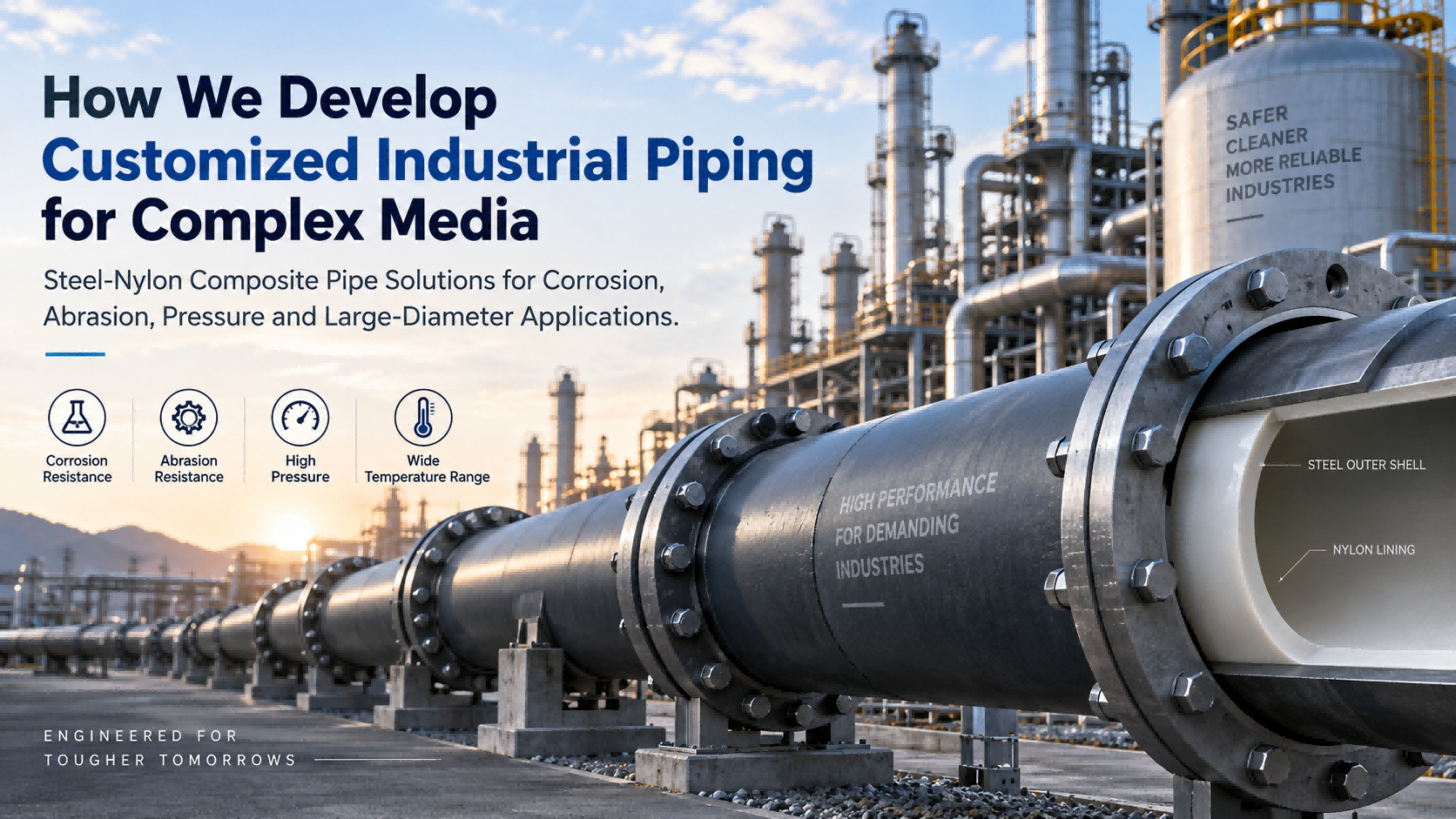
For Complex Media, How Do We Develop Customized Industrial Pipelines?
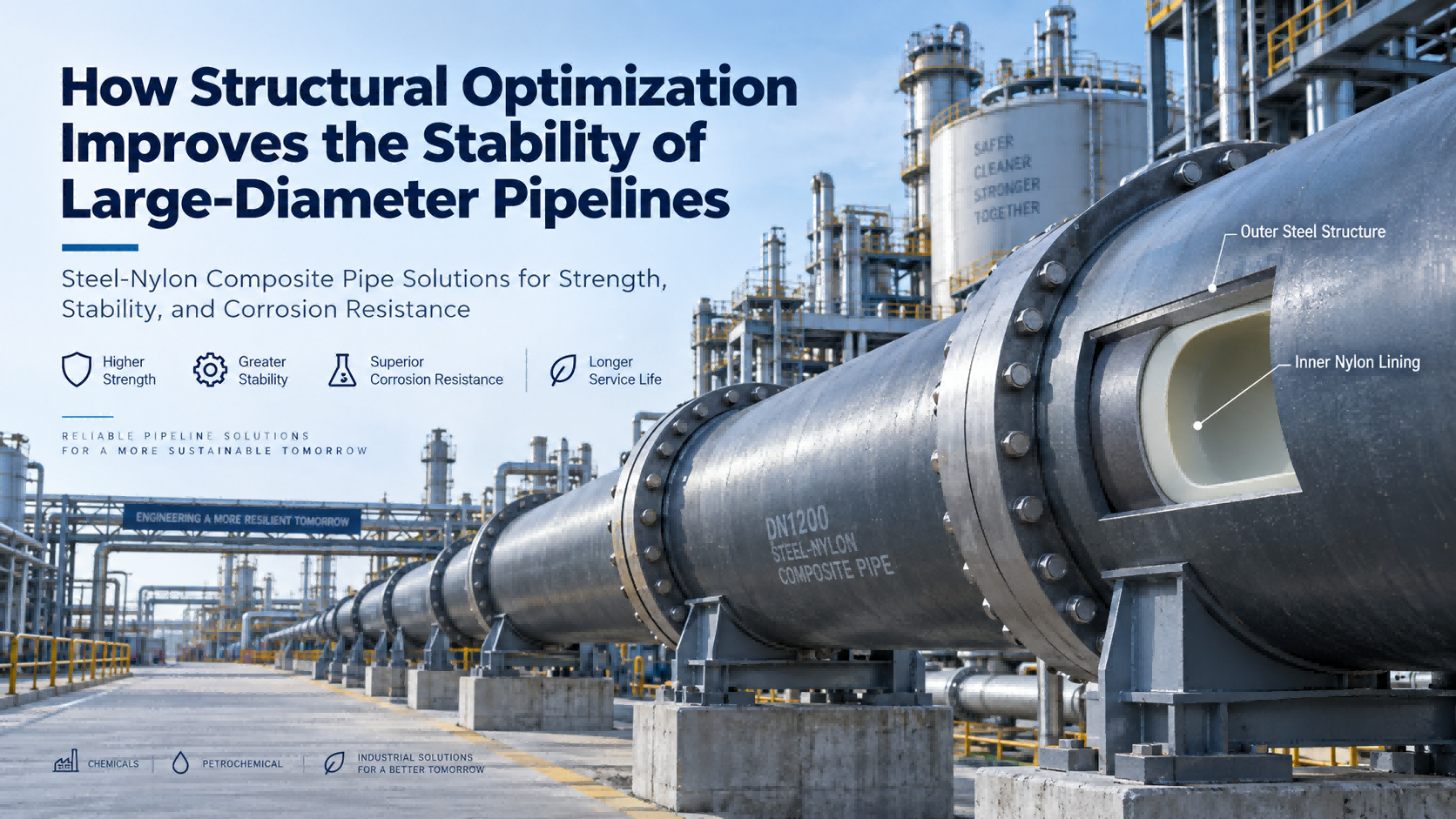
How Structural Optimization Improves the Stability of Large-Diameter Pipelines