The Design Logic Behind Integral Molded Flange Technology
However, extensive engineering experience shows that the long-term reliability of a piping system often depends not only on the pipe itself, but also on one easily overlooked area—the connection ends.
This is especially true for industrial pipelines transporting corrosive liquids, brine, alkali solutions, oilfield produced water, chemical mother liquor, and media containing solid particles. Flanged connections must simultaneously withstand:
-
Internal pressure;
-
Axial pipeline loads;
-
Installation preload;
-
Temperature fluctuations;
-
Pipeline vibration;
-
Media corrosion;
-
Fluid erosion;
-
Cyclic stresses caused by long-term startup and shutdown.
If the connection structure is poorly designed, leakage may occur at the joint even when the pipe body itself has excellent corrosion resistance.
This is the fundamental reason why we place great importance on Integral Molded Flange Technology in the design of steel–nylon composite pipes.
It is not simply a matter of “adding a flange to the pipe.” Instead, it represents a systematic design approach built around structural continuity, media isolation, sealing reliability, load transfer, and on-site installation efficiency.
1. Why Are Connections Often the Real Challenge in Industrial Composite Piping?
An industrial pipeline can generally be considered as three main parts:
Pipe body + connection ends + fittings.
Ideally, these three parts should provide comparable levels of corrosion resistance, wear resistance, and mechanical reliability.
In actual engineering applications, however, a common situation occurs:
The pipe body remains intact, while corrosion, seepage, or failure begins at the connection.
The reasons are not difficult to understand.
1.1 Connections are areas of significant structural transition
Straight pipe sections have relatively uniform geometry, allowing internal pressure to be distributed more evenly along the pipe wall.
At the flange end, however, the pipe diameter, wall thickness, structural stiffness, and load direction may all change.
Compression from bolt preload, axial pipeline forces, and thrust generated by internal pressure may become concentrated around the flange root.
If the transition is not properly designed, local stress concentration can occur.
1.2 Connections are also among the areas most likely to be exposed to corrosive media
In conventional metallic flange systems, if the lining does not fully cover the sealing area, corrosive media may come into contact with:
-
The inner edge of the flange;
-
The metal end face;
-
Weld seams;
-
Lining termination points;
-
Interfaces between metallic and non-metallic materials.
Once localized corrosion develops in these areas, the sealing surface can gradually deteriorate.
Therefore, an important design principle for corrosion-resistant composite piping is:
The corrosion-resistant layer should not stop at the pipe body. Wherever possible, it should extend continuously to the connection interface.
This is one of the core design principles behind integral molded flange technology.
2. What Is an Integral Molded Flange?
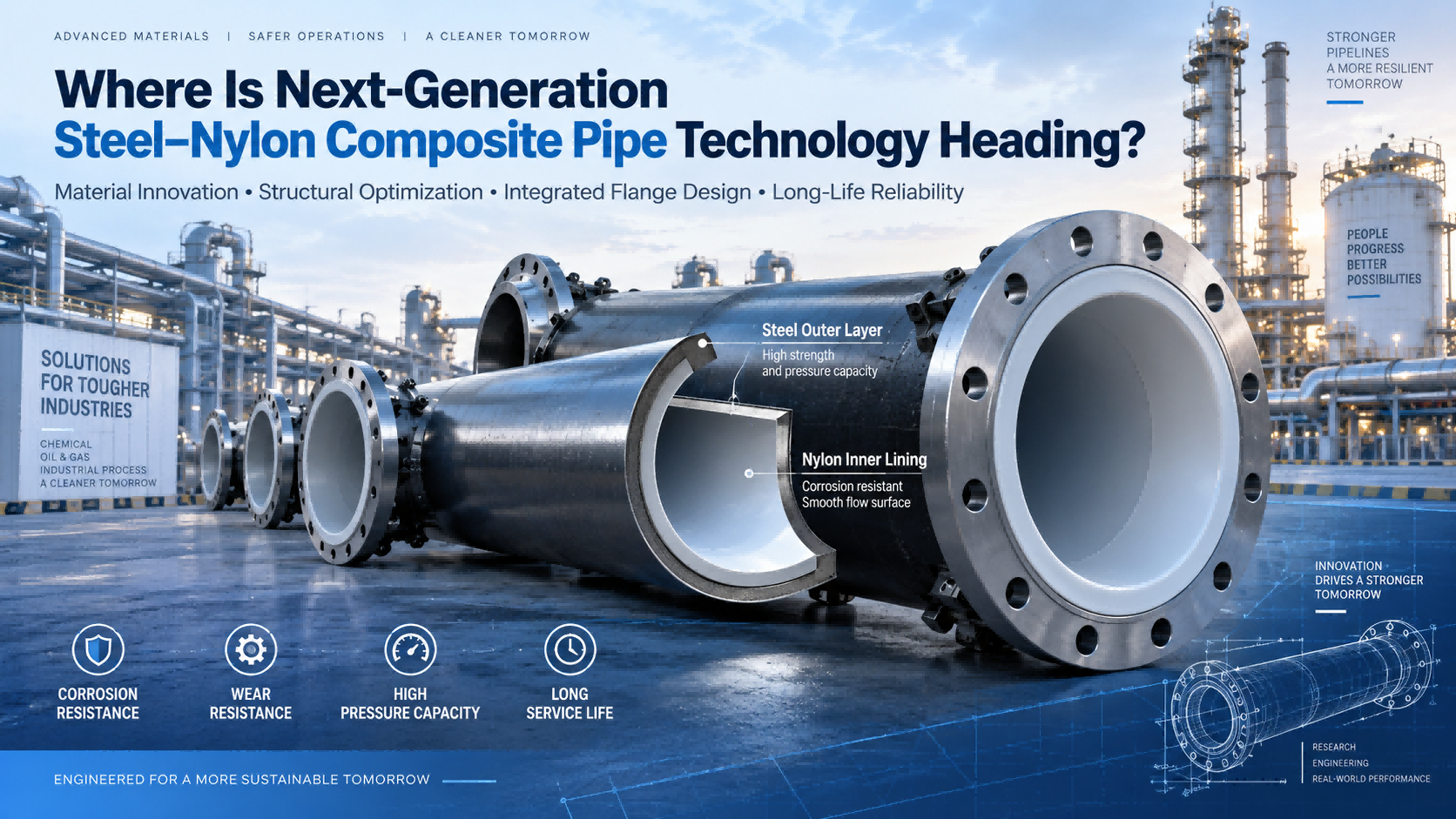
In a steel–nylon composite pipe, the steel structure primarily provides mechanical strength and structural support, while the nylon layer primarily isolates the conveyed medium and provides corrosion resistance, wear resistance, and low-friction flow characteristics.
A conventional design approach may be:
Manufacture the pipe body first, then separately treat the flange connection area.
The integral molded flange approach is more systematic:
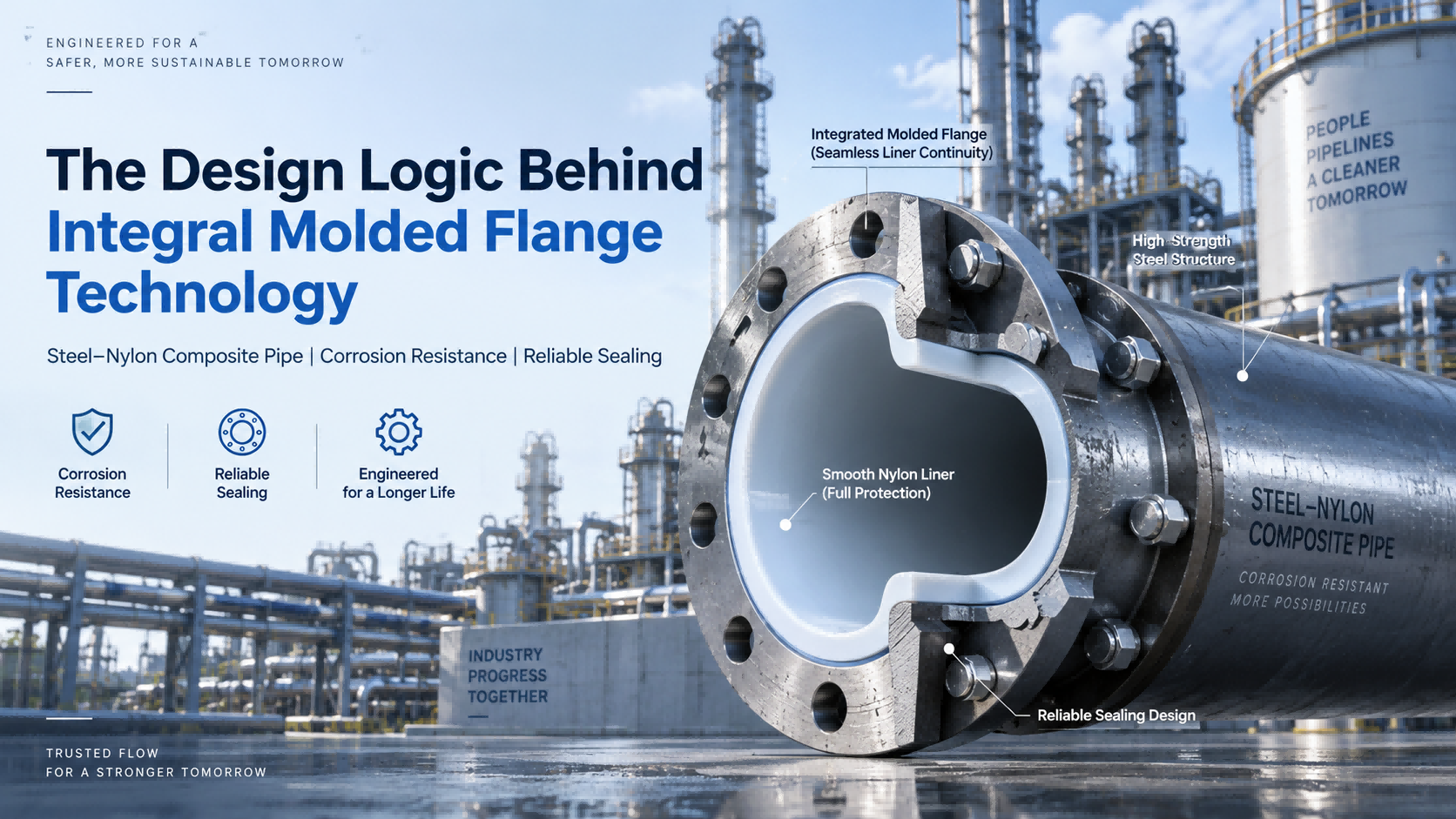
During structural design and forming, the nylon inner layer is designed not only to cover the internal pipe wall, but also to extend toward the flange end so that the pipe lining and flange sealing area form a continuous structure.
From an engineering perspective, this approach is intended to achieve three types of continuity:
Material continuity, sealing continuity, and load-transfer continuity.
These three forms of continuity ultimately determine whether a composite piping system can operate reliably over the long term.
3. First Design Principle: Extend Corrosion Protection All the Way to the Pipe End
The fundamental material logic of a steel–nylon composite pipe is simple:
Steel provides strength; nylon provides media isolation.
Therefore, if the nylon layer exists only inside the straight pipe section and suddenly terminates at the flange end, an obvious problem emerges:
The corrosion-protection barrier is interrupted.
From a corrosion-engineering perspective, any location where a protective layer suddenly terminates deserves special attention.
Such locations may create material interfaces, crevices, or locally exposed areas.
The purpose of an integral molded flange is to minimize this type of “corrosion barrier termination at the flange opening.”
Through appropriate end-structure design, the nylon protective layer extends continuously from:
The inner pipe wall
to:
The flange end and sealing area.
This provides several important benefits.
Reduced opportunity for the medium to contact the steel substrate
In services involving brine, alkaline media, highly mineralized water, and oilfield produced water, exposed carbon steel interfaces can become high-risk corrosion locations over long-term operation.
Maintaining a continuous nylon layer reduces the likelihood of direct contact between the process medium and the steel structure.
Reduced risk of localized corrosion at flange openings
Many industrial pipelines do not initially fail in the middle of a straight pipe section. Problems often begin at:
-
Connections;
-
Flanges;
-
Welds;
-
Fittings;
-
Reducers and transition sections.
Therefore, reliable composite-pipe design should not focus only on “how long the pipe body can last.” It should also address a more important question:
Does the entire fluid passage have continuous corrosion protection?
4. Second Design Principle: Make the Sealing Surface Part of the Piping System, Not an Added Component
The fundamental purpose of a flange connection is sealing.
Under internal pressure, the conveyed medium continuously tends to escape through the interface between two connected flanges.
A reliable flange system must therefore manage three factors simultaneously:
Sealing surfaces, gaskets, and bolt preload.
One of the main advantages of an integral molded flange is that the flange end becomes part of the sealing system from the product-design stage rather than being treated as a simple connection added after the pipe body has been manufactured.
This allows engineers to consider the following factors together during design:
-
Flange-face flatness;
-
Sealing-surface dimensions;
-
Lining continuity;
-
Bolt preload;
-
Gasket compression area;
-
Flange stiffness;
-
Internal pressure.
In other words:
The flange is not merely an accessory. It is part of the pressure boundary.
This is another important design philosophy behind integral molded flange technology.
5. Third Design Principle: Reduce Uncertainty Caused by Material Interfaces
One of the greatest technical challenges in composite piping is not the performance of any individual material, but rather:
How different materials can work together reliably over the long term.
Steel and nylon perform different functions.
Steel provides high structural stiffness and mechanical strength, while nylon offers corrosion resistance, wear resistance, and favorable fluid-transport characteristics.
If the connection ends require extensive secondary assembly, bonding, or complicated transition structures, additional material interfaces may be introduced.
Industrial equipment generally follows a useful rule:
The greater the number of interfaces, the more complex the potential failure modes.
One engineering advantage of integral forming is that it reduces unnecessary structural transitions wherever possible, allowing the pipe body and the connection end to function as a more integrated system.
This is particularly important in long-term operation.
Industrial pipelines do not face only a single pressure test. Over years of operation they may experience:
-
Pressure cycling;
-
Temperature fluctuations;
-
Vibration;
-
Media erosion;
-
Installation stresses;
-
Equipment startup and shutdown.
A well-designed piping system must account for the cumulative effects of all these factors.
6. Fourth Design Principle: Let the Steel Structure Carry Pressure Loads While Nylon Isolates the Medium
A steel–nylon composite pipe is not simply two materials layered together.
A more accurate way to understand the structure is:
Each material is assigned the engineering function it performs best.
The steel structure primarily provides:
-
Internal-pressure resistance;
-
Overall structural stiffness;
-
Resistance to installation loads;
-
Support for large-diameter structures;
-
Mechanical strength for flange connections.
The nylon layer primarily provides:
-
Isolation from corrosive media;
-
Improved wear resistance;
-
Reduced internal surface roughness;
-
Reduced scaling tendency;
-
Protection of the steel substrate.
This structure follows a key principle of modern composite-material engineering:
Use the most suitable material for each engineering function.
The same principle applies to the flange area. It is not sufficient to consider only corrosion resistance or only mechanical strength. The flange must simultaneously provide:
Structural load-bearing capacity + media isolation + sealing reliability.
Integral molded flange technology is designed around these three objectives.
7. Why Is This Structure Particularly Suitable for Corrosive Industrial Media?
For ordinary clean-water piping, a small area of exposed metal may not immediately create a serious problem.
For many chemical and oilfield media, however, the situation is very different.
Typical examples include:
-
Highly mineralized produced water;
-
Chloride-rich environments;
-
Salt-chemical mother liquor;
-
Alkali solutions;
-
Certain weakly acidic media;
-
Sand-containing fluids;
-
Slurries;
-
Media where corrosion and wear occur simultaneously.
These operating conditions share one common characteristic:
Any weak point may become increasingly significant during long-term operation.
Even a lining discontinuity only a few millimeters wide can gradually develop into a system-level weak point under the combined effects of corrosion and erosion.
For this reason, in highly corrosive industrial environments we emphasize:
It is not enough to select a corrosion-resistant material. A continuous corrosion-resistant flow path must also be established.
This is more meaningful than simply comparing laboratory corrosion-resistance data for individual materials.
8. How Can an Integral Molded Flange Improve Internal Flow Conditions?
If conventional pipe connections are poorly designed, the connection area may contain significant:
-
Steps;
-
Gaps;
-
Abrupt transitions;
-
Internal diameter changes.
These geometric discontinuities can increase flow resistance and generate localized turbulence.
For slurry or solid-containing media, localized turbulence can also accelerate erosion.
Therefore, flange-end design in steel–nylon composite piping should also consider:
Internal flow-path continuity.
Maintaining a relatively smooth internal transition can help:
-
Reduce localized hydraulic resistance;
-
Reduce sediment accumulation;
-
Reduce localized erosion;
-
Reduce scaling risk;
-
Improve long-term transport stability.
This is why industrial pipe design should not simply ask whether there is a flange on the outside.
The more important question is:
What is happening inside the flange?
9. Why Flange Design Becomes Even More Important for Large-Diameter Pipelines
As pipe diameter increases, flange design becomes increasingly important.
This is because the axial thrust generated by internal pressure is directly related to the pipeline cross-sectional area.
The basic relationship is:
F = P × A
Where:
-
F = axial thrust;
-
P = internal pipeline pressure;
-
A = effective cross-sectional area.
This means that:
Even if the pressure rating remains unchanged, the force acting on the pipe-end structure increases rapidly as the diameter becomes larger.
Therefore, the connection structure of a large-diameter industrial composite pipe cannot simply be a proportionally enlarged version of a small-diameter design.
The flange must be reconsidered in terms of:
-
Flange thickness;
-
Structural stiffness;
-
Number of bolts;
-
Bolt-circle diameter;
-
Sealing-surface dimensions;
-
Pipe-end reinforcement;
-
Permissible installation deviation;
-
Pressure rating.
This is also why large-diameter industrial composite-pipe manufacturing capability is not simply about whether a manufacturer can produce a large pipe body. It is equally about:
Whether the manufacturer can produce a reliable connection system that matches the large-diameter pipe body.
10. Why Does an Integral Flange Help Simplify On-Site Installation?
When industrial projects select piping systems, the purchase price of the pipe is only one part of the overall cost.
Field construction can also generate substantial costs.
Conventional industrial pipeline installation may involve:
-
Welding;
-
Bevel preparation;
-
Post-weld inspection;
-
Repair of corrosion-protection coatings;
-
Hot-work permits;
-
Construction-area isolation;
-
Special-site construction management.
By contrast, prefabricated flanged connections allow more work to be completed in the factory.
On site, the main procedures can be reduced to:
Positioning → gasket installation → bolting → tightening → inspection.
This has clear advantages in chemical plants, oil and gas fields, and retrofit projects where production shutdowns must be minimized.
Especially in areas with strict hot-work controls, flanged, modular, and prefabricated piping is no longer only about installation efficiency. It can also contribute to construction organization and risk management.
It is important to note that whether a project can truly achieve completely hot-work-free installation still depends on the design of the entire piping system, supports, valves, equipment interfaces, and on-site retrofit plan. It cannot be determined by one pipe section alone.
However, from a product-design perspective, an integral flange structure can create better conditions for reducing field welding.
11. What Are the Manufacturing Challenges of a Truly Reliable Integral Molded Flange?
An “integral flange” may appear to be only a structural feature, but achieving stable mass production is not simple.
The manufacturing process typically requires simultaneous control of several factors.
11.1 Pipe-to-flange concentricity
If the flange face is excessively misaligned relative to the pipe axis, additional stresses can be introduced after field assembly.
11.2 Flange-face flatness
Flange-face quality directly affects whether the gasket is compressed uniformly.
Insufficient local compression may create a potential leakage path.
11.3 Lining-thickness consistency
The corrosion-resistant layer must be sufficiently thick while also maintaining dimensional stability.
11.4 Forming quality in the flange area
Because the geometry of the flange region is more complex than that of a straight pipe section, the forming process requires tighter process control.
11.5 Dimensional control of the steel structure
The steel skeleton determines the overall mechanical performance and flange stiffness and therefore needs to match the pressure rating, pipe diameter, and operating conditions.
11.6 Final-product inspection
The finished integral structure must undergo dimensional, visual, sealing, and relevant pressure-performance inspections to ensure sufficient product consistency before shipment to the project site.
This is why the value of an industrial piping supplier does not lie simply in having access to a particular material.
What truly matters is:
Whether the supplier can consistently convert material performance into repeatable mass-manufacturing capability.
12. What Is the Fundamental Difference Between an Integral Flange and the Traditional “Pipe Body + Separate Connector” Approach?
The biggest difference between the two approaches is not appearance. It is engineering philosophy.
The traditional approach focuses more on:
How can two pipes be connected?
An integrated design asks a broader question:
How can the connection itself become part of the complete corrosion-resistant pressure piping system?
The two may look similar externally, but their design starting points are very different.
The integrated approach must simultaneously consider:
| Design Dimension | Key Engineering Question |
|---|---|
| Mechanical performance | Can the flange withstand long-term pressure and installation loads? |
| Corrosion resistance | Can the medium contact the steel substrate? |
| Sealing performance | Can the sealing surface remain stable over the long term? |
| Internal flow path | Are there significant steps or local erosion zones? |
| Manufacturing consistency | Are dimensions stable across batch production? |
| Installation efficiency | Is modular field connection convenient? |
| Maintenance | Can the flange be easily disassembled for inspection or replacement? |
Therefore, an integral molded flange reflects a broader concept:
System-Level Design.
13. Why Is Steel–Nylon Composite Pipe Particularly Well Suited to This Design?
Steel–nylon composite pipe already has a clearly defined functional structure.
Steel provides strength; nylon provides corrosion and wear resistance.
With a properly designed integral flange, these material advantages can be extended from the straight pipe section into the connection system itself.
The main benefits include:
13.1 Continuous corrosion protection
It helps reduce the risk of the flange end becoming a weak point in the corrosion-protection system.
13.2 Improved connection reliability
A more systematic flange structure helps manage pressure, bolt preload, and sealing performance.
13.3 Suitability for industrial pressure service
The steel structure provides necessary mechanical support, making the piping suitable for industrial applications requiring pressure capability and structural stiffness.
13.4 Combined corrosion and wear resistance
For operating conditions involving both corrosion and erosion, both failure mechanisms can be addressed simultaneously.
13.5 Support for large-diameter designs
Compared with structures that rely entirely on flexible non-metallic materials for load-bearing, an integrated steel structure can provide a more stable structural foundation for large-diameter piping.
13.6 Convenient flanged field connection
It supports prefabrication, modular installation, and partial replacement of aging pipelines.
These advantages make steel–nylon composite piping particularly suitable for applications including:
-
Oilfield gathering and transportation;
-
Oilfield produced-water systems;
-
Water-injection systems;
-
Chlor-alkali production;
-
Soda ash production;
-
Salt chemical processing;
-
Phosphate chemical processing;
-
Slurry transportation;
-
Chemical wastewater;
-
Other corrosive industrial-media transportation systems.
14. Flange Technology Ultimately Addresses More Than a “Connection Problem”—It Addresses Leakage Risk
At a higher level, the objective of integral molded flange technology is very clear:
Reduce the probability of leakage throughout the piping system.
Industrial pipeline leakage is rarely caused by a single factor. It usually results from several factors acting together:
Corrosion + pressure + stress + installation deviation + seal aging + vibration.
Therefore, simply improving the corrosion resistance of the pipe material does not automatically create a reliable industrial piping system.
Only when the following are considered as one integrated system can long-term leakage risk be effectively reduced:
-
Pipe body;
-
Flanges;
-
Fittings;
-
Seals;
-
Installation;
-
Supports;
-
Operating conditions.
This is also why steel–nylon composite piping design continues to evolve toward a more systematic engineering approach.
15. Moving from Purchase Price to Total Cost of Ownership
When industrial projects compare pipe materials, the first comparison is often the price per meter.
However, once flange design and connection reliability are included, the more meaningful metric becomes:
Total Cost of Ownership (TCO).
At a minimum, TCO should include:
TCO = pipe cost + installation cost + downtime cost + maintenance cost + replacement cost + leakage-risk cost
Suppose one piping option has a lower initial purchase price but:
-
Its connections require frequent maintenance;
-
Its flanges are susceptible to corrosion;
-
It causes repeated shutdowns;
-
Corrosion protection must frequently be repaired;
-
The pipeline must be replaced after only a few years.
Its lifecycle cost may ultimately be far higher than its initial purchase price suggests.
By contrast, if a properly engineered composite structure and integral connection design improve overall system reliability, the economic value becomes increasingly apparent over time.
We therefore believe that the future of industrial-pipeline competition will increasingly shift away from the question:
“Which pipe is cheaper?”
and toward:
“Which piping system can maintain a lower failure rate and lower total cost throughout its entire service life?”
16. Conclusion: The Best Flange Design Is One the User Hardly Notices
A well-designed industrial connection system should not constantly remind the user that it exists.
Quite the opposite.
It should continue for years—or even longer—to:
Maintain sealing integrity, withstand pressure, resist corrosion, tolerate vibration, and operate without frequent maintenance.
That is the real objective of integral molded flange technology.
For steel–nylon composite piping, the integral molded flange is not merely a product feature. It is an important part of the entire composite piping design system.
From load-bearing steel structure to corrosion-resistant nylon lining;
From continuous flow path to end sealing;
From factory prefabrication to on-site flanged installation;
All these design decisions ultimately serve one goal:
To ensure that pipeline connections no longer become the weakest point in the entire system.
For oil and gas, chemical processing, salt chemicals, soda ash, chlor-alkali, mining, and other highly corrosive or abrasive industrial systems, the key question is no longer simply “Which material should we choose?”
A more important question is:
Has that material been engineered into a complete, reliable piping system capable of long-term operation?
That is the true design logic behind integral molded flange technology.
How Structural Optimization Improves the Stability of Large-Diameter Pipelines
How Steel and Nylon Combine Structural Rigidity with Corrosion Resistance