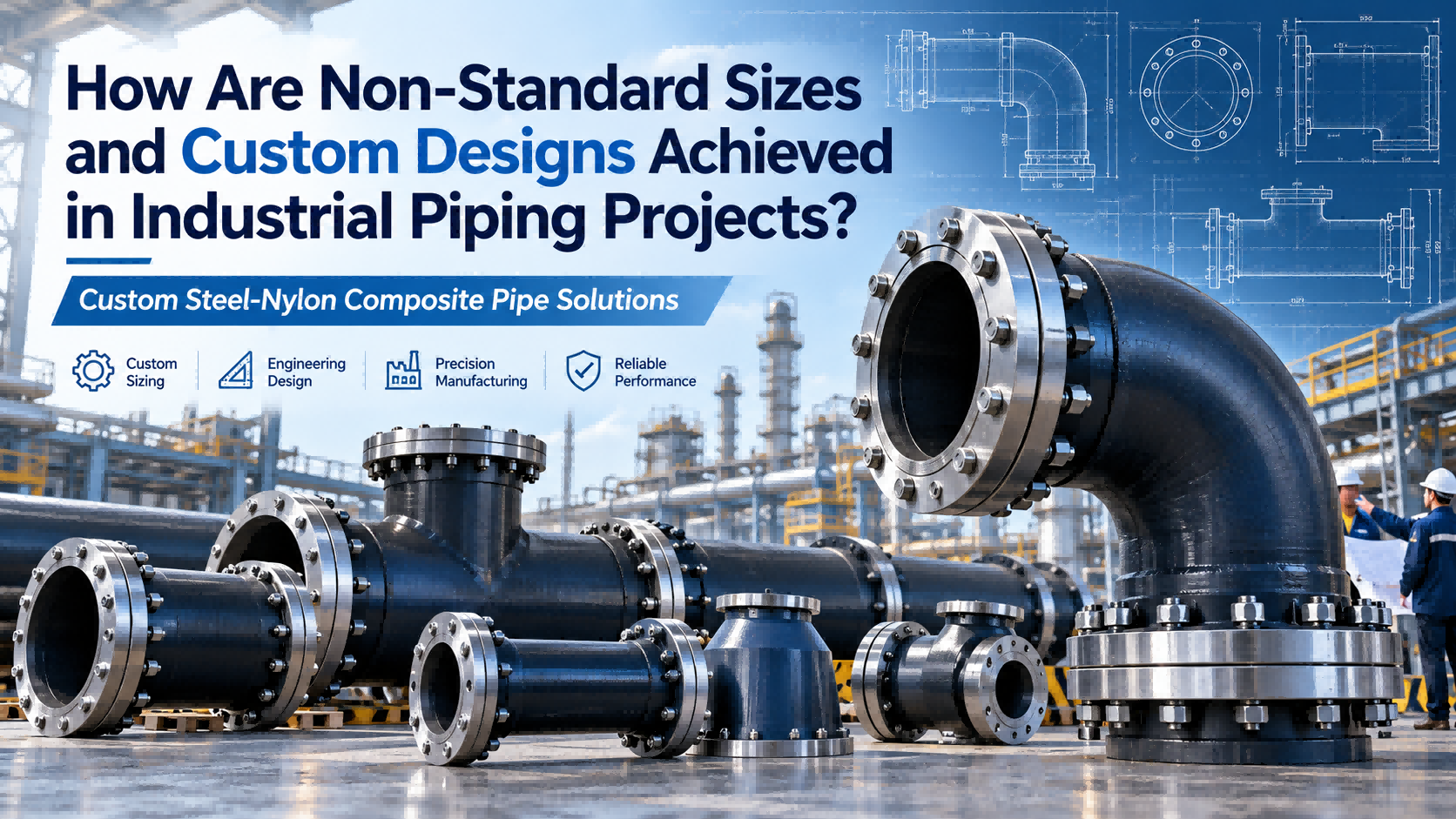
How Are Non-Standard Sizes and Custom Designs Achieved in Industrial Piping Projects?
In highly standardized municipal water supply and drainage projects, pipelines can usually be purchased according to established nominal diameters, pressure classes, and standard fittings.
However, once a project involves chemical processing, mining, oil and gas, power generation, salt chemicals, slurry transportation, or industrial plant retrofits, the situation can become much more complicated.
The real engineering questions are often not simply:
“What DN size and pressure rating are required?”
Instead, engineers may need to solve problems such as:
-
What if the existing equipment connection is not a standard size?
-
What if the pump outlet diameter differs from the main pipeline?
-
What if space limitations in an existing plant prevent the use of standard elbows?
-
Can special pipe lengths be manufactured for large-diameter pipelines to reduce field joints?
-
Can high-wear sections be reinforced locally?
-
How should flanges be designed when connecting pipelines made from different materials?
-
What if equipment nozzles, valves, expansion joints, and existing pipelines use different standards?
-
How should DN1000, DN1200, DN1600, or even larger pipelines be designed when standard products cannot meet structural requirements?
These are typical examples of an important issue in industrial piping projects:
Non-standard dimensions and customized pipeline design.
For a true industrial piping manufacturer, producing standard-sized products is only the starting point.
The more important capability is whether the supplier can translate actual operating conditions—including medium, pressure, temperature, flow rate, abrasion, corrosion, installation space, and connection requirements—into a piping solution that can be designed, manufactured, installed, inspected, and operated reliably over the long term.
This engineering capability is particularly important for steel-nylon composite pipes.
The steel structure provides mechanical strength, rigidity, and pressure-bearing capability, while the nylon layer provides excellent resistance to corrosion, wear, and many aggressive industrial media.
Through customized structural design, pipe dimensions, flange configurations, and fittings, steel-nylon composite piping can go beyond being a standard piping product and become an engineered solution for complex industrial transportation systems.
1. Why Are Non-Standard Requirements So Common in Industrial Piping Projects?
When purchasing industrial piping for the first time, some customers may assume:
Once the DN size, pressure rating, and pipe length are confirmed, production can begin.
However, during actual engineering implementation, many dimensions cannot be solved entirely with standard products.
There are several common reasons.
Existing Systems Often Have Inconsistent Dimensions
Many chemical plants, mines, power plants, and oilfield facilities have been operating for years or even decades.
During repeated expansions and modifications, the plant may have accumulated many different piping materials, including:
-
Carbon steel pipe
-
Stainless steel pipe
-
FRP pipe
-
HDPE pipe
-
Rubber-lined steel pipe
-
Plastic-lined steel pipe
-
Ductile iron pipe
-
Various composite pipe systems
Pipelines constructed during different periods may also follow different design standards.
For example, an existing pipeline may be:
DN450
while newly installed equipment may use:
DN500
and the valve may use yet another flange standard.
If only standard pipe components are purchased, direct connection may become impossible.
The project may therefore require:
-
Reducers
-
Non-standard flanges
-
Customized spool pieces
-
Transition connectors
-
Special tees
-
Equipment connection sections
This is one of the most common sources of customized piping requirements in industrial retrofit projects.
2. What Standard Products Cannot Solve Is Often the Real Engineering Challenge
A common misunderstanding in industrial projects is to ask:
“Can you simply manufacture the pipe in this size?”
In reality, non-standard design involves much more than changing one diameter.
Any dimensional change may affect the entire piping system.
For example, changing a DN600 pipe to a special dimension may simultaneously affect:
-
Internal diameter
-
Outside diameter
-
Wall thickness
-
Steel structural dimensions
-
Nylon layer thickness
-
Flange outside diameter
-
Bolt circle diameter
-
Number of bolt holes
-
Bolt hole diameter
-
Sealing face dimensions
-
Fitting dimensions
-
Support design
-
Flow velocity
-
Pressure loss
-
Pipe weight
-
Installation space
Therefore, true custom piping design is fundamentally:
A system engineering problem, not simply a dimensional modification.
This is why experienced industrial piping manufacturers normally do not immediately quote a non-standard product.
The first step should be understanding the complete operating conditions.
3. What Parameters Should Be Confirmed Before Custom Pipe Design?
Before designing a customized steel-nylon composite piping system, a complete operating-condition data sheet should be established.
Several key parameters need to be confirmed.
3.1 Transported Medium
The first question is always:
What will the pipeline transport?
Typical media include:
-
Industrial water
-
Brine
-
Seawater
-
High-salinity wastewater
-
Caustic soda
-
Mother liquor
-
Acidic and alkaline media
-
Oilfield produced water
-
Injection water
-
Tailings slurry
-
Iron ore slurry
-
Copper ore slurry
-
Limestone slurry
-
Flue gas desulfurization slurry
Different media require different material selection strategies.
For example:
Corrosive Media
Chemical resistance becomes the primary consideration.
High-Solids Slurry
Both corrosion and abrasion must be considered.
This is where steel-nylon composite piping can provide an important engineering advantage.
Different layers of the pipe perform different functions: the steel structure provides mechanical support while the nylon material protects the system from direct exposure to corrosive and abrasive media.
4. Pressure Means More Than Just the PN Rating
A customer may provide:
Working Pressure: 1.6 MPa
However, working pressure alone is not sufficient for engineering design.
Additional parameters should include:
-
Normal operating pressure
-
Maximum operating pressure
-
Design pressure
-
Water hammer pressure
-
Transient pressure during pump startup and shutdown
-
Vacuum conditions
-
Pressure fluctuation frequency
In slurry pipelines and long-distance transportation systems, for example, pump startup and shutdown can generate significant transient pressures.
If the pipeline is designed only according to normal operating pressure while ignoring pressure surges, the long-term safety margin may be insufficient.
One important advantage of steel-nylon composite pipe is that the steel structure can provide mechanical and pressure-bearing capacity while the internal nylon layer provides corrosion and wear protection.
Therefore, customized projects can optimize:
-
Steel structure
-
Pipe wall configuration
-
Flange design
-
Connection method
-
Reinforced sections
according to actual pressure requirements.
5. Temperature Also Affects Customized Design
Industrial pipeline dimensions should never be considered under static conditions alone.
Temperature changes can affect:
-
Material properties
-
Thermal expansion
-
Sealing performance
-
Flange connections
-
Pipe supports
-
Expansion compensation
Therefore, both:
Minimum Operating Temperature
and:
Maximum Operating Temperature
should be confirmed.
This is particularly important for:
-
Oilfields in cold regions
-
Winter mining operations
-
High-temperature chemical plants
-
Outdoor long-distance pipelines
Temperature conditions should always be incorporated into the overall engineering evaluation.
6. Abrasion Conditions Must Be Evaluated Separately
For mining, tailings, slurry, and solid-liquid two-phase transportation systems, corrosion resistance alone is not enough.
Engineers should also understand:
-
Solid content
-
Particle size
-
Slurry concentration
-
Flow velocity
-
Transportation distance
-
Particle hardness
-
Pipeline layout
Wear is rarely distributed evenly across the entire pipeline.
The most vulnerable sections are often:
-
Elbows
-
Tees
-
Pump outlets
-
Reducers
-
High-velocity sections
-
Flow-direction transition areas
Steel-nylon composite pipes can therefore be customized according to the risk level of different pipeline sections.
This is where customized engineering creates real value:
Instead of using the same structure throughout the entire pipeline, high-risk sections can receive targeted reinforcement.
This approach can often be more economical than simply increasing the wall thickness of the entire pipeline.
7. Common Types of Non-Standard Pipe Design
The term “non-standard” does not refer only to unusual pipe diameters.
Industrial customization may involve several different areas.
7.1 Non-Standard Pipe Diameter
Some equipment connections do not correspond exactly to standard DN dimensions.
In these situations, customized pipe diameters or transition sections can be designed based on:
Equipment connection size + required flow rate + target flow velocity
This allows the pipeline to connect properly while maintaining acceptable hydraulic performance.
7.2 Non-Standard Pipe Length
Standard pipe lengths are not always suitable for every project.
For example:
Long-distance above-ground pipelines may benefit from longer pipe sections to reduce the number of connections.
Equipment-dense areas may require short spool pieces.
Pipe sections can therefore be customized into:
-
Long pipe sections
-
Short spool pieces
-
Equipment connection sections
-
Removable maintenance sections
This can significantly reduce field modification work.
8. Non-Standard Flanges
Customized flanges are extremely common in industrial projects.
Different equipment may use different:
-
Flange outside diameters
-
Numbers of bolt holes
-
Bolt hole diameters
-
Pitch circle diameters (PCD)
-
Sealing faces
-
Pressure classes
If every pipe is manufactured strictly according to one standard, it may not be possible to connect directly to existing equipment.
Custom flange dimensions can therefore be manufactured to match actual equipment interfaces.
9. Why Are Integrally Molded Flanges Especially Important for Custom Projects?
In conventional plastic pipe or some composite piping systems, flanges may be installed later through welding, bonding, or other connection methods.
However, in demanding industrial piping systems, the flange is one of the most critical structural areas.
Flange connections may simultaneously experience:
-
Pipeline weight
-
Internal pressure
-
Installation stress
-
Pump vibration
-
Thermal expansion and contraction
-
External mechanical loads
A flange therefore cannot simply be considered:
“A connection plate added to the end of the pipe.”
With an integrated structural design, steel-nylon composite pipes can consider the flange and pipe body as one engineered system.
For customized industrial projects, this provides major advantages.
The following parameters can be adjusted according to the customer's equipment interface:
-
Flange diameter
-
Bolt-hole arrangement
-
Sealing surface
-
Flange thickness
-
Reinforcement structure
This can reduce the need for large numbers of transition fittings at the project site.
10. Custom Elbow Design Is More Complex Than Straight Pipe Design
In many industrial transportation systems, elbows are more vulnerable than straight pipe sections.
This is particularly true for:
-
Mineral slurry
-
Tailings
-
Desulfurization slurry
-
Other abrasive media
When solid particles pass through an elbow, the direction of flow changes and particles continuously impact the outer radius.
Customized elbows may therefore include:
-
Increased wear-resistant thickness
-
Optimized bend radius
-
Adjusted structural thickness
-
Optimized connection length
This is a typical example of customized engineering.
Compared with increasing the wall thickness of the entire pipeline, localized reinforcement is often more economical from a life-cycle cost perspective.
11. Tees Are Another Important Customized Component
Tee sections frequently experience a combination of:
Flow division + turbulence + impact + pressure variation
For high-solids slurry systems, tees are often among the most severe wear locations.
When designing customized tees, engineers may need to evaluate:
-
Main flow direction
-
Branch flow direction
-
Flow distribution ratio
-
Flow velocity
-
Particle concentration
-
Installation angle
In some applications, even an asymmetric structure may be required according to actual flow behavior.
This goes far beyond simply purchasing a standard tee from a catalog.
12. Why Reducer Design Involves More Than Two Diameters
A customer may say:
“We need a DN500-to-DN400 reducer.”
However, proper reducer design should also consider:
-
Reducer length
-
Taper angle
-
Flow velocity changes
-
Pressure loss
-
Slurry settlement
-
Turbulence
-
Abrasion
If the transition is too abrupt, high-velocity slurry may cause severe erosion.
Therefore, in slurry transportation systems, a properly engineered gradual transition is often more important than simply connecting two pipe diameters.
13. Customized Equipment Connections Are Common in Industrial Projects
Industrial pipelines frequently need to connect with:
-
Pumps
-
Valves
-
Storage tanks
-
Reactors
-
Heat exchangers
-
Filtration equipment
-
Thickeners
-
Separation equipment
These equipment connections do not always use identical standards.
A project may therefore require a customized:
Equipment Connection Spool
Its purpose is to provide a reliable transition between the equipment interface and the main pipeline.
If this transition is designed and manufactured at the factory, field operations such as:
-
Welding
-
Cutting
-
Drilling
-
Temporary modification
can be significantly reduced.
This is particularly valuable in chemical plants, oil and gas facilities, and other environments where hot work is heavily controlled.
14. Why Is Reducing On-Site Hot Work So Important?
Many industrial plants operate continuously.
The worksite may contain:
-
Flammable media
-
Explosive environments
-
Corrosive materials
-
High-temperature equipment
Any field welding may therefore require:
-
Hot-work permits
-
Production shutdown
-
Cleaning
-
Purging
-
Gas testing
-
Equipment isolation
-
Fire watch procedures
The real cost is often not the welding itself.
Instead, the major expense comes from:
Creating safe conditions in which the welding can be performed.
If non-standard dimensions, flanges, elbows, tees, reducers, and equipment connection sections are prefabricated at the factory, field installation can rely more heavily on flange or mechanical connections.
From an engineering perspective, this can significantly reduce installation complexity and project risk.
15. Why Do Large-Diameter Projects Depend More Heavily on Customization?
When pipeline diameter reaches:
DN800, DN1000, DN1200, DN1600, or even larger
the nature of the engineering challenge changes significantly.
At these sizes, a pipeline is no longer simply a standard industrial component.
It becomes a large structural system.
Engineers must consider:
-
Weight
-
Lifting
-
Transportation
-
Pipe supports
-
Structural stiffness
-
Flange deformation
-
Installation tolerances
-
Site space
In a large-diameter pipeline project, even a relatively small dimensional error can create major installation problems.
Therefore, the larger the pipe diameter becomes, the less practical it is to rely solely on a standard product catalog.
Instead, the project requires coordination among:
Design, manufacturing, quality control, transportation, and site installation.
16. Why Are Steel-Nylon Composite Pipes Suitable for Complex Customized Projects?
From a structural perspective, the key advantage of steel-nylon composite pipe is not simply that two materials are combined.
The real advantage is that different materials perform different functions.
The system can be understood as follows:
The Steel Structure Provides:
-
Mechanical strength
-
Rigidity
-
Pressure-bearing capacity
-
Structural support
The Nylon Material Provides:
-
Direct contact with the transported medium
-
Corrosion resistance
-
Wear resistance
-
Reduced direct exposure of the steel structure to aggressive media
This structure creates an important advantage:
The pipeline can be engineered according to actual operating conditions.
For example:
High-pressure projects can focus more strongly on structural strength.
High-abrasion projects can optimize the internal wear-resistant structure.
Special equipment connections can use customized flanges and transition sections.
Large industrial projects can optimize pipe lengths and fitting combinations.
Compared with a pipeline made from a single material, the composite structure provides greater flexibility for customized engineering.
17. True Customization Does Not Mean “Anything Can Be Manufactured”
There is another important principle in industrial engineering:
Customization must always remain within safe engineering boundaries.
A professional manufacturer should not automatically produce any dimension requested by a customer.
Instead, the engineering team should evaluate questions such as:
-
Is the requested dimension reasonable?
-
Is the pressure rating safe?
-
Is the flange strong enough?
-
Is the flow velocity too high?
-
Could solids settle in the pipeline?
-
Can the component be transported?
-
Can it be installed at the site?
-
Could stress concentration occur?
Sometimes the most professional answer is not:
“Yes, we can manufacture it.”
Instead, it may be:
“We recommend modifying the design.”
This is one of the key differences between an industrial piping solution provider and a conventional product supplier.
18. Our Customized Industrial Piping Design Process
For complex industrial projects, we prefer to follow a structured engineering process.
Step 1: Collect Operating Parameters
Confirm:
Medium, concentration, pressure, temperature, flow rate, flow velocity, particle characteristics, corrosion conditions, and abrasion conditions.
Step 2: Confirm Site Interfaces
Including:
-
Equipment flanges
-
Valves
-
Pumps
-
Existing pipelines
-
Pipe supports
-
Available installation space
Step 3: Determine Pipe Diameter and Structure
Perform preliminary design based on:
Flow + Pressure + Medium + Wear
Step 4: Design Customized Fittings
Depending on project requirements, this may include:
-
Elbows
-
Tees
-
Reducers
-
Spool pieces
-
Special flanges
-
Equipment connection sections
Step 5: Prepare Engineering Drawings
Critical dimensions should be confirmed before production begins.
Step 6: Manufacturing
Manufacture the steel structure, composite structure, flanges, and related components according to the approved design.
Step 7: Dimensional and Quality Inspection
Key inspection items include:
-
Length
-
Internal and external diameter
-
Flange dimensions
-
Bolt holes
-
Sealing surfaces
-
Fitting angles
-
Critical connection dimensions
Step 8: Site Installation
The pipeline system can then be assembled according to approved drawings and component identification numbers.
19. Why Do We Recommend Confirming Interface Drawings Before Production?
One of the biggest risks in customized projects is not necessarily material failure.
It is:
The pipe arriving at the site and not fitting.
For example:
-
The flange PCD may differ by several millimeters.
-
The number of bolt holes may be different.
-
The equipment nozzle elevation may have changed.
-
The elbow angle may be inaccurate.
-
The spool piece may be too long or too short.
Individually, these issues may appear minor.
However, in a large industrial project, they can cause:
-
Rework
-
Project delays
-
Remanufacturing
-
Crane and installation equipment waiting time
-
Extended production shutdown
For this reason, critical interface dimensions should always be confirmed before manufacturing customized piping components.
20. 3D Models and Digital Drawings Are Changing Customized Pipe Manufacturing
Future customized industrial piping projects will increasingly rely on digital engineering.
Using tools and drawings such as:
-
P&ID
-
Isometric Drawings
-
GA Drawings
-
3D Models
-
Equipment Layouts
engineers can identify potential problems before manufacturing, including:
-
Spatial interference
-
Incorrect connections
-
Pipe-support conflicts
-
Insufficient installation clearance
Industrial pipe suppliers are therefore gradually evolving from:
Manufacturing pipes according to dimensions
to:
Participating in the engineering design of the piping system.
This is particularly valuable for large mining, chemical, oil and gas, and international engineering projects.
21. Why Do Overseas Projects Require More Factory Prefabrication?
One major characteristic of international industrial projects is that:
Field modification can be extremely expensive.
If a customized fitting is manufactured with incorrect dimensions, the result may include:
-
International transportation delays
-
Remanufacturing
-
Additional sea or air freight
-
Project schedule delays
-
Installation teams waiting on site
For this reason, overseas projects should solve as many engineering problems as possible:
At the factory rather than at the installation site.
Factory-based processes can include:
-
Customized engineering design
-
Fitting prefabrication
-
Interface verification
-
Component numbering
-
Dimensional inspection
This can significantly reduce uncertainty during overseas installation.
22. Customized Design Should Be Evaluated Through Total Life-Cycle Cost
A common assumption is:
Standard products are inexpensive, while customized products are expensive.
If only the initial purchase price is compared, that may sometimes be true.
However, industrial projects should evaluate:
Total Cost of Ownership
A simplified model can be expressed as:
TCO = Purchase Cost + Installation Cost + Downtime Cost + Maintenance Cost + Replacement Cost
Imagine that a standard fitting has a lower initial price but needs to be replaced every two years.
A customized fitting optimized for abrasion may have a slightly higher initial cost but significantly reduce maintenance and replacement frequency.
Over the full operating life of the system, the customized solution may be far more economical.
This is why more industrial customers are moving away from:
Lowest purchase price
toward:
Lowest life-cycle cost.
23. When Should Customized Steel-Nylon Composite Pipes Be Considered?
Customized steel-nylon composite piping should be evaluated when a project involves situations such as:
1. Standard pipe dimensions cannot match equipment interfaces
2. Existing pipelines require partial retrofit
3. Large-diameter piping is required
4. The transported medium causes both corrosion and abrasion
5. Elbows and tees fail frequently
6. On-site hot work is difficult or restricted
7. Overseas projects need to minimize field modification
8. Installation space is limited
9. Special flange dimensions are required
10. The project aims to extend overall pipeline service life
These are all applications in which steel-nylon composite piping can demonstrate strong engineering advantages.
24. From “Selling Pipe” to “Solving Transportation Problems”
The future competition in the industrial piping industry will not simply be about:
Who can manufacture DN500 pipe?
The more important question is:
Who can transport a complex industrial medium from Point A to Point B safely, reliably, and economically?
Solving that problem requires comprehensive consideration of:
-
Materials
-
Pressure
-
Temperature
-
Flow rate
-
Flow velocity
-
Corrosion
-
Abrasion
-
Pipe diameter
-
Fittings
-
Flanges
-
Installation
-
Maintenance
-
Life-cycle cost
Non-standard dimensions and customized engineering are therefore an important step in transforming industrial piping from a standardized product into an engineered solution.
Conclusion
Non-standard requirements are not unusual exceptions in industrial piping projects.
In chemical processing, mining, oil and gas, power generation, salt chemicals, slurry transportation, and large-scale piping retrofit projects, customized diameters, special flanges, reducers, custom elbows, tees, and equipment connection sections are often an essential part of the project.
Reliable customization is not simply about changing a few dimensions.
It requires a complete engineering logic:
Medium → Pressure → Temperature → Flow → Abrasion → Connections → Structure → Manufacturing → Inspection → Installation
Steel-nylon composite pipes combine the mechanical strength of steel with the corrosion- and wear-resistant properties of nylon.
According to actual operating conditions, the pipeline system can be customized in terms of:
-
Pipe diameter
-
Pipe length
-
Flanges
-
Elbows
-
Tees
-
Reducers
-
Equipment connection sections
For complex industrial applications where standard piping products cannot solve the problem, the answer is often not to search for:
“Another standard pipe.”
Instead, the better approach may be:
To engineer a piping system specifically around the actual operating conditions of the project.
That is the real value of customized industrial piping design.
How We Provide Pipeline Technical Support for Overseas EPC Contractors and Engineering Companies
How We Recommend Pipe Materials Based on Medium, Pressure, Temperature, and Abrasion Conditions