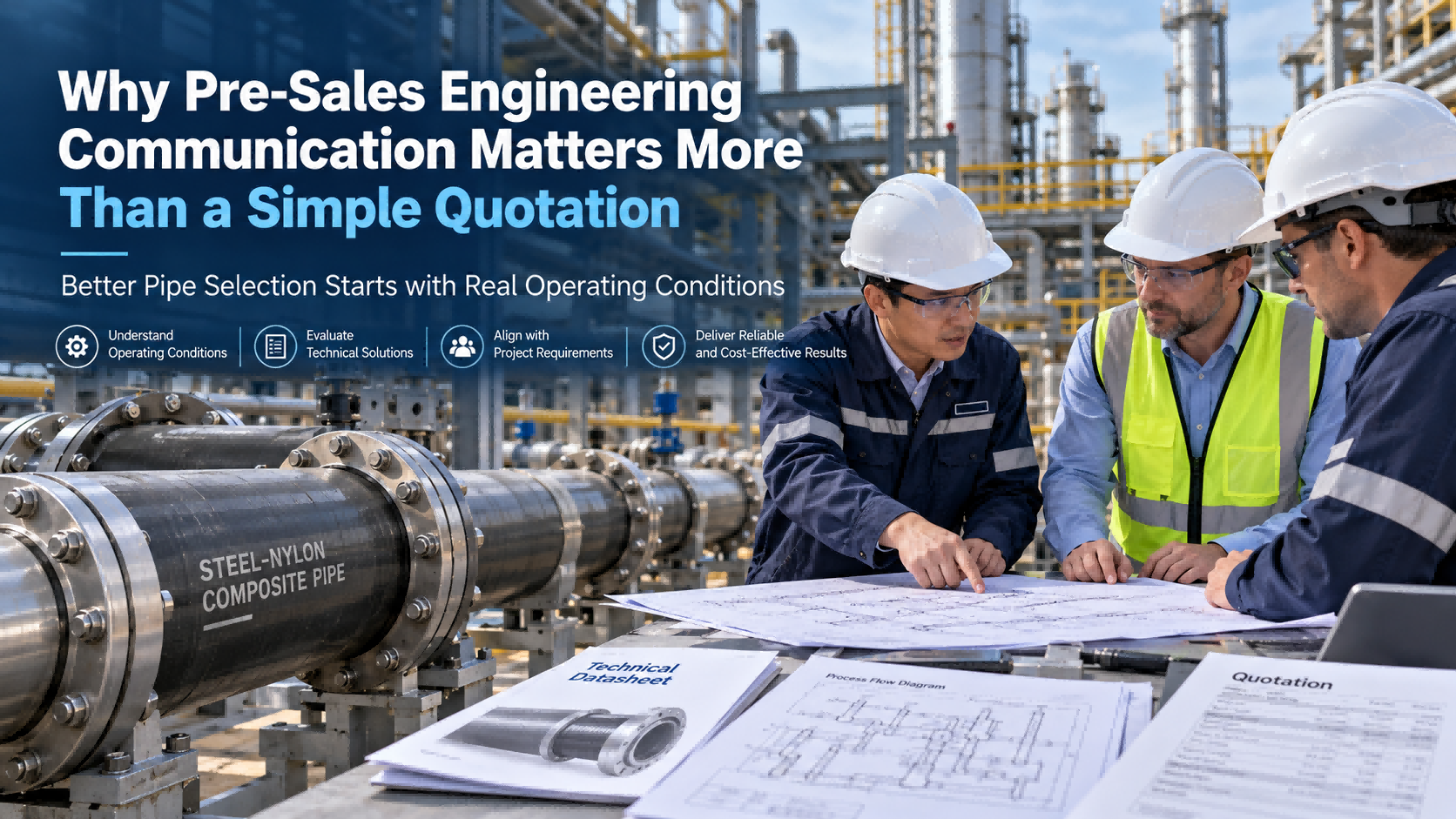
Why Pre-Sales Engineering Communication Matters More Than a Simple Quotation
One of the most common questions customers ask when purchasing industrial piping is:
“How much does this pipe cost per meter?”
For ordinary standardized products, this may be a perfectly reasonable question.
However, for demanding applications in chemical processing, mining, oil and gas, power generation, salt and alkali industries, seawater transportation, and industrial wastewater systems, providing a price based only on pipe diameter and length is often far from sufficient.
What truly determines whether an industrial piping system can operate reliably over the long term is not simply the purchase price, but a much broader set of engineering conditions:
-
What medium will the pipeline transport?
-
What is the operating pressure?
-
How does the operating temperature vary?
-
Is corrosion present?
-
Are abrasive particles involved?
-
What is the flow velocity?
-
How should the pipe diameter be determined?
-
How should the flanges and connections be designed?
-
Are there high-wear areas such as elbows, tees, and pump discharge sections?
-
What are the installation and construction conditions?
-
What will future maintenance and shutdown costs look like?
For industrial piping projects, therefore, high-quality pre-sales engineering communication is often more important than simply providing a quotation.
A quotation answers the question:
“How much will the pipe cost to purchase?”
Engineering communication answers the more important question:
“Will this piping system operate safely and reliably under the actual service conditions?”
1. Industrial Piping Is Not Simply a Standardized Commodity
At the early procurement stage, many industrial projects send suppliers relatively simple inquiries such as:
DN300, PN1.6 MPa, total length 2,000 meters. Please quote.
From a purchasing perspective, this may appear to contain enough information for pricing.
From an engineering perspective, however, these parameters may represent only 20–30% of the information required for proper pipe selection.
The same DN300, PN1.6 MPa pipeline can require completely different materials and designs depending on the actual application.
For example:
Application A: General Circulating Water
The main considerations may include:
-
Operating pressure
-
Water temperature
-
External environment
-
Required service life
-
Installation method
Application B: Mining Slurry
In addition to pressure, the system may require consideration of:
-
Solids concentration
-
Particle size
-
Mineral hardness
-
Slurry velocity
-
Elbow wear
-
Internal abrasion resistance
Application C: High-Salinity Industrial Wastewater
Additional considerations may include:
-
Chloride concentration
-
Total dissolved solids
-
pH value
-
Temperature
-
Corrosive environment
-
Scaling tendency
Application D: Chemical Mother Liquor
The system may involve substances such as:
-
NaOH
-
NaCl
-
HCl
-
H₂SO₄
-
Phosphoric acid
-
Various salts
-
Elevated temperatures
-
Combined corrosion and abrasion
This means that:
The same pipe diameter does not mean the same operating conditions, and the same pressure rating does not mean the same pipe material should be used.
If a supplier does not understand the actual operating conditions and simply provides a quotation based on nominal diameter and pressure class, the engineering value of that quotation is extremely limited.
2. A Professional Quotation Should Begin With Operating Condition Analysis
For industrial piping projects, an experienced supplier should not immediately finalize a technical solution after receiving an inquiry.
The first step should be:
Operating condition verification.
For steel-nylon composite pipe projects, our pre-sales engineering communication normally focuses on several key areas.
2.1 What Medium Will Be Transported?
This is one of the most fundamental parameters in pipe material selection.
Different media affect materials in completely different ways.
For example:
-
Clean water mainly requires consideration of pressure and service life.
-
Seawater requires consideration of chloride-induced corrosion.
-
Brine requires resistance to high-salinity environments.
-
Acid and alkali media require chemical resistance.
-
Mining slurry requires strong abrasion resistance.
-
Oilfield produced water may contain CO₂, H₂S, Cl⁻, suspended solids, and other aggressive components simultaneously.
Without understanding the chemical composition of the transported medium, selecting a pipe material based only on diameter can easily lead to incorrect material selection.
2.2 What Is the Operating Temperature?
Many materials perform well at ambient temperature, but as temperature increases, their:
-
Strength
-
Stiffness
-
Corrosion resistance
-
Pressure-bearing capability
may change significantly.
Industrial pipe selection therefore cannot be based only on a question such as:
“What is the maximum allowable temperature?”
Engineers should also understand:
-
Normal operating temperature
-
Maximum operating temperature
-
Minimum operating temperature
-
Temperature fluctuation range
-
Start-up and shutdown temperature variations
Long-term continuous operation at a certain temperature is very different from short-term temperature resistance.
3. Pressure Is Not Just a Single Number
Many inquiries provide only a nominal pressure rating such as:
PN1.0 / PN1.6 / PN2.5 / PN4.0 MPa
However, reliable engineering design requires a deeper understanding of the entire pressure profile, including:
-
Normal operating pressure
-
Maximum operating pressure
-
Design pressure
-
Water hammer pressure
-
Pump start-up and shutdown pressure surges
-
Possible vacuum conditions
-
Frequency of system start-stop cycles
For example, in long-distance transportation systems, mining slurry pipelines, and industrial circulating water systems, pump start-up and shutdown can generate significant transient pressure fluctuations.
If pipe selection is based only on normal operating pressure while ignoring pressure surges, the actual operating risk may be underestimated.
A professional supplier therefore should not simply ask:
“What is the pressure?”
The better engineering question is:
“How does the pressure change during actual system operation?”
4. Corrosion and Abrasion Often Occur at the Same Time
In many industrial applications, the most difficult challenge is neither corrosion alone nor abrasion alone.
It is:
Corrosion + abrasion.
For example:
Mining Applications
Solid particles in slurry continuously impact and wear the internal pipe surface.
Salt and Alkali Chemical Industries
High-salinity media can create long-term corrosion challenges.
Power Plant Flue Gas Desulfurization Systems
The transported medium may simultaneously involve:
-
Corrosion
-
Solid particles
-
Scaling
-
Erosion
Oilfield Produced Water
The system may contain:
-
CO₂
-
H₂S
-
Cl⁻
-
High mineral content
-
Suspended solids
Under these conditions, comparing only the initial price of different pipe materials can easily overlook the factors that actually determine service life.
5. Why Are Steel-Nylon Composite Pipes Suitable for Complex Industrial Applications?
Traditional piping materials often perform particularly well in one specific area.
For example:
Stainless steel offers good mechanical strength.
HDPE provides excellent corrosion resistance in many environments.
FRP offers good chemical resistance.
Steel pipe provides mature and reliable pressure-bearing performance.
However, demanding industrial applications often require a piping system to deliver several properties simultaneously:
Pressure resistance + corrosion resistance + abrasion resistance.
This is one of the core design principles behind steel-nylon composite pipe.
The steel structure provides mechanical strength and pressure-bearing capability, while the nylon material on the medium-contacting surface provides strong corrosion and abrasion resistance.
This combination makes steel-nylon composite pipe particularly suitable for applications such as:
-
Chemical media transportation
-
High-salinity wastewater
-
Oilfield produced water
-
Mining slurry transportation
-
Tailings transportation
-
Power plant desulfurization systems
-
Industrial circulating water
-
Salt chemical processing
-
Seawater and high-salinity water systems
For systems where pressure, corrosion, and abrasion coexist, the composite structure offers an alternative engineering approach to conventional single-material piping systems.
6. The Most Important Value of Pre-Sales Communication Is Avoiding the Wrong Material Choice
In industrial piping projects, the largest cost is often not the initial purchase.
The real cost can appear when the wrong material has been selected and the entire system must be repaired or replaced.
Suppose an industrial pipeline experiences severe corrosion or abrasion failure after only one year of operation.
The plant may then face costs including:
-
New pipe procurement
-
Removal of failed piping
-
Installation
-
Labor
-
Lifting and crane operations
-
Production shutdown
-
Cleaning
-
Safety risks
-
Environmental risks
Therefore, a lower initial purchase price does not necessarily mean a lower overall project cost.
The more meaningful metric is:
Total Cost of Ownership
TCO should include:
Initial procurement cost
Installation cost
Maintenance cost
Replacement cost
Shutdown losses
Expected service life
This is why an increasing number of industrial projects are evaluating pipe materials based on expected service life rather than simply comparing the price per meter.
7. Good Pre-Sales Engineering Communication Helps Reduce Project Risk
For steel-nylon composite pipe projects, we prefer to understand the customer's actual operating conditions thoroughly before finalizing a quotation.
A complete pre-project technical communication process normally includes several stages.
Step 1: Collect Operating Parameters
Typical information includes:
-
Transported medium
-
Chemical composition
-
Temperature
-
Pressure
-
Flow rate
-
Flow velocity
-
Solids concentration
-
Particle size
-
Pipe diameter
-
Transportation distance
Step 2: Analyze Potential Pipeline Failure Mechanisms
The main risks may include:
-
Chemical corrosion
-
Electrochemical corrosion
-
Erosion
-
Abrasion
-
Temperature effects
-
Pressure fluctuations
-
Scaling
-
Installation environment
Only after identifying the primary failure mechanisms can the appropriate pipe material be selected.
Step 3: Determine the Material and Structural Solution
Not every project should use the same piping material.
Professional technical support should first determine:
Is steel-nylon composite pipe actually suitable for this project?
If the answer is yes, the next step is to optimize:
-
Pipe diameter
-
Pressure class
-
Wall thickness
-
Connection method
-
Flange structure
-
Fitting configuration
-
Special section design
8. Elbows, Tees, and Pump Discharge Sections Often Require Special Attention
In many industrial piping systems, straight pipe sections may operate reliably while certain local areas fail much earlier.
Typical high-risk locations include:
-
Elbows
-
Tees
-
Reducers
-
Areas near valves
-
Pump discharge sections
-
High-velocity zones
These locations often experience:
-
Changes in flow direction
-
Local turbulence
-
Particle impact
-
Increased local velocity
As a result, the wear rate can be significantly higher than in straight pipe sections.
With adequate pre-sales engineering communication, these high-risk locations can be identified during the design stage.
Potential measures may include:
-
Optimizing fitting geometry
-
Adjusting flow velocity
-
Strengthening local wear-resistant design
-
Providing sufficient maintenance access
Solving these problems during the design stage is usually far less expensive than addressing them after the pipeline has already been installed.
9. Connection Design Also Determines Long-Term System Reliability
Many customers focus mainly on the pipe body while paying less attention to the connection system.
In reality, many industrial pipeline leakage problems occur not in the pipe body itself, but around:
-
Flanges
-
Sealing surfaces
-
Joints
-
Fittings
-
Valve connections
Pipeline design therefore should not consider only the pipe itself.
The complete connection system must also be evaluated.
Through an appropriately engineered composite structure and flange design, steel-nylon composite pipe can provide reliable mechanical connections while reducing direct contact between corrosive media and vulnerable metallic surfaces.
For industrial environments where field welding is undesirable or hot work should be minimized, flange connections can also simplify installation and improve construction efficiency.
10. Pre-Sales Technical Communication Is Even More Important for Overseas EPC Projects
In international industrial projects, piping suppliers often work with:
-
EPC contractors
-
Engineering companies
-
Procurement companies
-
Project owners
-
Installation contractors
The technical documentation may also be more complex.
Customers may provide:
-
Datasheets
-
Piping Specifications
-
P&IDs
-
Material Specifications
-
Project Standards
-
Installation Drawings
In such projects, the supplier's role is no longer simply to provide a price.
A capable supplier should be able to participate in:
Technical Selection Support
This may include:
-
Evaluating material compatibility with the medium
-
Recommending pressure classes
-
Recommending pipe structures
-
Providing flange dimensions
-
Providing technical data
-
Offering installation recommendations
-
Supporting technical clarification with EPC contractors
This is one of the key differences between a professional industrial piping supplier and a simple product seller.
11. Quotation Speed Matters, but Quotation Accuracy Matters More
There is a common misconception in industrial procurement:
The supplier who quotes the fastest must be the most professional.
For complex industrial piping projects, however, providing a price too quickly may sometimes indicate that the supplier has not fully understood the application.
A responsible industrial piping supplier should ask additional questions when important operating data is missing.
For example:
What is the operating medium?
What is the working temperature?
What is the operating pressure?
Are there any solid particles in the fluid?
What is the slurry concentration?
What is the total pipeline length?
What is the design flow rate?
These questions do not unnecessarily complicate the procurement process.
They help reduce downstream project risk.
Because:
A precise quotation based on incorrect operating conditions is still an incorrect quotation.
12. A Professional Supplier Does Not Simply Sell Pipe — It Provides a Solution
The future competition among industrial piping manufacturers will not simply be about:
Who offers the lowest price?
Increasingly, it will be about:
Who can help the customer solve the actual engineering problem?
What industrial customers truly need includes:
-
Longer pipeline service life
-
Less maintenance
-
Reduced downtime
-
More stable production
-
Lower total lifecycle cost
A mature industrial piping project should therefore normally follow a process such as:
Operating Condition Review → Engineering Analysis → Material Selection → Structural Design → Commercial Quotation → Technical Confirmation → Manufacturing → Inspection → Delivery → Installation Support
rather than simply:
Inquiry → Quotation → Purchase Order
13. Why Do We Place So Much Emphasis on Early-Stage Technical Communication?
As a manufacturer of steel-nylon composite pipes, we believe that:
A successful industrial piping project should begin with understanding the operating conditions, not with calculating the price.
Every industrial project has its own unique operating environment.
The challenges faced by a DN500 pipeline in a mining application can be completely different from those in chemical processing, oil and gas, power generation, or seawater transportation.
Therefore, during the early stage of a project, we prefer to communicate closely with customers, engineers, and EPC teams to understand:
-
Transported medium
-
Chemical composition
-
Operating pressure
-
Operating temperature
-
Flow velocity
-
Abrasion conditions
-
Installation environment
-
Required service life
Only then do we evaluate:
Is steel-nylon composite pipe the right solution for this application?
If it is suitable, we can further optimize:
-
Pipe diameter
-
Pressure class
-
Pipe structure
-
Flange connections
-
Fitting design
-
Installation solution
Our objective is not simply to provide a quotation.
It is to help customers identify a more reliable and economical long-term piping solution.
Conclusion: Industrial Pipe Procurement Should Move From “How Much Does It Cost?” to “How Long Will It Last?”
Industrial piping is a long-term infrastructure asset.
A pipeline may be expected to operate for:
5 years, 10 years, or even longer.
Therefore, the most important question should not simply be:
“How much does it cost per meter?”
A better question is:
“How long can this piping system operate reliably under my actual service conditions?”
That is the real value of pre-sales engineering communication.
Good engineering communication helps identify risks before a project begins.
Proper material selection can reduce future maintenance requirements.
And a well-designed piping solution can help reduce total lifecycle operating costs.
For industrial projects involving corrosion, abrasion, high salinity, pressure, or complex process media, steel-nylon composite pipe provides an engineering solution that combines mechanical strength with corrosion and abrasion resistance.
If your project is currently evaluating alternative industrial piping materials, instead of beginning with a simple comparison of price per meter, start with the actual operating conditions.
Because in industrial piping projects:
The right material selection is usually more valuable than the lowest quotation.
Welcome Overseas Customers for Factory Audits: What Should You Focus On?
How We Provide Pipeline Technical Support for Overseas EPC Contractors and Engineering Companies