Global Partnership Program: Developing Industrial Pipeline Markets Together

Introduction: The Global Industrial Pipeline Market Needs a More Collaborative Approach
As industrial infrastructure continues to develop and modernize worldwide, the industrial piping market is undergoing a significant transformation.
In industries such as oil and gas, chemicals, mining, power generation, water treatment, and seawater desalination, pipelines are no longer viewed simply as basic fluid transportation equipment. They are critical components that directly influence operational safety, production efficiency, maintenance costs, and long-term project profitability.
In particularly demanding applications involving corrosion, abrasion, high salinity, and complex pressure conditions, conventional piping materials face increasingly challenging engineering requirements.
At the same time, industrial procurement strategies are evolving.
More project owners, EPC contractors, and engineering companies are looking beyond initial pipe purchase prices and focusing on several important questions:
-
Can the pipeline withstand complex operating conditions over an extended period?
-
How can corrosion, abrasion, and unexpected leakage risks be minimized?
-
Can the piping system reduce maintenance expenses, repair frequency, and production downtime?
-
Does the manufacturer provide reliable technical support for material selection and engineering applications?
-
Can the manufacturer work with local partners to support project development, delivery, and after-sales services?
These changes are creating new opportunities not only for industrial pipe manufacturers but also for international distributors, regional agents, engineering contractors, and technical service providers.
As a manufacturer specializing in reinforced MC nylon pipes and steel-nylon composite pipes, we aim to establish long-term relationships with companies worldwide through our Global Partnership Program.
We welcome partners with strong local market knowledge, industrial customer networks, engineering expertise, and business development capabilities.
Our goal is not simply to supply industrial piping products to international markets.
We aim to work with global partners to develop corrosion-resistant and abrasion-resistant piping applications, solve real engineering challenges, and deliver long-term economic value to industrial customers.
1. Why Are New Opportunities Emerging in the Global Industrial Pipeline Market?
1.1 Industrial Pipelines Are Facing Increasingly Complex Operating Conditions
Pipeline failures in industrial facilities are rarely caused by a single factor.
In many applications, corrosion, abrasion, pressure fluctuations, temperature variations, and fluid characteristics interact to accelerate material degradation.
Different industries face different combinations of these challenges.
Oil and Gas Industry
Produced water pipelines, water injection systems, and high-salinity gathering networks may be exposed to CO₂, H₂S, chlorides, and other corrosive substances.
Chemical Processing Industry
Chlor-alkali, soda ash, salt chemical, and phosphate chemical facilities require piping materials that are compatible with specific chemical concentrations, operating temperatures, and process conditions.
Mining Industry
Iron ore, copper ore, tailings, and mine backfilling systems frequently transport abrasive slurries containing solid particles that can accelerate pipe wall erosion.
Power Generation Industry
Flue gas desulfurization systems, industrial cooling water networks, and other process pipelines must address corrosion, abrasion, scaling, and long-term operational reliability.
Seawater Desalination and Water Treatment
High chloride concentrations, salinity variations, and water treatment chemicals create additional challenges for piping materials and connection systems.
Despite their differences, these industries share one important requirement:
Industrial customers increasingly need engineering solutions tailored to their operating conditions, rather than simply purchasing pipes based on material type or unit price.
This transformation creates an opportunity for local distributors and engineering partners to move beyond conventional product trading and develop higher-value technical sales and project solution capabilities.
1.2 Industrial Customers Are Paying More Attention to Total Cost of Ownership
Traditional industrial procurement often emphasizes the initial purchase price.
However, the actual cost of a piping system extends far beyond material procurement.
A more comprehensive evaluation should consider installation, maintenance, downtime, repairs, and eventual replacement.
Total Cost of Ownership (TCO) can be expressed as:
TCO = Initial Purchase Cost + Installation Cost + Operating and Maintenance Costs + Downtime Losses + Replacement Costs + Other Lifecycle Costs
In highly corrosive or abrasive environments, maintenance and production interruption expenses can represent a significant portion of the total project cost.
If a piping solution can achieve a longer operating life and reduce maintenance frequency under verified service conditions, its long-term economic performance may justify a higher initial investment.
This is where high-performance steel-nylon composite piping can offer potential value.
For international partners, it also creates a more effective sales strategy:
Instead of competing primarily on price, partners can compete through engineering performance, operational reliability, lifecycle cost optimization, and measurable customer value.
2. Our Core Product: What Makes Steel-Nylon Composite Pipes Competitive?
Successful international market development begins with products that offer clear technical differentiation and practical engineering value.
Our core product portfolio includes reinforced MC nylon pipes and steel-nylon composite pipes designed for industrial applications involving corrosion, abrasion, and challenging fluid transportation conditions.
Steel-nylon composite pipes combine the structural characteristics of steel with the functional properties of nylon, offering an alternative material solution for selected demanding industrial applications.
2.1 Combining Steel and Nylon: Structural Strength and Internal Protection
The fundamental design concept of steel-nylon composite piping is to utilize the complementary advantages of two different materials.
Steel Structural Component
-
Provides structural support for the piping system
-
Contributes to mechanical strength under applicable design conditions
-
Helps accommodate certain installation and external loading requirements
-
Supports pressure and structural design according to project specifications
Nylon Functional Layer
-
Creates a protective barrier between the transported medium and the steel
-
Provides corrosion resistance against compatible chemicals
-
Offers abrasion resistance for selected particle-containing fluids
-
Provides a smooth internal surface that may help reduce hydraulic resistance and deposition under suitable operating conditions
By combining these characteristics, steel-nylon composite pipes can address structural strength, corrosion protection, and abrasion resistance within a single composite piping system.
Actual performance depends on the product's structural design, material formulation, manufacturing quality, and service conditions.
2.2 Corrosion Resistance for Complex Industrial Fluids
Corrosion is one of the major factors affecting pipeline maintenance requirements in chemical processing and oilfield operations.
Conventional carbon steel pipelines may experience internal corrosion when transporting high-salinity fluids, acidic liquids, or other aggressive process media.
Steel-nylon composite pipes use an internal nylon functional layer to separate the transported medium from the steel structure.
When chemical compatibility and operating conditions are properly verified, this design can reduce corrosion risks associated with direct contact between the process fluid and the steel.
Potential applications include:
-
Oilfield produced water and water injection systems
-
Brine and selected high-salinity process fluids
-
Compatible fluid transportation in chlor-alkali and soda ash plants
-
Chemical wastewater and industrial cooling water systems
-
Seawater transportation and selected desalination-related pipelines
Chemical compatibility must be evaluated according to fluid composition, concentration, operating temperature, oxidizing characteristics, and other relevant conditions.
Our approach emphasizes application-specific material selection rather than assuming that one piping material is suitable for every chemical environment.
2.3 Abrasion Resistance for Mining and Slurry Transportation
In mining, tailings transportation, slurry handling, and solid-liquid industrial processing systems, abrasive particles can gradually reduce pipe wall thickness.
Severe localized abrasion may lead to frequent replacement of elbows, tees, and straight pipe sections.
Suitable reinforced nylon functional layers offer abrasion resistance potential, making steel-nylon composite pipes a candidate solution for selected abrasive slurry applications.
Potential market opportunities include:
-
Mining slurry pipeline upgrades
-
Tailings transportation systems
-
High-wear elbow and pipe fitting replacement
-
Mine backfilling pipeline systems
-
Industrial slurry and particle-containing fluid transportation
Actual abrasion performance depends on particle size, particle hardness, solids concentration, flow velocity, and impact angle.
Application testing or engineering verification should therefore be conducted where necessary.
2.4 Flexible Engineering Options for Different Diameters and Pressure Requirements
Industrial pipeline requirements vary significantly between projects.
Some customers require smaller-diameter pressure pipelines, while others need large-diameter transportation systems.
Our product development and engineering approach considers the specific requirements of each application, including:
-
Nominal pipe diameter (DN)
-
Design and operating pressure
-
Design and operating temperature
-
Fluid composition and concentration
-
Corrosion and abrasion conditions
-
Pipeline connection methods
-
Installation environment and piping layout
For certain product series and specifications, pressure class requirements such as 1.0–4.0 MPa may be evaluated.
The applicable pressure rating must be confirmed using product-specific design calculations, testing results, and project technical documentation.
Large-diameter and non-standard piping projects require additional evaluation of manufacturing capability, pressure requirements, structural design, and transportation conditions.
This application-oriented approach provides international partners with opportunities to develop specialized engineering projects beyond standard pipe distribution.
2.5 Integrated Flange Design for Efficient Installation
Pipeline connections are critical components that deserve particular attention during design and installation.
For applicable product structures, we emphasize integrated flange designs to enhance connection integrity and minimize unnecessary structural weak points.
Flanged piping systems allow pipe sections to be assembled using bolted connections, reducing the need for certain on-site welding activities.
Potential benefits include:
-
Convenient pipe section assembly
-
Improved installation efficiency
-
Reduced requirements for certain hot-work connection procedures
-
Easier disassembly and localized replacement during maintenance
Connection reliability still depends on proper flange design, gasket selection, bolt tightening, installation quality, and operating conditions.
For international distributors and engineering contractors, well-designed connection systems can contribute to installation efficiency, project acceptance, and customer satisfaction.
3. How Do Steel-Nylon Composite Pipes Compare with Conventional Piping Materials?
Different piping materials offer different advantages and limitations.
We do not believe that a single material should replace every conventional piping solution.
Instead, our objective is to help customers identify the most technically appropriate and economically competitive material for their actual operating conditions.
| Piping Material | Main Advantages | Key Considerations |
|---|---|---|
| Carbon Steel Pipe | High mechanical strength and established industrial use | Corrosion protection and maintenance requirements |
| Stainless Steel Pipe | Good mechanical properties and corrosion resistance in suitable environments | Material cost, chloride exposure, and specific corrosion mechanisms |
| HDPE Pipe | Lightweight and resistant to many chemicals | Temperature limitations, pressure ratings, creep, and mechanical loading |
| FRP Pipe | Resistant to many corrosive media and relatively lightweight | Impact resistance, abrasion, joints, and installation conditions |
| Rubber-Lined Steel Pipe | Combines steel strength with protective rubber lining | Lining compatibility, localized damage, and repair requirements |
| Steel-Nylon Composite Pipe | Combines steel structural capacity with nylon-based corrosion and abrasion resistance | Chemical compatibility, composite construction quality, and design conditions |
For applications involving a combination of corrosion, abrasion, and structural loading requirements, steel-nylon composite pipes may provide a competitive alternative.
More importantly, we want to help our partners communicate this value through technical documentation, operating condition analysis, pilot installations, and lifecycle cost evaluation.
The objective is to demonstrate application-specific benefits rather than relying solely on material price comparisons.
4. Which Industries Will Our Global Partnership Program Focus On?
We aim to develop long-term partnerships with companies serving industries where corrosion resistance, abrasion resistance, and pipeline reliability are important purchasing considerations.
4.1 Oil and Gas: Corrosive Fluid Transportation and Oilfield Water Systems
Oilfield produced water, water injection, and other process fluid transportation systems may involve high salinity, corrosive gases, and suspended particles.
Under properly verified temperature, pressure, and fluid compatibility conditions, steel-nylon composite pipes can be evaluated for selected oilfield water transportation applications.
Potential Business Opportunities
-
Oilfield produced water pipelines
-
Water injection pipeline replacement
-
High-salinity industrial fluid transportation
-
Existing pipeline corrosion mitigation projects
-
Oilfield surface facility piping supply
We welcome cooperation with oilfield equipment suppliers, oil and gas engineering companies, and regional distributors with established energy-sector customer networks.
4.2 Chemical Processing: Corrosion-Resistant Industrial Piping
The chemical industry represents an important potential application market for steel-nylon composite pipes.
Chlor-alkali, soda ash, salt chemical, and certain inorganic chemical facilities require piping systems capable of handling fluids with different chemical characteristics.
Potential Business Opportunities
-
Chemical process pipeline modernization
-
Brine and mother liquor transportation
-
Selected alkaline process fluid pipelines
-
Corrosive industrial wastewater systems
-
Localized replacement of conventional piping materials
For partners already serving chemical plants, engineering design companies, or EPC contractors, we can jointly explore application-specific material selection and engineering evaluations.
4.3 Mining: Abrasion-Resistant Slurry Transportation
Mining operations place considerable importance on continuous production and maintenance cost management.
In certain projects, pipeline abrasion directly affects production schedules and equipment availability.
Potential Business Opportunities
-
Iron ore and copper ore slurry pipelines
-
Tailings processing and transportation
-
Mine backfilling systems
-
High-wear pipeline section and elbow replacement
-
Mining pipeline modernization projects
By initially targeting high-wear pipeline sections, partners can introduce alternative piping materials through manageable replacement projects.
Successful operating results may then support wider adoption.
4.4 Power Generation: Cooling Water and Desulfurization Systems
Power plants require reliable piping systems for cooling water, desulfurization, and other auxiliary processes.
Where fluid compatibility, temperature, and abrasion requirements are satisfied, steel-nylon composite pipes can be evaluated as an alternative for selected auxiliary systems.
Potential Business Opportunities
-
Industrial cooling water systems
-
Compatible desulfurization fluid and slurry pipelines
-
Power plant drainage and wastewater treatment
-
Corrosion protection upgrades for existing pipelines
4.5 Water Treatment and Seawater Desalination
Seawater desalination, coastal industrial water supply, and wastewater treatment projects require careful consideration of corrosion resistance, connection reliability, and maintenance requirements.
Steel-nylon composite pipes may be considered for selected industrial water transportation applications based on water chemistry, design pressure, and environmental conditions.
Applications involving drinking water require separate verification of applicable local hygiene and potable-water contact material certification requirements.
Potential Business Opportunities
-
Industrial seawater transportation
-
Desalination-related piping systems
-
High-salinity process water pipelines
-
Coastal industrial infrastructure modernization
-
Industrial wastewater and reclaimed water networks
These industry opportunities allow partners to focus on sectors that align with their local market strengths rather than following a single global sales strategy.
5. What Types of Global Partners Are We Looking For?
Different organizations bring different capabilities, technical resources, and customer networks.
Our Global Partnership Program is therefore designed to encourage multiple types of business collaboration rather than being limited to conventional product distribution.
5.1 Regional Industrial Pipe Distributors and Sales Agents
For companies already supplying industrial pipes, valves, pumps, or fluid handling equipment, steel-nylon composite pipes can offer an opportunity to expand their product portfolios.
When existing customers experience corrosion, abrasion, or frequent pipeline replacement, differentiated composite piping products can create new business opportunities.
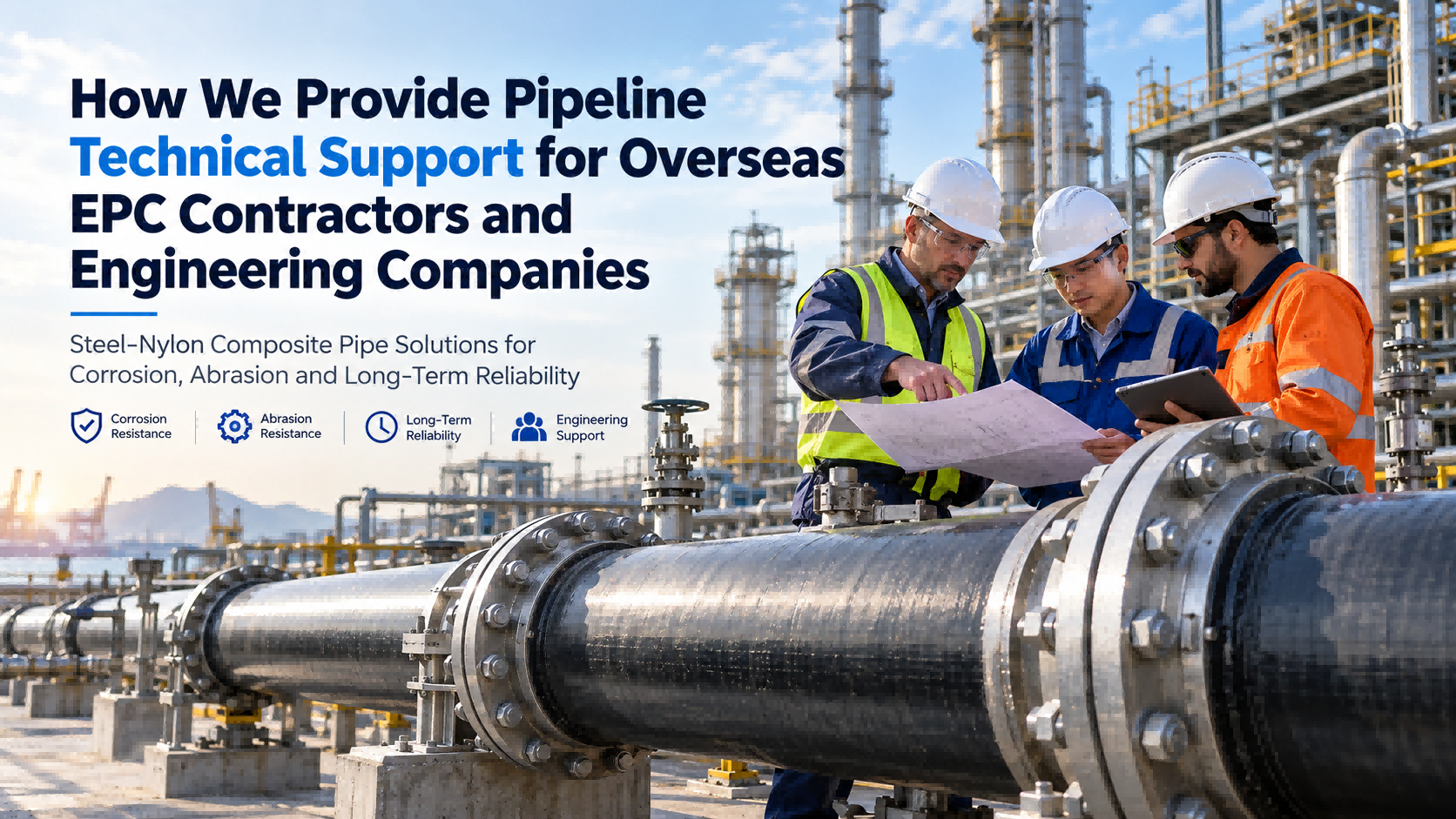
5.2 EPC Contractors and Engineering Companies
EPC contractors are deeply involved in engineering design, procurement, construction, and project delivery.
We aim to work with EPC partners through early-stage technical discussions, material selection, and manufacturing coordination.
Together, we can evaluate project specifications, operating parameters, material compatibility, and connection requirements to determine whether steel-nylon composite pipes are appropriate for specific engineering applications.
5.3 Industrial Equipment Suppliers and System Integrators
Many industrial equipment suppliers deliver complete systems rather than individual products.
Examples include:
-
Mining slurry transportation system suppliers
-
Chemical fluid handling system integrators
-
Industrial water treatment equipment companies
-
Power plant auxiliary system equipment suppliers
Integrating suitable piping products into larger industrial solutions can help these partners expand their scope of supply.
5.4 Engineering Maintenance and Technical Service Companies
Companies providing industrial maintenance services often identify corrosion and abrasion problems during routine inspections and repairs.
These partners can help identify potential pipeline improvement opportunities and collaborate with us in evaluating localized pipe replacement or larger system modernization projects.
6. How Do We Support Our International Partners?
Manufacturing capability is the foundation of an industrial piping partnership.
However, helping partners win the confidence of industrial customers requires coordinated support throughout the project lifecycle.
Our partnership approach focuses on six key areas.
6.1 Product Technical Documentation and Application Knowledge
International partners need to clearly communicate product structures, technical characteristics, and application limitations.
Depending on the product series and target market, we aim to coordinate the preparation and use of technical information covering:
-
Product structures and technical features
-
Specifications and key operating parameters
-
Typical industrial applications
-
Corrosion and abrasion resistance characteristics
-
Connection methods and installation considerations
-
Material selection and application limitations
-
Available testing and quality documentation
The availability and scope of documentation depend on the relevant product specifications, existing test results, and project requirements.
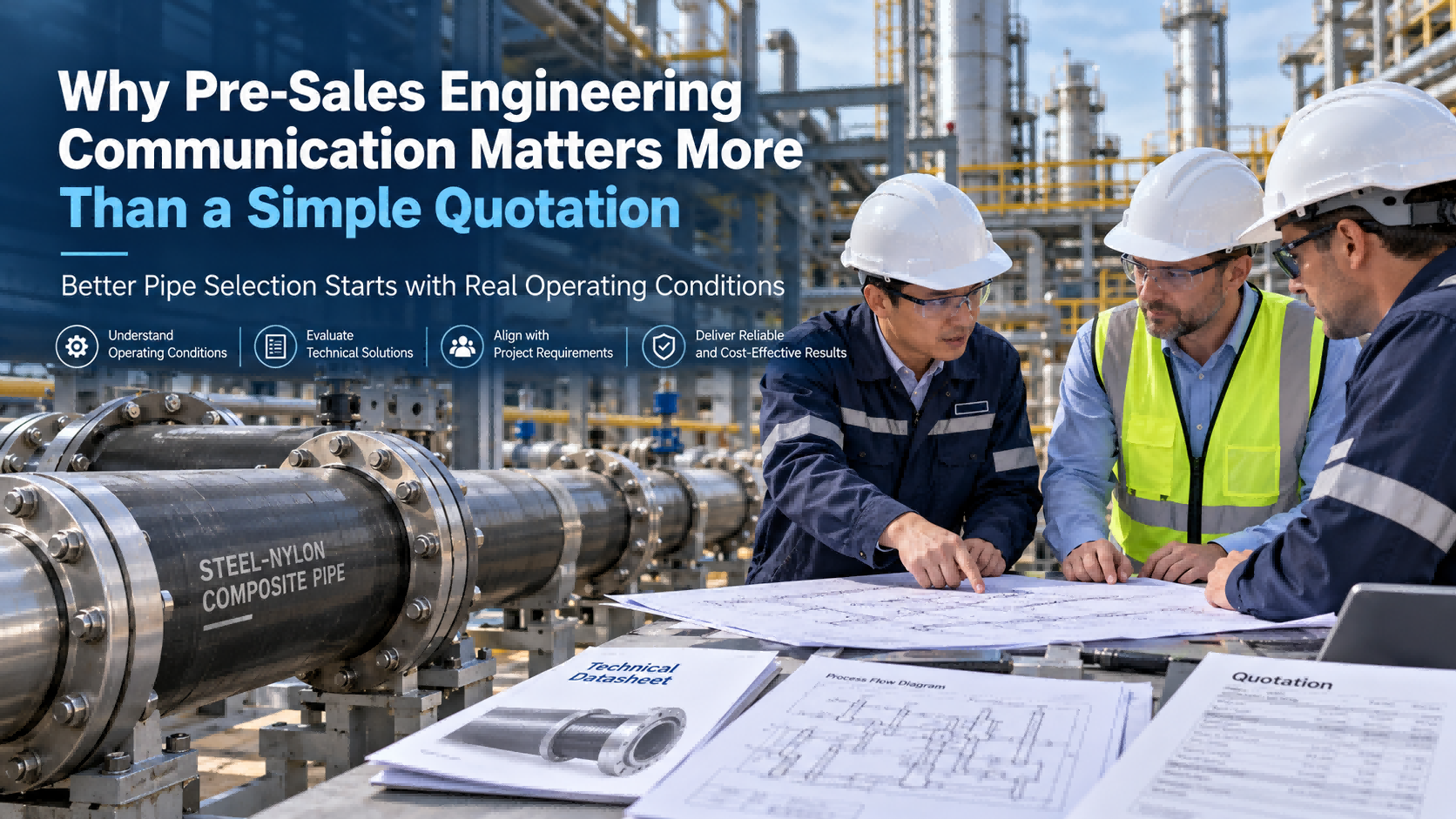
6.2 Early-Stage Engineering and Material Selection Support
We want our partners to do more than simply sell industrial pipes.
We want them to understand the operating problems experienced by their customers.
When international customers submit pipeline inquiries, the following information is particularly important:
-
Transported fluid and chemical composition
-
Fluid concentration, solids content, and particle characteristics
-
Operating and design temperatures
-
Operating pressure, design pressure, and pressure fluctuations
-
Pipe diameter, pipeline length, flow rate, and velocity
-
Installation conditions, connection methods, and applicable standards
Based on these parameters, the manufacturer and local partner can work together to evaluate chemical compatibility, structural design, and engineering suitability.
This approach helps reduce material selection risks caused by incomplete operating data.
6.3 Customized Design and Manufacturing Coordination
Different countries, industries, and projects may require different pipe dimensions, connection structures, and pipe lengths.
We welcome technical cooperation on project-specific requirements such as:
-
Non-standard pipe dimensions
-
Special flange connections
-
Large-diameter composite pipe structures
-
Specific engineering operating conditions
-
Matching pipe fittings and pipe section configurations
-
Project delivery and packaging requirements
For technically demanding applications, the necessary design reviews and manufacturing feasibility assessments should be completed before quotation confirmation and production.
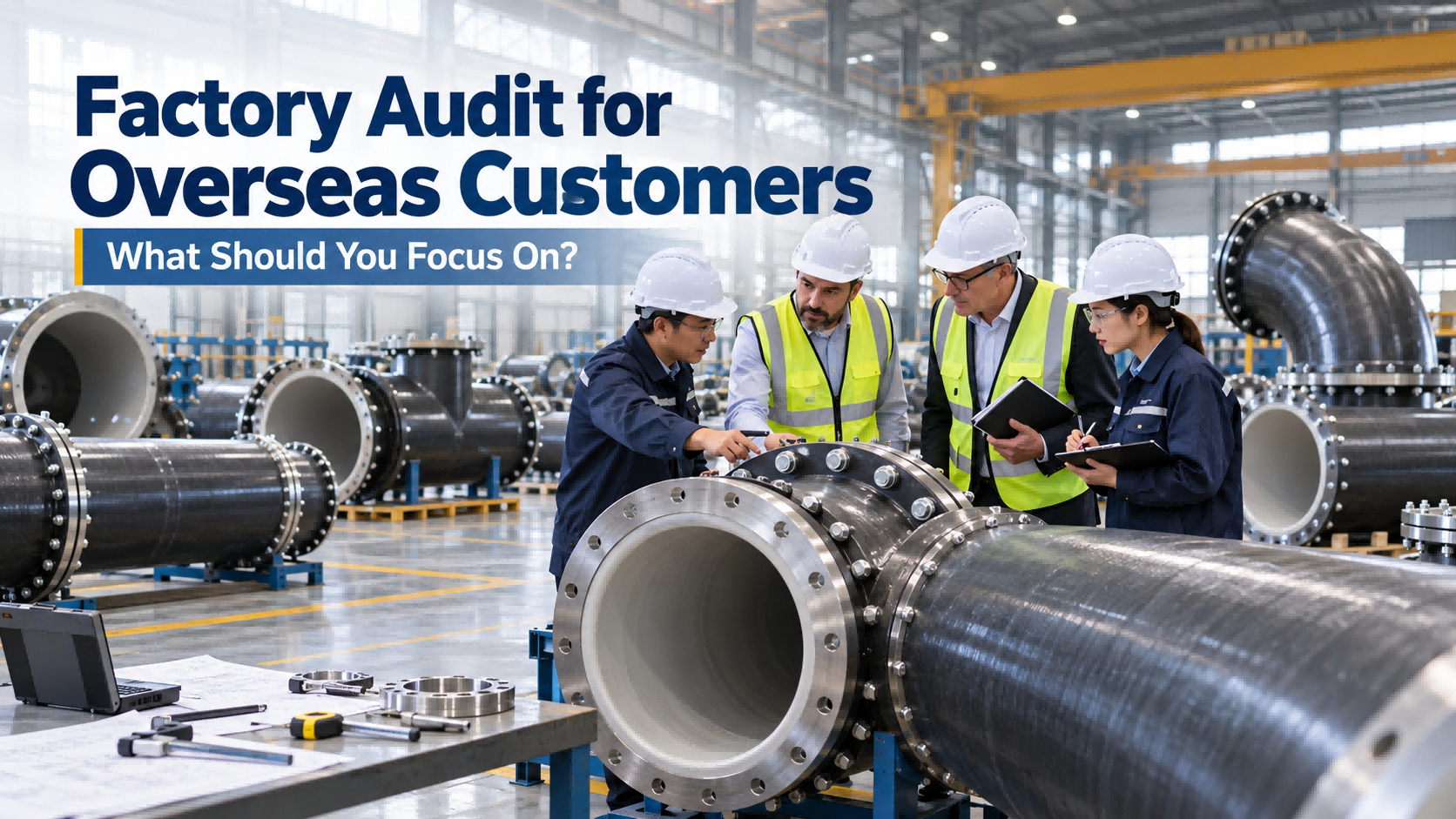
6.4 Quality Control and Inspection Coordination
International EPC contractors and industrial project owners place considerable importance on manufacturing quality, traceability, and technical documentation.
We emphasize the importance of aligning product manufacturing and quality control with project-specific requirements.
Depending on the contract and application, inspection and documentation arrangements may include:
-
Dimensional inspection
-
Visual examination
-
Applicable pressure testing
-
Relevant material records
-
Factory inspection documentation
-
Product quality verification requirements
Where third-party inspection, particular certifications, or international standard compliance are required, these expectations should be clearly established during the technical agreement and contract negotiation stages.
6.5 Joint Market Development and Project Promotion
Industrial market structures differ from one region to another.
Some countries have strong oil and gas industries, while others have extensive chemical processing, mining, or industrial water infrastructure.
We therefore encourage a market development strategy aligned with each partner's regional industry strengths.
Joint activities may include:
-
Technical discussions on corrosion-resistant piping for chemical plants
-
Promotion of abrasion-resistant pipeline upgrades to mining companies
-
Material selection discussions for oilfield produced water systems
-
Engineering consultations with EPC contractors
-
Lifecycle cost assessments for industrial end users
Effective industrial marketing should focus on solving customers' engineering problems rather than merely presenting product specifications.
6.6 Project Delivery and Long-Term Cooperation
Industrial piping projects typically involve multiple stages, including technical discussions, solution confirmation, procurement, manufacturing, inspection, transportation, and installation.
Manufacturers and international partners need clear responsibilities and effective communication throughout these stages.
We aim to coordinate manufacturing schedules, delivery information, technical documentation, and project feedback where appropriate.
Specific commercial arrangements, after-sales responsibilities, and support commitments can be discussed according to the capabilities and requirements of both parties.
7. From Product Distribution to Engineering Solutions: How Can We Win Projects Together?
We believe successful industrial piping partnerships should not be built around one-time transactions.
A more sustainable model combines the manufacturer's product and technical capabilities, the local partner's market resources, and the end user's engineering requirements.
Stage 1: Identify Specific Industrial Pipeline Challenges
Local partners use their industry experience to identify operating problems within customers' existing pipeline systems.
For example, a chemical plant may experience frequent maintenance in corrosive fluid pipelines.
A mining company may face excessive abrasion in slurry transportation elbows.
These real operating challenges provide a strong starting point for technical sales.
Stage 2: Conduct a Joint Technical Evaluation
The local partner shares relevant operating information with the manufacturer.
Both parties evaluate whether steel-nylon composite pipes are technically suitable candidates.
The main questions include:
-
What is causing the existing pipeline failure?
-
Which performance requirements must the alternative material satisfy?
-
Are there technical limitations or application risks?
-
How can the benefits of the proposed solution be demonstrated?
Where the available information is insufficient, additional testing or sample verification should be considered.
Stage 3: Introduce Pilot Sections and Demonstration Applications
For customers unfamiliar with steel-nylon composite pipes, replacing an entire pipeline may create a significant technical and commercial decision barrier.
A more practical approach can be to begin with a limited pilot installation when engineering conditions permit.
Potential pilot applications may include:
-
High-wear pipeline sections
-
Corrosive fluid branch pipelines
-
Selected elbows or pipe fittings
-
Representative pipeline segments suitable for monitoring
Pilot projects should establish clear evaluation criteria.
These may include operating duration, leakage performance, abrasion measurements, maintenance records, connection reliability, and actual operating costs.
Stage 4: Expand Applications Through Verified Operating Results
When a pilot project demonstrates satisfactory performance, the partners can use customer-approved operating data to discuss wider adoption.
This approach can help:
-
Reduce the technical risks of introducing new piping materials
-
Build customer confidence through practical evidence
-
Develop reusable engineering experience
-
Support larger pipeline modernization projects
-
Establish long-term customer relationships
For manufacturers and international partners, a properly verified engineering application is often more persuasive than general product advertising.
8. How Can Partners Build a Competitive Advantage with Steel-Nylon Composite Pipes?
The international industrial piping market is highly competitive.
Distributors relying exclusively on standard products and low-price competition often face significant margin pressure.
Partners capable of providing engineering-oriented solutions can build stronger and more sustainable competitive advantages.
8.1 Move from Price Competition to Value-Based Selling
Discussing the purchase price of a pipe addresses only one part of the customer's investment decision.
When a partner can evaluate corrosion, abrasion, maintenance costs, and production downtime, that partner can participate in more strategic engineering and procurement discussions.
The complementary structural and functional characteristics of steel-nylon composite pipes can provide a basis for value-based selling in suitable applications.
8.2 Move from Individual Product Sales to Project Solutions
Industrial pipeline procurement often requires consideration of pipe diameter, pressure, transported fluid, connection methods, installation, and maintenance.
Partners who can work with manufacturers to provide coordinated technical recommendations may become involved earlier in engineering projects.
This creates opportunities to compete through expertise and service rather than relying only on lower prices.
8.3 Move from One-Time Transactions to Long-Term Customer Relationships
Industrial pipelines operate over extended periods and require ongoing maintenance management.
Partners who develop a deeper understanding of customers' operating conditions can identify future equipment upgrades, localized pipeline replacements, and new project requirements.
This knowledge can support long-term business relationships.
8.4 Expand from One Industry into Multiple Industrial Markets
Steel-nylon composite pipes can be evaluated for a variety of applications with different operating characteristics.
For example, a distributor serving chemical processing customers may also explore industrial water treatment and power generation markets.
Similarly, a supplier working in the mining sector may identify opportunities in other abrasive slurry transportation systems.
Cross-industry market development can help partners gradually diversify their customer portfolios.
9. How Can Partners Demonstrate the Economic Value and ROI of Steel-Nylon Composite Pipes?
Promoting advanced piping materials requires more than technical product descriptions.
International partners also need to help customers understand the potential financial benefits of adopting an alternative piping solution.
We recommend using a Total Cost of Ownership framework.
A Practical Pipeline Cost Evaluation Model
Consider an industrial facility comparing a conventional piping system with a steel-nylon composite piping alternative.
The analysis should include the following factors:
| Cost Category | Evaluation Factors |
|---|---|
| Initial Procurement | Pipes, fittings, flanges, and connection materials |
| Installation | Transportation, lifting, assembly, and labor |
| Routine Maintenance | Inspection, repair, and protective maintenance expenses |
| Pipeline Replacement | Replacement frequency and costs of vulnerable pipe sections |
| Production Downtime | Maintenance shutdown duration and production losses |
| Long-Term Operation | Pumping energy, maintenance efficiency, and operational reliability |
| Project Risk | Leakage, environmental remediation, and other potential losses |
For projects requiring financial evaluation, future expenses can also be discounted to calculate their present value.
Lifecycle Cost NPV = Initial Investment + Present Value of Future Annual Costs
If verified operating conditions demonstrate that steel-nylon composite pipes can reduce maintenance, replacement, or downtime expenses, these savings may partially or fully offset differences in initial investment.
However, actual cost savings and payback periods must be calculated using project-specific quotations, operating data, and reasonable assumptions.
Fixed savings percentages should not be presented without supporting evidence.
By using a structured cost evaluation, international partners can help customers make more informed purchasing decisions.
10. Building Long-Term Partnerships: We Value More Than Sales Volume
In international industrial markets, the long-term value of a partnership cannot be measured solely by short-term sales revenue.
We are particularly interested in companies with the following characteristics.
Strong Local Market Knowledge
Partners who understand the key industries, engineering projects, and pipeline opportunities within their countries or regions.
Commitment to Technical Communication
Companies willing to understand customer operating conditions rather than simply reselling products.
Reliable Business Reputation
Organizations that value customer relationships, product quality, contractual commitments, and long-term cooperation.
Willingness to Develop Markets Together
Partners interested in jointly exploring new applications, accumulating engineering experience, and expanding customer networks.
Respect for Product Application Limitations
Companies committed to promoting products based on actual technical specifications, verified performance, and applicable test data.
We believe sustainable international competitiveness requires continuous communication, technical collaboration, and shared engineering experience.
The strengths of manufacturers and local partners are complementary.
Manufacturers understand product design, material characteristics, and manufacturing processes.
Local partners understand regional industries, customer requirements, purchasing practices, and project execution conditions.
Combining these capabilities creates a stronger foundation for sustainable international partnerships.
11. How Does Our Global Partnership Program Work?
To support efficient and practical cooperation, we recommend a structured partnership development process.
Step 1: Initial Business Communication
Potential partners introduce their companies, countries or regions, business activities, existing customer groups, and primary industry experience.
Both parties exchange information about their capabilities and commercial objectives to identify potential areas of cooperation.
Step 2: Identify Target Markets and Applications
Based on the industrial structure of the local market, both parties select one or two promising target industries.
These may include oilfield water handling, chemical corrosion-resistant pipelines, mining slurry transportation, or industrial water treatment.
Focusing initially on specific applications helps build a more effective market development strategy.
Step 3: Product and Technical Exchange
The manufacturer and partner discuss product structures, technical characteristics, operating conditions, quality documentation, and engineering requirements.
This stage helps the partner understand both the competitive advantages and the application limitations of steel-nylon composite pipes.
Step 4: Identify Project Opportunities
Both parties explore local pipeline replacement projects, new industrial facilities, and infrastructure modernization opportunities.
Priority can be given to applications with clear operating conditions, identifiable technical challenges, and measurable potential value.
Step 5: Project Evaluation, Quotation, and Commercial Negotiation
Once the preliminary technical solution has been established, project quotations and commercial discussions can proceed according to specifications, quantities, delivery requirements, and applicable business conditions.
Territorial arrangements, distribution models, responsibilities, and other commercial terms should be agreed upon separately.
Step 6: Project Execution and Experience Development
Following project execution, both parties should review customer feedback and actual operating performance.
Where customer permission is obtained and reliable data is available, project experience can be developed into technical case studies to support future market expansion.
This gradual approach allows both parties to develop stronger capabilities while managing technical and commercial risks.
12. Frequently Asked Questions (FAQ)
Q1: What types of companies can become global partners?
Industrial pipe distributors, regional sales agents, EPC contractors, engineering companies, industrial equipment suppliers, and fluid handling system integrators are welcome to explore potential cooperation.
We are particularly interested in partners with experience and customer networks in oil and gas, chemical processing, mining, power generation, and industrial water treatment.
Q2: Can a company become a partner without previous experience selling steel-nylon composite pipes?
Companies with relevant industrial piping experience or engineering service capabilities can explore cooperation even if they have not previously supplied steel-nylon composite pipes.
Initial collaboration can focus on product knowledge, technical communication, typical applications, and specific project evaluations.
Q3: Can steel-nylon composite pipes replace all conventional industrial pipes?
No.
Every piping material has specific advantages and limitations.
Steel-nylon composite pipes are particularly worth evaluating when structural strength, corrosion protection, and abrasion resistance must be considered together.
Their suitability depends on chemical compatibility, temperature, pressure, flow velocity, installation conditions, and applicable standards.
Q4: Can international partners receive technical support for pipeline selection?
We emphasize joint technical communication during the early stages of industrial projects.
This may include gathering operating information, evaluating material suitability, reviewing pipe specifications, and assessing manufacturing feasibility.
The specific scope of technical documentation, testing, engineering services, and project support can be determined according to individual requirements and mutual agreements.
Q5: Can we jointly develop special industrial applications for our local market?
We welcome cooperation proposals involving clearly defined engineering requirements.
For non-standard dimensions, special process fluids, and complex applications, both parties can assess material suitability, design requirements, manufacturing feasibility, and necessary verification procedures.
Q6: How can we join the Global Partnership Program?
Potential partners are welcome to contact us and introduce their companies, target markets, primary customer industries, and current industrial piping opportunities.
Through initial business and technical discussions, both parties can identify suitable directions for cooperation.
Conclusion: Growing Together in the Global Industrial Pipeline Market
The global industrial piping industry is gradually moving beyond conventional material procurement toward engineering decisions that place greater emphasis on reliability, technical suitability, and lifecycle value.
For industrial pipe manufacturers, this transformation requires more than dependable production capabilities.
It requires a deeper understanding of the operational challenges facing industrial customers.
For international distributors and engineering partners, the same transformation creates new business opportunities.
By offering technically differentiated piping products and application-oriented engineering solutions, partners can establish stronger competitive positions in their local markets.
Steel-nylon composite pipes combine the structural support of steel with the corrosion-resistant and abrasion-resistant characteristics of suitable nylon materials.
This combination provides an alternative material option for selected demanding industrial transportation systems.
However, the true value of any advanced piping material must be demonstrated through proper technical selection, reliable manufacturing quality, engineering verification, and actual operating performance.
Through our Global Partnership Program, we aim to establish long-term, mutually beneficial relationships with industrial pipe distributors, regional agents, EPC contractors, and engineering service companies around the world.
Our ambition goes beyond supplying steel-nylon composite pipes to more countries. We want to work with international partners to solve real industrial transportation challenges, optimize lifecycle costs, and create sustainable business value.
Become Our Global Industrial Pipeline Partner
Develop New Markets. Share Technical Strengths. Create Long-Term Value.
Are you looking for differentiated industrial piping products to expand your portfolio?
Do your customers need corrosion-resistant or abrasion-resistant piping solutions for demanding industrial applications?
Are you interested in developing new opportunities in chemical processing, oil and gas, mining, power generation, or industrial water treatment?
We welcome discussions with:
-
Industrial Pipe Distributors
-
Regional Sales Agents
-
EPC Contractors
-
Industrial Equipment Suppliers
-
Pipeline Engineering Companies
-
Mining and Chemical Industry Solution Providers
Whether your company focuses on local distribution, engineering procurement, industrial equipment integration, or project development, we welcome the opportunity to explore how we can work together.
Contact Us to Explore Partnership Opportunities
Share your company profile, target market, industry experience, and potential project opportunities with our team.
Together, we can explore the application potential of steel-nylon composite pipes and develop practical solutions for industrial customers in your region.
Let's build stronger industrial pipeline solutions, develop new markets, and create lasting partnerships worldwide.
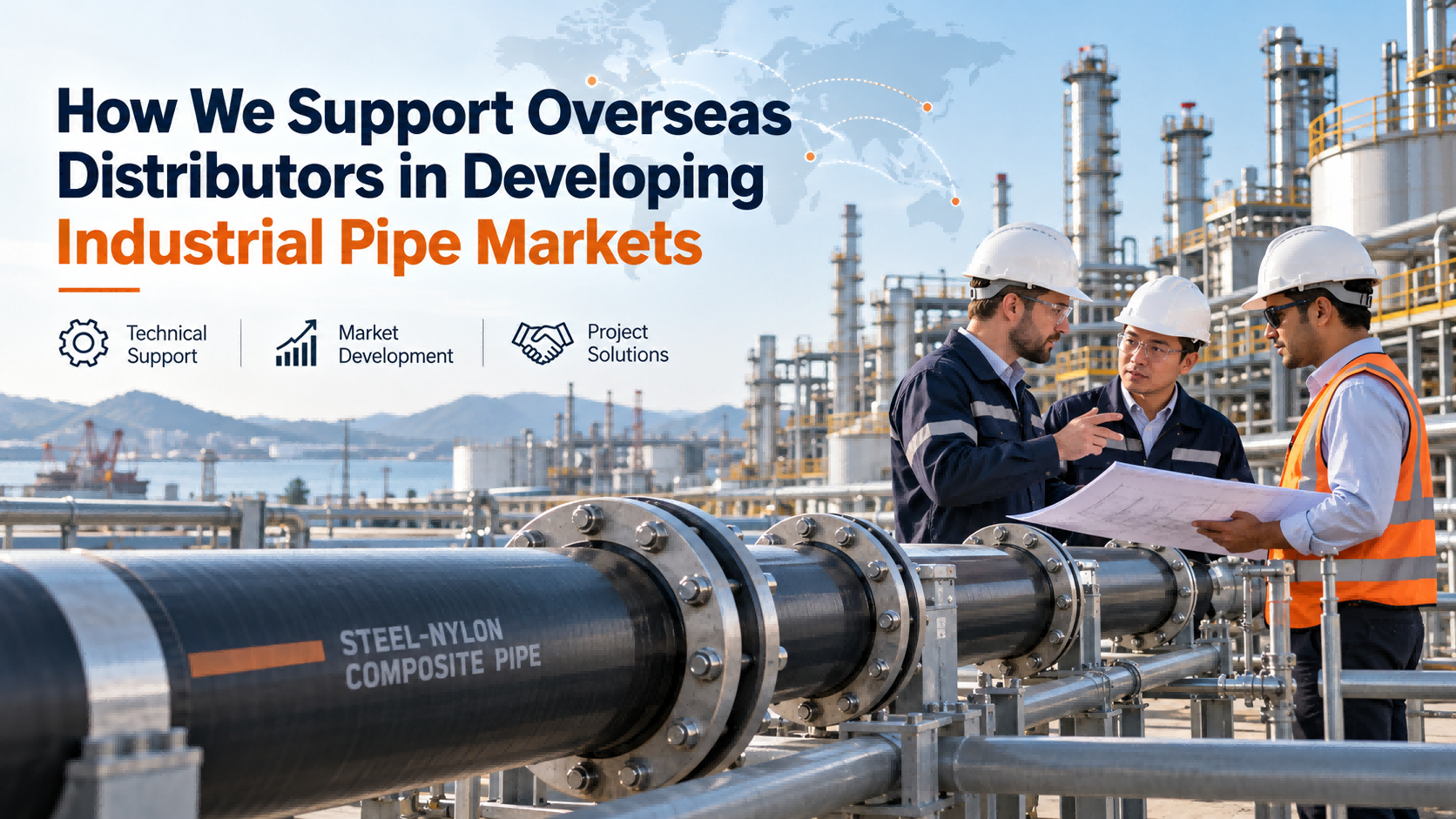
How We Support Overseas Distributors in Developing Industrial Pipe Markets