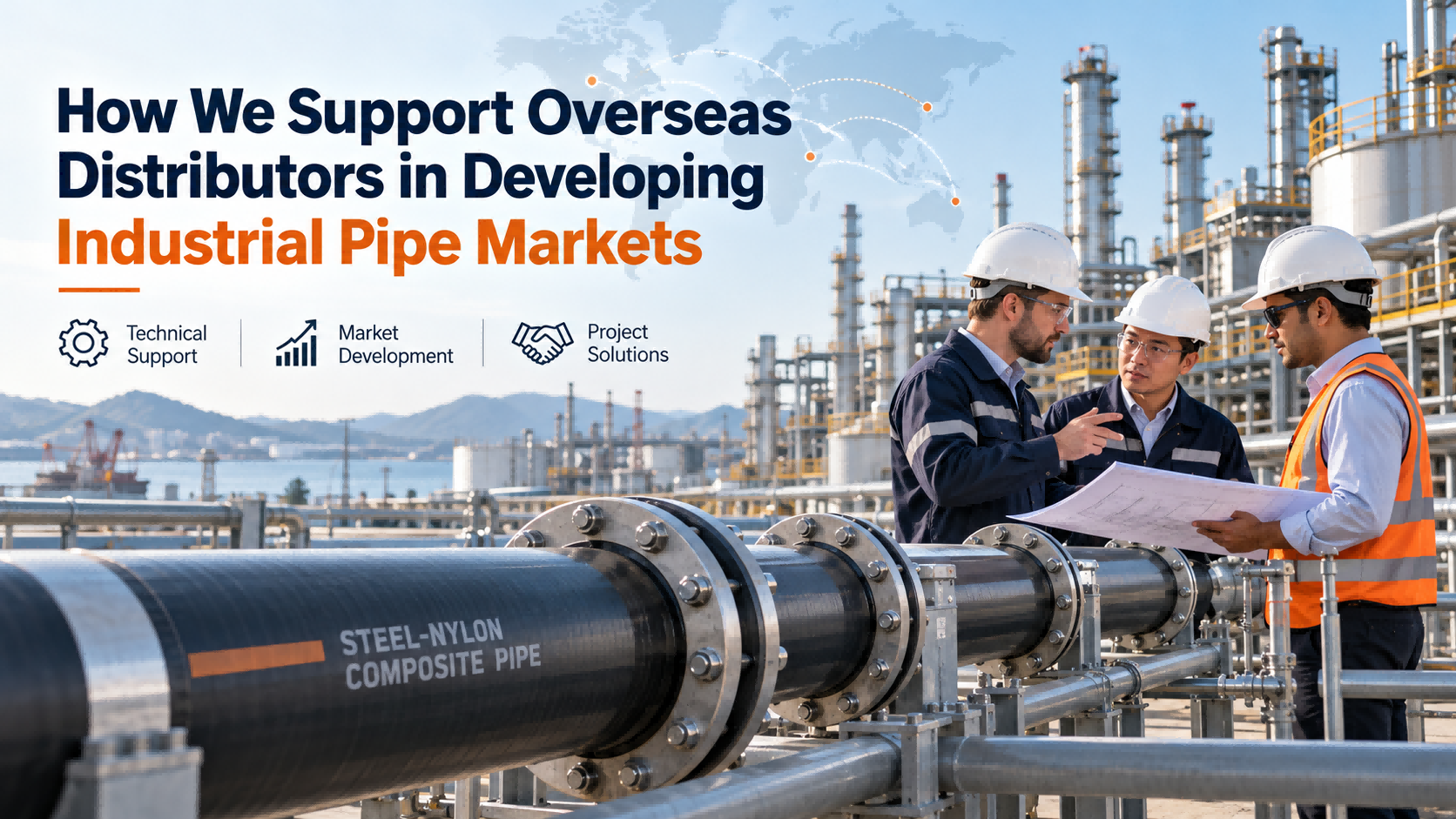
How We Support Overseas Distributors in Developing Industrial Pipe Markets
Introduction: Successful Industrial Pipe Distributors Need More Than Just a Supplier
As industrial infrastructure continues to develop and modernize worldwide, industries such as chemical processing, oil and gas, mining, power generation, water treatment, and municipal water supply are placing increasing importance on corrosion-resistant, wear-resistant, long-lasting, and low-maintenance piping solutions.
For international distributors looking to enter or expand in the industrial piping market, this trend creates significant business opportunities. However, it also brings increasingly complex technical and commercial challenges.
Unlike ordinary commercial products, industrial pipes are engineering components that require careful technical evaluation.
Industrial customers consider much more than the initial purchase price. Their decisions often depend on material compatibility, operating pressure, temperature, abrasion resistance, connection methods, installation costs, maintenance requirements, and long-term operational reliability.
Therefore, a successful industrial pipe distributor needs more than a competitive product portfolio. It needs a manufacturing partner capable of providing continuous technical assistance, engineering support, market development resources, and reliable project coordination.
As a manufacturer specializing in reinforced MC nylon pipes and steel-nylon composite pipes, we understand the challenges faced by overseas distributors and engineering partners.
Our goal is not simply to supply industrial pipes. We aim to help our international partners develop sustainable businesses by combining specialized manufacturing capabilities, technical expertise, customized piping solutions, and long-term cooperation.
In this article, we explain how we support overseas distributors throughout the entire business development process—from understanding local market opportunities to securing industrial projects and supporting successful project delivery.
1. Why Does the Global Industrial Piping Market Offer Long-Term Opportunities?
Industrial piping systems are essential components of industrial infrastructure.
Whether transporting corrosive chemicals in processing plants, produced water in oilfields, or abrasive slurry in mining operations, industrial facilities depend on reliable piping systems to maintain safe and efficient operations.
As existing industrial facilities undergo maintenance, modernization, and expansion, many operators are reassessing the performance and long-term cost of conventional piping materials.
1.1 Challenges Facing Traditional Industrial Pipe Materials
Different industrial environments expose piping systems to different forms of deterioration.
Common piping materials may face the following limitations:
Carbon Steel Pipes
Carbon steel pipes may suffer from internal corrosion, scaling, and wall-thickness reduction when exposed to corrosive media without adequate protection.
Stainless Steel Pipes
Although stainless steel offers excellent performance in many applications, certain grades may experience pitting or crevice corrosion in chloride-rich environments. Higher-alloy grades can also involve significant material costs.
Fiberglass Reinforced Plastic (FRP) Pipes
FRP pipes provide good corrosion resistance in many chemical applications. However, impact resistance, abrasion performance, long-term pressure behavior, and installation conditions must be carefully evaluated.
High-Density Polyethylene (HDPE) Pipes
HDPE pipes offer corrosion resistance and installation advantages. Nevertheless, elevated operating temperatures, long-term pressure requirements, and specific mechanical loads require appropriate engineering assessment.
Rubber-Lined or Plastic-Lined Steel Pipes
These materials can provide useful corrosion protection, but lining integrity, connection quality, and long-term maintenance requirements remain important considerations.
Every piping material has its appropriate applications and limitations.
No single material is suitable for every industrial operating condition.
This creates opportunities for composite piping solutions that combine mechanical strength, corrosion resistance, abrasion resistance, and favorable lifecycle economics.
1.2 Industrial Customers Are Paying More Attention to Total Cost of Ownership
Traditionally, industrial pipe purchasing decisions were often strongly influenced by the initial material price.
However, the actual cost of a pipeline extends far beyond the purchase of pipes and fittings.
For industrial systems operating continuously, unexpected leakage, repairs, production shutdowns, and premature pipe replacement can create expenses much greater than the initial difference in material costs.
As a result, industrial customers increasingly evaluate:
-
Initial pipe procurement costs
-
Transportation and installation expenses
-
Routine inspection and maintenance costs
-
Unplanned downtime and production losses
-
Expected replacement intervals
-
Long-term operational reliability
This approach, commonly described as Total Cost of Ownership (TCO), creates opportunities for industrial piping materials that offer meaningful performance advantages under suitable operating conditions.
For overseas distributors, it also represents an important change in sales strategy.
Instead of competing solely on price, distributors can position themselves as providers of application-specific engineering solutions.
2. Providing Differentiated Steel-Nylon Composite Pipe Products
The foundation of a successful distribution business is a product that solves real customer problems.
Our core product portfolio includes reinforced MC nylon pipes and steel-nylon composite pipes designed for industrial applications involving corrosion, abrasion, pressure requirements, and challenging fluid-handling conditions.
2.1 Combining the Advantages of Steel and Nylon
Steel-nylon composite pipes are engineered to combine the mechanical support provided by steel with the corrosion-resistant, wear-resistant, and low-friction characteristics of nylon materials.
This composite design offers several important advantages.
Mechanical Strength and Pressure-Bearing Capability
The steel structure provides mechanical support, allowing the composite piping system to accommodate specified pressure requirements when properly designed and manufactured.
Corrosion Resistance
The nylon inner layer helps prevent direct contact between the transported medium and the steel structure in compatible chemical environments, reducing the risk of internal corrosion.
Abrasion Resistance
For slurry, industrial wastewater, and certain particle-containing fluids, appropriately selected nylon materials can provide good resistance to abrasive wear.
Relatively Smooth Internal Surface
The smooth inner surface can help reduce frictional losses during fluid transport.
However, actual hydraulic performance depends on pipe diameter, flow velocity, fluid properties, pipeline length, and operating conditions.
Potential for Reduced Maintenance Requirements
When correctly selected, installed, and operated, composite pipes may help reduce maintenance associated with corrosion and abrasive wear.
These advantages should always be evaluated against actual operating conditions and supported by applicable technical data.
The objective is not to claim that one material can replace every traditional pipe, but to identify where steel-nylon composite piping provides measurable engineering and economic value.
2.2 Integrated Flange Design for Reliable Connections
For overseas industrial projects, connection reliability and installation efficiency are important procurement considerations.
We emphasize the development and application of integrated flange structures.
By optimizing the connection between the pipe body and the flange, this design aims to improve structural integration and installation consistency.
Potential advantages include:
-
Reducing complex on-site connection operations
-
Facilitating connections with compatible flange systems
-
Simplifying selected installation procedures
-
Supporting prefabricated and modular piping arrangements
-
Improving consistency in connection structure when properly engineered
The reliability of any flanged joint also depends on gasket selection, bolt tightening, flange pressure rating, alignment, and installation practices.
For international engineering projects where specialized on-site fabrication resources may be limited, a clearly defined flange connection system can provide practical installation benefits.
2.3 Flexible Pipe Sizes and Customized Engineering Solutions
Industrial projects vary significantly in their dimensional and structural requirements.
Smaller process pipelines often require accurate connections and careful space management.
Large-diameter industrial pipelines place greater emphasis on structural strength, transportation, lifting, installation, and joint reliability.
We support the selection and customization of reinforced nylon and steel-nylon composite piping solutions according to project requirements.
Potential customization options include:
-
Different nominal pipe diameters
-
Customized wall thicknesses
-
Project-specific pressure requirements
-
Large-diameter industrial pipes
-
Non-standard pipe lengths
-
Flange connection configurations
-
Elbows, tees, reducers, and other fittings
-
Special structural designs for complex applications
Final product specifications depend on manufacturing capabilities, technical verification, and project design requirements.
For overseas distributors, customization capability creates opportunities beyond standard pipe sales and allows them to participate in more technically demanding industrial projects.
3. Providing Professional Engineering and Technical Support
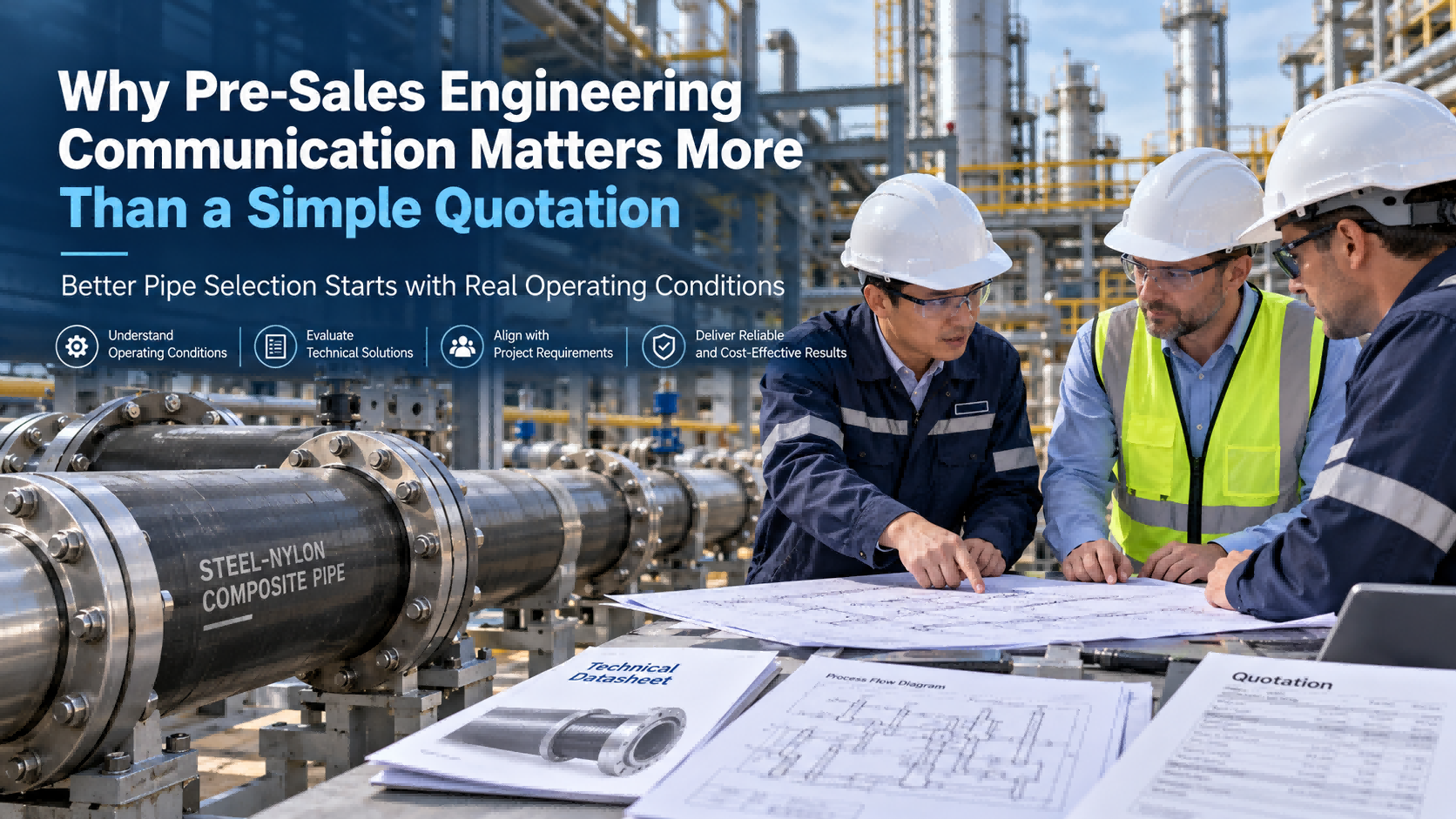
One of the most important factors in industrial pipe sales is the ability to help customers select the right material for the right operating conditions.
Many overseas distributors have extensive local customer networks and strong commercial relationships but may not have a complete in-house materials engineering or piping design team.
This is where a specialized manufacturer can provide significant value.
3.1 Assisting With Industrial Pipe Material Selection
When distributors receive inquiries from chemical plants, mining companies, or EPC contractors, we can help analyze the key technical parameters.
These typically include:
| Engineering Parameter | Key Evaluation Factors |
|---|---|
| Transported medium | Chemical composition, concentration, and pH |
| Operating pressure | Normal pressure, peak pressure, and water hammer |
| Operating temperature | Continuous temperature and short-term fluctuations |
| Pipe dimensions | Nominal diameter, wall thickness, and total length |
| Abrasion conditions | Solid concentration, particle size, and flow velocity |
| Installation environment | Aboveground, underground, outdoor, or corrosive environments |
| Connection requirements | Flange standards, sealing methods, and interface dimensions |
| Service requirements | Design life, inspection requirements, and project standards |
By reviewing these parameters, we help distributors identify suitable piping solutions and communicate technical recommendations more effectively.
Where material compatibility or performance cannot be established from available information, additional testing, engineering calculations, or pilot installations may be necessary.
This approach allows distributors to provide more valuable technical assistance instead of relying only on pipe diameter and unit price.
3.2 Supplying Technical Product Documentation
International engineering procurement often involves detailed documentation requirements.
Engineering customers need more than a basic product catalog.
Depending on the specific product and project, we can assist in preparing relevant technical materials, such as:
-
Technical Data Sheets (TDS)
-
Pipe dimension and structural drawings
-
Material performance test information
-
Applicable pressure and temperature parameters
-
Product inspection and quality documentation
-
Flange connection and installation instructions
-
Industrial application references
-
Additional technical submissions required by the project
Any certifications, third-party inspection reports, or test results supplied must be valid and applicable to the relevant product.
These documents help overseas distributors communicate more effectively with engineering consultants, EPC contractors, technical purchasing teams, and project owners.
3.3 Helping Distributors Answer Customer Technical Questions
Industrial customers frequently ask questions such as:
-
What are the advantages of steel-nylon composite pipes compared with 316L stainless steel pipes?
-
Are these pipes suitable for high-salinity industrial wastewater?
-
How do they perform in slurry pipelines containing abrasive solid particles?
-
Can they connect to existing flange systems?
-
Can steel-nylon composite pipes replace FRP pipes in certain applications?
These questions require technically informed answers.
Through material information, product test data, application analysis, and engineering experience, we help distributors respond with relevant technical explanations.
Our goal is to enable distributors not only to introduce our products, but also to explain where they are suitable, why they may offer advantages, and which operating limitations must be considered.
4. Helping Distributors Develop High-Potential Industrial Markets
One of the biggest challenges for a new industrial pipe distributor is determining which industries to target first.
Without a clear market strategy, distributors may spread their resources across too many applications, making customer acquisition inefficient.
We recommend initially focusing on industries where pipeline corrosion, abrasion, and maintenance costs create identifiable customer problems.
4.1 Oil and Gas Industry
Potential applications include:
-
Oilfield produced water transportation
-
Oilfield water injection systems
-
High-salinity industrial water pipelines
-
Selected oilfield gathering and surface transportation systems
These systems may be exposed to high mineral concentrations, carbon dioxide, hydrogen sulfide, and other corrosive factors.
Under appropriate conditions, steel-nylon composite pipes can be evaluated as alternatives to selected conventional metallic piping systems.
Projects involving hydrocarbons, elevated temperatures, high pressures, or sour service require dedicated material compatibility and engineering safety assessments.
4.2 Chemical and Salt Processing Industries
Chemical processing represents an important potential market for corrosion-resistant piping solutions.
Applications worth evaluating include:
-
Chlor-alkali processing
-
Soda ash manufacturing
-
Brine and saltwater transportation
-
Industrial mother liquor systems
-
Selected chemical wastewater pipelines
These applications can involve corrosion, deposits, temperature fluctuations, and continuous operation.
Distributors can approach local chemical manufacturers by focusing on pipeline maintenance, material selection, and the cost of unplanned shutdowns.
For strong acids, oxidizing chemicals, and high-temperature or highly concentrated chemical solutions, compatibility with the specific nylon material must be verified before recommending the product.
4.3 Mining and Mineral Processing Industry
Mining pipelines frequently experience severe abrasive wear.
Potential applications include:
-
Iron ore slurry transportation
-
Copper ore slurry pipelines
-
Tailings transportation
-
Mine backfill systems
-
Mine water and wastewater pipelines
In abrasion-dominated applications, choosing suitable wear-resistant materials can help reduce pipeline repair and replacement requirements.
Steel-nylon composite pipes combine structural support with a wear-resistant inner layer, making them a potential option for engineering and economic evaluation in selected mining applications.
4.4 Power Generation and Water Treatment
Additional opportunities may exist in:
-
Flue gas desulfurization slurry systems
-
Power plant circulating water pipelines
-
Industrial water treatment
-
Seawater transportation
-
Industrial wastewater treatment
-
Municipal water supply and drainage upgrades
In coastal environments and highly corrosive industrial settings, durability and maintenance requirements can play an important role in material selection.
For potable water applications, compliance with the applicable hygiene, safety, and certification requirements of the destination market is essential.
By developing industry-specific product recommendations, distributors can target customers more effectively instead of relying on generic marketing materials.
5. Supporting Local Marketing and Sales Development
Industrial piping sales often involve long decision-making cycles.
Distributors may need to engage with customers repeatedly before a new material is approved for an engineering project.
Effective marketing support from the manufacturer can help improve the efficiency of these early-stage activities.
5.1 Product Marketing Materials
We can work with distributors to prepare product information and application-oriented marketing resources, including:
-
English-language product introductions
-
Product brochures and catalogs
-
Industrial application images
-
Pipe structure and flange connection illustrations
-
Industrial pipe material comparison guides
-
Technical pipe selection information
-
Engineering application references
-
Frequently asked technical questions
For markets requiring local-language communication, distributors and manufacturers can also cooperate on the localization of suitable materials.
Consistent, accurate technical information helps distributors present products professionally and build trust with industrial customers.
5.2 Supporting Digital Marketing and Online Customer Acquisition
Today, many industrial buyers use Google, technical industry websites, and LinkedIn to identify potential suppliers and research piping solutions.
Manufacturers can support distributors in developing digital marketing content focused on specific engineering problems.
Potential keyword and content topics include:
-
Corrosion Resistant Industrial Pipes
-
Steel-Nylon Composite Pipes
-
Wear Resistant Slurry Pipelines
-
Chemical Processing Piping Solutions
-
Mining Slurry Pipeline Solutions
-
Industrial Water Treatment Pipes
-
Alternative Piping Materials for Corrosive Service
These topics can serve as an initial content strategy. Actual search volume, keyword competition, and lead-generation potential should be evaluated for each target market.
Distributors can use their websites, technical blogs, product pages, and engineering case studies to attract qualified industrial inquiries.
Rather than relying only on messages such as "competitive prices," we encourage marketing content that answers real questions from engineers and purchasing managers.
For example:
"Which Pipe Material Is Best for Corrosive Industrial Wastewater?"
"How to Reduce Slurry Pipeline Maintenance Costs?"
"Steel-Nylon Composite Pipes vs. Stainless Steel Pipes: Which Is Better for Your Application?"
Content built around real engineering challenges is more likely to attract customers with specific project requirements.
5.3 Supporting Technical Discussions With EPC Contractors
Major industrial piping projects often involve multiple decision-makers:
-
Project owners
-
Engineering consultants
-
EPC contractors
-
Procurement departments
-
Maintenance engineers
-
Local installation contractors
Overseas distributors can manage local relationships and identify project opportunities, while the manufacturer supports technical presentations, material evaluation, and piping solution discussions.
This cooperative approach can improve communication efficiency throughout complex procurement processes.
6. From Technical Inquiry to Project Delivery: A Structured Cooperation Process
Effective cooperation should involve more than receiving an inquiry and sending a quotation.
We believe overseas distributors benefit from a structured, engineering-oriented project support process.
Stage 1: Understanding Project Requirements
The distributor gathers essential project information, such as:
-
Customer industry
-
Transported medium
-
Pipe dimensions
-
Operating pressure and temperature
-
Installation conditions
-
Required quantities
-
Expected delivery schedule
-
Applicable technical standards
The manufacturer then reviews the available information to assess preliminary technical feasibility.
Stage 2: Pipe Selection and Engineering Proposal
Based on the operating conditions, suitable pipe structures, dimensions, connection methods, and any necessary customized configurations can be evaluated.
If significant material or engineering risks are identified, further verification requirements should be defined before proceeding.
Stage 3: Technical Quotation and Commercial Coordination
Once the product specifications and supply scope are clear, a project quotation can be prepared.
The quotation should clearly identify relevant terms, including:
-
Product specifications
-
Pipe and fitting quantities
-
Inspection requirements
-
Packing arrangements
-
Delivery terms
-
Applicable trade conditions
Clearly defined technical and commercial requirements help reduce misunderstandings during project execution.
Stage 4: Sample Testing or Pilot Pipeline Evaluation
For customers considering a new piping material for the first time, sample testing or a pilot installation may be appropriate.
For example, a project may consider a 100–500-meter pilot pipeline where operating conditions and evaluation objectives justify such a trial.
Potential evaluation criteria include:
-
Installation compatibility
-
Flange connection performance
-
Operating pressure behavior
-
Internal abrasion
-
Material compatibility with the transported medium
-
Inspection and maintenance requirements
The length and duration of a pilot installation should reflect the project risks, technical requirements, and measurable performance indicators.
A successful pilot project can provide valuable operational information and support future expansion.
However, pilot testing does not replace required engineering verification or long-term performance assessment.
Stage 5: Manufacturing and Export Delivery
After order confirmation, the manufacturer and distributor coordinate production planning, quality inspection, packaging, transportation, and delivery arrangements.
Large-diameter industrial pipes require particular attention to shipping dimensions, lifting requirements, and protection of flange connections and fittings.
Stage 6: Installation Guidance and After-Sales Technical Support
Project delivery should not mark the end of cooperation.
For industrial piping applications, installation guidance, technical communication, and operational feedback are important.
By maintaining engineering feedback records and resolving product-related questions through an organized process, distributors can provide better customer service and develop experience for future projects.
7. Helping Distributors Win Projects Through Total Cost of Ownership Analysis
One question that overseas distributors frequently encounter is:
"Why should customers consider steel-nylon composite pipes if another piping material has a lower initial purchase price?"
The answer should not be a simple claim that our pipes are always cheaper.
Instead, distributors should help customers compare the total economic impact of different piping solutions.
7.1 Looking Beyond the Initial Purchase Price
The Total Cost of Ownership of an industrial pipeline can be represented as:
TCO = Initial Procurement Cost + Installation Cost + Operating Cost + Maintenance Cost + Failure and Downtime Cost + Replacement Cost + End-of-Life Cost
The importance of each component varies by application.
For relatively mild operating environments, conventional piping materials may already provide excellent economic performance.
However, in industrial systems requiring frequent maintenance, repair, or replacement, a more durable piping material may offer better lifecycle value even if its initial cost is higher.
7.2 Demonstrating Value Through Project-Based Comparisons
Consider a mining company evaluating conventional piping against steel-nylon composite piping.
We recommend that distributors collect project-specific information for the following comparison.
| Evaluation Factor | Conventional Pipe | Steel-Nylon Composite Pipe |
|---|---|---|
| Initial purchase cost | Based on actual quotation | Based on actual quotation |
| Installation cost | Based on installation plan | Based on installation plan |
| Expected maintenance frequency | Based on operating records | Based on testing or reference data |
| Expected service life | Based on actual conditions | Based on verified performance |
| Downtime cost | Based on production data | Based on risk assessment |
| Long-term total cost | Calculated for the project | Calculated for the project |
Using the same evaluation period, operating assumptions, and discount rate allows customers to make more meaningful comparisons.
For overseas distributors, this data-driven sales method can be more effective than competing only on the purchase price per meter.
The value of our steel-nylon composite pipes lies not only in the product itself, but also in their potential to support longer reliable operation, more predictable maintenance, and improved lifecycle economics under suitable conditions.
8. Building Long-Term Partnerships and Supporting Distributor Interests
Developing an overseas distribution business requires significant investment in time, resources, technical communication, and customer relationships.
Distributors must introduce unfamiliar products, educate potential customers, participate in engineering tenders, and coordinate local service activities.
Manufacturers, in turn, need to provide dependable product quality, technical communication, supply capabilities, and transparent commercial processes.
We believe successful distribution relationships should be developed with long-term cooperation in mind.
8.1 Flexible Distribution Cooperation Models
Depending on the target market and the capabilities of each partner, different cooperation structures can be considered.
Non-Exclusive Distribution
Suitable for initial market development or for distributors wishing to evaluate local demand before making larger commitments.
Regional Distribution Partnerships
Appropriate for partners with established customer networks, technical sales capabilities, and consistent market development resources.
Project-Based Cooperation
Suitable for cooperation on specific engineering projects requiring technical support, quotation coordination, and product supply.
Any distribution authorization, territorial rights, pricing arrangements, project protection, sales targets, or exclusivity provisions should be defined in a formal agreement between the parties.
8.2 Transparent Market Development Processes
A strong distribution partnership requires clear and practical commercial rules.
Important considerations may include:
-
Defining territories and target customer groups
-
Establishing project registration and communication procedures
-
Clarifying quotation and commercial approval processes
-
Coordinating customer development investment
-
Defining quality and after-sales responsibilities
-
Reviewing market development performance regularly
These measures can help reduce channel conflicts, duplicated quotations, and misunderstandings concerning commercial responsibilities.
8.3 Developing Long-Term Industrial Customer Relationships
Industrial piping projects can generate ongoing procurement opportunities.
After completing an initial pipeline replacement or upgrade, the same customer may require:
-
New production line pipelines
-
Pipeline expansion projects
-
Replacement of high-wear pipe sections
-
Additional pipe fittings
-
Piping upgrades at other facilities
We therefore encourage distributors to build long-term relationships with engineering customers rather than focusing only on individual purchase orders.
A strong customer relationship supported by reliable technical service can offer much greater long-term value than repeated price competition.
9. Helping New Distributors Enter the Market: A Practical 90-Day Development Plan
For partners beginning to introduce steel-nylon composite pipes into their local markets, we recommend a phased development approach.
Days 1–30: Product Familiarization and Market Identification
Key activities include:
-
Understanding product structures and performance characteristics
-
Learning application requirements and operating limitations
-
Researching major local industrial sectors
-
Identifying customers experiencing corrosion or abrasion problems
-
Creating an initial list of potential engineering customers
-
Preparing localized marketing materials
Primary Objective: Enable the distributor to explain the product's advantages clearly and identify the most relevant target customers.
Days 31–60: Customer Development and Technical Engagement
Key activities include:
-
Visiting priority industrial customers
-
Contacting local EPC contractors and engineering consultants
-
Identifying existing pipeline performance problems
-
Conducting preliminary material selection discussions
-
Collecting project-specific inquiries
-
Performing technical evaluations of potential opportunities
Primary Objective: Move beyond general product promotion and begin developing real engineering opportunities.
Days 61–90: Project Evaluation and Commercial Development
Key activities include:
-
Conducting detailed assessments of priority inquiries
-
Preparing technically appropriate quotations
-
Discussing sample testing or pilot pipeline opportunities
-
Following engineering approval and procurement processes
-
Establishing project tracking procedures
-
Reviewing market feedback and refining the sales strategy
Primary Objective: Develop a pipeline of qualified project opportunities and advance initial customers toward technical approval, pilot evaluation, or procurement.
This 90-day framework is intended as a market development plan, not a guarantee that industrial projects can be completed or secured within 90 days.
Large industrial projects may involve much longer engineering approval and procurement cycles.
For new distributors, the most important early outcomes are establishing a clear market direction, developing technical competence, and creating a systematic approach to project management.
10. Why Partner Directly With a Specialized Steel-Nylon Composite Pipe Manufacturer?
Compared with companies focused primarily on product resale, a manufacturer with dedicated production and engineering capabilities can provide support across more stages of an industrial piping project.
10.1 Direct Technical Communication
Distributors can discuss operating media, pressure requirements, temperature conditions, pipe dimensions, and connection methods directly with the manufacturing team.
This can help reduce communication errors during technically complex projects.
10.2 Customized Manufacturing Capabilities
Industrial engineering projects rarely have identical requirements.
A manufacturer with suitable production equipment, tooling, and engineering resources can evaluate the feasibility of non-standard pipe sizes and customized connection structures.
10.3 Consistent Product Quality
For international distributors, product quality directly affects their reputation in the local market.
Therefore, raw material management, manufacturing processes, dimensional inspection, flange connection quality, and factory testing are essential elements of long-term cooperation.
Consistent production quality helps distributors build confidence among engineering customers and procurement teams.
10.4 Industry-Specific Application Knowledge
Different industrial sectors place different demands on piping systems.
A manufacturer specializing in corrosion-resistant and wear-resistant industrial piping can develop valuable experience in material selection and application engineering.
This knowledge can become an important technical resource for overseas distributors.
10.5 Moving From Product Supply to Engineering Solution Partnerships
We believe international distribution should involve more than a buyer-seller relationship.
An effective cooperation model combines the strengths of both parties:
The distributor understands the local market and customer requirements, while the manufacturer provides materials expertise, engineering support, and manufacturing capabilities.
Together, both parties can work toward delivering piping solutions that match the specific conditions of industrial customers.
This form of cooperation can create more sustainable competitive advantages.
11. What Types of Overseas Partners Are We Looking For?
We welcome discussions with international businesses operating in industrial engineering, piping distribution, and related markets.
Industrial Pipe Distributors
Companies with existing industrial pipe distribution networks that want to expand their portfolio with corrosion-resistant and wear-resistant composite piping products.
Engineering Material Suppliers
Suppliers serving chemical processing plants, mining operations, power generation facilities, and industrial infrastructure projects.
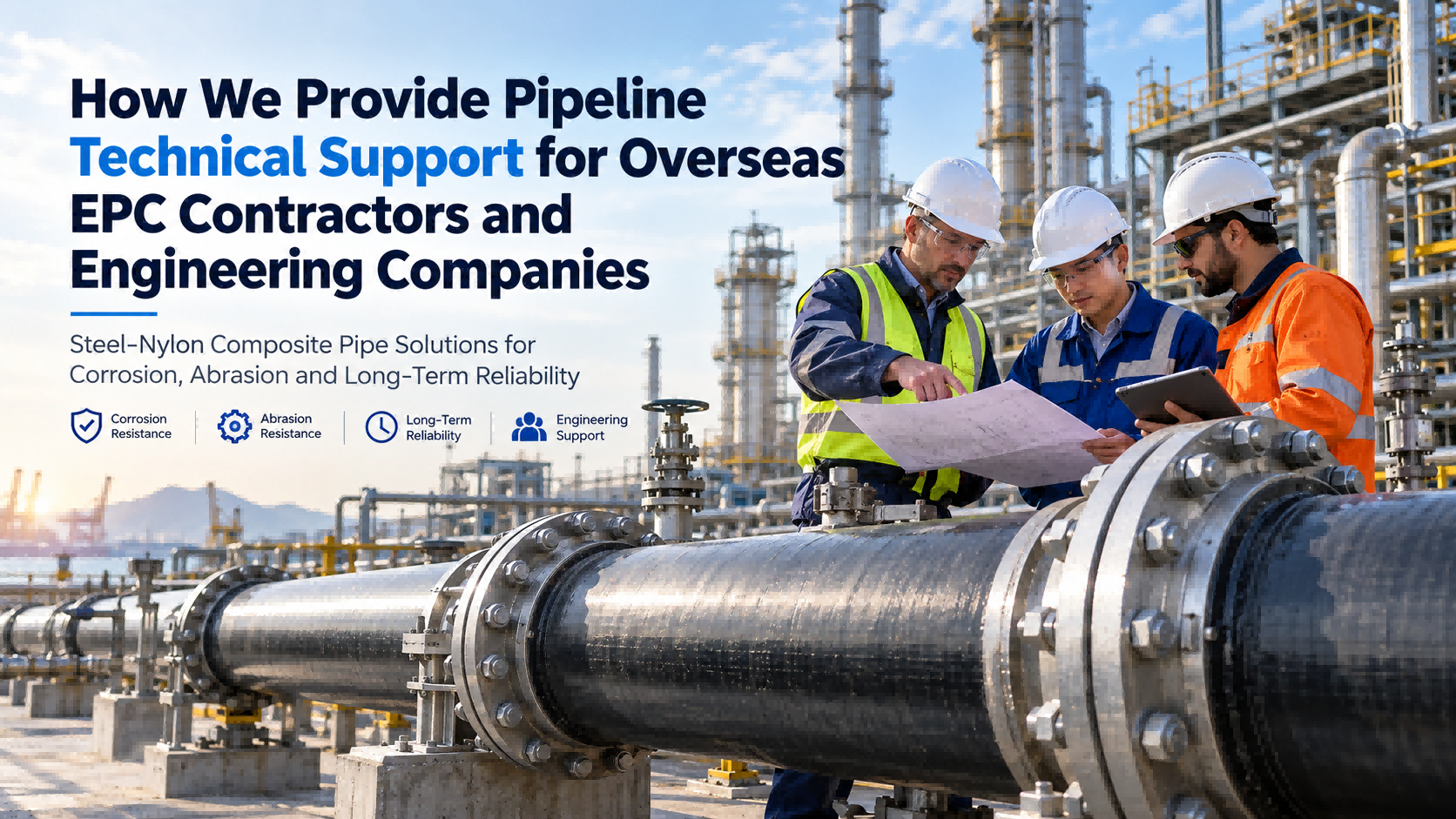
EPC Contractors and Engineering Companies
Organizations seeking dependable industrial pipe manufacturing partners and technical support for application-specific or customized piping requirements.
Industrial Equipment and Component Distributors
Businesses with established industrial customer relationships that are interested in adding industrial piping systems and related fittings to their product offerings.
Regional Market Development Partners
Teams with local industry knowledge, project development experience, and technical sales capabilities in oil and gas, chemical processing, mining, power generation, or water treatment.
We value partners who look beyond short-term pricing and recognize the importance of technical competence, project execution, customer trust, and sustainable market development.
12. Looking Ahead: From Pipe Distribution to Long-Term Industrial Piping Solution Partnerships
The industrial piping market is evolving toward greater attention to engineering suitability, operational reliability, and lifecycle economics.
For overseas distributors, this creates both new expectations and valuable business opportunities.
Successful industrial pipe distributors will increasingly need to do more than provide quotations for different materials.
They will need to understand industrial operating conditions, recognize customer problems, communicate technical solutions, and support project decisions.
Steel-nylon composite pipes offer a differentiated product option for suitable applications through their combination of mechanical support, corrosion resistance, abrasion resistance, and engineered structural design.
Meanwhile, continued technical assistance, engineering collaboration, quality management, and manufacturing flexibility can help distributors develop local markets more effectively.
We believe that successful international distribution partnerships are built not only on competitive products, but also on continuous technical cooperation, shared resources, mutual trust, and long-term growth.
By combining our industrial pipe manufacturing experience with the local market knowledge of international partners, we aim to deliver reliable, economical, and application-appropriate piping solutions to more industrial customers worldwide.
Partner With Us to Develop Your Industrial Piping Market
Looking for a Reliable Steel-Nylon Composite Pipe Manufacturer?
If you are looking for a professional steel-nylon composite pipe manufacturer to support your business development in chemical processing, oil and gas, mining, power generation, or water treatment, we welcome the opportunity to discuss potential cooperation.
We are interested in exploring opportunities involving:
-
Industrial pipe distribution
-
Engineering and technical support
-
Customized piping solutions
-
Local market development
-
Project-based cooperation
-
Long-term international partnerships
Whether you are an established industrial pipe distributor or a new market participant seeking to expand into corrosion-resistant and wear-resistant piping solutions, we would be pleased to learn more about your market and project requirements.
Contact Us to Explore Distribution and Partnership Opportunities.
Let's work together to develop international industrial piping markets and create long-term value through specialized products, professional engineering support, and reliable cooperation.
Global Partnership Program: Developing Industrial Pipeline Markets Together
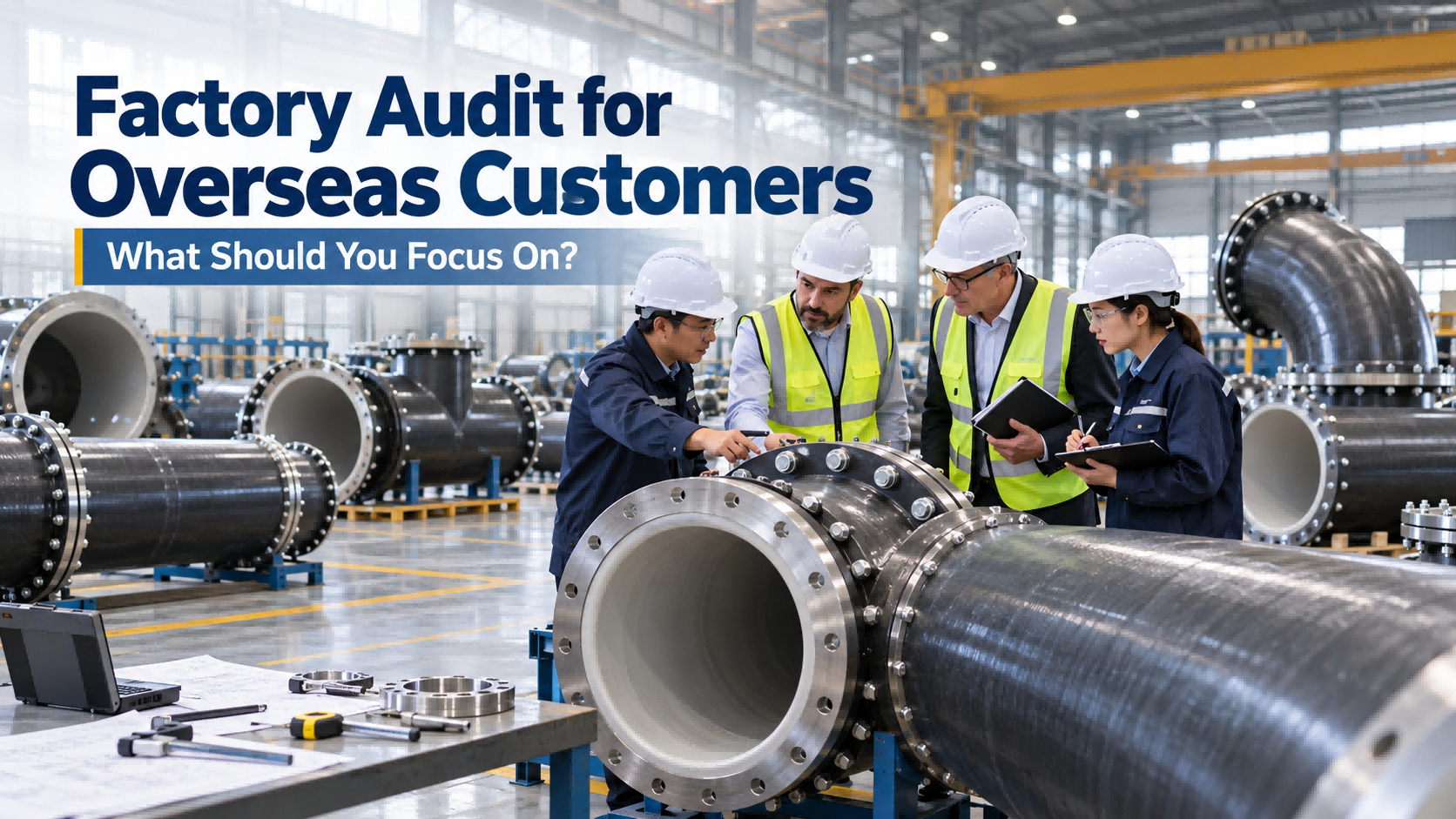
Welcome Overseas Customers for Factory Audits: What Should You Focus On?