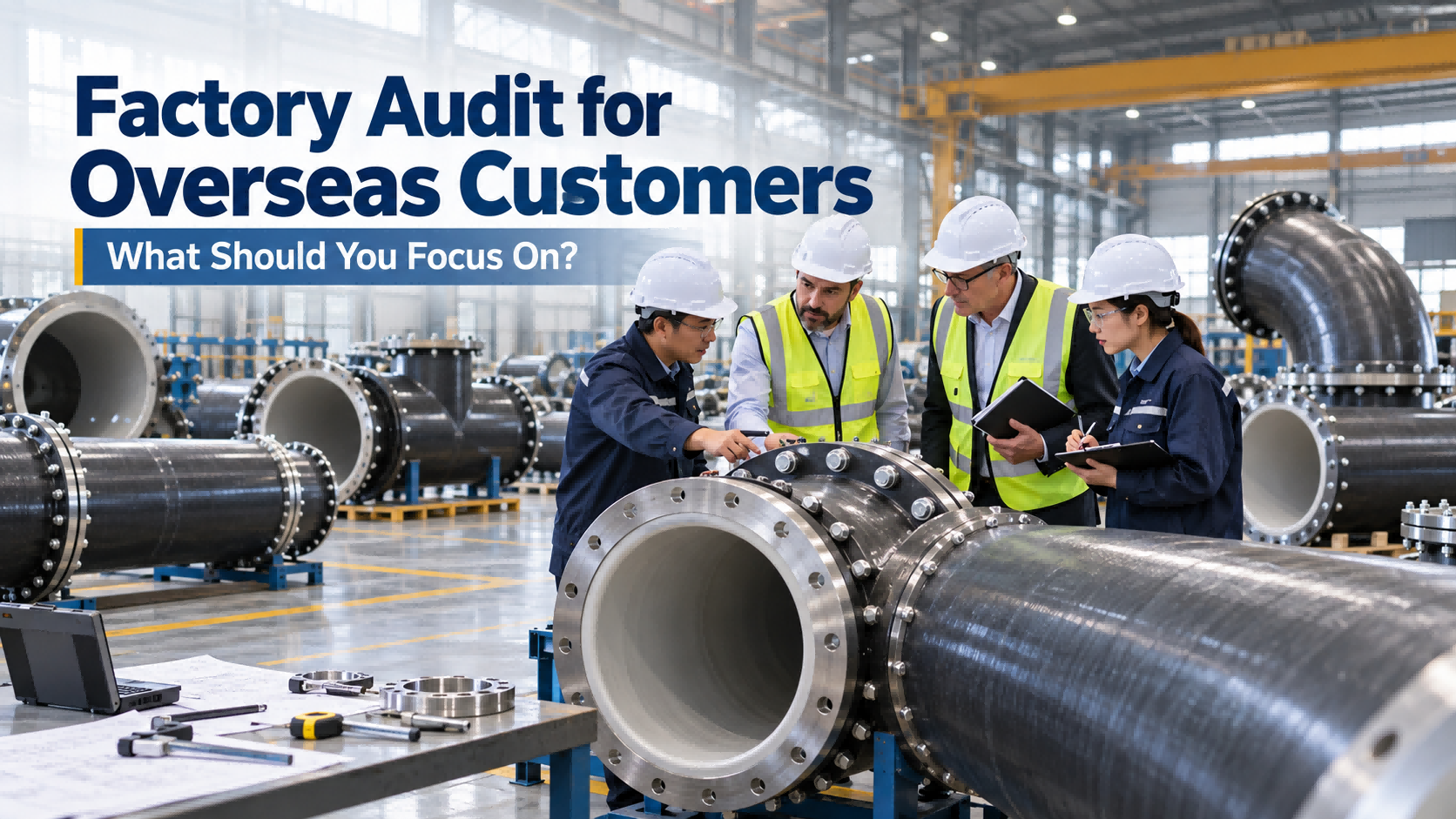
Welcome Overseas Customers for Factory Audits: What Should You Focus On?
For industrial pipeline projects, supplier selection should never be based solely on a quotation, a product catalog, or a few technical specifications.
This is especially true in demanding applications such as mining, chemical processing, oil and gas, power generation, salt chemicals, seawater transportation, and industrial wastewater systems, where pipelines may be continuously exposed to corrosion, abrasion, pressure, temperature fluctuations, particle erosion, and long-term operation.
Once a pipeline suffers from leakage, wear-through, connection failure, or inconsistent product quality, the resulting losses can far exceed the initial cost of the pipe itself.
For overseas EPC companies, engineering contractors, industrial operators, and large distributors, a factory audit is therefore an important step in evaluating the real capabilities of an industrial pipe manufacturer.
We warmly welcome overseas customers to visit our manufacturing facility for on-site audits.
A reliable industrial pipe manufacturer should not be afraid to show customers how its products are made. On the contrary, its manufacturing system, quality control, testing capabilities, engineering experience, and delivery capacity should all be important factors in supplier evaluation.
So, when overseas customers audit a steel-nylon composite pipe factory, what should they focus on?
1. The Real Purpose of a Factory Audit: Verify Consistent Manufacturing Capability
When visiting a factory for the first time, purchasing teams often naturally look at questions such as:
-
How large is the factory?
-
How many employees are there?
-
How many production machines are installed?
-
How much finished product is stored in the warehouse?
These factors are useful, but they are not the most important ones.
For industrial pipeline projects, the more important question is:
Can this factory consistently, reliably, and traceably manufacture products that meet the project requirements?
Producing one qualified pipe is not particularly difficult.
The real challenge is whether:
-
100 pipes can maintain consistent quality;
-
1,000 meters of pipeline can maintain consistent dimensions and structure;
-
different production batches remain consistent;
-
large-diameter pipes maintain dimensional and structural stability;
-
elbows, tees, flanges, reducers, and other fittings can form a complete piping system.
Therefore, during a factory audit, customers should evaluate the complete manufacturing system rather than simply inspect a few display samples.
2. First Priority: Raw Material Control
The quality of every industrial pipeline begins with its raw materials.
For steel-nylon composite pipes, particular attention should be paid to two key components:
the steel structural material and the nylon functional layer material.
Customers should examine the following areas.
2.1 Are Clear Raw Material Standards Established?
A mature industrial pipe manufacturer should have clearly defined purchasing and inspection requirements for raw materials, including:
-
Material grades;
-
Chemical composition;
-
Mechanical properties;
-
Dimensional requirements;
-
Batch information;
-
Supplier management;
-
Material quality certificates.
The important question is not simply whether the manufacturer can provide a material certificate.
The real question is:
Are raw materials genuinely integrated into the manufacturer's quality management system?
2.2 Are Incoming Materials Inspected?
Relying solely on documentation supplied by upstream material suppliers is not enough.
Customers should check whether the manufacturer has established an:
Incoming Material Inspection process
covering areas such as raw material appearance, dimensions, specifications, and relevant material characteristics.
For industrial pipelines, reliability begins with quality control at the very first stage of production.
2.3 Is There a Batch Traceability System?
Material traceability is especially important for large industrial projects.
Ideally, the manufacturer should be able to establish a traceability chain such as:
Raw Material Batch
↓
Production Batch
↓
Inspection Record
↓
Finished Product
↓
Project Delivery
In other words, an individual pipe delivered to the project should be traceable back to its production batch and relevant quality records.
This capability is particularly valuable for international engineering projects.
3. Second Priority: Observe the Actual Production Process, Not Just Finished Products
One of the most valuable parts of a factory audit is not the presentation in the meeting room.
It is the production floor.
Overseas customers should, whenever possible, follow the actual manufacturing flow:
Raw Materials → Manufacturing → Forming → Composite Processing → Machining → Inspection → Packaging → Shipment
For steel-nylon composite pipes, customers should pay particular attention to how a stable composite structure is produced.
4. Why Is the Manufacturing Process Especially Important for Steel-Nylon Composite Pipes?
The fundamental design concept of a steel-nylon composite pipe is to allow different materials to perform the functions they are best suited for.
In simplified terms:
The steel structure provides strength and pressure resistance, while the nylon layer provides corrosion and abrasion resistance.
Compared with single-material piping systems, this combination can provide a more balanced performance profile in many demanding industrial applications.
Typical applications include:
-
Highly abrasive slurry;
-
Tailings;
-
High-salinity water;
-
Industrial wastewater;
-
Salt chemical process fluids;
-
Corrosive liquids;
-
Circulating water;
-
Certain acidic and alkaline media;
-
Particle-containing slurries.
Traditional metallic pipes may face corrosion problems, while conventional non-metallic pipes may encounter limitations related to pressure, mechanical strength, or engineering connections in certain applications.
The purpose of the steel-nylon composite structure is to address multiple challenges simultaneously:
Strength + Corrosion Resistance + Abrasion Resistance
However, whether these advantages can actually be achieved depends heavily on manufacturing quality.
For this reason, customers auditing a factory should carefully observe the production process rather than relying only on technical specifications.
5. Third Priority: Steel Structural Manufacturing Quality
The steel structure is an important load-bearing component of a steel-nylon composite pipe.
During a factory audit, customers should examine the following areas.
Pipe Body Structure
Key items include:
-
Pipe dimensions;
-
Wall thickness;
-
Roundness;
-
Straightness;
-
Surface condition;
-
Welding quality;
-
Structural integrity.
These factors become even more important for large-diameter or higher-pressure pipelines.
Flange Structure
Flanged connections are one of the most important connection methods used in industrial piping systems.
Many pipeline failures do not occur in straight pipe sections but instead around:
-
Flanges;
-
Joints;
-
Elbows;
-
Tees;
-
Pump outlets;
-
Valve connection points.
Customers should therefore closely examine:
-
Flange structure;
-
Bolt-hole dimensions;
-
Sealing surfaces;
-
Integration between the flange and pipe body;
-
Dimensional consistency for installation.
A reliable industrial piping design must consider not only the pipe itself but also the integrity of the complete piping system.
6. Fourth Priority: Nylon Functional Layer Quality
One of the most important features distinguishing steel-nylon composite pipes from conventional steel pipes is the nylon functional layer.
During a factory audit, overseas customers may want to understand:
-
Nylon material properties;
-
Forming processes;
-
Thickness control;
-
Internal surface quality;
-
Stability of the composite structure;
-
Pipe-end treatment;
-
Flange-area construction.
Internal surface quality is particularly important in abrasive slurry applications.
During slurry transportation, particles continuously rub against and impact the inner wall of the pipe.
If the internal surface contains defects, inconsistent structures, or locally weak areas, these locations may become preferential wear points during long-term operation.
Therefore:
Abrasion resistance depends not only on material selection but also on manufacturing consistency.
7. Fifth Priority: Is the Composite Structure Stable?
For any composite piping system, one of the most fundamental questions is:
How are the different materials combined into a stable, long-term composite structure?
During an audit, overseas customers should ask:
-
How is the composite structure formed?
-
How is interface stability controlled?
-
Are there defined manufacturing process standards?
-
How is the risk of separation or localized failure minimized?
-
How are pipe ends and flange areas designed and manufactured?
These questions can be more important than simply asking whether nylon itself is corrosion resistant.
What industrial projects really require is:
long-term reliability of the complete piping system.
8. Sixth Priority: Manufacturing Capability for Elbows, Tees, and Reducers
A complete industrial piping system requires far more than straight pipe.
It normally includes:
-
Elbows;
-
Tees;
-
Reducers;
-
Flanges;
-
Spools;
-
Special fittings.
These components are often exposed to more complicated flow conditions, stress distributions, and wear patterns than straight pipe sections.
Why Are Elbows Especially Important?
When slurry enters an elbow, its flow direction changes.
Solid particles may repeatedly impact the outer radius of the elbow, meaning that elbows can experience significantly more severe wear than straight pipe sections.
For this reason, a professional abrasion-resistant piping manufacturer should not be capable of producing only wear-resistant straight pipes.
It should also be capable of manufacturing:
a complete abrasion-resistant piping system.
When auditing a factory, overseas customers should therefore determine:
Can the manufacturer produce a complete steel-nylon composite piping system, or does it simply purchase fittings from third parties?
9. Seventh Priority: Large-Diameter Manufacturing Capability
As mining, chemical, power, water treatment, and infrastructure projects continue to increase in scale, demand for large-diameter industrial piping is also growing.
However, as pipe diameter increases, manufacturing difficulty increases significantly.
Large-diameter pipes often involve greater challenges in:
-
Roundness control;
-
Dimensional accuracy;
-
Uniformity of the composite structure;
-
Flange dimensional control;
-
Handling and lifting;
-
Transportation;
-
Inspection.
Therefore, if a project requires:
DN500, DN800, DN1000, or even larger diameters,
customers should not simply ask:
“Can you produce this diameter?”
A more meaningful question is:
“Can you show us your actual manufacturing process and completed projects for this diameter?”
In other words, customers should verify actual manufacturing experience rather than accepting a simple statement of capability.
10. Eighth Priority: Quality Inspection System
Real manufacturing capability must be supported by inspection and verification.
Quality control should therefore be one of the most important parts of a factory audit.
Customers should examine whether the manufacturer has established processes for:
-
Raw material inspection;
-
In-process inspection;
-
Dimensional inspection;
-
Visual inspection;
-
Final product inspection;
-
Pressure-related testing;
-
Final inspection records.
Why Is In-Process Inspection So Important?
Many customers focus primarily on final inspection reports.
However:
Final Inspection cannot replace Process Control.
Some manufacturing defects are difficult or impossible to correct once the finished product has already been completed.
A mature manufacturing system should follow the principle:
Quality is built into the manufacturing process.
rather than:
Quality is inspected only after manufacturing.
The difference between these two approaches can reveal a great deal about the maturity of a manufacturer's quality management system.
11. Ninth Priority: Pressure Testing Capability
For pressurized transportation systems, pressure testing is an important factory-audit item.
Overseas customers may want to understand:
-
What pressure-testing equipment is available?
-
How is the test pressure determined?
-
How are test procedures recorded?
-
How are different pipe sizes tested?
-
Are testing records retained?
Corrosion resistance and abrasion resistance are extremely important for industrial pipelines, but the system must also meet the pressure requirements of the actual project.
Therefore:
Corrosion resistance, abrasion resistance, and pressure capability must all be considered together.
This is one of the important engineering considerations behind steel-nylon composite piping systems.
12. Tenth Priority: Product Dimensional Consistency
Industrial projects may involve:
hundreds of pipes, thousands of meters of pipeline, or even significantly longer transportation systems.
If dimensional variations between batches are excessive, field installation may encounter problems such as:
-
Flanges failing to align correctly;
-
Abnormal installation gaps;
-
Bolt holes failing to match;
-
Difficult valve connections;
-
Reduced installation efficiency.
Customers should therefore pay close attention to:
Dimensional Consistency
This is often an important indicator of process maturity and manufacturing stability.
13. Eleventh Priority: Real Project References, Not Just Product Samples
During a factory audit, we strongly recommend asking:
Where are these products actually operating?
For industrial piping systems, long-term field experience can often be as important as laboratory data.
Customers should particularly examine projects with operating conditions similar to their own.
For example:
Mining
-
Iron ore slurry;
-
Copper slurry;
-
Tailings;
-
Mine backfilling;
-
High-solids slurry.
Chemical Industry
-
Salt chemicals;
-
Chlor-alkali;
-
Soda ash;
-
Corrosive industrial wastewater;
-
Acidic and alkaline media.
Oil & Gas
-
High-salinity produced water;
-
Water injection systems;
-
Oilfield gathering systems.
Power Generation
-
Circulating water;
-
Flue gas desulfurization systems;
-
Industrial wastewater.
The most valuable question is not:
“How many customers do you have?”
Instead, ask:
“Do you have projects with similar media, pressure, temperature, diameter, and abrasion conditions to ours?”
14. Twelfth Priority: Does the Supplier Truly Understand Engineering Selection?
Industrial pipes are not ordinary standardized consumer products.
The same pipe can perform very differently under different operating conditions.
For example, two projects may both be described as “copper slurry transportation,” but their actual operating parameters may be completely different.
They may differ in:
-
Solids concentration;
-
Particle size;
-
Flow velocity;
-
Pipe diameter;
-
Pressure;
-
Transportation distance;
-
Number of elbows.
A professional industrial pipe manufacturer should therefore not immediately issue a quotation after receiving only a description such as:
“Copper Slurry Pipeline.”
Instead, the supplier should ask for detailed operating conditions.
What Parameters Should Be Evaluated?
For demanding industrial applications, key parameters generally include:
Medium
Pressure
Temperature
Diameter
Flow Velocity
Solid Content
Particle Size
Corrosive Components
Installation Environment
Expected Service Life
In other words:
-
Medium;
-
Pressure;
-
Temperature;
-
Diameter;
-
Flow velocity;
-
Solids content;
-
Particle size;
-
Corrosive components;
-
Installation environment;
-
Expected service life.
Together, these parameters influence material selection and structural design.
During a factory audit, overseas customers should therefore communicate directly with the supplier's engineering team.
This is one of the most effective ways to determine:
Is the supplier simply a pipe seller, or is it an engineering-oriented manufacturer that truly understands industrial operating conditions?
15. Thirteenth Priority: Custom Engineering Capability
Many international industrial projects are not fully standardized.
Typical field requirements may include:
-
Special lengths;
-
Special flanges;
-
Special pressure classes;
-
Non-standard diameters;
-
Special connection methods;
-
Reducer configurations;
-
Non-standard elbows;
-
Restricted installation spaces.
Therefore, a manufacturer's:
Custom Engineering Capability
can be extremely important.
For steel-nylon composite piping systems, valuable manufacturing capability means more than producing standard pipe sizes.
The supplier should be able to evaluate:
Medium + Pressure + Temperature + Wear + Installation Conditions
and recommend an appropriate piping solution accordingly.
16. Fourteenth Priority: Production Capacity and Delivery Capability
For large-scale projects, technical qualification alone is not enough.
If the supplier cannot deliver on schedule, the entire construction schedule may be affected.
Overseas customers should therefore also examine:
-
Monthly production capacity;
-
Large-diameter production capacity;
-
Ability to handle multiple projects simultaneously;
-
Raw material availability;
-
Production planning systems;
-
Finished-product storage areas;
-
Packaging capabilities;
-
Container-loading experience.
For EPC projects in particular:
Delivery Reliability
can be just as important as product quality.
17. Fifteenth Priority: Export Packaging and International Shipping Experience
Industrial pipe transportation is very different from ordinary product shipping.
This is particularly true for:
-
Large-diameter pipes;
-
Flanged pipes;
-
Elbows;
-
Tees;
-
Custom fittings.
Improper packaging can result in:
-
Flange damage;
-
Surface damage;
-
Pipe-end damage;
-
Product deformation during long-distance transportation.
During a factory audit, customers should therefore inspect the:
Export Packing Area
and understand:
-
How flanges are protected;
-
How large-diameter products are secured;
-
How containers are loaded;
-
How transportation damage is minimized;
-
Whether the manufacturer has experience with international project shipments.
18. Sixteenth Priority: Technical Documentation Capability
International engineering projects require more than physical products.
They also require complete technical documentation.
Overseas customers may require documents such as:
-
Product Datasheets;
-
Technical Specifications;
-
Inspection Reports;
-
Material Certificates;
-
Packing Lists;
-
Drawings;
-
Installation Guidelines;
-
Project Documentation.
For EPC projects:
Documentation Capability
is also an important part of supplier qualification.
19. Seventeenth Priority: Pre-Sales and After-Sales Technical Support
A complete industrial pipeline project generally follows a process such as:
Inquiry
→ Technical Discussion
→ Material Selection
→ Quotation
→ Drawing
→ Production
→ Inspection
→ Delivery
→ Installation
→ Operation
The value of a qualified supplier should not end when the products leave the factory.
During a factory audit, customers may want to determine:
-
Is there a dedicated engineering team?
-
Can the supplier assist with early-stage material selection?
-
Can installation guidance be provided?
-
How quickly can the supplier respond when project issues arise?
-
Can the supplier analyze actual operating conditions?
For overseas projects, these capabilities are particularly important.
20. Why Do We Welcome Overseas Customers to Audit Our Factory?
We believe industrial pipeline cooperation should not be built on marketing claims alone.
It should be built on:
Manufacturing + Engineering + Quality + Experience
In other words:
Manufacturing Capability + Engineering Capability + Quality Management + Project Experience
Steel-nylon composite pipe is not a product whose quality can be fully evaluated simply by looking at its appearance.
Its long-term performance depends on:
-
Materials;
-
Structural design;
-
Manufacturing processes;
-
Inspection;
-
Operating-condition compatibility;
-
Installation;
-
Long-term operating environment.
That is why we welcome customers to visit our factory in person.
See the equipment.
Inspect the raw materials.
Observe the manufacturing process.
Review the testing procedures.
Examine the finished pipes.
Inspect large-diameter products.
Look at the flanges.
Examine the fittings.
Review the project records.
Then decide:
Is this a supplier you can trust for your project?
21. What Problems Are Steel-Nylon Composite Pipes Designed to Solve?
When some industrial customers first hear about steel-nylon composite pipes, they may think of them simply as:
“A steel pipe with a nylon layer inside.”
But this description does not fully explain the engineering value of the product.
The real purpose of a steel-nylon composite pipe is to address a long-standing material challenge in industrial piping systems.
Metallic Piping
Advantages include:
-
High mechanical strength;
-
Strong pressure-bearing capability;
-
Mature engineering connection methods.
However, in certain demanding media, metallic piping may face:
-
Corrosion;
-
Pitting;
-
Abrasion;
-
Increasing maintenance requirements.
Conventional Non-Metallic Piping
Non-metallic pipes often provide good corrosion resistance.
However, in some demanding industrial applications, engineers may also need to consider:
-
Mechanical strength;
-
Pressure;
-
Temperature;
-
Large diameters;
-
Engineering connections;
-
Complex support conditions.
Steel-Nylon Composite Piping
The design philosophy is to allow the steel structure to provide:
Structural Strength
while allowing the nylon functional layer to provide:
Corrosion Resistance + Abrasion Resistance
The result is a combination of:
Strength + Corrosion Resistance + Wear Resistance
This material combination can be particularly valuable in industrial transportation systems where corrosion and abrasion challenges occur simultaneously.
22. The Real Comparison Is Not Pipe Price, but Total Lifecycle Cost
After a factory audit, many customers eventually return to one fundamental question:
Price.
Price is certainly important.
However, for industrial piping systems, a more meaningful comparison should focus on:
Total Cost of Ownership (TCO)
A simplified TCO model can be expressed as:
TCO = Initial Cost + Installation + Maintenance + Replacement + Downtime Loss
In other words:
**Initial purchasing cost
-
Installation cost
-
Maintenance cost
-
Replacement cost
-
Downtime losses**
If a lower-priced piping system requires frequent:
-
Repairs;
-
Leak maintenance;
-
Replacement;
-
Production shutdowns;
-
Site cleanup;
its true long-term cost may become significantly higher.
For this reason, an increasing number of industrial companies are shifting their focus from:
Lowest Purchase Price
to:
Lowest Lifecycle Cost
This approach is particularly important in continuously operating industries such as mining, chemicals, oil and gas, and power generation.
23. What Should an Effective Factory Audit Ultimately Answer?
At the end of a comprehensive factory audit, customers should be able to answer the following questions:
-
Does this company genuinely possess manufacturing capability?
-
Are raw materials effectively controlled?
-
Is the production process stable?
-
Is there a complete quality-control system?
-
Are products traceable?
-
Does the manufacturer have pressure-testing and quality-inspection capabilities?
-
Can it manufacture large-diameter pipes?
-
Can it manufacture elbows, tees, reducers, and custom fittings?
-
Does it have engineering design and material-selection capabilities?
-
Does it have experience with similar operating conditions?
-
Can it reliably deliver large project orders?
-
Does it have export packaging and international shipping experience?
-
Can it provide complete technical documentation?
-
Can it provide long-term engineering support?
If these questions can be answered clearly and confidently, the foundation for cooperation between the customer and supplier becomes much stronger.
Conclusion: A Factory Audit Is Not Just a Factory Tour—It Is a Supply Chain Risk Assessment
For ordinary products, supplier selection may focus primarily on:
Price + Delivery
But for demanding industrial piping systems, customers should evaluate:
**Material
-
Engineering
-
Manufacturing
-
Quality
-
Experience
-
Service Life
-
Lifecycle Cost**
Industrial pipelines are not simply purchasing items.
They are long-term operating assets.
In highly corrosive, highly abrasive, high-salinity, pressurized, or continuously operating environments, an incorrect material decision may lead to years of repeated maintenance and unnecessary operating costs.
That is why we welcome overseas customers to visit our factory and communicate directly with our engineering and manufacturing teams.
Customers are encouraged to bring actual project parameters, including:
Medium, pressure, temperature, pipe diameter, flow rate, solids content, particle size, transportation distance, and existing pipeline problems.
Based on real operating conditions, we can discuss together:
What type of piping solution can reduce operating risk and total lifecycle cost over the next 5, 10, or even more years?
For industrial projects that truly value long-term reliability:
A factory audit is not only about checking a supplier.
It is about verifying whether your future pipeline system is being built on a reliable manufacturing foundation.
How We Support Overseas Distributors in Developing Industrial Pipe Markets
Why Pre-Sales Engineering Communication Matters More Than a Simple Quotation