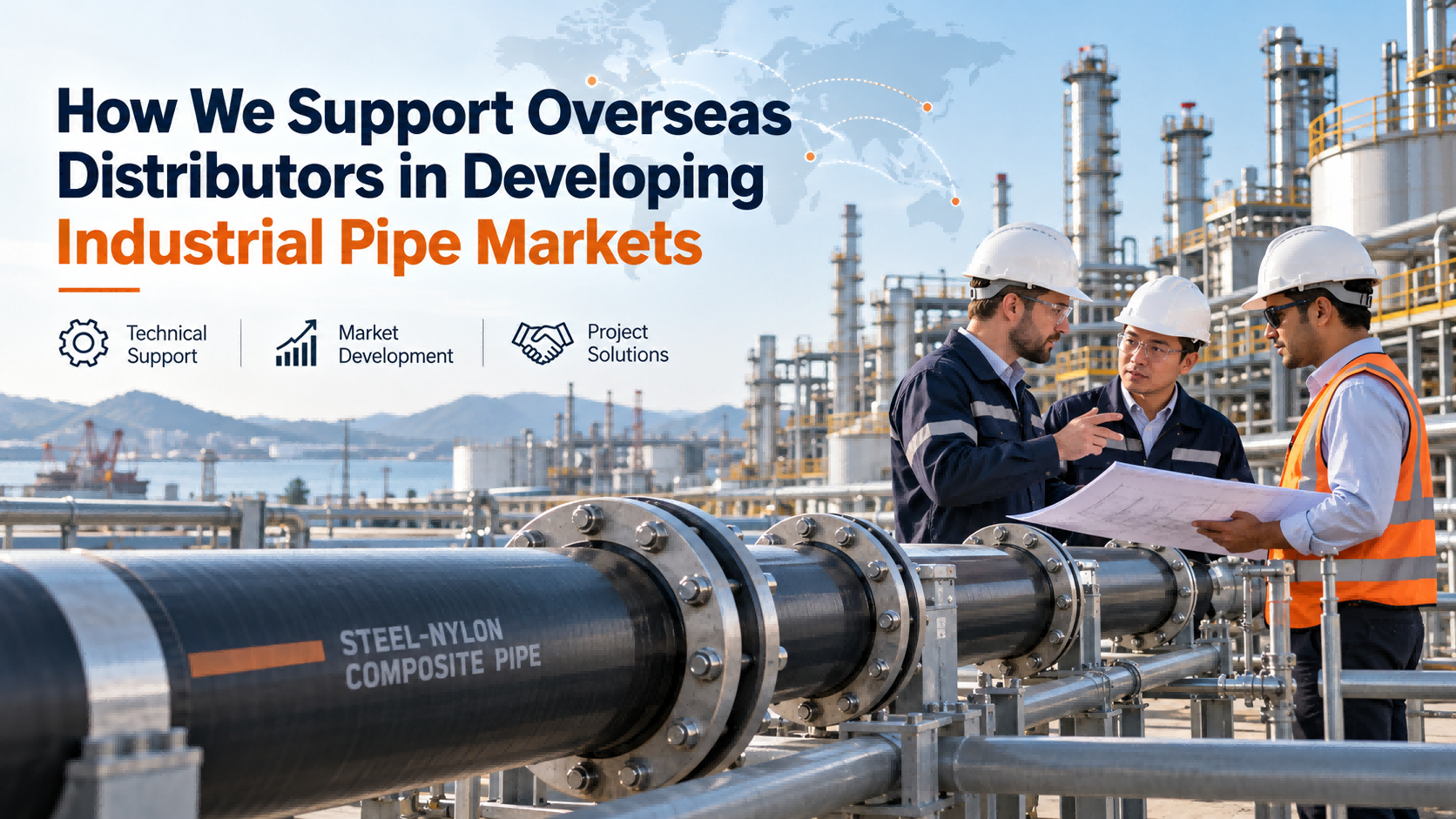
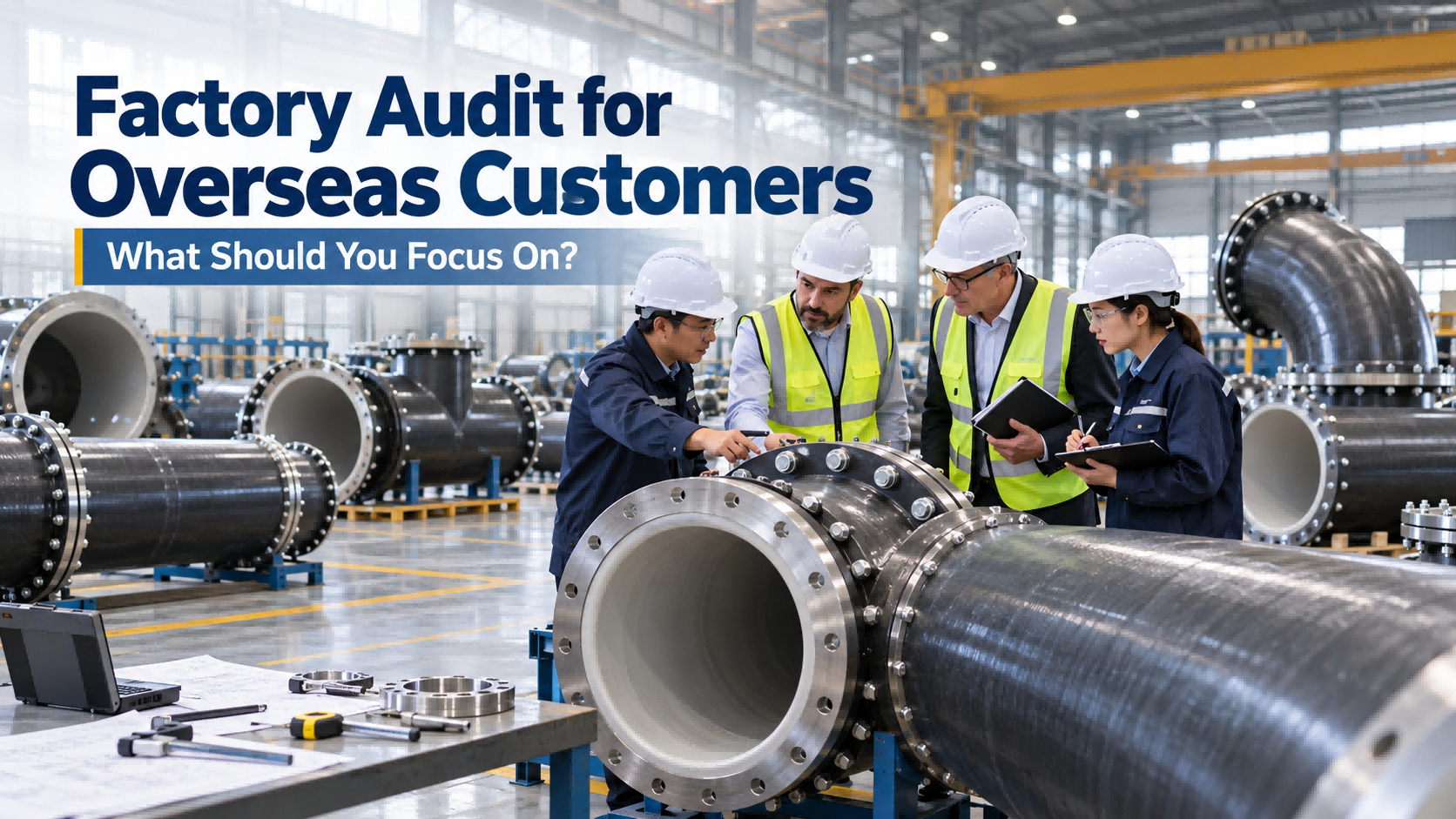
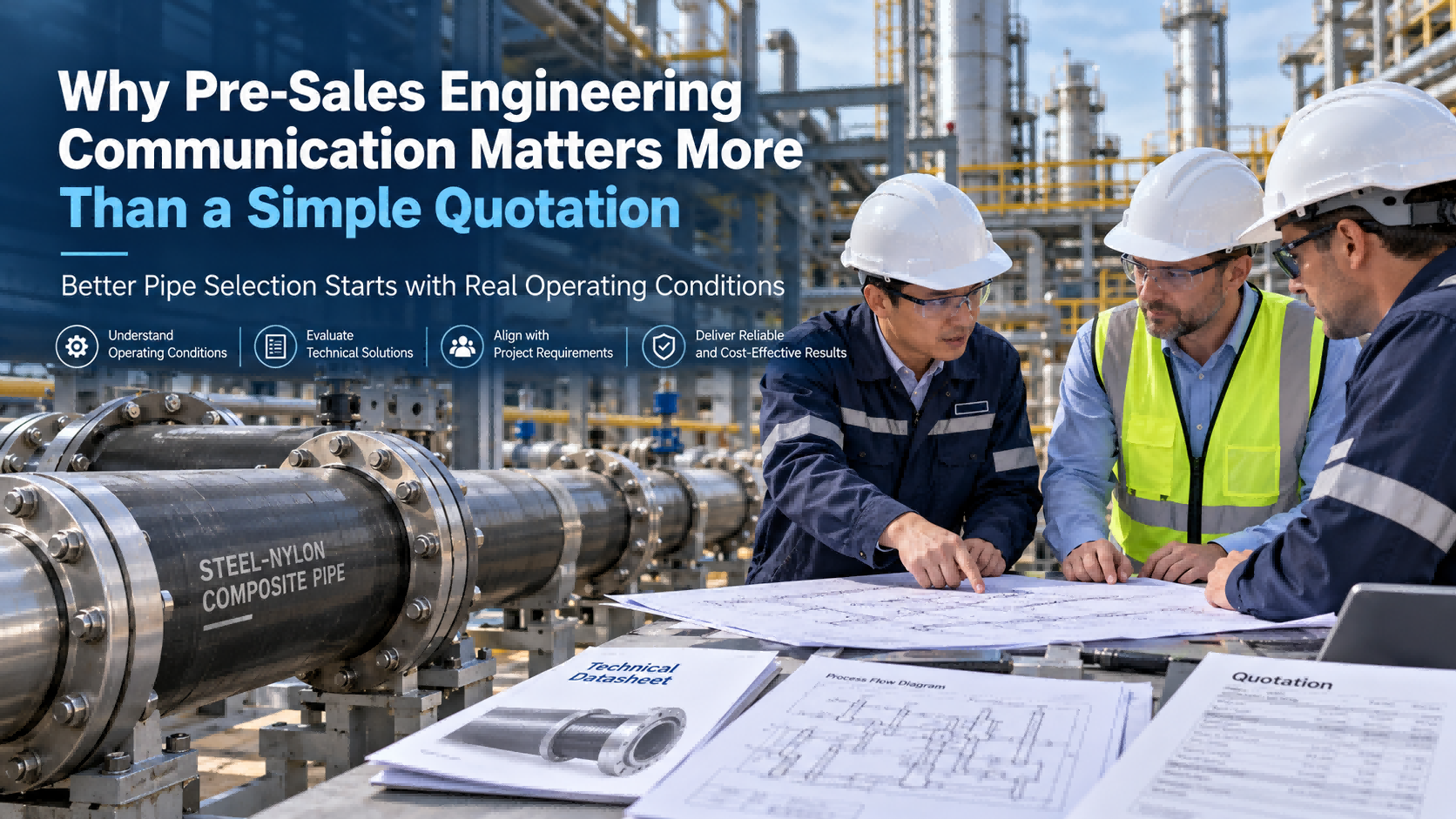
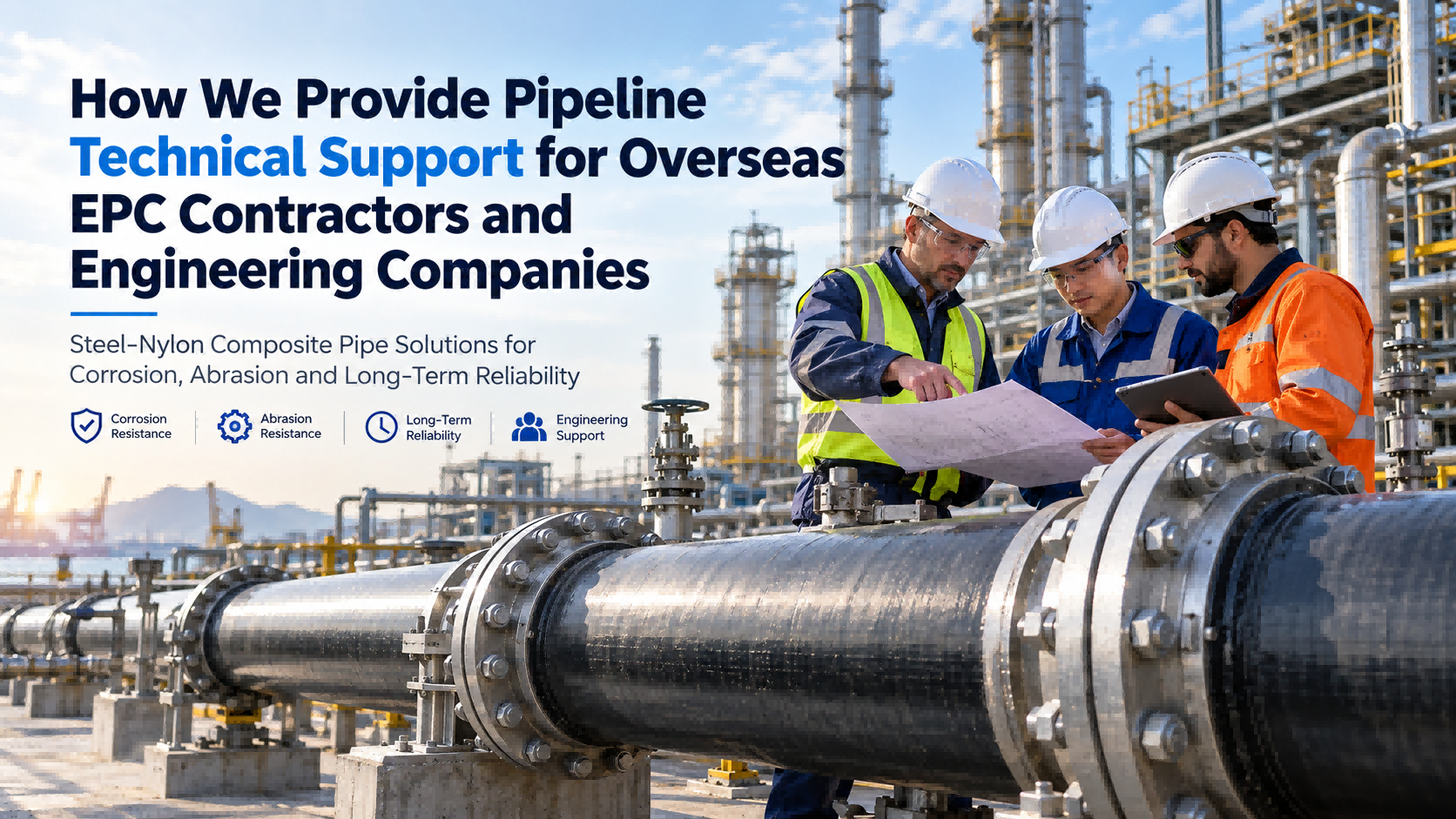
How We Provide Pipeline Technical Support for Overseas EPC Contractors and Engineering Companies
In large-scale chemical, mining, oil & gas, power generation, water treatment, and seawater desalination projects, pipeline procurement is rarely as simple as:
Inquiry → Quotation → Purchase Order.
For overseas EPC contractors and engineering companies, a reliable industrial pipeline supplier must be capable of doing much more than manufacturing pipes according to a specification.
More importantly, the supplier should be able to provide continuous technical support throughout multiple stages of the project, including:
-
Preliminary material selection
-
Engineering design support
-
Technical clarification
-
Material confirmation
-
Manufacturing
-
Quality inspection
-
Installation guidance
-
Long-term operation support
This is particularly important in pipeline systems transporting corrosive, abrasive, high-salinity, high-solids, or chemically complex media.
If the wrong pipeline material is selected, even a relatively low initial procurement cost can eventually lead to much higher expenses caused by leakage, corrosion perforation, abrasive wear, frequent replacement, maintenance, and unplanned shutdowns.
For overseas EPC projects, therefore, an ideal pipeline supplier should evolve from being simply a product manufacturer into a:
Pipeline Solution Partner.
As a manufacturer of steel-nylon composite pipes, our focus in industrial projects is not simply on selling a certain type of pipe.
Instead, we focus on a broader engineering question:
Under the customer's actual medium, temperature, pressure, velocity, pipe diameter, abrasion conditions, and operating environment, how can we help build a safer, more reliable, and lower-maintenance pipeline system?
This is the core philosophy behind the technical support we provide to overseas EPC contractors and engineering companies.
1. Why Do Overseas EPC Projects Require More Technical Support Than Standard Pipeline Procurement?
Industrial pipeline projects usually involve many different stakeholders, including:
-
Project owners
-
EPC contractors
-
Engineering companies
-
Process engineers
-
Piping engineers
-
Material engineers
-
Procurement teams
-
QA/QC teams
-
Construction contractors
-
Pipeline suppliers
Each group looks at the pipeline system from a different perspective.
Process engineers focus on the medium and flow rate.
Material engineers focus on corrosion and material compatibility.
Piping engineers focus on pressure, temperature, wall structure, dimensions, and connection methods.
Procurement teams focus on cost, delivery schedules, and supply capability.
Construction teams focus on installation efficiency.
The project owner ultimately cares about one fundamental question:
Can the pipeline system operate reliably for 10 years or even longer?
Therefore, if a supplier provides only a basic product quotation, it is difficult to solve the real material-selection challenges of an EPC project.
Professional industrial pipeline technical support should cover the entire project lifecycle.
2. Stage One: Supporting Pipeline Material Selection During the Early Project Phase
Many pipeline problems are actually determined during the earliest stages of a project.
For example, two systems may both be described as transporting "industrial wastewater," but their actual operating conditions can be completely different.
The differences may include:
-
pH
-
Chloride concentration
-
Solids content
-
Operating temperature
-
Pipeline pressure
-
Flow velocity
-
Abrasion conditions
-
Frequency of startup and shutdown
-
Outdoor exposure
-
Coastal salt-spray environment
Therefore, knowing only that the medium is "industrial wastewater" is not enough for proper material selection.
We generally recommend that EPC engineers identify at least the following parameters before selecting a pipeline material.
2.1 Transported Medium
Typical media may include:
-
NaOH
-
NaCl
-
HCl
-
H₂SO₄
-
Phosphoric acid
-
Brine
-
Seawater
-
Slurry
-
Tailings
-
Industrial wastewater
-
High-salinity produced water
Pipeline material selection should always begin with chemical compatibility.
2.2 Medium Concentration
The same chemical medium can behave very differently at different concentrations.
Therefore, engineers should not simply ask:
Is this material acid-resistant?
A more meaningful engineering question is:
Can this material operate reliably at the specified concentration and temperature for an extended period?
This distinction is critical in industrial pipeline design.
2.3 Operating Temperature
Temperature is one of the most underestimated factors in pipeline material selection.
As temperature increases:
-
Chemical reaction rates may accelerate
-
Corrosion rates may increase
-
The mechanical properties of polymer materials may change
-
Long-term pressure performance may be affected
Temperature must therefore be evaluated together with the medium and pressure rather than considered independently.
2.4 Operating Pressure and Design Pressure
Industrial pipeline design should distinguish between:
-
Normal Operating Pressure
-
Maximum Operating Pressure
-
Design Pressure
-
Test Pressure
For pressurized pipeline systems, selecting a pipe based only on average operating pressure is insufficient.
Engineers may also need to consider:
-
Pump startup pressure
-
Temporary pressure fluctuations
-
Water hammer
-
Static pressure caused by elevation differences
-
Pressure surges caused by rapid valve closure
Our steel-nylon composite pipes can be engineered for different pressure requirements according to project conditions, with typical industrial applications covering approximately 1.0–4.0 MPa pressure classes.
2.5 Flow Velocity
Flow velocity directly affects:
-
Pressure loss
-
Internal wall wear
-
Particle erosion
-
Pump energy consumption
In slurry, tailings, brine mud, and other solid-liquid transportation systems, velocity can have a direct impact on pipeline service life.
2.6 Solids Content
For applications involving:
-
Iron Ore Slurry
-
Copper Slurry
-
Tailings
-
Mine Backfill
-
Brine Mud
-
FGD Slurry
pipeline material selection cannot focus only on corrosion resistance.
It must consider two mechanisms simultaneously:
Corrosion + Abrasion
This is precisely where many traditional pipeline materials encounter difficulties.
3. Why Can Steel-Nylon Composite Pipe Be Suitable for Complex Industrial Media?
Traditional industrial pipeline materials usually involve significant performance trade-offs.
Carbon steel provides excellent structural strength, but it can experience serious corrosion when transporting aggressive media.
Stainless steel offers better corrosion resistance in many environments, but high-chloride conditions can create risks such as pitting and crevice corrosion. Material costs can also be relatively high.
FRP provides good corrosion resistance, but high-pressure applications, impact loads, complex installation environments, and certain abrasive services may require more careful engineering.
HDPE is lightweight and corrosion-resistant, but higher temperatures, higher pressures, large diameters, structural stiffness requirements, and long-term pressure performance can impose limitations in some industrial systems.
For these reasons, many industrial projects are increasingly considering composite material strategies:
Instead of requiring one material to perform every function, different materials can be combined so that each contributes its strongest properties.
Steel-nylon composite pipe is based on this principle.
4. Steel Provides Mechanical and Structural Strength
The steel structure primarily provides:
-
Pressure-bearing capability
-
Mechanical strength
-
Installation load resistance
-
External impact resistance
-
Structural stability for large-diameter pipelines
This allows the pipeline to retain many of the mature structural characteristics associated with conventional steel piping systems.
5. Nylon Provides the Corrosion- and Wear-Resistant Working Layer
The nylon layer in contact with the transported medium is designed to:
-
Isolate corrosive media from the steel structure
-
Reduce metallic corrosion risks
-
Improve abrasion resistance
-
Provide favorable internal flow characteristics
The resulting structure combines:
Steel Strength + Nylon Corrosion Resistance + Wear Resistance
This combination can provide significant engineering value in applications where both corrosion and abrasion are present.
6. Stage Two: Supporting EPC Engineers During Technical Confirmation
Once a project enters the detailed engineering phase, EPC teams require much more than general product information.
Technical confirmation typically includes:
-
Pipe Size
-
Design Pressure
-
Operating Pressure
-
Design Temperature
-
Pipe Wall Structure
-
Flange Standard
-
Connection Type
-
Pipe Length
-
Fittings
-
Support Spacing
-
Installation Conditions
-
Testing Requirements
At this stage, the pipeline supplier must be capable of participating in multiple rounds of technical clarification with the engineering company.
This is one of the main differences between industrial project supply and ordinary product trading.
7. Providing Flange and Connection Designs According to Project Standards
Overseas engineering projects may involve different international or regional standards, including:
-
ASME
-
ASTM
-
ANSI
-
EN
-
DIN
-
ISO
-
GB
The applicable standard should be determined according to project specifications, engineering requirements, and local regulations.
For international projects, connection designs can be developed according to the customer's requirements for:
-
Flange Standard
-
Bolt Hole Arrangement
-
Pressure Class
-
Connection Requirements
One important feature of steel-nylon composite piping is that it can incorporate integrally formed flanges or customized connection structures according to project requirements.
For large industrial pipelines, reliable flange connections can help improve:
-
Installation consistency
-
Sealing reliability
-
Construction efficiency
-
Maintenance convenience
They can also reduce the need for complicated hot work at the installation site.
8. Stage Three: Supporting Customized Fittings for Complex Pipeline Layouts
Real industrial pipeline systems rarely consist only of straight pipes.
Projects usually require a large number of:
-
Elbows
-
Tees
-
Reducers
-
Flanged Spools
-
Branch Connections
-
Pump Connection Pipes
-
Valve Connection Pipes
-
Special Fittings
Many pipeline failures are concentrated in these areas.
For example, in slurry transportation systems, elbows often experience faster wear than straight pipe sections.
Pump discharge areas may be exposed to higher velocities and more severe turbulence.
Reducers can experience localized erosion because of changing flow patterns.
During technical support, therefore, we recommend that engineers evaluate these high-risk areas separately rather than automatically applying the same design throughout the entire pipeline.
For specific high-wear locations, a:
Localized Upgrade Strategy
can often be applied.
Typical upgrade areas include:
-
Elbows
-
Tees
-
Pump outlets
-
High-velocity sections
-
Frequently replaced pipe sections
This approach can improve overall system reliability without requiring the entire pipeline to be replaced or upgraded.
9. Stage Four: Supporting Material Substitution Studies
Many overseas EPC projects are not designed completely from scratch.
A traditional pipeline material may already have been specified, such as:
-
Carbon Steel
-
304 Stainless Steel
-
316L Stainless Steel
-
Duplex Stainless Steel
-
Rubber-Lined Steel
-
FRP
-
HDPE
However, EPC teams may be seeking:
-
Lower lifecycle cost
-
Better corrosion resistance
-
Better abrasion resistance
-
Reduced maintenance frequency
-
More competitive material cost
In such cases, material substitution should not be evaluated simply by comparing:
USD per meter.
A more meaningful comparison is based on:
Total Cost of Ownership — TCO
A simplified formula can be expressed as:
TCO = Initial Cost + Installation Cost + Maintenance Cost + Replacement Cost + Downtime Loss
In many industrial projects, the purchase price of the pipe represents only a portion of the total lifecycle cost.
If one material requires repeated maintenance or replacement within five years while another provides much longer stable operation, the second material may offer a significantly lower TCO even if its initial procurement cost is somewhat higher.
This is one of the key reasons why steel-nylon composite pipe deserves evaluation in corrosive and abrasive services.
10. Stage Five: Reducing Material Substitution Risk Through Trial Sections
For large overseas projects, we generally do not recommend replacing an entire pipeline with a new material before the customer has gained sufficient confidence in its real operating performance.
A more practical approach is to begin with a:
Pilot Pipeline / Trial Section
For example:
-
100 meters
-
200 meters
-
300 meters
-
500 meters
of pipeline can first be installed for operational evaluation.
The project team can then monitor:
-
Internal wear
-
Corrosion behavior
-
Flange sealing performance
-
Pressure stability
-
Installation convenience
-
Maintenance frequency
If the trial section performs as expected, the material can gradually be expanded to larger parts of the system.
This approach can significantly reduce the technical risk for EPC companies and project owners when introducing a new pipeline material.
For major industrial projects, real field operating data can often be more convincing than laboratory data alone.
11. Stage Six: Quality Control During Manufacturing
For overseas EPC projects, manufacturing capability is just as important as product performance.
The key question is not:
Can the supplier produce one successful sample?
The real question is:
Can the supplier manufacture hundreds of meters or several kilometers of industrial pipe while maintaining consistent quality?
A systematic quality-control process is therefore essential during mass production.
Typical quality controls may include:
-
Raw Material Inspection
-
Dimensional Inspection
-
Pipe Structure Inspection
-
Flange Dimension Inspection
-
Visual Inspection
-
Pressure Testing
-
Batch Traceability
-
Final Inspection
For project orders, documentation may also be prepared according to customer requirements, including:
-
Inspection Reports
-
Test Reports
-
Packing Lists
-
Quality Documentation
-
Product Traceability Documents
This allows the EPC contractor's QA/QC team to integrate supplier documentation into the overall project quality system.
12. Stage Seven: Supporting Third-Party Inspection
Many international EPC projects require:
Third-Party Inspection — TPI
Independent inspectors may become involved during:
-
Raw material inspection
-
Manufacturing
-
Pressure testing
-
Final inspection
-
Pre-shipment inspection
A qualified industrial pipeline supplier should therefore be capable of cooperating with third-party inspection agencies.
During project execution, inspection requirements and quality-control points can be coordinated between the supplier, EPC contractor, project owner, and inspection organization.
These may include designated:
-
Inspection Points
-
Witness Points
-
Hold Points
depending on the project quality plan.
13. Stage Eight: Packaging and Transportation Are Also Part of Engineering Support
For overseas projects, manufacturing is only part of the supply process.
The pipeline must still go through:
-
Container Loading
-
Sea Transportation
-
Inland Transportation
-
Port Handling
-
Site Storage
For large-diameter pipes in particular, poor packaging or transportation planning may cause:
-
Flange damage
-
Pipe-end damage
-
Transportation deformation
-
Surface damage
For export projects, shipping plans should therefore consider:
-
Pipe diameter
-
Pipe length
-
Fitting dimensions
-
Container type
-
Transportation distance
-
Handling requirements
For large engineering projects, logistics optimization can itself have a direct impact on total project cost.
14. Stage Nine: Providing Installation Technical Support
Even a well-manufactured pipe can experience problems if it is installed incorrectly.
Technical support for overseas EPC projects should therefore also cover areas such as:
-
Pipe Handling
-
Flange Alignment
-
Gasket Selection
-
Bolt Tightening
-
Pipe Support
-
Installation Sequence
-
Hydrostatic Testing
For flanged pipeline systems, particular attention should be paid to preventing problems caused by:
-
Flange misalignment
-
Forced pipe alignment
-
Uneven bolt tightening
-
Improper support spacing
Proper installation guidance can significantly reduce construction-stage risks.
15. We Focus on the Long-Term Operating Results of EPC Projects
In ordinary product sales, the transaction may effectively end when the goods are shipped.
Industrial pipelines are different.
The real success of a pipeline solution is measured several years later.
Questions include:
-
Has the pipeline experienced frequent leakage?
-
Has severe wear occurred?
-
Has frequent maintenance been required?
-
Has the pipeline caused production shutdowns?
-
Have operating and maintenance costs decreased?
For this reason, we aim to establish long-term technical cooperation with EPC contractors rather than focusing only on individual transactions.
By continuously accumulating operating experience from different:
-
Media
-
Temperatures
-
Pressures
-
Industries
-
Pipeline configurations
future material-selection decisions can be improved.
16. Which Overseas Projects Should Consider Steel-Nylon Composite Pipe?
Based on the characteristics of the steel-nylon composite structure, this type of pipeline is particularly worth evaluating in the following industries.
16.1 Oil & Gas
Typical media include:
-
Produced Water
-
Injection Water
-
High-Salinity Water
-
Corrosive Wastewater
These systems may simultaneously contain chloride ions, CO₂, H₂S, water, and other corrosive components.
16.2 Chlor-Alkali Industry
Typical media include:
-
NaOH
-
Brine
-
Salt Solutions
-
Process Wastewater
Corrosion resistance is particularly important in high-salinity and alkaline environments.
16.3 Soda Ash Industry
Typical applications may involve:
-
Brine
-
Brine Mud
-
Mother Liquor
-
Process Wastewater
These media can involve both corrosion and abrasive wear.
16.4 Mining Industry
Typical media include:
-
Tailings
-
Iron Ore Slurry
-
Copper Slurry
-
Mine Backfill
For mining operations, wear resistance and the cost of pipeline-related downtime are often major material-selection considerations.
16.5 Power Plants
Typical applications include:
-
FGD Slurry
-
Circulating Water
-
Industrial Wastewater
-
Chemical Water Systems
Some systems may face a combination of corrosion, scaling, and particle abrasion.
16.6 Seawater and Desalination Projects
Seawater contains high concentrations of chloride ions.
For continuously operating seawater transportation systems, corrosion resistance and lifecycle cost are increasingly important material-selection criteria.
17. What Technical Information Should EPC Companies Provide When Sending an RFQ?
To improve the efficiency and accuracy of technical selection and quotation, we recommend that EPC contractors and engineering companies provide as much of the following information as possible when submitting an RFQ:
| Technical Parameter | Recommended Information |
|---|---|
| Medium | Transported medium |
| Concentration | Chemical concentration |
| Solid Content | Percentage or concentration of solids |
| Operating Temperature | Normal operating temperature |
| Design Temperature | Maximum design temperature |
| Operating Pressure | Normal operating pressure |
| Design Pressure | Required design pressure |
| Pipe Diameter | Required pipe size |
| Flow Rate | System flow rate |
| Velocity | Design flow velocity |
| Pipeline Length | Total pipeline length |
| Flange Standard | Required flange standard |
| Installation Environment | Indoor, outdoor, buried, coastal, etc. |
| Existing Pipe Material | Material currently in use |
| Existing Failure Problem | Corrosion, abrasion, leakage, frequent replacement, etc. |
| Required Service Life | Expected service life |
The more complete the operating data, the more accurately a pipeline solution can be evaluated.
18. Why Do EPC Companies Increasingly Need Technically Capable Suppliers?
A clear change is taking place in global industrial engineering projects.
Supplier evaluation is gradually shifting away from:
Who offers the lowest price?
toward:
Who can reduce project risk and lifecycle cost?
For a short, low-risk pipeline, initial price differences may be very important.
However, for systems such as:
-
Large chemical plants
-
Long-distance slurry pipelines
-
Oilfield gathering systems
-
Power plant circulating-water systems
-
Seawater transportation projects
a single major shutdown caused by pipeline failure may cost far more than the original savings achieved during procurement.
As a result, EPC companies are increasingly evaluating suppliers based on:
-
Engineering Capability
-
Material Knowledge
-
Manufacturing Capability
-
Quality Control
-
Delivery Capability
-
Technical Support
-
Lifecycle Cost
The role of the industrial pipeline supplier is therefore changing.
19. Moving From "Selling Pipes" to "Solving Pipeline Problems"
Our objective is not simply to tell customers:
Steel-nylon composite pipe is suitable for every project.
No pipeline material is suitable for every industrial operating condition.
Professional material selection should be based on a comprehensive assessment of:
Medium + Concentration + Temperature + Pressure + Velocity + Abrasion + Installation + Lifecycle Cost
When applied in suitable operating conditions, steel-nylon composite pipe combines:
the structural strength of steel
with
the corrosion and wear resistance of nylon
and can therefore provide an alternative solution for industrial applications where conventional carbon steel, stainless steel, FRP, HDPE, or lined piping may face long-term operating challenges.
20. Conclusion: EPC Companies Need More Than a Pipeline Quotation
For overseas EPC contractors and engineering companies, an industrial pipeline project requires much more than a simple price list.
A complete technical support system should cover:
Operating Condition Analysis
→ Material Selection
→ Technical Clarification
→ Pipeline Design
→ Customized Manufacturing
→ Manufacturing and Quality Control
→ Third-Party Inspection
→ Packaging and Delivery
→ Installation Guidance
→ Long-Term Operating Feedback
For projects involving corrosion, high abrasion, high salinity, or complex industrial media, our goal is to provide EPC partners with more than a pipeline product.
Through steel-nylon composite pipe technology, we aim to provide an industrial pipeline solution that is:
More Reliable
Lower Maintenance
More Resistant to Corrosion and Wear
More Focused on Lifecycle Cost
If your project is currently evaluating:
-
Carbon Steel Replacement
-
Stainless Steel Alternative
-
FRP Replacement
-
HDPE Alternative
-
Corrosion-Resistant Pipeline
-
Abrasion-Resistant Pipeline
-
Slurry Pipeline
-
Chemical Process Pipeline
it is advisable to bring actual operating conditions into the material-selection process as early as possible.
The earlier the material analysis is carried out, the easier it is to solve potential problems during the engineering stage—rather than after the pipeline has already entered operation.
Why Pre-Sales Engineering Communication Matters More Than a Simple Quotation
How Are Non-Standard Sizes and Custom Designs Achieved in Industrial Piping Projects?