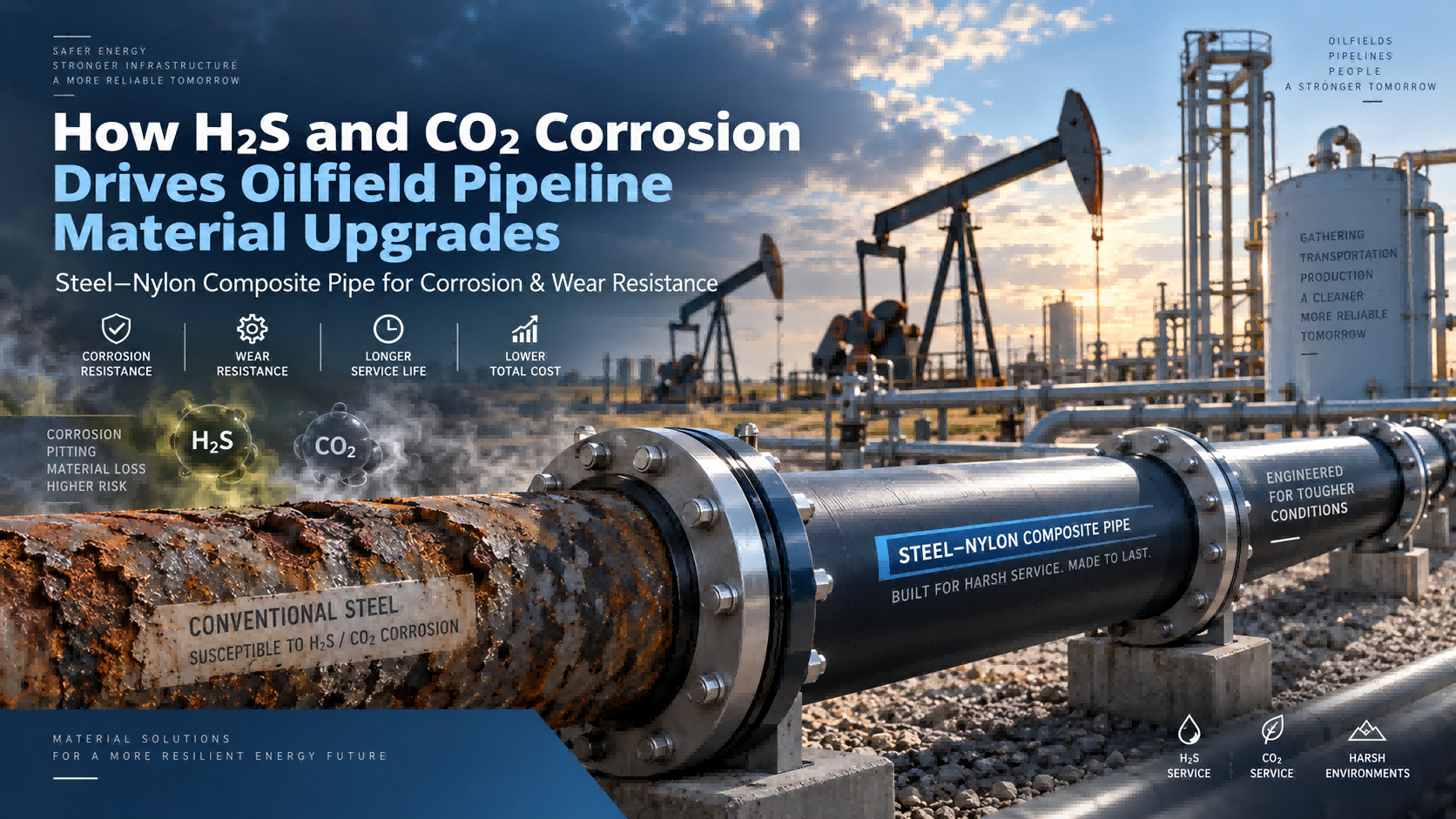
What Does the Desert Oilfield Environment Mean for Pipeline Materials?

When people think of desert oilfields, the first things that often come to mind are extreme heat, blowing sand, and remote, sparsely populated locations.
For oilfield pipeline engineering, however, the real challenge is not any single environmental factor. It is the long-term combination of multiple severe operating conditions:
-
Large day-to-night temperature variations;
-
Intense solar radiation and ultraviolet exposure;
-
Continuous wind-blown sand erosion;
-
High ground-surface temperatures;
-
High-salinity produced water and injection water;
-
Potentially simultaneous exposure to CO₂, H₂S, chlorides, and other corrosive factors;
-
Combined effects of crude oil, sand particles, and corrosive media;
-
Long pipeline distances;
-
Maintenance resources located far from the site;
-
High costs associated with shutdowns and repairs.
Therefore, pipeline material selection for desert oilfields cannot simply be reduced to one question:
“Which pipeline material is corrosion-resistant?”
The more important question is:
Can a pipeline material remain stable under the combined effects of corrosion, erosion, temperature cycling, pressure, wind-blown sand, and long periods of limited maintenance?
This is why desert oilfield projects are placing increasing emphasis on the full life-cycle reliability of pipeline systems.
1. The Desert Environment Tests More Than One Pipeline Property
In conventional industrial projects, pipeline material selection often focuses on several major parameters:
Pressure, temperature, transported medium, and design life.
Desert oilfields are usually far more complicated.
For example, an oilfield gathering pipeline may simultaneously face:
Inside the pipeline:
High-water-cut crude oil, saline water, chlorides, CO₂, H₂S, sand, and other corrosive media.
Outside the pipeline:
Intense ultraviolet radiation, blowing sand, repeated high-low temperature cycles, saline-alkaline soil, and complex ground conditions.
This leads to a very important conclusion:
Desert oilfields effectively create two different corrosion and aging environments.
One exists inside the pipeline.
The other exists outside the pipeline.
If only one of these problems is addressed, the pipeline system may still fail.
For example, even if the external anti-corrosion coating performs well, the pipe may still suffer internal perforation if high-salinity produced water continuously attacks the inner wall.
The reverse is also true.
For this reason, desert oilfield pipeline engineering increasingly emphasizes:
Internal corrosion protection + structural pressure resistance + external environmental protection.
Rather than relying on a single material to solve every problem.
2. Large Temperature Variations: An Often-Underestimated Desert Pipeline Challenge
One of the most typical characteristics of desert regions is the large difference between daytime and nighttime temperatures.
Ground temperatures may become extremely high during the day and then fall rapidly at night.
Over the long term, the pipeline system repeatedly experiences:
Thermal expansion → contraction → thermal expansion → contraction
These cycles affect more than the pipe body itself.
They can also affect:
-
Flanges;
-
Gaskets;
-
Joints;
-
Pipe supports;
-
Expansion compensation devices;
-
Anti-corrosion coatings;
-
Connections between pipelines and equipment.
Therefore, when evaluating pipeline reliability in desert oilfields, it is not enough to ask:
“What is the maximum temperature this material can withstand?”
Another important question is:
“After thousands of thermal cycles, will the connection system still remain stable?”
This is the key difference between long-term stability and short-term temperature resistance.
3. Why Is Internal Corrosion Often More Dangerous Than the Desert Itself?
From an engineering perspective, many serious pipeline problems in desert oilfields are not caused primarily by sand.
They originate inside the pipeline.
This is especially true after an oilfield enters a high-water-cut production stage.
In many mature oilfields, the proportion of water in produced fluids continues to increase.
This means the pipeline is no longer transporting only crude oil. Instead, it may be carrying a complex multiphase fluid consisting of:
Oil + water + salts + gases + solid particles
If the produced water also contains:
-
Cl⁻;
-
CO₂;
-
H₂S;
-
Dissolved oxygen;
-
Mineral salts;
ordinary carbon steel may gradually suffer from:
General corrosion, pitting corrosion, localized corrosion, and erosion-corrosion.
As water cut rises, these problems may become even more severe.
4. Why Are CO₂ and High-Salinity Water Dangerous?
In oilfield gathering systems, CO₂ can dissolve into the water phase and create a corrosive environment.
If the pipeline also contains:
High-salinity water, chlorides, changing flow velocities, and solid particles,
the actual corrosion process becomes even more complicated.
The risk is particularly significant at:
-
Elbows;
-
Tees;
-
Reducers;
-
Upstream and downstream sections of valves;
-
Pump outlets;
-
Areas where flow direction changes suddenly.
Localized corrosion and erosion are often more severe at these positions.
This is why the first failure point in many oilfield pipeline systems is not necessarily a straight pipe section.
It often appears at:
Wear-prone fittings and localized high-velocity areas.
Therefore, extending pipeline life in desert oilfields cannot be achieved simply by changing the straight-pipe material.
The entire system must also be considered, including:
Fittings, joints, and localized structural details.
5. What Does Wind-Blown Sand Mean for Pipeline Systems?
Many people assume that wind-blown sand has limited impact on steel pipelines.
However, when viewed over a service life of 20 years or more, the situation can be very different.
Long-term exposure to blowing sand can continuously affect:
-
External anti-corrosion coatings;
-
Pipe supports;
-
Flanges;
-
Bolts;
-
Valves;
-
Instruments;
-
Exposed metallic components.
If the external protective coating becomes locally damaged and is then exposed to:
Salts, moisture, temperature fluctuations, and soil conditions,
new external corrosion risks may develop.
Therefore, the assumption that “there is little rain in the desert, so corrosion is not a concern” is a common misunderstanding.
Low rainfall does not mean low corrosion risk.
6. Why Must UV Exposure Be Considered in Pipeline Design?
For pipelines that remain exposed above ground for long periods, ultraviolet aging is another factor that must be considered.
Solar radiation can gradually affect certain polymer materials and external protective systems.
Different materials should therefore be used according to their specific functions.
For composite pipelines, the design should separately consider:
What problem does the inner layer solve?
What function does the structural layer perform?
What protection is required for the external surface?
This is one of the fundamental principles of composite pipeline design.
The objective is not to force one material to perform every function.
Instead, different materials should perform the roles for which they are best suited.
7. This Is the Core Logic Behind Steel–Nylon Composite Pipe
Steel–nylon composite pipe is not simply a steel pipe combined with nylon.
Its material design philosophy is based on functional separation:
Steel Provides Structural Strength
The steel substrate mainly provides:
-
Mechanical strength;
-
Pressure-bearing capability;
-
Pipeline rigidity;
-
Structural support for large diameters;
-
Installation stability in engineering applications.
Nylon Protects the Medium-Contacting Surface
The nylon inner layer mainly serves to:
-
Prevent the transported medium from directly contacting the steel substrate;
-
Improve corrosion resistance;
-
Improve wear resistance;
-
Reduce internal surface roughness;
-
Reduce the risk of scaling and deposition in certain media.
This creates a combination of:
Steel Strength + Nylon Corrosion Resistance
In other words:
The rigidity of steel combined with the corrosion resistance of nylon.
For desert oilfield applications that simultaneously require:
Pressure resistance, corrosion resistance, wear resistance, and long-term operating reliability,
this composite material design can offer significant engineering value.
8. Why Is “Corrosion Isolation” on the Inner Wall So Important?
One fundamental problem with conventional carbon steel pipelines is that:
The transported medium directly contacts the steel surface.
As long as corrosive conditions exist, material loss can continue.
Steel–nylon composite pipe follows a different design philosophy.
It aims to create a stable non-metallic barrier between:
The corrosive medium
and
The steel structural layer.
In other words, the objective is not simply to make steel “corrode more slowly.”
It is to minimize direct contact between the corrosive medium and the steel substrate.
These are two fundamentally different corrosion-control strategies.
The first is:
Slowing corrosion.
The second is:
Isolating corrosion.
For high-salinity produced water, oilfield wastewater, and other corrosive gathering media, the second approach can be particularly valuable.
9. Why Do Desert Oilfields Also Require Strong Wear Resistance?
Desert oilfield pipelines do not face corrosion alone.
Many wellhead and gathering systems also contain sand and solid particles.
When solids are present in the fluid, the internal surface of the pipeline may simultaneously experience:
Corrosion + erosion + wear
This is particularly severe at:
90-degree elbows, pump outlets, reducers, and localized high-velocity areas,
where particles repeatedly strike the pipe wall.
If a conventional anti-corrosion coating does not have sufficient erosion resistance, it may first suffer localized damage.
Once the protective layer is damaged and the steel is exposed, corrosion can accelerate further.
This is the phenomenon commonly known in industrial piping as:
Corrosion–Erosion Synergy
In other words:
The combined effect of corrosion and wear.
One of the key advantages of steel–nylon composite pipe is its ability to address both:
Corrosion resistance + wear resistance
rather than solving only one of these problems.
10. What Does Long-Distance Pipeline Operation Mean?
Another typical feature of desert oilfields is the wide geographic distribution of pipelines.
The distance between well sites and processing stations can be significant.
A single pipeline may appear to be only one component of the production system.
But when an oilfield develops a gathering network extending across tens or even hundreds of kilometers, the maintenance logic changes completely.
At that point, the largest cost may no longer be:
How much does the pipeline cost to purchase?
Instead, the more important question becomes:
“How many times will it need to be repaired over the next 20 years?”
Every desert pipeline repair may require:
Vehicles, construction crews, equipment, spare parts, production shutdowns, emergency repairs, and recommissioning.
If the pipeline is located in a remote area, the cost rises even further.
Therefore, pipeline material selection for desert oilfields must consider:
Life Cycle Cost
or:
Total cost throughout the pipeline’s operating life.
11. The Real Comparison Should Not Be Price per Meter
During procurement, projects often compare initial pipeline costs:
| Pipeline Material | Initial Purchase Cost |
|---|---|
| Carbon Steel | Relatively low |
| PE/HDPE | Low to medium |
| Stainless Steel | High |
| Composite Pipe | Medium to high |
But this comparison is far from sufficient.
A more complete economic model should be:
TCO =
Pipeline purchase cost
-
Installation cost
-
Corrosion protection cost
-
Inspection cost
-
Maintenance cost
-
Replacement cost
-
Production-loss cost
-
Labor cost
-
Spare-parts inventory cost
-
Life-cycle maintenance cost
For remote desert oilfields,
the later items on this list may ultimately be more important than the initial purchase price.
Therefore, a pipeline system with a lower purchase price does not necessarily have a lower long-term cost.
12. Why Are Flanged Connections Well Suited to Desert Oilfield Projects?
Installation conditions are an important consideration in many oilfield projects.
Welding in remote areas may require:
-
Welding machines;
-
Power supply;
-
Certified welders;
-
Non-destructive testing;
-
Hot-work permits;
-
Fire-protection measures;
-
On-site gas detection.
In oil and gas production areas, hot-work control requirements are usually even stricter.
Therefore, standardized mechanical or flanged connections can reduce the complexity of field welding in suitable applications.
Our steel–nylon composite pipes can be supplied with flanged connection systems.
This allows a greater proportion of fabrication work to be completed in the factory.
On-site work can then focus primarily on:
Pipeline positioning → flange alignment → gasket installation → bolt tightening → pressure testing
This can provide significant engineering value in remote oilfield projects.
13. Desert Oilfields Ultimately Need Low-Maintenance Pipeline Systems
One clear trend in future oilfield pipeline engineering is not simply the search for:
Cheaper pipelines.
Instead, projects are increasingly looking for:
Pipeline systems that require less maintenance.
As:
Labor costs rise, environmental requirements become stricter, safety management becomes more demanding, and oilfields enter mature production stages,
“frequent maintenance” itself becomes increasingly expensive.
As a result, the way pipeline value is evaluated is also changing.
In the past:
How much does the pipe cost?
Today:
How much does the pipeline cost over its entire life?
This is why TCO thinking is becoming increasingly important in industrial pipeline procurement decisions.
14. Potential Applications of Steel–Nylon Composite Pipe in Desert Oilfields
Based on typical desert oilfield operating conditions, steel–nylon composite pipe can be considered for the following applications:
1. Oil and Gas Gathering Pipelines
Suitable for transporting corrosive oil-water mixtures.
2. High-Water-Cut Crude Oil Transportation
Particularly relevant to mature oilfields where internal corrosion has become a major concern.
3. Oilfield Produced-Water Pipelines
Designed to address corrosion associated with high-salinity water.
4. Water Injection Systems
Helps reduce the risk of internal corrosion commonly associated with conventional steel pipelines.
5. Sand-Containing Fluid Transportation
The wear resistance of nylon can help reduce localized erosion problems.
6. Wear-Prone Well-Site Pipe Sections
For example:
Elbows, tees, reducers, pump outlet sections, and upstream/downstream sections of valves.
7. Upgrading Aging Steel Pipelines
For areas with frequent leakage, projects can begin with partial replacement or 100–500 m trial sections.
15. What Questions Should Be Asked When Selecting Pipeline Materials for Desert Oilfields?
If an engineering team is designing a desert oilfield pipeline system, it should not ask only:
“Can this pipe be used?”
At minimum, the following questions should be answered:
-
What is the Cl⁻ concentration in the transported medium?
-
Are CO₂ and H₂S present?
-
What are the maximum and minimum operating temperatures?
-
What is the day-to-night ambient temperature variation?
-
Are solid particles present?
-
What is the flow velocity?
-
What is the pipeline design pressure?
-
Are negative-pressure conditions possible?
-
Will the pipeline be installed above ground, underground, or in a mixed configuration?
-
Will the external surface be exposed to long-term intense UV radiation?
-
What is the target service life of the project?
-
How frequently is maintenance expected?
-
What is the economic impact of a single shutdown for repair?
-
Is extensive hot-work construction permitted on site?
-
Will future expansion or maintenance require rapid removal and replacement of pipe sections?
Only after these questions have been answered can pipeline material selection become a truly engineering-based decision.
16. The Essence of Desert Oilfield Pipeline Design: Reducing Future Uncertainty
Oilfield pipeline engineering is not about finding a material that will “never fail.”
No such material exists.
A mature engineering approach is to:
Identify the most likely failure modes in advance and reduce those risks through material selection, structural design, and connection technology.
For desert oilfields, these risks typically include:
Internal corrosion, erosion and wear, temperature cycling, external aging, connection failure, difficult maintenance, and high shutdown costs.
A more rational design philosophy is therefore:
Use steel for structural pressure resistance;
use the nylon inner layer for corrosion protection from the transported medium;
use a suitable external anti-corrosion system to handle the surrounding environment;
use standardized flange connections for installation and maintenance;
and improve overall system life through the combination of materials and structural design.
This is also the core design philosophy of steel–nylon composite pipe.
17. From “Buying Pipe Materials” to “Designing a Pipeline System”
The desert oilfield environment raises an important question for the entire industrial pipeline industry:
In the future, are we simply purchasing a pipe,
or are we purchasing:
20 years of stable operating capability?
If the decision is based only on material purchasing, the lowest price can appear very attractive.
But when the full oilfield life cycle is considered,
the key indicators become:
-
Corrosion failure rate;
-
Number of leaks;
-
Maintenance intervals;
-
Number of shutdowns;
-
Replacement frequency;
-
Complexity of field installation;
-
System service life;
-
Total life-cycle cost.
This means the procurement logic for industrial pipelines is gradually shifting from:
Material Price
toward:
Pipeline Reliability + Life Cycle Cost
Conclusion: The Desert Environment Ultimately Tests Long-Term Pipeline Reliability
A desert oilfield is not simply a “high-temperature oilfield.”
It is a complex engineering environment where:
Large temperature variations + wind-blown sand + UV exposure + high-salinity water + CO₂/H₂S + solid particles + long-distance transportation + high maintenance costs
may all exist simultaneously.
This means traditional single-material selection strategies are becoming increasingly insufficient to address every challenge.
Steel–nylon composite pipe combines:
A steel structural layer for strength and pressure resistance,
a nylon inner layer for corrosion and wear resistance,
and flanged connections for easier installation and maintenance,
providing an engineering solution worth considering for desert oilfield gathering systems, produced-water pipelines, water-injection systems, and other applications where corrosion and wear occur simultaneously.
For desert oilfields, the truly valuable pipeline is not simply one that operates properly immediately after installation.
It is one that:
Years later, continues to reduce leakage, minimize maintenance, reduce shutdowns, and keep the entire transportation system operating reliably.
That is what the desert oilfield environment truly demands from pipeline materials.
Oil & Gas Field Pipeline Maintenance Is Shifting from Periodic Repair to Long-Life Design