
Will Future Oilfield Corrosion Control Depend More on Advanced Materials or Chemical Inhibitors?
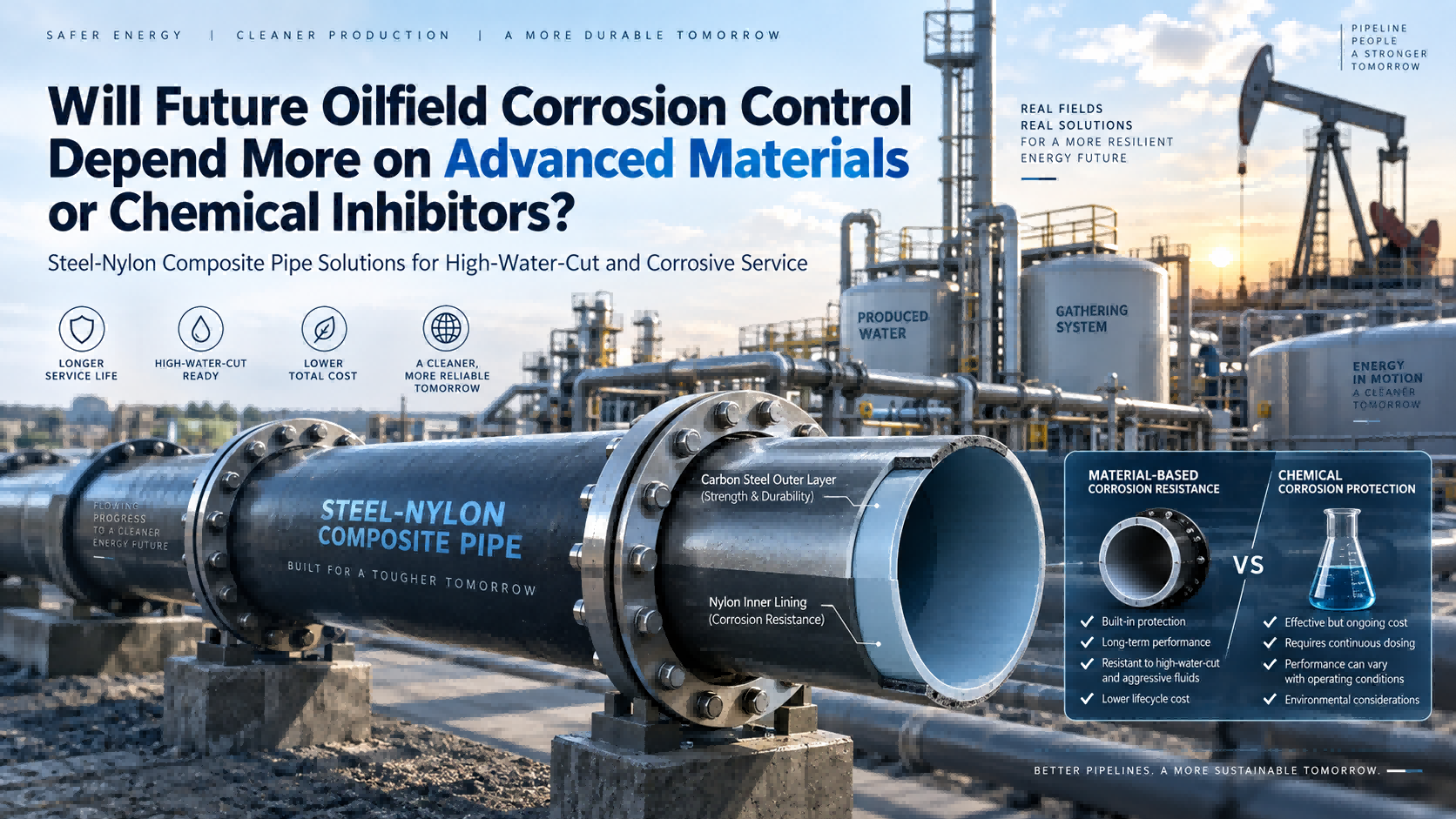
More than 70% of oil and gas fields currently under development worldwide are highly corrosive, and corrosion-related pipeline incidents account for 26.63% of all natural gas pipeline accidents in Europe. Faced with this harsh reality, oilfield corrosion control has long relied on two technical routes: chemical corrosion control, centered on corrosion inhibitors, and materials-based corrosion control, based on replacing corrodible materials with corrosion-resistant ones. As extreme operating conditions—high-temperature, high-salinity oilfields, sour gas fields, and CCUS—become more common, the industry is re-examining the cost-effectiveness boundaries of these two routes. An increasingly clear trend is that the center of gravity in future oilfield corrosion control is shifting from “continuous chemical intervention” to “intrinsic corrosion prevention rooted in materials.”
The Ceiling of Chemical Corrosion Control
Corrosion inhibitors have a long history in oilfields. Their advantage lies in flexibility and low entry barriers—continuously injecting a small amount of chemical into the wellbore or pipeline can inhibit corrosion without replacing pipe, and the initial investment is relatively small. However, the limitations of chemical corrosion control are being exposed more rapidly under multiple pressures.
The economic burden cannot be ignored. For a typical 3,400 bbl/d oil well, corrosion inhibitor injection is about 10 to 20 gallons per day. At $5 to $10 per gallon, chemical costs alone approach $50,000 per year, plus injection equipment maintenance, corrosion monitoring, and periodic system optimization, making annual corrosion-control operating expenses considerable. A single workover to replace corroded tubing costs between $25,000 and $1 million; if an unplanned workover occurs, production downtime losses are even greater. More critically, the protective efficiency of corrosion inhibitors drops significantly under high temperature and pressure, high salinity, and complex flow regimes, and it is often difficult to effectively cover pipe sections below the injection valve.
Environmental compliance pressure is also tightening. Traditional inorganic corrosion inhibitors have disadvantages such as toxicity and poor environmental adaptability; their protective films are not dense enough and can easily cause localized corrosion. Regulations in areas such as the North Sea have explicitly restricted the use of environmentally harmful chemicals, requiring chemical suppliers to replace them with environmentally friendly products. Corrosion inhibitors themselves are mostly derived from fossil feedstocks, have a relatively high carbon footprint, and face structural pressure under the global decarbonization trend.
In short, the essence of chemical corrosion control is an “adversarial strategy”—corrosion continues to occur, and protection continues to be consumed. Once chemical injection stops, corrosion resumes immediately. This passive model can still work in conventional oilfields where corrosion is manageable, but in the increasingly common extreme corrosive environments, its economic and reliability boundaries are being constantly breached.
The Divergence and Convergence of Materials-Based Routes
The core logic of the materials route is “intrinsic corrosion prevention”: by relying on the material’s own corrosion resistance, the corrosion reaction is blocked at the source rather than treated afterward. But the “materials route” is not monolithic; there is significant internal divergence.
**Corrosion-resistant alloys** (CRAs, such as nickel-based alloys and duplex stainless steel) have excellent corrosion resistance and are almost the standard solution for sour gas fields, but their cost is extremely high. Based on carbon steel pipe, the unit cost of 25Cr stainless steel is about 7 times higher, and Alloy 625 nickel-based alloy is as much as 14 times higher. Large-scale promotion is economically unbearable.
**Non-metallic pipes** (such as FRP and PE pipes) have excellent corrosion resistance and are easy to install, but their temperature resistance and permeation resistance are insufficient. FRP pipes have weak external pressure resistance, and PE-lined steel pipes are generally only suitable for operating conditions below 40°C.
**Composite pipes** combine the strength of metal with the corrosion resistance of non-metals, balancing performance and cost. Represented by a new generation of products such as steel-nylon composite pipes, they are becoming a key solution within the materials route that combines technical rationality and economic feasibility.
Steel-Nylon Composite Pipe: An Engineered Solution for Intrinsic Corrosion Prevention
The core technology of steel-nylon composite pipe lies in integrating the high strength and toughness of steel pipe with the salt resistance, wear resistance, and corrosion resistance of nylon, achieving tightly bonded, integrally formed pipe through processes such as centrifugal casting in a factory-controlled environment. This product route is noteworthy because it systematically responds to the respective shortcomings of chemical corrosion control and traditional materials-based corrosion control.
**Intrinsic corrosion resistance, maintenance-free over the full lifecycle.** The nylon liner directly contacts the corrosive medium and effectively shields against aggressive components such as produced water, hydrogen sulfide, and carbon dioxide. Unlike carbon steel pipelines that require continuous corrosion inhibitor injection, steel-nylon composite pipes achieve “intrinsic corrosion resistance and long service life.” PAMC nylon-steel composite pipes from Guangdong Kejin New Materials have been applied for more than 40,000 meters cumulatively at Sinopec Shengli Oilfield, Southwest Oil & Gas Company, and other units. The earliest pipeline put into operation has run continuously for 23 years without corrosion leakage. Twenty-three years of maintenance-free operation means an economic return period far exceeding that of inhibitor-based solutions.
**Adaptability under high-temperature and high-salinity conditions.** The pipe product has a temperature range of -36°C to 160°C, meeting the needs of produced fluid transportation in high-temperature, high-salinity oilfields. Reinforced MC nylon material has a softening temperature above 200°C, and long-term downhole service temperature can reach 130°C. The product’s nominal diameter covers DN50 to DN2000, and pressure ratings range from 1.0 to 4.0 MPa, allowing it to adapt to diverse scenarios from gathering pipelines to in-station and depot pipelines.
**Wear resistance for sand production challenges.** Sand production in unconsolidated sandstone reservoirs causes erosion of pipelines, a common failure cause for traditional carbon steel pipelines. The high wear resistance of nylon material makes steel-nylon composite pipes stand out under such conditions, effectively solving the erosion problem while also compensating for the weakness of traditional anti-corrosion coatings, which tend to develop weak points after sand abrasion.
**Lightweight and easy to install.** Composite pipes are lightweight and self-lubricating, with flexible installation methods. They can use standard flange or welded connections, have strong adaptability, and greatly reduce transportation and installation costs.
A Fundamental Shift in the Economics
From a lifecycle cost perspective, the advantages of steel-nylon composite pipes over chemical corrosion control solutions are being confirmed by data. In the oil and gas sector, composite pipes can save up to 50% of the cost of pure corrosion-resistant alloys. In oil and gas fields with high corrosive medium content, lifecycle costs are lower than carbon steel. Data from the Tazhong No. 1 condensate gas field show that the economics of composite pipes surpass carbon steel by years 5 to 10 of use.
The cost structure of chemical corrosion control is “continuous input”—corrosion inhibitor procurement, injection equipment maintenance, corrosion monitoring, and periodic workovers. Expenses accumulate year by year and climb as the corrosive environment worsens. The cost structure of steel-nylon composite pipes is “one-time investment, long-term maintenance-free”—the upfront pipe investment is higher than ordinary carbon steel, but after commissioning, almost no corrosion-related operating expenses are generated. Using the actual case of 23 years of maintenance-free operation as a reference, its lifecycle cost advantage is structural, not a marginal improvement.
Future Trend: Materials as the Foundation, Chemicals as a Supplement
Returning to the question in the title: will future oilfield corrosion control rely more on materials or chemical inhibition?
The answer is not either/or. In the short term, chemical corrosion control remains indispensable for maintaining existing pipeline networks and for local supplemental protection in downhole applications. But from the perspective of technological evolution, the paradigm of corrosion control is shifting from “process intervention” to “source immunity.” As intrinsic corrosion-prevention materials such as steel-nylon composite pipes continue to mature in performance parameters, manufacturing processes, and application validation, materials-based solutions are moving from “high-end option” to “standard configuration.” The most economical and reliable corrosion control strategy for the future is to use intrinsic corrosion-prevention materials as the main body and supplement them with chemical methods only in the few scenarios that materials cannot cover. For oilfield operators, the sooner they complete the mental shift from “continuously buying chemicals” to “selecting materials once,” the more they can gain a dual advantage in cost and safety over long-term operations.
What New Pipeline Materials Do Unconventional Oil & Gas Projects Need?

SEND MESSAGE