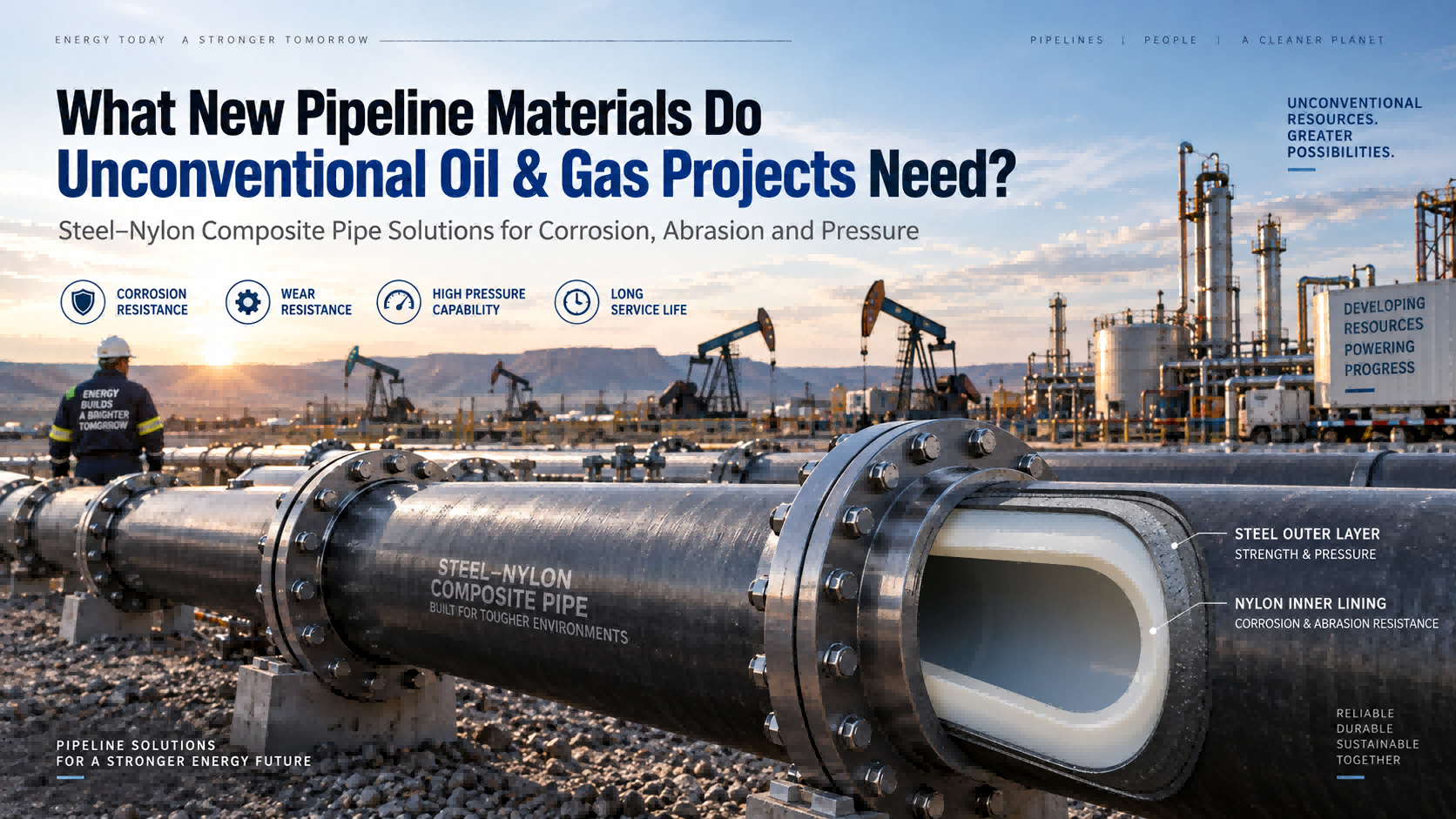
What New Pipeline Materials Do Unconventional Oil & Gas Projects Need?
The development of unconventional oil and gas resources—including shale gas, tight gas, tight oil, and coalbed methane—is changing the way pipeline materials are selected for oilfield surface facilities.
In the past, pipeline material selection was often based on several relatively straightforward parameters: design pressure, design temperature, fluid composition, and corrosion allowance.
However, in many unconventional oil and gas projects, pipeline life is no longer determined by a single factor. Instead, pipelines may be exposed simultaneously to:
-
Corrosion
-
Abrasion
-
High water cut
-
High salinity
-
CO₂ and H₂S
-
Chlorides
-
Solid particles
-
Pressure fluctuations
-
Complex field environments
This leads to an important change in pipeline engineering:
Unconventional oil and gas projects do not simply need “more corrosion-resistant pipes.” They increasingly require pipeline systems capable of balancing structural strength, corrosion resistance, wear resistance, installation efficiency, and lifecycle cost.
The U.S. Energy Information Administration identifies shale gas and tight gas as important components of unconventional natural gas production, while its Annual Energy Outlook 2026 continues to project a significant long-term role for shale and tight gas in U.S. natural gas production.
For the pipeline industry, this raises an increasingly important question:
What kind of pipeline materials can provide reliable long-term performance in unconventional oil and gas operations?
1. Why Are Unconventional Oil & Gas Projects Changing Pipeline Material Selection?
One of the key differences between conventional and unconventional oil and gas development is not simply the production method.
The operating conditions throughout the production and gathering system can also become significantly more complex.
In shale oil, shale gas, and tight oil and gas developments, horizontal drilling, hydraulic fracturing, multi-well pads, and centralized gathering systems have become common.
As wells move through different stages of production, the following parameters can change considerably:
-
Liquid composition
-
Water cut
-
Pressure
-
Flow rate
-
Solid particle concentration
This means that the operating conditions inside the same pipeline may change significantly during its service life.
During early production, fluids may consist mainly of oil, gas, and flowback water.
Later, water production may increase significantly.
In certain fields, produced fluids may also contain:
-
Highly mineralized water
-
CO₂
-
H₂S
-
Chloride ions
-
Sand
-
Residual proppant
-
Other suspended solids
For pipelines, this is therefore not simply a matter of “transporting water.”
It is often a complex:
oil–gas–water–salt–solid multiphase transportation environment.
This complexity is one of the major reasons pipeline materials for unconventional oil and gas projects are evolving.
2. Challenge One: High Water Cut Is Making Internal Corrosion Increasingly Important
Oil and gas pipeline design often focuses primarily on hydrocarbons.
However, as wells enter middle and late production stages, one factor becomes increasingly difficult to ignore:
Water.
Once a continuous water phase exists inside a pipeline, corrosion may occur.
If the water also contains:
-
CO₂
-
H₂S
-
Cl⁻
-
Dissolved salts
-
Microorganisms
-
Solid deposits
the corrosion mechanisms become considerably more complicated.
Industry guidance on internal corrosion control in steel oil and gas pipelines identifies water, CO₂, H₂S, solids, and microbiologically influenced corrosion as important factors that may need to be evaluated.
For unconventional oil and gas gathering systems, simply increasing carbon steel wall thickness does not fundamentally eliminate this problem.
A corrosion allowance essentially means:
allowing steel to corrode gradually while providing additional material thickness to extend the time before failure.
However, if the objective shifts from:
“Replace the pipeline after several years”
to:
“Achieve long-term stable operation with reduced maintenance,”
then the material design philosophy must also change.
Instead of asking:
How can we make steel corrode more slowly?
engineers increasingly need to consider:
How can we reduce direct contact between corrosive fluids and the load-bearing steel structure?
This is one of the reasons composite pipeline structures deserve increasing attention.
3. Challenge Two: Corrosion and Abrasion Often Occur Together
Unconventional wells may produce sand, residual fracturing proppant, scale particles, and other solids during different stages of operation.
When these particles move through the pipeline at relatively high velocity, erosion and abrasion can become concentrated at locations such as:
-
Elbows
-
Tees
-
Reducers
-
Pump outlets
-
Upstream and downstream sections of valves
-
Areas with sudden changes in velocity or flow direction
Industry guidance on erosion management in oil and gas systems specifically addresses the risk of sand-containing fluids damaging pipelines, valves, flowlines, and related equipment.
The more difficult problem is that:
corrosion and abrasion may accelerate each other.
For example, when corrosion products or protective films on a metal surface are repeatedly removed by solid particles, fresh metal becomes exposed.
Corrosion then continues.
The newly formed corrosion layer may again be removed by erosion.
This creates a repeating cycle:
Corrosion → Erosion → Fresh Metal Exposure → Further Corrosion
This combined erosion-corrosion mechanism can cause material loss much faster than either corrosion or mechanical wear acting alone.
Therefore, the correct question for unconventional oil and gas pipelines is not simply:
Which material has the best corrosion resistance?
A more useful engineering question is:
Which pipeline material can withstand corrosion and abrasion at the same time?
4. Challenge Three: Changes in Operating Conditions Matter as Much as Design Conditions
Traditional pipeline selection often focuses on three basic parameters:
Pressure + Temperature + Medium
Unconventional oil and gas projects increasingly require a fourth dimension:
Change.
Real operating conditions are rarely static throughout the entire lifecycle of a well or gathering system.
For example:
Production rates may initially be high.
Later, liquid production may increase.
The system may then enter a high-water-cut stage.
Some pipelines may experience intermittent operation.
Well switching can change flow rates.
Certain pipeline sections may undergo repeated shutdowns, restarts, and pressure fluctuations.
Therefore, future pipeline selection should not focus only on:
Can the pipeline operate under the initial design condition?
A better question is:
Can the pipeline remain reliable after ten years or more of changing operating conditions?
This is essentially a question of:
Material Adaptability.
And material adaptability is becoming increasingly important in unconventional oil and gas pipeline design.
5. Challenge Four: Remote Oilfields Are Redefining the True Cost of Pipelines
Many unconventional oil and gas projects are located far from major cities and industrial centers.
This means that when a pipeline fails, the real cost is much greater than the price of a replacement pipe.
Additional costs may include:
-
Production shutdown
-
Maintenance personnel mobilization
-
Lifting equipment
-
Transportation
-
Hot-work permits
-
Welding operations
-
Gas detection
-
Site isolation
-
Corrosion protection restoration
-
Environmental management
-
Safety management
-
Restarting the production system
Therefore, the procurement logic for unconventional oil and gas projects should gradually move away from:
Pipe Purchase Price
toward:
Pipeline Lifecycle Cost
In many remote oilfield projects, the total cost of a single unplanned maintenance event can significantly exceed the purchase price of the pipe itself.
For this reason, a valuable next-generation pipeline material should help operators achieve three goals:
Fewer leaks, fewer repairs, and fewer shutdowns.
6. Why Are Traditional Pipeline Materials Finding It Difficult to Meet All These Requirements Simultaneously?
Common pipeline materials used in oil and gas fields include:
-
Carbon steel
-
Stainless steel
-
Corrosion-resistant alloys
-
HDPE / PE
-
FRP / GRP
-
Various lined and composite piping systems
Each material has an appropriate range of applications.
The challenge in unconventional oil and gas service is that several performance requirements may need to be satisfied simultaneously.
| Material | Pressure Capability | Corrosion Resistance | Wear Resistance | Complex-Service Adaptability | Main Consideration |
|---|---|---|---|---|---|
| Carbon Steel | High | Highly dependent on corrosion control | Moderate | High | Internal corrosion and maintenance |
| Stainless Steel / CRA | High | Good in suitable environments | Good | High | Cost and environment-specific corrosion |
| PE / HDPE | Moderate | Good | Good | Moderate | Temperature, stiffness, and pressure limitations |
| FRP / GRP | Moderate | Good | Depends on structure | Moderate | Impact, connection, and long-term structural reliability |
| Steel–Nylon Composite Pipe | High | Internal nylon layer isolates corrosive media | Good | High | Requires compatibility assessment for actual service conditions |
This comparison highlights an important principle:
The future of pipeline material competition may not be determined by which material has the highest single performance parameter, but by which system provides the best overall balance of properties.
7. What Unconventional Oil & Gas Projects Really Need: Structural Materials + Functional Materials
This may become an increasingly important direction in industrial pipeline development.
A conventional single-material pipe is often expected to perform several functions simultaneously:
-
Withstand pressure
-
Provide structural rigidity
-
Resist impact
-
Resist corrosion
-
Resist abrasion
-
Maintain hydraulic performance
It is difficult for one material to perform all of these functions optimally.
A more effective approach is to:
Allow different materials to perform different functions.
This is the fundamental design philosophy behind steel–nylon composite piping.
External Steel Structure
The steel structure is primarily responsible for:
-
Mechanical strength
-
Pipeline rigidity
-
Internal pressure resistance
-
External load resistance
-
Mechanical protection during installation and operation
Internal Nylon Functional Layer
The nylon lining is primarily designed to:
-
Isolate corrosive media from the steel substrate
-
Improve wear resistance
-
Provide a smooth internal surface
-
Reduce corrosion-product formation
-
Support stable long-term fluid transportation
This separates a traditionally difficult material problem into two more manageable functions:
Steel provides strength; nylon manages the fluid-contact environment.
From a materials engineering perspective, this structural layer + functional layer approach can be more rational than requiring a single material to solve every problem simultaneously.
8. Why Is the Steel–Nylon Composite Structure Suitable for Complex Oilfield Conditions?
1. Combining Pressure Capability with Corrosion Resistance
This is one of the most important advantages of the composite structure.
Steel provides mature mechanical and pressure-bearing performance, while the internal nylon layer helps reduce direct contact between the transported medium and the steel substrate.
This can be particularly valuable in applications such as:
-
High-water-cut oil and gas gathering
-
Oilfield produced water pipelines
-
Water injection systems
-
Corrosive process fluid transportation
2. Addressing Combined Corrosion and Abrasion
Corrosion is not the only problem in unconventional oil and gas production.
Where sand or other solid particles are present, abrasion must also be considered.
Nylon materials can provide good wear resistance, making steel–nylon composite structures particularly relevant to operating conditions involving:
Corrosion + Abrasion
This can be especially important at:
-
Elbows
-
Tees
-
Reducers
-
High-velocity sections
-
Pump discharge lines
-
Valve upstream and downstream sections
where local wear rates can directly influence pipeline service life.
3. Smooth Internal Surfaces Can Support Long-Term Hydraulic Performance
A pipeline operating after many years may be very different from the same pipeline on its first day of service.
In conventional steel pipelines, corrosion, scaling, and deposition may progressively increase internal surface roughness.
This can result in:
Higher roughness → Greater flow resistance → Higher pressure drop → Lower transportation efficiency
A relatively smooth nylon internal surface can help reduce friction between the transported medium and the pipe wall while limiting the roughening caused by corrosion products.
Therefore, pipeline evaluation should not focus only on:
Day 1 Pressure Drop
It should also consider:
Year 10 Hydraulic Performance
9. Why Are Flanged Connections Particularly Valuable in Unconventional Oil & Gas Projects?
A pipeline may use an excellent material, but the installation method can still have a major impact on total project cost and risk.
For remote oilfields and operating production facilities, field welding can involve:
-
Hot-work permits
-
Certified welders
-
Welding equipment
-
Gas detection
-
Safety isolation
-
Additional inspection
-
More complex construction organization
For this reason, we place significant emphasis on flanged connection systems in the design of our steel–nylon composite pipelines.
Where technically suitable, flanged connections can provide several practical advantages.
Reduced Field Welding
This can simplify construction and reduce the amount of hot work required on site.
More Suitable for Partial Upgrades of Existing Pipelines
When severe corrosion is concentrated in specific sections, operators may not always need to replace the entire network.
Selected pipeline sections can be upgraded based on actual engineering conditions.
Easier Maintenance and Replacement
High-risk components such as:
-
Valves
-
Pump outlets
-
Elbows
-
Reducers
-
High-wear sections
can be designed for more modular maintenance.
This can be particularly valuable for unconventional oil and gas projects seeking to develop:
Low-Maintenance Pipeline Systems.
10. Five Core Requirements for Future Unconventional Oil & Gas Pipeline Materials
We believe future pipeline evaluation should focus less on simply asking “What material is it made from?” and more on the following five questions.
01 | Can It Maintain Long-Term Pressure Integrity?
Pressure capability remains a fundamental requirement for industrial pipeline systems.
02 | Can It Isolate the Steel Structure from Corrosive Media?
Particular attention should be given to environments containing:
-
Water
-
CO₂
-
H₂S
-
Chlorides
-
Dissolved salts
-
Other corrosive components
03 | Can It Resist Abrasion?
Sand-containing fluids, high flow velocities, and areas of local turbulence must be carefully evaluated.
04 | Can It Remain Stable as Operating Conditions Change?
Pipeline design should not only satisfy the first year of operation.
It should be capable of adapting to changing operating conditions throughout the project lifecycle.
05 | Can It Reduce 20-Year Lifecycle Cost?
A more complete cost model should include:
CAPEX + Maintenance + Shutdown + Replacement + Production Loss
rather than comparing only the initial purchase price per meter of pipe.
11. Steel–Nylon Composite Pipe Is Not a “Universal Material”
This point is important.
A professional pipeline supplier should never claim:
One material can be used in every oil and gas operating environment.
No such material exists.
The suitability of steel–nylon composite pipe must also be evaluated according to actual operating conditions, including:
-
Fluid composition
-
pH
-
Salt concentration
-
CO₂ / H₂S conditions
-
Solid particle concentration
-
Temperature
-
Pressure
-
Flow velocity
-
Pipe diameter
-
Installation method
In particular, systems involving strong acids, highly concentrated acids, certain organic chemicals, or extreme temperature conditions should undergo appropriate:
Material Compatibility Verification
before final material selection.
This engineering-based approach is far more important than simply describing a product as “corrosion resistant.”
12. Future Material Selection Will Shift from “Buying Pipe” to “Designing a Pipeline System”
Unconventional oil and gas development is also driving another important change.
Operators may increasingly require more than a:
Pipe Supplier
They may need a:
Pipeline Solution Provider
because the service life of an entire system is often determined by more than straight pipe sections.
Critical locations may include:
-
Elbows
-
Tees
-
Reducers
-
Valve connections
-
Pump outlet sections
-
High-velocity sections
-
Other localized high-risk areas
A main pipeline may theoretically operate for ten years.
But if an elbow fails every two years, the effective maintenance cycle of the entire system may still be only two years.
For this reason, a more rational engineering approach is to:
Design the entire pipeline network as an integrated system.
13. From “Corrosion-Resistant Materials” to “Long-Life Pipeline Systems”
For decades, one of the main drivers of industrial pipeline material development has been:
Corrosion Control.
In the future, an equally important objective may become:
Reducing Maintenance Frequency.
These two objectives may appear similar, but they are not exactly the same.
Corrosion resistance is primarily a material property.
Low maintenance is a system-level performance objective.
A truly long-life pipeline system should ideally combine:
**Corrosion Resistance
-
Wear Resistance
-
Pressure Capability
-
Structural Stability
-
Installation Efficiency
-
Low Maintenance**
This is also the direction in which we continue to develop and optimize our steel–nylon composite pipeline systems.
Our goal is not simply to replace carbon steel, stainless steel, PE, FRP, or other pipeline materials with another material.
The more important engineering question is:
When corrosion, abrasion, pressure, and complex field conditions exist simultaneously, can we create a better-balanced pipeline solution?
Steel provides structural strength.
Nylon provides functional protection on the fluid-contact surface.
Flanged connections can improve installation and maintenance efficiency.
The composite structure allows different materials to perform the functions they are best suited to handle.
This may represent exactly the type of material strategy that future unconventional oil and gas projects require.
Conclusion: The Next Generation of Oil & Gas Pipelines Will Compete on More Than Material Type
Unconventional oil and gas development is pushing the pipeline industry into a new stage.
In the past, material selection was often influenced heavily by the question:
Which material is cheaper?
Increasingly, operators are asking a different question:
Which pipeline can operate longer with less maintenance?
When high-salinity produced water, CO₂/H₂S, sand-containing fluids, pressure fluctuations, and remote construction conditions occur simultaneously, it becomes increasingly difficult for a single material to solve every challenge.
Steel–nylon composite pipe provides a different design approach:
Use steel to solve structural and pressure requirements, use nylon to address corrosion and abrasion at the fluid-contact surface, and use engineered connection methods to improve installation and maintainability.
For shale oil and gas, tight oil and gas, produced water systems, water injection networks, and other complex oilfield gathering applications, the most important question is no longer simply the initial pipe price.
Instead, operators increasingly need to ask:
How long can the pipeline operate reliably?
How many maintenance interventions will be required over 20 years?
How much can leakage and unplanned shutdown risk be reduced?
What is the true lifecycle cost of the pipeline system?
Once these questions become central to project decision-making, industrial pipeline competition moves beyond material price and enters a new stage:
Pipeline Lifecycle Performance Competition
And this is why steel–nylon composite piping deserves renewed consideration in the next generation of unconventional oil and gas projects.
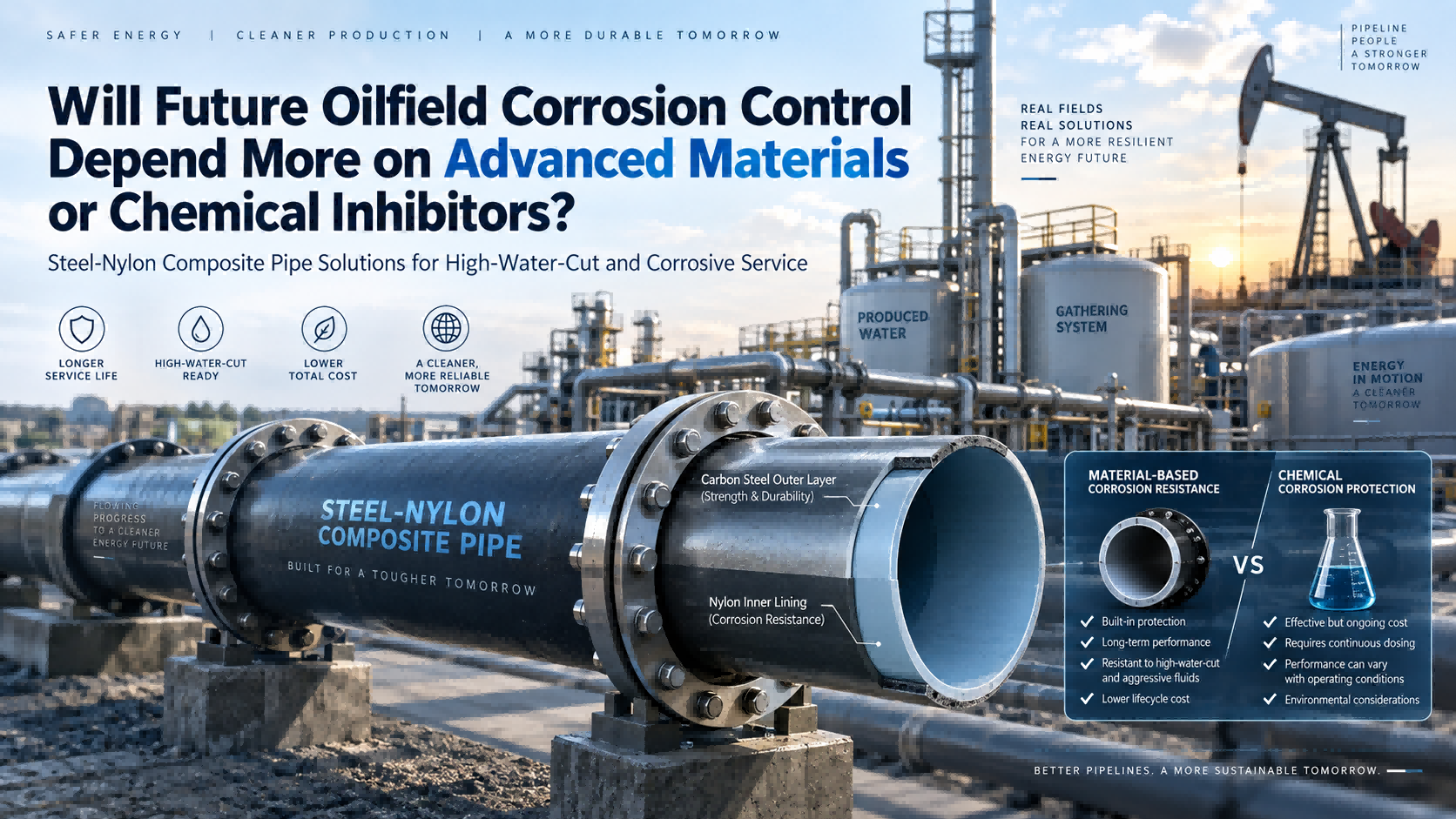
Will Future Oilfield Corrosion Control Depend More on Advanced Materials or Chemical Inhibitors?
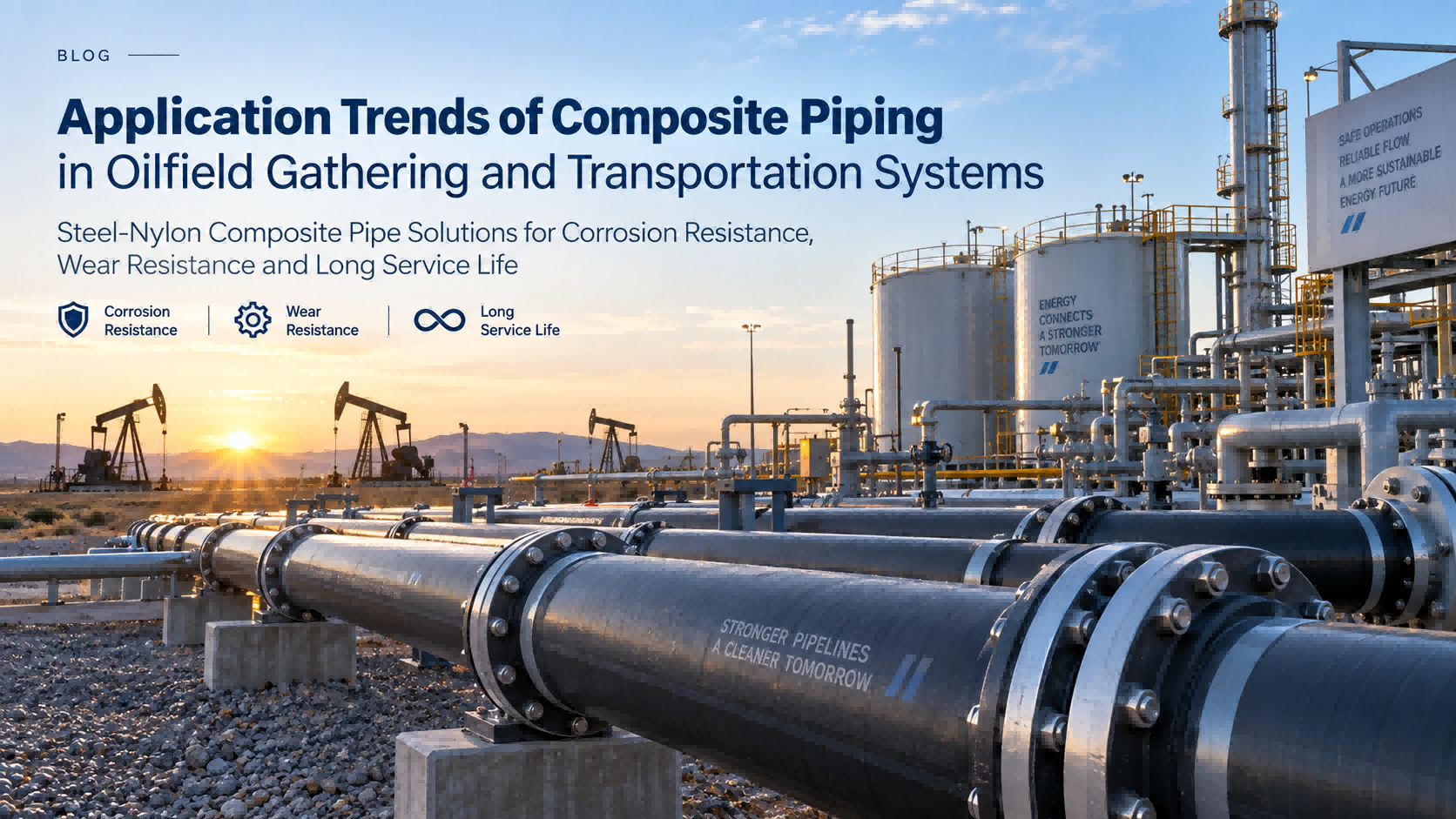
Application Trends of Composite Piping in Oilfield Gathering and Transportation Systems