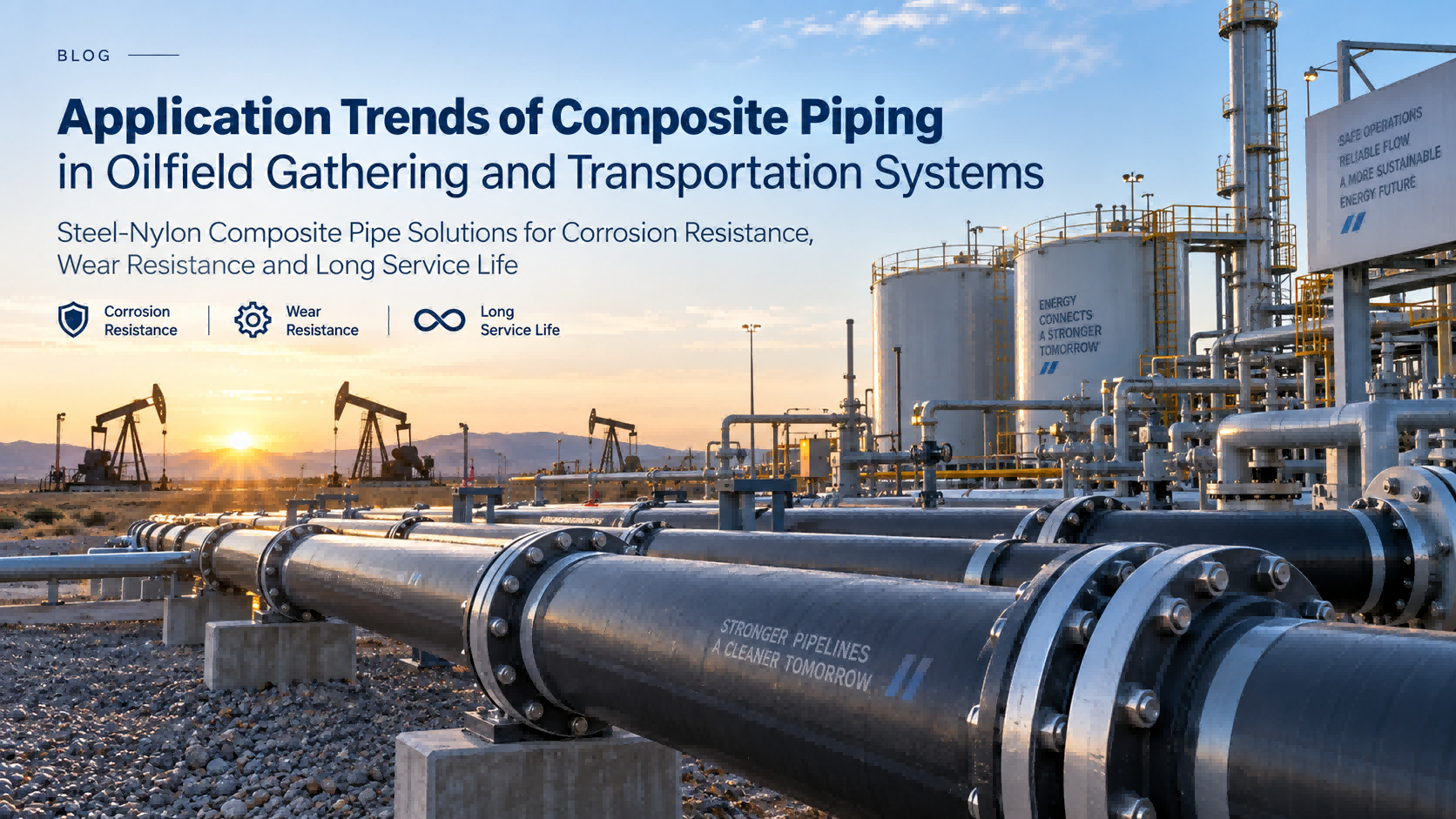
Application Trends of Composite Piping in Oilfield Gathering and Transportation Systems
Oilfield gathering and transportation systems are among the most critical infrastructure components in oil and gas production.
Crude oil, natural gas, produced water, and multiphase fluids extracted from wells must be transported through extensive networks of flowlines, gathering pipelines, valve manifolds, metering systems, and central processing facilities.
Compared with ordinary industrial pipelines, oilfield gathering pipelines often operate under far more complex conditions, including:
-
High water cut
-
Highly mineralized produced water
-
Corrosive components such as CO₂ and H₂S
-
Chloride-rich environments
-
Sand and solid-particle erosion
-
Oil-water-gas multiphase flow
-
Pressure fluctuations
-
Temperature variations
-
Difficult maintenance conditions in remote locations
Under the combined influence of these factors, conventional carbon steel pipelines may suffer from corrosion thinning, localized perforation, erosion, leakage, and frequent maintenance requirements.
As a result, oilfield pipeline material selection is gradually shifting from a simple question:
“Can the pipeline withstand the required design pressure?”
to a more comprehensive consideration:
“Can the pipeline maintain reliable performance under the combined effects of corrosion, wear, pressure, and harsh operating conditions over the long term?”
Against this background, composite piping is becoming an increasingly important technical option for oilfield gathering and transportation systems.
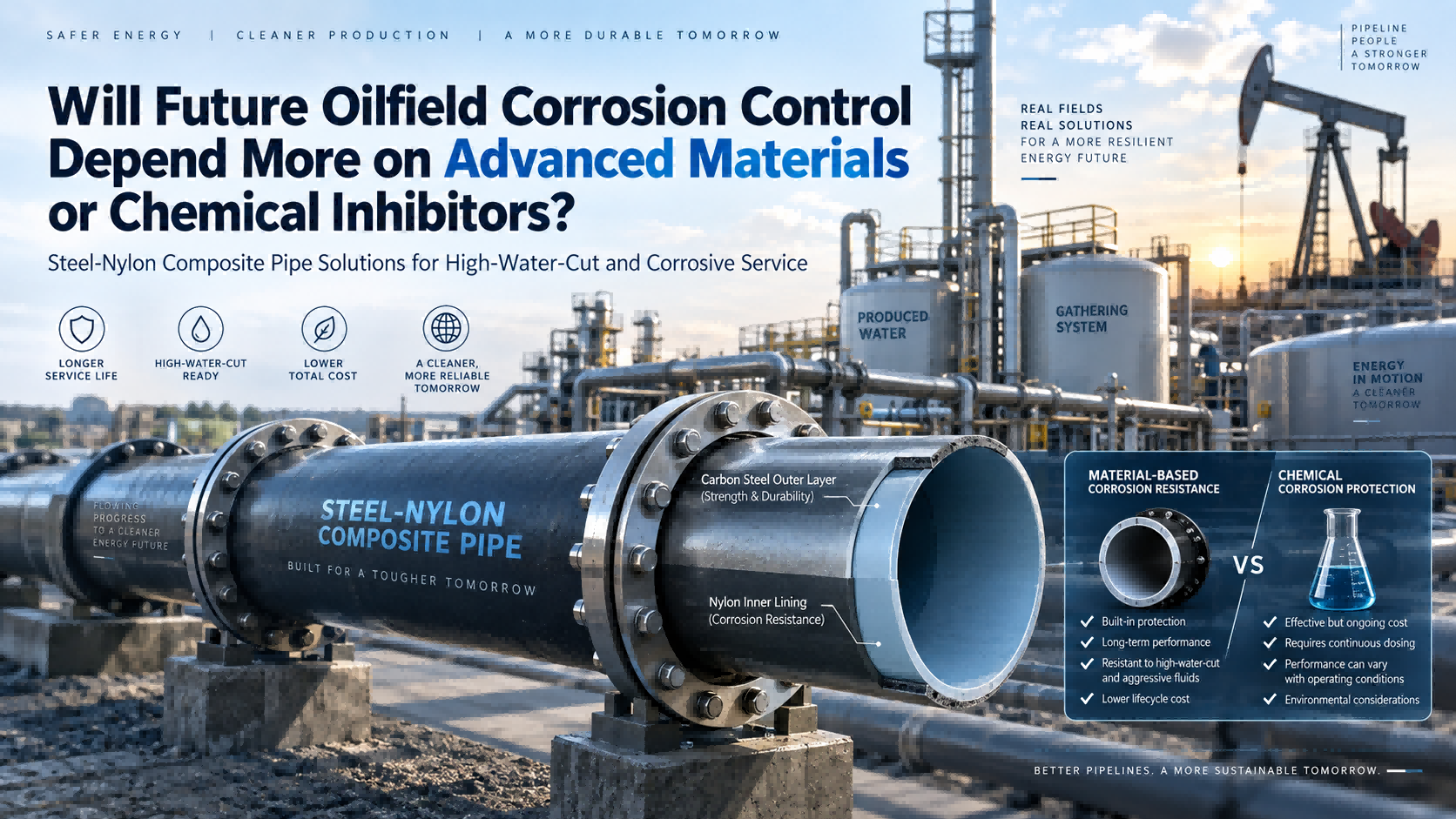
Steel-nylon composite pipe is one such solution, combining structural strength with internal corrosion and wear resistance.
1. Why Are Oilfield Gathering Systems Increasingly Considering Composite Pipes?
Traditional oilfield surface gathering systems have widely used carbon steel pipelines.
Carbon steel offers clear advantages:
-
High mechanical strength
-
Mature pressure-bearing performance
-
Well-established dimensional standards
-
Extensive engineering experience
However, in many oilfield applications, pipeline failure is not primarily caused by insufficient strength.
Instead, the real challenge is often:
Long-term degradation caused by corrosion and wear.
For example, as oilfields mature, produced fluids often contain increasing amounts of water.
When produced water contains substances such as:
-
NaCl
-
Chloride ions
-
CO₂
-
H₂S
-
Other dissolved salts
the internal corrosion environment becomes increasingly aggressive.
If sand, crystalline salts, corrosion products, or other solids are also present, the pipeline may experience a combined condition of:
Corrosion + Erosion + Abrasion
Under such operating conditions, simply upgrading the grade of steel does not necessarily eliminate long-term maintenance problems.
This has encouraged a different material engineering approach:
Use different materials to perform the functions they are best suited for.
For example:
Steel provides structural strength and pressure resistance, while the internal functional layer isolates the corrosive medium from the steel structure.
This is one of the fundamental design principles behind steel-nylon composite piping.
2. How Is Material Selection for Oilfield Gathering Pipelines Changing?
The future development of oilfield pipeline materials does not necessarily mean that one material will completely replace another.
A more important trend is the move toward:
More precise material selection for different operating conditions.
In the past, a large portion of an oilfield pipeline network might have been constructed using the same type of carbon steel.
Today, however, increasingly complex operating conditions mean that different materials may be required for:
-
Wellhead flowlines
-
Produced-water pipelines
-
Main gathering pipelines
-
Water injection pipelines
-
Valve manifold piping
-
Process piping inside central processing facilities
This shift can be seen in several major trends.
Trend 1: From Single-Material Pipelines to Multi-Material Composite Structures
Traditional industrial pipelines usually rely on one material to perform multiple functions.
For example, carbon steel may be expected to provide:
-
Pressure resistance
-
Structural strength
-
Wear resistance
-
Corrosion resistance
From a materials engineering perspective, however, this is not always the most efficient approach.
The primary advantages of steel are:
Strength and rigidity.
Polymeric materials, on the other hand, can offer advantages such as:
Corrosion resistance, low friction, and wear resistance under certain service conditions.
Combining these materials allows the pipeline structure to be divided according to function:
Steel Structure + Corrosion-Resistant Liner
In other words:
Steel provides structural and pressure-bearing capability, while the inner layer provides corrosion protection.
Steel-nylon composite pipe is a representative example of this approach.
The steel structure is responsible for:
-
Mechanical strength
-
External loading
-
Internal pressure
-
Pipeline rigidity during installation
The nylon functional layer is primarily responsible for:
-
Isolating the transported medium
-
Protecting against internal corrosion
-
Improving wear resistance
-
Reducing the tendency for internal scaling
This functional separation allows pipeline materials to better match the actual requirements of complex oilfield operating conditions.
3. Corrosion Control Will Continue to Drive Composite Pipe Adoption
Corrosion in oilfield gathering systems is often caused by several factors acting simultaneously.
Typical corrosion environments include the following.
CO₂ Corrosion
When CO₂ dissolves in water, it creates an acidic environment that can accelerate corrosion of carbon steel.
Corrosion risks may increase particularly under conditions involving:
-
High water cut
-
Elevated temperatures
-
High flow velocities
-
High CO₂ partial pressure
H₂S-Containing Environments
In sour oil and gas fields, H₂S can create not only corrosion challenges but also stricter requirements for:
-
Material selection
-
Welding procedures
-
Inspection
-
Safety management
Highly Mineralized Produced Water
Oilfield produced water may contain significant concentrations of:
-
NaCl
-
Ca²⁺
-
Mg²⁺
-
Cl⁻
-
SO₄²⁻
-
HCO₃⁻
Long-term exposure of metallic pipe surfaces to high-salinity fluids can significantly increase the complexity of corrosion management.
For this reason, an important trend in oilfield pipeline design is:
Reducing direct contact between corrosive fluids and the metallic pressure-bearing structure.
In steel-nylon composite pipe, the nylon inner layer isolates the transported medium from the steel structure, providing a technical approach to controlling internal corrosion.
4. The Combination of Corrosion Resistance and Wear Resistance Is Becoming More Important
Many oilfield pipelines do not operate under purely corrosive conditions.
Produced fluids may also contain:
-
Formation sand
-
Mud particles
-
Corrosion products
-
Crystalline deposits
-
Mechanical impurities
As these solids move through pipelines at high velocity, they continuously impact the pipe wall.
Wear can become especially severe at:
-
Elbows
-
Tees
-
Reducers
-
Upstream and downstream sections of valves
-
Pump discharge sections
-
Locations where flow direction changes
In many cases, localized wear in these areas is significantly more severe than in straight pipe sections.
Therefore, solving corrosion alone is often not enough.
A more suitable pipeline material should combine:
Corrosion Resistance + Wear Resistance
Nylon materials can provide favorable friction and wear characteristics under suitable operating conditions.
As a result, steel-nylon composite piping is particularly worth evaluating for applications where corrosion and erosive wear occur simultaneously.
This is also an important distinction between composite piping and conventional anti-corrosion steel piping.
5. From Initial Purchase Price to Total Cost of Ownership
Oilfield pipeline procurement is increasingly focusing on another important concept:
Total Cost of Ownership — TCO
Traditional procurement decisions may focus primarily on:
How much does the pipeline cost per meter?
For an oilfield operator, however, a more important question is:
How much will this pipeline cost over the next 10 years or throughout its entire service life?
The true cost of a pipeline system should include:
Pipeline Cost = Purchase + Installation + Maintenance + Shutdown + Replacement
In other words:
-
Initial pipe purchase
-
Installation
-
Routine maintenance
-
Production shutdown losses
-
Replacement costs
A pipeline with a low initial purchase price may ultimately become expensive if it requires frequent repairs.
Additional expenses may include:
-
Labor
-
Lifting equipment
-
Welding
-
Corrosion protection
-
Production interruption
-
Safety management
For pipelines exposed to severe corrosion, improving long-term reliability may therefore provide greater value than simply reducing the initial purchase price.
This lifecycle-cost perspective is expected to remain an important driver behind the adoption of high-performance composite piping.
6. Aging Oilfield Pipeline Networks Will Create More Opportunities for Composite Piping
Many mature oilfields have now been operating for decades.
As their production cycles continue, surface pipeline networks gradually enter a period of:
Maintenance, Replacement, and Upgrading
Many projects no longer involve constructing completely new gathering systems.
Instead, common projects include:
-
Replacing severely corroded pipe sections
-
Upgrading high-failure areas
-
Replacing valve manifolds
-
Upgrading pump discharge piping
-
Replacing elbows and tees
-
Rehabilitating highly corrosive produced-water pipelines
This means composite piping applications will not necessarily be limited to entire pipeline projects.
More practical adoption strategies may include the following.
Replacement of High-Wear Fittings
Priority can be given to replacing:
-
Elbows
-
Tees
-
Reducers
-
Pipe sections upstream and downstream of valves
-
Pump discharge sections
These locations are often subject to concentrated corrosion and erosion.
Field Trial Sections
Oilfield operators usually prefer to validate new materials before large-scale adoption.
For this reason:
100–500 m trial sections
can provide an effective route for introducing composite pipeline technologies into oilfield projects.
After a period of operation, performance can be evaluated through:
-
Wall-thickness inspection
-
Corrosion assessment
-
Pressure stability
-
Internal surface condition
-
Maintenance frequency
Partial Pipeline Upgrades
Existing carbon steel pipeline networks do not necessarily need to be completely replaced at once.
Operators can begin with sections characterized by:
Severe Corrosion + Frequent Leakage + High Maintenance Costs
This approach can reduce initial investment while allowing new materials to be validated progressively.
7. Flanged Connections Can Provide Significant Value in Oilfield Retrofit Projects
Oilfield pipeline construction and maintenance are often restricted by requirements related to:
-
Fire prevention
-
Explosion protection
-
Shutdown duration
-
Hot-work permits
-
Site operating conditions
Traditional steel pipeline installation frequently involves extensive field welding.
In oil and gas facilities, welding usually requires strict:
Hot Work Management
This may involve:
-
Gas detection
-
Hot-work permits
-
Process isolation
-
Fire-control measures
-
Safety supervision
-
Production shutdown arrangements
Therefore, in some retrofit projects:
Reducing field welding can itself create significant engineering value.
Steel-nylon composite pipes can be designed with flanged connections.
When properly engineered and installed, this connection method can support:
-
Modular installation
-
Easier pipe-section replacement
-
Faster maintenance
-
Reduced field welding
-
Shorter maintenance and installation windows in suitable applications
These advantages can be particularly valuable in mature oilfields where existing gathering systems require frequent local upgrades.
8. Higher Pressure Ratings Will Be an Important Direction for Composite Pipeline Development
One of the limitations of some early non-metallic pipeline systems in oilfield applications was:
Pressure-bearing capability.
Oilfield gathering and transportation systems are not limited to low-pressure service.
Depending on the application, pipelines may require pressure ratings such as:
-
1.0 MPa
-
1.6 MPa
-
2.5 MPa
-
4.0 MPa
or potentially higher design pressures.
Therefore, the expansion of composite piping into more oilfield applications will depend significantly on its ability to combine:
Corrosion resistance with reliable pressure-bearing performance.
One of the core advantages of steel-nylon composite construction is that:
Pressure and structural loads are primarily carried by the steel structure, while the nylon layer primarily provides medium isolation, corrosion resistance, and wear protection.
This creates a fundamental difference from all-polymer piping systems.
For operating conditions requiring a combination of:
Corrosion Resistance + Wear Resistance + Medium-to-High Pressure Capability
steel-nylon composite piping can offer significant application potential.
9. Large-Diameter Composite Pipes Will Enter More Gathering and Transportation Applications
As oilfield gathering systems increase in scale, some pipelines are moving toward larger diameters.
Large-diameter pipeline design raises an important engineering question:
How can dimensional stability and structural rigidity be maintained as pipe diameter increases?
The larger the pipe diameter, the more important factors such as the following become:
-
Pipe self-weight
-
External loading
-
Temperature variations
-
Vacuum conditions
-
Negative pressure
-
Pipe-support design
One important development direction for large-diameter composite piping is therefore:
Using the steel structure to provide overall rigidity while using the functional inner layer to address corrosion.
This concept can be applied to:
-
Large-diameter gathering lines
-
Produced-water pipelines
-
Process pipelines
-
Long-distance transportation systems
For DN500, DN800, DN1000, and even larger industrial pipelines, coordinated structural and material design will become increasingly important.
10. Composite Pipe Applications Will Increasingly Depend on Operating-Condition Matching
There is no pipeline material that is suitable for every operating condition.
Steel-nylon composite pipe is no exception.
A complete operating-condition assessment should be carried out before material selection.
At a minimum, the following parameters should be confirmed:
| Parameter | Information to Confirm |
|---|---|
| Transported medium | Crude oil, produced water, oil-water mixture, etc. |
| Chemical composition | Cl⁻, CO₂, H₂S, and other components |
| Temperature | Normal, maximum, and minimum operating temperatures |
| Pressure | Normal operating pressure and design pressure |
| Flow velocity | Average and maximum flow velocity |
| Solid particles | Sand content, particle size, and concentration |
| Pipe diameter | Required DN size |
| Installation environment | Above-ground, buried, pipe rack, etc. |
| Connection method | Flanged connections and system interface requirements |
| Service life | Required design life |
Only after these parameters are clearly defined can engineers determine whether a particular material is suitable.
The composite pipeline industry is therefore likely to move from:
“Selling a type of pipe”
toward:
“Designing pipeline material solutions based on actual operating conditions.”
11. Why Is Steel-Nylon Composite Pipe Suitable for Oilfield Gathering Systems?
The core requirements of oilfield pipelines can be summarized into four major areas.
1. Pressure Resistance
Oilfield gathering systems require reliable structural strength.
The steel structure provides established mechanical and pressure-bearing performance.
2. Corrosion Resistance
The nylon inner layer isolates the transported medium from the steel pressure-bearing structure, helping reduce the risk of internal metallic corrosion.
3. Wear Resistance
In fluids containing sand, solids, or other abrasive particles, the nylon functional layer can take advantage of its wear-resistant characteristics.
4. Maintainability
Flanged connections can facilitate modular installation and localized pipe-section replacement.
Therefore:
Steel-nylon composite pipe is not simply an attempt to replace steel with nylon.
Its real design philosophy is:
Use the strength of steel together with the corrosion and wear resistance of nylon, allowing each material to perform the function it is best suited for.
This is one of the reasons composite materials are becoming increasingly important in industrial pipeline engineering.
12. Future Oilfield Gathering Systems May Adopt Zone-Specific Material Strategies
Future oilfield pipeline networks may increasingly move away from the concept of using one material for every service condition.
A more rational strategy may include:
Low-Corrosion Areas
Continue using mature and economical conventional materials.
High-Corrosion Areas
Use corrosion-resistant piping or composite pipelines.
High-Wear Areas
Use specialized wear-resistant structures.
Combined Corrosion and Wear Areas
Use composite materials capable of addressing both corrosion and abrasion.
Critical Pipeline Locations
Use upgraded materials at locations such as:
-
Pump discharge sections
-
Valve upstream and downstream sections
-
Elbows
-
Tees
In other words:
Material selection is shifting from “one material for the entire project” toward “the right material for each operating condition.”
This is likely to become an important trend in oilfield gathering and transportation system upgrades.
13. From Pipe Manufacturer to Oilfield Pipeline Solution Provider
The future competitive landscape of the composite pipeline market may not simply depend on:
Who can manufacture pipes?
A more important question will be:
Who understands operating conditions and can provide a complete material and pipeline solution?
A capable pipeline supplier increasingly needs expertise in:
-
Operating-condition analysis
-
Material selection
-
Pipeline system design
-
Custom fitting manufacturing
-
Large-diameter pipe manufacturing
-
Pressure-rating design
-
Quality control
-
Field application experience
For steel-nylon composite pipe manufacturers, this also means expanding beyond individual pipe products.
The product offering can evolve from:
Pipe
toward:
Pipeline System
including:
-
Straight pipes
-
Elbows
-
Tees
-
Reducers
-
Flanges
-
Valve connection sections
-
Pump discharge sections
-
Trial sections
-
Partial replacement systems for aging pipelines
Only by providing a complete system solution can suppliers effectively address the long-term corrosion, wear, leakage, and maintenance challenges faced by oilfield operators.
14. Conclusion: Oilfield Pipelines Are Moving Toward Long-Life Design
The design philosophy of oilfield gathering and transportation systems is changing.
Traditionally, pipeline design focused heavily on one question:
Does the pipeline have sufficient mechanical strength?
Future pipeline systems will increasingly need to consider:
Strength + Corrosion Resistance + Wear Resistance + Maintainability + Lifecycle Cost
In other words:
-
Structural strength
-
Corrosion resistance
-
Wear resistance
-
Maintainability
-
Total lifecycle cost
These factors represent the core development direction of composite pipeline technology.
For oilfield gathering systems exposed to conditions such as:
-
High water cut
-
High salinity
-
CO₂/H₂S corrosion
-
Sand-containing fluids
-
Erosive wear
-
Medium-to-high pressure
-
Frequent maintenance
steel-nylon composite piping provides a material solution worth evaluating.
Its core value is not simply replacing conventional steel pipe.
Instead, it combines:
Steel Structure + Nylon Functional Layer
to integrate structural strength with corrosion and wear resistance.
As oilfield operators place greater emphasis on reliability and lifecycle economics, pipeline selection is also shifting from:
“Which pipe has the lowest initial purchase price?”
toward:
“Which pipeline can maintain stable operation for longer throughout its service life?”
For oilfield operators, this transition can mean fewer leaks, lower maintenance frequency, reduced shutdown requirements, and more reliable gathering and transportation systems.
For composite pipe manufacturers, it also represents a broader opportunity:
The future market is not only about supplying a new type of pipe.
It is about helping oilfield operators build more corrosion-resistant, wear-resistant, low-maintenance, and long-life gathering and transportation pipeline systems.
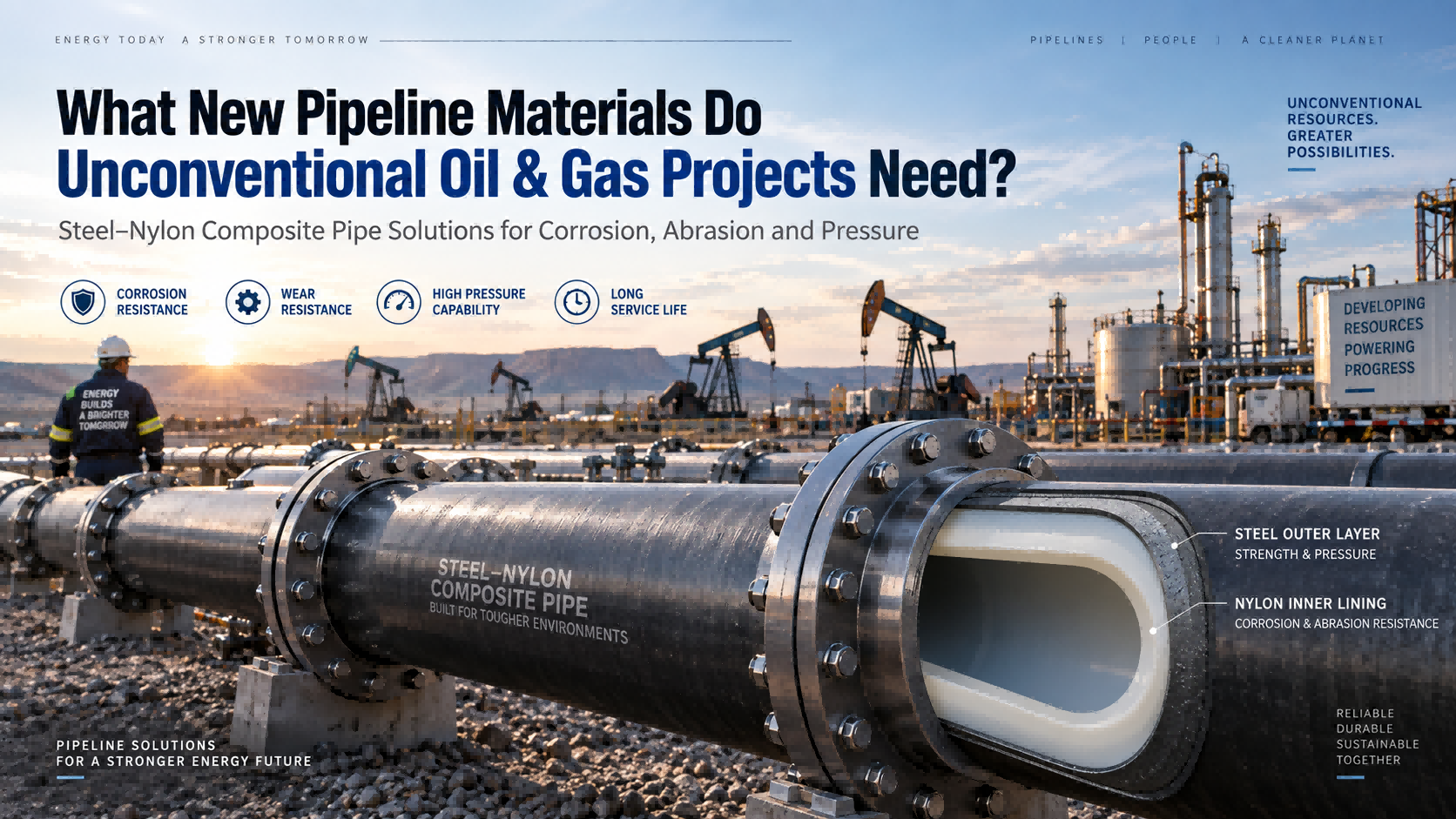
What New Pipeline Materials Do Unconventional Oil & Gas Projects Need?
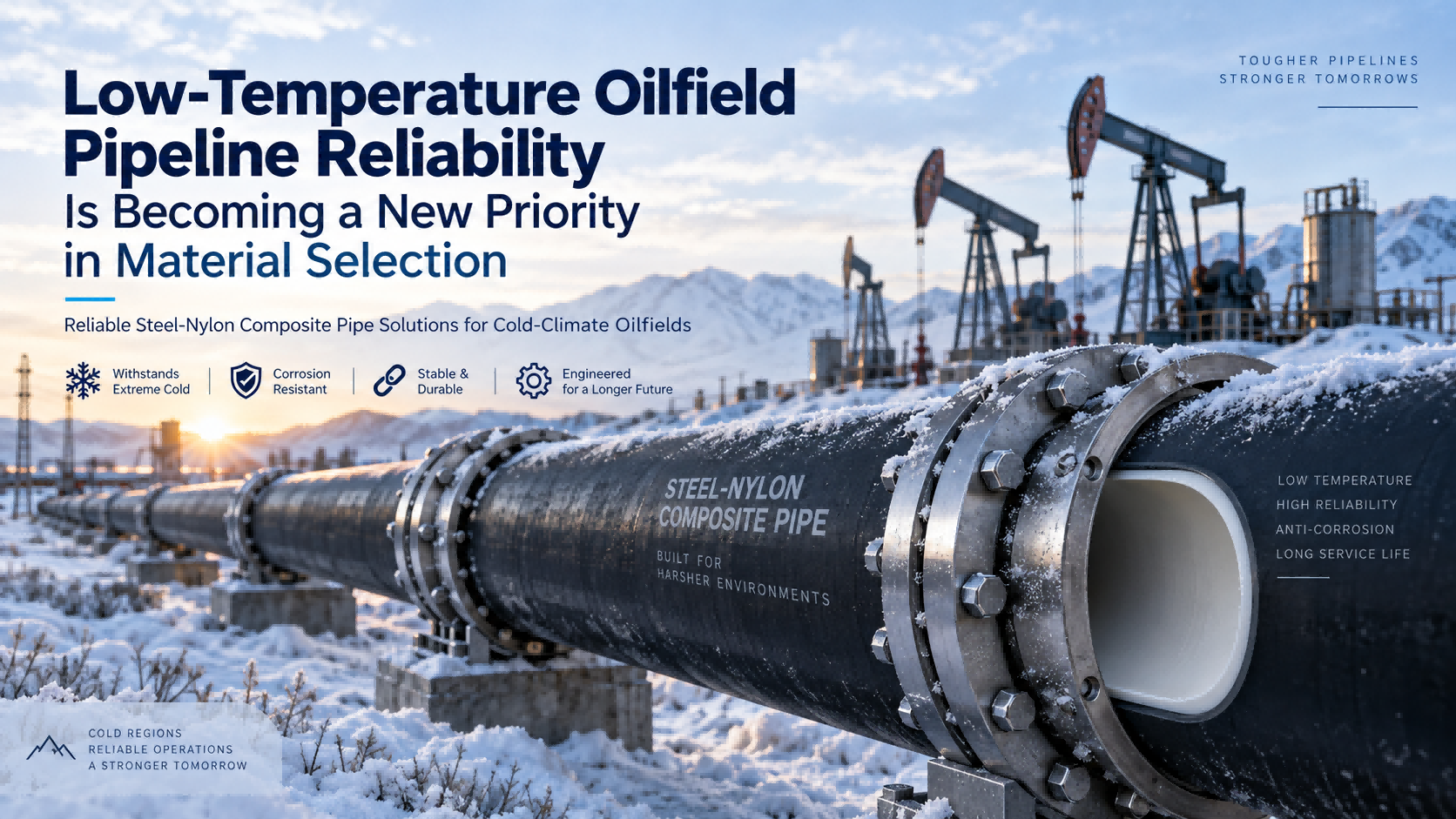
Low-Temperature Oilfield Pipeline Reliability Is Becoming a New Priority in Material Selection