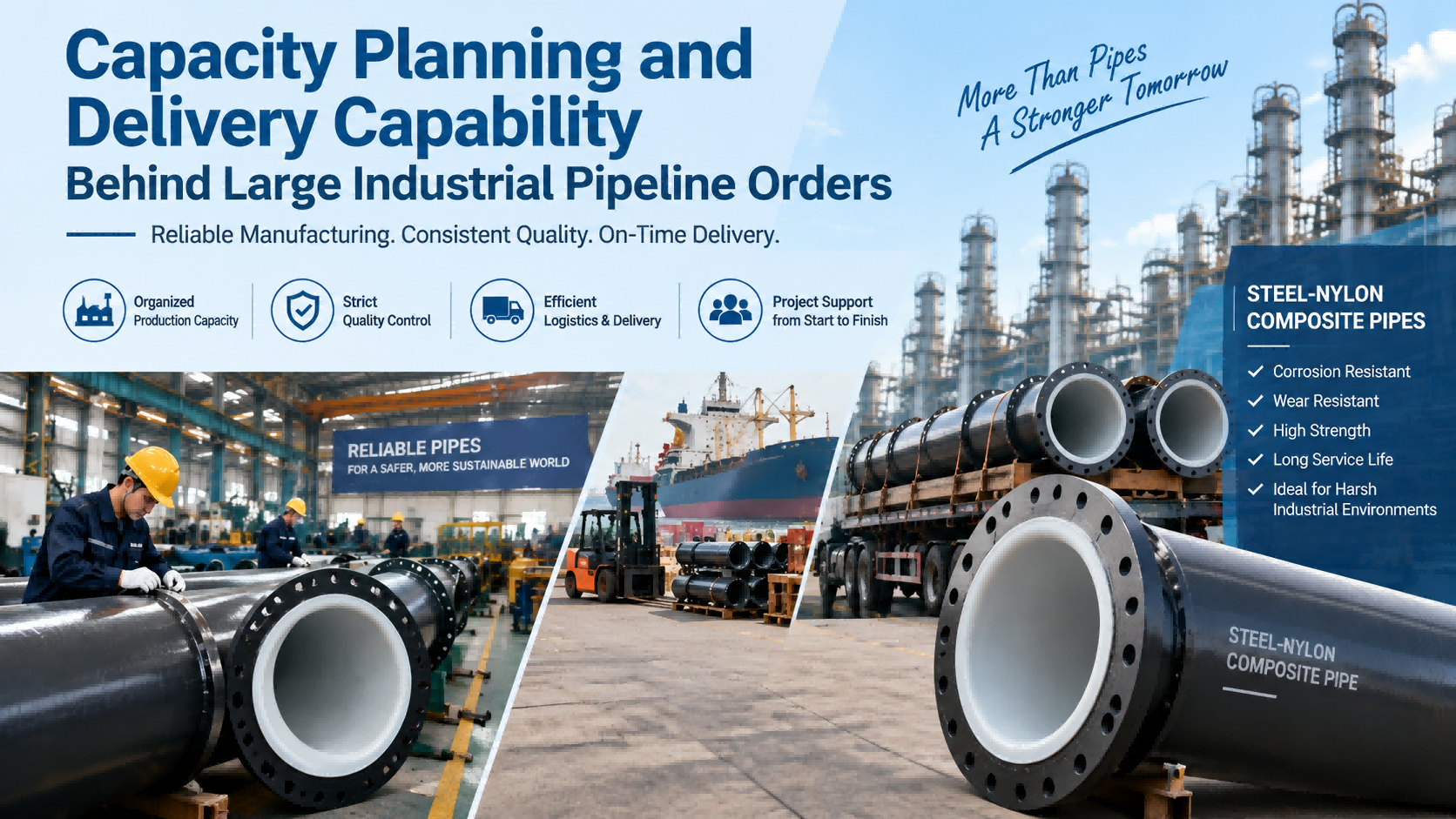
How Are DN2000 Ultra-Large-Diameter Industrial Pipes Manufactured?

In large-scale industrial sectors such as petrochemicals, mining and metallurgy, municipal water supply, and marine engineering, DN2000 (2‑meter diameter) and even larger pipes are indispensable. They serve as the main arteries for transporting crude oil, natural gas, mineral slurries, chemical media, and urban water supply. However, manufacturing such a “steel giant” – two metres in diameter, with considerable wall thickness and lengths of tens of metres – is far more complex than one might imagine. Today, we take an in‑depth look at the manufacturing processes for DN2000 super‑large‑diameter industrial pipes, and at an innovative solution that is reshaping the industry landscape: **steel‑nylon composite pipes**.
1. Manufacturing Challenges for DN2000 Pipes
Manufacturing DN2000‑class pipes first presents a formidable forming challenge. Unlike smaller‑diameter pipes, which can be produced by seamless rolling or continuous welding, the diameter of DN2000 pipes already exceeds the processing limits of conventional equipment.
The mainstream production route is **steel plate rolling and welding**. In essence, thick steel plates are rolled into cylindrical shapes using large plate‑rolling machines, and then the longitudinal seams are welded to form pipe sections. But this process is by no means as simple as “roll and weld”.
During the forming of super‑large‑diameter, thick‑wall steel pipes, several issues arise: the forming process for asymmetric pipe ends is cumbersome; the conventional three‑roll bending process is complex; and weld inspection efficiency is low. All these lead to poor forming efficiency and difficulties in ensuring precision. Specifically, manufacturing a single DN2000 pipe involves dozens of steps, including **modelling, cutting, rolling, welding, inspection, shot blasting, cleaning, coating, and end grinding**.
In the rolling stage, traditional methods often require three or four steel plates to be rolled into separate curved segments, which are then welded together. This is not only time‑consuming and labour‑intensive, but also carries significant safety risks. Today, advanced CNC three‑roll bending technology, using PLC control, can call up pre‑set parameters for various pipe specifications on a single machine, directly completing the head‑end and tail‑end forming and the overall cylindrical rolling – greatly improving efficiency.
In the welding stage, the main forming methods for large‑diameter longitudinal seam welded pipes include the UOE process, the JCOE process, and roll‑forming. Among these, roll‑forming requires relatively low investment, has a small equipment footprint, and offers a wide range of possible diameters. However, it also has drawbacks such as large pipe‑opening gaps and a tendency for edge misalignment. For weld inspection, traditional single‑probe ultrasonic testing is inefficient; nowadays, phased‑array ultrasonic testing technology enables high‑sensitivity dynamic focusing scanning over a large area.
In surface treatment, internal shot blasting for super‑large‑diameter steel pipes faces problems such as the large quantity of steel shot required and the difficulty of cleaning. Spray coating efficiency is also far lower than for smaller pipes. New self‑circulating shot‑blasting technology and simultaneous internal/external coating systems are gradually resolving these pain points.
Even when these manufacturing difficulties are overcome, traditional carbon steel pipes still face severe challenges in industrial service – **corrosion and wear**. In chemical plants, mines, oilfields, and other highly corrosive and abrasive conditions, ordinary steel pipes often have a service life of only a few years.
2. Steel‑Nylon Composite Pipes: A Better Solution for the DN2000 Era
It is against this backdrop that **steel‑nylon composite pipes** have emerged, offering an innovative solution that combines the strength of steel with the corrosion and wear resistance of nylon – an ideal choice for super‑large‑diameter industrial pipelines.
What is a Steel‑Nylon Composite Pipe?
A steel‑nylon composite pipe is a novel type of pipe that integrates the high strength of steel with the excellent corrosion and wear resistance of nylon. Its typical structure consists of an outer steel pipe and an inner nylon liner, which is tightly bonded to the steel inner wall by processes such as centrifugal casting. More advanced steel‑reinforced nylon pipes embed a metal framework or wire mesh within the nylon wall, forming a “nylon‑steel skeleton‑nylon” sandwich structure that greatly enhances the pipe’s pressure resistance and structural strength.
Breakthroughs in Manufacturing Technology
The core manufacturing process for steel‑nylon composite pipes is **centrifugal casting technology**. Caprolactam is melted and dehydrated, and appropriate reinforcing agents and catalysts are added to produce modified MC nylon. Under atmospheric pressure, the molten nylon polymer is evenly cast onto the inner wall of the steel pipe using a centrifugal casting process. Under the action of centrifugal force, the nylon forms a uniform, dense, and smooth lining layer that is firmly integrated with the steel substrate.
The advantage of this process is that **it can produce a tightly bonded, integrally formed composite pipe under controlled factory conditions**, effectively overcoming the shortcomings of traditional anti‑corrosion coatings, which often fail at welded joints and are highly dependent on installation quality.
More importantly, this technological approach has already been successfully scaled up for **DN2000 and even larger diameters**. The industry now has the capability to produce series of special‑purpose pipes with diameters up to DN2000mm and above, and pressure ratings from 1.0 to 4.0 MPa.
3. Six Core Advantages of Steel‑Nylon Composite Pipes
1. Excellent Corrosion Resistance
In the petroleum, chemical, and salt‑chemical industries, pipes face extreme corrosive environments – strong acids, strong alkalis, and high salinity. In high‑temperature, high‑salinity oilfield produced water (with mineralisation levels as high as tens of thousands or even hundreds of thousands mg/l), corrosion of traditional steel pipes is a critical problem. The nylon liner of steel‑nylon composite pipes has outstanding chemical stability, effectively shielding the corrosive medium and providing intrinsic corrosion resistance. In actual service, the earliest installed steel‑nylon composite pipes have been in continuous operation for **23 years** without any corrosion‑related leakage.
2. Superior Wear Resistance
In mining, metallurgy, and dredging, pipelines often transport slurries and tailings containing large amounts of solid particles, which cause severe abrasive wear on the pipe wall. The wear resistance of steel‑nylon composite pipes is **4 to 8 times** that of ordinary steel. This advantage translates into a service life several times longer under the same operating conditions, dramatically reducing replacement frequency and maintenance costs.
3. Perfect Combination of Steel Strength and Nylon Functionality
Steel‑nylon composite pipes retain the high strength and high pressure‑bearing capacity of steel, while gaining nylon’s self‑lubricating, anti‑scaling, and wide‑temperature performance. Their applicable temperature range spans from **‑50°C to 150°C**, far outperforming conventional steel‑lined PE pipes (generally limited to below 40°C). The smooth nylon inner surface also significantly reduces fluid friction, offering energy savings of over 20% compared to traditional steel pipes.
4. Feasibility of Large‑Diameter Manufacturing
Steel‑nylon composite pipe technology has successfully broken through the bottleneck of large‑diameter production, enabling serialised manufacturing of DN2000 and larger specifications. This fills a gap in the domestic and international market for large‑diameter nylon pipes, allowing even super‑sized pipelines to benefit from the performance advantages of composite materials.
5. Convenient Installation and Construction
Steel‑nylon composite pipes can be joined using standard flanged connections or welding, offering strong adaptability and flexible construction methods. Their relatively light weight makes installation easier. They are suitable not only for long‑distance transmission pipelines, but also for complex station piping, such as manifolds and vessels.
6. Life‑Cycle Cost Advantage
Although the initial investment for steel‑nylon composite pipes may be higher than that for ordinary carbon steel pipes, their exceptionally long service life (over 20 years), extremely low maintenance frequency, and energy‑saving operation mean that the total life‑cycle cost is significantly lower than that of traditional pipe solutions. This economic advantage has been fully validated in real applications in the salt‑chemical and oilfield industries.
Conclusion
The manufacture of DN2000 super‑large‑diameter industrial pipes – from traditional steel‑plate rolling and welding to the innovative steel‑nylon composite solution – reflects continuous progress in materials science and manufacturing technology. Steel‑nylon composite pipes, with **the strength of steel and the corrosion and wear resistance of nylon**, are becoming the new‑generation choice for super‑large‑diameter pipelines in heavy industries such as chemicals, mining, oilfields, power generation, and seawater treatment.
If you are seeking a reliable large‑diameter pipe solution for highly corrosive or abrasive service conditions, steel‑nylon composite pipes deserve serious consideration. They are not just pipes; they represent a comprehensive upgrade in reliability, economy, and sustainability for industrial conveying systems.
From Raw Material Inspection to Final Delivery: The Complete Quality Control Process for Industrial Piping
Inside the Factory: A Complete Guide to the Steel-Nylon Composite Pipe Manufacturing Process