How Are Pipeline Materials Changing in Thermal Power Plant Flue Gas Desulfurization Systems?
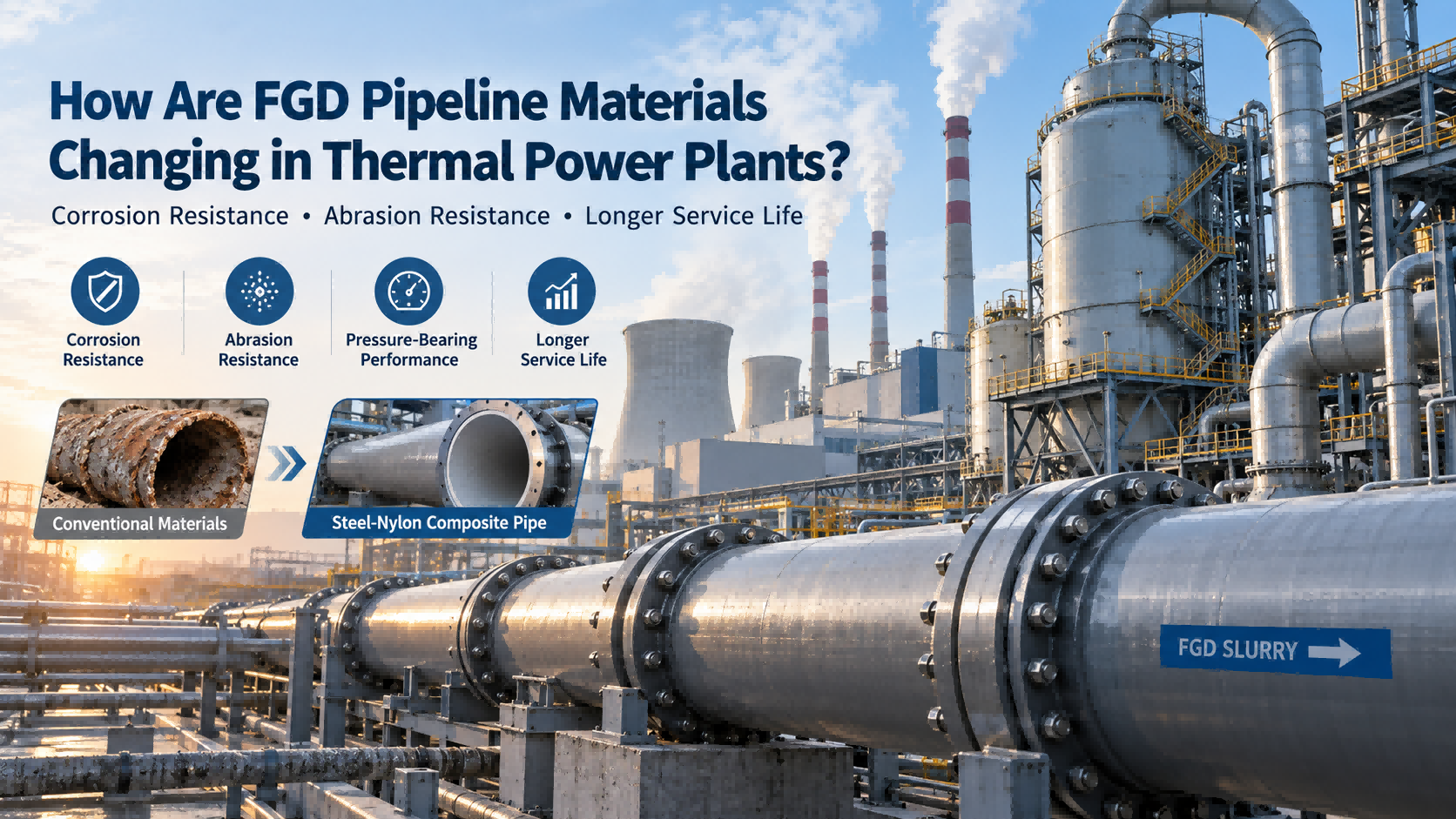
In wet flue gas desulfurization (WFGD) systems used in thermal power plants, pipelines are far more than ordinary industrial fluid transport lines.
Limestone slurry, gypsum slurry, desulfurization wastewater, and circulating slurry may simultaneously contain chloride ions, sulfates, suspended solids, abrasive particles, and acidic components.
As a result, FGD pipelines are not exposed to a single corrosion mechanism. Instead, they operate under a complex combination of:
corrosion, erosion, abrasion, scaling, deposition, mechanical loading, and localized stress.
This is why an increasingly important question is being raised in power plants:
Should FGD piping still be selected primarily according to traditional corrosion-resistance criteria?
The answer is gradually changing.
1. In the Past: The Primary Objective Was Corrosion Resistance
Wet limestone-gypsum FGD systems typically operate in humid environments containing chloride ions and suspended solid particles.
Historically, therefore, the basic philosophy behind FGD pipeline material selection was straightforward:
Solve the corrosion problem first.
This led to the widespread use of materials and structures such as:
-
Rubber-lined carbon steel pipe
-
FRP / fiberglass reinforced plastic pipe
-
Stainless steel pipe
-
High-alloy materials
-
Lined or coated steel pipe
These materials remain widely used today and can provide excellent performance when correctly matched to operating conditions.
However, after years of operation, many power plants have discovered an important reality:
Solving corrosion does not necessarily solve the pipeline service-life problem.
The real challenge is that corrosion and abrasion frequently occur at the same time.
2. Change No. 1: From “Corrosion Resistance” to “Corrosion + Abrasion Resistance”
This is one of the most important changes taking place in FGD pipeline material selection.
The circulating medium in a WFGD system is not a clean liquid.
Limestone particles, gypsum crystals, and suspended solids continuously travel through the piping system.
Abrasion and localized erosion can become particularly severe at:
-
Circulation pump outlets
-
Pipe elbows
-
Tees
-
Reducers
-
High-velocity sections
-
Slurry return lines
-
Gypsum discharge pipelines
At these locations, changes in flow direction and velocity can significantly increase particle impact against the pipe wall.
Therefore, asking only:
“Is this material corrosion resistant?”
is no longer sufficient.
A more useful engineering question is:
Can the pipeline withstand corrosive media, solid-particle abrasion, hydraulic pressure, and mechanical loads simultaneously over a long operating period?
This shift is fundamentally changing how FGD piping materials are evaluated.
3. Change No. 2: Rubber-Lined Steel Is Moving from a Default Solution to a Condition-Specific Solution
Rubber-lined carbon steel has long been an important option for FGD slurry transportation.
Its structural principle is simple:
The steel provides mechanical strength, while the rubber lining isolates the corrosive medium from the steel substrate.
This solution is mature and supported by substantial engineering experience.
However, its long-term performance depends heavily on one factor:
The integrity of the lining.
Potential problems can include:
-
Lining wear-through
-
Blistering
-
Delamination
-
Cracking
-
Joint damage
-
Local mechanical damage
Once the lining is damaged, the transported medium may come into direct contact with the carbon-steel substrate.
A typical deterioration process may then develop:
Lining damage → steel exposure → substrate corrosion → localized expansion of damage → repair or replacement
The risk may become more significant at elbows, reducers, tees, and other high-velocity locations.
For this reason, many plant owners are gradually shifting their focus from:
“How thick is the lining?”
to:
“How many inspections, repairs, and replacements will this pipeline require throughout its operating life?”
That is a much more important question from a lifecycle perspective.
4. Change No. 3: FRP Remains Important, but Mechanical Impact and Abrasion Are Receiving More Attention
FRP is a well-established material in FGD applications.
Its main advantages include:
-
Excellent corrosion resistance
-
Low weight
-
Good resistance to chloride-containing environments
-
Relatively convenient installation
As a result, FRP has been widely used for:
-
FGD slurry piping
-
Spray headers
-
Absorber towers
-
Flue ducts
-
Storage tanks
However, slurry transportation places requirements on pipelines that go beyond chemical resistance.
FRP may simultaneously need to withstand:
chemical corrosion + particle abrasion + water hammer + support loads + installation impact.
Therefore, engineers are increasingly evaluating not only whether FRP can resist the chemical environment, but also whether it can maintain long-term reliability under abrasive slurry service and mechanical loading.
In other words:
Corrosion resistance is only the first question. Mechanical durability and abrasion resistance are becoming equally important.
5. Change No. 4: Stainless Steel Selection Is Becoming More Dependent on Chloride Levels and Specific Service Conditions
Another major change is taking place in the use of stainless steel.
A common assumption in industrial piping is:
Stainless steel does not corrode easily.
But in wet FGD environments, this conclusion is incomplete.
The system may contain:
-
High chloride concentrations
-
Acidic condensate
-
Sulfates
-
Wet-dry cycling
-
Temperature fluctuations
-
Local concentration of corrosive ions
Under these conditions, the protective passive film on stainless steel can be challenged.
This means modern stainless-steel selection for FGD systems is gradually shifting from:
“Should stainless steel be used?”
to:
“What alloy grade is required for the actual chloride concentration, pH, temperature, and erosion conditions at this location?”
316L stainless steel, duplex stainless steel, high-molybdenum alloys, and nickel-based alloys should not simply be viewed as increasingly expensive versions of the same material.
They represent different corrosion-resistance ranges for different service environments.
6. Change No. 5: From One Material for the Entire System to Zoned Material Selection
This is another important trend in large FGD projects.
Operating conditions can vary considerably between different sections of a single desulfurization system.
For example:
| FGD System Location | Primary Challenge |
|---|---|
| Limestone slurry pipeline | Particle abrasion and deposition |
| Circulation pump outlet | High velocity and severe erosion |
| Absorber circulation slurry | Corrosion + abrasion |
| Gypsum slurry pipeline | Solid-particle wear |
| FGD wastewater pipeline | High chloride and high salinity |
| Flue gas condensation area | Acidic condensate corrosion |
| Elbows and tees | Localized erosion |
| Large-diameter main pipeline | Pressure resistance and structural stability |
Therefore, a more rational design philosophy is no longer:
“Use one material throughout the entire FGD system.”
Instead:
Select materials according to the specific medium, failure mechanism, and operating conditions of each pipeline section.
The future of FGD material selection is therefore unlikely to involve one material completely replacing all others.
Instead, different materials will compete according to where they provide the greatest technical and economic value.
7. Change No. 6: Steel-Nylon Composite Pipe Offers a Different Structural Approach
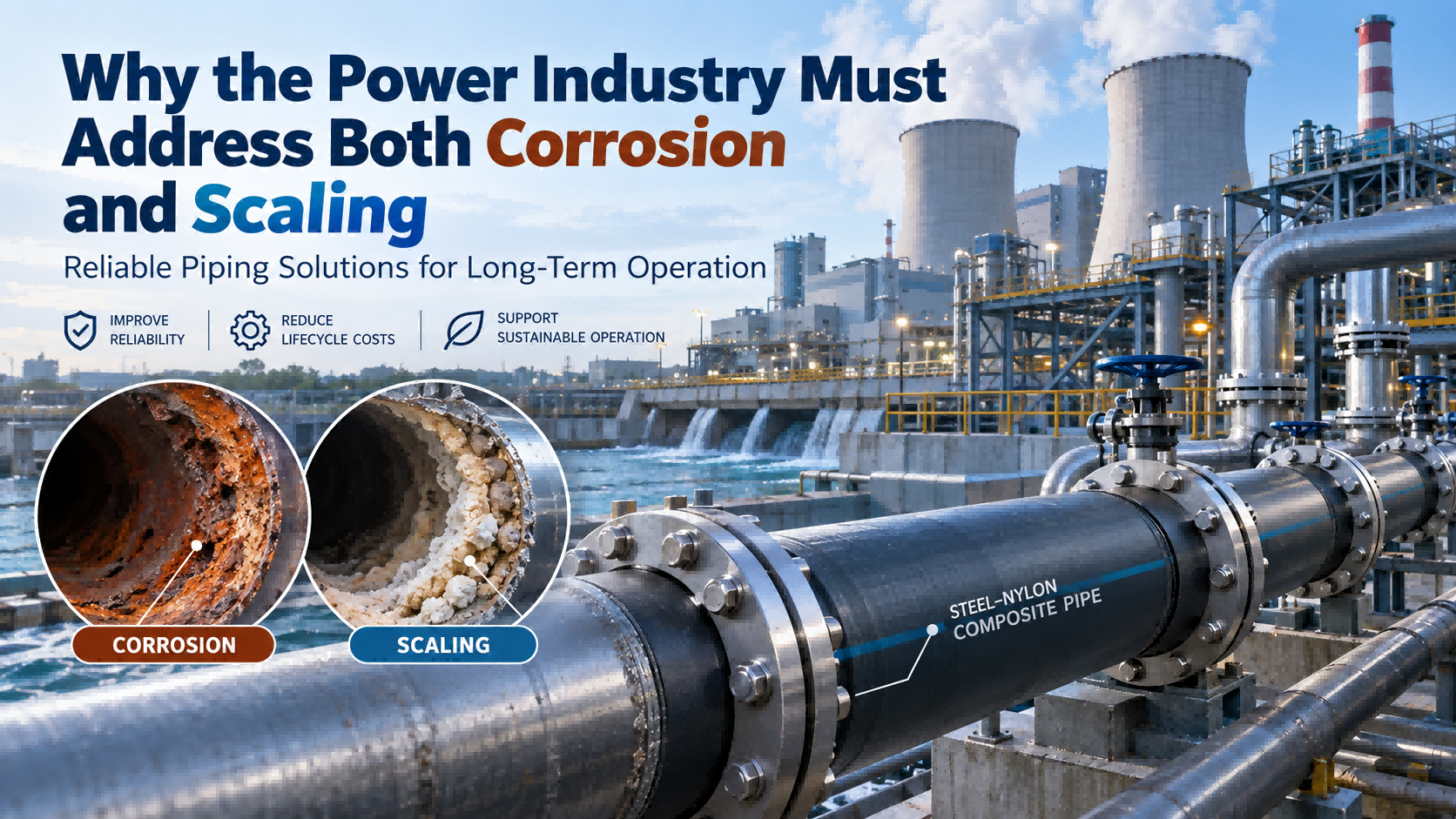
Against this background, steel-nylon composite pipe deserves to be included in the material evaluation process for certain FGD slurry applications.
It is not simply a conventional steel pipe with an additional anti-corrosion coating.
Its fundamental design philosophy is:
Let the steel structure handle mechanical strength and pressure, while the nylon working layer faces the transported medium, corrosion, and abrasive particles.
In other words, each material performs the function for which it is best suited.
8. The Steel Structure Provides Pressure Resistance and Rigidity
For large-diameter slurry pipelines, corrosion resistance alone is not enough.
The pipeline may also need to withstand:
-
Operating pressure
-
Vacuum conditions
-
Pipe dead weight
-
Slurry weight
-
Support spacing
-
Water hammer
-
Valve loads
-
Installation loads
Steel provides mature structural properties and extensive engineering design experience.
In a steel-nylon composite pipe, the steel structure therefore provides the main mechanical support and pressure-bearing capability.
This becomes particularly valuable in large-diameter industrial piping systems where rigidity and structural stability are critical.
9. The Nylon Working Layer Isolates the Steel from the Transported Medium
When aggressive process media remain in direct contact with carbon steel, corrosion allowance and anti-corrosion protection become major design considerations.
A steel-nylon composite structure uses the inner nylon layer to separate the transported medium from the steel structure.
For FGD slurry, saline fluids, industrial wastewater, and other media that are chemically compatible with nylon, this design can reduce direct exposure of the steel substrate to corrosive environments.
However, material compatibility must always be evaluated according to actual operating parameters, including:
-
pH
-
Chemical composition
-
Ion concentration
-
Operating temperature
-
Maximum temperature
-
Pressure
-
Presence of oxidizing agents
-
Solid-particle concentration
No industrial pipeline material should be selected based on corrosion resistance alone without evaluating the actual process conditions.
10. The Most Important Point: Nylon Also Provides Abrasion Resistance
One of the most important differences between FGD slurry transport and conventional chemical liquid transport is the presence of large quantities of solid particles.
This is where steel-nylon composite piping can provide an important advantage.
The reinforced nylon working layer does more than simply isolate corrosive media.
Its material characteristics can also help resist continuous friction and particle impact generated by slurry transportation.
The design therefore attempts to address:
Corrosion + Abrasion
rather than only:
Corrosion
This makes the concept particularly relevant for applications such as:
-
Limestone slurry
-
Gypsum slurry
-
FGD circulation slurry
-
High-solid-content process slurry
For these services, abrasion performance can be just as important as chemical resistance.
11. Why Is an Integrated Flange Structure Important?
In many slurry piping systems, the most vulnerable area is not necessarily the straight pipe section.
It is often the:
connection point.
Complex connection structures can introduce problems such as:
-
Local corrosion
-
Discontinuity of the internal protective layer
-
Stress concentration
-
Variations in installation quality
-
Greater maintenance difficulty
For this reason, flange and pipe-end design are particularly important in steel-nylon composite piping systems.
A properly designed flanged connection can help reduce field welding requirements while also simplifying:
-
Pipeline installation
-
Individual section replacement
-
Valve connections
-
Equipment maintenance
-
System inspection
This can be particularly valuable for retrofit projects in operating thermal power plants.
Many FGD projects today are no longer completely new installations.
They are:
upgrades to aging pipeline systems.
Reducing shutdown duration and installation complexity therefore becomes part of the material-selection decision.
12. The Criteria for Comparing FGD Pipeline Materials Are Changing
Traditionally, many projects focused heavily on one question:
How much does the pipe cost per meter?
However, a more meaningful comparison is:
Cost per unit of service life.
A simplified pipeline lifecycle cost model may be expressed as:
Pipeline TCO =
Initial pipe cost
-
Installation cost
-
Inspection cost
-
Repair cost
-
Lining maintenance cost
-
Replacement cost
-
Shutdown losses
-
Spare-parts inventory cost
This explains why the pipeline with the lowest initial purchase price does not necessarily deliver the lowest overall project cost.
13. How Should Different FGD Pipeline Materials Be Evaluated?
There is no single material that is ideal for every FGD pipeline.
A more engineering-oriented comparison is shown below:
| Material | Main Advantages | Key Factors to Evaluate |
|---|---|---|
| Carbon Steel | High strength, mature supply chain | Corrosion |
| Rubber-Lined Steel | Steel strength + corrosion protection | Lining wear, delamination, maintenance |
| FRP | Corrosion resistant, lightweight | Impact, abrasion, mechanical loading |
| Stainless Steel | High strength, extensive engineering experience | Chloride pitting, alloy grade, cost |
| High-Alloy Materials | Excellent corrosion resistance | Capital cost |
| Steel-Nylon Composite Pipe | Steel pressure resistance + nylon corrosion and abrasion resistance | Chemical compatibility, temperature, specific operating conditions |
The goal of proper material selection is not to find a so-called universal material.
It is to identify:
The material structure that best matches the dominant failure mechanisms of the actual application.
14. Which FGD Pipelines Should Consider Steel-Nylon Composite Pipe?
For thermal power plant FGD retrofit or new-build projects, several applications may deserve particular evaluation.
14.1 Limestone Slurry Pipelines
Key challenges include:
abrasion + corrosion + solid particles.
These conditions make abrasion resistance particularly important.
14.2 Gypsum Slurry Pipelines
Continuous transportation of solid particles can increase wear rates and maintenance requirements.
Where the chemical composition and operating temperature are suitable for nylon, composite piping can be evaluated as an alternative material structure.
14.3 FGD Circulation Slurry Pipelines
This is a typical service environment where:
corrosion and abrasion occur simultaneously.
It is therefore one of the applications where composite-material design can potentially provide the greatest value.
14.4 FGD Wastewater Pipelines
FGD wastewater may involve:
-
High salinity
-
High chloride concentrations
-
Aggressive corrosion conditions
Chemical compatibility and reliable joint design therefore become especially important.
14.5 Aging FGD Pipeline Replacement Projects
If an existing pipeline system is experiencing:
-
Frequent leak repairs
-
Repeated lining maintenance
-
Rapid elbow wear
-
Short replacement cycles
the key engineering question should not simply be:
“Which pipe should we replace it with?”
Instead, the first question should be:
Why did the existing pipeline fail?
Once the dominant failure mechanism has been identified, a more appropriate material system can be selected.
15. The Future Competition Is About Reducing Maintenance, Not Simply Reducing Pipe Price
For a thermal power plant operating continuously, the greatest value of pipeline material may not be visible on the day it is purchased.
Its real value may become apparent over the following:
5 years, 10 years, or even longer.
If a material upgrade prevents:
-
One unexpected leakage event
-
One shutdown for pipeline repair
-
One major lining restoration
-
One complete pipeline-section replacement
the resulting economic value may already exceed the original difference in pipe purchase price.
For this reason, future FGD pipeline material selection will increasingly focus on three indicators:
1. Service Life
How long can the pipeline maintain reliable operation?
2. Maintenance Frequency
How frequently does it require inspection, repair, or replacement?
3. Total Cost of Ownership
What is the actual cost of the pipeline throughout its lifecycle?
Rather than focusing exclusively on:
Initial Pipe Price
This represents an important change in industrial pipeline procurement philosophy.
16. What Is Really Changing in FGD Pipeline Materials?
The current transformation in FGD piping can be summarized in one sentence:
Thermal power plant FGD pipelines are moving from single-purpose corrosion-resistant material selection toward integrated designs that consider corrosion, abrasion, pressure resistance, structural reliability, and lifecycle cost simultaneously.
Several broader trends can be identified:
From corrosion protection → corrosion and abrasion control
From single materials → composite structures
From uniform material selection → application-specific material zoning
From purchase price → total lifecycle cost
From reactive maintenance → long-service-life design
This is why steel-nylon composite pipe deserves consideration in future FGD pipeline material evaluations.
Its value does not come from claiming to universally replace FRP, rubber-lined steel, or stainless steel.
Instead, its potential lies in certain pipeline sections where engineers must address three requirements simultaneously:
Corrosion + Abrasion + Pressure Resistance
For these demanding operating conditions, steel-nylon composite pipe provides another technical route for engineers to evaluate.
Conclusion
The evolution of pipeline materials in thermal power plant FGD systems is not simply about replacing one type of pipe with another.
The deeper change is that the industry is developing a more comprehensive understanding of pipeline failure mechanisms.
When corrosion, abrasion, chloride concentration, slurry particles, pressure, hydraulic impact, structural loading, and maintenance costs are considered within the same engineering framework, traditional single-factor material-selection methods inevitably become less effective.
For thermal power plants planning new FGD systems, capacity expansions, or aging pipeline upgrades, instead of asking:
“What is the best FGD pipe material?”
it is more useful to first answer the following questions:
-
What exactly is the transported medium?
-
What is the solids concentration?
-
What is the particle size distribution?
-
What are the normal and maximum operating temperatures?
-
What are the operating and design pressures?
-
What is the chloride concentration?
-
What is the pipeline flow velocity?
-
Where has previous wear or leakage occurred?
-
What service life is required?
-
What is the cost of one unplanned shutdown?
Only after these questions have been answered can pipeline material selection evolve from:
Pipe Purchasing
to:
Pipeline Lifecycle Engineering.
For FGD slurry transportation systems that simultaneously require corrosion resistance, abrasion resistance, and pressure-bearing capability, steel-nylon composite pipe deserves consideration as one of the candidate solutions for material selection, pilot-section testing, and long-term lifecycle evaluation.
Aging Circulating Water Systems Are Driving Pipeline Upgrades in Power Plants
Application Trends of Large-Diameter Wear-Resistant Pipelines in Mining Projects