Aging Circulating Water Systems Are Driving Pipeline Upgrades in Power Plants
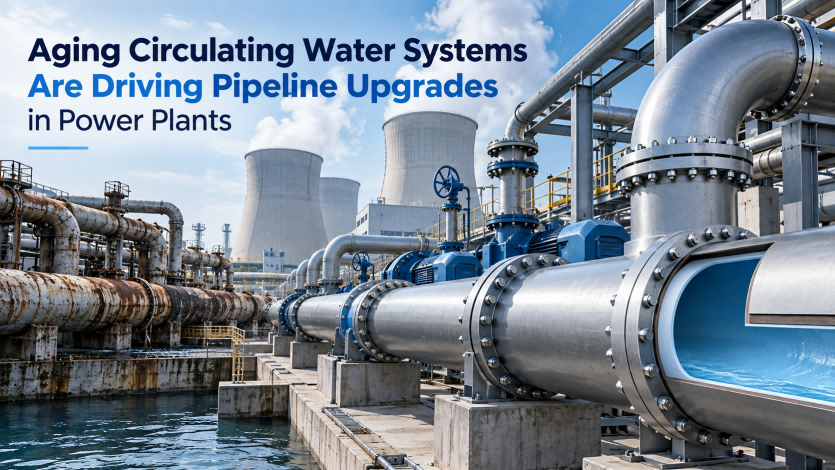
In many thermal power plants, combined heat and power plants, and industrial captive power stations that have been operating for more than 10 or even 20 years, circulating water systems are gradually entering a period of concentrated aging.
In the past, circulating water piping was often considered a relatively low-risk auxiliary system compared with boilers, steam turbines, main steam lines, and high-pressure feedwater systems.
Because the operating pressure of circulating water systems is usually moderate, early project designs often focused more on initial investment than on corrosion, erosion, scaling, maintenance, and replacement costs over a service life of 20 years or longer.
However, as power plants continue to age, many operators are discovering an increasingly important reality:
The long-term reliability of circulating water pipelines is determined not only by design pressure, but by the combined effects of corrosion, water quality, flow velocity, sediment, erosion, local geometry, and long-term operation.
As a result, circulating water system rehabilitation is gradually shifting from simple replacement of old pipes to a more systematic material upgrade strategy.
The key engineering question is no longer simply which pipe is cheaper.
Instead, power plants increasingly need to balance:
-
corrosion resistance;
-
abrasion and erosion resistance;
-
mechanical strength;
-
installation reliability;
-
pressure capability;
-
large-diameter structural stability;
-
and total lifecycle cost.
For these applications, steel-nylon composite pipe provides an alternative material solution worth evaluating.
1. Why Are More Power Plants Facing Aging Circulating Water Pipelines?
Circulating water systems are responsible for transporting large volumes of cooling water to condensers, auxiliary cooling equipment, heat exchangers, and other process equipment.
Typical characteristics include:
-
large pipe diameters;
-
high flow rates;
-
continuous long-term operation;
-
limited maintenance shutdown windows;
-
varying water quality;
-
numerous elbows, tees, valves, and reducers;
-
humid operating environments;
-
and potentially significant consequences when leakage occurs.
During the early years of operation, many of these problems may not be obvious.
As the system ages, however, material deterioration gradually becomes more visible.
For example:
Carbon steel pipelines may experience internal corrosion, external corrosion, and progressive wall thinning.
Rubber-lined or plastic-lined steel pipes may suffer from aging, delamination, blistering, or localized lining failure.
FRP piping may be affected by impact damage, installation quality, local loading, or long-term fatigue.
Thermoplastic piping can offer excellent corrosion resistance, but large-diameter applications may require additional consideration of structural stiffness, support spacing, temperature, pressure, and long-term creep.
This leads to an important conclusion:
Upgrading a circulating water system is not simply about finding a pipe that does not rust. The real objective is to select a piping material capable of handling high flow, corrosion, erosion, pressure, mechanical loads, and long-term operation at the same time.
2. Five Common Aging Problems in Circulating Water Systems
2.1 Internal Corrosion and Progressive Wall Thinning
When carbon steel pipelines transport circulating water for long periods, corrosion usually develops gradually rather than instantaneously.
If the circulating water contains:
-
chloride ions;
-
dissolved oxygen;
-
salts;
-
microorganisms;
-
suspended solids;
-
or other corrosive constituents;
internal corrosion may accelerate.
In open circulating water systems, make-up water quality, evaporation, concentration cycles, and changes in water chemistry can further alter the corrosion environment.
Over time, the result can be:
progressive pipe wall thinning and an increasing probability of leakage.
More importantly, corrosion is often not uniform.
Severe deterioration frequently develops around:
-
welds;
-
the bottom of horizontal pipes;
-
sediment accumulation zones;
-
elbows;
-
tees;
-
valve locations;
-
and areas where flow velocity changes suddenly.
This means that even when the main pipeline appears to remain operational, some localized sections may already be approaching failure.
2.2 Corrosion and Erosion Often Occur Simultaneously
Circulating water is not always clean water.
Depending on the system, it may contain:
-
sand;
-
rust particles;
-
scale;
-
suspended solids;
-
biological deposits;
-
and particles generated by water treatment processes.
When these particles move through a pipeline at significant velocity, they can continuously erode the pipe surface.
The problem is particularly severe at:
-
elbows;
-
tees;
-
pump discharge sections;
-
reducers;
-
and downstream sections of valves.
This explains why many circulating water pipelines do not fail first in long straight sections.
Instead, leakage and wall penetration often develop first in local high-velocity or high-turbulence areas.
This failure mechanism is essentially the combined result of:
corrosion + erosion + hydraulic impact.
Therefore, solving corrosion alone may not be enough to ensure the long-term reliability of a circulating water system.
2.3 Scaling Can Reduce Hydraulic Efficiency
Another frequently overlooked problem is internal scaling.
A pipeline may not be leaking, but its transportation efficiency may already be declining.
As scale, biological films, corrosion products, and deposits accumulate on the internal surface, the effective flow area may gradually decrease.
At the same time, internal surface roughness can increase.
Under the same flow requirement, this may result in:
-
higher hydraulic resistance;
-
increased pumping energy consumption;
-
reduced hydraulic efficiency;
-
and changes in local flow velocity.
If the problem persists for many years, the operating cost of the circulating water system may continue to rise.
For this reason, internal surface condition should also be considered when selecting materials for a pipeline upgrade.
3. Why Is Upgrading Large-Diameter Circulating Water Pipelines Particularly Difficult?
Power plant circulating water systems commonly use DN500, DN800, DN1000, and even larger pipelines.
The larger the diameter, the more complex the material selection process becomes.
Engineers must evaluate not only chemical compatibility but also:
-
pipe stiffness;
-
vacuum resistance;
-
water hammer;
-
support spacing;
-
equipment connections;
-
valve loads;
-
thermal expansion and contraction;
-
foundation settlement;
-
flange loads;
-
installation tolerances;
-
and lifting conditions.
This is why:
A material that is corrosion-resistant is not automatically suitable for a large power plant circulating water system.
For large-diameter industrial pipelines, structural performance must be considered together with corrosion resistance.
This is one of the reasons composite piping systems are attracting increasing attention.
4. Why Are More Circulating Water Projects Considering Composite Pipes?
Traditional pipe materials often share one common limitation:
A single material may struggle to provide every required property simultaneously.
Carbon Steel
Carbon steel offers:
-
high mechanical strength;
-
mature pressure-bearing capability;
-
extensive manufacturing experience in large diameters.
Its primary weakness is:
corrosion.
Stainless Steel
Stainless steel generally provides better corrosion resistance.
However, for large-diameter and extensive piping networks, material costs can become significant.
In chloride-containing environments, localized corrosion mechanisms such as pitting and crevice corrosion may also require careful evaluation.
FRP Pipe
FRP offers good corrosion resistance and relatively low weight.
However, large industrial circulating water systems may require careful consideration of:
-
impact resistance;
-
support design;
-
joints;
-
localized loading;
-
long-term fatigue;
-
and installation quality.
PE-Based Piping
PE-based piping offers good corrosion resistance and lightweight construction.
For large industrial applications, however, engineers may need to evaluate:
-
operating temperature;
-
design pressure;
-
pipe diameter;
-
ring stiffness;
-
support spacing;
-
and long-term creep.
As a result, more projects are considering a different design philosophy:
Instead of requiring one material to perform every function, different materials can be combined so that each material performs the function it is best suited for.
Steel-nylon composite pipe is based on this concept.
5. Why Is Steel-Nylon Composite Pipe Suitable for Circulating Water System Upgrades?
The fundamental design concept of steel-nylon composite pipe can be summarized as:
Steel provides structural strength, while nylon protects against the transported medium.
The steel structure is primarily responsible for:
-
mechanical strength;
-
structural loading;
-
internal pressure;
-
and large-diameter dimensional stability.
The nylon working layer is primarily responsible for:
-
corrosion resistance;
-
wear resistance;
-
isolating the fluid from direct contact with the steel substrate;
-
and improving internal surface characteristics.
This composite structure allows the pipeline to combine selected advantages of traditional metallic piping and engineering polymer piping.
6. Advantage 1: Improved Corrosion Resistance
When ordinary carbon steel pipes transport circulating water directly, the fluid remains in continuous contact with the steel surface.
This creates the conditions for electrochemical corrosion.
The design approach of steel-nylon composite pipe is different:
The nylon working layer separates the conveyed medium from the structural steel layer.
As a result, the fluid comes into contact primarily with the corrosion-resistant nylon layer rather than the steel substrate.
For circulating water, industrial water, and certain saline-water applications, this structure can help reduce the risk associated with internal corrosion of carbon steel.
This is particularly valuable in industrial systems involving:
-
elevated salinity;
-
high chloride concentrations;
-
corrosive water conditions;
-
and continuously humid environments.
7. Advantage 2: Addressing Erosion and Wear at the Same Time
Power plant circulating water upgrades should not focus exclusively on corrosion.
Many localized failures occur in:
-
circulating water pump discharge lines;
-
90-degree elbows;
-
tees;
-
reducers;
-
downstream sections of valves;
-
and other high-velocity areas.
These locations often experience significant particle erosion.
Nylon materials can provide good wear resistance, making steel-nylon composite piping particularly suitable for applications where:
corrosion and erosion occur simultaneously.
This can provide an important advantage over some lining systems that may offer corrosion protection but limited abrasion resistance.
8. Advantage 3: Steel Structure Supports Large-Diameter Pipeline Stability
This is an important distinction between steel-nylon composite pipe and all-plastic piping.
For DN800, DN1000, DN1200, and larger circulating water pipelines, structural stability becomes as important as corrosion resistance.
The steel structural layer can provide:
-
higher rigidity;
-
stronger pressure-bearing capability;
-
stable flange connections;
-
and mature interfaces with industrial equipment.
This can make the pipe particularly suitable for connections involving:
-
pumping stations;
-
valves;
-
condensers;
-
large heat exchangers;
-
and other industrial equipment.
9. Advantage 4: Integrated Flange Structures for Industrial Connections
Power plant circulating water systems typically include many:
-
valves;
-
pumps;
-
condensers;
-
heat exchangers;
-
equipment nozzles;
-
and maintenance points.
Therefore, industrial pipeline reliability depends on more than the pipe body itself.
Flange connection reliability is equally important.
Steel-nylon composite pipe can be designed with integrated flange structures according to project requirements, allowing straight pipes, elbows, tees, valves, and equipment connections to form a complete piping system.
For large industrial circulating water rehabilitation projects, this type of connection structure can fit well with established industrial installation and maintenance practices.
10. Circulating Water System Upgrades Should Not Be Based Only on Pipe Price per Meter
This is one of the most common mistakes in industrial pipeline replacement projects.
For example:
Option A may cost 20% less per meter.
Option B may have a higher initial purchase price.
If the decision is made only on material purchase cost, Option A may appear more attractive.
However, the real cost of a circulating water pipeline should include:
TCO = Material Cost + Installation Cost + Maintenance Cost + Downtime Loss + Replacement Cost + Energy Cost
This is the Total Cost of Ownership.
For a power plant, the most expensive part of a pipeline failure is often not the pipe itself.
It is the cost associated with:
-
emergency repair;
-
production interruption;
-
maintenance manpower;
-
equipment access;
-
system shutdown;
-
and repeated replacement.
Therefore, circulating water system upgrades should increasingly move away from:
lowest initial purchase price
toward:
lowest lifecycle cost.
11. Which Sections Should Be Upgraded First?
For circulating water systems that have already been operating for many years, replacing the entire pipeline network at once is not always necessary.
A more economical strategy may be to prioritize the highest-risk sections.
Stage 1: Identify High-Risk Areas
Priority inspection areas include:
-
pump discharge sections;
-
elbows;
-
tees;
-
downstream sections of valves;
-
low points in the pipeline;
-
areas with long-term water accumulation;
-
high-velocity sections;
-
and areas with known severe corrosion.
Stage 2: Perform Wall Thickness Inspection
A remaining-wall-thickness database can be established through regular inspections.
This helps operators determine:
-
which sections can continue operating;
-
which sections require closer monitoring;
-
and which sections should be replaced first.
Stage 3: Replace High-Risk Sections First
For example, the section from:
circulating water pump discharge → elbow → main pipeline
may experience particularly high flow velocity and erosion.
Replacing these localized high-risk sections first can significantly reduce the initial capital required for a full-system upgrade.
Stage 4: Validate New Materials Through Trial Sections
For large power plant projects, new piping materials can first be evaluated using a controlled trial section.
For example, a representative 100–500 meter section can be installed and monitored under actual operating conditions.
The plant can then evaluate:
-
corrosion performance;
-
wear performance;
-
flange reliability;
-
hydraulic performance;
-
and installation efficiency.
Once stable operating data has been accumulated, application can gradually be expanded to larger sections of the circulating water network.
This approach helps reduce the risk associated with replacing conventional materials with a new piping solution.
12. What Parameters Should Be Evaluated Before a Circulating Water Pipeline Upgrade?
Industrial pipe selection should never be based solely on the material name.
At minimum, the following project data should be collected.
1. Transported Medium
Is the system carrying:
-
freshwater;
-
circulating cooling water;
-
industrial wastewater;
-
seawater;
-
or high-salinity water?
2. Water Chemistry
Important parameters include:
-
pH;
-
chloride concentration;
-
total dissolved solids;
-
suspended solids;
-
hardness;
-
and other corrosive constituents.
3. Temperature
The following should be defined:
-
normal operating temperature;
-
maximum design temperature;
-
minimum ambient temperature.
4. Pressure
This should include:
-
operating pressure;
-
design pressure;
-
water-hammer pressure.
5. Flow Velocity
Special attention should be paid to:
-
pump discharge sections;
-
elbows;
-
tees;
-
and other high-turbulence locations.
6. Pipe Diameter
The engineering logic for DN300 piping is very different from that for DN1600 piping.
Large-diameter pipelines require much greater attention to structural design.
7. Installation Method
Examples include:
-
above-ground installation;
-
buried installation;
-
pipe racks;
-
trenches;
-
and equipment rooms.
Only after these parameters are clearly defined can a meaningful pipe material selection process begin.
13. The Future of Power Plant Circulating Water Systems: Long-Life Design
The traditional maintenance model for circulating water pipelines can often be summarized as:
Corrosion occurs → repair the pipe → continue operating → repair it again.
The problem is that as the system becomes older, maintenance frequency often increases.
Eventually, the accumulated maintenance cost may exceed the value of the pipeline itself.
A more sustainable approach is:
to move from repair-based maintenance toward service-life-oriented design.
This means considering, from the material selection stage, the expected performance over the next 10, 20, or more years in terms of:
-
corrosion;
-
wear;
-
energy consumption;
-
inspection;
-
maintenance;
-
replacement;
-
and downtime.
From this perspective, the value of composite pipe is not simply that it is “corrosion resistant.”
Its greater value lies in:
reducing future maintenance requirements through material and structural design.
14. Potential Applications of Steel-Nylon Composite Pipe in Power Plant Circulating Water Systems
Depending on actual project conditions, steel-nylon composite pipe can be evaluated for several key locations.
Circulating Water Pump Discharge Pipelines
High velocity and hydraulic impact make these areas particularly vulnerable to combined erosion and corrosion.
Main Circulating Water Pipelines
These pipelines typically have large diameters, high flow rates, and long continuous operating periods, making reliability especially important.
Condenser Inlet and Outlet Pipelines
These sections connect directly to critical heat-exchange equipment and therefore require reliable mechanical connections.
Elbows and Tees
Changes in flow direction can significantly increase localized turbulence and erosion.
Industrial Wastewater Pipelines
Certain wastewater streams may contain elevated levels of corrosive components.
Seawater Cooling Systems
Coastal power plants must pay particular attention to chloride-induced corrosion.
These areas may represent suitable locations for evaluating steel-nylon composite pipe.
15. Aging Circulating Water Systems Are Forcing Power Plants to Rethink Pipe Materials
Historically, circulating water systems were not always the first priority in power plant modernization programs.
However, as more power stations enter extended operating periods, one trend is becoming increasingly clear:
The reliability of auxiliary systems can directly affect the operating economics of the entire power plant.
Pipeline corrosion, localized perforation, leakage, and repeated repairs are not merely maintenance problems.
They raise a more fundamental question:
Was the original material selected for the full service life of the system?
Therefore, the key question for future circulating water system upgrades may no longer be:
“What should replace the old carbon steel pipe?”
Instead, it may become:
“Which piping solution can simultaneously address corrosion, wear, pressure, large-diameter structural stability, and long-term maintenance costs?”
This is why steel-nylon composite pipe deserves further evaluation by power plant owners, engineering institutes, EPC contractors, and industrial pipeline designers.
Conclusion
Circulating water piping may appear to be only one part of a power plant's auxiliary systems, but these pipelines often operate with:
-
large flow rates;
-
large diameters;
-
long operating cycles;
-
and limited opportunities for shutdown.
When serious leakage occurs, the resulting maintenance and downtime costs can be far greater than the cost of the pipe itself.
As more power plants enter equipment renewal cycles, circulating water system rehabilitation is gradually shifting from repair-based maintenance toward material and system upgrades.
For circulating water applications involving a combination of:
corrosion, erosion, high flow, large diameter, and continuous long-term operation,
a single conventional material may struggle to provide an optimal balance of all required properties.
Steel-nylon composite pipe uses a different structural approach:
steel for pressure-bearing and structural strength + nylon for corrosion and wear resistance.
For power plants planning circulating water system upgrades, the most important comparison should therefore not be limited to the initial pipe purchase price.
A more meaningful question is:
Which piping solution can reduce leakage, maintenance, shutdowns, and replacement costs over the next 10–20 years?
That is the real engineering objective behind modern circulating water system upgrades.
Engineering Selection Recommendation
Before requesting a quotation or selecting a piping material for a circulating water system upgrade, project owners should prepare the following information:
-
transported medium;
-
water chemistry;
-
operating temperature;
-
design temperature;
-
working pressure;
-
design pressure;
-
pipe diameter;
-
flow rate;
-
flow velocity;
-
water analysis report;
-
installation method;
-
and the primary failure locations of the existing pipeline.
Based on these parameters, the suitability of steel-nylon composite pipe can be evaluated for main pipelines, pump discharge sections, elbows, tees, and high-corrosion zones.
Pressure class, wall thickness, connection structure, and overall pipe design should then be optimized according to the actual operating conditions.
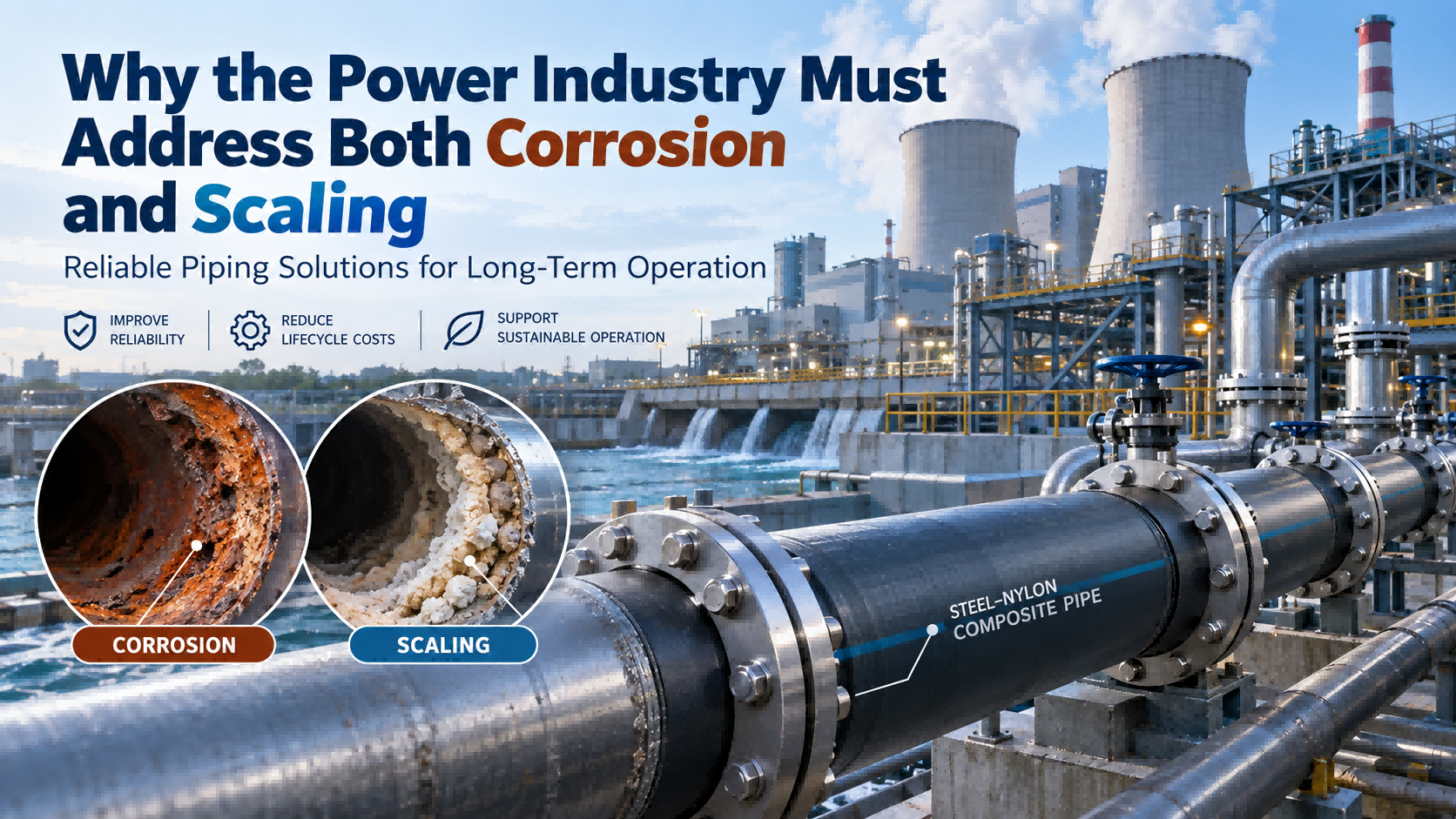
Why the Power Industry Must Address Both Corrosion and Scaling in Piping Systems
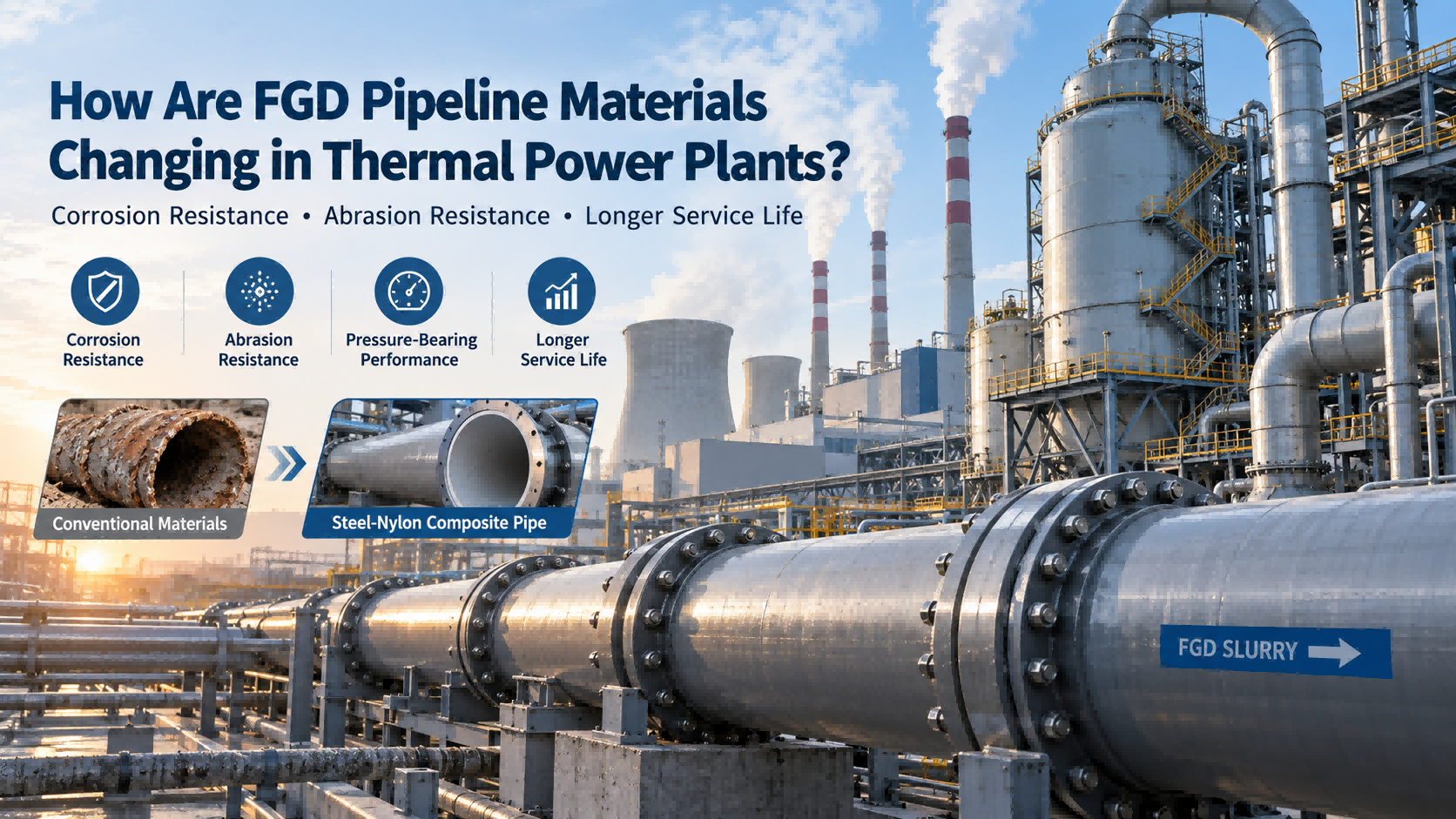
How Are Pipeline Materials Changing in Thermal Power Plant Flue Gas Desulfurization Systems?