Application Trends of Large-Diameter Wear-Resistant Pipelines in Mining Projects
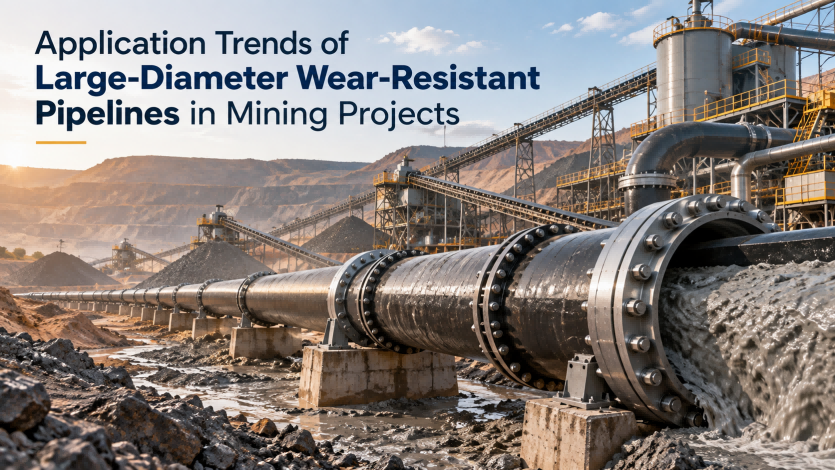
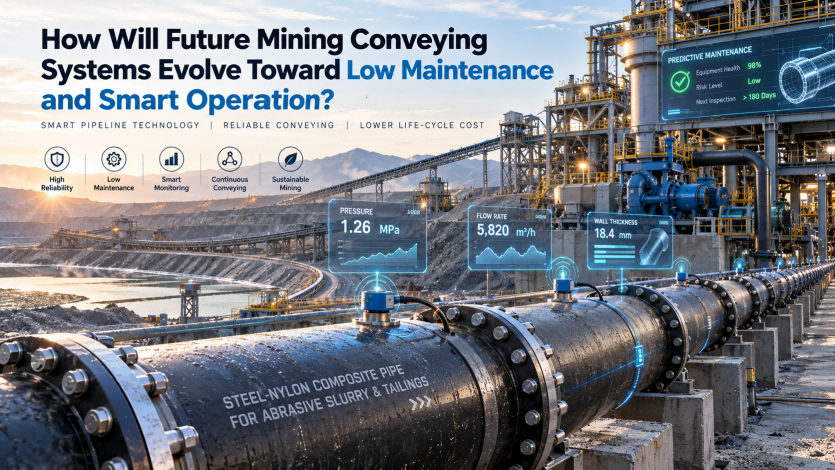
As mining projects continue to move toward larger production capacity, continuous operation, and higher throughput, the scale of slurry, tailings, concentrate, and backfill transportation is also increasing.
In the past, pipeline selection in mining projects often focused first on purchase price, design pressure, and pipe diameter. Today, however, more and more mine owners are reconsidering a more fundamental question:
For a large-diameter slurry pipeline, what really matters most—the initial purchase cost, or the ability to maintain stable transportation throughout the entire project lifecycle?
This is especially important under operating conditions involving high solids concentration, severe abrasion, long-distance transport, and continuous operation.
Under these conditions, pipelines are no longer simply auxiliary equipment.
They are becoming critical infrastructure that directly affects:
-
transportation capacity;
-
plant availability;
-
maintenance frequency;
-
operating reliability;
-
and long-term production cost.
The future of large-diameter wear-resistant mining pipelines is therefore moving away from simply:
“Increasing pipe diameter”
and toward:
“Large diameter + wear resistance + pressure resistance + corrosion resistance + low maintenance + system-level design.”
This is also one of the key reasons why steel-nylon composite pipes are attracting increasing attention in mining transportation systems.
1. Why Are Mining Projects Requiring Larger-Diameter Pipelines?
One of the defining characteristics of large-scale mining is the continuous increase in material-handling capacity.
From mining, crushing, and grinding to mineral processing, tailings transportation, and mine backfilling, large quantities of slurry often need to be transported continuously through pipelines.
Typical conveyed media include:
-
iron ore slurry;
-
copper concentrate slurry;
-
gold mine tailings;
-
phosphate slurry;
-
high-concentration tailings;
-
paste and backfill slurry;
-
mine drainage water;
-
sand- and solids-containing wastewater;
-
corrosive mineral-processing media.
As production capacity increases, continuing to rely on smaller pipelines often means either increasing flow velocity or installing more parallel pipelines.
However, higher velocity is not always better.
Slurry velocity must be high enough to prevent excessive solids settling and pipeline blockage.
At the same time, excessive velocity can increase particle impact, erosion, pressure loss, and pump energy consumption.
Therefore, mining slurry transportation always requires a balance among several important factors:
Transport Capacity → Anti-Settlement → Pipeline Wear → Pressure Loss → Pumping Energy → Pipeline Life
For this reason, selecting a larger pipeline diameter can provide more flexibility for optimizing the entire transport system.
However, one point must be emphasized:
A large-diameter pipeline is not simply a scaled-up version of a smaller pipe.
As pipe diameter increases, engineers must consider:
-
pipe stiffness;
-
vacuum resistance;
-
support spacing;
-
flange strength;
-
liner stability;
-
installation tolerances;
-
transportation conditions;
-
and construction requirements.
A real large-diameter mining pipeline should therefore be treated as a complete engineering system.
2. High-Solids Slurry Is Changing the Logic of Wear-Resistant Pipeline Selection
One of the most important differences between mining slurry and ordinary industrial liquids is the presence of large quantities of solid particles.
Quartz, iron ore particles, tailings, and other hard minerals continuously move through the pipeline and may generate:
-
sliding wear;
-
rolling wear;
-
impact wear;
-
erosion wear;
-
local turbulent erosion.
These wear mechanisms become even more significant under high-solids operating conditions.
This means that pipeline evaluation should no longer focus only on one question:
“How much pressure can this pipe withstand?”
It should also consider:
“How long can this material withstand continuous wear under this particle size, solids concentration, and flow velocity?”
This is one of the main reasons why mining pipeline materials are evolving.
3. Why Can Traditional Carbon Steel Face Challenges in Slurry Service?
Carbon steel offers excellent structural strength, mature manufacturing technology, and well-established engineering standards.
For this reason, it has long been widely used for pressurized mining pipelines.
However, in highly abrasive slurry systems, carbon steel may face one important limitation:
Adequate structural strength does not necessarily mean adequate internal wear resistance.
When solid particles continuously strike and rub against the internal surface of the pipe, several problems may gradually develop:
-
localized wall thinning;
-
bottom-side wear;
-
elbow erosion;
-
abnormal wear near welds;
-
perforation;
-
leakage;
-
unplanned shutdowns.
One traditional approach is simply to increase the wall thickness.
This provides more wear allowance, but it can also result in:
Higher weight → Higher material consumption → Higher transportation cost → More difficult lifting → Higher total project cost
This raises an important engineering question:
Can one material provide structural strength while another material provides corrosion and wear resistance?
This is exactly the design principle behind composite pipelines.
4. Steel-Nylon Composite Pipe: Different Materials Perform Different Functions
A steel-nylon composite pipe is not simply a steel pipe combined with a plastic pipe.
Its core design philosophy is to allow different materials to perform different engineering functions.
Steel Provides the Structural Framework
The steel structure can provide:
-
mechanical strength;
-
pressure-bearing capacity;
-
large-diameter dimensional stability;
-
resistance to external mechanical loads;
-
a structural foundation for flanged connections.
Reinforced Nylon Provides the Functional Inner Layer
The reinforced nylon layer is directly exposed to the conveyed slurry and can be designed to provide:
-
wear resistance;
-
particle erosion resistance;
-
corrosion resistance;
-
isolation between the conveyed medium and the steel structure;
-
reduced risk of direct chemical attack on the steel layer.
This creates a functional division:
The outer structure provides mechanical performance, while the inner layer handles corrosion and wear.
For large-scale mining pipelines, this approach can be particularly valuable because a single material may struggle to simultaneously optimize:
pressure resistance, stiffness, wear resistance, corrosion resistance, and large-diameter manufacturability.
5. Why Are Large-Diameter Steel-Nylon Composite Pipes Suitable for Mining Projects?
5.1 Handling Both Wear and Corrosion
Mining slurry does not always create a pure abrasion problem.
The conveyed medium may also contain:
-
salts;
-
acidic components;
-
alkaline components;
-
process chemicals;
-
dissolved oxygen;
-
corrosive ions.
This means many mining pipelines face a combined environment of:
Corrosion + Abrasion
In other words:
chemical corrosion and mechanical wear occur at the same time.
If corrosion first damages the pipe surface, particle erosion may accelerate further.
One of the main advantages of steel-nylon composite structures is that the conveyed medium can be isolated from direct contact with the load-bearing steel structure.
The reinforced nylon layer becomes the primary functional surface exposed to the slurry.
5.2 Better Structural Capability for Large-Diameter Pressure Systems
Many non-metallic materials provide excellent corrosion resistance for small and medium pipe diameters.
However, as diameter increases, material selection becomes more complex.
For DN1000, DN1200, DN1600, or even larger pipelines, engineers must consider:
-
ring stiffness;
-
vacuum stability;
-
support conditions;
-
pipe self-weight;
-
full-pipe fluid weight;
-
flange deformation;
-
installation misalignment;
-
water hammer;
-
internal pressure;
-
external loads.
For this reason, large-diameter industrial pipelines increasingly require a combination of:
structural materials + functional materials.
Our steel-nylon composite pipes combine a steel structural layer with a reinforced nylon functional layer.
The pipe structure can be designed according to:
-
pipe diameter;
-
operating pressure;
-
conveyed medium;
-
particle characteristics;
-
transport distance;
-
installation conditions.
Our available pressure classes can cover approximately 1.0–4.0 MPa, depending on project requirements, and the technology can also be extended to very large industrial pipeline diameters.
6. Large Diameter Is Not Only About Higher Flow Capacity—It Also Helps Optimize Velocity
For slurry pipelines, one of the most important operating parameters is:
Flow Velocity
If the velocity is too low:
→ solids may settle
→ deposits may form at the pipe bottom
→ effective flow area may decrease
→ blockage risk may increase
If the velocity is too high:
→ particle kinetic energy increases
→ impact becomes more severe
→ wear increases
→ pressure loss rises
→ pumping energy consumption increases
This gives large-diameter pipelines another important engineering advantage:
More flexibility for hydraulic optimization.
While maintaining the required production capacity, engineers can optimize the combination of:
Pipe Diameter + Flow Rate + Velocity + Solids Concentration + Pump Parameters
The objective is not simply to achieve the highest possible flow velocity.
Instead, the objective is to find a more appropriate operating range that balances:
-
transportation efficiency;
-
anti-settlement performance;
-
wear resistance;
-
energy consumption;
-
pipeline life.
7. The Most Severe Wear Often Occurs at Fittings Rather Than Straight Pipe Sections
In many mining systems, the first failure does not necessarily occur in a straight pipe section.
The most critical wear areas often include:
Elbows
When slurry changes direction, particles may strike the outside wall of the elbow with greater force.
This can significantly increase localized erosion.
Tees
Flow division or mixing can generate complex flow patterns and localized turbulence.
High-Elevation-Difference Sections
Gravity and velocity changes may alter particle motion and flow behavior.
Areas Near Pump Discharge
Pressure and flow conditions can fluctuate significantly.
Upstream and Downstream of Valves
Local flow acceleration and turbulence may increase erosion.
This is why wear-resistant pipeline design should not focus only on laboratory material wear data.
A reliable mining pipeline system must consider:
Material + Structure + Hydraulics + Fittings + Connections + Supports
8. Why Flanged Connections Matter in Large Mining Pipeline Systems
Mining sites often have challenging installation conditions.
Pipelines may be installed in:
-
mountainous regions;
-
deserts;
-
high-altitude areas;
-
low-temperature zones;
-
open-pit mines;
-
tailings facilities;
-
remote mining corridors.
If large amounts of on-site welding are required, installation can become more complicated and quality control can become more difficult.
For this reason, we place significant emphasis on flanged and reduced-hot-work connection solutions for steel-nylon composite pipeline systems.
For mining projects, this type of connection can offer several practical advantages:
Factory Prefabrication → On-Site Alignment → Bolted Connection → Section-by-Section Installation
This modular approach can be particularly useful for pipelines requiring:
-
maintenance;
-
relocation;
-
system modification;
-
localized replacement.
More importantly, composite pipeline connections must ensure that:
Not only the pipe body, but also the connection zone maintains reliable medium isolation.
Otherwise, the connection point may become the weakest part of the entire system.
9. Why Are Mining Companies Paying More Attention to Downtime Instead of Only Pipe Price?
For a large mining operation, the purchase price of the pipeline is only one part of the economic equation.
A more complete evaluation should consider:
Total Cost of Ownership
The total lifecycle cost can be simplified as:
TCO = Initial Purchase + Installation + Maintenance + Spare Parts + Replacement + Downtime Loss + Energy Consumption
Traditional procurement methods often focus mainly on the first item.
However, large mining operations are increasingly paying attention to the remaining costs.
Once a critical slurry pipeline leaks or wears through, the recovery process may involve:
Shutdown
↓
Pipeline draining
↓
Slurry cleanup
↓
Removal of the damaged section
↓
New pipe installation
↓
Pressure testing
↓
Restarting production
This means that extending pipeline service life is not only about reducing the number of replacement pipes purchased.
The greater value may be:
Avoiding one unplanned shutdown.
For a high-capacity mine operating continuously, that can be significantly more important than reducing the initial pipe purchase price.
10. Comparison of Large-Diameter Pipeline Materials for Mining Applications
| Pipeline Type | Pressure / Structural Strength | Corrosion Resistance | Wear Resistance Potential | Large-Diameter Capability | Main Engineering Consideration |
|---|---|---|---|---|---|
| Carbon Steel Pipe | High | Depends on medium | Moderate | Mature | Internal wear and corrosion |
| HDPE | Moderate | High | Good | Available | Pressure, temperature, stiffness |
| FRP | Moderate | High | Depends on structure | Good | Impact, joints, wear layer |
| Rubber-Lined Steel | High | Good | Good | Mature | Liner aging and separation |
| Ceramic-Lined Pipe | High | Good | Very high | Structure-dependent | Weight, impact, complex fittings |
| Steel-Nylon Composite Pipe | High | High | High | Suitable for large-diameter design | Composite structure and joint design |
It is important to emphasize:
No single pipeline material is suitable for every mining condition.
Professional material selection should not begin with:
“Which pipe material is the best?”
Instead, it should begin with:
“What exactly is being transported?”
11. What Data Should Be Provided for Large-Diameter Mining Pipeline Selection?
For accurate engineering selection, a pipeline manufacturer should ideally receive the following information.
1. Conveyed Medium
Examples include:
iron ore slurry, copper slurry, tailings, mine wastewater, or backfill slurry.
2. Solids Concentration
Both weight concentration and volume concentration can affect hydraulic behavior.
3. Particle Size
D50, D80, and maximum particle size are important for evaluating wear.
4. Particle Hardness
High quartz content generally increases abrasive wear.
5. Design Flow Rate
Usually expressed in m³/h.
6. Normal Operating Velocity
Usually expressed in m/s.
7. Operating and Design Pressure
Usually expressed in MPa.
8. Pipeline Diameter
DN.
9. Transportation Distance
Especially important for long-distance slurry pipelines.
10. Elevation Difference
Mine terrain can significantly affect pressure distribution.
11. Temperature
Including both normal operating temperature and extreme environmental temperature.
12. pH and Corrosive Components
These are required for corrosion resistance evaluation.
Only when these parameters are available can engineers properly evaluate:
Pipe Diameter, Wall Thickness, Steel Structure, Nylon Layer Thickness, Pressure Class, Flange Design, and Support Layout
12. Five Major Trends in Large-Diameter Wear-Resistant Mining Pipelines
Based on the development direction of modern mining projects, several trends are becoming increasingly clear.
Trend 1: Pipeline Diameters Will Continue to Increase
As mine production capacity increases, more systems will need to handle higher material throughput.
As a result, industrial pipelines in sizes such as:
-
DN800;
-
DN1000;
-
DN1200;
-
DN1600;
-
and even larger diameters
are likely to receive increasing attention.
Trend 2: From Wear Resistance to “Wear + Corrosion Resistance”
Future material selection will increasingly move away from evaluating wear resistance alone.
Real mining environments often involve:
Particle Abrasion + Chemical Corrosion + Hydraulic Erosion
These mechanisms can act simultaneously.
Trend 3: From Material Life to System Reliability
Project owners will no longer ask only:
“How low is the material wear rate?”
They will increasingly evaluate:
-
flange life;
-
elbow life;
-
tee life;
-
support reliability;
-
liner stability;
-
maintenance intervals;
-
overall pipeline availability.
Trend 4: From Lowest Purchase Price to Lowest Lifecycle Cost
More mining projects will evaluate pipelines using:
CAPEX + OPEX + Downtime
This means:
The cheapest pipeline does not necessarily create the lowest-cost transportation system.
Trend 5: Composite Materials Will Play a Larger Role
A single material may struggle to solve all of the challenges associated with:
large diameter, pressure, abrasion, corrosion, impact, and maintenance.
As a result, using different materials to perform different engineering functions will become increasingly important.
Steel-nylon composite pipe follows exactly this design principle.
13. Potential Applications of Steel-Nylon Composite Pipes in Mining Projects
Steel-nylon composite pipes can be evaluated for a variety of mining transportation systems.
Tailings Transportation
Suitable for long-distance, high-solids, continuously abrasive operating conditions.
Iron Ore Slurry Transportation
Designed for systems involving hard particles and continuous operation.
Copper Slurry Transportation
Can combine wear resistance with corrosion protection in complex slurry environments.
Mine Backfill Systems
Suitable for transporting high-concentration backfill slurry.
Mining Wastewater
Particularly useful where corrosive media and suspended solids coexist.
Mineral Processing Plant Pipelines
Can be used between:
-
thickeners;
-
pumps;
-
separation equipment;
-
and other process units.
Long-Distance Slurry Pipelines
The combination of steel structural strength and a reinforced nylon functional layer can be customized according to different terrain, pressure, and medium conditions.
14. Our Approach: We Do Not Simply Sell Pipe—We Solve Transportation Problems
For complex mining projects, we do not recommend that a customer provide only one specification:
“We need a DN1000 pipe.”
Because DN1000 only describes the diameter.
It does not tell us:
-
what medium is being transported;
-
particle size;
-
solids concentration;
-
operating pressure;
-
flow velocity;
-
transportation distance;
-
where severe wear is most likely to occur.
For this reason, we prefer to evaluate the complete transportation system together with the customer:
Medium → Particle → Concentration → Flow Rate → Velocity → Pressure → Diameter → Wear → Connection → Installation
Only after reviewing these factors should the final steel-nylon composite pipe structure be determined.
Our reinforced nylon pipes and steel-nylon composite pipes can be customized for different industrial applications and can be designed for demanding operating conditions involving:
-
large diameters;
-
severe abrasion;
-
corrosive media;
-
pressure transportation;
-
complex installation environments.
Conclusion: The Future of Mining Pipelines Is Not Simply “Thicker”—It Is “Better Designed”
In the past, one of the simplest solutions to pipeline wear was:
Increase the wall thickness.
However, modern large-scale mining projects face much more complex challenges.
A high-performance slurry transportation system must balance:
transport capacity, flow velocity, solids settling, pressure, wear, corrosion, energy consumption, installation, maintenance, and lifecycle cost.
Therefore, the future of large-diameter wear-resistant pipelines will not simply be:
Larger and thicker pipes.
Instead, the trend is moving toward:
More appropriate material combinations, better structural design, longer operating life, and lower total lifecycle cost.
Steel-nylon composite pipes combine the structural and pressure-bearing capability of steel with the wear and corrosion resistance of reinforced nylon, providing an alternative solution worth evaluating for large mining systems transporting:
-
tailings;
-
mineral slurry;
-
backfill slurry;
-
abrasive industrial media;
-
corrosive process fluids.
For a large mining project, the most important question is not simply:
“How much does one meter of pipe cost?”
A more valuable question is:
“Over the entire life of the mine, how much does it cost to transport one ton of slurry?”
That may ultimately become one of the most important criteria for selecting large-diameter wear-resistant mining pipelines.
How Are Pipeline Materials Changing in Thermal Power Plant Flue Gas Desulfurization Systems?
Pipeline Challenges as Mine Backfill Systems Move Toward High-Flow Conveying