How Will Future Mining Conveying Systems Evolve Toward Low Maintenance and Smart Operation?
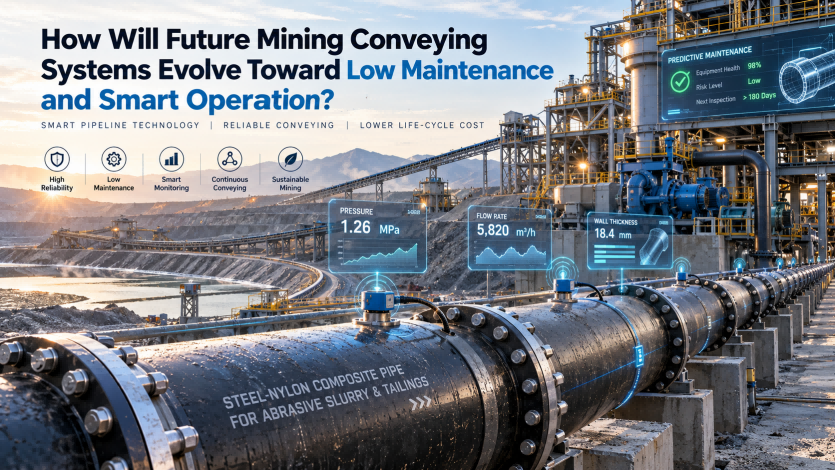
Mining conveying systems are undergoing a significant transformation.
In the past, when selecting pipelines for slurry, tailings, process water, and other mining applications, companies mainly focused on initial purchase cost, design pressure, and pipe diameter.
However, as mining operations become larger, conveying distances increase, slurry solids concentrations rise, and the cost of unplanned downtime continues to grow, simply asking whether a pipeline can “handle the service” is no longer enough.
Mining companies are increasingly asking more strategic questions:
-
How long can the pipeline operate continuously and reliably?
-
How frequently will high-wear sections such as elbows, tees, and pump discharge lines require replacement?
-
Can unplanned shutdowns be reduced?
-
Can wear, leakage, or pressure abnormalities be detected in advance?
-
Can remaining pipeline life be estimated from operating data?
-
Can pipeline systems be integrated into digital mine management platforms?
-
How can total maintenance costs over 20 years or more be reduced?
As a result, the future of mining pipeline systems will not simply be about replacing one pipe material with another.
The broader transition will be from traditional reactive maintenance toward:
Low Maintenance + Condition Monitoring + Predictive Maintenance + Intelligent Pipeline Management
And pipeline materials will remain the foundation of this transformation.
1. Why Are Mining Conveying Systems Entering the Low-Maintenance Era?
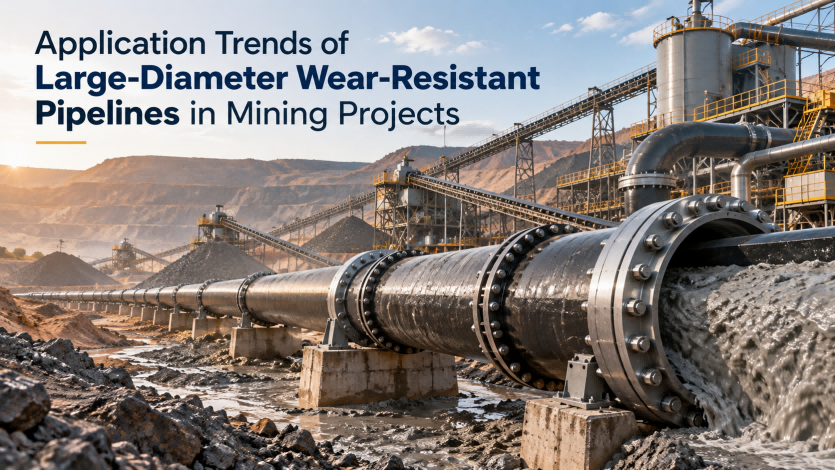
Mining pipelines operate under conditions that are very different from those of ordinary industrial water pipelines.
Typical mining media include:
-
Iron Ore Slurry
-
Copper Concentrate Slurry
-
Gold Tailings
-
Mine Tailings
-
Backfill Slurry
-
High-Solids Slurry
-
Process Water
-
Corrosive Mine Water
These media often involve a combination of:
solid particles, high velocity, severe abrasion, corrosion, impact, pressure fluctuations, and long-distance transportation.
Pipeline failure in mining applications is therefore rarely caused by only one factor.
Instead, it is usually the combined result of:
Abrasion + Corrosion + Pressure + Impact + Hydraulic Conditions
At elbows, tees, reducers, valve areas, and pump discharge sections in particular, local velocity, turbulence, and particle impact can increase significantly, making these areas the most vulnerable sections of the pipeline.
If a pipeline requires frequent repair and replacement, even a relatively low initial purchase price can result in very high lifecycle costs.
For this reason, an increasingly important question in mining pipeline procurement is:
Maintenance Frequency
In practical terms:
How many times will this pipeline need to be repaired or replaced over the next 10 to 20 years?
2. The Most Expensive Part of a Mining Pipeline Failure Is Often Not the Pipe
For a large mining operation, a pipeline leak does not simply mean replacing a section of pipe.
It may also lead to:
-
Production shutdowns
-
Reduced conveying capacity
-
Slurry leakage
-
Site cleanup
-
Emergency repairs
-
Additional labor and equipment requirements
-
Spare-part transportation
-
Environmental remediation
-
Interruptions to downstream processes
As a result, more mining companies are shifting their attention from:
Pipe Price
to:
Total Cost of Ownership (TCO)
A more realistic economic model for a mining pipeline should consider:
TCO = Initial Cost + Installation + Maintenance + Replacement + Downtime Loss + Energy Consumption
A pipeline material may have a lower purchase price but require repeated repairs or replacement within five years.
In such cases, its total cost may actually be higher.
By contrast, a pipeline system with a higher initial investment may deliver better long-term economics if it can significantly extend maintenance intervals and reduce downtime.
This is why low maintenance is becoming an increasingly important design objective for large mining projects.
3. Trend One: From Periodic Replacement to Long-Service-Life Design
Traditional mining pipeline maintenance often follows a simple pattern:
Operation → Wear → Leakage → Shutdown → Replacement
Later, many mines adopted scheduled maintenance:
Operation → Periodic Inspection → Scheduled Replacement
However, both approaches have a limitation:
Maintenance is generally carried out only after the material has already suffered substantial deterioration.
Future large-scale mining conveying systems will increasingly adopt:
Design for Long Service Life
This means reducing maintenance requirements from the beginning of the project.
Pipeline selection should therefore consider:
-
Wear Resistance
-
Corrosion Resistance
-
Pressure Capacity
-
Impact Resistance
-
Operating Temperature
-
Pipe Diameter
-
Flow Velocity
-
Slurry Concentration
-
Particle Size
-
Installation Conditions
For slurry systems where abrasion and corrosion occur simultaneously, ordinary carbon steel may struggle to provide sufficient long-term wear resistance.
At the same time, some non-metallic materials offer excellent corrosion resistance but may face limitations in pressure capacity, structural rigidity, large-diameter applications, or resistance to mechanical impact.
This is one reason why composite pipeline technologies, which combine the advantages of different materials, are receiving increasing attention.
4. Why Are Steel-Nylon Composite Pipes Suitable for Low-Maintenance Mining Conveying Systems?
The design philosophy of steel-nylon composite pipe is not based on expecting a single material to solve every engineering problem.
Instead, it combines the strengths of different materials:
Steel Structure + Modified Nylon Functional Layer
The steel structure provides mechanical strength and pressure-bearing capability, while the enhanced nylon layer provides corrosion and wear resistance.
For challenging slurry and tailings applications, this structure offers several important advantages.
4.1 Steel Structure Provides Pressure Capacity and Structural Rigidity
Long-distance slurry transportation may involve:
-
Relatively high design pressure
-
Pressure fluctuations during pump startup and shutdown
-
Water hammer
-
Significant elevation differences
-
Pipeline support loads
-
External mechanical loads
A steel structural layer provides high overall mechanical strength.
This is particularly important for large-diameter, higher-pressure, and topographically complex mining projects.
Our steel-nylon composite pipes can be engineered for different project operating conditions, with common pressure ratings covering:
1.0–4.0 MPa
Final engineering design should still be determined according to pipe diameter, medium, operating temperature, pressure cycles, installation conditions, and other project-specific parameters.
4.2 Nylon Functional Layer Helps Resist Slurry Abrasion
Solid particles in slurry continuously impact and abrade the internal pipe surface during transportation.
Wear can become particularly severe in:
-
Elbows
-
Tees
-
Reducers
-
Pump discharge sections
-
High-velocity zones
Enhanced nylon materials offer good wear resistance together with relatively low surface friction characteristics, making them suitable for conveying applications involving abrasive particles.
This changes the philosophy of pipeline upgrading.
Instead of simply asking:
“Can we make the pipe wall thicker?”
engineers can ask:
“Can we use a material better suited to the actual wear mechanism?”
4.3 Addressing Both Corrosion and Abrasion
A common mistake in slurry pipeline design is to focus only on abrasion while overlooking corrosion.
Mine water, tailings water, process water, and certain slurries may contain:
-
Chlorides
-
Sulfates
-
Dissolved Salts
-
Acidic or Alkaline Components
If corrosion attacks a metallic surface first, subsequent mechanical wear may accelerate.
This interaction is commonly referred to as:
Corrosion-Abrasion Synergy
The advantage of a steel-nylon composite structure is that the steel layer primarily provides mechanical strength, while the internal functional layer helps reduce direct contact between the conveyed medium and the steel substrate.
This makes it possible to address corrosion and abrasion within the same pipeline design.
5. Trend Two: Mining Pipelines Will Become Increasingly Monitorable
Traditionally, engineers evaluated pipeline condition through visual inspections, periodic wall-thickness measurements, or investigations after a leak occurred.
Future mining conveying systems will increasingly adopt:
Condition Monitoring
Potential monitoring parameters include:
-
Pressure
-
Flow Rate
-
Temperature
-
Vibration
-
Wall Thickness
-
Leakage
-
Differential Pressure
-
Pump Operating Conditions
Collecting data alone, however, is not the ultimate objective.
The real value comes from identifying whether the pipeline's operating condition is changing over time.
For example, if pressure loss gradually changes under the same flow conditions, engineers may need to investigate deposition, local blockage, or changes in hydraulic behavior.
If vibration increases continuously in certain pipe sections, supports, flow conditions, or structural factors may need to be checked.
If wall thickness in a high-wear area begins decreasing faster than expected, replacement can be planned before failure occurs.
Pipeline management can therefore evolve from:
“Detecting a failure.”
to:
“Observing how the failure is developing.”
6. Trend Three: Predictive Maintenance Will Gradually Replace Fixed-Interval Maintenance
Traditional maintenance is often based on fixed schedules:
Inspect every six months.
Inspect every 12 months.
Replace every three years.
But wear rates can vary dramatically depending on slurry properties, flow velocity, pipeline geometry, and location.
For this reason, one of the most important future directions will be:
Predictive Maintenance
For example, a mine may continuously record:
Wall Thickness vs. Operating Hours
Over time, this allows engineers to establish a wear-rate model for specific pipeline locations.
If the wall thickness of a high-wear elbow decreases at a relatively consistent rate, the system can estimate its remaining service life.
This makes it possible to convert:
Emergency Replacement
into:
Planned Replacement
For a large mining operation, the economic difference can be substantial.
Planned maintenance allows the operator to prepare in advance:
-
Spare Parts
-
Maintenance Personnel
-
Cranes and Equipment
-
Shutdown Windows
-
Replacement Pipe Sections
Maintenance can then be coordinated with planned production shutdowns.
7. Trend Four: Smart Systems Will Not Eliminate Maintenance—but They Can Reduce Unnecessary Maintenance
One major benefit of smart mining systems is not the elimination of manual inspection.
Instead, they can help answer a more useful question:
Where Should We Inspect First?
For a tailings pipeline that extends several kilometers or even tens of kilometers, it is unrealistic to inspect every section with the same level of intensity every day.
Future systems can combine:
-
Historical maintenance records
-
Pressure variations
-
Flow-rate changes
-
Wall-thickness data
-
Terrain information
-
Flow velocity
-
Pipe diameter
-
Elbow locations
to identify:
High-Risk Pipeline Sections
Maintenance personnel can then prioritize these areas.
Maintenance resources can therefore shift from being evenly distributed across the entire system to being allocated according to actual risk.
8. Trend Five: High-Wear Locations Will Use Differentiated Material Strategies
Future mining conveying systems are unlikely to assume that every section of a pipeline must use exactly the same configuration.
Operating conditions vary considerably throughout the system.
For example:
Straight sections are generally exposed to long-term slurry abrasion.
Elbows experience greater particle impact and localized turbulence.
Pump discharge lines may simultaneously experience:
High Velocity + Turbulence + Pressure Fluctuation
A more rational approach is therefore:
Segmented Pipeline Material Strategy
Different designs can be used for different risk zones.
For example:
Standard configurations may be used in ordinary straight sections.
Higher wear-resistant designs may be used in severe wear zones.
Elbows and pump discharge sections can receive additional reinforcement.
This approach can improve the balance between performance and capital investment.
9. Trend Six: Targeted Upgrades Will Become Important for Existing Mines
Many mines that have been operating for 10, 20, or more years already have extensive existing pipeline infrastructure.
In these projects, replacing the entire conveying system may not be economically practical.
An increasingly important strategy will therefore be:
Targeted Pipeline Upgrades
Priority areas commonly include:
-
Pump Discharge Sections
-
Elbows
-
Tees
-
Reducers
-
High-Velocity Sections
-
High-Wear Sections
-
Frequently Repaired Sections
If 80% of pipeline maintenance occurs in only 20% of the system, upgrading those high-failure sections first may be far more practical than immediately replacing the entire line.
Steel-nylon composite pipe can be considered as one option for this type of localized material upgrade.
Mining companies can also begin with a:
100–500 m Trial Section
and evaluate:
-
Wear Rate
-
Pressure Stability
-
Installation Performance
-
Maintenance Frequency
Based on actual operating data, the application can then be expanded.
This approach can significantly reduce the risk associated with adopting a new pipeline material.
10. Trend Seven: Large-Diameter Slurry Pipelines Will Place Greater Emphasis on Structural Reliability
As mining production capacity increases, slurry and tailings systems are moving toward:
Higher Flow Rate + Larger Diameter
However, increasing the pipe diameter introduces more complex engineering requirements.
These may include:
-
Ring Stiffness
-
Vacuum Stability
-
Support Spacing
-
Flange Rigidity
-
Installation Deformation
-
Water Hammer
-
Structural Stress
-
Long-Distance Pressure Control
Large-diameter pipeline selection therefore cannot be based solely on corrosion resistance.
The structural system must also be considered.
Our enhanced nylon and steel-nylon composite pipe systems are available in a range of industrial sizes, including large and extra-large diameters, and can be engineered according to project-specific requirements such as:
Diameter + Pressure + Medium + Temperature + Installation Conditions
11. Trend Eight: Pipelines Will Become Data Nodes in the Digital Mine
In future smart mines, pipelines should no longer be viewed simply as passive assets connecting two pieces of equipment.
They will increasingly become:
Data Assets
For example:
Changes in slurry concentration → changes in flow → changes in pressure → changes in pump operation → changes in pipeline wear
These variables are interconnected.
When:
-
Pump Data
-
Pipeline Data
-
Process Data
-
Maintenance Data
are integrated into a unified platform, mining companies can gradually establish a:
Pipeline Digital Model
This may eventually develop into a:
Digital Twin
In that environment, mine operators will no longer see only a physical pipeline.
They will see a digital pipeline asset capable of reflecting:
-
Current Operating Condition
-
High-Risk Areas
-
Historical Failures
-
Remaining Service Life
-
Maintenance Requirements
12. Pipeline Materials Are an Often-Overlooked Foundation of Mining Intelligence
There is an important principle that should not be overlooked:
If the pipeline material itself has a short service life, even the most advanced sensor system cannot truly deliver low-maintenance operation.
A sensor can tell you:
“This pipe is close to failure.”
But better engineering should also ask:
“How can we make it fail much later?”
Future smart mining conveying systems therefore need to solve two different problems.
The first is:
Know When Failure May Occur
The second is:
Delay the Failure Itself
The first depends on digitalization and monitoring.
The second depends on materials and engineering design.
A mature low-maintenance system must combine both.
13. The Role of Steel-Nylon Composite Pipe in Future Mining Systems
From a long-term perspective, the value of steel-nylon composite pipe is not simply to “replace” another type of pipe.
It can be positioned as:
A Long-Life Pipeline Solution for Harsh Mining Service
Its design concept aims to balance multiple requirements:
| Mining Conveying Requirement | Steel-Nylon Composite Pipe Design Approach |
|---|---|
| Severe Abrasion | Enhanced nylon functional layer |
| Corrosive Media | Reduces direct contact between the medium and steel substrate |
| Pressure Requirements | Steel structure provides mechanical strength |
| Long-Distance Conveying | Structural stability for demanding pipeline systems |
| Large Diameter | Composite structure for large industrial pipelines |
| Localized Upgrades | Suitable for critical sections such as elbows and pump discharge lines |
| Low Maintenance | Designed to extend maintenance intervals |
| Smart Monitoring | Can be integrated with condition-monitoring strategies |
The future competitive question in mining pipeline systems may therefore no longer be:
Which Pipe Is Cheaper?
Instead, it may become:
Which Pipeline Keeps the Mine Running Longer?
That is the real value of pipeline reliability.
14. The Future Mining Conveying System: Materials + Data + Maintenance Strategy
Over the next decade, mining conveying systems are likely to evolve toward a structure such as:
Wear-Resistant Materials
↓
Long-Life Pipeline Design
↓
Online Monitoring
↓
Condition Assessment
↓
Predictive Maintenance
↓
Lower Downtime
↓
Lower Total Cost of Ownership
This transformation will also change the role of pipeline manufacturers.
Customers will increasingly need more than a:
Pipe Manufacturer
They will need a:
Pipeline Solution Provider
that understands:
-
Slurry Characteristics
-
Corrosion
-
Abrasion
-
Pressure
-
Hydraulic Conditions
-
Pipeline Structure
-
Maintenance Strategy
Conclusion: Low Maintenance May Be More Important Than a Low Purchase Price
The future direction of mining conveying systems is becoming increasingly clear:
larger scale, longer conveying distances, higher solids concentrations, lower maintenance requirements, digitalization, and intelligent operation.
Against this background, traditional failure-driven maintenance will increasingly shift toward:
Long-Life Design + Condition Monitoring + Predictive Maintenance
Materials will remain the foundation of pipeline reliability.
For slurry, tailings, and mining process systems exposed simultaneously to:
Abrasion + Corrosion + Pressure
steel-nylon composite pipe combines the structural strength of steel with the wear- and corrosion-resistant characteristics of enhanced nylon, providing a technical route that can balance:
Wear Resistance + Corrosion Resistance + Pressure Capacity + Long Service Life
For mining projects considering slurry, tailings, or process pipeline upgrades, comparing only the cost per meter of pipe is no longer enough.
A more meaningful evaluation should ask:
How many replacements, shutdowns, and maintenance events will be required over a 20-year lifecycle?
Because the most important question for the future of mining pipelines may not be:
How much does the pipeline cost?
but rather:
How Much Downtime Can the Pipeline Eliminate?
A more reliable mining conveying system creates value by keeping production running longer—not by keeping maintenance teams busier.
Why the Power Industry Must Address Both Corrosion and Scaling in Piping Systems