Why the Power Industry Must Address Both Corrosion and Scaling in Piping Systems
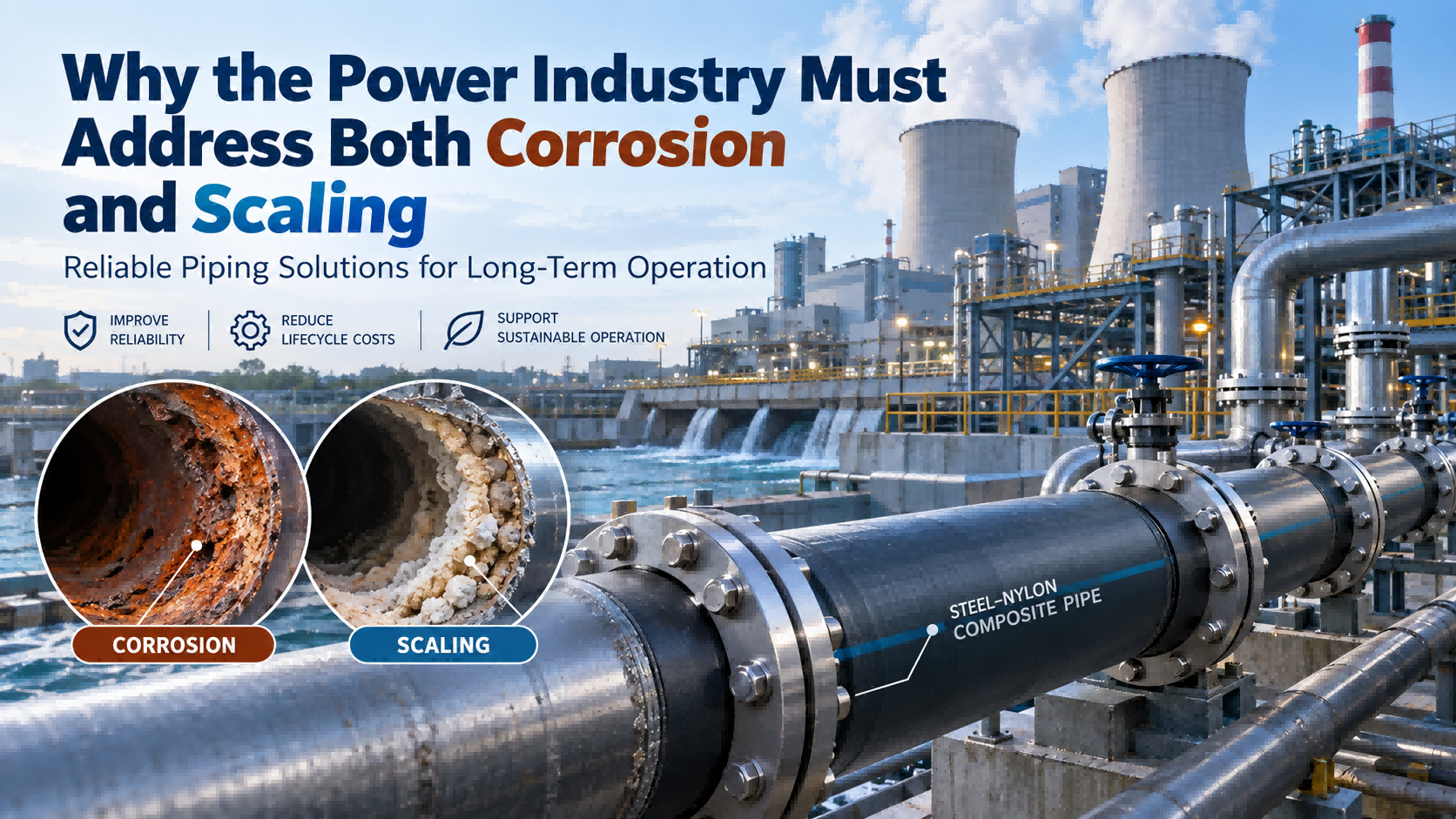
In power plants, corrosion and scaling are often treated as two separate piping problems.
When pipe wall thinning, pitting, or leakage occurs, engineers tend to focus on corrosion-resistant materials. When flow capacity decreases, heat-transfer efficiency drops, or pipelines become partially blocked, attention usually shifts to scale control, chemical cleaning, and water treatment.
However, under actual power plant operating conditions, corrosion and scaling are rarely isolated problems.
Instead, they often interact with and reinforce each other.
This is particularly important in systems such as:
-
Circulating cooling water
-
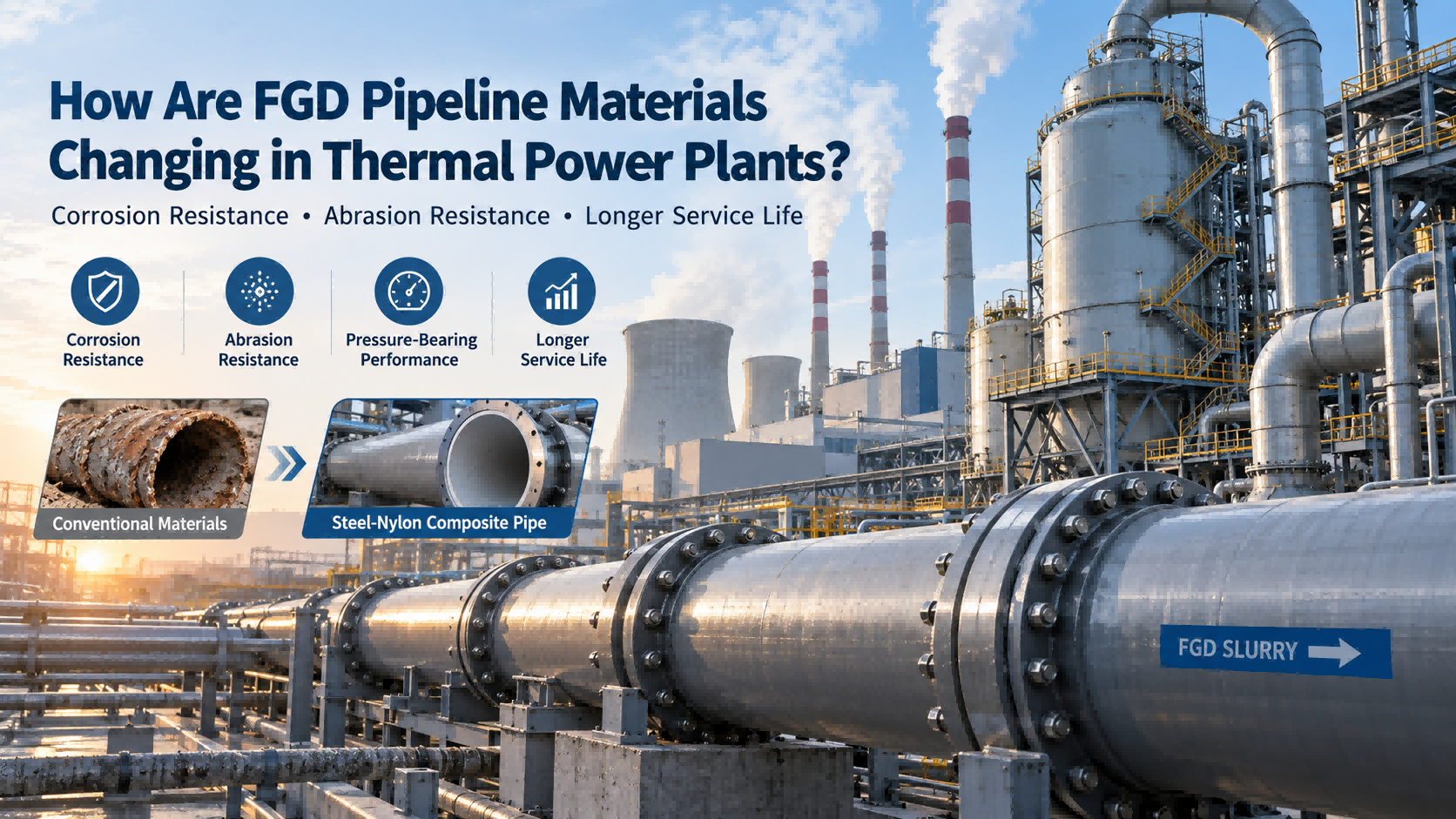
Flue gas desulfurization
-
Industrial wastewater
-
High-salinity water
-
Concentrated brine
-
Ash water
-
Slurry transportation
-
Other saline or solids-containing process streams
Corrosion can generate large quantities of corrosion products, while scale and deposits can create localized environments that further accelerate corrosion.
Therefore, the key question for power plant piping is no longer simply:
“Is this pipe material corrosion resistant?”
A more meaningful engineering question is:
“How will this piping system perform when corrosion, scaling, deposition, abrasion, pressure, and long-term continuous operation occur at the same time?”
This is why power generation projects increasingly need to move beyond simple corrosion protection toward a more comprehensive approach involving corrosion resistance, scale control, abrasion resistance, reliability, and total life-cycle cost.
1. Why Are Power Plant Piping Systems Particularly Vulnerable to Both Corrosion and Scaling?
A power plant does not operate with only one type of fluid.
A typical plant may contain piping systems handling:
-
Circulating cooling water
-
Makeup water
-
Industrial water
-
Demineralized water
-
Concentrated water
-
FGD slurry
-
Limestone slurry
-
Gypsum slurry
-
High-salinity wastewater
-
Ash water and ash slurry
-
Acid and alkaline regeneration wastewater
-
Chloride-containing industrial wastewater
The chemical composition, temperature, salinity, solids concentration, and flow velocity can vary significantly from one system to another.
Circulating cooling water is a typical example.
As water evaporates from the cooling system, most dissolved salts remain in the circulating water. As the cycles of concentration increase, dissolved mineral concentrations also increase.
If the system is not properly controlled, both scaling and corrosion risks can increase.
The U.S. Department of Energy identifies corrosion, scaling, fouling, and microbiological activity as four major water-treatment challenges in open recirculating cooling systems.
Increasing cycles of concentration can help reduce makeup water consumption and blowdown volume, but it also places greater demands on:
-
Water chemistry control
-
Chemical treatment
-
Material selection
-
Corrosion resistance
-
Long-term piping reliability
For this reason, improvements in water efficiency cannot be considered separately from piping material performance.
2. How Does Corrosion Damage Power Plant Piping?
For conventional carbon steel piping, corrosion is much more than simple surface rust.
Over long-term operation, deterioration can progress through stages such as:
General Corrosion → Localized Corrosion → Pitting → Perforation → Leakage
Another common deterioration process is:
Corrosion → Corrosion Product Formation → Increased Surface Roughness → More Deposition → Local Flow Changes → Accelerated Corrosion
In cooling water environments, corrosion behavior can be influenced by:
-
Dissolved oxygen
-
Chloride concentration
-
Conductivity
-
pH
-
Temperature
-
Water contaminants
-
Flow velocity
Among these factors, chloride ions are particularly important.
Under high-chloride conditions, some metallic piping materials can become increasingly susceptible to localized corrosion and pitting.
For power plants designed for continuous operation, localized corrosion may be much more dangerous than uniform wall loss.
A pipeline may appear to be in acceptable overall condition while one localized area has already experienced severe wall thinning.
Therefore, piping life may not be determined by the average corrosion rate, but rather by:
How quickly the weakest point develops a through-wall defect.
This makes corrosion management a reliability issue rather than simply a material-loss issue.
3. Why Should Scaling Never Be Underestimated?
Scaling occurs when dissolved substances in water become supersaturated and precipitate onto piping or heat-transfer surfaces.
Common deposits may include:
-
Calcium carbonate
-
Calcium sulfate
-
Phosphate deposits
-
Magnesium salts
-
Silicates
-
Iron corrosion products
-
Suspended solids
-
Biological deposits
Scaling tendency depends on several operating conditions, including:
-
Water chemistry
-
pH
-
Temperature
-
Cycles of concentration
-
Residence time
-
Surface condition
Once initial deposits form, they can create additional nucleation sites, allowing further deposition to occur more rapidly.
In other words, scaling may not develop linearly.
The process may look more like:
Clean Surface → Initial Deposition → More Nucleation Sites → Accelerated Deposit Growth
For industrial piping systems, serious scaling can create several major operational problems.
Reduced Effective Flow Area
As deposits accumulate, the internal diameter gradually decreases.
To maintain the same flow rate, the system may require higher velocity or higher pumping pressure.
Increased Hydraulic Resistance
A rougher internal surface increases frictional resistance and pressure loss.
Over long periods of operation, this can contribute to higher pumping energy consumption.
Lower Heat-Transfer Efficiency
In heat-transfer systems, deposits act as an insulating layer.
As scale thickness increases, thermal resistance increases and heat-transfer efficiency decreases.
The system may then require additional energy to maintain the required process performance.
More Frequent Cleaning
When deposits become severe, operators may have to perform:
-
Mechanical cleaning
-
Chemical cleaning
-
Flushing
-
Sectional pipe replacement
The actual cost is not limited to cleaning chemicals.
It can include:
Labor + Chemicals + Shutdown Time + Wastewater Treatment + Maintenance + Production Losses
This is why scaling must be evaluated as part of the piping system's overall operating cost.
4. The Greater Risk: Corrosion and Scaling Can Reinforce Each Other
One of the most commonly overlooked issues in power plant piping design is the interaction between corrosion and deposition.
Deposits do not always protect the pipe surface.
Instead, they can create localized environments that accelerate corrosion underneath the deposit.
A typical deterioration process may look like this:
Metal Begins to Corrode
↓
Rust and Corrosion Products Form
↓
Internal Surface Becomes Rougher
↓
Suspended Solids and Crystals Deposit More Easily
↓
A Deposit Layer Develops
↓
Water Chemistry Beneath the Deposit Becomes Different from the Bulk Fluid
↓
Oxygen Concentration Cells, Ion Concentration, or Local Chemical Changes Develop
↓
Under-Deposit Corrosion Accelerates
↓
Severe Localized Pitting Occurs
This means that:
Scaling is not simply a water-treatment problem, and corrosion is not simply a material-selection problem.
The two mechanisms can be closely connected.
From an engineering perspective, this interaction is particularly important because it can create hidden damage beneath deposits that may not be visible during routine inspection.
5. Which Power Plant Systems Require the Most Attention?
5.1 Circulating Cooling Water Systems
Cooling water piping is one of the most typical environments where corrosion and scaling coexist.
As cooling water evaporates, dissolved salts become increasingly concentrated.
Higher cycles of concentration can reduce water consumption and blowdown requirements, but they also make water chemistry more difficult to control.
If treatment programs or material selection are inadequate, the system may experience:
-
Metal corrosion
-
Carbonate scaling
-
Biological fouling
-
Corrosion product deposition
-
Increased hydraulic resistance
Cooling water piping should therefore be designed by considering both water chemistry and long-term pipe surface stability.
5.2 Flue Gas Desulfurization Systems
Wet flue gas desulfurization systems can present an even more complicated environment.
The piping may simultaneously experience:
Corrosion + Slurry Abrasion + Solid Particles + Chlorides + Deposition + Scaling
During slurry transportation, locations such as:
-
Elbows
-
Tees
-
Pump discharge sections
-
High-velocity zones
may experience particularly severe particle erosion.
Therefore, selecting piping for FGD systems should not focus only on chemical resistance.
The material should be evaluated in terms of:
Corrosion Resistance + Abrasion Resistance + Deposit Behavior + Pressure Capability
5.3 High-Salinity Wastewater and Concentrated Water
As power plants increase water reuse, wastewater recycling, and high-concentration operation, the salinity of certain process streams may rise significantly.
For conventional metallic piping, this creates increasingly challenging electrochemical corrosion conditions.
For certain non-metallic piping materials, other factors need to be considered, including:
-
Temperature
-
Pressure
-
Large-diameter structural strength
-
Pipe support requirements
-
Long-distance stability
-
External mechanical loads
Therefore, material selection cannot be based on corrosion resistance alone.
5.4 Ash Water and Slurry Transportation
These systems are often dominated by a combination of:
Abrasion + Corrosion + Deposition
If a pipe is designed only for corrosion resistance while abrasive solids are ignored, premature failure can still occur.
This is why slurry pipelines require materials capable of resisting both chemical attack and mechanical wear.
6. Why Do Traditional Solutions Sometimes Fail to Solve the Entire Problem?
When corrosion occurs, many projects respond by:
-
Increasing corrosion allowance
-
Applying protective coatings
-
Upgrading metal grades
-
Increasing wall thickness
All of these approaches have valid applications.
However, if the operating environment simultaneously involves corrosion, scaling, and abrasion, simply upgrading the metal grade may not solve the entire system-level problem.
Carbon Steel
Carbon steel offers:
-
High mechanical strength
-
Mature engineering experience
-
Wide availability
However, when continuously exposed to aggressive cooling water, saline wastewater, or chemically complex fluids, carbon steel often depends on:
-
Water treatment
-
Corrosion inhibitors
-
Coatings
-
Corrosion allowance
Once corrosion begins, large amounts of rust and corrosion products may also become part of the deposition problem.
Stainless Steel
Stainless steel generally provides better corrosion resistance than conventional carbon steel.
However, in some high-chloride environments, localized corrosion and pitting resistance still require careful evaluation.
For large-diameter piping systems, material cost may also increase significantly.
FRP Pipe
FRP offers good corrosion resistance and relatively low weight.
However, industrial applications should still evaluate:
-
Resin system
-
Temperature
-
Pressure
-
Mechanical impact
-
Installation conditions
-
Long-term structural stability
Its suitability depends heavily on the specific operating environment.
HDPE and Other Thermoplastic Pipes
Plastic piping can offer significant advantages in certain low-pressure water and corrosive applications.
However, projects involving:
-
Higher pressure
-
Higher temperature
-
Very large diameters
-
Long-distance pipelines
-
Industrial pipe supports
-
Complex external loading
require careful evaluation of structural behavior and long-term stability.
This leads to an important design principle:
Instead of forcing one material to perform every function, a composite structure can allow different materials to perform the functions they are best suited for.
7. Why Can Steel–Nylon Composite Pipe Be Suitable for Complex Power Industry Applications?
The fundamental design philosophy of steel–nylon composite pipe is not simply to apply a thin coating to a steel pipe.
Its engineering concept is:
Steel Structure for Mechanical Strength and Pressure Resistance
Enhanced Nylon Working Layer for Corrosion Resistance, Abrasion Resistance, and Fluid Contact
This combination can offer several advantages for demanding power plant piping systems.
8. Isolating the Process Fluid from the Steel Structure
In conventional steel piping, the process fluid directly contacts the metal surface.
If water chemistry conditions change, electrochemical corrosion can begin directly on the pressure-bearing pipe wall.
In a steel–nylon composite pipe, the continuous nylon working layer separates the transported medium from the steel structure.
This can reduce direct exposure of the steel substrate to corrosive fluids.
The design philosophy is fundamentally different from simply increasing corrosion allowance.
A traditional approach might be described as:
“The pipe will corrode, so we will make it thick enough to tolerate corrosion.”
The composite approach is closer to:
“Prevent the transported fluid from directly attacking the pressure-bearing steel structure whenever possible.”
This can be particularly valuable for long-term industrial operation.
9. Reducing Corrosion Products Can Also Help Reduce Deposition
Another important advantage of steel–nylon composite pipe is that its internal working surface does not continuously generate rust-type corrosion products in the same way as exposed carbon steel.
This can be significant because:
Corrosion products themselves can become part of the deposit layer.
In addition, rough corroded surfaces and existing deposits can provide nucleation sites for further scale formation.
Reducing metallic corrosion can therefore help reduce several contributors to deposition:
-
Rust
-
Corrosion debris
-
Rough corrosion surfaces
-
Secondary deposit sources
However, an important engineering distinction must be made:
This does not mean that nylon piping can never scale.
If calcium, magnesium, or other dissolved species become highly supersaturated, deposits can potentially develop on many types of surfaces.
The real advantage of steel–nylon composite pipe is that it can help interrupt one important part of the deterioration cycle:
Metal Corrosion → Corrosion Products → Deposition → Under-Deposit Corrosion
This is a more technically realistic benefit than claiming that a pipe material is completely scale-free.
10. Why Does a Smooth Internal Surface Matter Over the Long Term?
When pipes are newly installed, differences in hydraulic performance between materials may initially appear relatively small.
The more important question is:
What will the internal surface look like after 5, 10, or even 20 years of operation?
A conventional metallic pipeline undergoing corrosion may develop according to the following sequence:
Smooth Internal Surface
↓
Localized Rusting
↓
Rust Nodules and Deposits
↓
Higher Surface Roughness and Reduced Effective Diameter
This can gradually increase hydraulic resistance and pumping energy demand.
An enhanced nylon working layer avoids the progressive internal roughening associated with metallic rust formation.
Therefore, steel–nylon composite piping should not be evaluated only on initial purchase price.
A more meaningful comparison asks:
How will the internal surface condition change throughout the operating life of the pipeline?
11. When Corrosion and Abrasion Exist Together, Corrosion Protection Alone Is Not Enough
Some power plant systems, including:
-
FGD slurry pipelines
-
Ash slurry pipelines
-
Solid-containing wastewater systems
are exposed to significant particle erosion.
In these applications, one critical question is:
Can the corrosion-protection system withstand long-term particle abrasion?
If a protective layer is worn away, the underlying metal may become exposed.
Corrosion can then accelerate rapidly.
A possible failure mechanism is:
Abrasion → Protective Layer Damage → Metal Exposure → Corrosion → Rougher Surface → Increased Turbulence → Accelerated Local Wear
This is a typical example of corrosion–erosion synergy.
Enhanced nylon materials can provide good abrasion resistance, making steel–nylon composite structures especially attractive in systems where the pipe must simultaneously handle:
Corrosion + Abrasion + Pressure
12. The Steel Structure Addresses Another Limitation of Pure Plastic Piping
If corrosion resistance were the only requirement, many non-metallic materials could be considered.
However, large industrial power plant piping systems may also need to withstand:
-
Large pipe diameters
-
Long support spans
-
Higher internal pressures
-
Concentrated valve loads
-
Pipe support loads
-
Water hammer
-
Lifting and installation loads
-
Complex fittings
-
Long-distance transportation
Therefore, corrosion resistance alone is not enough.
This is where the steel–nylon composite structure provides another important advantage.
External Steel Structure
Provides:
Pressure Resistance + Rigidity + Structural Stability
Internal Enhanced Nylon Working Layer
Provides:
Corrosion Resistance + Abrasion Resistance + Direct Fluid Contact Surface
From an engineering perspective, this represents a division of functions:
Structural performance and fluid compatibility are handled by different materials within one composite system.
For large industrial piping networks, this can provide a more balanced design than trying to find a single “universal” material.
13. Why Is Integrated Flange Design Important?
In complex power plant piping networks, the greatest reliability risks are not always located in straight pipe sections.
Potential weak points often include:
-
Flanges
-
Joints
-
Elbows
-
Tees
-
Transitions
If the corrosion-resistant lining protects only the straight pipe body while exposing metal at the flange face, the system may experience:
A corrosion-resistant pipe body but premature corrosion at the connection.
For this reason, steel–nylon composite pipe design should pay particular attention to continuous corrosion protection through the flange area.
Through integrated molding or continuous nylon coverage of fluid-contact surfaces, the system can minimize exposed metallic areas at connections.
For power generation projects requiring long-term reliable operation:
Connection reliability is just as important as pipe-body reliability.
14. How Should Power Plants Redefine Piping Material Selection?
Traditionally, many projects compare piping materials primarily by:
Purchase Price per Meter
For long-life power plant infrastructure, this metric is insufficient.
A more comprehensive selection process should include:
| Evaluation Factor | Key Engineering Question |
|---|---|
| Corrosion Resistance | Will long-term fluid exposure cause significant material loss? |
| Scaling and Deposition | Will internal surfaces encourage corrosion deposits or excessive fouling? |
| Abrasion Resistance | Will solid particles rapidly reduce wall thickness? |
| Pressure Capability | Can the pipe safely withstand long-term operating pressure? |
| Temperature Resistance | Is the material suitable for continuous operating temperature? |
| Large-Diameter Capability | Can it be engineered for DN1000, DN1600, or even larger diameters? |
| Joint Reliability | Are flange and fitting areas potential corrosion weak points? |
| Installation Cost | Is extensive on-site welding required? |
| Maintenance | How often will inspection, cleaning, or replacement be required? |
| Shutdown Risk | Could pipe failure interrupt the generating unit or auxiliary systems? |
| TCO | What is the true 10- to 20-year total cost? |
This broader engineering perspective is one reason steel–nylon composite piping has strong potential in demanding power industry applications.
15. The Real Comparison Should Be TCO, Not Initial Pipe Price
Consider two hypothetical piping solutions.
Solution A
Lower initial purchase cost, but:
-
Corrosion begins after several years
-
Regular cleaning is required
-
Local welding repairs are necessary
-
Elbows need frequent replacement
-
Chemical treatment consumption increases
-
Unplanned shutdowns may occur
Solution B
Higher initial investment, but:
-
Lower corrosion risk
-
More stable internal surface condition
-
Reduced maintenance frequency
-
Longer replacement cycle
-
Lower risk of unplanned outages
The real engineering comparison should therefore not focus only on:
CAPEX: How much does the first batch of pipe cost?
Instead, the project should evaluate:
Total Cost of Ownership
Pipe Purchase
Installation
Corrosion Protection
Chemical Treatment
Cleaning
Maintenance
Spare Parts
Replacement
Energy Consumption
Shutdown Losses
For power plants expected to operate for decades, these long-term costs can become far more significant than the original pipe purchase price.
16. Potential Applications of Steel–Nylon Composite Pipe in the Power Industry
By combining the structural strength of steel with the corrosion and abrasion resistance of enhanced nylon, steel–nylon composite pipe can be evaluated for several demanding power plant applications.
Circulating Water Systems
Suitable for applications where corrosion, deposition, large diameter, and long-term water transportation are key concerns.
Industrial Wastewater Systems
Particularly relevant for wastewater containing:
-
Salts
-
Acids
-
Alkalis
-
Other corrosive constituents
Flue Gas Desulfurization Systems
Suitable for slurry transport environments where both corrosion and abrasion must be considered.
Ash Water and Slurry Systems
The abrasion resistance of enhanced nylon can help reduce wear caused by solid particles.
Chemical Water Treatment Auxiliary Lines
Material compatibility can be evaluated according to specific:
-
Acid concentration
-
Alkali concentration
-
Salt concentration
-
Operating temperature
High-Salinity Concentrate Transportation
After confirming chemical compatibility and operating conditions, steel–nylon composite pipe can be considered as an alternative to conventional metallic piping systems.
17. How Should Steel–Nylon Composite Pipe Be Selected for a Power Plant Project?
No industrial piping material is suitable for every operating condition.
Therefore, pipe selection should never be based simply on the fact that the project is a “power plant.”
A proper evaluation should consider detailed operating data.
Fluid Parameters
-
Medium name
-
Chemical composition
-
pH
-
Chloride concentration
-
Solids concentration
-
Particle size
-
Acid, alkali, or salt content
Operating Parameters
-
Normal operating temperature
-
Maximum temperature
-
Normal operating pressure
-
Design pressure
-
Flow velocity
Pipeline Parameters
-
Nominal diameter
-
Wall thickness requirements
-
Pipeline length
-
Number of elbows
-
Pipe support spacing
-
Flange standard
-
Valve connection method
Project Objectives
What problem is the customer actually trying to solve?
Corrosion?
Abrasion?
Scaling?
Or is the real challenge:
Corrosion + Abrasion + Deposition + Frequent Maintenance occurring simultaneously?
Only when these parameters are considered together can piping material selection become a meaningful engineering process.
18. Steel–Nylon Composite Pipe Addresses a Group of Problems, Not Just One
The difficulty of upgrading power industry pipelines is that field problems are rarely caused by a single variable.
A piping system may simultaneously require:
Corrosion Resistance
Abrasion Resistance
Pressure Capability
Large-Diameter Construction
Low Maintenance
Long-Term Reliability
Optimizing only one of these factors may simply create a weakness somewhere else.
The core value of steel–nylon composite pipe lies in combining:
The Structural Performance of Steel
with
The Fluid Compatibility, Corrosion Resistance, and Abrasion Resistance of Enhanced Nylon
Depending on project conditions, steel–nylon composite pipes can be engineered with different diameters, pressure ratings, and structural configurations.
They can be evaluated for applications including:
-
Circulating cooling water
-
Chemical wastewater
-
Flue gas desulfurization slurry
-
Ash and mineral slurry
-
High-salinity fluids
-
Corrosive industrial media
-
Other services where corrosion and abrasion coexist
Conclusion: Power Plant Piping Must Move from “Corrosion Protection” to “System Reliability”
The power industry is placing increasing emphasis on:
-
Water conservation
-
Energy efficiency
-
Long operating cycles
-
Lower maintenance requirements
-
Life-cycle cost optimization
Under these conditions, simply asking:
“Which pipe is less likely to corrode?”
is no longer sufficient.
A more important question is:
Which material can maintain stable performance when corrosion, scaling, deposition, abrasion, pressure, and long-term operation occur simultaneously?
Corrosion can generate deposits.
Deposits can create localized corrosion environments.
Scaling can increase hydraulic resistance.
Abrasion can destroy protective layers.
Ultimately, these mechanisms can produce the same operational consequences:
Higher Maintenance Frequency + Increased Energy Consumption + Shorter Equipment Life + Greater Risk of Unplanned Shutdown
For this reason, the future of piping material selection in the power industry should not focus on corrosion resistance alone.
The key requirements are increasingly becoming:
Corrosion Resistance + Abrasion Resistance + Pressure Capability + Low Maintenance + Long Service Life
By combining a pressure-bearing steel structure with an enhanced nylon working layer, steel–nylon composite pipe provides a material solution worth evaluating for demanding power generation applications.
For power plants experiencing circulating water corrosion, FGD slurry abrasion, high-salinity wastewater transportation, frequent scaling, pipeline leakage, or aging piping system upgrades, material selection should be based on a comprehensive analysis of fluid chemistry, temperature, pressure, flow velocity, solids concentration, pipe diameter, and expected service life.
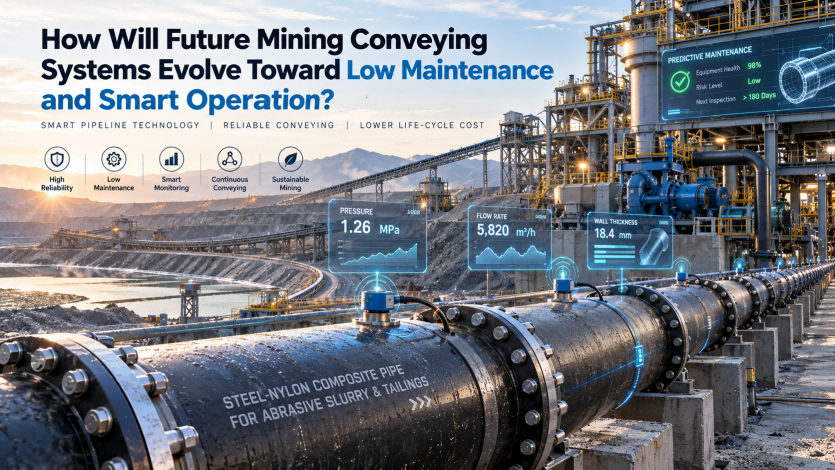
How Will Future Mining Conveying Systems Evolve Toward Low Maintenance and Smart Operation?
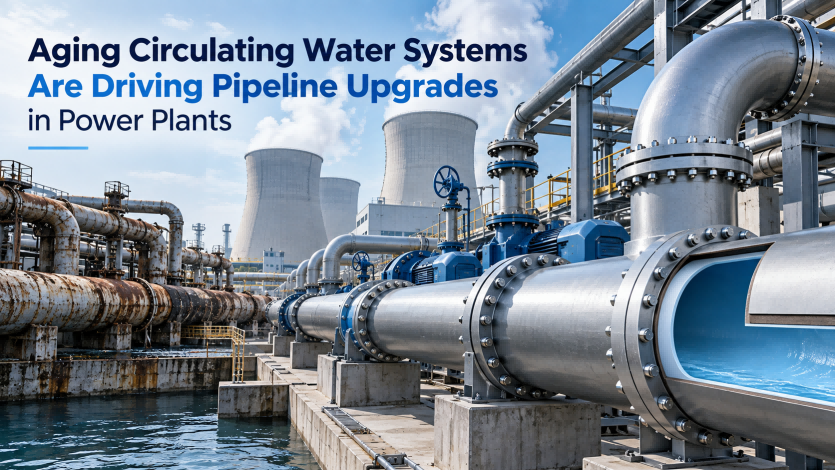
Aging Circulating Water Systems Are Driving Pipeline Upgrades in Power Plants