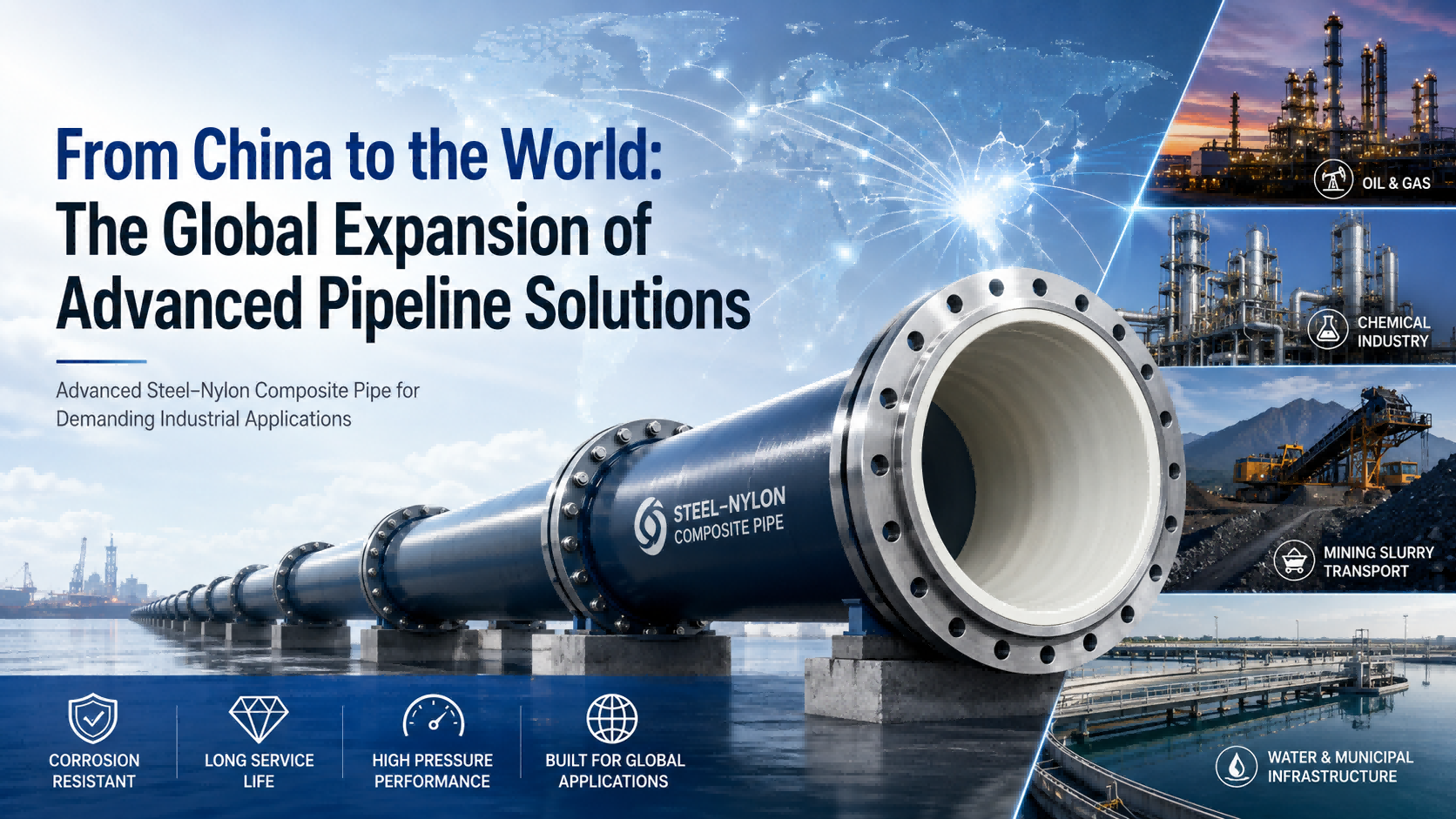
From China to the World: The International Expansion of Advanced Pipeline Solutions
This is especially true in industries such as oil and gas, chemicals, mining, power generation, seawater desalination, industrial water treatment, and municipal water supply and drainage. Across these sectors, more and more projects are facing the same fundamental question:
Can traditional pipeline materials still meet the demands of industrial operations over the next 20 years—or even longer?
Corrosion, abrasion, scaling, high temperatures, elevated pressures, aggressive media, and frequent maintenance are exposing the limitations of many conventional materials.
At the same time, Chinese manufacturing is evolving from simple “product export” toward the international delivery of technology, engineering experience, and complete industrial solutions.
Against this background, advanced composite pipeline technologies—represented by steel–nylon composite pipe—are emerging as an important option for highly corrosive, abrasive, and demanding industrial environments around the world.
The real value of internationally competitive Chinese pipeline technology is no longer simply to export “a pipe.”
It is to provide an advanced pipeline solution that helps customers reduce lifecycle costs and improve long-term reliability.
1. How Is the Global Industrial Pipeline Market Changing?
For decades, industrial pipeline material selection has largely focused on several established categories:
-
Carbon steel pipe
-
Stainless steel pipe
-
Rubber-lined steel pipe
-
Plastic-lined steel pipe
-
HDPE / PE pipe
-
FRP / GRP pipe
-
Ductile iron pipe
Each of these materials has mature and proven applications.
However, as operating conditions become more demanding, the limitations of single-material pipeline systems are becoming increasingly apparent.
Carbon steel, for example, offers excellent mechanical strength and a mature manufacturing ecosystem. Yet when continuously exposed to corrosive fluids, it may suffer from wall thinning, localized corrosion, and eventual perforation.
Stainless steel improves corrosion resistance in many applications, but in environments containing high chloride concentrations, aggressive chemicals, or complex temperature conditions, it may still face risks such as pitting, crevice corrosion, and stress corrosion cracking. Its material cost can also be significantly higher.
PE and HDPE offer excellent corrosion resistance, but for high-temperature, high-pressure, and ultra-large-diameter industrial applications, long-term pressure performance, ring stiffness, and connection reliability require careful engineering evaluation.
FRP provides strong chemical resistance, but under long-term pressure, mechanical impact, complex installation conditions, or highly abrasive service, structural reliability must also be carefully considered.
As a result, industrial users are increasingly moving away from the question:
“Which pipe is cheaper?”
and toward:
“Which pipeline provides the lowest lifecycle cost?”
In other words, global industrial pipeline procurement is gradually shifting from initial purchase price to total lifecycle value.
2. Global Customers Are Buying Reliability, Not Just Pipe
In major industrial projects, the most expensive part of a pipeline is often not the initial purchase price.
The real cost includes:
Purchase cost + installation cost + shutdown losses + maintenance cost + replacement cost + safety risk + service life
Suppose one type of pipeline has a low initial price but must be replaced after only a few years because of corrosion perforation.
The plant may then have to pay not only for new pipe, but also for:
-
Production shutdown
-
Pipeline removal
-
Lifting and handling
-
Welding
-
Corrosion protection
-
Scaffolding
-
Labor
-
Safety management
-
Production losses
For continuous-process industries, the cost of a single day of downtime may far exceed the value of the pipeline section itself.
This is why international customers increasingly focus on three key indicators:
Reliability
Long-term operational reliability.
Service Life
Sustained performance over an extended operating period.
Total Cost of Ownership
The full cost of the pipeline throughout its service life.
These are precisely the areas where advanced composite pipeline systems can create significant value.
3. Why Are Composite Materials Becoming More Important in Industrial Pipelines?
One of the long-standing challenges in industrial piping is that:
Mechanical strength and corrosion resistance are difficult to optimize simultaneously with a single material.
Steel is strong, but susceptible to corrosion.
Plastics resist corrosion, but temperature and pressure capability may be limited in certain applications.
Rubber can protect against corrosion, but aging, abrasion resistance, and vacuum stability must be carefully evaluated.
FRP offers strong corrosion resistance, but certain high-impact, high-abrasion, or high-pressure applications can require more sophisticated engineering.
Modern materials engineering therefore increasingly follows a different principle:
Let each material perform the function it does best.
This is the fundamental logic behind composite pipeline technology.
In steel–nylon composite pipe, the objective is not simply to combine two materials.
Instead, the structure is designed so that steel and nylon complement one another.
The steel structure provides:
Strength & Pressure Resistance
The nylon functional layer provides:
Corrosion Resistance & Abrasion Resistance
Together, they create:
Mechanical Strength + Corrosion Resistance + Abrasion Resistance
This combination is one of the main reasons steel–nylon composite pipe can be considered for demanding industrial services.
4. Steel–Nylon Composite Pipe: A Material System for Complex Industrial Conditions
Steel–nylon composite pipe is not intended to replace every traditional pipeline material.
Its most appropriate positioning is:
A solution for complex operating conditions where conventional single-material pipes struggle to satisfy multiple requirements at the same time.
Typical examples include:
-
Corrosion + high pressure
-
Corrosion + abrasion
-
Large diameter + elevated pressure
-
Strong alkali + long-term operation
-
Slurry transportation + erosion
-
Oilfield produced water + CO₂ / H₂S corrosion
-
Outdoor pipe racks + temperature variation
-
Aggressive chemical media + continuous production
In these operating conditions, selecting a material purely because it is “corrosion resistant” is often not enough.
Engineers must evaluate multiple parameters simultaneously:
-
Temperature
-
Pressure
-
Flow velocity
-
Chemical composition
-
Solid particle content
-
Pipe diameter
-
Support spacing
-
Vacuum conditions
-
Water hammer
-
Installation environment
-
Maintenance accessibility
This means the future of industrial pipeline technology will increasingly depend on:
Material + Structure + Connection + Manufacturing + Application Engineering
rather than simply the name of the pipe material.
5. What Are the Core Advantages of Our Steel–Nylon Composite Pipe?
5.1 Steel Structure Provides Reliable Mechanical Support
A demanding industrial pipeline must first meet fundamental mechanical safety requirements.
This is particularly important in large-diameter, high-pressure, and long-distance pipeline systems, where the pipe may be subjected to:
-
Internal pressure
-
Pipe self-weight
-
Fluid weight
-
Support loads
-
Temperature changes
-
Vibration
-
Water hammer
-
External mechanical loads
The steel structure provides strong overall rigidity and pressure-bearing capability, while the nylon layer is responsible for corrosion and abrasion resistance.
This rigid-flexible combination makes steel–nylon composite pipe particularly attractive for demanding industrial applications that may exceed the practical limits of some conventional non-metallic pipelines.
6. Nylon Provides a Long-Term Corrosion-Resistant Barrier
Corrosion remains one of the most common causes of industrial pipeline failure worldwide.
The problem is especially serious in environments involving:
-
Oilfield produced water
-
Brine
-
High-chloride solutions
-
Strong alkaline media
-
Chemical mother liquor
-
Industrial wastewater
-
Seawater
-
Corrosive slurries
When conventional metallic pipes are exposed to these media over long periods, they may experience:
General Corrosion
Pitting Corrosion
Under-Deposit Corrosion
and eventually localized perforation.
Steel–nylon composite pipe uses a nylon working layer to reduce direct contact between corrosive process media and the metallic structural layer.
This changes the traditional strategy of relying only on higher-alloy metals to resist corrosion.
The concept can be particularly valuable in industries such as salt chemicals, chlor-alkali, soda ash, oilfield water handling, and selected slurry transportation systems.
7. Abrasion Resistance Matters Just as Much as Corrosion Resistance
Many industrial fluids are not simple liquids.
Typical examples include:
-
Mining slurry
-
Salt slurry
-
Crystallizing mother liquor
-
Sand-containing oilfield wastewater
-
Fly ash slurry
-
Flue gas desulfurization slurry
Solid particles in these media continuously impact and scour the inside of a pipe.
This can produce a combined failure mechanism known as:
Erosion–Corrosion
In other words:
Abrasion and corrosion occur simultaneously.
Under these conditions, even a metal with good chemical corrosion resistance may still lose wall thickness rapidly due to mechanical erosion.
Nylon offers excellent abrasion resistance, making steel–nylon composite pipe especially suitable for applications where both:
Corrosion + Abrasion
must be addressed.
This is an important distinction between steel–nylon composite pipe and many conventional anti-corrosion piping systems.
8. Wide Temperature Capability: Approximately –36°C to 160°C
One characteristic of international industrial projects is the extreme variation in climate and process conditions.
The Middle East may face very high ambient temperatures.
Northern oilfields may operate in severe cold.
Chemical process pipelines may continuously transport elevated-temperature media.
Some systems may also experience frequent thermal cycling.
Our steel–nylon composite pipe can be engineered for applications across an approximate temperature range of:
–36°C to 160°C
This broad operating window allows the technology to serve a diverse range of industrial environments and provides an important foundation for international applications.
However, material selection for every project should still be confirmed according to:
Medium + Concentration + Temperature + Pressure + Flow Velocity
rather than relying on temperature alone.
9. 1.0–4.0 MPa: Designed for Real Industrial Pressure Requirements
Many corrosion-resistant non-metallic pipelines perform well in conventional water applications.
Industrial pipelines, however, often involve much more demanding conditions.
Chemical plants, mines, oilfields, and energy facilities may face:
-
Higher operating pressures
-
Pressure fluctuations
-
Pump start-stop cycles
-
Water hammer
-
Temperature changes
-
Long-term continuous operation
Our steel–nylon composite pipeline products can be designed for pressure classes of approximately:
1.0–4.0 MPa
The steel structure provides the pressure-bearing foundation, while the nylon functional layer provides corrosion and abrasion resistance on the media-contact side.
This combination enables the product to enter industrial pressure ranges that may be difficult for some conventional plastic piping systems.
10. DN2000+: Large-Diameter Capability for Major Industrial Projects
Industrial infrastructure continues to move toward larger-scale systems.
Examples include:
-
Seawater desalination
-
Mine tailings transportation
-
Circulating cooling water
-
Power plant desulfurization
-
Industrial water supply and drainage
-
Large chemical facilities
-
Long-distance slurry transportation
These applications frequently require large pipe diameters such as:
DN800
DN1000
DN1200
DN1600
or even DN2000 and above.
Our manufacturing system is capable of producing ultra-large-diameter specialty pipes of DN2000 and above.
For international markets, this is a significant capability.
The technical challenge of ultra-large-diameter pipelines is not simply whether a manufacturer can physically produce a large pipe.
It also involves:
-
Roundness control
-
Wall thickness consistency
-
Structural stability
-
Flange strength
-
Transportation
-
Lifting
-
On-site connection
-
Long-term pressure resistance
-
Installation tolerance
Large-diameter production capability is therefore an important indicator of a manufacturer's overall engineering and manufacturing strength.
11. Flanged Connections: An Important Installation Advantage in International Projects
Many industrial pipeline projects face difficult field installation conditions.
Traditional metallic pipelines commonly depend on welding.
Welding requires:
-
Hot-work permits
-
Qualified welders
-
Welding equipment
-
Power supply
-
Non-destructive testing
-
Coating repair
-
Longer installation time
In oil and gas plants, chemical facilities, and operating industrial sites in particular, hot work is itself a major safety management issue.
Our steel–nylon composite pipes are primarily connected using:
Flanged Connections
Integrated flange designs can further simplify installation.
This can significantly reduce field welding requirements.
For international projects, that creates a practical commercial advantage:
Less on-site construction complexity = shorter installation time + lower labor cost + lower construction risk
In countries with high labor costs, this advantage can sometimes create more value than the difference in pipe purchase price itself.
12. Why Does Chinese Steel–Nylon Composite Pipe Have Global Potential?
China has experienced several decades of rapid industrial development.
Oil and gas, chemicals, power generation, mining, and urban infrastructure have created a wide variety of demanding engineering environments.
These conditions have also created a unique technological advantage:
Real Industrial Experience
Chinese industrial projects have long faced challenges such as:
-
High salinity
-
Strong alkalinity
-
High water content
-
Severe abrasion
-
Large diameters
-
High pressures
-
Continuous operation
-
Harsh outdoor conditions
The international competitiveness of advanced Chinese industrial products should therefore no longer be defined simply by:
Made in China
It should evolve toward:
Engineered and Proven in Complex Industrial Conditions
In other words:
Solutions validated in demanding real-world industrial environments.
13. Forty Years of Technical Experience Matters More Than Product Data Alone
Industrial procurement is fundamentally different from consumer-product purchasing.
International engineering customers do not choose an unfamiliar pipeline technology simply because the datasheet looks impressive.
They want to know:
Has it been used before?
Where has it been used?
How long has it been operating?
What problem did it solve?
Can the performance be verified?
For advanced industrial pipeline suppliers, one of the strongest market barriers is therefore not the product catalog.
It is:
Application History
Our nylon and steel–nylon composite pipeline technologies have accumulated decades of industrial application experience in sectors including petroleum, chemicals, salt chemicals, mining, and other demanding industrial systems.
This long-term engineering experience is an important foundation for global expansion.
Because in industrial procurement:
Long-term field performance is more convincing than laboratory data alone.
Laboratory testing demonstrates material properties.
Engineering cases demonstrate something equally important:
The technology can operate successfully in real industrial conditions.
14. From “Selling Pipe” to Becoming a Pipeline Solution Provider
For Chinese industrial companies to build long-term international competitiveness, traditional export thinking is no longer enough.
The old model is often:
Inquiry → Quotation → Price Comparison → Export
For technical products such as steel–nylon composite pipe, a more effective international business model is to become a:
Pipeline Solution Provider
The customer provides information such as:
-
What medium is being transported?
-
What is the operating temperature?
-
What is the pressure?
-
What is the pipe diameter?
-
What is the flow rate?
-
Does the medium contain solids?
-
What is the corrosion environment?
-
Why is the existing pipeline failing?
-
What service life is expected?
The supplier then helps develop a complete solution covering:
Material Selection → Pipe Design → Connection Design → Manufacturing → Installation Guidance → Lifecycle Evaluation
This is how advanced manufacturing companies can create sustainable international competitiveness.
15. What Pipeline Problems Are International Markets Trying to Solve?
For steel–nylon composite pipe, international expansion should not be based only on searching for customers country by country.
A more effective strategy is to target customers according to their industrial problems.
Oil & Gas
Relevant search terms include:
Produced Water Pipeline Corrosion
CO₂ Corrosion
H₂S Corrosion
High Water-Cut Oilfield Pipeline
Typical challenges:
Corrosion, scaling, sand abrasion, and frequent leakage.
Chlor-Alkali Industry
Relevant search terms include:
Caustic Soda Pipeline
Brine Pipeline
Alkali Resistant Pipe
Typical challenges:
Strong alkalinity, saline media, corrosion, and crystallization.
Soda Ash Industry
Relevant search terms include:
Mother Liquor Pipeline
Brine Slurry Pipeline
Typical challenges:
High chloride concentrations, corrosion, abrasion, and scaling.
Mining
Relevant search terms include:
Mining Slurry Pipeline
Abrasion Resistant Pipe
Tailings Pipeline
Typical challenges:
Severe particle erosion and rapid wear.
Power Plants
Relevant search terms include:
FGD Slurry Pipeline
Desulfurization Pipeline
Typical challenges:
Corrosion, scaling, and abrasion.
Seawater Desalination
Relevant search terms include:
Seawater Pipeline
Corrosion Resistant Large Diameter Pipe
Typical challenges:
Chloride corrosion and long-term operation of large-diameter pipelines.
These problems exist not only in China, but also throughout:
-
The Middle East
-
Southeast Asia
-
Central Asia
-
Africa
-
South America
-
Europe
-
North America
This means the real global opportunity for Chinese industrial technology is not tied to one geographic market.
It lies in solving industrial problems shared by customers around the world.
16. Why Might International Customers Choose Steel–Nylon Composite Pipe?
If customers compare only material names, they already have many established options.
But when evaluated from the perspective of engineering requirements, steel–nylon composite pipe occupies a much clearer market position.
| Engineering Requirement | Value of Steel–Nylon Composite Pipe |
|---|---|
| Corrosive service | Nylon working layer provides corrosion resistance |
| Abrasive media | Strong wear resistance |
| High pressure | Steel structure provides pressure-bearing capability |
| Large diameter | Available up to DN2000+ |
| High and low temperatures | Approx. –36°C to 160°C |
| Installation efficiency | Flanged connections reduce field welding |
| Continuous production | Helps reduce frequent pipe replacement |
| Maintenance cost | Supports lower lifecycle maintenance costs |
| Complex media | Can be engineered for specific operating conditions |
| Aging pipeline replacement | An alternative for upgrading traditional pipe systems |
The real strength is therefore not any single specification.
It is:
Multiple Performance Advantages in One Pipeline System
In practical terms, this means combining:
Mechanical strength, corrosion resistance, abrasion resistance, large-diameter capability, elevated-pressure capability, and installation efficiency in one integrated pipeline solution.
17. From Initial Price Competition to Lifecycle Value Competition
Chinese manufacturing has historically been associated in many international markets with:
Low Cost
But advanced industrial products cannot build long-term brand value by focusing only on being cheaper.
The stronger positioning for steel–nylon composite pipe is:
Lower Lifecycle Cost
Consider two pipeline systems.
The first has a lower purchase price but must be replaced every three to five years.
The second requires a somewhat higher initial investment but remains in stable operation for a much longer period.
When the following costs are included:
-
Shutdowns
-
Maintenance
-
Replacement
-
Labor
-
Construction
-
Safety management
-
Production losses
the second option may deliver a significantly lower:
Total Cost of Ownership, or TCO
The key question in international industrial procurement should therefore no longer be:
“How much does the pipe cost?”
It should be:
“How much does the pipeline cost over its entire service life?”
This is the critical step for advanced Chinese industrial pipeline manufacturers to move from price competition toward value competition.
18. The Future: From Product Export to Engineering Value Export
Over the next decade, the internationalization of Chinese industrial products is likely to undergo a major transformation.
In the past:
Made in China
Then:
Designed in China
Next:
Engineered in China
And ultimately:
Global Industrial Solutions from China
The pipeline industry will follow the same direction.
Companies capable of competing globally will need more than manufacturing equipment.
They will need:
-
Manufacturing capability
-
Materials technology
-
Operating-condition analysis
-
Engineering design
-
Project references
-
Quality management systems
-
Understanding of international standards
-
Overseas technical support
Once these capabilities are integrated, Chinese manufacturers will no longer be exporting only:
Pipe
They will be exporting:
Pipeline Reliability
19. Where Are the Global Opportunities for Steel–Nylon Composite Pipe?
From an application perspective, steel–nylon composite pipe is especially relevant for projects where traditional pipelines repeatedly suffer from the following problems:
Frequent Corrosion
Repeated corrosion and perforation.
Severe Abrasion
Rapid erosion and wear.
Scaling & Blockage
Internal deposits and flow restriction.
Short Service Life
Frequent pipeline replacement.
High Maintenance Cost
Excessive repair and inspection expenses.
Frequent Shutdown
Production interruption caused by pipeline failures.
High Installation Cost
Complex construction and welding requirements.
Difficult Large-Diameter Applications
Challenges associated with large-diameter corrosion-resistant pipelines.
This leads to an important market insight:
Our real competitor is not simply another pipe material.
The real question is:
Why does the customer's existing pipeline keep failing?
Once the sales and engineering process begins with this question, the international market positioning of steel–nylon composite pipe becomes much clearer.
20. Globalization Is Not Just About Exporting—It Is About Solving Problems
For Chinese industrial companies, “going global” should not simply mean selling products overseas.
True internationalization means that engineers in different countries begin to recognize Chinese technologies as reliable options when solving difficult pipeline problems.
When an oilfield engineer faces:
Produced Water Corrosion
steel–nylon composite pipe should become one of the solutions considered.
When a chemical plant faces:
High-Alkali Pipeline Corrosion
steel–nylon composite pipe should enter the material selection discussion.
When a mine faces:
Slurry Pipeline Abrasion
the same technology should be considered.
And when a major industrial project requires:
DN1000–DN2000+ Corrosion-Resistant Pipeline
a reliable Chinese-engineered solution should be available.
That is the real meaning of globalization.
Conclusion: Helping the World Rediscover Chinese Industrial Pipeline Technology
The global industrial pipeline market is moving from material competition toward system performance and lifecycle value competition.
Corrosion, abrasion, high pressure, high temperature, large diameters, installation efficiency, and maintenance costs are making it increasingly difficult for conventional single-material pipelines to satisfy every demanding industrial requirement.
Steel–nylon composite pipe combines:
The mechanical performance of steel
with
The corrosion and abrasion resistance of nylon
to create a differentiated industrial pipeline solution.
With an approximate operating temperature range of –36°C to 160°C, pressure classes of 1.0–4.0 MPa, manufacturing capability for DN2000+ ultra-large-diameter pipes, flanged connections, and decades of industrial application experience, we are bringing pipeline technologies proven in demanding Chinese industrial environments to a broader global market.
The future of advanced Chinese manufacturing is not simply about exporting products.
It is about exporting:
Experience.
Engineering.
Reliability.
Lifecycle Value.
And, ultimately, a complete technology system capable of solving real industrial problems.
From China to the World.
Advanced Pipeline Solutions for Demanding Industrial Applications.
Why We Focus on Corrosion-Resistant and Wear-Resistant Industrial Pipeline Technology
40 Years of Industrial Pipeline Innovation: The Evolution of Steel–Nylon Composite Pipe Technology