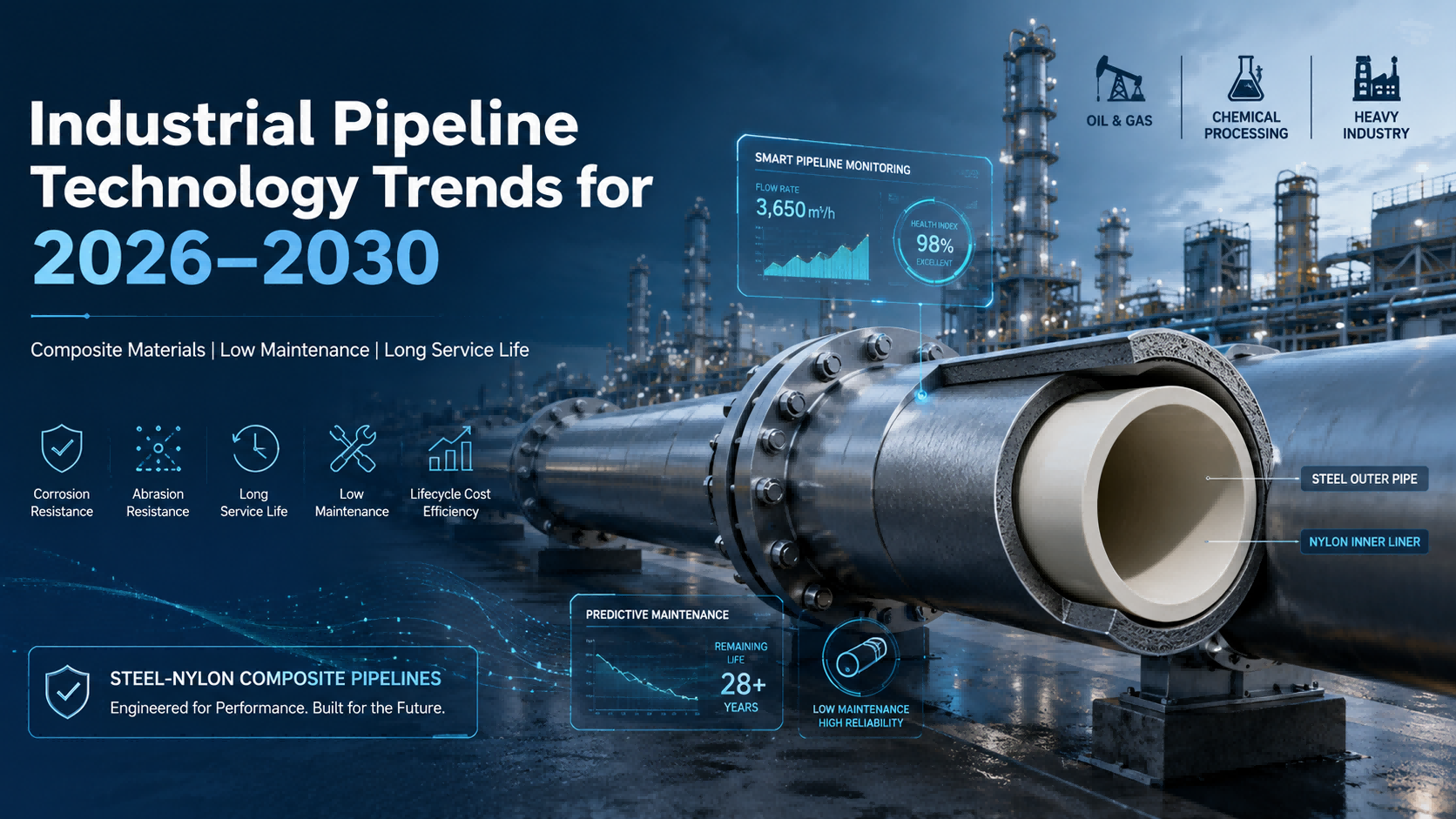
Future Development Trends in Corrosion-Resistant Industrial Pipeline Technology
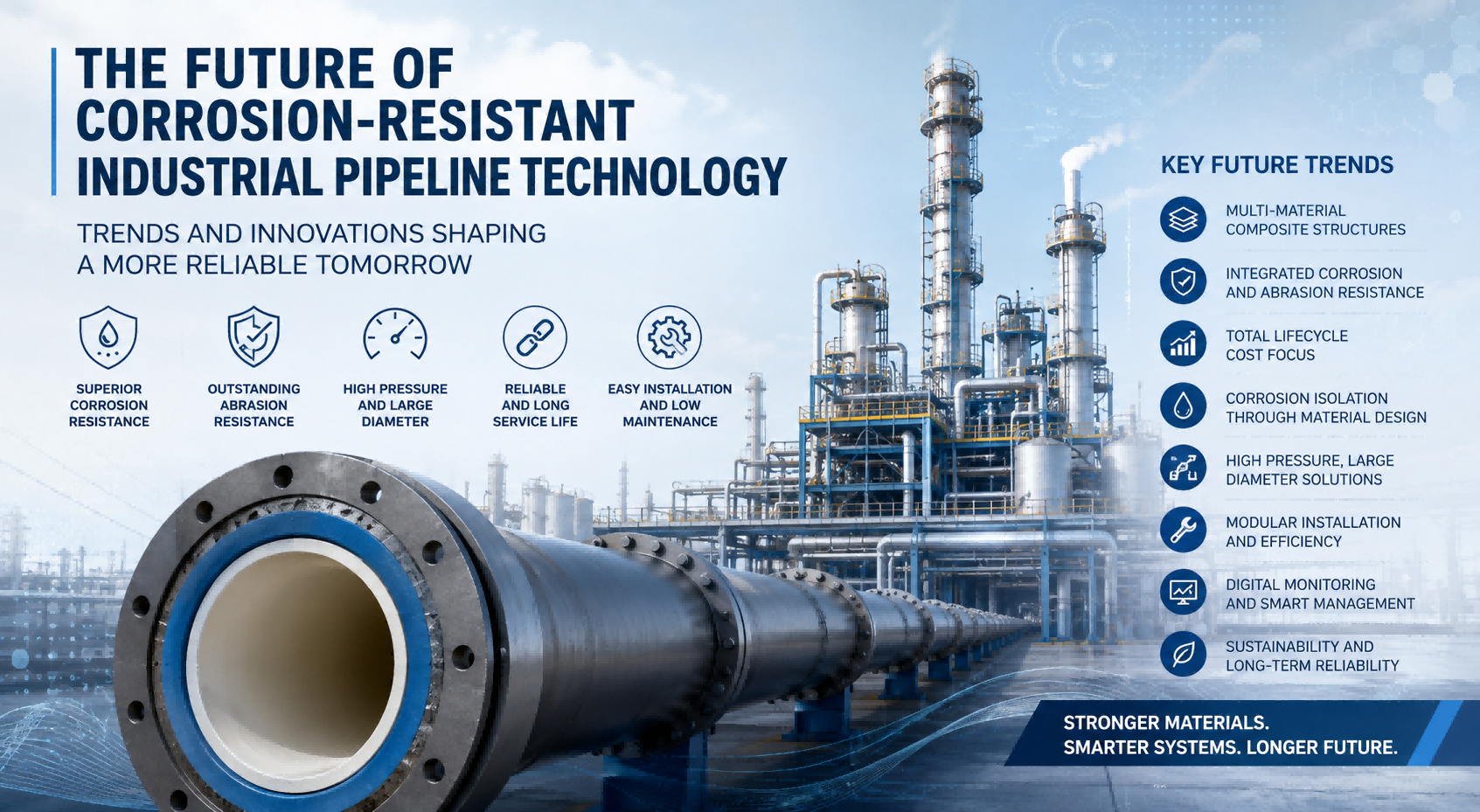
Ultimately, corrosion affects the safety, production continuity, maintenance cost, and service life of the entire industrial system.
As a new cycle of industrial infrastructure development begins, corrosion-resistant pipeline technology is undergoing a significant transformation:
The industry is gradually shifting from “protecting pipelines after corrosion occurs” to “reducing the probability of corrosion through material and system design from the very beginning.”
This means that the future competition in industrial piping will no longer focus only on which material is more corrosion-resistant.
Instead, the key questions will be:
-
Which pipeline can address corrosion, abrasion, pressure, temperature, and mechanical strength at the same time?
-
Which material can reduce maintenance requirements and production shutdowns?
-
Which pipeline offers the lowest total lifecycle cost?
-
Which structure can handle increasingly complex industrial media?
-
Which piping system can operate longer while reducing overall asset risk?
From this perspective, the technology represented by steel-nylon composite pipe, combining the structural strength of steel with the corrosion resistance of high-performance nylon, is increasingly aligned with the future direction of industrial pipeline development.
1. Why Will Corrosion-Resistant Industrial Pipelines Remain a Long-Term Technology Growth Area?
Even after decades of development in industrial materials, corrosion has not disappeared.
AMPP reported in its 2026 U.S. pipeline industry analysis that corrosion remains one of the important causes of pipeline incidents. Based on PHMSA data, corrosion has historically accounted for approximately 18% of pipeline incidents in the United States, with the proportion exceeding 25% in 2024.
This demonstrates that even in markets with mature inspection, coating, cathodic protection, and integrity management technologies, corrosion remains a major infrastructure reliability challenge.
More importantly, modern industrial operating environments are becoming increasingly complex.
Traditional industrial pipelines may only have transported water, oil, or relatively simple chemical media.
Today, many pipeline systems must simultaneously handle:
H₂S, CO₂, saline water, strong alkalis, weak acids, slurry, salt slurry, solid particles, high flow velocities, elevated pressures, and fluctuating temperatures.
Under such conditions, simply increasing the wall thickness of carbon steel or relying on surface coatings may no longer be sufficient to solve all failure mechanisms.
Modern corrosion control therefore increasingly involves a complete system of:
material selection, structural design, protective coatings, inspection, cathodic protection, corrosion inhibitors, and lifecycle corrosion management.
Several major technology trends are emerging from this change.
Trend 1: From Single-Material Pipes to Multi-Material Composite Structures
For many years, industrial pipeline materials have generally followed two major technology routes.
The first is metallic materials, including:
-
Carbon steel
-
Stainless steel
-
Duplex stainless steel
-
High-alloy materials
The second is non-metallic materials, including:
-
PE
-
HDPE
-
PVC
-
FRP
-
Engineering polymer piping systems
Both categories have advantages, but both also have inherent limitations.
Metal pipes generally provide high mechanical strength and pressure capability, but under certain media they may suffer from:
-
Pitting corrosion
-
Crevice corrosion
-
Stress corrosion cracking
-
Erosion-corrosion
-
General chemical corrosion
Non-metallic pipelines, on the other hand, naturally provide excellent corrosion resistance but may face limitations in:
-
High-pressure service
-
Large-diameter systems
-
Elevated temperatures
-
Structural stiffness
-
Mechanical impact resistance
For this reason, one increasingly important direction is:
Instead of forcing one material to solve every engineering problem, different materials are used to perform different functions.
This is the fundamental principle behind composite pipeline technology.
In a steel-nylon composite pipe:
The steel structural layer provides mechanical strength, ring stiffness, and pressure-bearing capability.
The nylon functional layer provides corrosion resistance, abrasion resistance, media isolation, and reduced scaling tendency.
This design philosophy separates structural performance from chemical-service performance.
As industrial operating conditions become more demanding, such composite structures provide greater engineering flexibility than conventional single-material pipes.
Trend 2: Corrosion Resistance and Abrasion Resistance Will Increasingly Be Considered Together
Many industrial pipeline failures are not caused by corrosion alone.
The more difficult problem is often:
Corrosion + erosion + abrasion occurring simultaneously.
For example:
Oilfield produced fluids may contain saline water, CO₂, H₂S, and sand particles at the same time.
Mining pipelines may transport abrasive slurry containing solid particles and corrosive chemicals.
Phosphate chemical plants, salt chemical plants, soda ash plants, and flue gas desulfurization systems may experience a combination of:
-
Chemical corrosion
-
Crystallization
-
Scaling
-
Solid-particle erosion
-
High-velocity fluid impact
When solid particles continuously remove corrosion products or protective films from a metal surface, fresh metal becomes exposed again, potentially accelerating corrosion.
Therefore, the future definition of a corrosion-resistant pipe will increasingly involve more than chemical resistance.
It must also address:
Abrasion Resistance + Erosion Resistance + Corrosion Resistance
In other words:
Corrosion resistance, wear resistance, and erosion resistance will increasingly become integrated performance requirements.
This is one of the application areas where steel-nylon composite pipe offers strong potential.
The nylon layer not only isolates corrosive media from the steel structure, but also provides excellent abrasion resistance.
This makes steel-nylon composite pipelines particularly suitable for industrial systems involving both corrosive environments and particle erosion, including:
-
Oilfield produced fluid pipelines
-
High-water-cut crude oil gathering systems
-
Sand-containing media
-
Mining slurry transportation
-
Salt slurry pipelines
-
Mother liquor transportation
-
Power plant desulfurization slurry
-
Chemical slurry systems
In the future, industrial pipeline materials may increasingly be evaluated not simply by their corrosion rate, but by their overall failure rate under combined service conditions.
Trend 3: Pipeline Procurement Will Shift from Initial Price to Total Lifecycle Cost
This may become one of the most important changes in industrial pipeline procurement.
Traditionally, many pipeline projects begin by comparing:
“What is the price per meter?”
For long-term industrial operations, however, this is not necessarily the most important question.
The actual cost of a pipeline system includes:
Purchase Cost + Installation Cost + Corrosion Protection Cost + Inspection Cost + Maintenance Cost + Replacement Cost + Shutdown Losses + Leakage Risk
This means procurement departments will increasingly evaluate pipelines based on:
TCO — Total Cost of Ownership
Consider two pipeline systems.
Pipeline A costs 20% less initially but requires frequent maintenance and replacement.
Pipeline B has a higher initial investment but significantly reduces repair frequency and shutdowns.
Over a 10-year or 20-year operating period, Pipeline B may ultimately be the more economical solution.
Therefore, future competition in corrosion-resistant industrial piping will gradually shift from:
Price per Meter
to:
Cost per Year of Reliable Operation
This shift creates an important opportunity for long-service-life composite pipeline technologies such as steel-nylon composite pipe.
Trend 4: Future Material Design Will Focus More on Corrosion Isolation, Not Only on Higher-Alloy Metals
The traditional material upgrade path often looks like this:
Carbon Steel → 304 Stainless Steel → 316L Stainless Steel → Duplex Stainless Steel → Higher-Alloy Materials
The core idea is to continuously improve the corrosion resistance of the metal itself.
This remains an important engineering approach.
However, higher alloy grades usually mean significantly higher material costs.
Moreover, every metallic material still has specific limitations depending on:
-
Chemical composition
-
Chloride concentration
-
Temperature
-
Stress conditions
-
Flow velocity
-
pH
-
Pressure
As a result, another technical route is becoming increasingly important:
Prevent corrosive media from directly contacting the load-bearing metal structure.
This is essentially a barrier technology strategy.
A high-performance polymer or other non-metallic material forms a continuous internal protective layer.
The corrosive medium primarily contacts the corrosion-resistant functional layer, while the steel structure provides mechanical load capacity.
Steel-nylon composite pipe is a typical example of this design philosophy.
Rather than simply increasing steel wall thickness, it changes the relationship between the corrosive medium and the structural material.
The structure becomes:
Corrosive Medium → Nylon Functional Layer → Steel Structural Layer
instead of:
Corrosive Medium → Metallic Pressure-Bearing Layer
This concept is likely to remain an important direction in future composite pipeline development.
Trend 5: High Pressure, Large Diameter, and Complex Service Conditions Will Drive Rigid-Flexible Composite Pipe Development
Traditional non-metallic pipelines are already widely used in many low-pressure transportation systems.
However, as pipe diameter, pressure, and temperature increase, engineers must simultaneously consider:
-
Ring stiffness
-
Internal pressure
-
Vacuum or negative pressure
-
Support span
-
Ground settlement
-
Temperature variation
-
Mechanical impact
-
Installation loads
As a result, high-performance industrial piping systems will increasingly emphasize:
Rigid Structure + Corrosion-Resistant Functional Layer
In other words:
High-strength structural support combined with a corrosion-resistant internal layer.
Steel-nylon composite pipe follows this rigid-flexible structural concept.
In our product system, steel-nylon composite pipes can support multiple industrial pressure classes and large-diameter applications while combining steel's structural strength with nylon's corrosion and abrasion resistance.
This makes them particularly suitable for demanding industries such as:
-
Oil and gas
-
Chemical processing
-
Mining
-
Power generation
-
Seawater desalination
-
Large-scale municipal infrastructure
where large diameter, structural strength, pressure capability, and corrosion resistance may all be required simultaneously.
Trend 6: Installation Method Will Become Part of Pipeline Technology Competition
Future industrial projects will place increasing emphasis on construction and installation efficiency.
Installation time is not simply a matter of labor cost.
For many industrial plants, the larger issue is:
Production downtime.
Traditional welded piping may require:
Cutting → Beveling → Alignment → Welding → Nondestructive Testing → Corrosion Protection Repair
In oil, gas, and chemical facilities, hot work also introduces additional safety management requirements.
Therefore, industrial pipeline connections are increasingly developing toward:
-
Modular construction
-
Mechanical connections
-
Faster installation
-
Reduced field hot work
-
Easier maintenance and replacement
Steel-nylon composite pipe can use flange connections, allowing straight pipe sections, elbows, tees, reducers, and other fittings to form modular pipeline systems.
This can be particularly valuable for:
-
Existing pipeline upgrades
-
Partial pipeline replacement
-
Trial pipeline sections
-
Maintenance projects
-
Plant retrofit projects
Future pipeline competition will therefore no longer be limited to the pipe material itself.
It will increasingly involve:
The installation efficiency of the entire pipeline system.
Trend 7: Digital Monitoring Will Complement Corrosion-Resistant Materials Rather Than Replace Them
Sensors, online monitoring, AI-based predictive maintenance, and digital twins are becoming increasingly common in industrial infrastructure.
Future pipeline systems may continuously monitor:
-
Pressure
-
Temperature
-
Flow
-
Wall-thickness change
-
Vibration
-
Leakage
-
Corrosion rate
-
Operating abnormalities
Digital technologies can help operators identify problems earlier.
But digital monitoring cannot replace corrosion-resistant materials.
A sensor can tell an operator:
“This pipeline is corroding.”
Better material design attempts to answer:
“How can we prevent or significantly reduce corrosion from occurring in the first place?”
Therefore, the future industrial pipeline system will increasingly combine:
High-Performance Materials + Intelligent Monitoring + Predictive Maintenance
These technologies are complementary rather than competitive.
Trend 8: Hydrogen, CCUS, and Low-Carbon Industries Will Create New Material Challenges
Future industrial pipelines will not only transport traditional oil, natural gas, water, and chemical media.
New energy and low-carbon industries are creating new pipeline requirements for media such as:
-
Hydrogen
-
CO₂
-
CCUS-related fluids
-
New chemical feedstocks
These media can create entirely new material challenges.
Hydrogen pipeline systems, for example, require careful consideration of:
-
Hydrogen embrittlement
-
Hydrogen permeation
-
Weld integrity
-
Leakage risk
-
Material compatibility
CO₂ transport systems may also require strict control of:
-
Moisture content
-
Impurities
-
Corrosion
-
Stress cracking
-
Pressure-temperature conditions
This means that industrial pipeline selection will increasingly require:
Media-Specific Material Engineering
It is important to emphasize that not every corrosion-resistant material is automatically suitable for hydrogen, supercritical CO₂, or other emerging applications.
Before any pipeline material is introduced into a new service environment, it should be evaluated based on:
-
Pressure
-
Temperature
-
Permeability
-
Media composition
-
Relevant codes and standards
-
Application-specific testing
This also reflects a broader industry transition:
From general-purpose pipe products toward application-specific pipeline solutions.
Trend 9: Sustainability Will Increasingly Be Linked to Infrastructure Service Life
In future industrial projects, sustainability will involve more than the carbon footprint of producing the pipe itself.
Consider a pipeline that corrodes frequently.
It must be:
Manufactured, transported, installed, operated for several years, removed, and then replaced.
Every replacement cycle consumes additional:
-
Raw materials
-
Energy
-
Transportation
-
Construction resources
-
Labor
Therefore:
Extending pipeline service life can itself reduce the overall resource consumption of industrial infrastructure.
Future pipeline evaluation may increasingly consider:
-
Service Life
-
Maintenance Frequency
-
Replacement Cycle
-
Lifecycle Impact
-
Resource Efficiency
rather than only the initial material cost.
If a pipeline can operate longer while reducing repairs, replacements, and shutdowns, its value goes far beyond corrosion protection.
It improves the resource efficiency of the entire industrial system.
Trend 10: The Future Is Not About Finding the “Best Pipe,” but the “Best Pipe for the Application”
Industrial pipeline material selection will become increasingly specialized.
For example:
PE may be suitable for certain low-pressure water transportation systems.
FRP may perform well in specific corrosive environments.
316L stainless steel may be appropriate for certain chemical or sanitary applications.
Duplex stainless steel may be selected for specific high-strength corrosive environments.
Steel-nylon composite pipe, meanwhile, is particularly attractive when several requirements must be achieved simultaneously:
Corrosion Resistance + Abrasion Resistance + Structural Strength + Higher Pressure Capability + Large Diameter
Future engineering decisions should therefore move beyond the question:
“Which pipeline material is the best?”
Instead, engineers should ask:
-
What is the transported medium?
-
What is the operating temperature?
-
What is the operating pressure?
-
Are solid particles present?
-
Is erosion expected?
-
Is negative pressure possible?
-
What is the pipe diameter?
-
What is the expected operating life?
-
What is the financial impact of one unplanned shutdown?
Only when these factors are considered together can an appropriate pipeline material be selected.
Why Does Steel-Nylon Composite Pipe Fit the Future Direction of Industrial Pipelines?
From the broader evolution of pipeline technology, the future will probably not belong exclusively to either “metal pipes” or “plastic pipes.”
One of the most promising technology directions is:
Allowing different materials to perform the functions they are best suited for.
Steel-nylon composite pipe is based on exactly this principle.
The steel structure provides:
-
Mechanical strength
-
Structural rigidity
-
Pressure-bearing capability
-
Stability for large-diameter industrial applications
The nylon functional layer primarily provides:
-
Corrosion resistance
-
Abrasion resistance
-
Low-friction internal surface
-
Isolation between the transported medium and steel
Our steel-nylon composite pipeline systems can be designed for a wide range of industrial requirements, including:
-
Large-diameter applications from approximately DN100 to DN2000
-
Pressure classes from 1.0 to 4.0 MPa
-
Operating temperatures of approximately -36°C to 160°C
-
Weak acids, strong alkalis, and multiple corrosive media
-
Particle-containing fluids, slurry, and erosive media
-
Oilfields, soda ash plants, chlor-alkali plants, salt chemicals, phosphate chemicals, mining, power plants, seawater desalination, and municipal infrastructure
Flanged connection systems also help simplify installation, maintenance, and pipeline replacement in complex industrial environments.
Steel-nylon composite pipe is not intended to replace every type of industrial pipeline.
Instead, it addresses a more specific engineering challenge:
When corrosion resistance, abrasion resistance, mechanical strength, pressure capability, and long-term reliability are all required at the same time, can one pipeline system provide a better overall balance?
This is where the real technical value of steel-nylon composite pipe lies.
The Future: Industrial Pipeline Competition Will Shift from Material Competition to Service-Life Competition
In the past, industrial pipeline markets mainly compared:
Materials.
In the future, they will increasingly compare:
Service life.
In the past, procurement teams compared:
Purchase price.
In the future, they will increasingly compare:
Total lifecycle cost.
In the past, the key question was:
Can this pipeline be used?
In the future, the question will increasingly become:
Can this pipeline operate reliably for a long period with minimal maintenance?
For this reason, the next decade of corrosion-resistant industrial pipeline technology will likely develop around several major directions:
Composite Materials, Integrated Corrosion and Abrasion Resistance, Large-Diameter High-Pressure Capability, Modular Installation, Intelligent Monitoring, Lifecycle Engineering, and Greater Adaptability to Complex Media.
Ultimately, all of these trends point toward one common goal:
Transforming industrial pipelines from components that require frequent maintenance and replacement into long-term infrastructure assets capable of reliable operation.
Conclusion
Corrosion itself will never completely disappear.
What is changing is the way industry controls it.
Future industrial pipeline technology will no longer rely only on adding another protective coating to steel or selecting a more expensive alloy.
Instead, the industry is moving toward a more comprehensive engineering approach:
Material Design + Structural Design + Corrosion Isolation + Abrasion Resistance + Intelligent Monitoring + Lifecycle Management
The composite material philosophy represented by steel-nylon composite pipe is one important part of this evolution.
For oil and gas fields, chemical plants, mining operations, power stations, seawater desalination systems, and other demanding industrial applications, the key pipeline selection question may no longer be:
“Which pipe has the lowest purchase price?”
Instead, the more important question will be:
“Which pipeline can keep this system operating reliably for the next 10, 20, or more years while minimizing maintenance, replacement, and shutdown costs?”
When industrial companies begin evaluating pipeline materials from this perspective, corrosion-resistant piping technology will move beyond traditional “corrosion protection” and enter a new era of:
Long-Term Asset Reliability Engineering
Why Low-Maintenance Piping Is Becoming a New Trend in Industrial Projects
Why Industrial Companies Are Shifting Toward Longer-Lasting Pipeline Materials