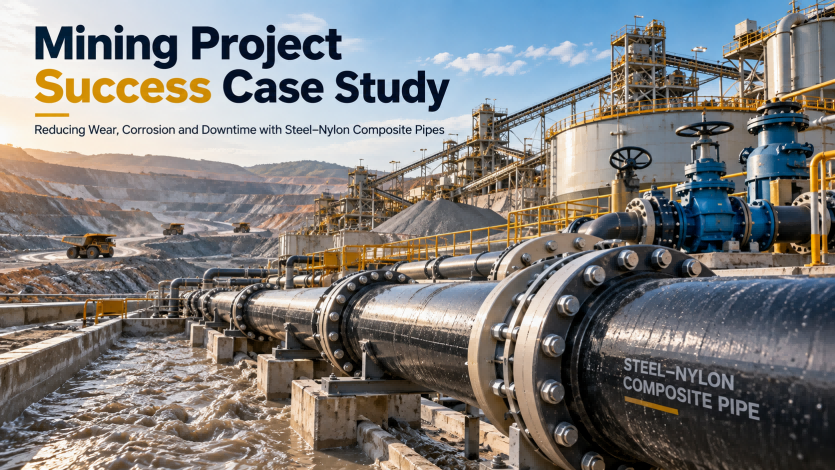
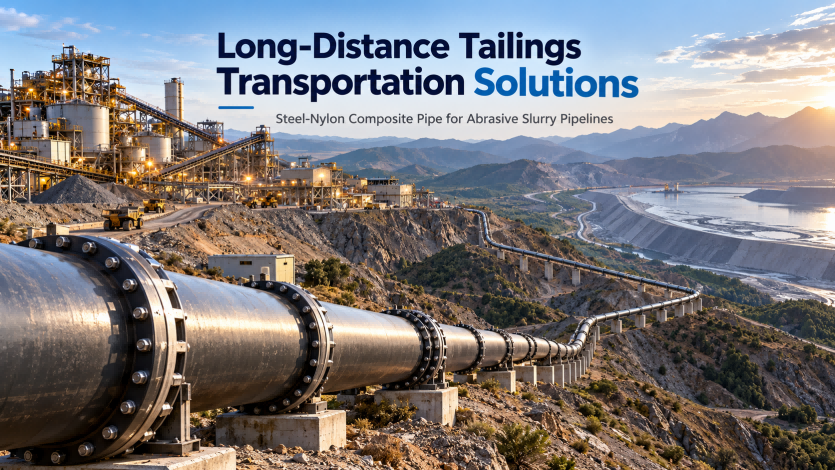
Recommended Pipeline Solutions for Gold Mine Tailings Transportation: How to Select a More Reliable Pipeline for Highly Abrasive and Corrosive Conditions

In gold mining operations, tailings pipelines are far more than ordinary material-conveying components.
As mining operations expand, tailings transportation distances increase, slurry concentrations rise, and continuous production becomes increasingly important, tailings pipelines are becoming a critical factor affecting operating reliability, maintenance costs, and even overall production efficiency.
Gold mine tailings pipelines are typically required to continuously transport slurry containing fine mineral particles, quartz, residual processing chemicals, and potentially corrosive components. This means that pipeline systems may simultaneously face:
-
Continuous abrasive wear
-
Chemical corrosion
-
High-solids slurry erosion
-
Pressure fluctuations
-
Severe localized wear at elbows
-
Pressure losses over long-distance pipelines
-
Production losses caused by shutdowns and maintenance
Therefore, the key question for a gold mining project should not simply be:
“Which pipeline has the lowest purchase price?”
A more important question is:
“Which pipeline can provide stable transportation throughout its service life while reducing replacement frequency, maintenance costs, and unplanned shutdown risks?”
This is one of the reasons why steel–nylon composite pipes are attracting increasing attention in mine tailings transportation projects.
1. Why Is Gold Mine Tailings Transportation So Demanding on Pipelines?
Gold mine tailings are generally a solid-liquid mixture generated after ore crushing, grinding, flotation, leaching, or other mineral processing operations.
Although the composition of tailings varies significantly from one mine to another, many tailings transportation systems share several common operating characteristics.
1.1 High Solid Particle Content
Gold mine tailings may contain:
-
Quartz
-
Silicate minerals
-
Feldspar
-
Fine sand
-
Residual metallic mineral particles
As these particles move through the pipeline at relatively high velocities, they continuously impact and rub against the internal pipe surface.
This is a typical form of abrasive wear.
As slurry concentration increases, more solid particles pass through the pipeline within a given period, potentially accelerating pipeline wear.
1.2 Tailings Slurry Is Not Always Chemically Neutral
Tailings transportation systems may contain residual:
-
Flotation reagents
-
Chloride ions
-
Sulfates
-
Acidic or alkaline components
-
Dissolved salts
-
Metal ions
Some gold mines use cyanide leaching processes, after which tailings may undergo detoxification and neutralization before final disposal.
Therefore, a tailings pipeline may not face mechanical wear alone.
In many applications, the real challenge is:
abrasion + corrosion occurring simultaneously.
When abrasive particles continuously remove protective films from metallic pipe surfaces, fresh metal is repeatedly exposed to the process fluid.
This can accelerate what is commonly known as:
erosion-corrosion.
1.3 Long-Distance Tailings Transportation Is Becoming More Common
In large mining projects, tailings storage facilities can be located several kilometers or even farther away from the processing plant.
Long-distance transportation normally requires:
-
Higher pumping pressures
-
Larger pipe diameters
-
Greater system reliability
-
Lower hydraulic resistance
-
More stringent leakage control
A localized pipeline failure can affect the operation of the entire tailings transportation system.
For this reason, large mining companies are increasingly evaluating pipelines according to long-term reliability rather than initial purchase cost alone.
2. Common Failure Modes of Gold Mine Tailings Pipelines
Several typical failure mechanisms should be carefully considered when designing gold mine tailings transportation systems.
2.1 Pipeline Wall Wear-Through
Wear-through is one of the most common problems in slurry transportation systems.
It is particularly serious at:
-
Elbows
-
Tees
-
Reducers
-
Areas near valves
-
Locations where slurry velocity changes abruptly
At these locations, particles may strike the pipe wall at higher velocities or unfavorable impact angles.
As a result:
localized wear rates can be significantly higher than those in straight pipe sections.
In some systems, straight pipe sections may remain operational while elbows have already experienced severe wall loss or perforation.
2.2 Wall Thickness Reduction Caused by Metal Corrosion
If the tailings slurry is corrosive, ordinary carbon steel pipelines may experience:
-
General corrosion
-
Pitting corrosion
-
Crevice corrosion
-
Under-deposit corrosion
Corrosion gradually reduces the effective pressure-bearing wall thickness.
When corrosion and abrasion occur simultaneously, pipeline service life can decrease even faster.
2.3 Lining Delamination or Failure
To improve the wear and corrosion resistance of carbon steel pipe, some mining projects use:
-
Rubber-lined steel pipe
-
Plastic-lined steel pipe
-
Ceramic-lined pipe
Although these structures can improve certain pipeline properties, long-term operation depends heavily on the reliability of the bond between the lining and the steel structure.
Potential problems include:
-
Blistering
-
Cracking
-
Delamination
-
Localized peeling
Once a lining is damaged, high-velocity slurry may penetrate the damaged area and accelerate further deterioration.
2.4 Local Deformation or Pressure Limitations of HDPE
HDPE offers excellent corrosion resistance and is widely used in certain mining applications.
However, for high-pressure, large-diameter, or long-distance tailings transportation systems, engineers also need to consider:
-
Required wall thickness
-
Ring stiffness
-
Temperature-related pressure derating
-
Deformation during long-distance installation
-
Joint reliability
Therefore, for certain high-pressure and large-diameter slurry applications, a single-material thermoplastic structure may not always provide the most balanced engineering solution.
3. What Parameters Should Be Considered When Selecting a Gold Mine Tailings Pipeline?
Professional pipeline selection should never be based solely on the name of the material.
At minimum, the following parameters should be evaluated.
3.1 Solids Concentration
This generally includes:
-
Solids concentration by weight
-
Solids concentration by volume
Higher solids concentrations normally increase the interaction between particles and between particles and the pipe wall.
This may significantly affect the wear rate.
3.2 Particle Size
Particle size directly affects impact behavior.
For example:
Fine particles may produce predominantly sliding abrasion.
Larger particles can generate more significant impact wear.
Therefore, average and maximum particle sizes should both be considered.
3.3 Mineral Hardness
The mineral composition of gold mine tailings can strongly influence abrasive wear.
Quartz, for example, has a Mohs hardness of approximately 7.
As a result, even relatively fine tailings can cause serious pipeline abrasion when the quartz content is high.
3.4 Slurry Velocity
Slurry velocity is one of the most important design parameters in tailings transportation.
If the velocity is too low:
solid particles may settle inside the pipeline.
If the velocity is too high:
pipeline wear can increase substantially.
Pipeline designers therefore need to establish an appropriate operating velocity above the critical deposition velocity while avoiding unnecessary excessive velocities.
3.5 Operating Pressure
In long-distance tailings transportation systems, the pressure class should be determined by considering:
-
Transportation distance
-
Elevation difference
-
Friction losses
-
Number of pumping stations
-
Water hammer
-
Start-up and shutdown pressure fluctuations
For large-scale tailings pipelines, wear resistance alone is not sufficient.
The pipe must also provide reliable and stable pressure-bearing performance.
3.6 Chemical Characteristics of the Slurry
Important parameters include:
-
pH
-
Chloride concentration
-
Sulfate concentration
-
Total dissolved salts
-
Temperature
-
Residual mineral-processing chemicals
These factors help determine whether the selected pipe material can maintain long-term chemical stability in the actual operating environment.
4. Comparison of Common Gold Mine Tailings Pipeline Materials
Common pipeline materials used in mining slurry and tailings transportation include:
-
Carbon steel pipe
-
Rubber-lined steel pipe
-
HDPE pipe
-
FRP pipe
-
Ceramic-lined composite pipe
-
Steel–nylon composite pipe
No single material is universally suitable for every mining application.
A more reliable approach is to evaluate each material according to actual operating conditions.
Carbon Steel Pipe
Advantages
-
Good pressure-bearing capability
-
Mature manufacturing technology
-
Suitable for large diameters
-
Established installation systems
Limitations
-
Susceptible to corrosion
-
Can experience rapid abrasion in tailings service
-
Corrosion allowance may be required
-
Potentially high long-term maintenance costs
For highly abrasive and corrosive tailings slurry, bare carbon steel pipelines often require regular wall-thickness inspections.
5. Why Consider Steel–Nylon Composite Pipe for Gold Mine Tailings Transportation?
Steel–nylon composite pipe is not simply a conventional steel pipe combined with a plastic pipe.
The fundamental engineering concept is:
use the steel structure to provide mechanical strength and pressure resistance while using reinforced nylon to provide abrasion and corrosion resistance.
This hybrid structure helps address several conflicting requirements encountered in tailings transportation systems.
5.1 Steel Structure Provides Pressure Resistance
Long-distance tailings transportation systems may operate under relatively high pressures.
The steel structure can provide:
-
Structural strength
-
Resistance to deformation
-
Pressure-bearing capability
-
Stability for large-diameter pipelines
This can be particularly important in large mining projects.
Our steel–nylon composite pipes can be engineered for different pressure classes according to project requirements, providing an effective structural solution for tailings systems requiring higher pressure resistance.
5.2 Nylon Inner Layer Provides Abrasion Resistance
Reinforced nylon offers favorable wear resistance and a relatively low coefficient of friction.
As slurry flows through the pipeline, the nylon internal surface helps reduce friction between mineral particles and the pipe wall.
Compared with bare steel, potential benefits include:
-
Reduced abrasive wear
-
Lower localized erosion
-
Slower wall-thickness loss
-
Longer replacement intervals
These properties are particularly valuable when transporting gold mine tailings containing significant quantities of quartz and other abrasive minerals.
6. Why Must Abrasion Resistance and Corrosion Resistance Be Considered Together?
This is an important issue that is sometimes underestimated during tailings pipeline selection.
Some projects focus primarily on abrasion resistance while overlooking chemical corrosion.
However, with metallic materials:
corrosion and abrasion can interact and accelerate one another rather than simply acting independently.
For example:
Slurry particles remove protective films from the metal surface.
Fresh metal is exposed to the corrosive medium.
Corrosion products are then removed by the moving slurry.
New metal is exposed again.
This continuous cycle creates a classic:
erosion-corrosion mechanism.
Nylon does not rely on a metallic passive oxide film for corrosion protection.
Therefore, within its appropriate chemical compatibility range, reinforced nylon can help reduce pipeline deterioration caused by both:
chemical corrosion and mechanical abrasion.
7. Why Does a Low-Friction Inner Surface Matter in Long-Distance Tailings Pipelines?
Energy consumption is an important operating cost in long-distance slurry transportation.
Generally, a rougher internal pipe surface results in greater hydraulic resistance.
After prolonged operation, steel pipe surfaces may also experience:
-
Corrosion deposits
-
Scaling
-
Sediment accumulation
-
Increased surface roughness
All of these factors can increase flow resistance.
Nylon provides a relatively smooth internal surface.
Under appropriate design conditions, this can help reduce friction losses.
For a pipeline extending several kilometers, even a relatively small reduction in pressure loss per unit length may become significant when accumulated over the entire pipeline.
Therefore, pipeline material selection can also influence:
the long-term pumping energy consumption of a mining operation.
8. Why Are Composite Structures Particularly Valuable for Large-Diameter Tailings Pipelines?
As mining operations become larger, tailings pipeline diameters are increasing.
DN500, DN800, DN1000, and even larger tailings pipelines are becoming increasingly common in major projects.
However, as pipe diameter increases, engineering challenges also increase.
These include:
-
Higher pipe weight
-
Greater ring stiffness requirements
-
More difficult transportation
-
Higher installation accuracy requirements
-
Greater effects from pressure fluctuations
For very large diameters, pure thermoplastic pipelines may require substantially thicker walls to achieve the necessary structural stability.
A steel–nylon composite structure allows the steel component to carry structural loads while the nylon layer provides abrasion and corrosion resistance.
This functional separation can improve the engineering adaptability of large-diameter pipeline systems.
Our company has manufacturing capabilities for large-diameter steel–nylon composite pipes and can develop project-specific solutions based on:
-
Pipe diameter
-
Operating pressure
-
Slurry concentration
-
Transportation distance
-
Temperature
-
Particle characteristics
9. What Are the Advantages of Flanged Connections in Mine Tailings Pipelines?
Mining projects are often located in remote regions where installation conditions can be challenging.
Traditional welded pipelines may require:
-
Welding equipment
-
Skilled welders
-
Weld inspection
-
Hot-work permits and management
Industrial pipelines using flanged connections can simplify certain aspects of field installation.
Steel–nylon composite pipes can be manufactured with integrated flange structures.
Pipeline sections can then be assembled using:
flanges and bolted connections.
This approach can offer several practical advantages for mining projects:
-
Faster installation
-
Simpler field assembly
-
Easier pipe-section replacement
-
Improved maintenance efficiency
-
Reduced need for on-site hot work
For large tailings pipeline maintenance projects, modular replacement of individual pipeline sections can help shorten maintenance shutdowns.
10. Why Should Pipeline Selection Consider More Than the Initial Purchase Price?
Consider two hypothetical tailings pipeline options.
Pipeline A has a lower purchase cost but requires replacement every three years.
Pipeline B has a somewhat higher initial investment but may operate for eight to ten years or longer under the appropriate service conditions.
If only the initial purchase price is compared:
Pipeline A appears more economical.
However, mining companies actually bear the:
Total Cost of Ownership (TCO).
A simplified calculation can be expressed as:
TCO = Initial Pipeline Cost
-
Installation Cost
-
Maintenance Cost
-
Replacement Cost
-
Production Downtime Losses
-
Energy Cost
-
Leakage and Environmental Risk Costs
For many mining operations, the most expensive consequence is not the cost of the pipe itself.
It is:
unplanned downtime.
If a main tailings pipeline leaks or fails, the consequences may include:
-
Reduced processing plant throughput
-
Inability to discharge tailings normally
-
Emergency repair requirements
-
Cleanup of spilled slurry
-
Environmental remediation
-
Production losses
Therefore, reliability can be substantially more important than the lowest initial purchase price.
11. Which Gold Mine Tailings Applications Are Particularly Suitable for Evaluating Steel–Nylon Composite Pipe?
Steel–nylon composite pipe is particularly worth evaluating under the following operating conditions.
High-Concentration Tailings
High solids content increases the requirement for abrasion-resistant pipeline materials.
Long-Distance Tailings Transportation
Long pipelines require low flow resistance, stable pressure resistance, and long-term reliability.
Tailings with High Quartz Content
Hard mineral particles can generate severe abrasive wear.
Corrosive Tailings Slurry
Both abrasion and chemical corrosion need to be controlled.
Large-Diameter Tailings Pipelines
The pipeline must combine structural stability with corrosion and wear resistance.
Mines with High Maintenance Costs
Remote mining locations often face high labor, logistics, and spare-part costs, making longer replacement intervals particularly valuable.
12. Recommended Data for Gold Mine Tailings Pipeline Selection
Before selecting a pipeline material, engineering teams should ideally provide the following information.
Slurry Characteristics
-
Tailings composition
-
Solids concentration
-
pH
-
Salt concentration
-
Corrosive components
Particle Characteristics
-
Average particle size
-
Maximum particle size
-
Quartz content
-
Particle hardness
Transportation Parameters
-
Flow rate
-
Flow velocity
-
Transportation distance
-
Elevation difference
-
Operating pressure
Pipeline Parameters
-
Pipe diameter
-
Required wall thickness
-
Connection method
-
Installation environment
Only after developing a complete understanding of the operating conditions can engineers make a reliable pipeline material selection.
13. Gold Mine Tailings Transportation Is Moving Toward Long-Life Pipeline Systems
A clear change is taking place across the mining industry.
In the past, tailings pipeline design often focused heavily on:
initial capital cost.
Today, more mining companies are evaluating:
-
Pipeline service life
-
Downtime
-
Maintenance frequency
-
Energy consumption
-
Environmental risk
-
Total lifecycle cost
As a result, tailings pipeline materials are gradually evolving from conventional single-material solutions toward:
composite and function-specific pipeline systems.
Steel–nylon composite pipe represents one potential solution within this broader technological trend.
By combining:
steel structural strength and pressure resistance + reinforced nylon abrasion and corrosion resistance
the composite structure can provide a balanced solution for highly abrasive, corrosive, and long-distance slurry transportation applications.
Conclusion
Gold mine tailings transportation may appear to be only one part of the mineral processing system, but pipeline reliability can directly affect:
production continuity, maintenance costs, energy consumption, and environmental safety.
For high-concentration, highly abrasive, and potentially corrosive tailings slurry, conventional single-material pipelines may struggle to simultaneously deliver:
-
Abrasion resistance
-
Corrosion resistance
-
Pressure resistance
-
Large-diameter capability
-
Long service life
Steel–nylon composite pipe combines the structural strength of steel with the abrasion and corrosion resistance of reinforced nylon, providing an engineering solution worth evaluating for gold mine tailings transportation.
For mining companies planning a new tailings transportation system or upgrading an existing pipeline that suffers from frequent wear and leakage, the decision should go beyond comparing the cost per meter of pipe.
A more valuable question is:
Which pipeline solution can keep the entire tailings transportation system operating longer and more reliably while reducing maintenance interventions and unplanned shutdown losses over the next 10 years?
That is the real engineering and economic consideration behind gold mine tailings pipeline selection.
How to Select Pipes for Mine Backfill Systems: Balancing Abrasion Resistance, Pressure Capacity, and Long-Term Reliability
Copper Slurry Transportation Solutions: How to Address Abrasion, Corrosion, Sedimentation, and Long-Term Operating Challenges