
How H₂S and CO₂ Corrosion Is Driving Material Upgrades in Oilfield Pipelines
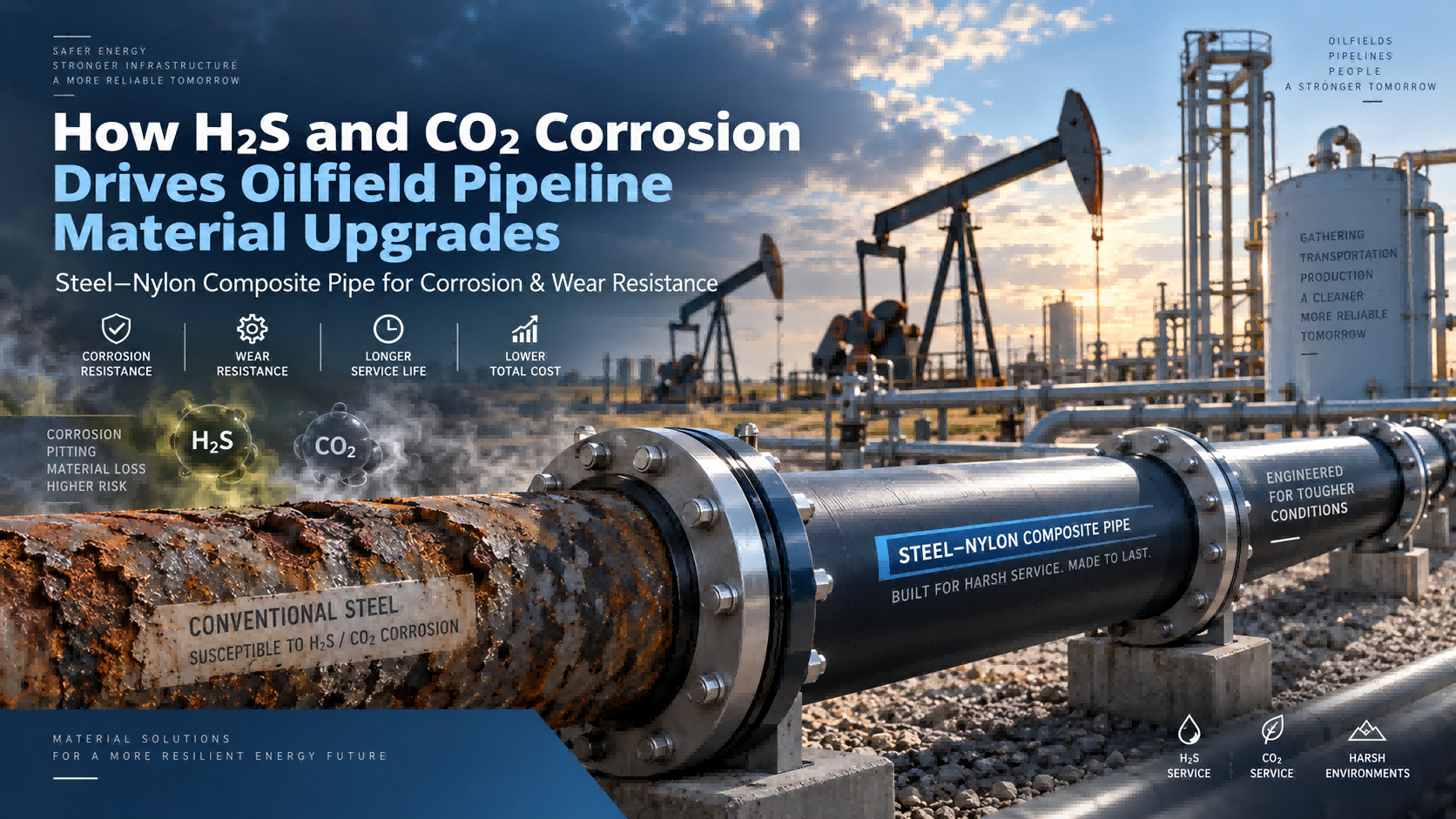
Pipeline corrosion is not a new problem in oil and gas production.
However, as more oilfields enter the middle and late stages of development, produced-fluid water cut continues to increase, fluid composition becomes more complex, and H₂S, CO₂, chlorides, highly mineralized water, sand, and microorganisms may act simultaneously.
As a result, the internal corrosion environment faced by conventional carbon steel pipelines is becoming increasingly severe.
In the past, many oilfields managed corrosion by increasing corrosion allowance, injecting corrosion inhibitors, performing regular pigging, and replacing damaged pipe sections.
Under complex operating conditions involving high water cut, high salinity, H₂S, and CO₂, however, the long-term cost and operational risk associated with this maintenance-intensive corrosion-control strategy can increase substantially.
This is driving an important change in oilfield pipeline material selection:
The industry is gradually shifting from “how to protect steel from corrosion” toward “how to minimize direct contact between corrosive media and the pressure-bearing steel structure.”
Steel–nylon composite pipe is one of the industrial pipeline solutions that deserves greater attention within this material-upgrade trend.
1. Why Are H₂S and CO₂ Major Corrosion Concerns in Oilfield Pipelines?
Oilfield-produced fluids are rarely single-phase media.
They commonly consist of a complex multiphase mixture containing crude oil, natural gas, produced water, salts, acid gases, and solid particles.
CO₂ and H₂S alone do not necessarily result in the same corrosion severity under every operating condition.
Actual corrosion behavior is determined by their interaction with:
-
Water phase
-
Temperature
-
Partial pressure
-
pH
-
Flow velocity
-
Chloride concentration
-
Other contaminants and impurities
Research published by AMPP on oil and gas pipeline corrosion has demonstrated that complex interactions exist among CO₂, H₂S, and corrosion-product films. Therefore, actual corrosion behavior cannot be accurately evaluated based on a single factor alone.
CO₂ Corrosion: A Typical Form of “Sweet Corrosion”
When CO₂ comes into contact with an aqueous phase, it creates a corrosive environment capable of promoting electrochemical corrosion of carbon steel.
Under certain conditions, corrosion products such as FeCO₃ may form on the steel surface. These deposits can sometimes reduce the subsequent corrosion rate.
However:
The formation of a corrosion-product layer does not mean that the corrosion problem has disappeared.
Its stability may be influenced by:
-
Temperature
-
pH
-
CO₂ partial pressure
-
Fluid velocity
-
Water chemistry
-
Deposits and suspended solids
If the protective layer is incomplete, poorly adhered, or damaged by high-velocity fluid, solid-particle erosion, or operating fluctuations, fresh metal may once again be exposed to the corrosive environment.
Therefore, in real oilfield gathering and transportation systems, engineers should not focus only on average corrosion rates.
They must also consider:
Localized corrosion, pitting, and uneven loss of pipe-wall thickness.
2. H₂S Creates More Than Conventional Corrosion Problems
If CO₂ corrosion primarily raises concerns about wall thinning, H₂S-containing environments can introduce even more complex material challenges.
When H₂S reacts with steel, iron sulfide corrosion products may form.
Under some conditions, these layers may reduce general corrosion rates. Under other conditions, however, the structure and adhesion of the film, combined with fluid erosion, may contribute to severe localized corrosion.
Research on wet-gas and multiphase environments containing H₂S has shown that significant localized pitting may occur even when the overall uniform corrosion rate appears relatively low.
More importantly, metallic materials exposed to H₂S environments may also require evaluation for mechanisms such as:
-
Sulfide stress cracking
-
Hydrogen-induced cracking
-
Stress-oriented hydrogen-induced cracking
-
Other hydrogen-related failure mechanisms
This is why the international oil and gas industry normally requires dedicated material evaluation for sour service environments.
The ANSI/NACE MR0175 / ISO 15156 series is among the important reference standards used for material selection in H₂S-containing oil and gas production environments.
Therefore:
Resistance to general corrosion does not automatically mean that a material is suitable for every H₂S-containing application.
This distinction is extremely important when selecting materials for oilfield pipelines.
3. Why Is Corrosion More Difficult to Predict When H₂S and CO₂ Coexist?
Real oilfield environments are rarely exposed to pure CO₂ or pure H₂S.
Many gathering pipelines actually transport combinations such as:
H₂S + CO₂ + highly mineralized produced water + chlorides + sand + crude oil + temperature variations + multiphase flow.
Corrosion therefore becomes a complex interaction between:
Material + fluid chemistry + flow conditions.
During CO₂ corrosion, iron carbonate films may form.
H₂S may subsequently change the composition and properties of the corrosion products present on the steel surface.
At the same time, fluid shear stress, sand erosion, and localized deposits may further damage these protective layers.
Research has shown that changes in the H₂S/CO₂ ratio can significantly affect both uniform and localized corrosion behavior of carbon steel.
The mechanism is not simply linear.
This means that knowing only:
“This pipeline contains H₂S”
or:
“This pipeline contains CO₂”
is far from sufficient for material selection.
A professional oilfield pipeline material evaluation should consider factors such as:
-
Fluid composition
-
Water-phase percentage
-
H₂S partial pressure
-
CO₂ partial pressure
-
Temperature
-
Design pressure
-
pH
-
Chloride concentration
-
Flow velocity
-
Sand concentration
-
Solid-particle size
-
Oxygen content
-
Microbiological environment
-
Required design life
4. High Water Cut Is Further Increasing Internal Corrosion Risks in Mature Oilfields
One of the most important changes in mature oilfields is the continuous increase in water cut.
During the early stages of production, fluids may contain a relatively high proportion of oil and gas.
As water injection and reservoir development continue, however, the proportion of produced water often increases significantly.
What does this mean for pipeline corrosion?
It means that a continuous electrolyte phase is more likely to exist inside the pipeline.
When H₂S, CO₂, chlorides, and other corrosive components dissolve into the aqueous phase, conditions for electrochemical corrosion become more favorable.
As a result, the corrosion risk of the same gathering pipeline may be completely different during the early production stage compared with the high-water-cut stage of a mature field.
Particular attention should be paid to areas such as:
-
Low points where water accumulates
-
Elbows
-
Tees
-
Upstream and downstream sections of valves
-
Reducers
-
Areas with sudden changes in flow pattern
-
Locations where deposits accumulate
-
Long-term low-flow sections
Oilfield pipeline design therefore cannot focus only on straight pipe sections.
In many cases:
The first leakage may occur at fittings or localized high-erosion areas rather than along straight pipe sections.
5. Why Is the “Carbon Steel + Corrosion Inhibitor” Strategy Facing Increasing Maintenance Pressure?
Carbon steel offers several important advantages:
-
Mature manufacturing technology
-
Relatively low initial cost
-
High pressure-bearing capability
-
Well-established construction and installation systems
For these reasons, carbon steel remains an important material for oilfield gathering pipelines.
To control internal corrosion, many projects rely on:
Carbon steel + corrosion allowance + corrosion inhibitors + pigging + corrosion monitoring.
From an engineering perspective, this remains a practical and economical solution for many applications.
The fundamental issue is that it represents a:
Continuous-maintenance corrosion-control system.
The effectiveness of corrosion inhibitors depends on several factors, including:
-
Chemical type
-
Concentration
-
Injection stability
-
Flow regime
-
Water-phase distribution
-
Field operating management
If inhibitor injection becomes unstable, water accumulates locally, deposits cover the metal surface, dead zones develop, or protective corrosion films are damaged, localized corrosion may still occur.
As oilfields move into high-water-cut and more chemically complex production stages, the way pipeline costs are evaluated is also changing.
In the past, purchasing decisions often focused on:
How much does one meter of pipe cost?
Increasingly, operators are asking:
How much will this pipeline actually cost over the next 10 years?
This is the concept of Total Cost of Ownership — TCO.
6. Oilfield Pipeline Design Is Moving from “Corrosion Protection” Toward “Material Isolation”
The traditional corrosion-control concept is relatively straightforward:
Continue using steel as the surface directly exposed to the process medium, while reducing corrosion through inhibitors, coatings, and corrosion allowance.
The design philosophy behind advanced composite pipelines is different:
Allow the material responsible for mechanical strength and the material directly exposed to corrosive media to perform different functions.
This is the fundamental concept behind steel–nylon composite pipe.
The steel structure provides:
Pressure resistance, rigidity, mechanical strength, and structural stability.
The nylon working layer provides:
Direct contact with the transported medium while minimizing direct exposure of the pressure-bearing steel structure to corrosive fluids.
Pipeline design therefore evolves from:
“Finding one material capable of doing everything”
toward:
“Using a composite structure in which different materials perform the functions they are best suited for.”
7. Why Is Steel–Nylon Composite Pipe Suitable for Complex Oilfield Media?
We specialize in the research, development, and manufacturing of steel–nylon composite pipes and reinforced nylon industrial piping systems.
For oilfield gathering, produced-water transportation, water injection, and other industrial pipeline systems carrying corrosive media, the primary value of a steel–nylon composite structure is not simply that one material can be described as “more corrosion-resistant.”
Its greater engineering value lies in changing the way corrosive media interact with the pressure-bearing steel structure.
7.1 Isolating Corrosive Media from the Steel Substrate
In a conventional carbon steel pipe:
Transported medium → direct contact with carbon steel
In a steel–nylon composite pipe:
Transported medium → nylon working layer → steel structural layer
As long as the internal lining system remains intact, corrosive aqueous media are prevented from directly attacking the pressure-bearing steel wall in the same way they would attack bare carbon steel.
The corrosion-control concept therefore changes from:
Reducing the corrosion rate of steel
toward:
Reducing the conditions necessary for direct corrosion of the steel structure.
For pipeline systems containing combinations of CO₂, H₂S, chlorides, and highly mineralized water, this approach can provide significant engineering value.
8. Oilfield Pipelines Often Face Wear as Well as Corrosion
Many oilfield pipeline failures are not caused by chemical corrosion alone.
Produced fluids may contain:
-
Sand
-
Corrosion products
-
Scale particles
-
Other suspended solids
As these particles move through the pipeline at elevated velocities, they repeatedly impact and erode areas such as:
-
Outer surfaces of elbows
-
Tees
-
Reducers
-
Valve areas
-
Pump discharge sections
This creates a typical:
Erosion–Corrosion Synergy
Corrosion reduces wall thickness.
Erosion damages corrosion-product films.
Fresh metal becomes exposed.
Corrosion accelerates again.
For this type of operating condition, improving corrosion resistance alone may not be sufficient.
The material must also provide:
Wear resistance.
Nylon materials offer favorable wear resistance and relatively low friction characteristics.
For this reason, steel–nylon composite structures are particularly suitable for applications where corrosion and erosive wear occur simultaneously.
9. Combining the Strength of Steel with the Media Resistance of Nylon
One major difference between oilfield industrial pipelines and ordinary water-distribution pipelines is the requirement for greater mechanical reliability.
Pipeline design may need to consider:
-
Internal pressure
-
External loads
-
Temperature variations
-
Pipe supports
-
Installation span
-
Valve weight
-
Ground settlement
-
Mechanical impact
Using a single non-metallic material may sometimes create limitations in areas such as:
-
Pressure capacity
-
Structural rigidity
-
Large-diameter manufacturing
-
Industrial connection systems
Steel–nylon composite pipe uses a:
Steel Structure + Nylon Working Layer
configuration.
The steel layer provides mechanical strength.
The nylon layer performs the media-contact function.
Depending on project requirements, our steel–nylon composite piping systems can be designed for different specifications and pressure ratings.
Under applicable design conditions, industrial pressure classes from approximately 1.0 to 4.0 MPa can be accommodated, while large-diameter industrial pipeline solutions can also be engineered and manufactured.
This makes the system suitable for applications including:
-
Oilfield station process piping
-
Gathering pipelines
-
Water-injection systems
-
Industrial pipeline rehabilitation projects
10. A Smooth Inner Surface Can Improve Long-Term Hydraulic Performance
Corrosion is not the only long-term problem affecting oilfield pipelines.
Another major issue is:
Scaling and deposition.
As operating time increases, the internal surfaces of some steel pipelines may gradually accumulate:
-
Corrosion products
-
Inorganic scale
-
Solid-particle deposits
This reduces the effective flow area of the pipeline, increases friction losses, and decreases transportation efficiency.
The relatively smooth surface of the nylon working layer can help reduce the tendency of materials to adhere and accumulate on the internal pipe wall.
For oilfield transportation systems designed for long-term service, pipeline economics should therefore not be evaluated only when the pipeline is newly commissioned.
A more important question is:
Can the pipeline maintain stable transportation performance after 5 or 10 years of operation?
11. Flanged Connections Offer Practical Advantages for Oilfield Rehabilitation Projects
Many oilfield pipeline projects are not completely new installations.
Typical projects include:
-
Partial replacement of aging pipelines
-
Upgrading severely corroded pipe sections
-
Process-piping modifications within stations
-
Valve-group rehabilitation
-
Replacement of highly vulnerable fittings
Construction efficiency therefore becomes extremely important.
Steel–nylon composite pipes can be designed with flanged connections, allowing convenient integration with:
-
Pumps
-
Valves
-
Tees
-
Elbows
-
Other process equipment
For rehabilitation projects where extensive field welding is undesirable or where reducing hot work is important, prefabricated flanged connections can significantly improve installation convenience.
This is particularly useful for implementation strategies such as:
Partial Replacement + High-Risk Section Upgrade + Trial Section Verification
For example, operators may initially replace:
-
Severely corroded elbows
-
Tees
-
Pump discharge sections
-
Upstream and downstream valve sections
Alternatively, a 100–500 meter trial pipeline section can be installed.
After operational performance has been verified, the application can then be gradually expanded.
This approach can reduce project risk compared with replacing an entire pipeline system at once.
12. How Should Different Oilfield Pipeline Materials Be Compared?
| Material | Corrosion-Control Approach | Mechanical Strength | Corrosion + Wear Conditions | Maintenance Characteristics |
|---|---|---|---|---|
| Carbon Steel | Inhibitors / corrosion allowance | High | Moderate | Requires continuous corrosion management |
| Stainless Steel | Alloy-based corrosion resistance | High | Depends on operating conditions | Higher material cost |
| PE / HDPE | Non-metallic media resistance | Low to medium | Depends on grade and conditions | Temperature, pressure, and connection limitations must be evaluated |
| FRP | Resin-system corrosion resistance | Medium | Depends on structural design | Manufacturing and installation quality are critical |
| Steel–Nylon Composite Pipe | Nylon working layer isolates the medium | High | Designed to address both corrosion and wear | Suitable for industrial flanged connections and partial upgrades |
Scientific material selection should not simply ask:
“Which material is the best?”
Instead, engineers should ask:
“Which material can achieve the required service life under these specific operating conditions while delivering the lowest lifecycle cost?”
13. Which Oilfield Applications Should Consider Steel–Nylon Composite Pipe?
From an engineering perspective, steel–nylon composite pipe deserves particular consideration for applications such as:
-
High-water-cut oilfield gathering pipelines
-
Produced-fluid pipelines containing CO₂ and/or H₂S
-
Highly mineralized produced-water systems
-
Oilfield water-injection systems
-
Sand-containing produced-fluid pipelines
-
Sections exposed to simultaneous corrosion and wear
-
Elbows, tees, and other high-wear components
-
Pump discharge piping
-
Upstream and downstream valve sections
-
Aging carbon steel pipelines requiring frequent repair
-
Oilfield pipeline upgrades focused on reducing long-term maintenance
For projects adopting a new material for the first time, we recommend the following engineering route:
Fluid Analysis → Operating Condition Assessment → Material Suitability Evaluation → High-Risk Component Trial → 100–500 m Trial Section → Operational Data Verification → Large-Scale Application
This is one of the most effective approaches for reducing the risk associated with pipeline material upgrades.
14. Important: H₂S Service Cannot Be Evaluated by Pipe Material Name Alone
For sour-service applications, no material should be selected simply because it is described as “corrosion-resistant.”
Applications involving H₂S require comprehensive evaluation of factors including:
-
H₂S partial pressure
-
CO₂ partial pressure
-
Design temperature
-
Design pressure
-
Water chemistry
-
pH
-
Chloride concentration
-
Flow velocity
-
Sand concentration
-
Oxygen content
-
Required service life
-
Pipeline connection design
For pressure-bearing metallic components, connections, or other critical metallic structures that may still be exposed to H₂S-containing media, material suitability should also be evaluated according to applicable project specifications and standards such as ISO 15156 / ANSI/NACE MR0175.
Therefore, the correct engineering value proposition of steel–nylon composite pipe is not:
“It can directly replace any pipeline operating in an H₂S environment.”
Instead:
Through an appropriately engineered composite structure, the system can minimize direct contact between corrosive media and the pressure-bearing steel substrate under suitable operating conditions, while the steel structure continues to provide the required mechanical performance. This creates an alternative material strategy for complex oilfield environments involving both corrosion and wear.
This positioning is more technically credible and more appropriate for international oil and gas engineering markets.
15. Oilfield Pipeline Competition Is Shifting from “Material Price” to “Lifecycle Reliability”
Historically, industrial pipeline procurement often began with one simple comparison:
Price per meter.
For mature oilfields, however, the most expensive element is often not the pipe itself.
The real costs may include:
-
Production losses caused by leakage
-
Emergency repairs
-
Labor
-
Equipment
-
Environmental remediation
-
Corrosion inhibitors
-
Inspection and monitoring
-
Repeated replacement
-
Downtime caused by unexpected failures
A more realistic procurement model is therefore:
Pipeline Cost = Initial Investment + Installation + Corrosion Control + Inspection + Maintenance + Replacement + Downtime Cost
In other words:
The true cost of a pipeline is its total lifecycle cost.
A pipeline with a lower initial purchase price may not be the most economical solution if it requires frequent maintenance and replacement.
Conversely, if a pipeline material can maintain more stable performance under corrosive and erosive conditions, its long-term TCO may be lower even when the initial investment is higher.
Conclusion: H₂S and CO₂ Are Driving Oilfield Pipelines into a New Era of Material Upgrading
H₂S and CO₂ are not new substances in oilfield production.
What is changing is:
The operating environment of the oilfield itself.
As mature oilfields experience increasing water cut, higher produced-water salinity, aging pipeline networks, and rising maintenance costs, traditional strategies based on corrosion allowance, inhibitor injection, and periodic replacement are facing increasing pressure.
The future of oilfield pipeline materials will not simply involve searching for:
“A more corrosion-resistant steel.”
A more important trend is:
Using material combinations and structural design to fundamentally change the relationship between corrosive media and the pressure-bearing structure.
Steel–nylon composite pipe represents this concept:
Steel for Strength.
Nylon for Corrosion and Wear Resistance.
Composite Design for Long-Term Reliability.
For oilfield transportation systems involving high water cut, high mineralization, CO₂/H₂S, and simultaneous corrosion and wear, steel–nylon composite pipe provides an alternative solution worthy of engineering evaluation.
Oilfield pipeline material selection is gradually shifting from asking:
“Which pipeline has the lowest purchase price?”
toward:
“Which pipeline can operate more reliably while reducing maintenance and failure costs throughout its service life?”
That may be the most important change behind the material upgrade being driven by H₂S and CO₂ corrosion.
Why Oilfield Water Injection Systems Are Paying More Attention to Internal Corrosion
Why High Water Cut Accelerates Gathering Pipeline Corrosion in Mature Oilfields


