High-Solids Slurry Is Driving the Evolution of Wear-Resistant Pipeline Materials
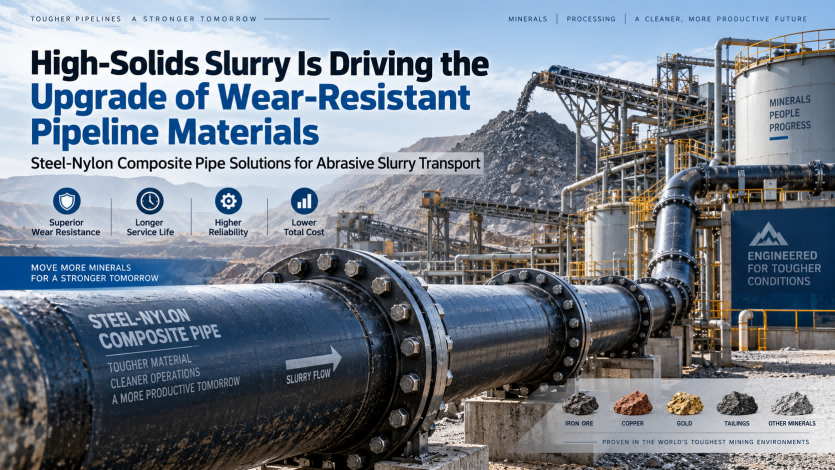
Introduction: Slurry Transportation Is Entering a New Era of Higher Solids Concentrations, Greater Wear Resistance, and Longer Service Life
In mining, mineral processing, tailings management, and mineral-based chemical production, slurry pipelines play a critical role in connecting production processes and ensuring continuous material transportation.
As mining companies seek to improve production efficiency, optimize water consumption, and reduce processing costs per ton of ore, high-solids slurry transportation has become an increasingly important technological consideration.
Compared with conventional low-concentration slurry, high-solids slurry typically exhibits more complex rheological properties. Its particle concentration, particle size distribution, and flow characteristics can significantly influence pipeline wear rates, pressure losses, and operational stability.
For conventional industrial pipelines, these conditions create more demanding operating environments.
Ordinary carbon steel pipes may experience accelerated internal wear. Certain non-metallic pipelines may face limitations in pressure resistance, structural stability, or complex installation environments. Traditional lined pipes require careful consideration of localized lining failure, joint wear, and long-term operational reliability.
Mining companies no longer need pipelines that simply transport slurry. They need comprehensive transportation solutions that combine wear resistance, corrosion resistance, pressure-bearing capacity, and long-term operational efficiency.
Against this background, steel-nylon composite pipes offer an alternative material solution for high-solids slurry transportation by combining the structural strength of steel with the wear-resistant and corrosion-resistant properties of modified nylon.
1. Why Is High-Solids Slurry Changing the Operating Conditions of Conventional Pipelines?
1.1 Higher Particle Concentrations Create More Complex Wear Conditions
Slurry generally consists of solid mineral particles suspended in water or another carrier liquid.
During transportation, solid particles generate friction, impact, and erosion against the inner surfaces of pipelines, gradually causing material loss.
As the solids concentration increases, the number of particles per unit volume rises, changing particle-to-particle interactions and the contact conditions between particles and the pipe wall.
However, slurry-induced wear does not necessarily increase linearly with solids concentration.
The actual wear rate depends on several factors:
-
Hardness, particle size, and shape of the solid particles.
-
Slurry velocity and flow conditions.
-
Distribution of solid particles across the pipeline cross-section.
-
Wear resistance of the pipeline material.
-
Local flow conditions at elbows, reducers, and connections.
For slurry containing quartz, silicates, and other hard mineral particles, the inner pipe surface must withstand not only continuous friction but also localized particle impact where the flow direction changes.
This means that simply increasing the wall thickness of conventional steel pipes may not fundamentally solve long-term maintenance problems under highly abrasive operating conditions.
1.2 High-Concentration Slurry Exhibits More Complex Flow Characteristics
The flow behavior of high-solids slurry differs significantly from that of clean water.
As solids concentration increases, the apparent viscosity, yield stress, and particle sedimentation behavior of the slurry may change.
Some high-concentration slurries containing fine particles exhibit pronounced non-Newtonian behavior, while slurries containing a large proportion of coarse particles may develop heterogeneous flow patterns.
If the pipeline system is not properly designed, two different operational risks may arise.
Risk 1: Insufficient Flow Velocity Causes Particle Deposition
For settling slurries, when the actual flow velocity falls below the critical deposition velocity under the relevant operating conditions, solid particles may gradually accumulate at the bottom of the pipeline.
This can reduce the effective flow area and, in severe cases, cause pipeline blockage.
Risk 2: Excessive Flow Velocity Accelerates Pipeline Wear
Excessive flow velocity may intensify the erosive action of solid particles against the pipe wall while increasing pressure losses and pumping energy consumption.
Therefore, high-solids slurry pipeline design must balance the prevention of particle deposition, control of abrasive wear, and reduction of energy consumption.
The critical deposition velocity depends on particle characteristics, slurry rheology, and pipeline operating conditions. A single fixed flow velocity should not be applied as a universal design standard for every slurry transportation project.
Upgrading high-solids slurry pipelines requires the simultaneous optimization of material performance and hydraulic system design. Simply replacing the pipeline with a more wear-resistant material cannot solve every operational challenge.
2. What New Performance Requirements Does High-Solids Slurry Place on Industrial Pipelines?
2.1 Wear Resistance: Moving Beyond Increasing Wall Thickness
Conventional carbon steel pipes rely on the metal itself to withstand internal pressure while remaining in direct contact with the transported medium.
Under highly abrasive conditions, solid particles may continuously erode the inner pipe wall, resulting in gradual wall-thickness reduction.
Such wear is often unevenly distributed.
The bottom of horizontal pipelines, the outer curves of elbows, and areas experiencing significant flow disturbances may be particularly susceptible to localized wear.
For mining companies that require continuous operation, localized wall thinning can lead to more frequent inspections, maintenance, and pipeline replacement.
Therefore, pipeline material upgrades should focus on two objectives.
First, improve the wear resistance of the material directly exposed to the slurry, reducing material loss during operation.
Second, optimize pipeline structures and local flow conditions to minimize abnormal wear in high-risk areas.
The value of wear-resistant materials lies not only in reducing the wear rate of internal pipe surfaces but also in helping operators establish more predictable maintenance intervals.
2.2 Corrosion Resistance: Addressing the Combined Effects of Wear and Corrosion
In practical slurry transportation systems, pipelines are often exposed to more than mechanical wear.
Certain slurries may contain dissolved salts, acidic or alkaline components, and other corrosive substances.
When corrosive media and solid particles are present simultaneously, metallic pipelines may experience combined corrosion and erosion.
For example, particle impact may remove corrosion products or protective films from the metal surface, continuously exposing fresh metal to corrosive media.
Corrosion can subsequently alter the surface condition of the material, further influencing localized wear behavior.
This interaction makes material degradation more complex under certain slurry transportation conditions.
Therefore, pipeline materials intended for complex slurry applications should be evaluated for both wear resistance and chemical compatibility.
For slurries that are simultaneously abrasive and corrosive, simply increasing material hardness does not necessarily guarantee satisfactory long-term performance.
2.3 Pressure-Bearing Capacity: Meeting Complex Slurry Transportation Requirements
The design pressure of a high-solids slurry transportation system depends on factors such as slurry rheology, transportation distance, elevation differences, pipe diameter, flow rate, and pumping station configuration.
For long-distance transportation projects, pipelines with significant elevation changes, or systems requiring higher pumping pressures, the pipeline must have sufficient pressure-bearing capacity to meet actual operating requirements.
Pipeline design must also consider:
-
Normal operating pressure and maximum operating pressure.
-
Pressure fluctuations caused by pump startup and shutdown.
-
Transient pressure resulting from valve operations.
-
Pipeline supports, temperature variations, and external loads.
-
The influence of localized wear on long-term pressure-bearing performance.
For certain pipelines primarily manufactured from non-metallic materials, long-term internal pressure, temperature, and material creep must receive particular attention.
Using a steel structure to carry the primary pressure load while employing a wear-resistant inner layer to isolate the transported medium represents one structural design approach for highly abrasive industrial applications.
3. Why Are Steel-Nylon Composite Pipes Worth Considering for High-Solids Slurry Transportation?
Steel-nylon composite pipes combine steel and modified nylon materials to take advantage of their complementary properties.
Their core structural design principle is straightforward:
The steel structure provides primary pressure-bearing capacity and structural support, while the nylon inner layer remains in direct contact with the slurry and provides wear-resistant and corrosion-resistant protection.
This composite structure differs significantly from conventional single-material pipelines.
3.1 Modified Nylon Inner Layer: Designed for Particle Friction and Erosion
During slurry transportation, solid particles continuously generate friction and impact against the internal surfaces of pipelines.
Our steel-nylon composite pipes use modified nylon as the inner layer directly exposed to the transported medium.
By utilizing the wear resistance, toughness, and corrosion resistance of nylon materials, the inner layer provides material protection for abrasive slurry transportation.
Compared with conventional carbon steel pipes whose metal surfaces are directly exposed to slurry, the composite structure shifts the medium-contacting surface to a wear-resistant inner layer.
This helps reduce the direct exposure of the pressure-bearing steel structure to abrasive particles.
For slurry transportation projects involving hard, fine particles and requiring long-term continuous operation, a properly selected modified nylon inner layer offers potential application advantages.
However, actual material wear life depends on particle characteristics, flow velocity, temperature, and impact angle.
For applications involving large quantities of sharp, coarse particles, particularly severe localized impact, or elevated operating temperatures, material suitability should be established through targeted abrasion testing and engineering validation.
Our product development focuses not only on improving the wear resistance of the material itself but also on enhancing overall pipeline reliability through appropriate composite structural design.
3.2 Steel Reinforcement: Combining Pressure Resistance with Structural Stability
Wear resistance is essential for slurry transportation pipelines, but the pipeline must also withstand internal pressure, external loads, and mechanical stresses during installation.
Steel-nylon composite pipes use steel as the primary pressure-bearing structure, allowing the wear-resistant inner layer and the steel reinforcement to perform different functions.
This design avoids relying entirely on nylon to withstand internal system pressure and provides additional structural design flexibility for medium- and high-pressure slurry transportation projects.
Our company manufactures steel-nylon composite pipes with pressure-rating series ranging from 1.0 to 4.0 MPa, allowing product selection according to specific project design conditions.
However, the applicable pressure rating of each pipeline must be confirmed based on nominal diameter, operating temperature, wall thickness, connection type, and the relevant product design documentation.
The final pressure-bearing capacity cannot be determined solely by the material category.
For long-distance slurry transportation projects, combining steel reinforcement with a wear-resistant inner layer allows pipeline design to address both structural pressure resistance and internal surface protection.
3.3 Corrosion-Resistant Inner Layer: Reducing Direct Contact Between Corrosive Slurry and Steel
When slurry contains salts, acidic substances, or alkaline components, exposed metal surfaces may experience corrosion.
Steel-nylon composite pipes use a continuous nylon inner layer to separate the transported medium from the pressure-bearing steel structure.
This design can reduce direct contact between corrosive slurry and steel.
For slurry systems in which the chemical compatibility of the nylon material has been verified, the composite structure can help reduce the risk of internal corrosion affecting the steel reinforcement.
In phosphate processing, salt mineral transportation, and certain chemical slurry applications, corrosion resistance may be just as important as wear resistance.
However, different nylon formulations vary in their resistance to acids, alkalis, solvents, and oxidizing substances.
Strong acids, high-temperature acidic media, and strongly oxidizing chemicals require specific material compatibility assessments.
Steel-nylon composite pipes should not be considered universally suitable for every corrosive medium.
3.4 Composite Structure: Integrating Material Performance with Engineering Pressure Requirements
A single pipeline material is often expected to meet several requirements simultaneously, including wear resistance, corrosion resistance, pressure-bearing capacity, and structural stability.
Steel-nylon composite pipes provide a more flexible engineering design approach by assigning different functions to different materials.
The steel structure provides primary mechanical strength and pressure resistance.
The nylon inner layer remains in direct contact with the transported medium, providing the required wear resistance and chemical protection.
By combining these materials, the composite structure helps address the comprehensive performance requirements of slurry transportation systems.
However, actual reliability also depends on lining continuity, interfacial bonding quality, temperature adaptability, end-sealing integrity, and structural stability under long-term cyclic loading.
Therefore, composite pipeline performance should not be evaluated solely based on the individual properties of steel and nylon.
The complete pipeline and its connection components must also be verified.
4. Why Is the Pipeline Connection System Equally Important in High-Solids Slurry Transportation?
In conventional slurry transportation systems, pipeline connections can become important maintenance points.
Connection design directly affects installation and maintenance efficiency, particularly in projects requiring frequent inspections, localized pipe replacement, or limited on-site hot work.
In developing our steel-nylon composite pipes, we place considerable emphasis on integrally formed flange structures and connection solutions that minimize the need for on-site welding.
4.1 Integrally Formed Flange Design
An integrally formed flange structure combines the pipeline-end connection design with the composite pipe structure.
Properly designed flange connections maintain the required connection performance while facilitating pipeline disassembly, replacement, and subsequent maintenance.
For high-solids slurry transportation, special attention should be paid to flange faces, lining termination points, and sealing areas.
The design should minimize internal misalignment, lining discontinuities, and sealing defects that could cause localized abnormal wear or leakage.
4.2 Reducing the Need for On-Site Welding
Mining pipelines may pass through equipment-intensive areas, locations with limited maintenance access, or production environments where on-site welding is inconvenient.
Suitable prefabricated flange connections can reduce the amount of welding required during installation.
For highly abrasive pipeline sections that require periodic replacement, flange connections can also improve maintenance convenience.
However, flange connections must still be installed according to the applicable design requirements.
Sealing material compatibility, bolt preload, pressure rating, and end-connection wear resistance must be verified for the intended operating conditions.
For slurry transportation systems, connection reliability is just as important as the performance of the pipe itself. Coordinated design of the pipe, connecting components, and sealing structures is essential for improving long-term system reliability.
5. How Should Mining Companies Choose Between Conventional Wear-Resistant Pipes and Steel-Nylon Composite Pipes?
Material selection for high-solids slurry pipelines should not focus exclusively on a single performance characteristic.
Different pipeline materials have distinct technical advantages and application limitations.
| Pipeline Material | Main Characteristics | Key Considerations During Selection |
|---|---|---|
| Carbon Steel Pipe | High structural strength and mature manufacturing and installation processes. | Abrasive or corrosive slurry may cause wall-thickness reduction. Wear allowance and maintenance intervals must be evaluated. |
| Rubber-Lined Steel Pipe | Elastic rubber lining offers wear protection under certain particle-impact conditions. | Particle impact conditions, lining adhesion, temperature, chemical compatibility, and joint protection must be considered. |
| Ceramic-Lined Pipe | High surface hardness, suitable for certain highly abrasive applications. | Localized impact, brittle fracture risk, lining fixation, and complex fitting structures require attention. |
| HDPE Pipe | Resistant to many chemical media, provides flexibility, and can offer good wear resistance under suitable conditions. | Design pressure, operating temperature, long-term creep, external loads, and connection methods must be evaluated. |
| Steel-Nylon Composite Pipe | Combines a steel pressure-bearing structure with a nylon inner layer for wear-resistant and corrosion-resistant design. | Slurry-specific wear performance, chemical compatibility, composite interface integrity, end-connection design, and complete-pipeline pressure resistance must be verified. |
It is important to emphasize that higher material hardness does not necessarily translate into longer service life under every slurry transportation condition.
Wear performance is also influenced by particle impact angle, particle size, flow velocity, and material deformation characteristics.
Therefore, for critical slurry transportation projects, a more reliable approach is to conduct comparative material testing using the actual transported medium.
The final pipeline solution should then be determined by considering structural requirements, operating pressure, and maintenance needs.
The value of steel-nylon composite pipes lies in providing an integrated material solution for projects that simultaneously require wear resistance, corrosion resistance, and pressure-bearing capacity—not in replacing every conventional wear-resistant pipeline material.
6. From Increasing Pipe Wall Thickness to Optimizing Total Cost of Ownership
Initial purchase price is often an important consideration in pipeline procurement for mining companies.
However, for high-solids slurry transportation systems that operate continuously over extended periods, the purchase price alone cannot fully represent the actual cost of pipeline ownership.
For example, a slurry pipeline may initially use relatively inexpensive carbon steel pipes.
If the system subsequently experiences frequent wear, localized leakage, pipe replacement, and production shutdowns, long-term maintenance costs may gradually increase.
Therefore, pipeline economics should be evaluated by considering total cost of ownership (TCO), rather than initial purchase price alone.
6.1 What Makes Up the Total Cost of Ownership of a Pipeline?
A simplified model can be expressed as follows:
TCO = Initial Procurement Cost + Installation Cost + Operating Energy Cost + Maintenance and Replacement Cost + Downtime Losses + End-of-Life Disposal Cost
The main cost components include:
Initial Procurement Cost: The purchase cost of pipes, fittings, and connection components.
Installation Cost: Transportation, lifting, pipeline connection, and on-site construction expenses.
Operating Energy Cost: Primarily the impact of pipeline pressure losses on pumping energy consumption.
Maintenance and Replacement Cost: Periodic inspections, localized repairs, pipe replacement, and spare parts.
Downtime Losses: Production interruptions, material losses, and recovery expenses resulting from pipeline failures.
End-of-Life Disposal Cost: Pipeline removal, transportation, and waste material disposal expenses.
6.2 Where Does the Economic Value of Steel-Nylon Composite Pipes Come From?
For slurry transportation projects where steel-nylon composite pipes are technically suitable, their potential economic value can be reflected in several areas.
First, the wear-resistant inner layer may help reduce material loss caused by direct slurry contact, potentially lowering associated maintenance requirements.
Second, the composite structure can combine pressure resistance with protection against the transported medium, helping address application limitations associated with single-material pipelines.
Third, connection solutions such as integrally formed flanges can improve the convenience of assembly and disassembly in certain pipeline sections, facilitating maintenance and localized replacement.
However, actual economic benefits must be supported by wear testing, service-life estimates, and project-specific cost data under comparable operating conditions.
For new projects without sufficient long-term operational data, representative pipeline sections can be selected for pilot testing.
Wear rates, pressure losses, maintenance time, and operating costs can then be recorded to evaluate the feasibility of wider implementation.
The long-term value of wear-resistant pipelines lies not only in extending the service life of individual pipes but also in reducing the overall operating cost of the entire slurry transportation system through appropriate material selection and system design.
7. How Should Steel-Nylon Composite Pipes Be Selected for High-Solids Slurry Projects?
Slurry composition, transportation distance, and operating conditions can vary significantly between mining projects.
Therefore, we do not recommend selecting a pipeline model solely based on nominal diameter or the general name of the transported slurry.
Before selecting steel-nylon composite pipes, the following parameters should be confirmed.
| Selection Parameter | Required Information | Impact on Pipeline Design |
|---|---|---|
| Solids Concentration | Solids concentration by mass and volume, including the expected variation range. | Influences rheological properties, particle distribution, and wear conditions. |
| Particle Characteristics | D50, D90, maximum particle size, hardness, and particle shape. | Influences wear mechanisms and inner lining material selection. |
| Slurry Chemical Properties | pH, salt concentration, acidic or alkaline components, and other chemical substances. | Determines the chemical compatibility requirements of the nylon inner layer. |
| Flow Rate and Velocity | Normal flow rate, maximum flow rate, and minimum operating flow rate. | Influences pipe diameter, deposition risk, pressure losses, and wear. |
| Operating Pressure | Normal pressure, design pressure, and transient pressure. | Determines the design of pressure-bearing structures and connecting components. |
| Operating Temperature | Normal, maximum, and minimum operating temperatures. | Influences material properties, dimensional stability, and allowable pressure. |
| Pipeline Layout | Transportation distance, elevation differences, number of elbows, and installation method. | Influences pressure distribution, localized wear, and structural design. |
| Maintenance Requirements | Continuous operating duration, allowable downtime, and maintenance intervals. | Influences connection methods, wear allowance, and spare-part arrangements. |
Two considerations are particularly important.
7.1 High-Solids Slurry Is Not a Single Type of Transported Medium
Even when two pipelines transport slurry with the same solids concentration by mass, their actual wear behavior may differ significantly.
For example, a high-concentration slurry dominated by fine particles may exhibit different flow characteristics and wear mechanisms from a slurry containing a large proportion of coarse particles.
Therefore, pipeline selection must consider the actual particle composition rather than relying exclusively on solids concentration to determine material suitability.
7.2 Pipeline Materials Must Be Integrated with System Design
For long-distance slurry transportation projects, pipe diameter selection, pressure-loss calculations, pumping station configuration, shutdown flushing procedures, and transient pressure analysis should be completed alongside material selection.
For areas subject to particularly high wear, engineers may consider optimizing elbow radii, reducing unnecessary changes in flow direction, and using locally reinforced or replaceable wear-resistant pipe sections where appropriate.
Only by integrating material properties with actual operating conditions can the structural advantages of steel-nylon composite pipes be effectively utilized.
8. How Our Steel-Nylon Composite Pipes Support Mining and Mineral Processing Projects
As a manufacturer of industrial wear-resistant and corrosion-resistant composite pipelines, we focus on the technical requirements that complex transportation media place on pipeline materials and structural design.
Our product development and manufacturing efforts are centered on combining steel and modified nylon materials to provide industrial customers with composite pipeline solutions that integrate pressure-bearing capacity, wear resistance, and corrosion resistance.
In slurry transportation, we focus on the following application areas.
8.1 Phosphate Mining and Phosphate Chemical Slurry Transportation
During phosphate processing, slurry may contain hard mineral particles and chemical components with varying degrees of corrosiveness.
For operating conditions compatible with the selected materials, steel-nylon composite pipes offer an alternative pipeline solution by combining a wear-resistant and corrosion-resistant inner layer with a steel pressure-bearing structure.
Specific product selection requires verification of slurry composition, operating temperature, particle hardness, and actual system pressure.
8.2 Mineral Processing Systems
Slurry transportation pipelines in mineral processing facilities may need to handle fluids containing large quantities of solid particles over extended operating periods.
For these applications, attention should be given to the wear resistance of the inner layer, localized protection of elbows, and the reliability of pipeline connections.
By selecting appropriate steel-nylon composite pipe specifications and connection structures, mining companies can obtain wear-resistant pipeline solutions designed for their specific operating conditions.
8.3 Tailings and Long-Distance Slurry Transportation
Tailings transportation pipelines often operate for extended periods, cover considerable distances, and pass through locations where maintenance access may be difficult.
For projects that meet the application requirements of steel-nylon composite pipes, the wear-resistant inner layer, steel pressure-bearing structure, and convenient connection design can provide engineering benefits for long-distance transportation systems.
Specific applications also require comprehensive consideration of pressure distribution, terrain changes, operating velocity, and pipeline flushing and maintenance procedures.
8.4 Large-Diameter Industrial Slurry Transportation
As mining production capacity increases, certain slurry transportation projects require larger pipe diameters and higher transportation capacity.
Our company has large-diameter steel-nylon composite pipe manufacturing capabilities.
Our production capabilities cover diameters up to DN1600, with custom manufacturing capabilities for ultra-large-diameter pipes of DN2000 and above.
For large-diameter slurry transportation projects, our focus extends beyond nominal pipe diameter to include composite structural stability, inner lining quality, end-connection design, and manufacturing consistency.
Specific pipe diameters, pressure ratings, and product structures can be evaluated and customized according to project requirements.
9. The Future of Wear-Resistant Pipelines: From Individual Material Properties to Overall System Reliability
The challenges created by high-solids slurry are changing the way wear-resistant pipelines are designed and evaluated.
In the past, some projects placed greater emphasis on initial procurement cost, material hardness, or pipe wall thickness.
However, under complex slurry transportation conditions, a single performance indicator is no longer sufficient to represent the long-term value of a pipeline.
Going forward, mining companies will need to consider not only the pipeline material itself but also how well its properties match actual operating conditions, the effectiveness of its structural design, connection reliability, and long-term maintenance economics.
For steel-nylon composite pipes, this means that product technology should continue to develop in the following directions.
9.1 Developing Modified Nylon Materials for Different Slurry Applications
By studying the effects of particle abrasion, chemical media, and temperature on material performance, manufacturers can improve the compatibility between the inner lining and specific application environments.
9.2 Continuously Optimizing Steel-Nylon Composite Structures
Further development should focus on composite interface stability, inner lining thickness, end-sealing integrity, and structural reliability at different operating temperatures.
9.3 Improving the Overall Performance of Complex Pipe Fittings
Product development should extend beyond straight pipe sections.
Elbows, reducers, flange connections, and other areas subject to localized wear require corresponding structural optimization.
9.4 Improving Product Selection Through Long-Term Operational Data
Material testing, field performance monitoring, and the accumulation of data from representative operating conditions can support the development of more reliable wear-performance evaluation methods and product selection guidelines.
The fundamental objective of wear-resistant pipeline development is not to endlessly increase a single material property. It is to ensure that pipeline materials, structures, and transportation systems are better suited to actual operating conditions.
Conclusion: High-Solids Slurry Is Accelerating the Development of High-Performance Composite Pipelines
High-solids slurry transportation creates opportunities for mining companies to optimize production processes and water-resource utilization.
At the same time, it places greater demands on pipeline systems.
As slurry concentrations, transportation distances, and continuous operating requirements evolve, conventional pipelines may face challenges involving wear, corrosion, pressure losses, and maintenance costs.
For mining companies, an effective pipeline solution must consider wear resistance, chemical compatibility, structural strength, connection reliability, and long-term operating economics.
Steel-nylon composite pipes combine the pressure-bearing capacity of steel with the wear-resistant and corrosion-resistant properties of modified nylon, providing a promising composite material option for complex slurry transportation applications.
Through appropriate material selection, composite structural design, and coordinated optimization of the slurry transportation system, steel-nylon composite pipes can provide reliable transportation solutions for mining projects that meet their application requirements.
They can also create opportunities to reduce long-term maintenance costs.
High-solids slurry is driving more than the development of wear-resistant materials. It is accelerating the transition from single-material pipeline selection to comprehensive industrial transportation solutions.
For mining companies seeking to improve production continuity and reduce long-term operating costs, selecting high-performance pipelines that match actual operating conditions will become an increasingly important part of slurry transportation system optimization.
Contact Us: Find the Right Steel-Nylon Composite Pipe Solution for Your Slurry Transportation Project
If your mining or mineral processing project is experiencing high-solids slurry abrasion, pipeline corrosion, frequent pipe replacement, or long-distance transportation challenges, contact our technical team.
Based on your project's slurry concentration, particle characteristics, operating pressure, temperature, and transportation conditions, we can help evaluate the suitability of steel-nylon composite pipes and provide corresponding product selection and structural design recommendations.
Our Main Products:
-
Steel-Nylon Composite Pipes
-
Reinforced MC Nylon Pipes
-
Large-Diameter Wear-Resistant and Corrosion-Resistant Industrial Composite Pipes
-
Integrally Formed Flanges and Customized Industrial Pipeline Connection Components
Our goal is to help industrial customers improve pipeline reliability, reduce unnecessary maintenance, and optimize long-term transportation costs through advanced wear-resistant materials and composite structural design.
Contact us to discuss a pipeline solution tailored to your specific slurry transportation requirements.
Why Are Mining Companies Paying Increasing Attention to Pipeline Downtime Costs?
As Tailings Transport Distances Increase, What Are the New Requirements for Pipelines?