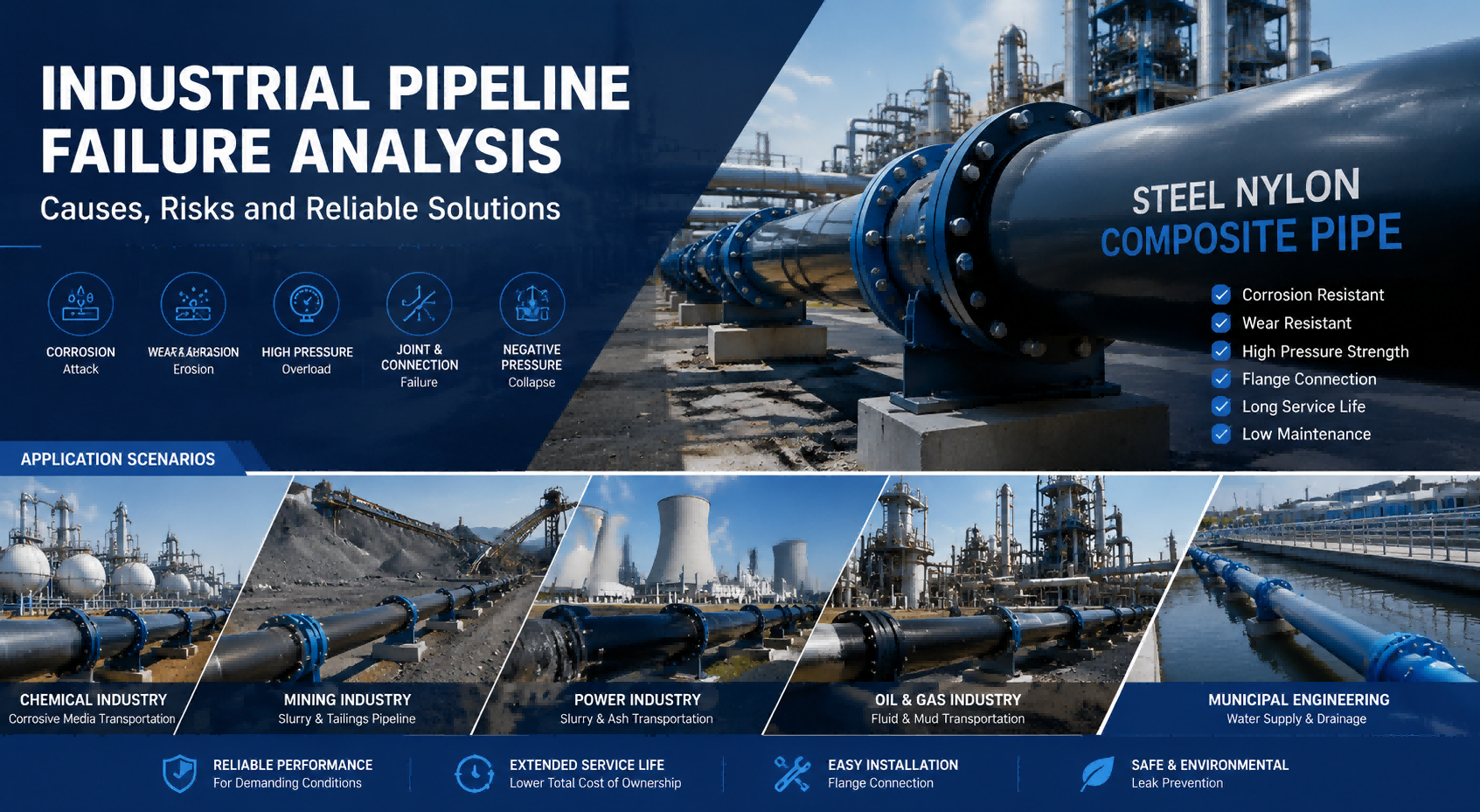
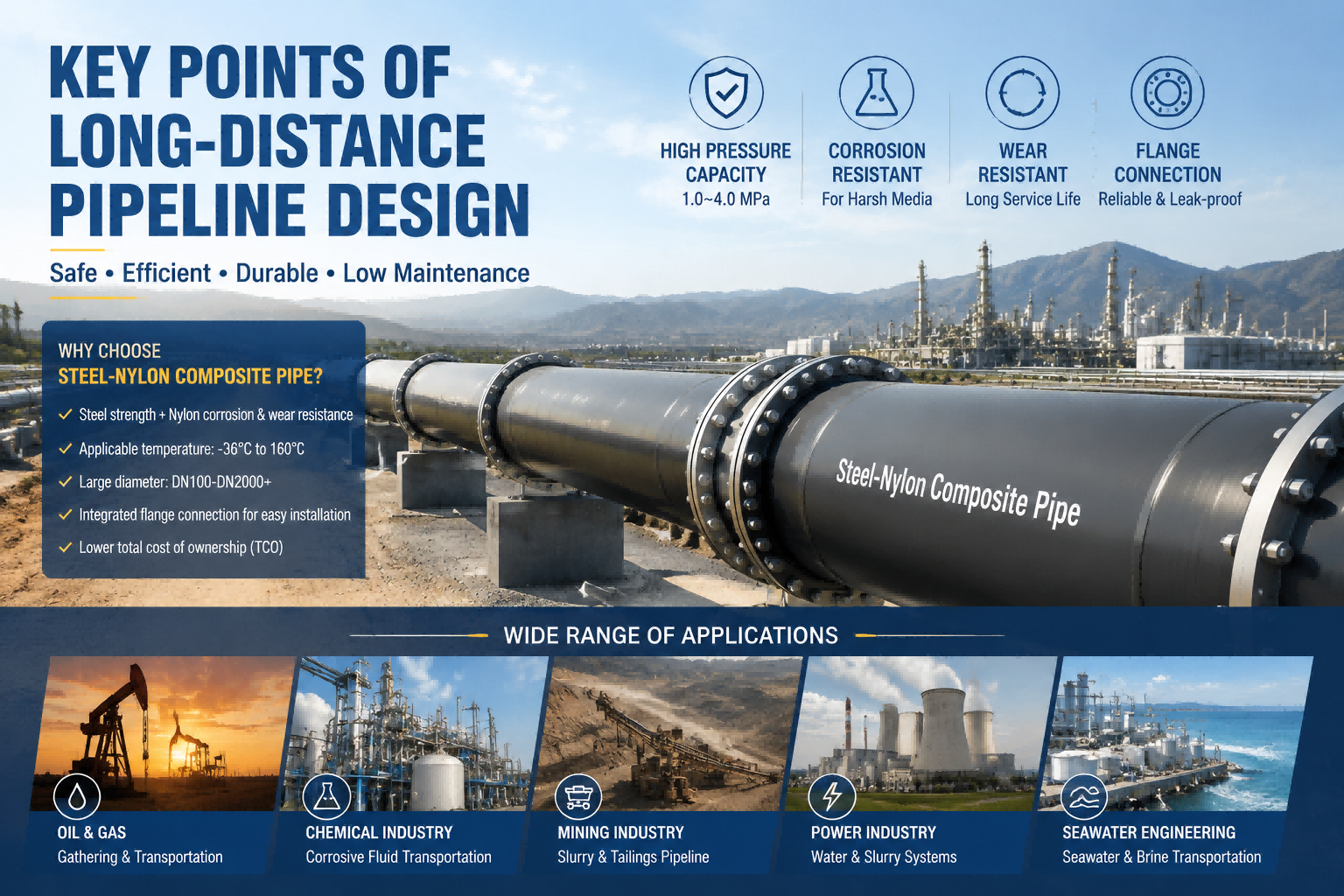
High Temperature Pipeline Material Selection Guide: How to Choose Industrial Pipes for High Temperature, Corrosion Resistance and Long Service Life?

Introduction: Pipeline Material Selection Determines System Reliability Under High Temperature Conditions
In industrial sectors such as chemical processing, oil & gas, metallurgy, power generation, chlor-alkali, and salt chemical industries, pipelines often operate under extremely challenging conditions:
-
Continuous exposure to high-temperature fluids;
-
Chemical corrosion from aggressive media;
-
Pressure fluctuations and thermal cycling;
-
Abrasive wear caused by solid particles;
-
Outdoor aging caused by harsh environments.
Many engineering projects focus only on initial purchase costs during pipeline selection, while ignoring the long-term operating cost. When pipelines suffer from high-temperature deformation, corrosion failure, liner peeling, or frequent maintenance shutdowns, the hidden costs can far exceed the original investment.
Therefore, selecting the right pipeline material for high-temperature applications requires comprehensive evaluation of:
Temperature resistance + Pressure capability + Corrosion resistance + Wear resistance + Service life + Installation and maintenance cost.
Steel-Nylon Composite Pipe has been developed to meet these demanding industrial requirements.
1. What Challenges Do High Temperature Conditions Create for Industrial Pipelines?
1.1 High Temperature Reduces the Performance of Plastic Pipes
Traditional plastic pipes such as PE and HDPE offer excellent corrosion resistance under normal temperature conditions. However, their mechanical performance decreases significantly as temperature rises.
Typical problems include:
(1) Reduced Mechanical Strength
As temperature increases, polymer molecular chains become more active, resulting in:
-
Reduced ring stiffness;
-
Lower pressure resistance;
-
Increased long-term creep deformation.
Under continuous high-temperature operation, conventional plastic pipes may experience:
-
Pipe deformation;
-
Sagging;
-
Connection leakage.
(2) Accelerated Thermal Aging
Some non-metallic pipes exposed to high temperatures for long periods may suffer from:
-
Reduced oxidation resistance;
-
Faster material fatigue;
-
Shortened service life.
Therefore, standard PE, PVC, and similar plastic pipes are generally unsuitable for high-temperature, high-pressure, and highly corrosive applications.
2. Comparison of Common High Temperature Pipeline Materials
Industrial projects commonly use the following pipeline materials:
-
Carbon steel pipe;
-
Stainless steel pipe;
-
Steel pipe lined with plastic;
-
FRP (fiberglass reinforced plastic) pipe;
-
HDPE pipe;
-
Steel-Nylon Composite Pipe.
The following comparison evaluates their engineering performance:
| Material | Temperature Resistance | Corrosion Resistance | Wear Resistance | High Pressure Capability | Main Limitations |
|---|---|---|---|---|---|
| Carbon Steel Pipe | Excellent | Poor | Average | Excellent | Severe corrosion issues |
| 304/316L Stainless Steel | Excellent | Good | Average | Excellent | High cost, corrosion in special media |
| Plastic Lined Steel Pipe | Medium | Good | Average | Good | Liner peeling risk |
| FRP Pipe | Medium | Excellent | Average | Medium | Brittle, reduced strength at high temperature |
| HDPE Pipe | Medium | Excellent | Good | Limited | Pressure reduction at high temperature |
| Steel-Nylon Composite Pipe | Excellent | Excellent | Excellent | Excellent | Comprehensive performance advantage |
3. Why Choose Steel-Nylon Composite Pipe for High Temperature Applications?
Steel-Nylon Composite Pipe adopts a unique composite structure:
Outer steel layer for mechanical strength + Inner reinforced nylon layer for corrosion and wear resistance
This design solves the traditional conflict between metal and plastic pipes:
-
Metal pipes provide strength but suffer from corrosion;
-
Plastic pipes resist corrosion but have limited high-temperature pressure performance.
Steel-Nylon Composite Pipe combines:
"The strength of steel with the corrosion and wear resistance of nylon."
4. Advantages of Steel-Nylon Composite Pipe in High Temperature Applications
4.1 Stable High Temperature Performance
Reinforced nylon materials provide excellent thermal stability.
Operating temperature range:
-36°C to 160°C
This makes the pipe suitable for many industrial high-temperature applications, including:
-
Chemical slurry transportation;
-
Brine systems;
-
Mother liquor transportation;
-
Process circulation water;
-
Corrosive chemical fluids.
Compared with conventional PE pipes, Steel-Nylon Composite Pipe maintains better:
-
Dimensional stability;
-
Pressure resistance;
-
Long-term operating reliability.
4.2 Steel Structure Provides High Pressure Capability
Many high-temperature industrial systems also require pressure resistance.
Typical applications include:
-
Chemical circulation systems;
-
Pump outlet pipelines;
-
Process transportation pipelines.
Steel-Nylon Composite Pipe is available with pressure ratings from:
1.0 MPa to 4.0 MPa
covering a wide range of industrial pressure applications.
The steel outer layer provides structural support, preventing common plastic pipe problems such as:
-
Expansion;
-
Creep deformation;
-
Structural instability.
4.3 Nylon Inner Layer Provides Superior Corrosion Protection
Traditional steel pipelines transporting:
-
Acids;
-
Alkalis;
-
Brine;
-
Chemical mother liquor;
are vulnerable to:
-
Internal corrosion;
-
Pitting corrosion;
-
Pipe wall penetration.
Steel-Nylon Composite Pipe uses a high-performance nylon lining layer that provides:
-
Excellent acid and alkali resistance;
-
Strong chemical corrosion resistance;
-
Smooth inner surface to reduce scaling.
It is especially suitable for:
Chlor-Alkali Industry
Applications include:
-
Brine transportation;
-
Caustic soda systems;
-
Process fluid pipelines.
Soda Ash Industry
Solving problems such as:
-
Mother liquor corrosion;
-
Solid particle erosion;
-
Long-term continuous operation.
Phosphate Chemical Industry
Suitable for:
-
Phosphoric acid transportation;
-
Corrosive slurry;
-
High-wear environments.
5. Advantages Under Combined High Temperature and Wear Conditions
Many industrial pipeline failures are not caused by corrosion alone, but by:
Corrosion + Mechanical Wear
working together.
For example, mining slurry pipelines face:
-
High particle impact;
-
High flow velocity;
-
Continuous abrasion.
Traditional steel pipes:
→ Wall thickness gradually decreases
→ Leakage occurs
Plastic pipes:
→ Good corrosion resistance but insufficient rigidity
Steel-Nylon Composite Pipe:
→ Steel layer provides strength
→ Nylon layer protects against abrasion
creating a dual protection system.
6. Built-In Flange Design Reduces High Temperature Installation Risks
In high-temperature industrial pipeline installation, welding creates several challenges:
-
Hot work safety risks;
-
Heat affected zones;
-
Longer installation periods;
-
Weld corrosion risks.
Steel-Nylon Composite Pipe adopts:
Integrated factory-formed flange connections
No field welding is required.
Advantages:
6.1 Fewer Leakage Points
Traditional welded pipelines contain multiple potential failure points:
Pipe + Weld Joint + Flange Connection
Steel-Nylon Composite Pipe uses integrated manufacturing technology to improve connection reliability.
6.2 Faster Installation
Especially suitable for:
-
Chemical plant upgrades;
-
Pipeline replacement projects;
-
Large-diameter industrial pipelines with limited shutdown time.
7. Key Parameters for Selecting High Temperature Industrial Pipelines
When selecting pipelines for high-temperature applications, engineers should evaluate:
1. Operating Temperature
Consider:
-
Normal operating temperature;
-
Maximum temperature;
-
Temperature fluctuation frequency.
2. Operating Pressure
Evaluate:
-
Maximum system pressure;
-
Pump outlet pressure;
-
Water hammer pressure.
3. Transport Medium
Important factors include:
-
PH value;
-
Solid particle content;
-
Corrosion level;
-
Chemical concentration.
4. Pipe Diameter Requirements
For large-scale industrial transportation systems:
Steel-Nylon Composite Pipe supports:
DN100-DN2000+
Suitable for:
-
Main pipelines;
-
Process pipelines;
-
Large industrial transportation systems.
8. Typical Applications of Steel-Nylon Composite Pipe
Steel-Nylon Composite Pipe is widely used in:
Oil & Gas Industry
-
Gathering pipelines;
-
Well station process pipelines;
-
Oil-water transportation systems.
Chemical Industry
-
Chlor-alkali;
-
Soda ash;
-
Salt chemical;
-
Phosphate chemical industries.
Mining Industry
-
Tailings transportation;
-
Mineral slurry pipelines;
-
Backfilling systems.
Power Industry
-
Desulfurization systems;
-
Cooling water systems.
Seawater Desalination
-
High-salt environment transportation pipelines.
9. Conclusion: High Temperature Pipeline Selection Should Focus on Lifecycle Value
For high-temperature industrial applications, the most economical pipeline is not necessarily the one with the lowest initial purchase price. The best choice is the pipeline with:
The lowest lifecycle cost and the most reliable long-term performance.
Steel-Nylon Composite Pipe provides:
✓ Operating temperature range from -36°C to 160°C
✓ Pressure ratings from 1.0 MPa to 4.0 MPa
✓ High-strength steel structural support
✓ Nylon corrosion and wear-resistant inner layer
✓ Large diameter capability up to DN2000+
✓ Integrated flange connection without welding
It offers a reliable solution for high-temperature, high-pressure, and highly corrosive industrial pipeline systems.
For companies upgrading existing pipelines or designing new industrial facilities, Steel-Nylon Composite Pipe can significantly reduce maintenance costs, minimize downtime, and extend the service life of pipeline systems.
Low-Temperature Pipeline Material Selection Guide: How to Choose Reliable, Safe, and Long-Lasting Piping Systems
How to Select Industrial Pipes for 1.0–4.0 MPa Pressure Systems? A Complete Guide for High-Pressure Pipeline Material Selection