
Why High Water Cut Accelerates Gathering Pipeline Corrosion in Mature Oilfields
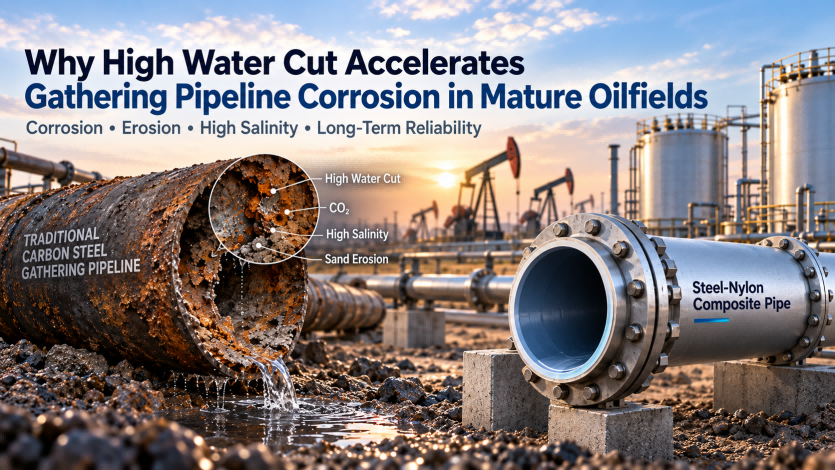
As an oilfield enters the middle and late stages of development, one change becomes increasingly common: crude oil production may gradually decline while the water cut of the produced fluids continues to rise.
In some mature oilfields, gathering systems are no longer transporting fluids dominated by crude oil. Instead, the stream may consist primarily of large volumes of produced water, together with crude oil, natural gas, sand, corrosive ions, and various production chemicals.
This creates an important issue that is often underestimated:
As mature oilfields enter the high-water-cut stage, subsurface production challenges increasingly become surface gathering pipeline corrosion and integrity challenges.
Many gathering pipelines may operate for years without serious leakage during the early stages of field development. However, as the water cut continues to increase, pitting, localized wall thinning, and even corrosion perforation may begin to occur much more frequently.
Why?
Because a high water cut does not simply mean that there is “more water” inside the pipeline.
It fundamentally changes the phase distribution, electrochemical environment, flow regime, concentration of corrosive species, deposition behavior, and erosion conditions inside the pipeline.
1. The Real Risk Is Not Simply More Water—It Is Water Becoming the Dominant Corrosion Phase
From a corrosion perspective, typical electrochemical corrosion of metals requires an electrolyte.
In oilfield gathering pipelines, produced water provides exactly this conductive environment.
During the early stages of oilfield production, when the oil phase represents a larger proportion of the transported fluid, parts of the steel surface may remain covered by an oil film, reducing direct contact between the steel wall and the aqueous phase.
As the field moves into a high-water-cut stage, however, the situation changes significantly.
The proportion and continuity of the water phase increase, and the pipeline wall may remain wetted by produced water for longer periods and over larger areas.
Once corrosive gases, salts, microorganisms, and other aggressive species are present, the electrochemical conditions required for steel corrosion can be maintained continuously.
Therefore:
A high water cut fundamentally increases the probability that the steel pipeline wall will remain exposed to a continuous electrochemically active environment.
This helps explain a common phenomenon in mature oilfields:
A pipeline may perform relatively well for many years during the early production stage, but corrosion problems can increase rapidly once the field enters a high-water-cut period.
2. Why Does CO₂ Corrosion Become More Significant at High Water Cut?
Carbon dioxide alone does not necessarily cause severe corrosion in a dry environment.
The critical condition is:
CO₂ + Water
When CO₂ in the produced oil and gas dissolves into produced water, it changes the chemistry of the aqueous phase and promotes corrosion of carbon steel.
For mature oilfields, therefore, CO₂ concentration should not be considered independently.
Engineers need to evaluate the combined effects of:
CO₂ partial pressure × water cut × temperature × flow velocity × produced-water chemistry
As the water cut rises, the pipeline wall becomes increasingly exposed to the corrosive aqueous phase, even if the gas composition remains relatively unchanged.
At the same time, corrosion-product films formed on carbon steel are not necessarily stable.
Changes in flow velocity, solids erosion, temperature, chloride concentration, and local deposits can damage or destabilize these protective layers.
As a result, mature oilfield gathering pipelines may face not only general corrosion but also more dangerous forms of deterioration, including:
pitting, localized corrosion, and perforation failure.
For pipeline integrity management, localized corrosion is often much more dangerous than uniform wall thinning.
3. High-Salinity Produced Water Makes the Corrosion Environment Even More Complex
Produced water in many mature oilfields is not ordinary water.
It can be a highly mineralized brine containing significant concentrations of:
-
Cl⁻
-
HCO₃⁻
-
Ca²⁺
-
Mg²⁺
-
Other dissolved salts and ions
For carbon steel pipelines, a high concentration of dissolved salts generally increases the conductivity of the aqueous phase, making electrochemical corrosion easier to sustain.
Among these ions, chloride deserves particular attention.
Chloride ions can interfere with the stability of corrosion-product layers and may significantly increase the risk of localized attack.
This explains why some gathering pipelines can develop very deep corrosion pits even when the average corrosion rate appears relatively moderate.
For pipeline integrity:
Average wall loss is not always the most dangerous parameter. A deep localized pit may actually determine the remaining service life of the pipeline.
A pipeline may still retain substantial average wall thickness, but a single localized corrosion site can eventually lead to perforation and leakage.
4. As Water Cut Rises, Corrosion and Erosion Can Begin to Interact
Another issue that is frequently overlooked in mature oilfields is that gathering pipelines are not necessarily exposed to chemical corrosion alone.
Produced fluids may also contain:
-
Sand
-
Scale particles
-
Corrosion products
-
Other suspended solids
These particles are transported together with oil, water, and gas and can repeatedly strike the inner surface of the pipeline.
The result may be a combined failure mechanism involving:
Corrosion + Erosion + Wear
The problem is particularly severe at locations where the flow direction or velocity changes significantly.
| High-Risk Location | Typical Cause |
|---|---|
| Elbows | Sudden flow-direction changes and increased particle impact |
| Tees | Complex turbulence caused by flow splitting or mixing |
| Reducers | Rapid changes in velocity and pressure |
| Pump outlets | High velocity and strong turbulence |
| Upstream/downstream of valves | Local acceleration and throttling |
| Pipeline low points | Water and solids accumulation |
| Undulating sections | Continuous changes in oil-water-gas phase distribution |
| Gathering junctions | Sudden changes in flow rate and flow regime |
This is why the first perforation in an oilfield pipeline often does not occur in the middle of a long straight section.
Instead, failures frequently appear at:
elbows, valves, reducers, low points, junctions, and other high-turbulence areas.
For this reason, mature oilfield pipeline material selection should evaluate not only corrosion resistance, but also long-term resistance to erosion and abrasive wear.
5. Deposits Can Create Highly Aggressive Local Corrosion Cells
As an oilfield enters a high-water-cut stage, deposition and scaling inside the pipeline can become another major problem.
Sand, scale, corrosion products, and other solids may gradually accumulate on the internal surface.
At first glance, these deposits may appear to be simply a cleanliness or flow problem.
In reality, however, they can create highly aggressive localized environments.
Conditions beneath deposits can differ significantly from those in the surrounding bulk fluid in terms of:
-
Ion concentration
-
pH
-
Flow velocity
-
Oxygen availability
-
Microbial activity
This can lead to:
Under-Deposit Corrosion (UDC)
One of the greatest risks of under-deposit corrosion is that it is difficult to detect visually.
The overall pipeline surface may appear relatively sound while deep localized corrosion develops underneath deposits.
If sulfate-reducing bacteria or other corrosive microorganisms are also present, the situation can be further complicated by:
Microbiologically Influenced Corrosion (MIC).
Instead of producing uniform wall thinning, these mechanisms may ultimately create a small but extremely deep corrosion site capable of perforating the pipe wall.
6. Why Do Existing Carbon Steel Pipelines Struggle in Mature Oilfields?
There is an important engineering reason behind the increasing corrosion problems seen in mature fields.
Many gathering systems currently in operation were designed ten, twenty, or even several decades ago according to the production conditions that existed at that time.
But oilfield operating conditions are not constant.
During the early production stage, the transported fluid may be characterized by:
Relatively low water cut + high oil and gas production
After many years of production, the same system may be transporting:
High-water-cut fluids + highly mineralized produced water + sand + CO₂/H₂S + aging pipelines
The problem is straightforward:
The pipeline has become older, while the operating environment has become more aggressive.
This creates a classic mismatch between the original pipeline material and the current service conditions.
The carbon steel may still provide sufficient structural strength, but direct exposure of its internal surface to highly corrosive produced water may no longer be appropriate for long-term service.
This is one of the main reasons pipeline rehabilitation is becoming increasingly important in mature oilfields.
7. Why Simply Increasing Carbon Steel Wall Thickness Does Not Solve the Root Cause
One of the most straightforward responses to corrosion is to increase the pipe wall thickness or corrosion allowance.
This approach can certainly extend service life to some extent.
However, what it really does is:
Allow more steel to corrode before failure occurs.
It does not fundamentally:
Reduce the corrosion mechanism itself.
The limitation becomes even more obvious when localized pitting is involved.
Suppose the average corrosion rate remains relatively low, but a particular location experiences severe localized attack due to deposits, chlorides, CO₂, and unfavorable flow conditions.
Increasing the overall wall thickness does not eliminate the mechanism that produces the localized pit.
This raises an important question for mature oilfield pipeline design:
Instead of continuously increasing corrosion allowance, should we prevent the corrosive medium from contacting the structural steel in the first place?
This is one of the key reasons composite pipeline systems are receiving increasing attention.
8. Mature Oilfields Need More Than Corrosion Resistance
Oilfield gathering systems are significantly more demanding than ordinary water-transfer pipelines.
They often require a combination of:
-
Pressure resistance
-
Structural strength
-
Corrosion resistance
-
Wear resistance
-
Impact resistance
-
Reliable connections
-
Adaptability to complex field conditions
This creates trade-offs when conventional pipeline materials are considered.
Carbon steel provides excellent mechanical strength but is vulnerable to internal corrosion.
Some thermoplastic pipes provide good corrosion resistance, but pressure, temperature, stiffness, large-diameter capability, and mechanical loading must be evaluated carefully for demanding oilfield applications.
Stainless steel provides strong overall performance, but project costs can be high, and localized corrosion still needs to be considered in certain high-chloride environments.
FRP offers corrosion resistance but requires careful evaluation of impact resistance, connection reliability, mechanical loading, and long-term service conditions.
For this reason, mature oilfield gathering systems increasingly benefit from a different design philosophy:
Let different materials perform different functions.
Steel provides:
Structural strength and pressure-bearing capability.
A corrosion-resistant inner layer provides:
Isolation between the corrosive fluid and the structural steel.
This is the fundamental engineering concept behind steel-nylon composite pipes.
9. Why Are Steel-Nylon Composite Pipes Suitable for High-Water-Cut Oilfield Gathering Systems?
A steel-nylon composite pipe is not simply two materials placed together.
It is designed to address a long-standing contradiction in industrial pipeline engineering:
Metal offers high structural strength but can corrode, while polymer materials offer corrosion resistance but may have limitations when used alone for demanding structural applications.
The steel-nylon composite structure separates these functions.
Steel Structure Provides Pressure Resistance and Mechanical Strength
The external steel structure provides the mechanical strength, rigidity, and pressure-bearing capability required for industrial pipeline systems.
This is particularly important for oilfield gathering pipelines involving:
-
Higher operating pressures
-
Complex terrain
-
Large diameters
-
Mechanical loads
-
Long-term industrial service
Nylon Lining Isolates the Steel from Corrosive Produced Fluids
The transported medium primarily contacts the nylon inner layer instead of directly contacting the steel substrate.
This helps reduce direct exposure of the load-bearing steel structure to high-salinity produced water and other corrosive environments.
This approach is fundamentally different from simply increasing carbon steel corrosion allowance.
Increasing wall thickness means:
The steel continues to corrode, but more material is available before failure.
A composite structure aims to:
Minimize direct contact between the corrosive medium and the structural steel layer.
That represents a fundamentally different corrosion-control strategy.
10. High-Water-Cut Oilfields Need Both Corrosion Resistance and Wear Resistance
If corrosion were the only challenge in gathering systems, pipeline material selection would be relatively straightforward.
The more difficult situation occurs when:
Corrosion and wear exist simultaneously.
Sand and solids contained in produced fluids can continuously attack the internal surface, especially at:
-
Elbows
-
Tees
-
Reducers
-
Pump outlets
-
Valve sections
Therefore, even if a lining material provides good corrosion resistance, another question must be considered:
Can the lining maintain its integrity after years of erosion and abrasive wear?
Reinforced MC nylon combines corrosion resistance with strong wear resistance, allowing steel-nylon composite pipes to better handle complex conditions involving:
High water cut + corrosive fluids + sand + erosion
The engineering objective is therefore not simply:
Corrosion Resistance
but rather:
Corrosion Resistance + Erosion Resistance + Wear Resistance
This distinction is particularly important in mature oilfields.
11. A Smooth Inner Surface Provides Additional Long-Term Value
As oilfield pipelines continue operating, scale, corrosion products, and other deposits may gradually accumulate on the internal surface.
A rough and corroded steel surface can further promote deposition.
Over time, this may create a damaging cycle:
Corrosion → Surface Roughness → Increased Deposition → Under-Deposit Corrosion → More Severe Localized Attack
Steel-nylon composite pipes provide a relatively smooth internal surface.
This can help reduce surface adhesion tendencies and limit the long-term increase in hydraulic resistance associated with rough, corroded pipe walls.
For an oilfield gathering system expected to operate for ten years or longer:
The value of a pipeline should not be judged only by its condition on the day it is installed. It should also be evaluated by the condition of its internal surface years later.
12. Mature Oilfield Pipeline Rehabilitation Does Not Necessarily Require Complete Replacement
When operators face hundreds or even thousands of kilometers of aging gathering pipelines, pipeline material upgrading may appear prohibitively expensive.
However, complete replacement is not always necessary.
A more practical strategy is:
Risk-Based Pipeline Rehabilitation
Operators can first identify locations with the highest probability of failure, including:
-
High-water-cut well groups
-
Elbows
-
Tees
-
Reducers
-
Pump outlets
-
Upstream and downstream valve sections
-
Pipeline low points
-
Highly corrosive blocks
-
Sections with a history of frequent leakage
These locations can then be upgraded first.
For example, existing carbon steel trunk lines may continue operating while vulnerable sections such as pump outlets, valve groups, elbows, and 100–500-meter high-corrosion sections are replaced with steel-nylon composite pipes.
This creates a practical upgrade path:
Small-Scale Trial → Field Verification → Sectional Replacement → System-Wide Upgrade
For mature oilfields, this approach can be more practical and economically manageable than replacing an entire gathering network at once.
13. Field Experience Shows Why Pipeline Materials Must Be Re-Evaluated at High Water Cut
A typical example can be found in an oil and gas gathering system project at the Gudong Oil Production Plant of Shengli Oilfield.
The area represents a mature oilfield operating environment where the overall water cut reached approximately 97.2%, with some blocks exceeding 98%.
At the same time, the transported fluids involved heavy crude oil, high viscosity, sand, and complex corrosive conditions.
These factors created continuous corrosion and wear challenges for conventional gathering pipelines.
Beginning in 2015, PAMC nylon steel-lined composite pipes were progressively introduced for corrosion- and wear-resistant upgrades.
The application gradually expanded to:
-
Well-drain valve groups
-
Reducers
-
Elbows
-
Manifolds
-
Main process pipelines within gathering stations
The cumulative installed length reached approximately 2.6 km.
This type of engineering experience demonstrates an important principle:
Once an oilfield enters an ultra-high-water-cut stage, pipeline material selection should no longer follow the same assumptions used during early field development.
The gathering system should be reassessed based on:
Water cut, produced-water chemistry, corrosion conditions, abrasion, pressure, temperature, flow regime, and total lifecycle maintenance cost.
14. Mature Oilfield Pipeline Management Is Shifting from Leak Repair to Failure Prevention
Traditional pipeline maintenance often follows a familiar pattern:
Leak occurs → Locate the leak → Shut down → Excavate → Repair or weld → Resume operation
For occasional failures, this approach may be acceptable.
But once a field enters a high-water-cut stage and multiple sections of the same network begin experiencing repeated corrosion, this maintenance model becomes increasingly expensive.
The true cost is no longer limited to the replacement pipe.
It can also include:
-
Production losses
-
Labor costs
-
Excavation costs
-
Welding and repair expenses
-
Inspection costs
-
Environmental risks
-
Repeated shutdowns
-
Emergency maintenance
As a result, mature oilfield pipeline management is gradually shifting from:
“Repair wherever it leaks”
to:
“Understand why it leaks and eliminate the failure mechanism.”
This is why Total Cost of Ownership (TCO) is becoming increasingly important when selecting industrial pipeline materials.
15. How Should Gathering Pipelines Be Selected for High-Water-Cut Oilfields?
For a mature oilfield that has entered a high-water-cut stage, material selection should not begin with only one question:
“Which pipe has the lowest purchase price?”
A more useful question is:
“How much will this pipeline cost to own and operate over the next ten years?”
Important parameters should include:
-
Water cut
-
Produced-water salinity
-
Chloride concentration
-
CO₂ and H₂S conditions
-
Operating temperature
-
Design pressure
-
Flow velocity
-
Solids and sand content
-
Pipe diameter
-
Terrain profile
-
Expected service life
-
Inspection and maintenance requirements
If the application combines:
High water cut + corrosion + wear + industrial pressure requirements
then simply increasing carbon steel wall thickness or continuously increasing corrosion-inhibitor dosage may not provide the best long-term solution.
This is precisely the type of service condition in which steel-nylon composite piping deserves serious engineering evaluation.
However, pipeline selection should always be based on the actual chemical composition of the transported fluid, temperature, pressure, operating conditions, and material compatibility—not simply on water cut alone.
Conclusion: Mature Oilfields May Need to Upgrade Not Only Production Technology, but Also Their Gathering Pipeline Systems
When a mature oilfield enters a high-water-cut stage, the nature of the fluid transported by the surface gathering system changes fundamentally.
What was once primarily an:
Oil and Gas Gathering System
increasingly behaves like a:
Highly Mineralized and Corrosive Produced-Water Transportation System
At the same time, CO₂, chlorides, sand, deposits, microorganisms, and complex multiphase flow can further accelerate pipeline deterioration.
Frequent leakage in mature oilfields should therefore not always be viewed as a series of isolated accidents.
It may indicate something more fundamental:
The original pipeline material system is no longer well matched to the current operating environment.
The key question for the next generation of gathering pipeline upgrades should therefore move beyond:
“How can we repair the pipe that has already corroded?”
toward:
“How can we reduce the probability of corrosion and wear through better pipeline material design?”
By combining a steel pressure-bearing structure with a corrosion- and wear-resistant nylon inner layer, steel-nylon composite pipes provide an alternative technical route to conventional carbon steel pipelines for mature oilfield gathering systems.
For applications involving high water cut, high salinity, solids, and simultaneous corrosion and abrasion, pipeline material selection is increasingly shifting away from a simple comparison of initial purchase price.
Instead, operators are beginning to evaluate:
Reliability, maintenance frequency, shutdown risk, service life, and total lifecycle cost.
This will likely become one of the most important directions for pipeline material upgrading in mature oilfields.
How H₂S and CO₂ Corrosion Is Driving Material Upgrades in Oilfield Pipelines
Why We Continue to Develop Weld-Free Industrial Pipe Connection Solutions


