Why Are Chemical Companies Paying More Attention to Hot-Work-Free Piping Installation?
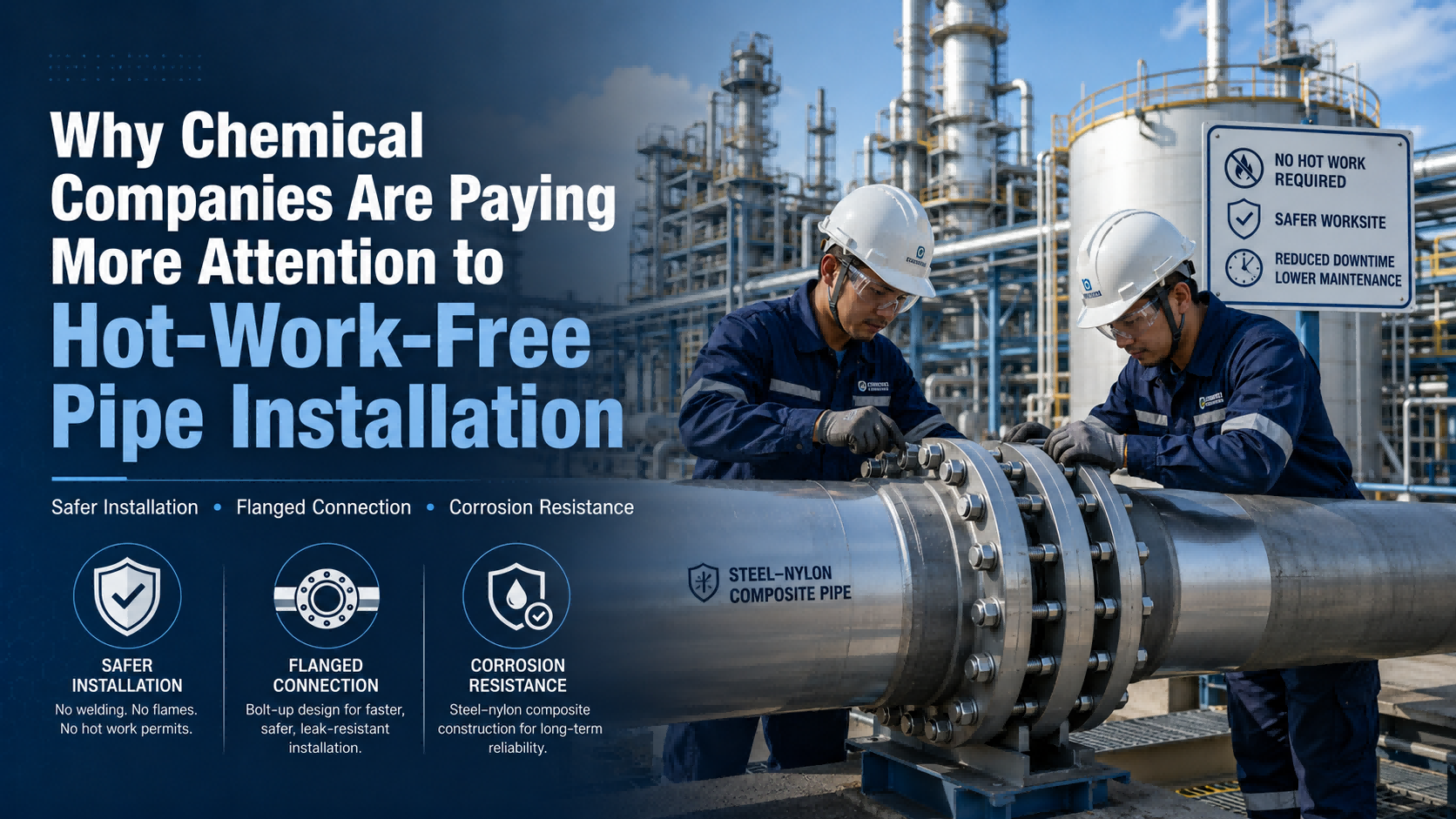
In traditional chemical projects, pipeline installation has long been closely associated with welding, cutting, grinding, and other hot-work activities.
New plants require welding during construction. Aging pipelines often need to be cut and welded during replacement. Even the repair of a relatively short pipe section may involve on-site hot work.
For decades, this has been considered a normal part of industrial piping installation.
However, an important change is becoming increasingly visible across the chemical industry:
More chemical companies are actively looking for piping systems that can reduce or, where technically feasible, avoid on-site hot work.
This shift is about much more than changing the installation method.
It reflects a broader change in how chemical companies evaluate safety risks, plant continuity, maintenance efficiency, construction schedules, and total lifecycle costs.
For highly corrosive and demanding process services, the competition between piping materials is no longer simply about:
Which material is more corrosion resistant?
A more important question is emerging:
Which piping solution can maintain long-term reliability while making installation, replacement, and maintenance safer and easier?
This is exactly where steel–nylon composite pipes with integral flanged connections can offer significant engineering advantages.
1. Why Is Hot Work More Complicated in Chemical Plants?
Hot work generally includes operations such as:
-
Welding
-
Flame cutting
-
Grinding
-
Brazing
-
Heating
-
Any activity capable of producing flames, sparks, or high-temperature surfaces
In an ordinary manufacturing facility, welding may simply be a routine construction activity.
Inside petroleum, chemical, chlor-alkali, soda ash, salt chemical, phosphate chemical, and other process plants, however, the situation can be very different.
Production areas may contain:
-
Flammable gases
-
Combustible liquids
-
Organic vapors
-
Oil and gas mixtures
-
Corrosive process media
-
Toxic or hazardous gases
-
Confined spaces
-
Pressurized pipelines
-
High-temperature equipment
-
Adjacent production systems that remain in operation
The question, therefore, is not whether welding itself can be performed reliably.
The real question is:
How much additional operational complexity and risk management does hot work introduce into an active chemical facility?
This is one of the reasons why more companies are reconsidering the way industrial pipelines are connected.
2. One Welding Job Can Trigger an Entire Chain of Maintenance Procedures
When comparing piping materials, it is easy to focus only on one number:
How much does the pipe cost per meter?
But for an operating chemical plant, the pipe itself may represent only a small portion of the true cost of a maintenance project.
Replacing even a relatively short welded pipeline section may involve:
-
Shutting down the relevant process line
-
Isolating upstream and downstream equipment
-
Draining the process medium
-
Cleaning the pipeline
-
Purging or inerting the system
-
Gas testing
-
Obtaining hot-work permits
-
Establishing a controlled work zone
-
Preparing firefighting equipment
-
Assigning safety supervision
-
Cutting out the damaged section
-
Welding the replacement section
-
Inspecting the welds
-
Performing pressure testing where required
-
Restoring the pipeline
-
Restarting the process system
If the pipeline is located in an aging production unit, pipe rack, tank farm, valve manifold, pump station, or congested process area, the procedure may become even more complicated.
As a result, what appears to be a simple pipe replacement can become a multi-department maintenance operation.
This raises an important engineering question:
If a piping system can be assembled using flanged mechanical connections, can part of the on-site welding requirement be eliminated?
For many chemical companies, the answer is increasingly worth investigating.
3. The Real Value of Reducing Hot Work Is Not Simply Eliminating a Weld
The main benefit of hot-work-free or reduced-hot-work installation is not merely saving the time required to make a weld.
Its greater value comes from simplifying the entire construction and maintenance process.
Several areas are particularly important.
3.1 Reduced Installation Complexity in High-Risk Areas
Chemical plants are characterized by a high concentration of equipment.
A pipeline requiring maintenance may be located next to:
-
Storage tanks
-
Reactors
-
Pumps
-
Valve manifolds
-
Hydrocarbon pipelines
-
Chemical process lines
-
Cable trays
-
Operating production equipment
Available working space is often limited.
Whenever hot work is introduced into such an environment, additional safety controls and operating procedures are generally required.
By comparison, a pre-engineered pipeline system using integral flanged connections can, in suitable applications, significantly reduce the amount of field welding required during installation.
This can be particularly valuable for:
-
Chemical plant revamp projects
-
Aging pipeline replacement
-
Pump discharge sections
-
Pipeline sections upstream and downstream of valves
-
Wear-prone elbows
-
Localized corrosion repairs
-
Small-scale maintenance projects
4. Aging Chemical Plants Are Increasing the Value of Reduced-Hot-Work Installation
In a completely new chemical plant, a large proportion of welding can be completed before the facility enters production.
The situation is very different in a chemical plant that has already been operating for 10, 20, or even more years.
Many industrial facilities are now entering major equipment and piping renewal cycles.
Existing carbon steel, stainless steel, lined steel, and other pipeline systems may gradually experience:
-
Wall thinning
-
Pitting corrosion
-
Perforation
-
Weld corrosion
-
Erosion
-
Scaling
-
Liner deterioration
-
Localized leakage
This means that a growing proportion of future chemical piping projects will not involve building completely new systems.
Instead, companies will increasingly be required to:
Maintain, upgrade, and replace pipelines while existing production systems continue to operate.
Under these conditions, ease of installation becomes increasingly important.
Plant operators want to minimize maintenance windows.
Therefore, simply offering a long service life may no longer be enough.
An increasingly attractive piping solution should combine:
Long service life + Easy installation + Easy replacement + Low maintenance
This is one of the key reasons why hot-work-free and reduced-hot-work piping concepts are attracting increasing attention.
5. Why Does Installation Method Become More Important in Corrosive Service?
At first glance, corrosion resistance and installation methods may seem like two unrelated issues.
In reality, they are closely connected.
Severe corrosion means:
A higher probability of future maintenance and replacement.
Consider a carbon steel pipeline transporting a corrosive process medium.
If sections of the pipeline must be replaced every few years, the company is not merely facing a material corrosion problem.
It is repeatedly facing the entire cycle of:
Shutdown → Isolation → Hot Work → Welding → Inspection → Restart
As a result, a low-cost pipe with a relatively short service life may generate substantial maintenance expenses over a 10-year operating period.
This is why more engineers are beginning to ask a different material-selection question:
Which material can reduce corrosion while also simplifying future maintenance?
This is where steel–nylon composite piping deserves closer attention.
6. Why Is Steel–Nylon Composite Pipe Suitable for Reduced-Hot-Work Installation?
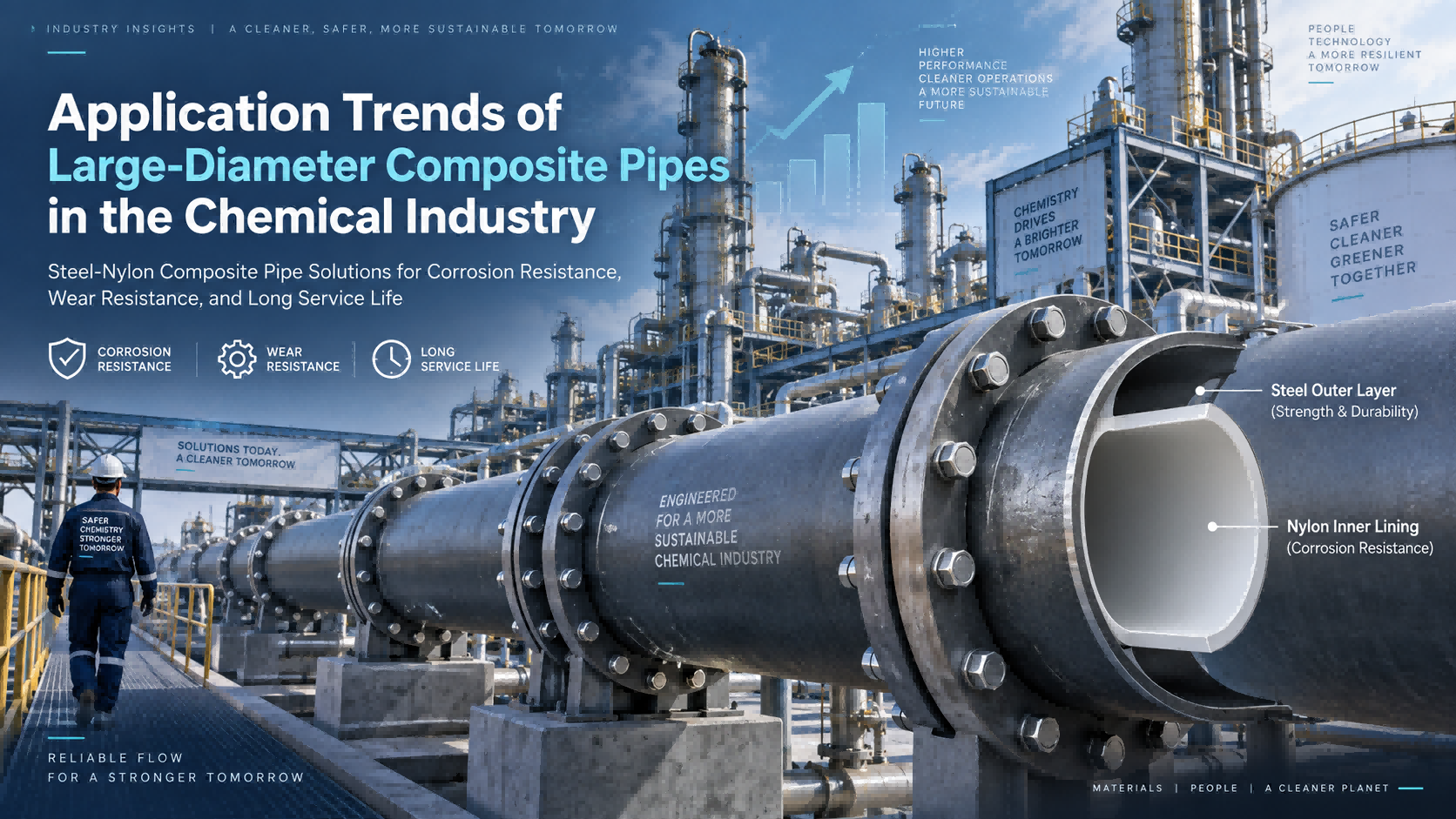
A steel–nylon composite pipe should not simply be understood as a conventional steel pipe with a plastic liner added inside.
Its engineering concept is based on combining the advantages of different materials.
In the composite structure:
The steel structure provides mechanical strength, pressure capability, and structural rigidity.
Meanwhile:
The nylon functional layer provides medium isolation, corrosion resistance, wear resistance, and a smooth internal surface.
For chemical piping systems, another important feature is the use of:
Integral Flanged Connections
Pipe sections can be connected using:
Flanges + Gaskets + Bolts
rather than welding every pipe joint together in the field.
Under appropriate engineering and site conditions, this allows much of the installation work to shift from field welding to mechanical assembly.
This can be especially valuable in:
-
Chemical plant modernization
-
Replacement of corroded pipelines
-
Aging piping network upgrades
-
Pump station piping
-
Valve manifolds
-
Process spool replacement
-
Maintenance-intensive pipeline areas
The engineering benefit is therefore much greater than simply saying:
"Installation is easier."
A more accurate description is:
The piping system can convert a substantial portion of field connection work from welding operations into mechanical flange assembly.
7. Why Are Flanged Connections Particularly Valuable for Chemical Plant Maintenance?
For chemical plants requiring regular inspection and maintenance, flanged connections offer another important advantage:
They are removable.
Once a welded pipeline is installed, replacing an individual section generally requires cutting the pipe again.
With a properly designed flanged piping system, a pipe section can be removed through a process such as:
Unbolt → Remove → Replace → Reinstall
This can make steel–nylon composite pipes especially suitable for locations exposed to frequent corrosion, erosion, or maintenance.
Typical examples include the following.
Pump Discharge Sections
Areas close to pump outlets may experience:
-
Higher turbulence
-
Flow disturbances
-
Particle impact
-
Localized erosion
In many systems, the first component to fail is not necessarily a long straight pipe section.
It may be the short section immediately downstream of the pump.
If these sections are designed with removable flange connections, future replacement can become much easier.
Elbows
When a fluid containing solid particles passes through an elbow, the direction of flow changes.
This often creates localized particle impact and erosion.
Elbows can therefore become critical wear points in slurry and solids-containing process systems.
A modular flanged piping system makes localized component replacement significantly more practical.
Pipeline Sections Around Valves
Flow velocity, pressure drop, and turbulence can change substantially around valves.
In services involving both corrosion and erosion, these sections may be particularly vulnerable.
Removable flange connections can make future maintenance more efficient.
8. Reduced Hot Work Is Only One Advantage — Reducing Future Maintenance Is More Important
A pipeline that is easy to install but fails frequently after only a few years is still not an ideal industrial solution.
A truly valuable reduced-hot-work piping system must therefore address two issues simultaneously:
First: It should simplify installation.
Second: It should minimize the need for future maintenance.
This combination is where steel–nylon composite pipe can provide greater long-term value.
9. Corrosion Resistance: Addressing One of the Most Common Chemical Pipeline Failure Mechanisms
Corrosion remains one of the most significant long-term challenges in chemical piping systems.
Process fluids may contain:
-
Chlorides
-
Salts
-
Alkalis
-
Weak acidic components
-
Water
-
Suspended solids
-
Dissolved gases
Traditional carbon steel can suffer from general corrosion, localized corrosion, and eventual perforation.
Certain stainless steels may also face pitting or crevice corrosion under specific chloride-containing environments.
In a steel–nylon composite pipe, the nylon functional layer separates the transported medium from the steel structural layer.
This helps reduce direct chemical attack on the steel structure when the material is properly selected for the process medium.
Therefore, the benefit is not simply reducing hot work during one replacement project.
The more important objective is:
Reducing how often that replacement is required in the first place.
That is where lifecycle cost savings begin.
10. Wear Resistance: Addressing Combined Corrosion and Erosion
Chemical pipeline failure is not always caused by corrosion alone.
Many process streams also contain suspended solids.
Examples include:
-
Salt slurries
-
Crystalline particles
-
Mineral slurries
-
Solids-containing wastewater
-
Chemical mother liquor
-
Process slurry
When solid particles move through a pipeline at significant velocity, they continuously impact and scour the internal surface.
If chemical corrosion occurs at the same time, a particularly damaging mechanism can develop:
Corrosion–Erosion Synergy
The material surface is chemically attacked and weakened.
Particles then remove the damaged surface.
Fresh material is exposed.
Corrosion continues.
The cycle repeats.
This can produce rapid wall loss.
Nylon materials can provide strong wear resistance in suitable industrial applications.
For this reason, steel–nylon composite piping can be particularly attractive where both corrosion and abrasive wear must be addressed simultaneously.
For chemical plants, this means another important advantage:
Lower replacement frequency for wear-prone pipeline sections.
11. A Smooth Internal Surface Can Also Help Reduce Scaling Problems
In many chemical piping systems, failure does not begin with perforation.
Instead, the internal diameter gradually becomes smaller.
Crystals, deposits, solids, and corrosion products accumulate on the pipe wall.
This can cause:
-
Reduced flow capacity
-
Increased pressure loss
-
Higher pumping energy consumption
-
Lower process efficiency
-
More frequent cleaning
-
Eventually, a plant shutdown for pipe cleaning or replacement
Steel–nylon composite pipes feature a relatively smooth internal surface.
In suitable applications, this can help reduce the tendency of certain deposits to adhere to the pipe wall.
From a long-term operational perspective, this may help reduce the need for:
-
Chemical cleaning
-
Mechanical cleaning
-
Pipe dismantling
-
Shutdown maintenance
Therefore, reduced scaling and reduced hot work are actually part of the same broader strategy:
Reduce Maintenance.
12. Why Is Integrated Composite Construction Important?
When engineers discuss composite pipes, one common question arises immediately:
Will the inner layer delaminate?
This is an important and technically valid concern.
Certain traditional lined piping systems may experience problems such as:
-
Blistering
-
Wrinkling
-
Local separation
-
Liner collapse under vacuum
-
Thermal movement issues
-
Interfacial deterioration
For this reason, composite structure design is critical.
Steel–nylon composite pipes focus on an integrated composite structure designed to improve long-term structural stability between the functional layer and the supporting structure.
This becomes particularly important in applications involving:
-
Pressure fluctuations
-
Frequent startup and shutdown
-
Temperature variation
-
Complex chemical media
-
Long-term industrial service
A properly engineered composite pipe should not solve only one problem:
Corrosion.
It should address several requirements simultaneously:
Corrosion Resistance + Pressure Capability + Mechanical Strength + Structural Stability
13. Large-Diameter Chemical Pipelines Can Also Benefit from Reduced Hot Work
Reduced-hot-work installation is sometimes associated only with relatively small pipe sizes.
In reality, larger-diameter pipelines may gain even greater benefits.
As pipe diameter increases:
-
Weld circumference becomes longer
-
Welding time increases
-
Lifting requirements become more complex
-
Welding distortion becomes harder to control
-
Field working space becomes more important
-
Inspection workload increases
Therefore, for DN500, DN800, DN1000, and even larger industrial pipelines, reducing the amount of on-site welding can deliver substantial project benefits.
Steel–nylon composite piping can be engineered for large-diameter industrial applications and equipped with flanged connections.
For large chemical plants, process pipe racks, and industrial fluid transportation systems, this configuration can simplify installation planning and future maintenance.
14. Reduced-Hot-Work Installation Is Particularly Valuable for Partial Pipeline Upgrades
Many chemical plants will not replace their entire piping network at once.
A more practical strategy is often:
Upgrade the Most Problematic Areas First
For example:
-
One elbow repeatedly suffers from erosion
-
A pump discharge pipe requires frequent repair
-
One mother-liquor pipeline experiences serious scaling
-
A carbon steel section repeatedly develops corrosion leaks
-
A valve manifold requires frequent replacement of pipe fittings
In these situations, companies can first replace the highest-risk sections using steel–nylon composite piping.
Possible pilot applications include:
-
Elbows
-
Tees
-
Reducers
-
Pump discharge spool pieces
-
Pipe sections upstream and downstream of valves
-
50–500 meter trial sections
-
Localized highly corrosive process pipelines
If operational performance proves satisfactory, the application can then be expanded progressively.
This strategy reduces initial investment pressure while allowing the plant to evaluate the material through real operating data.
15. This Is Changing the Way Industrial Piping Is Purchased
Traditional procurement often focuses heavily on one principle:
Choose the material with the lowest purchase price.
But more industrial projects are now moving toward another approach:
Choose the solution with the lowest total lifecycle cost.
The difference between these approaches is significant.
Purchase price only answers:
How much does the pipe cost today?
Lifecycle analysis considers:
Material Cost
Installation Cost
Welding Cost
Inspection Cost
Shutdown Losses
Maintenance Cost
Replacement Cost
Future Construction Costs
If a piping material has a somewhat higher initial purchase cost but can:
-
Reduce field welding
-
Simplify installation
-
Improve corrosion resistance
-
Improve wear resistance
-
Reduce scaling
-
Extend replacement intervals
-
Reduce maintenance frequency
then its total cost over 10 or even 20 years may be significantly lower.
16. Steel–Nylon Composite Pipe Is Not Intended to Replace Every Piping Material
There is no universally "best" industrial piping material.
Different process media, temperatures, pressures, operating conditions, and installation environments require different solutions.
Carbon steel, stainless steel, FRP, HDPE, rubber-lined steel, and other composite piping systems all have their appropriate applications.
Steel–nylon composite piping is particularly worth evaluating where several of the following conditions occur:
-
Significant corrosion
-
Combined corrosion and abrasive wear
-
Scaling problems
-
Industrial pressure requirements
-
Structural rigidity requirements
-
Frequent pipeline replacement
-
Aging plant modernization
-
Preference for reduced field welding
-
Flanged connection requirements
-
Desire for lower long-term maintenance
Under these conditions, material selection should not be based solely on:
Which pipe is cheapest?
A better question is:
Which piping system can make the next ten years of operation easier and more reliable?
17. The Future Competition in Chemical Piping May Be About "Material + Installation + Maintenance"
For many years, competition between industrial piping technologies focused primarily on:
Material Performance
Which material is more corrosion resistant?
Which performs better at elevated temperatures?
Which handles greater pressure?
Which provides better wear resistance?
These questions remain extremely important.
But industrial piping evaluation is gaining additional dimensions:
Can field construction be reduced?
Can hot-work requirements be minimized?
Can maintenance windows be shortened?
Can damaged sections be replaced quickly?
Can long-term maintenance be reduced?
Can plant downtime be minimized?
Can total lifecycle costs be lowered?
This means industrial piping is no longer simply:
A pipe that transports fluid.
It is increasingly becoming part of the overall plant reliability strategy.
18. Our Design Philosophy for Steel–Nylon Composite Piping
We focus on steel–nylon composite pipes and reinforced nylon industrial piping solutions for demanding industrial fluid transportation applications.
Our objective is not simply to replace one conventional piping material.
Instead, our product philosophy is focused on solving several recurring industrial challenges:
Corrosion, wear, scaling, frequent maintenance, and installation complexity.
The steel structure provides the mechanical strength and structural support required for industrial piping.
The nylon functional layer provides protection against suitable corrosive media and abrasive wear while offering a smooth internal surface.
Integral flange connections allow pipe sections to be mechanically assembled without requiring every joint to be welded in the field.
Depending on project design requirements, steel–nylon composite piping can be considered for applications including:
-
Oil and gas gathering systems
-
Produced-water pipelines
-
Water injection systems
-
Chemical mother-liquor transport
-
Soda ash production
-
Chlor-alkali plants
-
Salt chemical processing
-
Phosphate chemical plants
-
Mining slurry transportation
-
Power plant desulfurization systems
-
Industrial water treatment
-
Municipal water supply and drainage
For industrial projects increasingly focused on safety, reliability, and lifecycle cost, the value of steel–nylon composite pipe is not limited to:
Corrosion resistance.
Its broader value proposition is:
Corrosion Resistance + Wear Resistance + Flanged Connection + Low Maintenance + Long Service Life
19. From "Avoiding One Hot-Work Operation" to "Reducing Maintenance for the Next Ten Years"
The real value of reduced-hot-work installation is not simply that one installation project becomes easier.
It represents a broader engineering philosophy:
Do Not Leave Unnecessary Maintenance Problems for the Future.
If a pipeline can be installed once and then operate reliably for many years, the company may reduce much more than a few welding operations.
It may reduce:
-
Repeated shutdowns
-
Repeated maintenance projects
-
Repeated pipeline cleaning
-
Repeated cutting and welding
-
Repeated safety procedures
-
Repeated workforce mobilization
-
Repeated material purchases
This is why more chemical companies are beginning to evaluate two questions at the same time:
How will the pipeline be installed?
and
How easy will it be to maintain in the future?
That is one of the fundamental reasons why reduced-hot-work piping installation is becoming increasingly important.
Conclusion: Industrial Piping Is Moving from "Reliable Connections" to "Lifecycle Reliability"
In the past, chemical companies selected piping by first asking:
Will it work?
Later, the question became:
How long will it work?
Today, more companies are asking additional questions:
Can it be installed more safely?
Can maintenance be simplified?
Can future hot-work requirements be reduced?
Can shutdown periods be shortened?
Can lifecycle costs be lowered?
This represents an important change in how industrial piping systems are evaluated.
A high-performance pipeline should not only transport process media reliably during normal operation.
It should also help reduce engineering complexity during:
-
Installation
-
Maintenance
-
Plant modification
-
Pipeline replacement
For chemical plants facing corrosion, erosion, scaling, and frequent maintenance challenges, a steel–nylon composite piping system with integral flanged connections offers an alternative engineering approach:
Reduce field welding to simplify installation.
Reduce corrosion and wear to minimize maintenance.
Extend pipeline service life to lower total lifecycle costs.
From this perspective, hot-work-free or reduced-hot-work installation is not simply an installation advantage.
It represents a broader direction for the future of industrial piping:
Moving from material-performance competition toward integrated solutions combining safer installation, long-term reliability, and lower maintenance requirements.
Why Is Demand for Strong Alkali-Resistant Piping Materials Growing in the Chemical Industry?
Severe Corrosive Service Is Driving Continuous Upgrades in Chemical Pipeline Materials