How Composite Materials Are Reshaping the Traditional Industrial Pipeline Market

Today, however, that logic is changing.
In increasingly demanding industrial environments such as oil and gas fields, chemical plants, mining operations, power generation, salt chemical processing, and seawater treatment, engineers are gradually recognizing a fundamental reality:
It is difficult to find a single material that can simultaneously deliver high strength, pressure resistance, corrosion resistance, wear resistance, temperature resistance, low maintenance, and reasonable cost.
As a result, industrial pipeline technology is moving away from simply “finding a better material” and toward combining the strengths of different materials.
This is the fundamental reason composite pipelines are gaining increasing importance.
From fiber-reinforced composite pipes and thermoplastic composite pipes to metal-polymer composite structures, composite materials are changing not only the product structure of the industrial pipeline market, but also the way engineering projects evaluate service life, maintenance costs, and total lifecycle value.
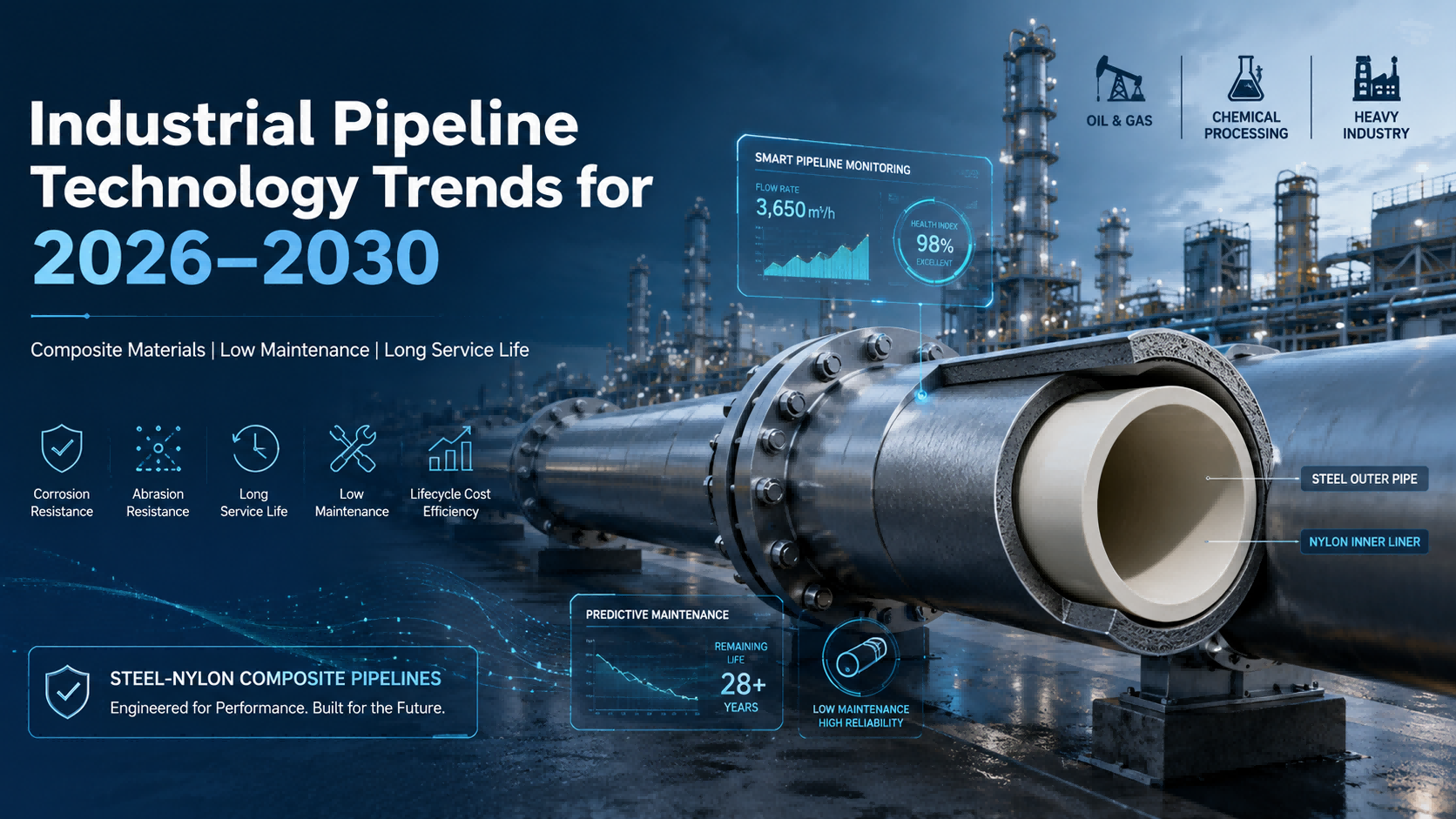
For the steel-nylon composite pipe technology that we have focused on for many years, the core value is not simply “replacing steel with nylon.”
Instead, the concept is:
Let steel provide structural strength, and let nylon manage contact with the transported medium.
This structural approach addresses many of the limitations that traditional single-material pipes struggle to overcome.
1. What Problems Are Traditional Industrial Pipelines Facing?
An industrial pipeline may appear to be a simple system for transporting media, but in real industrial environments, it often has to withstand several degradation mechanisms at the same time.
For example, an oilfield gathering pipeline may simultaneously be exposed to high water content, chloride ions, CO₂, H₂S, sand erosion, pressure fluctuations, and temperature changes.
A chemical mother-liquor pipeline may have to handle strong alkalis, salts, crystallization, erosion, and frequent start-stop cycles.
Mining slurry, flue gas desulfurization slurry, and tailings pipelines may experience both corrosion and severe abrasion.
This means that the traditional approach of selecting one material based on one dominant parameter is becoming increasingly inadequate.
Carbon steel offers good mechanical strength and a mature engineering system, but long-term exposure to corrosive media can result in wall thinning, scaling, and perforation.
Stainless steel can provide improved corrosion resistance, but in chloride-rich, strongly alkaline, or other specific corrosive environments, careful grade selection and corrosion assessment are still required. Material and installation costs can also be significantly higher.
PE and HDPE offer good corrosion resistance, but high-temperature, high-pressure, large-diameter, and high-ring-stiffness applications require more careful structural evaluation.
FRP offers low weight and corrosion resistance, but resin systems, reinforcement design, manufacturing quality, connection methods, and long-term loading conditions can all affect actual field performance.
Rubber-lined or plastic-lined steel pipes attempt to combine the mechanical strength of steel with the corrosion resistance of non-metallic materials, but liner integrity, negative-pressure conditions, abrasion, and complex fittings still require careful consideration.
Therefore, the real question in industrial pipeline design is shifting from:
“Which material is the best?”
to:
“How can different materials be designed to perform the functions they are best suited for?”
This is exactly why composite pipeline technologies are gaining momentum.
2. Composite Materials Are Changing More Than Pipe Materials — They Are Changing Design Logic
Traditional pipelines are generally designed around the idea that one material performs nearly all functions.
Carbon steel, for example, provides pressure resistance while also being directly exposed to the transported medium. Stainless steel carries the structural load while relying on its alloy composition to resist corrosion.
Composite pipelines follow a different design philosophy.
They divide the required functions of the pipeline between different material layers.
The structural layer provides strength, stiffness, and pressure resistance, while the functional layer provides corrosion resistance, wear resistance, anti-scaling performance, or media isolation.
This concept closely follows the broader development of modern engineering materials.
Industries such as aerospace, automotive, wind energy, and shipbuilding have long used multi-material structures because engineers increasingly understand that:
The best engineering structure is often not one material doing everything, but the right material performing the right function in the right location.
Industrial pipelines are undergoing a similar transformation.
Recent developments in international standards also reflect this shift. ISO standards for the oil and gas industry increasingly cover thermoplastics, fiber-reinforced composite materials, and thermoplastic-lined pipe systems. This shows that non-metallic materials, liners, and composite structures are becoming part of a more formalized and standardized engineering framework.
It is important to note that such standards should not be interpreted as certification of any specific steel-nylon composite product. Rather, they illustrate a broader industry trend:
Composite and multi-material pipeline structures are becoming an increasingly important part of industrial pipeline engineering.
3. Three Fundamental Ways Composite Pipelines Are Changing the Industrial Pipe Market
3.1 From Material Competition to Structural Competition
In the future, industrial pipeline competition may no longer simply be:
Carbon Steel vs Stainless Steel vs PE vs FRP.
Instead, the real question may become:
Which structure can solve a specific operating problem at the lowest overall lifecycle cost?
For example, in applications involving corrosion, high pressure, and large diameter at the same time, simply upgrading to a higher grade of stainless steel is not the only possible solution.
If a metallic outer structure is used to carry mechanical loads while an engineered polymer internal layer isolates the corrosive medium, a completely different balance between cost, durability, and reliability can be achieved.
Steel-nylon composite pipe follows this exact principle.
It does not force engineers to choose between steel and nylon.
Instead, it takes advantage of the complementary strengths of both materials.
3.2 From Purchase Price to Total Cost of Ownership
Industrial pipeline projects have traditionally placed considerable emphasis on initial purchase price.
But after several years of operation, operators often discover that the purchase price of the pipe is only one part of the overall cost.
Leak repairs, shutdowns, labor, fitting replacement, scaffolding, lifting, welding, inspection, cleaning, scale removal, and accident risks can easily exceed the initial cost of the piping itself.
As a result, industrial operators are paying increasing attention to Total Cost of Ownership, or TCO.
A lower-cost pipe that leaks frequently is not necessarily a low-cost solution.
Conversely, a pipe with a slightly higher initial cost may achieve a lower total cost if it significantly extends maintenance intervals and reduces shutdown frequency.
This is one of the key reasons composite pipelines are attracting growing attention.
3.3 From One Material for the Entire Pipeline to Failure-Mode-Based Material Selection
Future industrial pipeline systems may increasingly avoid using a single material throughout an entire facility.
Straight pipe sections may use one material, while elbows, tees, reducers, pump outlet sections, and upstream or downstream valve sections use more wear-resistant composite structures.
Highly corrosive sections may use one solution, while conventional water-transfer sections use another.
This failure-mode-based approach gives composite materials greater opportunities for practical deployment.
For steel-nylon composite pipe, this is particularly suitable for starting with high-wear fittings, critical pipeline sections, or 100–500 meter trial sections, and then gradually expanding application based on long-term operating data.
4. Why Is the “Steel + Nylon” Combination Worth Attention?
Steel and nylon appear to belong to completely different material families.
But because their properties are so different, they can also complement each other very effectively.
Steel: Solving Structural Challenges
The fundamental advantages of steel remain highly relevant.
Steel provides mature mechanical properties, high structural stiffness, strong pressure-bearing capability, and well-established engineering support and design systems.
In high-pressure, large-diameter, long-span, or complex industrial pipeline networks, structural strength remains essential.
Therefore, completely eliminating steel is often unnecessary.
The real engineering question is:
How can we prevent corrosive or abrasive media from directly attacking the steel structure?
Nylon: Managing Contact With the Process Medium
Nylon is an engineering polymer.
Within suitable temperature and chemical environments, it can offer good corrosion resistance, wear resistance, and low-friction characteristics.
By placing nylon on the inner surface of the pipe, the transported medium primarily contacts the nylon layer instead of directly contacting the steel structure.
This fundamentally changes the failure mechanism of the pipeline.
The steel mainly carries pressure and external mechanical loads.
The nylon primarily provides media isolation, corrosion resistance, and wear resistance.
This is the central engineering concept behind steel-nylon composite pipe:
Structural Strength Outside + Corrosion and Wear Resistance Inside
In other words:
The outside provides strength; the inside handles the medium.
5. Steel-Nylon Composite Pipe Addresses a Combination of Problems, Not Just One
Truly valuable industrial pipeline technologies rarely solve only one problem.
The strength of steel-nylon composite structures lies in their ability to address several common failure mechanisms at the same time.
| Engineering Challenge | Potential Limitation of Traditional Pipes | Steel-Nylon Composite Design Approach |
|---|---|---|
| Internal corrosion | Metal continuously contacts corrosive media | Nylon inner layer isolates the medium from the steel structure |
| Abrasion | Slurry and solid particles continuously erode the pipe wall | Nylon provides strong wear resistance |
| High pressure | Single polymer pipes may face structural limitations | Steel structure carries the primary mechanical load |
| Large diameter | Ring stiffness and structural support become more demanding | Metallic structure provides stiffness |
| Scaling | Rough, corroded internal surfaces may promote deposits | Smooth inner surface helps reduce adhesion |
| Installation | Welding and hot work increase construction complexity | Integrated flange structure can reduce field welding |
| Long-term maintenance | Corrosion and leakage lead to frequent repairs | Design reduces major failure mechanisms from the start |
| Total cost | Low purchase price may lead to high maintenance costs | Lifecycle cost becomes more important than unit price |
This is why we believe:
Steel-nylon composite pipe should not simply be defined as another plastic-lined steel pipe.
A more accurate description is that it is an industrial fluid transportation solution designed around corrosion, wear, pressure, and structural requirements.
6. Which Industries Can Benefit Most From Composite Pipeline Technology?
Oil & Gas: Corrosion, Wear, and Pressure at the Same Time
Oil and gas gathering, produced-water transportation, and water-injection systems are typical examples of complex pipeline environments.
As oilfields enter high-water-cut production stages, pipelines may simultaneously contain water, salts, CO₂, H₂S, oil, and solid particles.
Traditional carbon steel systems often require continuous corrosion management under such conditions.
A steel-nylon composite structure can help reduce direct contact between the medium and the steel substrate while maintaining the pressure-bearing capability of the steel structure.
This makes the technology worth evaluating for gathering systems, water injection, wastewater transportation, and high-water-content pipeline systems.
Chlor-Alkali, Soda Ash, and Salt Chemical Industries: Long-Term Stability Is the Real Test
Salt, strong alkalis, crystallization, temperature, and continuous production combine to create challenging operating conditions in salt chemical industries.
Pipeline selection in these environments cannot rely only on short-term laboratory corrosion tests.
The real question is whether the material remains stable under the combined influence of pressure, temperature, mechanical stress, connection design, and long-term exposure to process media.
This is where composite structures can provide significant value.
By separating structural functions from chemical-resistance functions, it may be possible to avoid using expensive alloy materials throughout the entire pipe wall.
Mining and Slurry Transportation: Corrosion and Abrasion Must Be Considered Together
Mining slurry, tailings, backfill, and particle transportation systems create a difficult engineering challenge because many materials are either corrosion-resistant but insufficiently wear-resistant, or mechanically strong but prone to abrasion.
Elbows, tees, reducers, and pump outlet sections are particularly vulnerable because local velocity and particle impact are often much higher.
For this reason, future slurry pipeline selection should move beyond simply comparing material hardness.
Instead, operators should consider:
Wear resistance + structural strength + replacement interval + shutdown losses
Power Plant Desulfurization and Industrial Slurry Systems: Scaling Is Also a Cost
Industrial pipeline failure does not always mean perforation or leakage.
Scaling can reduce the effective flow area, increase hydraulic resistance, and raise pumping energy consumption.
For this reason, internal surface condition is becoming increasingly important.
Future pipeline evaluation systems will likely pay more attention to long-term hydraulic efficiency, fouling tendency, and operating resistance, rather than only asking whether a pipe will corrode.
7. Will Composite Materials Completely Replace Metal Pipes?
No.
This is one of the most important points to understand about the future of composite pipeline markets.
The future is unlikely to be simply:
Composite vs Metal
It is more likely to be:
Composite + Metal
Steel still offers highly mature structural performance, manufacturing capability, and engineering standards.
High-performance polymers will not replace metals in every application.
The real development direction is to assign different functions to different materials depending on the operating conditions.
In some applications, stainless steel will still be the best option.
In low-pressure, ambient-temperature water systems, PE may remain more economical.
In lightweight systems, FRP may offer clear advantages.
However, when a project simultaneously involves corrosion + wear + pressure + temperature + large diameter + long-term maintenance costs, the value of steel-nylon composite structures becomes much more significant.
A professional pipeline manufacturer should therefore never simply tell customers:
“Our material is suitable for every application.”
A more responsible approach is to first examine:
-
What medium is being transported?
-
What is the concentration?
-
What is the operating temperature?
-
What is the design pressure?
-
Are solid particles present?
-
What is the flow velocity?
-
Is negative pressure possible?
-
Is the pipeline indoors or outdoors?
-
What is the pipe diameter?
-
What is the expected service life?
Only after these conditions are understood should material selection begin.
8. The Competitive Advantage of Steel-Nylon Composite Pipe Is Shifting From Material Performance to System Value
In the past, industrial pipeline suppliers often focused on phrases such as “corrosion resistant,” “wear resistant,” and “long service life.”
But as global industrial buyers become increasingly sophisticated, material performance alone is no longer enough.
What customers are really purchasing is:
Fewer leaks, longer maintenance intervals, lower shutdown risk, and more stable plant operation.
Our steel-nylon composite pipe system has been continuously developed around this logic.
By combining a steel structure with reinforced nylon, the system can balance structural strength with resistance to aggressive process media. Depending on specific engineering conditions, the products can be configured for different pressure classes and diameters.
Within our current product system, pressure ratings can cover approximately 1.0–4.0 MPa, while the applicable temperature range can extend to approximately −36°C to 160°C, depending on the specific product design and transported medium.
The system can also be developed for large-diameter industrial pipeline networks.
More importantly, our integrated flange connection design allows straight pipes, elbows, tees, reducers, and other fittings to form a complete piping system while reducing the complexity associated with traditional field welding.
Ultimately, these capabilities are not about promoting a single product specification.
They are about achieving a more important objective:
Reducing uncertainty throughout the lifecycle of an industrial fluid transportation system.
9. The Future of Industrial Pipelines May Belong to Multi-Material Collaboration
Over the next decade, industrial pipeline technology is likely to continue evolving in several important directions.
First, single-material pipelines will not disappear, but composite structures are likely to gain a larger share in complex operating environments.
Second, pipeline selection will gradually shift from simply comparing corrosion resistance to designing around specific failure mechanisms.
Third, customers will increasingly evaluate TCO rather than only comparing price per meter.
Fourth, trial sections, critical fittings, and localized upgrades will become important entry points for new materials in large industrial projects.
Fifth, materials, structural design, connection methods, and intelligent monitoring may ultimately become integrated into complete Pipeline System Solutions, rather than being treated as isolated pipe products.
From this perspective, the real impact of composite materials on the traditional industrial pipeline market is not simply the introduction of another type of pipe.
It is a change in the way the industry thinks:
From searching for one perfect material to designing a more intelligent combination of materials.
10. Why Steel-Nylon Composite Pipe Deserves to Be Reconsidered
For decades, the industrial pipeline market has been searching for balance among different materials.
Steel provides strength, but corrosion must be managed.
Some non-metallic materials provide corrosion resistance, but may face limitations in pressure, temperature, or structural stiffness.
High-alloy metals offer excellent performance, but project costs can increase significantly.
Steel-nylon composite pipe offers another approach.
It does not require a single material to solve every problem.
Instead:
Steel performs the structural functions it is best at.
Nylon performs the corrosion-resistance, wear-resistance, and media-isolation functions it is best at.
This “right material for the right function” design philosophy may become one of the important directions in next-generation industrial pipeline technology.
For long-term oil and gas, chemical, salt chemical, mining, power generation, seawater, and industrial water treatment projects, the real question is no longer simply:
Which pipe is cheaper?
The better question is:
Which pipeline system will cost less over the next 10–20 years?
That is one of the deepest reasons composite materials are reshaping the traditional industrial pipeline market.
Conclusion: Industrial Pipelines Are Moving From the “Material Era” to the “Structural Era”
Industrial pipelines will not abandon steel simply because composite materials are becoming more widely used.
In fact, the opposite may be true.
Some of the most competitive future technologies may come from combining metals and high-performance polymers in more intelligent ways.
From single materials to multi-material collaboration;
from purchase price to lifecycle cost;
from reactive maintenance to proactive failure prevention;
from selling a pipe to designing an industrial fluid transportation solution.
This is the transformation taking place in the industrial pipeline market.
Through long-term industrial application experience and continuous technological development, we have remained focused on steel-nylon composite pipes and reinforced nylon industrial pipeline technologies, providing solutions for demanding applications involving corrosion, abrasion, high pressure, large diameter, and high maintenance costs.
For projects currently evaluating carbon steel, stainless steel, FRP, PE, HDPE, rubber-lined steel, or other traditional pipeline alternatives, the first step should not be deciding which pipe to purchase.
Instead, the entire pipeline system should be re-evaluated based on:
Medium + Pressure + Temperature + Wear + Corrosion + Connection Method + Maintenance Interval + 10-Year Total Lifecycle Cost
Because the future competition in industrial pipelines will not be about which material is more expensive or which material is newer.
It will be about:
Which material structure can keep the pipeline operating longer, reduce maintenance, and deliver a lower total cost of ownership.
The Future of Industrial Piping Competition: From Purchase Price to Life Cycle Cost
Why Low-Maintenance Piping Is Becoming a New Trend in Industrial Projects