How to Calculate the Total Cost of Ownership (TCO) of Industrial Piping Systems?
When evaluating industrial piping solutions, many project owners focus primarily on the initial purchase price. However, experienced engineers and procurement professionals understand that the true cost of a piping system extends far beyond its upfront investment.
A pipe that appears inexpensive at the time of purchase may ultimately generate significant expenses through maintenance, corrosion repairs, downtime, energy consumption, and premature replacement. This is why more industries are adopting the concept of Total Cost of Ownership (TCO) when selecting piping systems.
In this article, we will explore how industrial pipe TCO is calculated and why Steel-Nylon Composite Pipes are becoming an increasingly attractive solution for long-term operational efficiency and cost reduction.
What Is Total Cost of Ownership (TCO)?
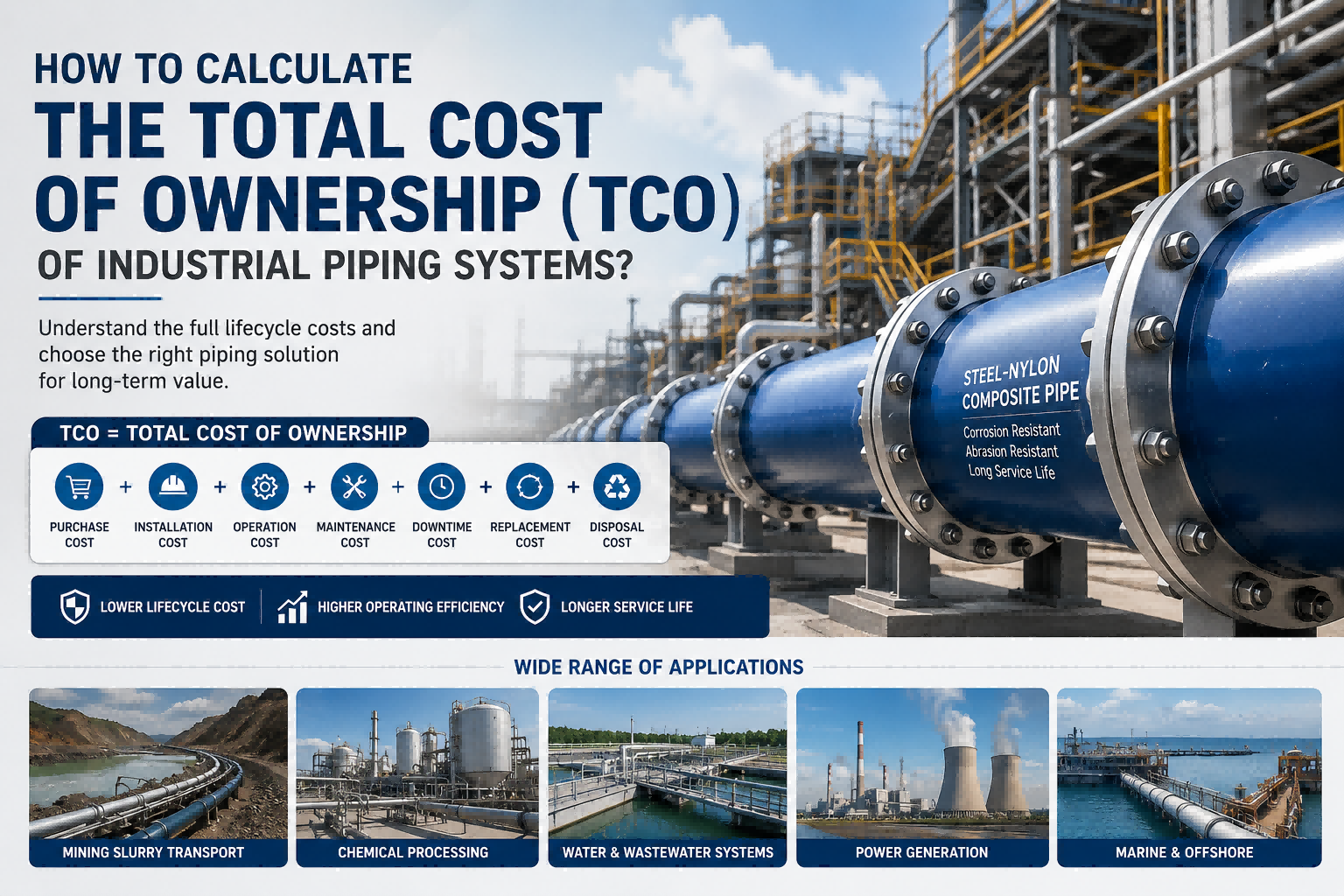
Total Cost of Ownership (TCO) refers to the complete cost incurred throughout the entire lifecycle of an asset—from acquisition and installation to operation, maintenance, replacement, and disposal.
For industrial piping systems, TCO can be expressed as:
TCO = Purchase Cost + Installation Cost + Operating Cost + Maintenance Cost + Downtime Cost + Replacement Cost + Disposal Cost
While the initial purchase price is highly visible during procurement, it often represents only a fraction of the overall lifecycle expenditure.
For piping systems expected to operate for 10, 20, or even 30 years, operational and maintenance expenses frequently exceed the original investment.
The Six Major Components of Industrial Pipe TCO
1. Initial Purchase Cost
This includes:
-
Pipe materials
-
Fittings and connectors
-
Flanges
-
Valves and accessories
-
Transportation costs
Formula:
Purchase Cost = Pipe Unit Price × Length + Accessory Costs
Although purchase cost is often the first factor considered, it should never be the only decision criterion.
2. Installation Cost
Installation costs can account for 15%–35% of total project investment.
Key expenses include:
-
Welding
-
Labor
-
Lifting equipment
-
Construction machinery
-
Inspection and testing
Traditional steel piping systems often require extensive welding and longer installation times, increasing labor expenses and project schedules.
Steel-Nylon Composite Pipes, however, can significantly reduce installation complexity through optimized connection methods, resulting in:
-
Faster installation
-
Reduced labor requirements
-
Lower construction risks
-
Shorter project timelines
These benefits contribute directly to lower project costs.
3. Operating and Energy Costs
Energy consumption is often overlooked when evaluating piping systems.
Key factors affecting operating costs include:
-
Internal surface roughness
-
Flow resistance
-
Pressure loss
-
Pumping energy requirements
As pipelines age, conventional steel pipes often experience:
-
Corrosion
-
Scaling
-
Surface degradation
These issues increase friction losses and force pumps to consume more energy to maintain the same flow rate.
Advantage of Steel-Nylon Composite Pipes
The nylon liner provides:
-
Extremely smooth internal surfaces
-
Low friction coefficients
-
Excellent anti-scaling performance
As a result, flow efficiency remains stable over time, reducing pressure losses and lowering pumping energy consumption.
For long-distance transportation systems, these energy savings can generate substantial financial benefits throughout the pipe's service life.
4. Maintenance Cost
Maintenance is one of the largest hidden expenses in industrial piping systems.
Typical maintenance activities include:
-
Corrosion protection
-
Leak repairs
-
Pipe replacement
-
Routine inspections
Traditional steel pipes are vulnerable to:
-
Electrochemical corrosion
-
Pitting corrosion
-
Wall thinning
-
Leakage
As a result, operators often face recurring maintenance costs and unexpected repair expenses.
Corrosion: The Biggest Cost Driver in Industrial Pipelines
Industry studies indicate that more than 60% of pipeline failures are directly related to corrosion.
This issue becomes especially severe in applications involving:
-
Chemical processing
-
Mining slurry transport
-
Saltwater systems
-
Industrial wastewater
-
High-humidity environments
Corrosion not only shortens service life but also increases maintenance frequency and operational risk.
How Steel-Nylon Composite Pipes Reduce Maintenance Costs
Steel-Nylon Composite Pipes combine the strengths of two advanced materials.
Outer Steel Layer
Provides:
-
High mechanical strength
-
Excellent pressure resistance
-
Superior structural stability
-
Impact resistance
Inner Nylon Liner
Provides:
-
Outstanding corrosion resistance
-
Excellent wear resistance
-
Chemical resistance
-
Smooth flow characteristics
This dual-layer structure creates a highly durable piping solution capable of operating reliably in demanding industrial environments.
Key benefits include:
✔ No rust formation
✔ Reduced scaling
✔ Excellent abrasion resistance
✔ Lower leakage risk
✔ Reduced maintenance frequency
These advantages are particularly valuable in mining, chemical processing, power generation, and industrial water transportation systems.
5. Downtime Cost
Downtime is often underestimated during the procurement phase.
However, the financial impact of a single pipeline failure can far exceed the value of the pipe itself.
Potential losses include:
-
Production interruption
-
Raw material waste
-
Environmental remediation
-
Safety incidents
-
Emergency repair costs
For continuous-process industries such as mining, chemicals, metallurgy, and power generation, downtime can cost thousands or even millions of dollars per day.
A more reliable piping system directly reduces the risk of unplanned shutdowns.
6. Replacement and End-of-Life Costs
Pipeline replacement is expensive, particularly for buried or difficult-to-access installations.
Replacement costs may include:
-
Removal of old pipelines
-
Civil engineering work
-
New material procurement
-
Production shutdown during replacement
Extending pipeline lifespan can significantly reduce future capital expenditures.
TCO Comparison: Conventional Steel Pipe vs. Steel-Nylon Composite Pipe
Consider a 1,000-meter industrial pipeline project.
| Cost Factor | Conventional Steel Pipe | Steel-Nylon Composite Pipe |
|---|---|---|
| Initial Purchase Cost | Lower | Slightly Higher |
| Installation Cost | Higher | Lower |
| Corrosion Protection Cost | High | Minimal |
| Maintenance Cost | High | Low |
| Energy Consumption | Increases Over Time | Remains Stable |
| Downtime Risk | Higher | Lower |
| Service Life | 5–10 Years | 15–30 Years |
| Total Lifecycle Cost | Higher | Lower |
Although Steel-Nylon Composite Pipes may require a slightly higher initial investment, their superior durability and lower maintenance requirements often result in a significantly lower TCO over the life of the project.
Why More Industries Are Choosing Steel-Nylon Composite Pipes
As industrial operators shift from focusing solely on purchase price to maximizing lifecycle value, the demand for advanced piping solutions continues to grow.
Today's industrial projects require:
-
Longer service life
-
Lower maintenance requirements
-
Improved flow efficiency
-
Reduced operational risks
-
Better return on investment
Steel-Nylon Composite Pipes meet these demands through a combination of strength, corrosion resistance, and long-term reliability.
Superior Corrosion Resistance
Suitable for:
-
Chemical media
-
Acid and alkali solutions
-
Saline water systems
-
Mining tailings transportation
Excellent Wear Resistance
The nylon lining offers outstanding resistance to abrasion, making it ideal for slurry and particle-laden media.
High Pressure Capability
The steel outer layer provides the structural strength required for demanding industrial applications.
Extended Service Life
Longer operational life reduces replacement frequency and future capital expenditures.
Lower Overall Operating Costs
Reduced maintenance, fewer shutdowns, and improved energy efficiency help maximize profitability over the lifetime of the system.
Conclusion: The Lowest Purchase Price Is Not Always the Lowest Cost
When selecting an industrial piping solution, decision-makers should look beyond initial procurement costs and evaluate the complete lifecycle economics of the system.
The most important question is not:
"How much does this pipe cost today?"
But rather:
"How much will this pipe save over the next 10, 20, or 30 years?"
From a Total Cost of Ownership perspective, Steel-Nylon Composite Pipes offer compelling advantages through superior corrosion resistance, wear resistance, lower maintenance requirements, longer service life, and enhanced operational reliability.
As industries increasingly prioritize long-term performance and cost efficiency, Steel-Nylon Composite Pipes are becoming a strategic investment that delivers sustainable value throughout the entire lifecycle of industrial piping systems.
Metal Pipe vs Non-Metal Pipe: Fundamental Differences and Why Steel-Nylon Composite Pipe Is the Future of Industrial Pipeline Systems
What Factors Affect Industrial Pipeline Service Life? A Complete Analysis from Material Selection to Operation Management