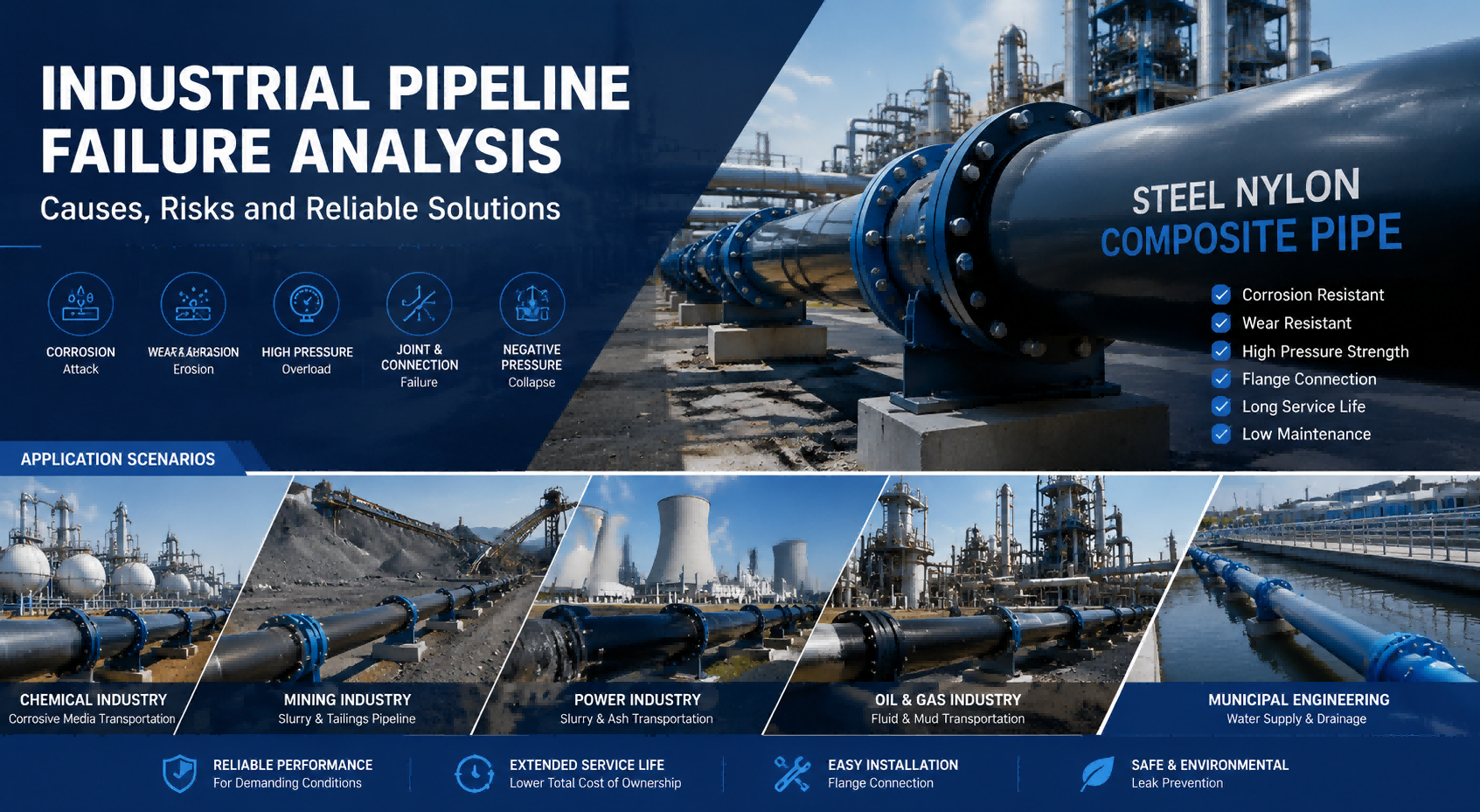
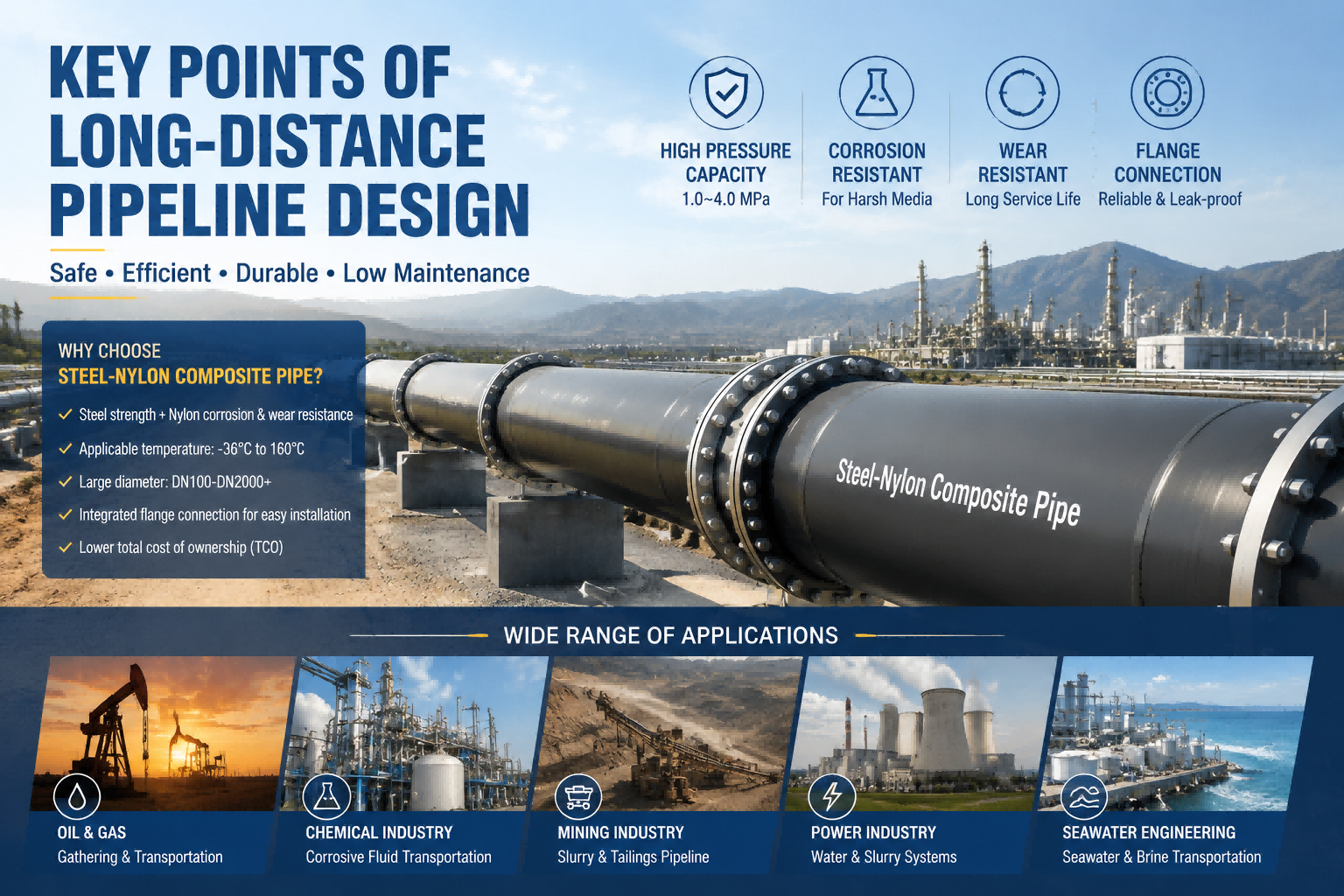
How to Select Industrial Pipes for 1.0–4.0 MPa Pressure Systems? A Complete Guide for High-Pressure Pipeline Material Selection
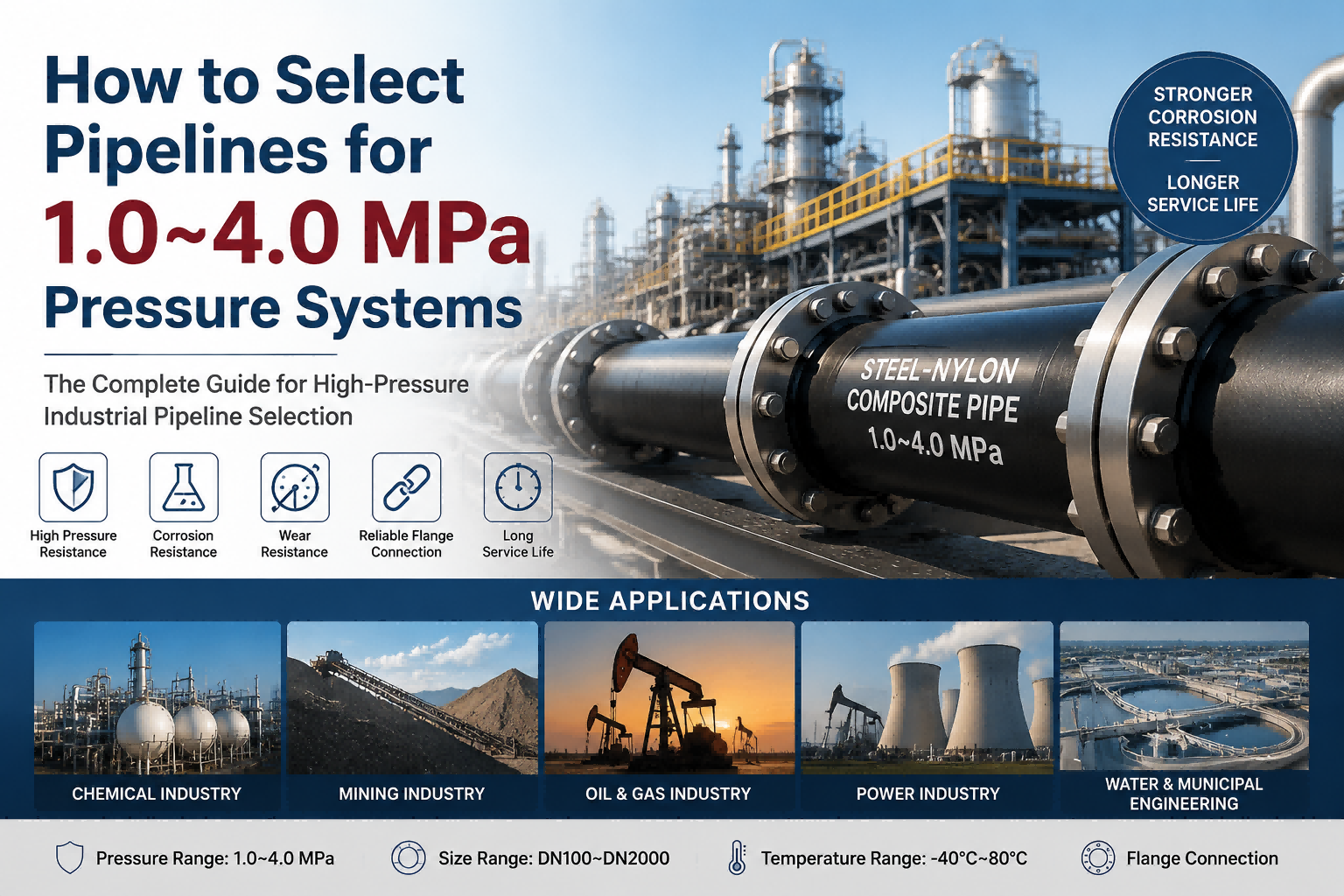
In industrial production, pipelines are not simply used for transporting fluids — they directly determine operational safety, production efficiency, maintenance costs, and equipment reliability.
When pipeline systems operate under 1.0–4.0 MPa pressure, traditional materials such as carbon steel pipes, stainless steel pipes, HDPE pipes, and lined pipes may face challenges including:
-
Insufficient pressure resistance
-
Corrosion failure
-
Abrasive wear
-
Frequent maintenance
-
Short service life
So, how should engineers select the right pipeline material for 1.0 MPa, 2.5 MPa, and 4.0 MPa industrial applications?
This article analyzes pipeline selection from the perspectives of:
-
Pressure rating
-
Corrosion resistance
-
Wear resistance
-
Connection reliability
-
Total Cost of Ownership (TCO)
and explains why Steel-Nylon Composite Pipe has become an advanced solution for high-pressure, corrosive, and abrasive industrial applications.
1. Why Is Pipeline Selection More Challenging for 1.0–4.0 MPa Systems?
In the past, industrial pipeline selection was relatively simple:
-
Low pressure → PE, PVC pipes
-
General industrial applications → Carbon steel pipes
-
Corrosive environments → Stainless steel or lined pipes
However, modern industries require pipelines to handle multiple challenges simultaneously:
-
High operating pressure
-
Strong corrosive chemicals
-
Solid particle erosion
-
Temperature fluctuations
-
Long-distance transportation
-
Continuous production requirements
Typical applications include:
Chemical Industry
Examples:
-
Chlor-alkali production
-
Soda ash production
-
Phosphate chemical processes
-
Salt chemical systems
Mining Industry
Applications:
-
Tailings transportation
-
Slurry pipelines
-
Mine backfilling systems
Oil & Gas Industry
Applications:
-
Crude oil gathering systems
-
Produced water pipelines
-
Sand-containing oil transportation
These industries require pipelines with:
✔ High pressure resistance
✔ Excellent corrosion protection
✔ Superior wear resistance
✔ Reliable connections
✔ Long service life
A single traditional material often cannot meet all requirements.
2. Comparison of Common Pipeline Materials for 1.0–4.0 MPa Pressure
2.1 Carbon Steel Pipe: Strong Pressure Performance but Limited Corrosion Resistance
Carbon steel has been widely used in industrial pipelines due to:
Advantages:
-
High mechanical strength
-
Excellent pressure capacity
-
Mature manufacturing technology
-
Competitive initial cost
However, corrosion remains a major challenge.
In acidic, alkaline, and saline environments:
-
Internal corrosion reduces wall thickness
-
Weld areas become potential failure points
-
Corrosion products contaminate the medium
Especially in chemical industries, continuous corrosion may result in:
Pipeline leakage → Production shutdown → High maintenance costs
Therefore, traditional carbon steel pipes often cannot meet modern chemical process requirements.
2.2 Stainless Steel Pipe: Excellent Corrosion Resistance but High Cost
304 and 316L stainless steel pipes provide good corrosion resistance.
Advantages:
-
Smooth internal surface
-
High strength
-
Good appearance and durability
However, under certain industrial conditions:
Such as:
-
Strong alkaline solutions
-
Chloride environments
-
Abrasive media
stainless steel may still experience:
-
Pitting corrosion
-
Stress corrosion cracking
-
Wear damage
For large diameter pipelines:
-
Material cost
-
Welding cost
-
Installation cost
can become extremely high.
2.3 HDPE / PE Pipe: Corrosion Resistant but Limited Pressure and Temperature Capability
PE pipes are widely used because of:
Advantages:
-
Excellent chemical resistance
-
Lightweight structure
-
Easy installation
However, when pressure reaches:
2.5–4.0 MPa
engineers must consider:
-
Increased wall thickness
-
Long-term creep deformation
-
Reduced stiffness
-
Temperature limitations
Especially for:
-
Large diameter pipelines
-
High-pressure systems
-
Long-distance transportation
PE pipes have application limitations.
2.4 FRP Pipe: Lightweight and Corrosion Resistant but Limited Impact Resistance
FRP (Fiber Reinforced Plastic) pipes offer:
-
Lightweight construction
-
Good corrosion resistance
However, industrial applications may face:
Internal abrasion problems
Solid particles can damage the resin layer and expose reinforcement fibers.
Connection reliability issues
Some FRP systems rely on:
-
Adhesive joints
-
Socket connections
which require strict installation control under high-pressure conditions.
3. Steel-Nylon Composite Pipe: Combining Steel Strength with Nylon Corrosion Protection
For industrial pressure systems from 1.0–4.0 MPa, Steel-Nylon Composite Pipe provides a unique solution.
Its structure combines:
Outer steel layer + reinforced nylon inner layer
The design principle is:
Steel provides mechanical strength, while nylon provides corrosion and wear protection.
This creates a pipeline system with:
The strength of metal pipes + the chemical resistance of non-metal pipes
4. How Does Steel-Nylon Composite Pipe Handle 1.0–4.0 MPa Pressure?
4.1 High Pressure Resistance
The steel reinforcement layer provides:
-
Structural stability
-
High load capacity
-
Long-term pressure resistance
Typical pressure range:
1.0 MPa–4.0 MPa
Suitable for:
-
Industrial process pipelines
-
Pump outlet pipelines
-
Long-distance transportation systems
Compared with conventional plastic pipes:
Steel-Nylon Composite Pipe provides better resistance against:
-
Pressure deformation
-
Long-term creep
-
Structural instability
4.2 Reinforced Nylon Inner Layer Solves Corrosion Problems
The nylon lining provides excellent resistance against:
-
Acids
-
Alkalis
-
Salts
-
Chemical corrosion
Especially suitable for:
-
Chlor-alkali industry
-
Soda ash industry
-
Salt chemical industry
-
Phosphate chemical industry
4.3 Superior Wear Resistance for Abrasive Applications
Traditional metal pipes often suffer from:
Particle impact
↓
Wall thinning
↓
Leakage failure
Steel-Nylon Composite Pipe uses a high-performance nylon inner layer featuring:
-
High toughness
-
Low friction coefficient
-
Excellent impact resistance
Ideal for:
-
Mining slurry
-
Tailings transportation
-
Sand-containing oil pipelines
-
Solid-liquid mixed media
5. Integrated Flange Design Improves High-Pressure Pipeline Reliability
Many pipeline failures occur at:
Connection points
Traditional pipelines often require:
-
On-site welding
-
Complex installation procedures
-
Welding quality control
Steel-Nylon Composite Pipe adopts:
Integrated flange connection technology
Advantages:
1. Reduced welding requirements
No complicated field welding process.
2. Fewer leakage risks
Standardized flange connections improve reliability.
3. Faster installation
Especially suitable for:
-
Chemical plant upgrades
-
Shutdown-limited projects
-
Large industrial pipeline replacement
6. How to Select Pipes According to Pressure Level?
Below 1.0 MPa
Recommended:
-
PE pipe
-
PVC pipe
-
Standard carbon steel pipe
Suitable for:
Low-pressure and low-risk applications.
1.0–2.5 MPa
Recommended options:
-
Steel-Nylon Composite Pipe
-
Plastic-lined steel pipe
-
Stainless steel pipe
Suitable for:
-
Chemical transportation
-
Water treatment
-
Mining systems
2.5–4.0 MPa
Recommended:
Steel-Nylon Composite Pipe
Reasons:
✔ High-strength steel structure supports pressure
✔ Reinforced nylon provides corrosion protection
✔ Available in large diameters from DN100 to DN2000+
✔ Excellent wear resistance
✔ Longer service life
✔ Lower lifecycle cost
Ideal for:
-
High-pressure chemical pipelines
-
Oil & gas gathering systems
-
Mining slurry transportation
-
Large industrial projects
7. Consider Total Cost of Ownership (TCO), Not Only Initial Price
Many companies focus only on:
Initial pipeline purchase cost
However, the real cost includes:
-
Equipment investment
-
Installation expenses
-
Production downtime
-
Maintenance frequency
-
Replacement costs
Example:
Carbon Steel Pipe
Lower initial cost
↓
Corrosion damage
↓
Frequent repairs
↓
Higher operational costs
Steel-Nylon Composite Pipe
Higher initial reliability
↓
Long-term stable operation
↓
Reduced maintenance frequency
↓
Lower lifecycle cost
Therefore:
Pipeline selection should focus not only on pressure rating but also on long-term operational reliability.
8. Typical Applications of Steel-Nylon Composite Pipe
Steel-Nylon Composite Pipe is widely used in:
Chemical Industry
-
Chlor-alkali plants
-
Soda ash plants
-
Salt chemical production
-
Phosphate chemical processes
Oil & Gas Industry
-
Oil gathering systems
-
Water injection pipelines
-
Sand-containing media transportation
Mining Industry
-
Tailings pipelines
-
Backfilling pipelines
-
Slurry transportation
Power Industry
-
Desulfurization systems
-
Circulating water pipelines
Municipal Engineering
-
Water supply systems
-
Drainage systems
-
Seawater desalination
Conclusion: Steel-Nylon Composite Pipe Is the Future Choice for 1.0–4.0 MPa Industrial Pipelines
As industries move toward:
-
Higher pressure
-
Larger diameter
-
Stronger corrosion environments
-
Longer service life requirements
traditional single-material pipelines are becoming less suitable.
Steel-Nylon Composite Pipe combines:
Steel pressure-bearing capability + reinforced nylon corrosion resistance + integrated flange connection
to solve common pipeline problems:
-
Corrosion
-
Wear
-
Leakage
-
Frequent maintenance
For industrial pipeline systems operating at 1.0–4.0 MPa, Steel-Nylon Composite Pipe is becoming a reliable and cost-effective solution for:
-
Chemical plants
-
Mining operations
-
Oil & gas projects
-
Power generation facilities
-
Large industrial infrastructure
High Temperature Pipeline Material Selection Guide: How to Choose Industrial Pipes for High Temperature, Corrosion Resistance and Long Service Life?
5 Most Overlooked Issues When Purchasing Industrial Pipelines: Why Low Purchase Prices May Lead to Higher Engineering Costs