
Hydrochloric Acid Pipeline Selection: How to Choose the Right Pipe Material for Different Concentrations and Operating Conditions
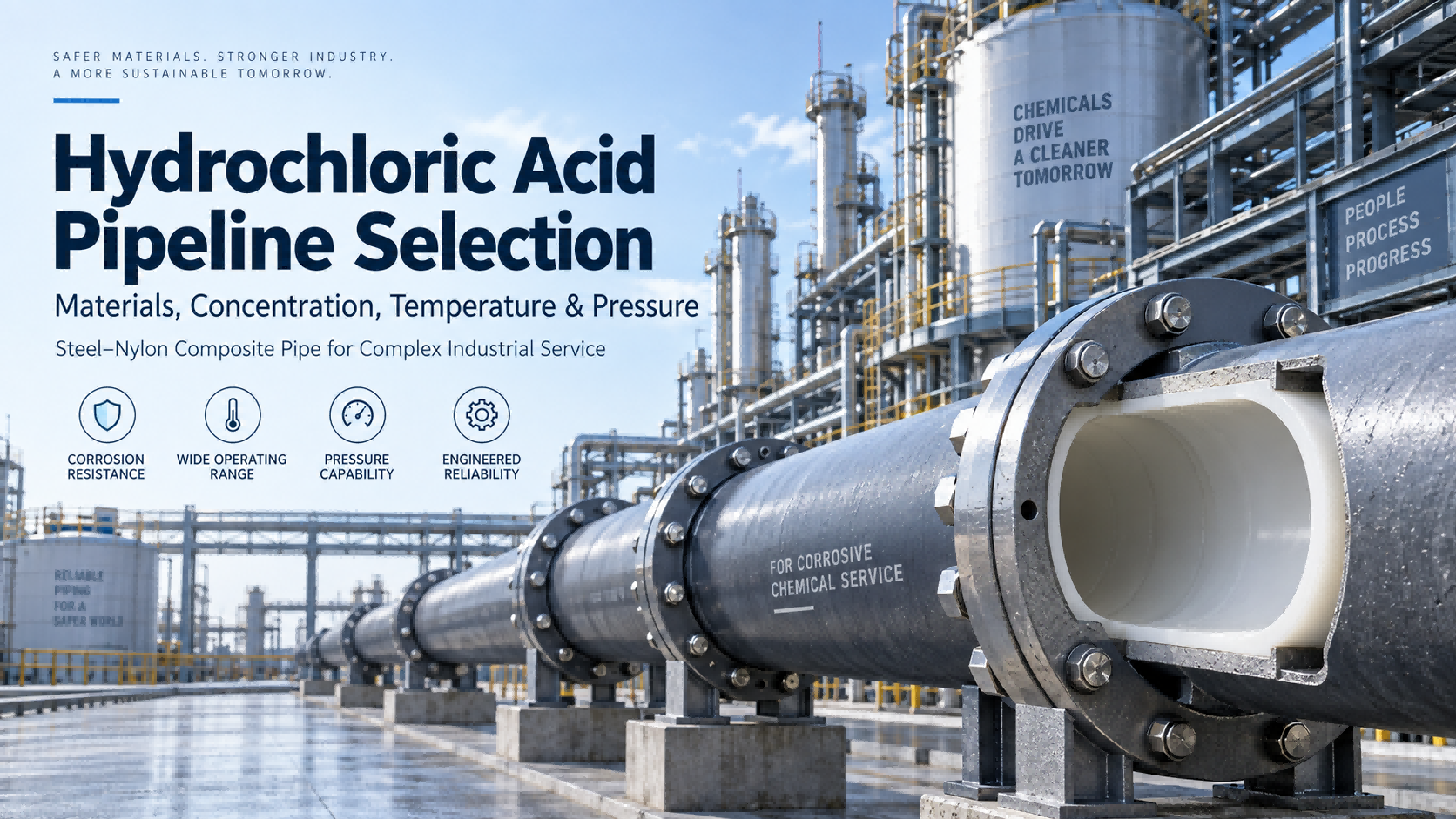
Hydrochloric acid is widely used in the chemical, chlor-alkali, metallurgical, mining, water treatment, steel pickling, and chemical processing industries.
Compared with ordinary industrial fluids, selecting piping for hydrochloric acid service is considerably more complex. This is because pipeline performance depends not only on corrosion resistance, but also on acid concentration, temperature, pressure, flow velocity, impurities, and operating conditions.
Therefore, when asking, “What pipe material is suitable for hydrochloric acid transportation?”, it is not enough to simply compare whether a material is described as “acid resistant.”
A more professional selection process should first answer several key questions:
-
What is the hydrochloric acid concentration?
-
What is the normal operating temperature?
-
What is the working and design pressure?
-
Does the fluid contain solids or other chemical components?
-
Is the pipeline operated continuously or intermittently?
-
Will the pipe be exposed to both corrosion and abrasive wear?
-
Is the project focused primarily on initial purchase cost or total lifecycle cost?
One point must be made especially clear:
Steel–nylon composite pipe is not a universal solution for concentrated hydrochloric acid or severe strong-acid service.
For low-concentration acidic fluids, mildly acidic industrial media, and certain weak-acid environments, steel–nylon composite pipe may be considered after the chemical compatibility of the actual operating conditions has been verified.
However, for concentrated hydrochloric acid, high-temperature hydrochloric acid, and other severe strong-acid conditions, pipe materials specifically designed for strong-acid resistance should be selected.
1. Why Is Hydrochloric Acid Pipeline Selection So Challenging?
The real challenge in hydrochloric acid piping is not simply finding a “corrosion-resistant material.”
The challenge is achieving an appropriate balance between:
Chemical resistance + mechanical strength + temperature + pressure + installation requirements + lifecycle cost
Some materials may perform well under static laboratory conditions but experience significantly different service lives when exposed to actual industrial operating environments.
Several factors explain this difference.
1.1 Hydrochloric Acid Concentration Matters
In industrial pipeline engineering, hydrochloric acid cannot be treated as a single fixed medium.
Low-concentration acidic wastewater, dilute hydrochloric acid solutions, and concentrated industrial hydrochloric acid can impose very different requirements on piping materials.
A material that performs satisfactorily in a low-concentration acidic fluid does not necessarily perform well in concentrated hydrochloric acid.
Therefore, the first step in material selection should always be to determine the actual acid concentration and its possible fluctuation range.
1.2 Temperature Can Significantly Change Material Performance
Chemical compatibility should never be evaluated based on concentration alone.
A material that is suitable for a certain acidic solution at 20°C may not necessarily remain suitable at 60°C or at even higher temperatures.
As operating temperature increases:
-
Chemical reactions may accelerate;
-
Polymer properties may change;
-
Liner stability requirements increase;
-
Flange and gasket reliability becomes more critical;
-
Long-term corrosion behavior can change significantly.
For this reason, industrial pipe selection should consider four parameters together:
Medium + Concentration + Temperature + Pressure
Simply describing a pipe as “acid resistant” is not sufficient for engineering selection.
2. Why Is Ordinary Carbon Steel Generally Unsuitable for Hydrochloric Acid Service?
Carbon steel provides good structural strength and attractive initial cost for many conventional industrial pipeline applications.
However, in hydrochloric acid environments, ordinary carbon steel can face serious corrosion problems.
Long-term corrosion may lead to:
-
Progressive pipe-wall thinning;
-
Localized corrosion;
-
Weld-area deterioration;
-
Leakage around flanges and connections;
-
Increased maintenance frequency;
-
Reduced pipeline service life.
More importantly, the actual cost of pipeline failure is rarely limited to replacing one section of pipe.
A single leakage incident may result in:
-
Production shutdown;
-
Loss of process fluid;
-
Environmental remediation;
-
Maintenance labor;
-
Safety risks;
-
Damage to surrounding equipment.
For corrosive acidic services, evaluating only the initial price of carbon steel may therefore produce a misleading economic comparison.
3. What Pipe Materials Are Commonly Used for Hydrochloric Acid Service?
Common materials considered for hydrochloric acid and other corrosive chemical services include:
-
Carbon steel;
-
Stainless steel;
-
FRP / fiberglass reinforced plastic;
-
PVC / CPVC;
-
PE / HDPE;
-
PTFE and other fluoropolymers;
-
Lined steel pipe;
-
Specialized corrosion-resistant alloys.
However, there is no single material that is suitable for every hydrochloric acid application.
Material selection must be based on the actual operating conditions of each project.
4. Is Stainless Steel the Best Choice for Hydrochloric Acid Piping?
When corrosion is mentioned, many procurement teams instinctively think of:
304 or 316L stainless steel.
However, “stainless steel” does not mean “resistant to every corrosive chemical.”
Hydrochloric acid environments can be particularly challenging for many stainless steels. The combination of acidity and chloride ions can create serious corrosion risks.
Therefore, common grades such as 304 and 316L should not automatically be treated as universal solutions for hydrochloric acid transportation.
This highlights an important principle in industrial pipeline selection:
A more expensive material is not automatically a more suitable material.
Chemical compatibility must come first.
5. Are PVC, CPVC, and Other Plastic Pipes Suitable for Hydrochloric Acid?
PVC, CPVC, and certain other polymer piping systems are commonly considered in low-pressure chemical applications.
One of their major advantages is that the pipe body does not experience the same electrochemical corrosion mechanism as ordinary carbon steel.
However, industrial applications require more than chemical resistance alone.
Mechanical Strength
As pipeline diameter increases, particularly in large-diameter installations, structural support, deformation control, and mechanical stability become increasingly important.
Pressure Capacity
Higher-pressure applications place additional demands on thermoplastic piping systems.
Operating Temperature
Different polymer materials have different allowable temperature ranges and long-term performance characteristics.
External Loads
Pipe supports, span length, vibration, equipment connections, and installation conditions can all influence long-term reliability.
Therefore:
Corrosion resistance is only one part of industrial pipeline design.
6. What Are the Advantages and Limitations of FRP Pipe?
FRP is widely used in certain corrosive chemical applications.
Its advantages can include:
-
Good corrosion resistance in compatible environments;
-
Relatively low weight;
-
Large-diameter manufacturing capability.
However, long-term industrial applications should also evaluate:
-
Liner structure;
-
Resin system;
-
Manufacturing consistency;
-
Joint reliability;
-
Abrasive wear;
-
Installation quality;
-
Long-term structural integrity.
This becomes particularly important when corrosion and abrasion occur simultaneously.
In these applications, chemical resistance alone cannot determine the best pipeline solution.
7. What Materials Should Be Considered for Concentrated Hydrochloric Acid?
For concentrated hydrochloric acid, elevated-temperature hydrochloric acid, and severe strong-acid service, material selection requires particular caution.
Depending on concentration, temperature, pressure, and other operating conditions, engineers may need to evaluate:
-
PTFE / PFA and other fluoropolymers;
-
Specialized acid-resistant lining systems;
-
Special non-metallic materials;
-
Corrosion-resistant specialty alloys;
-
Composite systems specifically engineered for strong-acid environments.
Final material selection should be based on chemical compatibility data, engineering standards, and actual process conditions.
For these severe applications:
Conventional steel–nylon composite pipe should not be treated as the default solution.
Understanding this application boundary is essential when selecting hydrochloric acid piping.
8. What Types of Acidic Media Are Better Suited to Steel–Nylon Composite Pipe?
Steel–nylon composite pipe is better positioned for:
Low-concentration acidic media, mildly acidic industrial fluids, and complex industrial applications where corrosion, abrasion, pressure, and mechanical loads may occur simultaneously.
The fundamental engineering concept behind steel–nylon composite pipe is not to make one material perform every function.
Instead, different layers perform different roles.
A simplified structure can be described as:
Steel structural layer + Nylon working layer
The steel structure primarily provides:
-
Pressure-bearing capability;
-
Mechanical strength;
-
Pipe rigidity;
-
Structural stability for large diameters.
The nylon working layer helps address:
-
Isolation between compatible corrosive media and the steel structure;
-
Abrasive wear;
-
Internal scaling and deposition;
-
Flow resistance.
This makes steel–nylon composite pipe particularly valuable in complex industrial applications where a single conventional material may struggle to balance all performance requirements.
9. What Are the Main Advantages of Steel–Nylon Composite Pipe?
9.1 Combining Structural Strength with Corrosion Protection
Metallic piping provides excellent mechanical strength.
Many non-metallic materials provide good corrosion resistance in compatible environments.
Steel–nylon composite pipe combines these two engineering concepts.
The outer steel structure provides mechanical and pressure-bearing strength, while the inner nylon working layer contacts the transported medium.
Therefore, in mildly acidic applications where chemical compatibility has been confirmed, the composite structure can provide a more balanced combination of performance characteristics.
9.2 Well Suited to Applications Combining Corrosion and Abrasion
Many industrial fluids are not clean chemical solutions.
Chemical wastewater, process slurries, salt-containing fluids, mother liquors, and other industrial media may contain:
Corrosive components + Solid particles + Flow-induced abrasion
Under these conditions, simply comparing corrosion resistance is not enough.
Nylon has good wear resistance, making steel–nylon composite pipe particularly attractive where the application involves:
Corrosion + Abrasion
This combination is common in chemical processing, mining, oilfield, and slurry transportation systems.
9.3 Smooth Inner Surface Helps Reduce Scaling and Hydraulic Resistance
After several years of operation, corrosion is not always the only factor affecting pipeline performance.
Another major problem is:
Scaling and deposition.
Internal deposits can gradually reduce the effective pipe diameter and lead to:
-
Reduced flow capacity;
-
Increased pumping energy consumption;
-
Higher pressure losses;
-
More frequent pipeline cleaning.
The relatively smooth inner surface of steel–nylon composite pipe can help reduce deposition and scaling tendencies in suitable applications while maintaining efficient fluid transportation.
9.4 Suitable for Large-Diameter and Pressure-Bearing Industrial Pipelines
For small-diameter, low-pressure chemical transportation systems, many non-metallic pipe materials are available.
However, as industrial pipelines become larger, such as:
-
DN300;
-
DN500;
-
DN800;
-
DN1000;
-
And even larger diameters;
while simultaneously requiring higher pressure capacity and greater structural stability, material selection becomes more complicated.
This is where steel–nylon composite construction offers an important engineering advantage.
By using steel as the structural and pressure-bearing layer, the pipeline can combine:
Large diameter + Pressure resistance + Abrasion resistance + Corrosion protection
This is fundamentally different from the design requirements of conventional small-diameter chemical plastic piping.
10. Why Do We Not Recommend Steel–Nylon Composite Pipe for Concentrated Hydrochloric Acid?
One of the most important capabilities of a professional industrial pipeline supplier is not claiming that one product can be used for every medium.
It is knowing:
Where the product should be used—and where it should not.
Nylon is not a universal corrosion-resistant material for all strong-acid environments.
As hydrochloric acid concentration increases or the chemical environment becomes more aggressive, the long-term stability of the material must be evaluated much more carefully.
Therefore, for applications involving:
-
Concentrated hydrochloric acid;
-
Severe strong-acid environments;
-
High-temperature strong acids;
-
Continuous long-term transportation of highly acidic media;
our general principle is:
Steel–nylon composite pipe is not recommended as the default material.
These applications should use piping systems specifically engineered for strong-acid service.
11. Can Steel–Nylon Composite Pipe Be Used Directly for Dilute Hydrochloric Acid?
Not without evaluating the actual operating conditions.
Even when hydrochloric acid concentration is relatively low, or the fluid is only mildly acidic, the following parameters should still be confirmed:
| Parameter | Information Required |
|---|---|
| Medium | Hydrochloric acid or mixed process fluid |
| Concentration | Normal concentration and fluctuation range |
| Temperature | Normal and maximum operating temperature |
| Pressure | Normal working pressure and design pressure |
| Flow velocity | Whether high-velocity erosion is present |
| Solid content | Presence of solids, slurry, or salt sludge |
| Operating cycle | Intermittent or 24/7 continuous operation |
| Other chemicals | Salts, alkalis, solvents, and other components |
| Cleaning chemicals | Chemicals used during periodic cleaning |
Material compatibility should then be assessed based on the complete operating conditions.
For new or uncertain process fluids, additional verification may include:
Material immersion testing, pilot-section testing, or field trial installation.
12. Hydrochloric Acid Pipe Selection Should Not Focus Only on Corrosion Resistance
A common mistake in industrial procurement is reducing hydrochloric acid pipeline selection to one question:
Which material has the best corrosion resistance?
In reality, industrial piping must be evaluated as a complete system.
A more appropriate selection model is:
**Chemical Compatibility
-
Pressure
-
Temperature
-
Abrasion
-
Mechanical Strength
-
Installation
-
Maintenance
-
Lifecycle Cost**
Only by evaluating all of these factors together can engineers determine the most appropriate material for a particular project.
13. Practical Guidelines for Hydrochloric Acid Pipeline Material Selection
The following framework can be used as a preliminary selection guide.
Low-Concentration, Low-Pressure Hydrochloric Acid or Mildly Acidic Media
Potential materials to evaluate may include:
-
PVC;
-
CPVC;
-
PE-based materials;
-
Other compatible non-metallic piping systems.
Low-Concentration Acidic Media + Higher Pressure
If greater mechanical strength and pressure-bearing capability are required, the evaluation can be expanded to include:
-
Lined steel piping;
-
Composite piping systems;
-
Steel–nylon composite pipe, provided chemical compatibility is verified.
Low-Concentration Acidic Media + Abrasive Wear
If the fluid also contains solid particles or causes significant erosive wear:
The combined advantages of steel–nylon composite pipe become more relevant.
In these applications, both chemical corrosion and abrasion resistance should be evaluated.
Large Diameter + Pressure + Corrosion + Abrasion
This is a particularly challenging combination for many conventional single-material piping systems.
When the transported medium falls within the confirmed compatibility range of the nylon working layer, steel–nylon composite pipe can become a strong candidate for engineering evaluation.
Its composite construction provides a way to combine structural performance with internal wear and corrosion protection.
Concentrated Hydrochloric Acid / Severe Strong-Acid Service
For these environments, the preferred approach is:
Use a corrosion-resistant piping system specifically designed and verified for strong-acid service.
Conventional steel–nylon composite pipe should not be considered the primary recommendation for these applications.
14. A More Important Question: What Is the Pipeline's Total Lifecycle Cost?
Many industrial pipeline projects initially compare only one figure:
Price per meter.
However, over a 5-year, 10-year, or longer operating period, initial material cost is often not the main factor determining economic performance.
A more realistic calculation is:
TCO = Purchase Cost + Installation Cost + Maintenance Cost + Cleaning Cost + Replacement Cost + Production Downtime Loss
This is the pipeline's:
Total Cost of Ownership (TCO).
A pipeline with a lower purchase price may become much more expensive if it requires frequent maintenance, replacement, cleaning, or production shutdowns.
For this reason, more industrial companies are shifting their decision-making process from:
“Which pipe is the cheapest?”
to:
“Which pipeline system provides the lowest total lifecycle cost?”
15. Steel–Nylon Composite Pipe Is Designed for Complex Industrial Conditions
The value of steel–nylon composite pipe is not that it replaces every corrosion-resistant pipe material.
Its real value lies in addressing a more complex engineering question:
How can an industrial pipeline achieve a better balance when pressure, corrosion, abrasion, large diameter, mechanical loading, and maintenance requirements all exist at the same time?
This is one of the fundamental differences between steel–nylon composite pipe and conventional single-material plastic or metallic pipes.
Typical applications worth evaluating include:
-
Chemical process fluids;
-
Mildly acidic industrial wastewater;
-
Strong alkaline media;
-
Brine and high-salinity fluids;
-
Salt sludge;
-
Process mother liquor;
-
Mineral slurry;
-
Oilfield produced fluids;
-
Corrosive fluids containing solid particles;
-
Industrial fluids where corrosion and abrasion occur simultaneously.
However, compatibility should always be confirmed according to actual chemical concentration, temperature, pressure, and operating conditions.
16. Eight Parameters You Should Provide Before Selecting a Hydrochloric Acid Pipeline
If you are selecting piping for hydrochloric acid or another corrosive medium, simply telling the supplier:
“We need a pipe for hydrochloric acid.”
is not enough.
A professional supplier should request complete operating data.
At minimum, provide:
-
Name of the transported medium
-
Hydrochloric acid concentration
-
Normal and maximum operating temperature
-
Normal working pressure and maximum/design pressure
-
Pipeline diameter
-
Design flow rate / flow velocity
-
Whether solid particles are present
-
Operating cycle and required design life
If the transported fluid is a mixed solution, the major chemical components should also be provided.
Only then can the supplier determine:
Whether the pipe material is truly suitable—not simply whether the pipe can be manufactured.
17. Conclusion: There Is No Universal Pipe Material for Hydrochloric Acid
The key to hydrochloric acid pipeline selection is not finding one material capable of handling every possible condition.
Professional material selection should evaluate:
Concentration, temperature, pressure, abrasion, mechanical load, installation requirements, and lifecycle cost.
For concentrated hydrochloric acid and severe strong-acid applications, materials specifically designed for strong-acid service should be prioritized.
For low-concentration acidic media, mildly acidic industrial fluids, and complex applications involving both corrosion and abrasion, steel–nylon composite pipe may offer significant engineering advantages after chemical compatibility has been confirmed.
Its potential benefits include:
-
Steel structural strength;
-
High pressure-bearing capability;
-
Good mechanical stability;
-
Wear-resistant nylon working layer;
-
Protection against compatible corrosive media;
-
Smooth internal surface;
-
Large-diameter manufacturing capability;
-
Flanged connection;
-
Reduced maintenance requirements.
The real objective of professional pipeline selection is not to prove that one material can handle every chemical.
It is to identify:
The right material for the right operating condition.
For hydrochloric acid and other corrosive-media pipeline projects, we recommend providing complete information on chemical composition, concentration, temperature, pressure, flow velocity, and solids content before selecting a pipe material.
This enables a more accurate material compatibility assessment and helps prevent premature failure, unnecessary maintenance, and costly production interruptions.
Sodium Hypochlorite Transfer Solutions: How to Balance Corrosion Resistance, Pressure Capability, and Long-Term Reliability
Sulfuric Acid Transfer Pipeline Selection: How to Choose the Right Pipe Material for Different Concentrations, Temperatures, and Operating Conditions


