How We Recommend Pipe Materials Based on Medium, Pressure, Temperature, and Abrasion Conditions
Industrial piping selection may appear to be simply a matter of choosing a pipe material. In reality, it is a complex engineering process that requires matching material performance with actual operating conditions.
Even when two pipelines transport liquids, their requirements can be completely different. One may only need basic corrosion resistance, while another must withstand high salinity, elevated temperatures, pressure fluctuations, abrasive solids, and continuous operation at the same time.
Similarly, a DN300 pipeline carrying clean water requires a completely different material selection approach from a DN300 pipeline transporting mineral slurry.
Therefore, reliable industrial pipe selection should not begin with the question:
“Which pipe material is the best?”
Instead, it should begin with a more fundamental question:
“Under what conditions will this pipeline actually operate?”
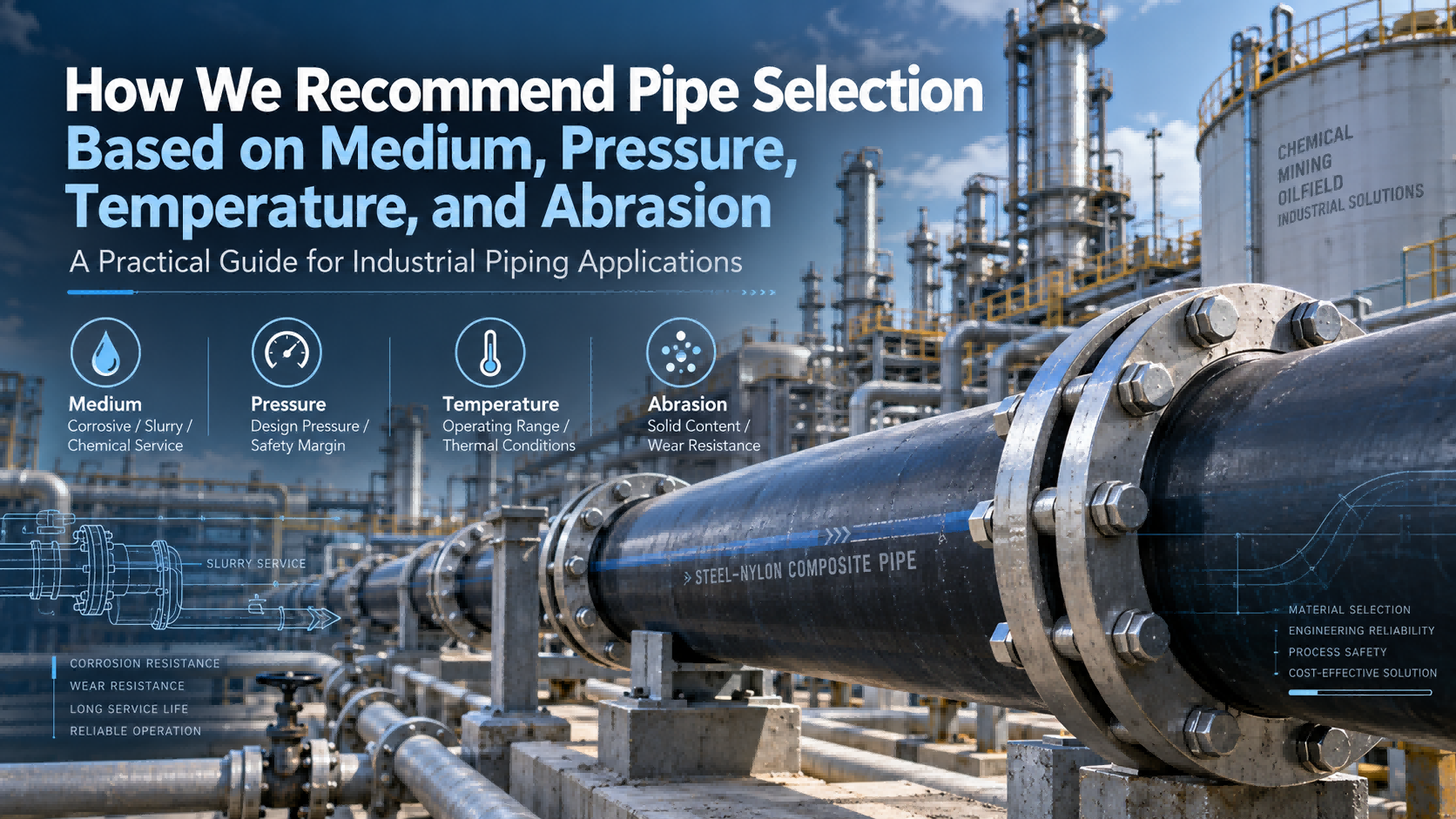
In our engineering selection process, we normally focus on four major variables:
Medium, Pressure, Temperature, and Abrasion.
We then consider additional factors such as pipe diameter, flow velocity, installation environment, connection method, maintenance requirements, and expected service life.
Only after evaluating these factors together can we determine which piping solution offers the best balance between reliability, safety, service life, and total lifecycle cost.
For demanding industrial systems where corrosion, abrasion, and pressure resistance are required simultaneously, steel-nylon composite pipe is one of the key solutions we recommend.
1. Why Industrial Pipe Selection Should Not Focus Only on Corrosion Resistance
One of the most common mistakes in industrial pipeline design is selecting materials based only on the name of the transported medium.
For example:
“It's brine, so we need a corrosion-resistant pipe.”
“It's acid, so we need an acid-resistant pipe.”
“It's slurry, so we need an abrasion-resistant pipe.”
These statements are not necessarily wrong, but they are far from sufficient.
The real service life of an industrial pipeline is usually determined by several interacting factors rather than one isolated condition.
For example, a chemical wastewater pipeline may simultaneously experience:
-
High salt concentration
-
Elevated temperature
-
Crystallized solids
-
Continuous operating pressure
-
Changes in flow velocity
-
Localized erosion at elbows
-
Pressure fluctuations during startup and shutdown
If the pipe material is selected only because the fluid is classified as “corrosive wastewater,” engineers may overlook the actual mechanisms that determine where and when the pipeline will fail.
Industrial pipe selection should therefore answer four fundamental questions:
Will the medium chemically attack the pipe?
Can the pipe withstand the required pressure over the long term?
Will temperature affect the material's mechanical or chemical performance?
Will particles and flow velocity continuously erode the inner wall?
Only when these four questions are evaluated together does material selection become meaningful from an engineering perspective.
2. Step One: Analyze the Medium Before Selecting the Material
The first factor we evaluate in an industrial piping project is the transported medium.
However, understanding the medium involves much more than simply knowing its name.
For example, if a customer tells us:
“The pipeline transports brine.”
We normally need additional information.
What is the salt concentration?
What is the chloride concentration?
Does the fluid contain acids, alkalis, or other chemicals?
Does it contain crystallized salts?
Are sand, mineral particles, or other solids present?
What is the pH value?
What is the operating temperature?
Does the chemical composition remain stable during operation?
These parameters can significantly affect material compatibility and expected pipeline life.
Strong Acids, Alkalis, and High-Salinity Media
Chemical processing, chlor-alkali, soda ash, oilfield, and salt chemical industries frequently involve media such as:
-
NaOH
-
NaCl
-
Brine
-
High-salinity wastewater
-
HCl
-
H₂SO₄
-
Phosphoric acid
-
Seawater
-
Oilfield produced water
-
Water injection fluids
Conventional carbon steel may experience varying degrees of corrosion in these environments.
Even stainless steels require careful evaluation when chlorides, elevated temperatures, and aggressive chemical concentrations are involved.
When long-term corrosion becomes one of the primary operating risks, the material selection philosophy may need to move away from relying entirely on a single metallic material toward a composite structure such as:
Metal Load-Bearing Structure + Corrosion-Resistant Functional Layer
This is one of the fundamental design principles behind steel-nylon composite pipe.
The steel structure provides mechanical strength and pressure resistance, while the nylon functional layer is designed to isolate the steel from direct contact with the transported medium.
This functional separation is one of the key differences between composite piping systems and conventional single-material pipes.
3. Step Two: Use Pressure Conditions to Determine the Structural Foundation
Corrosion resistance alone does not guarantee that a pipe can safely withstand industrial operating pressure.
This is an especially important consideration when evaluating purely non-metallic piping systems.
Industrial pipelines must often handle more than normal operating pressure.
Additional pressure conditions may include:
-
Pump startup pressure
-
Pressure changes during pump shutdown
-
Water hammer
-
Rapid valve closure
-
Elevation differences
-
Pipeline blockage
-
Sudden flow changes
-
Process fluctuations
Therefore, pipe selection should never be based only on normal operating pressure.
Why Pressure Capacity Must Be Evaluated Independently
Suppose a pipeline normally operates at 1.0 MPa.
This does not necessarily mean that simply selecting a “1.0 MPa pipe” is sufficient.
Engineering evaluation should also consider:
Design pressure, safety margin, temperature effects, long-term loading, and temporary pressure surges.
In chemical plants, mines, oilfields, and power plants, pipes often need to provide both corrosion resistance and significant structural strength.
This is one of the major advantages of steel-nylon composite piping.
Its design concept can be summarized simply:
Steel provides pressure-bearing strength, while nylon provides corrosion and abrasion resistance.
Compared with many single-material non-metallic pipes, this structure can offer a better balance between mechanical strength and resistance to aggressive media under demanding industrial conditions.
Our steel-nylon composite pipe systems can be engineered for industrial applications within approximately 1.0–4.0 MPa pressure classes, depending on project requirements.
Final design, however, must always be verified according to the actual medium, operating temperature, pipe diameter, pressure conditions, and project specifications.
4. Step Three: Temperature Can Change the Actual Performance of Pipe Materials
Temperature is one of the most underestimated factors in industrial pipe selection.
A material may perform very well at ambient temperature, but its mechanical properties, dimensional stability, chemical resistance, and expected service life may change significantly as temperature rises or falls.
For this reason, pipe selection should not rely solely on a manufacturer's stated “maximum temperature.”
A much more important question is:
What is the long-term operating temperature?
Why Continuous Operating Temperature Matters More Than a Short-Term Maximum
A material may theoretically withstand a relatively high temperature for a short period without being suitable for continuous service at that temperature.
Industrial pipelines are often expected to operate continuously for many years.
Therefore, we normally evaluate:
-
Normal operating temperature
-
Maximum continuous temperature
-
Short-term peak temperature
-
Minimum ambient temperature
-
Startup and shutdown temperature differences
-
Day/night temperature variations
-
Seasonal temperature changes
-
Frequency of thermal cycling
All of these factors can affect long-term pipeline reliability.
Temperature and Pressure Must Be Evaluated Together
Pressure and temperature should never be considered completely independently.
For many materials, allowable pressure may need to be derated as temperature increases.
A more appropriate engineering principle is:
Temperature + Pressure = Structural Verification
In other words, the pipe's ability to withstand design pressure must be verified at the actual operating temperature.
Our reinforced MC nylon and steel-nylon composite piping solutions can be evaluated for operating environments within approximately −36°C to 160°C, depending on the specific material configuration and service conditions.
However, continuous operating temperature, transported medium, pressure, and other project-specific factors must always be reviewed before final selection.
5. Step Four: Abrasion Often Determines the Real Replacement Cycle
In mining, thermal power, chemical processing, and oilfield applications, many pipelines fail not because of corrosion alone, but because of abrasion.
Typical abrasive media include:
-
Iron ore slurry
-
Copper ore slurry
-
Gold mine tailings
-
Tailings slurry
-
Mine backfill slurry
-
Flue gas desulfurization slurry
-
Sand-containing produced water
-
Salt mud
-
Salt slurry
-
Chemical wastewater containing suspended solids
These systems share one major characteristic:
Solid particles continuously impact and wear the inner surface of the pipe.
Abrasion Cannot Be Evaluated Simply by Asking Whether Solids Are Present
The actual wear rate depends on several important variables.
Solids Concentration
Higher solids concentration generally means that more particles interact with the pipe wall over a given period.
Particle Hardness
Quartz sand, ore particles, mineral solids, and softer suspended materials can produce dramatically different wear rates.
Particle Size
Larger particles generally create stronger impact forces, especially in areas where the flow direction changes.
Flow Velocity
As velocity increases, particle impact and cutting effects on the pipe wall may increase significantly.
Pipeline Geometry
Straight pipe sections, elbows, tees, reducers, and pump discharge sections do not experience the same wear conditions.
6. Why Do Elbows, Tees, and Pump Outlets Often Fail First?
Abrasion is rarely distributed uniformly throughout a pipeline.
In straight sections, fluid direction remains relatively stable.
When the flow enters an elbow, however, solid particles tend to continue moving due to inertia and impact the outer radius of the elbow.
As a result, many slurry pipeline systems experience a common situation:
The straight pipe is still usable,
but the elbow has already suffered severe wall loss.
Similar accelerated wear can occur at:
-
Tees
-
Pump outlets
-
Areas near valves
-
Reducers
-
High-velocity sections
That is why our engineering evaluation does not only ask:
“What medium does the pipeline transport?”
We also ask:
“Where does the existing pipeline fail first?”
This question is extremely important.
In many retrofit projects, the most economical solution may not be to replace the entire pipeline.
Instead, it may be more practical to upgrade the highest-risk sections first.
7. Corrosion Plus Abrasion: One of the Most Challenging Industrial Conditions
Many industrial piping systems do not experience purely corrosive or purely abrasive service.
A very common operating condition is:
Corrosive Liquid + Solid Particles + Pressure
For example:
High-salinity oilfield produced water may contain chlorides, CO₂, H₂S, and sand.
Mineral slurry may contain both abrasive particles and chemically aggressive components.
Wet flue gas desulfurization slurry can involve corrosion, abrasion, and scaling simultaneously.
Chemical mother liquor may be corrosive while also containing crystallized salts or solid particles.
In these environments, an important phenomenon may occur:
Corrosion and abrasion can accelerate each other.
Corrosion weakens or attacks the material surface.
Abrasion continuously removes the affected or protective surface layer.
Fresh material is then exposed to the medium again.
This creates a repeating cycle:
Corrosion → Wear → Fresh Surface Exposure → Corrosion
This interaction helps explain why conventional piping materials sometimes achieve a significantly shorter service life than expected under complex operating conditions.
8. Why Steel-Nylon Composite Pipe Is Well Suited to Multi-Factor Operating Conditions
The value of steel-nylon composite pipe does not come from maximizing one single property.
Its advantage lies in its ability to address several industrial pipeline challenges at the same time.
1. Steel Provides the Structural Foundation
Steel has mature and well-understood structural properties.
For industrial systems requiring pressure resistance, large diameters, mechanical strength, and structural stability, the steel component provides the primary load-bearing foundation.
2. The Nylon Layer Provides Corrosion Resistance
The transported medium mainly contacts the nylon functional layer, reducing direct exposure of the steel structure to corrosive fluids.
For brine, alkaline liquids, high-salinity industrial wastewater, and many other aggressive media, this structure can significantly reduce the internal corrosion risk commonly associated with conventional carbon steel piping.
3. Nylon Also Provides Good Abrasion Resistance
In mineral slurry, industrial slurry, sand-containing fluids, and other solids-bearing media, the inner functional layer must withstand continuous friction, impact, and erosion.
The favorable friction characteristics and abrasion resistance of reinforced nylon make it particularly suitable for applications where corrosion and wear occur simultaneously.
4. Steel and Nylon Perform Different Functions
A conventional single-material pipe may be expected to provide:
-
Pressure resistance
-
Corrosion resistance
-
Abrasion resistance
-
Impact resistance
-
Connection reliability
-
Structural support
all through one material.
A composite structure allows different materials to perform different functions according to their strengths.
This reflects an important direction in modern industrial materials engineering:
Instead of requiring one material to solve every problem, composite structures combine the advantages of multiple materials.
9. What Does Our Pipe Selection Process Look Like?
For a new industrial pipeline project, we normally do not immediately tell the customer:
“Use a DN300 steel-nylon composite pipe.”
A reliable selection process requires several steps.
Step 1: Confirm the Transported Medium
We first determine:
What is the medium?
What are its main chemical components?
What is the concentration?
What is the pH?
Does it contain chlorides?
Does it contain solid particles?
Is crystallization possible?
Is scaling likely?
Does the medium composition change during operation?
Step 2: Confirm the Pressure Conditions
We evaluate:
Normal operating pressure
Design pressure
Maximum transient pressure
Pump discharge pressure
Potential water hammer
Frequency of pressure fluctuations
Step 3: Confirm the Temperature
We evaluate:
Normal operating temperature
Minimum temperature
Maximum temperature
Short-term peak temperature
Ambient temperature
Step 4: Confirm the Abrasion Conditions
We focus on:
Solids concentration
Particle type
Particle size
Particle hardness
Flow velocity
Known high-wear locations
Step 5: Confirm Pipe Diameter and Flow Rate
Pipe diameter should never be selected independently from flow rate.
If the pipe diameter is too small:
Flow velocity may become excessive, increasing pressure loss and potentially accelerating abrasion.
If the pipe diameter is unnecessarily large:
Capital cost increases, while low flow velocity may contribute to sedimentation or solids deposition.
The engineering objective is therefore to achieve a balance between:
Flow Rate, Velocity, Pressure Loss, Abrasion, and Investment Cost.
10. A Practical Four-Dimensional Pipe Selection Model
For complex industrial piping systems, the selection logic can be summarized using four key dimensions:
| Condition | Key Question | Primary Impact |
|---|---|---|
| Medium | Is the fluid chemically aggressive? | Material compatibility |
| Pressure | What is the maximum design pressure? | Structural design and wall thickness |
| Temperature | What is the long-term operating temperature? | Material performance and pressure rating |
| Abrasion | Are solids present and what is the velocity? | Expected service life |
If all four conditions are relatively mild, the range of suitable materials is usually wide.
However, when a system involves:
High Corrosion + High Abrasion + Pressure + Temperature Variation
material selection becomes much more challenging.
These are precisely the conditions in which steel-nylon composite piping can provide significant engineering value.
11. Different Operating Conditions Require Different Material Selection Strategies
Consider several typical examples.
Condition A: Ambient-Temperature Clean Water
Primary considerations include:
Pressure, cost, installation, and service life.
Corrosion and abrasion may not be the dominant factors.
Condition B: High-Salinity Industrial Wastewater
Primary considerations include:
Corrosion, operating pressure, long-term reliability, and maintenance cost.
Conventional carbon steel may face significant internal corrosion risk.
Condition C: Mineral Slurry Transportation
Primary considerations include:
Abrasion, velocity, particle characteristics, elbow life, and downtime cost.
Condition D: High-Salinity Produced Water Containing Sand
Primary considerations include:
Corrosion + Abrasion + Pressure
This multi-factor environment may be better evaluated using a composite piping approach.
Condition E: High-Temperature Corrosive Medium
The system requires simultaneous analysis of:
Chemical compatibility, long-term temperature, design pressure, and thermal cycling.
Material selection must therefore undergo more rigorous operating-condition verification.
12. Why We Do Not Recommend Selecting Industrial Pipes Based Only on Purchase Price
In industrial projects, the lowest initial purchase price does not necessarily result in the lowest overall cost.
Suppose a relatively inexpensive pipeline needs to be replaced every two or three years.
The real cost includes much more than the pipe itself:
-
Removal of the old pipeline
-
Purchase of replacement pipe
-
Installation
-
Lifting and equipment costs
-
Labor
-
Production downtime
-
Leakage risk
-
Environmental risk
-
Maintenance manpower
A more appropriate way to compare industrial piping systems is therefore:
TCO — Total Cost of Ownership
The full lifecycle cost can be summarized as:
TCO = Initial Purchase + Installation + Maintenance + Replacement + Downtime Loss + Risk Cost
For a basic utility pipeline, downtime may have a relatively limited economic impact.
However, for:
-
Mineral processing plants
-
Chemical production units
-
Oilfield production systems
-
Thermal power plants
-
Continuous industrial production lines
the cost of one day of shutdown may be substantially higher than the purchase cost of the pipe itself.
Therefore, the most valuable pipe material is not necessarily the one with the lowest initial price.
It is often the material that delivers:
Fewer Repairs + Fewer Shutdowns + Fewer Replacements Over the Entire Project Lifecycle
This is one of the key value propositions we focus on when evaluating steel-nylon composite piping projects.
13. Why a Trial Pipeline Section Can Be More Convincing Than a Data Sheet
For complex industrial media, material specifications alone may not always provide enough information to predict actual field performance.
This is especially true when:
-
The medium composition is complex
-
The existing pipeline has a history of frequent failures
-
The customer plans to replace the original material
-
The project involves a large pipeline network
In these situations, we often recommend evaluating a:
100–500 Meter Trial Section
A trial section can provide direct information about:
-
Actual abrasion
-
Actual corrosion behavior
-
Joint reliability
-
Installation convenience
-
Pressure stability
-
Maintenance requirements
If the trial section demonstrates stable long-term performance, the material can then be gradually applied to a larger portion of the pipeline system.
For industrial users, field validation often provides stronger evidence than material data alone.
14. A Professional Pipe Supplier Should Understand the Operating Conditions Before Recommending a Product
If an industrial pipeline inquiry contains only:
Pipe diameter + Quantity
that information is usually not sufficient for proper engineering selection.
A more complete technical discussion should include at least:
Medium
What is being transported?
Concentration
What is the chemical concentration?
Temperature
What is the operating temperature?
Pressure
What is the operating and design pressure?
Flow Rate
What is the required flow rate?
Velocity
What is the expected flow velocity?
Particle Content
Are solid particles present?
Particle Size
What is the particle size?
Pipeline Diameter
What pipe diameter is required?
Service Life
What is the expected operating life?
Only after understanding these factors can we make a meaningful assessment of which material is most suitable.
15. Our Goal Is Not Simply to Sell a Pipe — It Is to Reduce Pipeline Failure Risk
The most important question in industrial pipe selection is not:
“Which material is the most advanced?”
The real question is:
“Which material is best suited to this specific operating condition?”
For low-corrosion, low-abrasion, and low-pressure systems, overengineering is unnecessary.
However, when a project simultaneously involves:
Corrosion, Abrasion, Pressure, Temperature, and Continuous Long-Term Operation
material selection must be approached much more carefully.
Steel-nylon composite pipe combines:
Steel Structure for Pressure Resistance + Nylon Layer for Corrosion Resistance + Nylon Layer for Abrasion Resistance
to provide a composite piping solution for demanding industrial transport systems.
Typical applications include:
-
Chemical processing pipelines
-
Chlor-alkali plants
-
Soda ash plants
-
Salt chemical industries
-
Oilfield produced water
-
Oilfield water injection
-
High-salinity wastewater
-
Mineral slurry transportation
-
Tailings pipelines
-
Mine backfill systems
-
Flue gas desulfurization slurry
-
Power plant circulating water
-
Seawater and other corrosive industrial fluids
Conclusion: Industrial Pipe Selection Is Fundamentally About Matching the Pipe to the Operating Conditions
Whether an industrial pipeline can operate reliably for many years is rarely determined by a single parameter.
A proper selection process must evaluate several interacting factors:
The medium determines chemical compatibility.
Pressure determines structural requirements.
Temperature affects long-term material performance.
Abrasion often determines the actual service life of slurry pipelines.
Additional factors such as pipe diameter, flow velocity, connection method, installation environment, maintenance requirements, and lifecycle cost must also be considered.
That is why our approach to industrial piping projects is not simply to answer:
“Which pipe material should you use?”
We first seek to understand the customer's real operating conditions and then identify the best match between material performance and project requirements.
For complex industrial systems where corrosion, abrasion, and pressure occur simultaneously, steel-nylon composite pipe provides a solution worth serious consideration:
Let steel provide the structure. Let nylon handle the medium.
The ultimate objective is not merely to extend the life of a single pipe.
It is to help industrial operators achieve:
Fewer Leaks, Less Maintenance, Less Downtime, and Lower Total Lifecycle Cost.
Engineering Information Required for Pipe Selection
If you are evaluating an industrial pipeline system, preparing the following information can significantly improve the accuracy of material selection:
Medium + Chemical Composition/Concentration + Operating Pressure + Design Pressure + Normal Temperature + Maximum Temperature + Pipe Diameter + Flow Rate + Solids Content + Particle Size + Existing Pipe Material + Current Service Life
The more complete the operating data, the more accurately the piping solution can be evaluated.
For complex media involving both corrosion and abrasion, the project can then be compared across conventional metal pipe, non-metallic pipe, lined pipe, and steel-nylon composite pipe solutions from both a technical and total lifecycle cost perspective.
This makes it possible to identify the piping system that is truly suitable for reliable long-term industrial operation.
How Are Non-Standard Sizes and Custom Designs Achieved in Industrial Piping Projects?
Why Industrial Pipe Suppliers Must Understand the Customer’s Real Operating Conditions