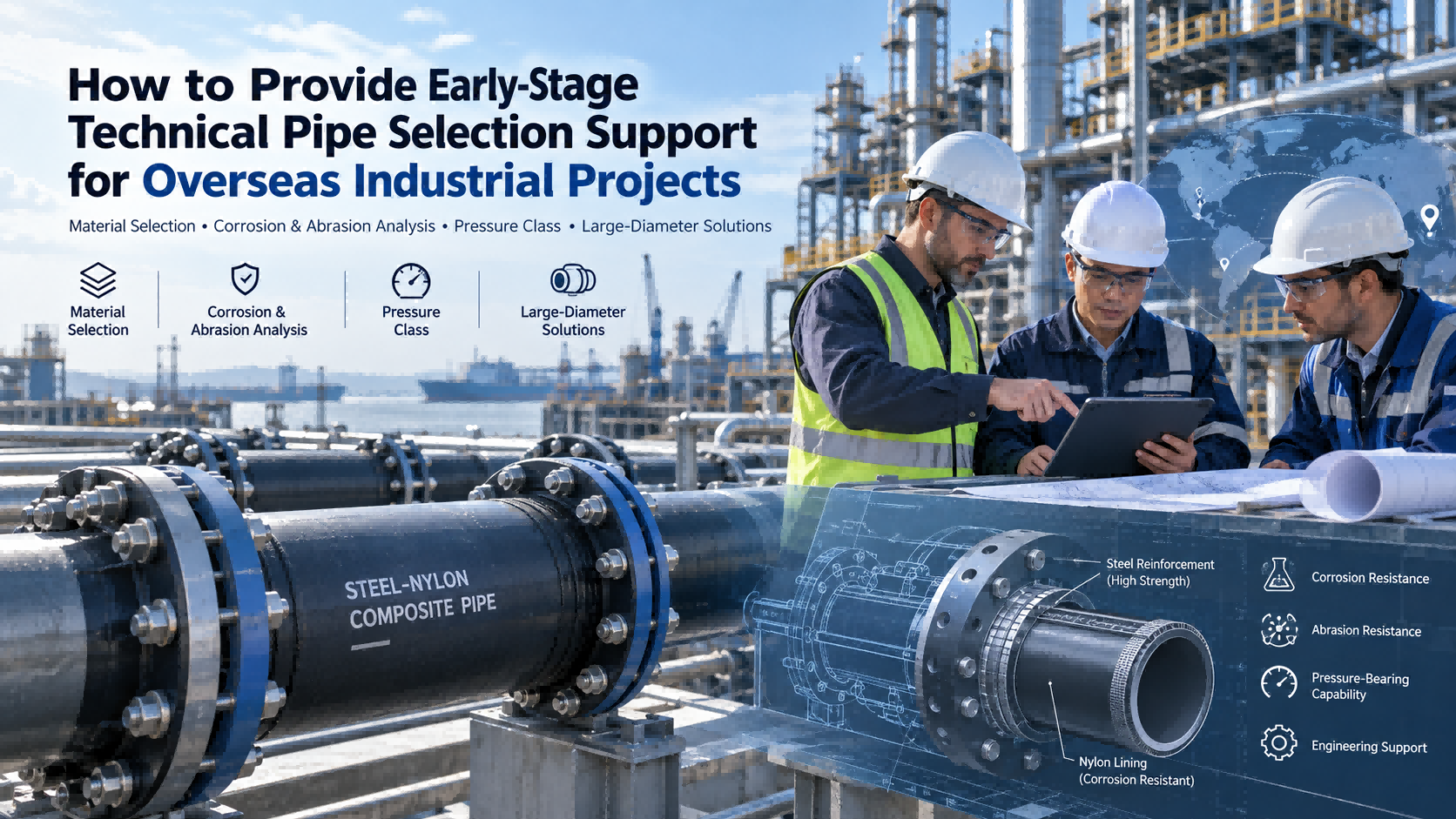
How to Provide Early-Stage Technical Pipe Selection Support for Overseas Industrial Projects
For overseas industrial pipeline projects, the long-term reliability of a piping system is often determined not by price negotiations during procurement, but by whether the technical material selection is correct at the early stage of the project.
In oil and gas, chemical processing, mining, power generation, salt chemical, phosphate chemical, and industrial water treatment projects, the same pipe material can perform very differently under different media, temperatures, pressures, flow velocities, and installation conditions.
Therefore, when selecting industrial piping for an overseas project, customers should not simply ask:
“Please quote DN500 pipe.”
More important questions include:
-
What medium will be transported?
-
What is the concentration of the medium?
-
What are the operating and maximum design temperatures?
-
What are the normal operating pressure and design pressure?
-
Does the medium contain solid particles?
-
Are corrosion and abrasion present at the same time?
-
Will the pipeline operate continuously or intermittently?
-
Is welding permitted at the project site?
-
What are the pipeline length, terrain, and installation conditions?
-
What service life is expected from the pipeline?
A professional industrial pipe supplier should therefore help the customer complete a preliminary Technical Pipe Selection Review before issuing a formal quotation.
This step is particularly important for overseas projects.
1. Why Do Overseas Industrial Pipeline Projects Require Early Technical Selection Support?
Domestic projects can often resolve technical issues quickly through site visits, face-to-face discussions with design institutes, and direct communication with project engineers.
Overseas projects are different.
When industrial piping is supplied from China to the Middle East, Southeast Asia, Africa, Central Asia, South America, or other international markets, the manufacturing facility may be thousands of kilometers away from the project site.
If the wrong material is selected, the cost of correction can be extremely high.
The consequences may include:
-
Redesign;
-
Repurchasing materials;
-
International transportation;
-
Port handling and customs clearance;
-
On-site lifting;
-
Pipeline reinstallation;
-
Production shutdown losses;
-
Additional labor costs;
-
Project delays.
For overseas projects:
The cost of incorrect material selection can be far greater than the difference in the initial pipe purchase price.
This is why an increasing number of industrial customers request technical information during the inquiry stage, including:
-
Material Recommendation;
-
Technical Data Sheet;
-
Chemical Compatibility;
-
Pressure Rating;
-
Temperature Range;
-
Connection Method;
-
Installation Recommendation;
-
Expected Service Life;
-
Material Comparison.
This trend indicates that international industrial pipe procurement is gradually shifting from simple price-based purchasing toward engineering solution-based procurement.
2. Step One: Understand the Medium Before Choosing the Pipe Material
The first question in industrial pipe selection should not be:
“Which pipe should we use?”
Instead, it should be:
“What exactly will this pipeline transport?”
A professional selection process should begin by establishing a complete set of process and medium parameters.
Important information includes:
-
Medium;
-
Concentration;
-
pH;
-
Operating Temperature;
-
Maximum Temperature;
-
Solid Content;
-
Particle Size;
-
Flow Velocity;
-
Corrosive Components;
-
Abrasive Components.
This is particularly important in chemical processing and mining applications.
For example, two pipelines may both be described as transporting “brine,” but the actual operating conditions may be completely different in terms of:
-
NaCl concentration;
-
Temperature;
-
pH;
-
Impurities;
-
Solid particles;
-
Flow velocity.
As a result, the corrosion and abrasion mechanisms can also be very different.
Therefore, material selection should never be based on the medium name alone.
3. Step Two: Identify the Primary Failure Mechanism
At its core, technical pipe selection attempts to answer one important question:
What is most likely to cause this pipeline to fail in the future?
Common industrial pipeline failure mechanisms include the following.
3.1 General Corrosion
General corrosion is common when carbon steel pipelines transport corrosive media.
Over time, the pipe wall gradually becomes thinner.
This can eventually result in:
-
Insufficient wall thickness;
-
Perforation;
-
Leakage.
3.2 Pitting and Localized Corrosion
In some high-chloride or high-salinity environments, localized corrosion may occur even when the overall pipe wall thickness has not changed significantly.
This type of failure can be more difficult to predict.
3.3 Erosion and Abrasive Wear
When slurry, tailings, salt mud, crystallized solids, or other high-solid-content media travel through a pipeline at high velocity, particles continuously impact the pipe wall.
The most vulnerable areas typically include:
-
Elbows;
-
Tees;
-
Pump discharge sections;
-
Reducers;
-
High-velocity sections.
3.4 Combined Corrosion and Abrasion
This is one of the most challenging conditions found in industrial piping systems.
Typical examples include:
-
Salt chemical slurry;
-
Mining slurry;
-
High-salinity produced water;
-
Chemical mother liquor;
-
Brine mud;
-
Flue gas desulfurization slurry.
If engineers consider only corrosion resistance while ignoring abrasion resistance, the pipeline may still fail prematurely.
The opposite is also true.
For this reason, more industrial projects are evaluating:
Corrosion + Abrasion Resistance
rather than focusing on only one material property.
4. Step Three: Confirm Pressure, Temperature, and Pipe Diameter
After analyzing the medium, the project should move into the mechanical design stage.
The main parameters include the following.
Design Pressure
Normal operating pressure alone is not sufficient for pipe selection.
Engineers should also consider:
-
Pump startup pressure;
-
Pressure fluctuations;
-
Water hammer;
-
Transient pressure;
-
Safety factors.
For example, a pipeline may operate normally at only 1.0 MPa, while the actual design pressure may be significantly higher.
The selected pipe must therefore be evaluated against the actual project design pressure.
Design Temperature
Temperature directly affects the mechanical performance of piping materials.
For some polymer piping materials, the allowable working pressure may decrease significantly as temperature increases.
Therefore, high-temperature industrial pipeline projects should not use room-temperature pressure ratings without further evaluation.
Pressure and temperature should always be considered together:
Pressure + Temperature
rather than independently.
Pipe Diameter
Large-diameter industrial piping also requires a different engineering approach from small-diameter piping.
When pipe sizes reach:
DN600
DN800
DN1000
DN1200
DN1600
or even DN2000,
engineers should pay particular attention to:
-
Ring stiffness;
-
Structural stability;
-
Vacuum conditions;
-
External loads;
-
Flange rigidity;
-
Lifting;
-
Transportation;
-
Installation supports;
-
Deformation over long pipeline sections.
Therefore, manufacturers of large-diameter industrial piping need more than material expertise.
They also require strong structural design and manufacturing capabilities.
5. Why Should Pipe Materials Not Be Selected Only from a Chemical Resistance Chart?
A common mistake in engineering projects is to select a pipe material simply by checking a chemical resistance chart.
Chemical resistance charts are useful for preliminary screening, but they are not sufficient for final engineering selection.
Actual industrial operating conditions are much more complicated.
For example, a material may:
-
Have good chemical resistance but poor abrasion resistance;
or:
-
Have good corrosion resistance but insufficient pressure capacity;
or:
-
Resist corrosion and abrasion but lack adequate structural stability at very large diameters.
Therefore, industrial pipe selection should follow a multidimensional evaluation model:
**Chemical Resistance
-
Abrasion Resistance
-
Pressure Resistance
-
Temperature Resistance
-
Structural Stability
-
Installation
-
Maintenance
-
Life-Cycle Cost**
Only when these factors are evaluated together can a piping material be considered a reliable long-term solution.
6. Why Can Steel-Nylon Composite Pipe Be Suitable for Complex Industrial Applications?
This is one of the main reasons composite piping systems are receiving increasing attention in industrial projects.
Traditional piping materials often face a structural contradiction:
Materials with excellent corrosion resistance may not provide sufficient mechanical strength, while high-strength materials may not provide adequate corrosion resistance.
The concept behind steel-nylon composite pipe is to combine two materials so that each performs a different function.
In simple terms:
Steel provides structural strength.
Nylon provides corrosion and abrasion resistance.
The steel structure is primarily responsible for:
-
Pressure resistance;
-
External loads;
-
Mechanical strength;
-
Structural stability.
The nylon functional layer is exposed to the transported medium and is designed to help address:
-
Corrosion;
-
Abrasion;
-
Scaling tendency;
-
Direct contact between the medium and the steel structure.
This structure can be particularly valuable in industrial environments requiring both:
Corrosion Resistance
and:
Pressure-Bearing Capability
while also facing:
Abrasion.
7. Which Overseas Projects Should Consider Steel-Nylon Composite Pipe?
Steel-nylon composite pipe is not automatically the best solution for every industrial project.
Material selection should always depend on actual operating conditions.
However, steel-nylon composite piping deserves technical evaluation in the following types of applications.
Oil and Gas Fields
Potential applications include:
-
Produced Water Pipelines;
-
Gathering Pipelines;
-
Oilfield Water Injection;
-
High-Salinity Water Transportation;
-
Corrosive Water Transportation.
When high salinity, CO₂, H₂S, or other corrosive factors are present, conventional carbon steel pipelines may require increasingly intensive corrosion control and maintenance.
Chlor-Alkali and Salt Chemical Industries
Typical applications include:
-
Brine;
-
Brine Mud;
-
Mother Liquor;
-
Caustic Soda-Related Service;
-
Industrial Wastewater.
These systems often face a combination of:
Corrosion + Crystallization + Solid Particle Abrasion
which makes material selection particularly challenging.
Soda Ash Industry
Soda ash production involves a number of complex media, including:
-
Brine;
-
Brine Mud;
-
Mother Liquor;
-
Process Wastewater.
For continuous-process plants, pipeline reliability directly affects overall production stability.
Mining
Typical applications include:
-
Tailings Pipelines;
-
Slurry Pipelines;
-
Mine Backfill Pipelines;
-
Iron Ore Slurry;
-
Concentrate Pipelines.
The main challenges in mining pipelines are often:
High Solids Content + High Flow Velocity + Long-Distance Transportation
which makes abrasion resistance a critical factor in pipeline service life.
Power Generation and Industrial Circulating Water Systems
Potential applications include:
-
Cooling Water;
-
Circulating Water;
-
Flue Gas Desulfurization Systems;
-
Industrial Wastewater.
When corrosive ions or abrasive particles are present, pipe material selection should be based on a comprehensive engineering evaluation.
8. How Should an Overseas Project Establish a Technical Pipe Selection Process?
For overseas industrial projects, we recommend the following selection process.
Step 1: Collect Operating Data
The customer should provide:
-
Medium;
-
Concentration;
-
Temperature;
-
Pressure;
-
Flow Rate;
-
Pipe Diameter;
-
Pipeline Length;
-
Solid Content;
-
Installation Environment.
Step 2: Analyze the Corrosion and Abrasion Mechanisms
Determine whether the primary challenge comes from:
-
Corrosion;
-
Abrasion;
-
Temperature;
-
Pressure;
-
Or a combination of several factors.
Step 3: Conduct Material Screening
Different piping materials can then be compared, such as:
-
Carbon Steel;
-
Stainless Steel;
-
HDPE;
-
FRP;
-
Rubber-Lined Steel;
-
Steel-Nylon Composite Pipe.
The goal at this stage should not simply be to find the “best material.”
The goal is to identify:
The most suitable material for the actual operating conditions.
9. Material Comparison Should Not Be Based Only on Purchase Price
Consider an industrial project with three possible solutions.
Option A
Low initial purchase cost, but the pipeline may require replacement every two or three years.
Option B
Higher initial purchase cost, but longer operating life.
Option C
Moderate initial cost with lower maintenance requirements.
If only the quotation price is compared, Option A may appear to be the cheapest solution.
However, if the project evaluates ten years of:
-
Replacement Costs;
-
Maintenance;
-
Labor;
-
Crane Costs;
-
Transportation;
-
Shutdown Losses;
-
Spare Pipe Inventory;
the conclusion may be completely different.
This is why overseas industrial customers are increasingly focused on:
Total Cost of Ownership — TCO
A more realistic calculation is:
**TCO = Initial Investment
-
Installation
-
Maintenance
-
Replacement
-
Shutdown Loss
-
Disposal Cost**
For continuously operating facilities such as:
-
Chemical Plants;
-
Mines;
-
Oilfields;
-
Power Plants;
the cost of an unplanned shutdown can sometimes be much greater than the purchase cost of the pipe itself.
Therefore, the economic value of a long-service-life piping system may not be fully reflected in the initial quotation.
10. Step Four: Evaluate Connection Methods and Site Installation Conditions
One issue that is often underestimated in overseas projects is the:
Pipe Connection Method
In practice, the connection method directly affects:
-
Installation speed;
-
Labor costs;
-
Installation equipment;
-
Site safety;
-
Future maintenance.
This is especially important in:
-
Oil and Gas Facilities;
-
Chemical Plants;
-
Existing Plant Upgrade Projects.
In some operating facilities, hot work may be restricted.
If a pipeline system can use appropriate flanged or mechanical connections to reduce the amount of on-site welding, it may help reduce requirements associated with:
-
Fire Permits;
-
Welding Equipment;
-
Certified Welders;
-
Hot Work Risks.
For overseas EPC projects, installation methodology itself can be an important economic factor.
11. Step Five: Consider a Trial Section When Necessary
When an overseas customer is considering a new piping material for the first time, the biggest concern is often not price.
It is:
Risk.
Engineers may naturally ask:
“What if it does not work?”
One practical solution is to install a:
Trial Section
For example:
100 m
200 m
300 m
500 m
of trial pipeline.
The customer can then evaluate:
-
Internal wear;
-
Corrosion conditions;
-
Flanged connections;
-
Pressure stability;
-
Actual operating performance.
If the trial section performs well, the application can gradually be expanded:
100 m → 1 km → Entire Pipeline
This approach can significantly reduce the technical and commercial risk associated with introducing a new piping material.
For major overseas industrial projects, trial sections can provide a practical pathway toward broader adoption.
12. What Technical Documents Should Overseas Customers Request Before Purchasing Industrial Pipe?
For industrial pipeline procurement, customers should request at least the following information from the supplier.
Technical Documents
-
Product Data Sheet;
-
Material Properties;
-
Pressure Rating;
-
Temperature Range;
-
Dimensions;
-
Flange Standards;
-
Connection Methods.
Quality Documents
-
Raw Material Inspection Records;
-
Dimensional Inspection;
-
Pressure Test Documentation;
-
Factory Inspection Records;
-
Quality Control Documentation.
Engineering Information
-
Installation Guide;
-
Material Recommendation;
-
Chemical Compatibility Information;
-
Application References;
-
Project Case Studies.
A true industrial pipeline supplier should provide more than a product catalog.
More importantly, the supplier should be able to provide:
Engineering Support.
13. What Is the Core Value of Steel-Nylon Composite Pipe in Overseas Projects?
In one sentence:
The value of steel-nylon composite pipe is not simply to replace one traditional piping material, but to provide engineers with another material option for industrial environments where corrosion, abrasion, pressure, and long-term maintenance must be addressed simultaneously.
Its main technical advantages include the following.
13.1 Combining Structural Strength with Corrosion Resistance
The steel structure provides mechanical strength, while the nylon functional layer faces the transported medium.
13.2 Suitable for Applications with Both Corrosion and Abrasion
Many industrial applications do not involve corrosion alone.
Instead, they face:
Corrosion + Abrasion
Such operating conditions place greater demands on the overall performance of the pipeline.
13.3 Suitable for Higher-Pressure Industrial Transportation Systems
Compared with some single-material non-metallic pipes, the steel structure provides stronger mechanical support.
Our steel-nylon composite pipe systems can be engineered for different pressure classes, including approximately:
1.0–4.0 MPa
for a range of industrial applications.
The final design pressure should always be confirmed according to the medium, temperature, pipe diameter, connection method, and specific project requirements.
13.4 Large-Diameter Manufacturing Capability
Large-diameter pipe manufacturing capability is particularly important for:
-
Industrial Water Transportation;
-
Slurry Pipelines;
-
Tailings Pipelines;
-
Chemical Processing;
-
Large-Scale Industrial Transfer Systems.
Our product range covers a wide variety of industrial pipe diameters, with manufacturing capability extending to approximately DN1600 and larger steel-nylon composite pipe systems.
For ultra-large-diameter projects around DN2000, a dedicated technical assessment should be conducted based on:
-
Pressure;
-
Temperature;
-
Pipeline Layout;
-
Installation Method;
-
Applicable Project Standards.
13.5 Potential to Reduce Long-Term Maintenance Frequency
Maintenance costs deserve particular attention in overseas projects.
If a pipeline fails at a remote mine, desert oilfield, or overseas chemical complex, the repair cost may involve much more than replacing several meters of pipe.
Additional costs may include:
-
Production Shutdown;
-
Construction Personnel;
-
Cranes;
-
Welders;
-
Spare Parts;
-
International Logistics;
-
Safety Management.
For this reason:
Long Service Life + Low Maintenance
can be more important than simply pursuing the lowest initial purchase price.
14. A Complete Material Selection Model for Overseas Industrial Pipelines
For major projects, the following engineering selection logic can be used.
Process Conditions
Medium
↓
Concentration
↓
Temperature
↓
Pressure
↓
Flow Velocity
↓
Solid Content
↓
Failure Analysis
Corrosion
+
Abrasion
+
Pressure
+
Temperature
↓
Material Screening
Carbon Steel
FRP
HDPE
Stainless Steel
Lined Steel
Steel-Nylon Composite Pipe
↓
Engineering Evaluation
Pipe Diameter
Connection Method
Installation
Transportation
Maintenance
↓
Economic Evaluation
CAPEX
+
Maintenance
+
Replacement
+
Shutdown Cost
↓
Final Material Selection
This represents a more complete engineering approach to industrial pipeline material selection.
15. For Overseas Customers, a Good Supplier Should Do More Than Simply Sell Pipe
As overseas industrial projects become increasingly complex, manufacturing capability alone is no longer sufficient.
What customers increasingly need is:
Manufacturer + Engineering Support
Especially during the early stage of a project, an experienced industrial pipe manufacturer should be able to help customers answer questions such as:
-
Which material should we use?
-
What pressure class is suitable?
-
What pipe diameter is recommended?
-
What connection method should be used?
-
Is the medium compatible with the pipe material?
-
How can maintenance costs be reduced?
-
Should we start with a trial section?
Only after these questions have been addressed does a commercial quotation become truly meaningful.
Conclusion
Overseas Industrial Pipeline Projects Should Begin with Material Selection, Not Price Comparison
Industrial piping may represent only one part of the total project investment, but its reliability can have a major impact on the long-term operation of the entire transportation system.
This is particularly important when handling challenging media such as:
-
Corrosive Chemicals;
-
High-Salinity Water;
-
Slurry;
-
Tailings;
-
Brine;
-
Mother Liquor;
-
Industrial Wastewater.
Selecting a piping material based only on initial purchase price can create significant long-term maintenance risks.
A more effective approach is:
Understand the Medium
→ Identify the Failure Mechanism
→ Compare Materials
→ Evaluate Pressure and Temperature
→ Analyze Installation Conditions
→ Calculate TCO
→ Select the Final Pipe Solution
By combining the structural strength of steel with the functional properties of nylon, steel-nylon composite pipe provides an additional engineering option for industrial projects that must simultaneously address corrosion resistance, abrasion resistance, pressure-bearing capability, and large-diameter transportation requirements.
For overseas industrial projects, we recommend completing a preliminary technical selection review before preparing the final quotation.
Customers can initially provide:
Medium + Temperature + Pressure + Pipe Diameter + Flow Rate + Pipeline Length
Based on these parameters, the supplier can further evaluate material compatibility, pressure class, structural design, connection method, and overall project economics.
Because for industrial piping:
The right material selection is not only about buying a pipe.
It is about reducing operating risk throughout the entire life of the pipeline.
From Inquiry to Delivery: What Stages Does an Industrial Pipeline Project Typically Go Through?