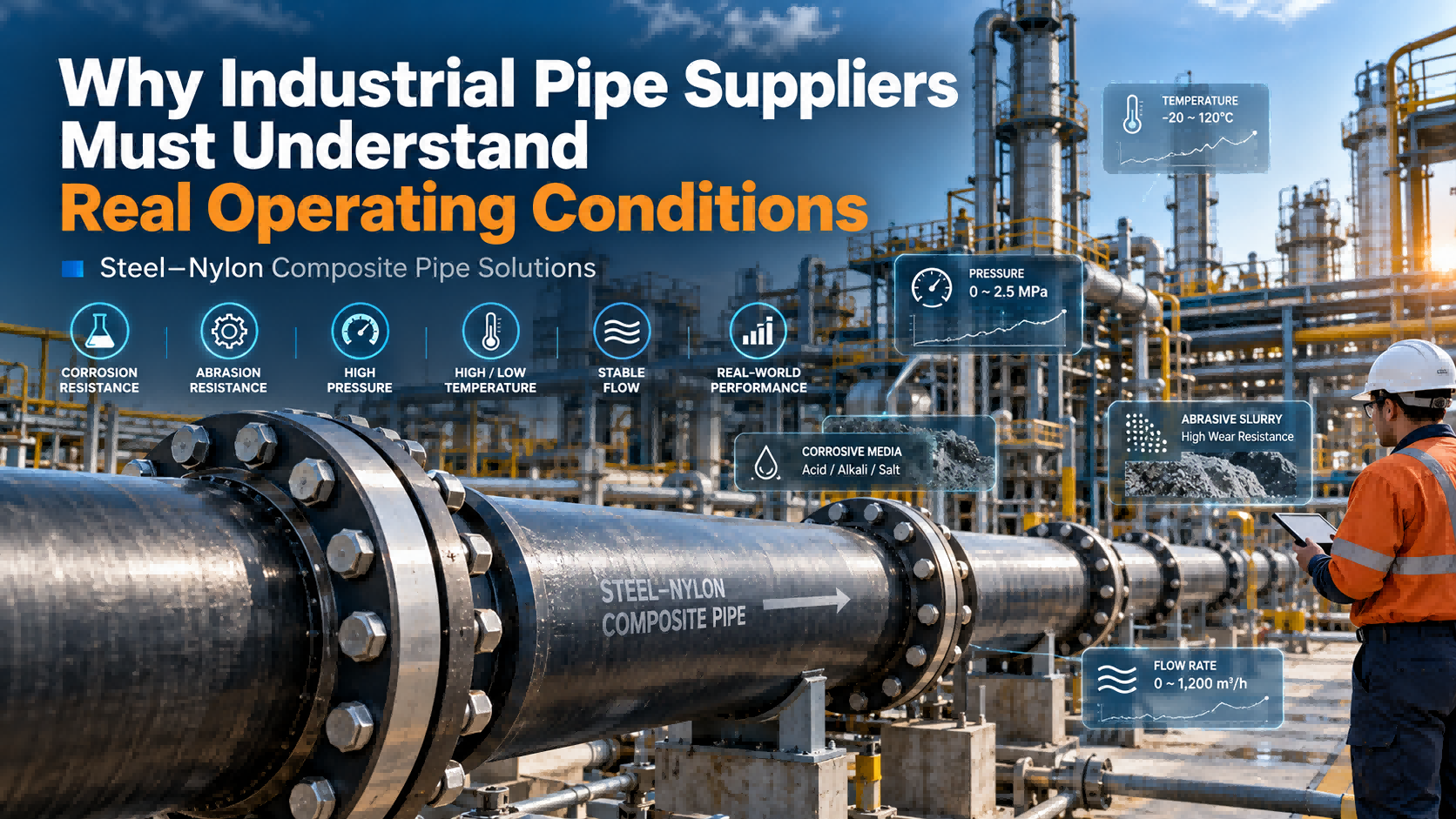
Why Industrial Pipe Suppliers Must Understand the Customer’s Real Operating Conditions
In industrial piping projects, customers often ask suppliers what appears to be a simple question:
“What type of pipe should we use for this medium?”
However, in a truly complex industrial conveying system, simply knowing the name of the medium is far from sufficient for reliable pipe material selection.
Two pipelines may both transport brine, yet their salt concentration, temperature, pressure, flow velocity, and solids content can be completely different. Likewise, two slurry pipelines may experience entirely different wear mechanisms because of differences in particle size, hardness, solids concentration, and flow velocity.
This means:
The key to industrial pipe selection is not simply choosing a material. It is matching the material and pipe structure to the actual operating conditions.
For industrial pipe suppliers, failing to understand the customer’s real operating conditions can lead to poor service life even when the pipe material itself has good performance.
A supplier with real engineering capability should therefore begin with the customer’s operating environment, analyze corrosion, abrasion, pressure, temperature, installation, and maintenance conditions, and only then determine the appropriate pipe material and structural design.
This is why, when evaluating a steel–nylon composite pipe project, the first questions should not simply be:
“What pipe diameter do you need?”
or
“How many meters do you need?”
The more important questions are:
What exactly is flowing through the pipeline? How does the system operate? And where is the pipeline most likely to fail?
1. Why Industrial Pipes Cannot Be Selected Based Only on the Name of the Medium
One of the most common mistakes in industrial pipe selection is directly linking a medium to a particular material.
For example:
-
Brine → corrosion-resistant pipe
-
Slurry → abrasion-resistant pipe
-
Acid → non-metallic pipe
-
High-pressure fluid → steel pipe
These assumptions may provide an initial direction, but they are far from sufficient for engineering design.
Actual industrial operating conditions are usually affected by several factors simultaneously.
A single pipeline may face:
Corrosion + abrasion + pressure + temperature + impact + frequent start-stop cycles
If only one of these challenges is addressed, premature pipeline failure may still occur.
For example, conventional steel pipe can provide good mechanical strength, but it may suffer from internal corrosion when transporting highly saline fluids, acids, alkalis, or media containing corrosive gases.
Some non-metallic materials provide excellent corrosion resistance, but their structural reliability must be carefully evaluated when large diameters, higher pressures, elevated temperatures, or complex mechanical loads are involved.
Slurry pipelines are even more complicated.
Solid particles not only cause abrasion but can also change local flow patterns, creating severe erosion at:
-
Elbows
-
Tees
-
Reducers
-
Pump outlets
-
Direction changes
Therefore, the first responsibility of an industrial pipe supplier is not simply to determine:
“Which material should we sell?”
Instead, the supplier should identify:
What is actually causing the customer’s pipeline to fail?
2. What Operating Conditions Should a Pipe Supplier Understand?
For an industrial piping project, operating conditions should be evaluated from several key perspectives.
2.1 What Is the Transported Medium?
The first step is to understand the actual composition of the medium rather than relying on a general name.
For example, the term “industrial wastewater” alone provides very little useful information for pipe material selection.
More detailed information may include:
-
pH
-
Salt concentration
-
Chloride ion concentration
-
Acid or alkali concentration
-
Oil content
-
Presence of H₂S
-
Presence of CO₂
-
Suspended solids
-
Crystalline particles
-
High-hardness particles
These characteristics may cause different forms of deterioration, including:
-
Chemical corrosion
-
Electrochemical corrosion
-
Pitting corrosion
-
Crevice corrosion
-
Erosion
-
Abrasive wear
-
Scaling
Different failure mechanisms require different material and structural solutions.
3. Operating Temperature Must Be Clearly Defined
Temperature is often underestimated during preliminary pipe selection.
Many materials perform well at ambient temperature, but their mechanical properties and chemical resistance can change significantly as temperature increases.
For an industrial project, suppliers should understand:
-
Normal operating temperature
-
Maximum operating temperature
-
Minimum ambient temperature
-
Start-up and shutdown temperatures
-
Whether rapid temperature fluctuations occur
In oil and gas fields, chemical plants, mining operations, and power stations, temperature changes may also create thermal expansion and contraction.
Therefore, material selection should not be based only on performance at one laboratory temperature.
The complete operating temperature range must be considered.
4. Pressure Determines More Than Just Pipe Wall Thickness
Pressure is another critical parameter in industrial piping design.
Customers may provide:
Operating pressure or design pressure.
However, engineering analysis should also consider:
-
Normal operating pressure
-
Maximum operating pressure
-
Water hammer
-
Pump start-up pressure
-
Transient pressure fluctuations
-
Pressure cycling frequency
For example, a pipeline may normally operate at only 1.6 MPa, while pump start-up or rapid valve closure can generate significantly higher transient pressures.
If pipe selection is based only on normal operating pressure, the actual mechanical load may be underestimated.
One of the fundamental design concepts behind a steel–nylon composite pipe is to combine the structural strength of steel with the corrosion- and wear-resistant characteristics of nylon.
The steel structure provides mechanical support and pressure-bearing capability, while the nylon layer protects the medium-contact surface against corrosion and abrasion.
This combination can provide an effective engineering solution for industrial systems where pressure, corrosion, and wear occur simultaneously.
5. Flow Velocity Can Strongly Influence Pipeline Service Life
Many customers provide information such as:
-
Pipe diameter
-
Pressure
-
Medium
But sometimes do not provide the actual flow velocity.
For slurry, brine slurry, mud, and fluids containing solid particles, flow velocity can be one of the most important factors affecting pipeline wear.
As velocity increases, the impact energy of particles against the pipe wall can increase significantly.
This is especially important at:
-
Elbows
-
Tees
-
Reducers
-
Valve areas
-
Pump outlets
-
Pipeline direction changes
Wear in these areas can be much more severe than in straight pipe sections.
Therefore, a professional supplier should not only ask:
“What is the nominal pipe diameter?”
The supplier should also ask:
“What is the actual flow rate?”
Flow velocity can then be calculated using:
v = Q / A
Where:
-
v = Flow velocity
-
Q = Volumetric flow rate
-
A = Internal cross-sectional area of the pipe
Only with this information can engineers better understand what is actually happening inside the pipeline.
6. Slurry Pipelines Require Detailed Particle Information
When the transported medium contains solids, simply knowing that particles are present is not enough.
Several additional parameters should be investigated.
Solids Concentration
For example:
10%
30%
50%
60%
Different solids concentrations can result in very different flow characteristics.
Particle Size
Relevant parameters may include:
-
D50
-
D80
-
Maximum particle size
Particle size directly influences impact and abrasion mechanisms.
Particle Hardness
Limestone, coal, tailings, iron ore, and quartz particles have very different abrasive characteristics.
When a slurry contains high-hardness mineral particles, conventional piping materials may experience severe abrasive wear.
Particle Shape
Sharp-edged particles and rounded particles can also produce different wear mechanisms.
For this reason, in mining slurry pipeline projects, a responsible supplier should request as much slurry data as possible rather than asking only:
“Is the material tailings or slurry?”
7. A Supplier Must Understand Why the Existing Pipeline Failed
For industrial pipeline rehabilitation or replacement projects, one extremely valuable question is often overlooked:
Why did the existing pipeline fail?
The answer can provide critical engineering information.
For example:
Internal Corrosion
This may indicate that chemical corrosion is the dominant problem.
Pipe Wall Worn Through
This may indicate that abrasive particles are the primary failure mechanism.
Frequent Elbow Perforation
This may indicate severe localized erosion.
Leakage Around Flanges
The problem may be associated with connection design, gasket selection, alignment, or installation.
Liner Separation
Possible causes may include liner bonding, temperature cycling, vacuum conditions, or mechanical stresses.
Pipe Body Cracking
Potential factors may include material brittleness, external mechanical loading, installation stress, or operating conditions.
If a supplier can obtain information about the previous pipeline, including:
-
Existing pipe material
-
Actual service life
-
Failure photographs
-
Failure locations
-
Changes in wall thickness
-
Replacement frequency
it becomes much easier to identify the root cause of failure.
8. Do Not Ask Only About Design Life — Understand the Customer’s Maintenance Strategy
Different industrial customers have very different operating requirements.
Some plants can shut down once a year for scheduled maintenance.
Others operate continuously, and even a short shutdown can result in significant economic losses.
Examples include:
-
Mineral processing plants
-
Continuous chemical production lines
-
Oilfield gathering systems
-
Power plant circulating water systems
-
Large-scale salt chemical facilities
For these projects, the ability to maintain continuous operation may be more important than the initial cost of the pipe.
This is why pipe materials should not be evaluated solely on purchase price.
A more appropriate approach is to consider Total Cost of Ownership (TCO):
TCO = Material Cost + Installation Cost + Maintenance Cost + Replacement Cost + Downtime Loss
A pipe with a lower initial price does not necessarily mean a lower overall project cost.
If the pipeline requires frequent maintenance, repair, replacement, or shutdowns, the cumulative operating cost over several years may far exceed the initial savings.
9. Why Steel–Nylon Composite Pipe Is Well Suited to Complex Industrial Conditions
One of the biggest challenges in industrial piping is that a single material may struggle to deliver all the required properties simultaneously.
Industrial projects may require a combination of:
-
Corrosion resistance
-
Abrasion resistance
-
Pressure resistance
-
Mechanical strength
-
Large-diameter capability
-
Long-distance transportation
-
Long service life
The design philosophy of a steel–nylon composite pipe is to combine the advantages of different materials in one structure.
The basic principle can be summarized as:
Steel provides mechanical strength and pressure-bearing capability, while reinforced nylon provides corrosion and abrasion resistance.
This combination makes it possible to address:
Structural strength + corrosion resistance + abrasion resistance
within one piping system.
Steel–nylon composite pipes can therefore be considered for demanding applications in industries such as:
-
Oil and gas
-
Chemical processing
-
Salt chemical production
-
Soda ash
-
Chlor-alkali
-
Mining
-
Industrial water transportation
Different pipe diameters, pressure ratings, and structural configurations can be evaluated according to the specific service conditions of each project.
10. Steel–Nylon Composite Pipe Is Not a “Universal Solution”
This point is extremely important.
A professional supplier should never tell a customer:
“Our pipe is suitable for every operating condition.”
There is no universal industrial piping material.
Whether a steel–nylon composite pipe is suitable for a particular project still depends on factors such as:
-
Chemical composition of the medium
-
Concentration
-
Temperature
-
Pressure
-
Flow velocity
-
Solids concentration
-
Particle characteristics
-
Pipe diameter
-
Installation environment
-
Required design life
Only after these parameters have been evaluated can a more reliable material and structural recommendation be made.
Professional technical support should not simply tell the customer:
“Our product is the best.”
Instead, it should explain:
Why this pipe structure is suitable for this specific operating condition.
11. Professional Suppliers Should Help Customers Perform an “Operating Condition Diagnosis”
In our view, the preliminary communication for an industrial piping project should function more like an engineering diagnosis.
Customers should ideally provide the following information:
| Parameter | Recommended Information |
|---|---|
| Transported Medium | Chemical composition |
| Concentration | Acid, alkali, salt concentration, etc. |
| Temperature | Normal / Maximum / Minimum |
| Pressure | Operating pressure / Design pressure |
| Flow Rate | m³/h |
| Pipe Diameter | DN |
| Solids Content | % |
| Particle Size | D50 / D80 / Maximum size |
| Pipeline Length | m / km |
| Elevation Difference | m |
| Connection Method | Flange / Other |
| Existing Pipe Material | Current material in service |
| Actual Service Life | Operating time before failure |
| Failure Mode | Corrosion / Wear / Leakage / Cracking |
| Required Design Life | Target service life |
| Installation Environment | Aboveground / Underground / Indoor / Outdoor |
The more complete the operating data, the lower the risk of incorrect material selection.
12. For Complex Projects, a Trial Section Can Be More Valuable Than Theoretical Debate
Some operating conditions are highly specialized, including:
-
High-solids slurry
-
High-salinity produced water
-
Special chemical mother liquor
-
High-temperature corrosive fluids
-
Highly abrasive media
When sufficient long-term application data is unavailable, a practical approach may be to install a:
100–500 meter trial section
The trial section can be monitored for:
-
Pipe wall wear
-
Corrosion
-
Connection reliability
-
Pressure stability
-
Maintenance frequency
Once the actual performance has been verified, the application can be expanded to a larger section or the complete pipeline.
This approach can significantly reduce the technical risk associated with replacing an existing material with a new piping solution.
13. Pipe Suppliers Are Ultimately Selling Reliable Operating Time
Industrial procurement often begins with a simple comparison:
“How much does the pipe cost per meter?”
However, after several years of operation, customers usually become more concerned about questions such as:
-
How long will the pipeline last?
-
How many repairs are required each year?
-
Will it leak?
-
Will pipeline failure interrupt production?
-
How many maintenance personnel are required?
-
How much does each shutdown cost?
-
What is the total cost over ten years?
For this reason, the real value of an industrial pipeline should not be measured only in:
USD/m
Another useful perspective is:
USD / Service Year
In other words:
What is the total cost for each year of reliable pipeline operation?
If a piping system can significantly extend maintenance intervals while reducing leakage, replacement frequency, and unplanned shutdowns, a higher initial purchase cost may still result in a lower total lifecycle cost.
14. From a “Pipe Supplier” to an “Engineering Solution Provider”
The future of the industrial piping market is unlikely to be driven solely by material price competition.
Industrial customers increasingly need suppliers that understand:
How the customer’s process system actually operates.
A capable supplier should be able to investigate questions such as:
Why does corrosion occur at this location?
Why do elbows wear much faster than straight pipe?
Why did one pipe material last only two years?
Why has another pipeline operated for more than ten years?
How can maintenance frequency be reduced?
How can total lifecycle cost be lowered?
When a supplier begins addressing these questions, the relationship with the customer moves beyond a simple:
Buyer–seller relationship
and develops into a partnership focused on:
Solving engineering problems together.
Conclusion: Reliable Industrial Pipe Selection Begins with Understanding the Real Operating Conditions
An industrial pipeline may appear to be a relatively simple system for transporting fluids.
In reality, its performance is affected simultaneously by:
Chemistry, materials, fluid dynamics, mechanical loading, pressure, temperature, and installation conditions.
For this reason, reliable industrial pipe selection should never begin with:
“Which pipe should we recommend?”
It should begin with a more fundamental question:
What are the actual operating conditions of this pipeline?
Only after understanding the medium, pressure, temperature, flow velocity, particles, corrosion mechanisms, wear mechanisms, and maintenance requirements can engineers determine which pipe material and structure are better suited to the application.
For projects where corrosion, abrasion, and pressure-bearing requirements exist simultaneously, steel–nylon composite pipe provides an engineering approach worth evaluating:
The steel structure provides mechanical strength and pressure resistance, while the reinforced nylon layer improves corrosion and abrasion resistance on the medium-contact surface.
However, final material selection should always be based on actual operating conditions, chemical compatibility analysis, and engineering design.
Because in industrial piping:
Understanding the operating conditions is often more important than choosing the material itself.
How We Recommend Pipe Materials Based on Medium, Pressure, Temperature, and Abrasion Conditions
From Inquiry to Delivery: What Stages Does an Industrial Pipeline Project Typically Go Through?