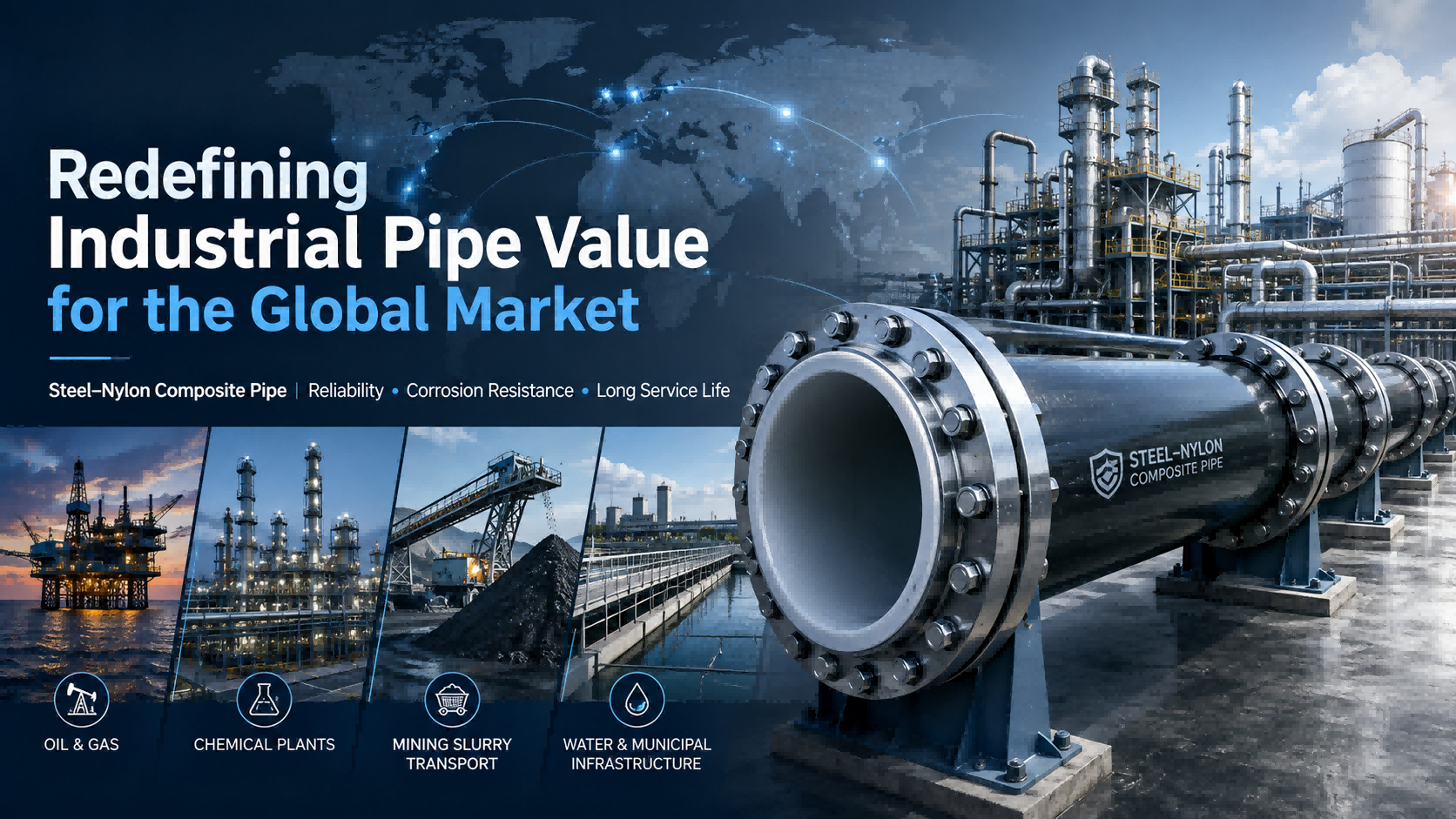
Long-Term Thinking: Why Industrial Pipeline Manufacturing Requires Decades of Engineering Experience

How can a pipeline truly prove that it is reliable?
Is it a set of laboratory test results?
A single pressure test?
A material specification?
Or a polished product datasheet?
All of these matter. But for pipelines actually operating in oilfields, chemical plants, mines, power plants, and corrosive industrial conveying systems, the most meaningful answer is often just one word:
Time.
An industrial pipeline is not a product whose job ends once installation is complete. It is part of an engineering system that may be expected to operate continuously for 10, 20, or even more years.
A pipeline that withstands pressure today may not necessarily remain reliable ten years later.
A pipeline that does not leak today may still face corrosion, abrasion, aging, cracking, or joint failure over the long term.
That is why the real technological barrier in industrial pipeline manufacturing is not simply production equipment, material formulations, or product specifications.
It is the engineering experience accumulated over decades across different media, temperatures, pressures, operating conditions, and project environments.
This is also why we believe that:
Industrial pipeline manufacturing is fundamentally a long-term business.
1. Industrial Pipelines Are Not Ordinary Products — They Are Long-Term Reliability Systems
Many industrial products can be evaluated relatively quickly through short-term testing.
Industrial pipelines are different.
They may be buried underground, installed on pipe racks, integrated into process units, or deployed in remote oilfields and mining areas. Once in operation, the cost of replacement is often far higher than the original purchase cost of the pipe itself.
A single pipeline failure may result in:
-
Media leakage
-
Plant shutdown
-
Production interruption
-
Pipeline cleaning and repair
-
Valve and equipment removal
-
Environmental treatment
-
Additional labor and machinery mobilization
-
Increased safety risks
For industrial users, the real question should therefore not be:
“How much does this pipe cost?”
The better question is:
“How reliably can this pipeline system operate over the next 10 or even 20 years?”
This is one of the biggest differences between industrial piping and ordinary commercial products.
The real value of a pipeline is not demonstrated when it leaves the factory.
It is demonstrated over years of operation.
2. Why Laboratory Data Cannot Fully Replace Long-Term Engineering Experience
Laboratory testing provides essential material information, including:
-
Tensile strength
-
Impact resistance
-
Corrosion resistance
-
Abrasion resistance
-
Thermal performance
-
Pressure capability
-
Chemical compatibility
However, real industrial operating conditions are far more complex than laboratory environments.
A real pipeline system is usually exposed to several factors simultaneously.
For example, an oilfield gathering pipeline may experience:
High water cut + chloride ions + CO₂ + H₂S + sand + temperature fluctuation + pressure fluctuation + changing flow velocity.
A chemical slurry pipeline may simultaneously face:
Corrosion + solid-particle erosion + temperature + vibration + severe localized wear at elbows.
A strong-alkali pipeline may also involve:
Long-term chemical exposure + thermal cycling + flange connections + pipeline supports + outdoor aging.
No single laboratory test can perfectly reproduce all of these combined conditions.
That is why mature industrial pipeline technology usually develops through three stages:
Material Testing → Field Application → Long-Term Operating Feedback
The third stage cannot be accelerated artificially.
It requires time.
3. The Real Challenge Is Knowing Under What Conditions a Pipeline May Fail
A mature pipeline manufacturer should never simply claim:
“Our product can be used everywhere.”
In fact, real engineering experience means understanding the application boundaries of a product.
For example:
At what temperature should additional caution be taken?
At what pressure rating should the design be recalculated?
Which media require additional compatibility verification?
At what slurry concentration should flow velocity become a major design factor?
At what pipe diameter should support spacing be reconsidered?
Which locations are most vulnerable to localized wear?
Which elbows require special reinforcement?
When should an on-site trial section be installed before full-scale replacement?
These questions cannot always be answered by simply reading a material handbook.
They come from project experience.
One of the most valuable assets of a mature industrial pipeline manufacturer is therefore a continuously expanding:
Failure and Operating Condition Database.
Knowing why a product succeeds is important.
But knowing:
Where it may fail, why it may fail, and how failure can be prevented in advance
is often even more valuable.
That is the value of engineering experience.
4. Why Steel-Nylon Composite Pipe Is Also the Result of Long-Term Engineering Optimization
Traditional industrial piping materials all have their own performance limits.
Carbon steel offers good structural strength, but may suffer from long-term corrosion in aggressive environments.
Stainless steel provides strong overall performance, but under certain chloride-rich, highly corrosive, or chemically aggressive conditions, issues such as pitting, crevice corrosion, and high material cost may still need to be considered.
PE and HDPE pipes offer good corrosion resistance, but under higher temperatures, higher pressures, large diameters, or higher structural stiffness requirements, additional engineering evaluation is often necessary.
FRP offers good corrosion resistance, but long-term performance can also depend on impact resistance, interlaminar integrity, and installation quality.
Therefore, our long-term focus has never been to search for a so-called:
“Universal material.”
Instead, the engineering challenge is:
How can the strengths of different materials be combined more effectively?
Steel-nylon composite pipe was developed under this engineering logic.
5. Steel Provides Structural Strength, While Nylon Faces the Medium
The core design philosophy of steel-nylon composite pipe can be summarized in one sentence:
Let each material perform the function it does best.
The steel structure is mainly responsible for:
-
Mechanical strength
-
Internal pressure resistance
-
External load resistance
-
Structural stability
-
Large-diameter pipeline rigidity
The nylon working layer is mainly responsible for:
-
Direct contact with the transported medium
-
Corrosion resistance
-
Abrasion resistance
-
Reduced scaling tendency
-
Lower flow resistance
This creates a typical:
Structure + Protection
design concept.
In other words:
Structural Load-Bearing Layer + Functional Working Layer
Instead of relying on a single material to simultaneously solve strength, corrosion, wear, and service-life problems, a composite material system offers another engineering solution.
6. True Composite Pipe Technology Is More Than Simply Combining Two Materials
When people first learn about composite pipelines, they may assume that:
Adding a non-metallic layer inside a steel pipe automatically creates a reliable composite pipe.
In reality, the engineering challenge is much more complicated.
Long-term composite pipe reliability depends on multiple factors.
6.1 How Can Steel and Nylon Remain Stable Together Over the Long Term?
The two materials have different:
-
Thermal expansion coefficients
-
Elastic moduli
-
Thermal conductivity characteristics
-
Mechanical properties
Therefore, the design must consider:
-
Temperature cycling
-
Pressure fluctuation
-
Thermal expansion and contraction
-
Long-term mechanical loading
Only after prolonged field operation can the stability of a composite structure be properly evaluated.
6.2 How Should the Pipe Ends Be Designed?
In many composite pipeline systems, the most vulnerable location is not necessarily the middle of a straight pipe.
It is often the:
Pipe connection end.
If the end structure is poorly designed, the transported medium may penetrate into the interface between different materials, creating a potential failure path.
For this reason, end-connection design is a critical part of composite pipeline engineering.
Our steel-nylon composite pipes use an integral flange connection structure, helping the nylon working layer maintain more complete isolation from the transported medium around the connection area while reducing the complexity associated with field welding.
7. A Flange May Look Like a Simple Connector, but It Can Determine System Reliability
One of the biggest mistakes in industrial pipeline design is to focus only on the pipe itself while ignoring the complete:
Pipeline system.
In real projects, common high-risk locations include:
-
Flanges
-
Elbows
-
Tees
-
Reducers
-
Areas upstream and downstream of valves
-
Pump outlet sections
-
High-flow-velocity zones
Therefore, pipeline manufacturing cannot solve only the straight-pipe problem.
A mature conveying system must consider:
Pipe + Fittings + Connections + Operating Conditions
Our development direction is therefore not limited to producing steel-nylon composite straight pipes.
We increasingly focus on complete industrial conveying systems, including:
-
Steel-nylon composite straight pipes
-
Elbows
-
Tees
-
Reducers
-
Flanged connection structures
-
Valve connection sections
-
Pump outlet wear sections
-
Customized special fittings
The objective is to move from simply:
Selling pipes
to providing:
Complete industrial pipeline solutions.
8. What Is Actually Accumulated Over Decades of Engineering Experience?
Many people assume that decades of manufacturing experience simply means:
“This product has been manufactured for many years.”
The real value goes much deeper.
What truly matters is the accumulation of several types of engineering knowledge.
8.1 Media Application Database
For example:
-
Oilfield produced fluids
-
High-salinity wastewater
-
Strong alkaline solutions
-
Salt chemical media
-
Chemical mother liquor
-
Mining slurry
-
Flue gas desulfurization slurry
-
Industrial wastewater
-
Seawater
Different media can result in completely different material behavior.
8.2 Temperature Experience
Polymer materials are particularly sensitive to temperature.
Temperature changes can affect:
-
Strength
-
Stiffness
-
Dimensional behavior
-
Long-term service life
-
Chemical interaction rates
Therefore, simply saying that a material is “high-temperature resistant” is not enough.
The more important question is:
How long can the material operate reliably under the combined effects of temperature, pressure, and chemical exposure?
8.3 Pressure and Diameter Experience
A DN100 pipeline and a DN1000 pipeline are not simply scaled versions of the same design.
As pipe diameter increases:
-
Hoop stress behavior changes
-
Wall-thickness design changes
-
Support requirements change
-
Thermal expansion effects become more significant
-
Sensitivity to installation errors can increase
This is why large-diameter industrial pipeline manufacturing depends heavily on engineering experience.
8.4 Experience with High-Wear Locations
In slurry transport systems, wear is rarely uniform.
High-risk areas are usually concentrated at:
Elbows, tees, reducers, and locations where flow direction changes.
A mature pipeline design should identify these high-risk locations before failure occurs.
8.5 Installation Experience
Even an excellent pipeline can fail if it is installed incorrectly.
Potential issues include:
-
Incorrect support spacing
-
Flange misalignment
-
Uneven bolt loading
-
Excessive external stress on the pipe
-
Inadequate thermal expansion compensation
-
Valve weight being directly transferred to the pipeline
All of these can affect long-term service life.
A mature manufacturer must therefore understand installation as well as manufacturing.
9. Why We Place Greater Emphasis on 100–500 Meter Trial Sections
For complex industrial pipeline projects, we believe:
The most valuable technical proof is not a presentation. It is real field operation.
This is especially true when dealing with:
-
New customers
-
New media
-
New operating conditions
-
Large-scale pipeline replacement projects
Replacing several kilometers of pipeline all at once may not always be the most rational approach.
A more disciplined engineering method is usually:
Step 1
Analyze the failure mechanism of the existing pipeline.
Step 2
Confirm the medium, temperature, pressure, flow velocity, and solids content.
Step 3
Select representative high-risk sections.
Step 4
Install a 100–500 meter trial section or selected high-wear fittings.
Step 5
Monitor operating performance.
Step 6
Expand the application after performance has been verified.
This is a classic engineering approach:
Small-Scale Validation → Field Data → Design Optimization → Large-Scale Application
Long-term thinking does not mean being conservative.
It means making innovation more evidence-based and more reliable.
10. Industrial Companies Are Recalculating the Difference Between Low Purchase Price and Long-Term Value
One common problem in industrial pipeline procurement is that decisions are often based only on:
Price per Meter.
However, mature industrial procurement should evaluate:
Total Cost of Ownership — TCO.
A pipeline may have a lower initial purchase price, but if it requires frequent:
-
Replacement
-
Welding repair
-
Maintenance
-
Shutdowns
-
Cleaning
-
Emergency intervention
its total lifecycle cost may ultimately be far higher than a solution with a higher initial investment but longer service life.
The true cost calculation should include:
Pipeline Cost + Installation Cost + Maintenance Cost + Shutdown Cost + Replacement Cost + Lifecycle Risk
In many industrial projects, the pipeline itself is not the most expensive part.
The real cost comes from:
The production system being forced to stop because of pipeline failure.
That is why more industrial users are shifting from:
Lowest Purchase Price
to:
Lowest Lifecycle Cost.
11. Long-Term Thinking Ultimately Means Reducing the Customer’s Future Problems
Excellent industrial manufacturing does not end once the product is delivered.
For industrial pipelines, delivery is only the beginning.
The more important questions are:
What happens after five years?
What happens after ten years?
What happens after repeated pressure cycles?
What happens after long-term corrosion exposure?
What happens after years of particle erosion?
What happens after long-term outdoor service?
A manufacturer’s true engineering capability should ultimately produce one result:
The customer has fewer problems to solve in the future.
Fewer leaks.
Less maintenance.
Fewer shutdowns.
Less pipeline replacement.
Less scaling.
Less field welding.
Fewer maintenance personnel entering high-risk operating areas.
That is the real value of industrial pipeline technology.
12. From Pipe Manufacturer to Industrial Conveying Solution Provider
The future of the industrial pipeline industry will not simply be about:
Who can manufacture a pipe.
The real competition will increasingly become:
Who understands industrial conveying systems better.
Customers are often not actually looking for a particular material.
They are looking for answers:
-
How should this corroded pipeline be upgraded?
-
Why does this elbow wear through every six months?
-
How can this slurry pipeline last longer?
-
Why does this oilfield pipeline leak repeatedly?
-
How can this pipeline network require less maintenance?
-
How should stainless steel, FRP, PE, and composite pipe be compared?
Our development direction is therefore not limited to producing:
Steel-Nylon Composite Pipe.
The more important goal is to provide:
Industrial Pipeline Solutions.
From media analysis and material selection to structural design, fitting optimization, installation methods, and long-term operational feedback, the objective is to build a complete engineering cycle.
13. Decades of Engineering Experience Cannot Be Quickly Replicated
Machines can be purchased.
Production lines can be purchased.
Testing equipment can be purchased.
Raw materials can be purchased.
Even certain product structures can be imitated.
But one thing is difficult to purchase:
Time.
After participating in industrial projects across different periods and conditions, a manufacturer gradually develops knowledge that cannot always be fully written into a product datasheet.
Where should the structure be reinforced?
Which operating conditions require extra caution?
Which designs look acceptable initially but may cause long-term problems?
Which customer problems should be prevented before they occur?
Which material combinations provide better long-term stability?
Which installation details may affect service life years later?
Over time, this knowledge becomes embedded in:
-
Material selection
-
Product structure
-
Manufacturing processes
-
Tooling design
-
Flange design
-
Fitting design
-
Quality control
-
Project engineering
True industrial manufacturing experience is often invisible.
But customers eventually experience its value through one thing:
How long the pipeline keeps operating reliably.
Conclusion: A Truly Good Industrial Pipeline Must Stand the Test of Time
Industrial pipeline manufacturing is not an industry built around short-term results.
The real value of a pipeline system can only be fully demonstrated after:
One year, five years, ten years, or even longer.
That is why we believe:
The core competitiveness of industrial pipeline manufacturing is not only manufacturing capability, but long-term engineering experience.
Steel-nylon composite pipe is not simply a combination of two materials.
What matters behind the product is the accumulation of long-term field applications, continuous problem identification, continuous structural optimization, and the gradual development of more reliable industrial conveying solutions.
For oil & gas, chemical processing, mining, power generation, and other highly corrosive or abrasive industrial environments, the best pipeline is not necessarily the one with the lowest purchase price.
It is the one that delivers:
Less corrosion, less wear, fewer leaks, less maintenance, and fewer shutdowns throughout its lifecycle.
Because in industrial pipeline engineering, the real competition has never been about:
How well the pipeline performs on Day One.
It is about:
How well it is still performing ten years later.
Our Mission: Helping Industrial Pipelines Achieve Lower Maintenance Costs and Longer Service Life
From a Single Pipe Material to an Industrial Conveying Solution: Our Product Evolution Journey