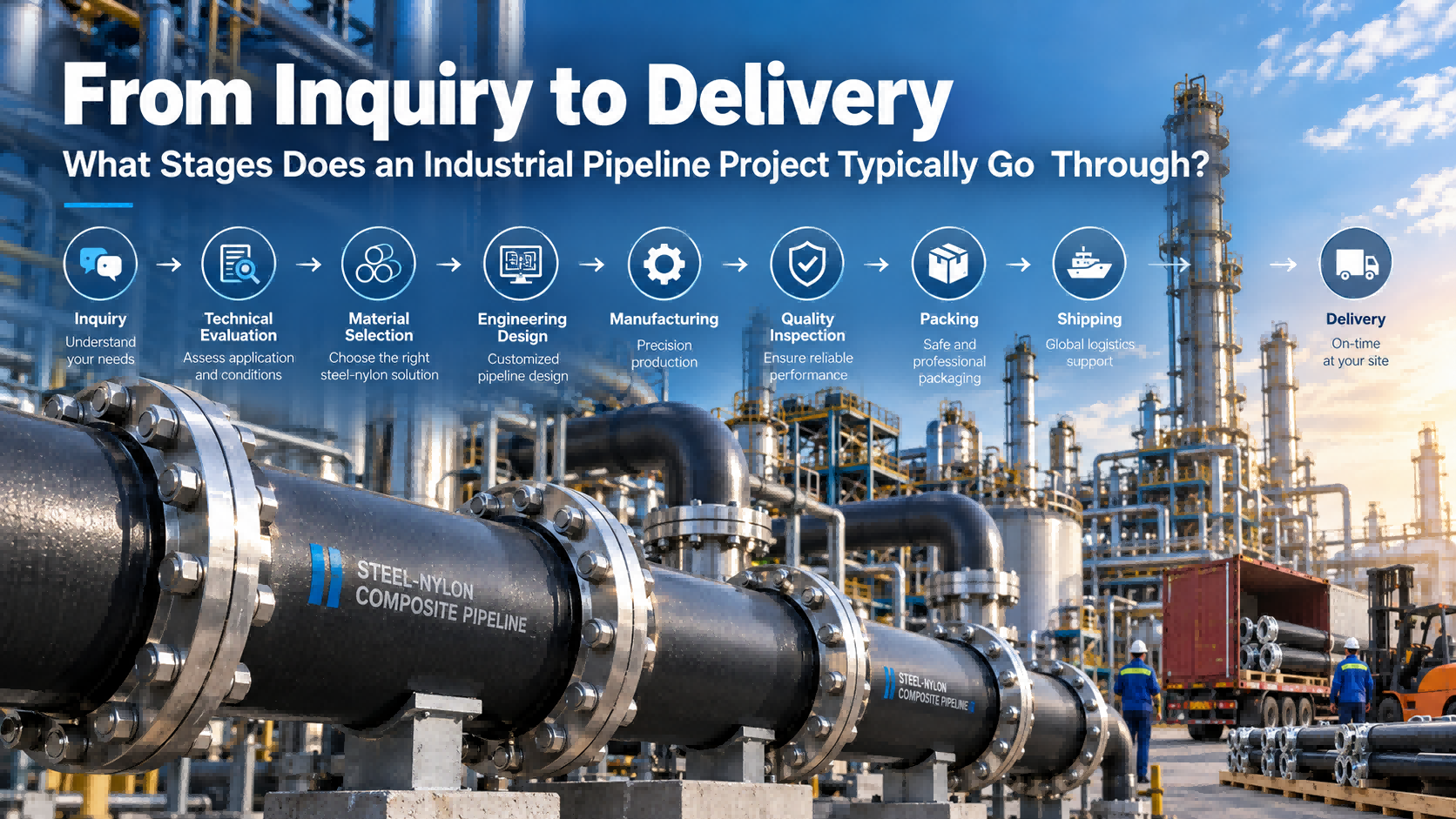
From Inquiry to Delivery: What Stages Does an Industrial Pipeline Project Typically Go Through?
For ordinary products, the process from inquiry to shipment may involve little more than confirming specifications, quantity, and price.
Industrial piping projects are fundamentally different.
A pipeline used in an oilfield, chemical plant, mine, power station, or industrial water system may be required to withstand pressure, corrosion, abrasion, temperature fluctuations, and complex process media for many years. What appears to be a simple “pipe purchase” may actually involve media analysis, material selection, pressure design, connection design, structural engineering, manufacturing, quality inspection, packaging, transportation, field installation, and long-term operation and maintenance.
For industrial customers, the most important question is therefore not:
“How much does one meter of pipe cost?”
The more meaningful question is:
“Can this piping system operate reliably under my actual service conditions and be successfully designed, manufactured, transported, installed, and commissioned?”
Particularly in highly corrosive, highly abrasive, or relatively high-pressure applications, a supplier’s ability to manage the complete project lifecycle can directly affect system reliability and total lifecycle cost.
Using steel–nylon composite pipe projects as an example, this article explains the key stages an industrial pipeline project typically goes through—from the initial inquiry to final delivery and commissioning.
1. The Inquiry Stage Is Not Simply the Beginning of Quotation—It Is the Beginning of Technical Evaluation
When industrial customers first contact us, the information they provide may look something like this:
-
DN300 pipeline
-
2.0 MPa
-
2,000 meters
-
Chemical plant
This information is useful for a preliminary assessment, but it is normally far from sufficient for proper industrial pipeline selection.
Even when pipe diameter, pressure, and total length are identical, differences in transported media, temperature, solids content, or operating conditions can lead to completely different pipe structure recommendations.
Therefore, the first step in a professional industrial piping project should not be issuing a price immediately.
It should be collecting and analyzing the operating conditions.
The following parameters are particularly important.
1.1 Transported Medium
Typical examples include:
-
Brine
-
Process mother liquor
-
NaOH solution
-
Acidic media
-
High-salinity produced water
-
Industrial wastewater
-
Tailings slurry
-
Iron ore slurry
-
Limestone slurry
-
Circulating water
The characteristics of the transported medium largely determine the dominant pipe failure mechanisms.
1.2 Medium Concentration and Chemical Composition
For chemical pipelines, simply knowing whether the fluid is “acidic” or “alkaline” is usually not enough.
Additional information may include:
-
NaOH concentration
-
Chloride ion concentration
-
pH value
-
H₂S content
-
CO₂ content
-
Salinity
-
Presence of oxidizing substances
-
Suspended solids content
These parameters can directly affect corrosion mechanisms and material compatibility.
1.3 Design Temperature and Operating Temperature
Industrial pipe performance is often closely related to temperature.
The following conditions should therefore be distinguished:
-
Normal operating temperature
-
Maximum design temperature
-
Minimum ambient temperature
-
Cleaning temperature
-
Short-term abnormal temperature
In chemical, oilfield, and power applications in particular, temperature variation can influence mechanical properties, thermal expansion, dimensional stability, and long-term service performance.
1.4 Working Pressure and Design Pressure
It is important to understand that:
Working Pressure ≠ Design Pressure
Design pressure may need to consider:
-
Normal operating pressure
-
Pump discharge pressure
-
Water hammer
-
Transient pressure fluctuations
-
Engineering safety margins
Selecting pipe solely according to normal working pressure may therefore introduce unnecessary risk.
Steel–nylon composite pipes can be engineered for different pressure classes according to actual project requirements, making them particularly suitable for industrial systems that need to balance pressure-bearing capability with corrosion resistance.
1.5 Flow Velocity and Solid Particles
For slurry, tailings, salt mud, or other solids-containing media, additional parameters become critical:
-
Flow velocity
-
Solids concentration
-
Particle size
-
Particle hardness
-
Slurry density
-
Transportation distance
Many industrial pipes do not fail because of chemical corrosion alone.
Instead, continuous particle impact and abrasion may result in:
-
Progressive wall thinning
-
Elbow wear-through
-
Tee failure
-
Rapid erosion near pump discharge sections
For this reason, corrosion and abrasion should often be evaluated together.
2. The Second Stage: Identify the Real Failure Mechanism
After collecting the operating data, the next step is not simply selecting a material.
The first question should be:
Why did the previous pipeline fail?
Common industrial pipeline failure mechanisms include the following.
Chemical Corrosion
Examples include:
-
Acid corrosion
-
Alkali corrosion
-
Chloride-induced corrosion
-
High-salinity corrosion
-
H₂S / CO₂ corrosion
Abrasive Wear
Common applications include:
-
Mineral slurry
-
Tailings
-
Salt mud
-
Limestone slurry
-
Ash slurry
-
Solid-liquid mixtures
Erosion-Corrosion
This is an even more complex mechanism.
High-velocity fluids or suspended particles continuously damage the protective surface layer, while the corrosive medium simultaneously attacks the newly exposed material.
As a result, material loss may accelerate significantly.
Localized Corrosion
Examples include:
-
Pitting corrosion
-
Crevice corrosion
-
Weld-area corrosion
-
Corrosion around flange connections
Structural Failure
This may include:
-
Pressure-induced deformation
-
Water-hammer damage
-
Improper support design
-
Insufficient thermal expansion compensation
-
Foundation settlement
-
Pipeline vibration
A mature material-selection process should therefore work backward from the actual failure mechanism to determine the appropriate material and structural solution.
It should not simply compare the purchase price of different pipe materials.
3. The Third Stage: Preliminary Pipe Material Selection
Once the operating conditions and failure mechanisms have been analyzed, the project can move into the material-selection stage.
Common industrial piping materials include:
-
Carbon Steel
-
Stainless Steel
-
Duplex Stainless Steel
-
HDPE
-
FRP
-
Rubber-Lined Steel
-
Plastic-Lined Steel
-
Steel–Nylon Composite Pipe
Each material has its own applicable operating range.
No single material is suitable for every application.
A practical material-selection process should seek an appropriate balance among:
Corrosion Resistance + Wear Resistance + Pressure Capacity + Mechanical Strength + Installation Requirements + Lifecycle Cost
4. Why Steel–Nylon Composite Pipe Is Well Suited to Complex Industrial Applications
The design logic of steel–nylon composite pipe is not simply to replace steel pipe, nor is it intended to function merely as an alternative to plastic pipe.
The fundamental concept is:
Allow each material to perform the function it does best.
The external steel structure primarily provides:
Mechanical Strength + Pressure-Bearing Capability
The internal reinforced nylon functional layer primarily provides:
Corrosion Resistance + Wear Resistance
This creates a typical composite engineering concept:
Steel for Strength
Nylon for Corrosion and Wear Resistance
For industrial environments where the pipeline must simultaneously withstand:
Corrosion + Abrasion + Pressure
a composite structure can provide an alternative material solution.
Typical applications may include:
-
Oil and gas gathering systems
-
High-salinity produced water
-
Chemical mother liquor
-
Brine
-
Salt mud
-
Caustic soda systems
-
Soda ash production
-
Mineral slurry transportation
-
Tailings transportation
-
Industrial water systems in power plants
-
Circulating water systems
-
Selected slurry transportation systems
5. The Fourth Stage: Determine Diameter, Pressure Rating, and Pipe Structure
After preliminary material selection, the project requires further engineering definition.
Typical parameters include:
-
Nominal Diameter (DN)
-
Pressure Rating
-
Wall Thickness
-
Nylon Layer Thickness
-
Steel Structure
-
Flange Standard
-
Pipe Length
-
Fittings
-
Pipe Supports
-
Thermal Expansion Requirements
For example, two DN600 steel–nylon composite pipelines may require very different designs if one transports circulating water and the other carries high-solids slurry.
The circulating water pipeline may focus more heavily on:
-
Corrosion resistance
-
Hydraulic efficiency
-
Long-term stability
The slurry pipeline, by contrast, may place greater emphasis on:
-
Abrasion resistance
-
Flow velocity
-
Elbow service life
-
Localized erosion
Industrial pipeline selection should therefore not be simplified to only:
DN + Pressure Rating
6. The Fifth Stage: Connection Design
Many industrial piping failures do not occur in the pipe body itself.
They occur at the connections.
Connection design is therefore an important part of the overall piping system.
Common connection methods include:
-
Flange Connection
-
Welding
-
Mechanical Connection
-
Other Project-Specific Connections
For steel–nylon composite pipes, flange connections can provide important engineering advantages.
Easier Field Installation
Flange connections can reduce the amount of complicated field welding required.
Easier Maintenance and Replacement
Individual pipe sections can be removed when maintenance is required.
Well Suited to Retrofit Projects
For operating facilities such as:
-
Chemical plants
-
Oil and gas stations
-
Power plants
-
Mining operations
reducing hot work can be particularly valuable.
In flammable, explosive, or continuously operating industrial environments, minimizing field hot-work requirements can significantly simplify construction planning and reduce operational disruption.
7. The Sixth Stage: Develop a Technical Solution, Not Just a Price Quotation
A complete industrial pipe quotation should ideally contain more than price information.
A mature technical and commercial proposal may include:
Project Data
Basic project information.
Operating Conditions
Detailed operating parameters.
Recommended Pipe Structure
Recommended pipe configuration and design.
Material Selection
Material specification and explanation.
Pressure Rating
Required pressure class.
Dimensions
Dimensional information.
Connection Method
Recommended joining method.
Fittings
Elbows, tees, reducers, and other fittings.
Inspection Requirements
Required inspection and testing.
Delivery
Expected delivery schedule.
Packing
Packing and protection requirements.
Technical Support
Scope of engineering and technical support.
In this way, the customer is not simply purchasing a batch of pipes.
The customer is receiving a more complete:
Pipeline Solution
8. The Seventh Stage: Compare Total Cost of Ownership, Not Just Purchase Price
More industrial projects are moving beyond Purchase Price and evaluating:
Total Cost of Ownership
or TCO.
For example, a conventional material may have a lower initial purchase cost but require replacement twice within five years.
Its actual cost may include:
**Initial Cost
-
Installation Cost
-
Shutdown Cost
-
Maintenance Cost
-
Replacement Cost
-
Production Loss**
The more meaningful comparison is therefore often not:
Cost per Meter
but:
Cost per Year of Service
or even:
Cost per Ton of Fluid Transported
A Simple TCO Model
A basic calculation can be expressed as:
TCO = Initial Investment + Installation Cost + Maintenance Cost + Replacement Cost + Downtime Loss
Assume:
Solution A has a lower initial investment but requires frequent maintenance.
Solution B has a somewhat higher initial investment but provides a longer operating cycle.
For large industrial systems, Solution B may ultimately generate a lower long-term total cost.
This is one reason why the value of steel–nylon composite pipe in certain highly corrosive and abrasive applications should not be evaluated solely by its price per meter.
9. The Eighth Stage: Use a Trial Section When Necessary
For large industrial or overseas projects, we generally do not recommend replacing an entire piping system with a new material before the customer has obtained sufficient application experience.
A more controlled approach is:
Trial Section
For example, the customer may first install:
100–500 meters of trial pipeline
and evaluate its performance under actual operating conditions.
Key observations may include:
-
Corrosion condition
-
Abrasion condition
-
Pressure stability
-
Connection reliability
-
Installation efficiency
-
Maintenance frequency
If the trial section performs as expected, the project can gradually expand from:
Trial Section → Production Line → Pipeline Section → Entire Pipeline System
This approach can significantly reduce the perceived and technical risk associated with introducing a new pipe material.
For engineering products such as steel–nylon composite pipes, long-term field operating data can often be more valuable than laboratory data alone.
10. The Ninth Stage: Technical Confirmation and Contract Execution
Once the customer accepts the technical solution, the project enters the formal commercial stage.
Typical items include:
-
Final Technical Specification
-
Quantity Confirmation
-
Commercial Terms
-
Delivery Terms
-
Payment Terms
-
Inspection Requirements
-
Packing Requirements
-
Shipping Requirements
-
Project Schedule
This stage is extremely important.
Many disputes in large industrial projects are caused not by product quality itself, but by unclear technical boundaries established during the early stages of the project.
A formal technical confirmation document should therefore clearly define the project requirements before production begins.
11. The Tenth Stage: Production Preparation
After the order has been formally placed, production does not necessarily begin immediately.
Technical and production preparations are normally required first.
These may include:
-
Raw material preparation
-
Drawing confirmation
-
Mold preparation
-
Process parameter confirmation
-
Production scheduling
-
Quality control planning
-
Inspection planning
For customized steel–nylon composite pipe projects, the final structure may be determined according to:
-
Pipe diameter
-
Pressure
-
Pipe length
-
Flange requirements
-
Transported medium
-
Operating temperature
12. The Eleventh Stage: Raw Material Quality Control
The final quality of an industrial piping product is often determined before manufacturing even begins.
Raw-material quality control is therefore essential.
For example:
Steel Structure Materials
Important parameters may include:
-
Material Grade
-
Thickness
-
Dimensions
-
Mechanical Properties
Nylon Materials
Important parameters may include:
-
Material Formulation
-
Modification Technology
-
Batch Stability
-
Mechanical Properties
-
Wear Resistance
-
Chemical Resistance
The real technical challenge in steel–nylon composite pipe manufacturing is not simply:
“Putting steel and nylon together.”
The challenge is ensuring long-term:
Structural Stability, Dimensional Consistency, and Composite Structure Reliability.
13. The Twelfth Stage: Manufacturing
Once formal manufacturing begins, quality control should continue throughout the production process.
Typical stages may include:
-
Steel structure fabrication
-
Surface preparation
-
Forming preparation
-
Nylon material forming
-
Composite structure formation
-
Flange manufacturing
-
Dimensional control
-
Visual inspection
-
Final product testing
For large industrial piping projects:
Consistency across the entire production batch is often more important than the performance of a single pipe.
A large project may include:
-
Hundreds of pipe sections
-
Thousands of pipe sections
-
Numerous elbows
-
Tees
-
Reducers
-
Flanges
If dimensional or manufacturing consistency is poor, field installation problems may include:
-
Flange misalignment
-
Dimensional deviation
-
Installation difficulty
-
Sealing problems
One of the core capabilities required for large industrial pipe manufacturing is therefore:
Batch Consistency
14. The Thirteenth Stage: Quality Inspection
After manufacturing is completed, finished pipes should be inspected according to the project requirements.
Typical inspection activities may include:
Visual Inspection
Inspecting:
-
Surface condition
-
Defects
-
Flanges
-
Pipe ends
-
Overall forming quality
Dimensional Inspection
Including:
-
Outside diameter
-
Pipe length
-
Wall thickness
-
Flange dimensions
-
Bolt-hole spacing
Pressure Testing
Appropriate pressure verification may be carried out according to the technical specification.
Structural Inspection
The steel structure and nylon functional layer are checked to confirm compliance with design requirements.
For large projects, the customer may also request an:
ITP — Inspection and Test Plan
This allows customers, EPC contractors, or third-party inspection organizations to participate in important quality-control checkpoints.
15. The Fourteenth Stage: Packing and Transportation
For large industrial pipeline projects, logistics is also part of engineering.
This is particularly important for large-diameter pipes such as:
-
DN800
-
DN1000
-
DN1200
-
DN1600
-
DN2000
For pipes of this size, transportation planning can have a significant impact on total project cost.
The logistics plan may need to consider:
-
Container Loading
-
Flat Rack
-
Break Bulk Shipment
-
Inland Transportation
-
Lifting
-
Port Handling
Packaging must also reduce the risk of:
-
Flange damage
-
Pipe-end deformation
-
Internal layer damage
-
Surface damage
For this reason, large-diameter industrial pipeline projects should consider logistics during the engineering stage—not only after manufacturing has been completed.
16. The Fifteenth Stage: Field Installation
Once the pipes arrive at the project site, the system enters one of its final critical phases.
Important installation considerations may include:
-
Pipe lifting
-
Pipe supports
-
Flange connections
-
Gaskets
-
Bolts
-
Alignment
-
Thermal expansion
-
Pipeline stress
-
Pressure testing
Installation guidance is particularly important for composite piping systems.
Even a well-manufactured pipe can experience problems if installed incorrectly.
Examples include:
-
Forced alignment
-
Flange eccentricity
-
Uneven bolt loading
-
Incorrect support spacing
-
Improper lifting methods
A reliable industrial pipeline supplier should therefore not simply:
Ship the Pipes
but should also help the customer:
Install the Pipeline Correctly
17. The Sixteenth Stage: Pressure Testing and Commissioning
After installation is complete, the system generally requires:
-
Overall system inspection
-
Pressure testing
-
Leakage inspection
-
Valve inspection
-
Support inspection
-
Initial operating observation
Only after these stages are successfully completed should the pipeline move into formal operation.
For projects using a new material, customers may also establish follow-up inspections at intervals such as:
3 Months
6 Months
12 Months
Long-term operating feedback can then be used to continuously verify the original material-selection decision.
18. What Does a Mature Industrial Pipeline Supplier Actually Deliver?
At first glance, a pipe supplier appears to deliver:
Pipes + Fittings
But for complex industrial projects, the real deliverables should include:
**Material Selection
-
Engineering Support
-
Manufacturing
-
Quality Control
-
Logistics
-
Installation Support
-
Lifecycle Value**
This is one of the biggest differences between simply selling pipe products and providing an industrial pipeline solution.
19. The Value of Steel–Nylon Composite Pipe Within a Complete Project System
The advantages of steel–nylon composite pipe do not come from a single material property.
Its value comes from the combination of multiple engineering characteristics.
For industrial systems that need to simultaneously consider:
-
Corrosion
-
Abrasion
-
Pressure
-
Mechanical strength
-
Large diameters
-
Installation requirements
-
Service life
the combination of steel and reinforced nylon can provide an alternative engineering solution.
Steel–nylon composite pipes can be designed for different diameters and pressure ratings according to project requirements and can be considered for applications in chemical processing, oil and gas, mining, power generation, and industrial water transportation.
For complex projects, we recommend beginning with the real operating conditions and following a complete engineering process:
Operating Conditions → Failure Analysis → Material Selection → Structural Design → Manufacturing → Testing → Installation → Operation
This creates a complete technical closed loop from initial evaluation to long-term service.
20. Conclusion: The Core of an Industrial Pipeline Project Is Not Simply “Buying Pipe”—It Is Managing Long-Term Risk
An industrial pipeline project from initial inquiry to final commissioning is a complete engineering chain.
A typical project may go through:
Inquiry
↓
Operating Condition Analysis
↓
Failure Analysis
↓
Material Selection
↓
Engineering Design
↓
Quotation & TCO Evaluation
↓
Trial Section
↓
Technical Confirmation
↓
Production
↓
Quality Inspection
↓
Packing & Logistics
↓
Installation
↓
Commissioning
↓
Long-Term Operation
A problem at any stage can affect the final operating performance of the system.
Therefore, when selecting an industrial pipeline supplier, customers should consider more than product price.
They should also evaluate:
Does the supplier truly understand the transported medium and operating conditions?
Can the supplier provide material-selection support?
Does the supplier have stable batch manufacturing capability?
Can the supplier handle large-diameter, high-pressure, or complex-service projects?
Can the supplier provide comprehensive support from early-stage engineering through final delivery?
For steel–nylon composite pipeline projects, our focus is not simply to sell a batch of pipes.
Our objective is to help customers identify a more appropriate balance among corrosion resistance, abrasion resistance, pressure capacity, structural reliability, installation requirements, and lifecycle cost based on the actual service conditions.
Because in a real industrial project:
A successful pipeline project does not begin with manufacturing. It begins with understanding the operating conditions.
And the true value of a high-quality industrial pipeline is not proven on the day it leaves the factory.
It is proven after years of stable and reliable operation.
Why Industrial Pipe Suppliers Must Understand the Customer’s Real Operating Conditions
How to Provide Early-Stage Technical Pipe Selection Support for Overseas Industrial Projects