5 Most Overlooked Issues When Purchasing Industrial Pipelines: Why Low Purchase Prices May Lead to Higher Engineering Costs
In industrial projects, pipeline systems represent a significant part of the overall investment. However, many companies still focus primarily on purchase price, delivery time, and basic specifications when selecting industrial pipelines, while overlooking several critical factors that determine long-term operating performance.
In reality, the final cost of an industrial pipeline system is not determined by the initial purchase price, but by its entire lifecycle performance, including:
-
Reliability
-
Maintenance frequency
-
Downtime risks
-
Service life
-
Total operating costs
Especially in demanding industries such as chemical processing, mining, oil & gas, power generation, and salt chemical production, traditional materials including carbon steel pipes, stainless steel pipes, rubber-lined pipes, and FRP pipes may experience problems such as corrosion, abrasion, leakage, and frequent maintenance.
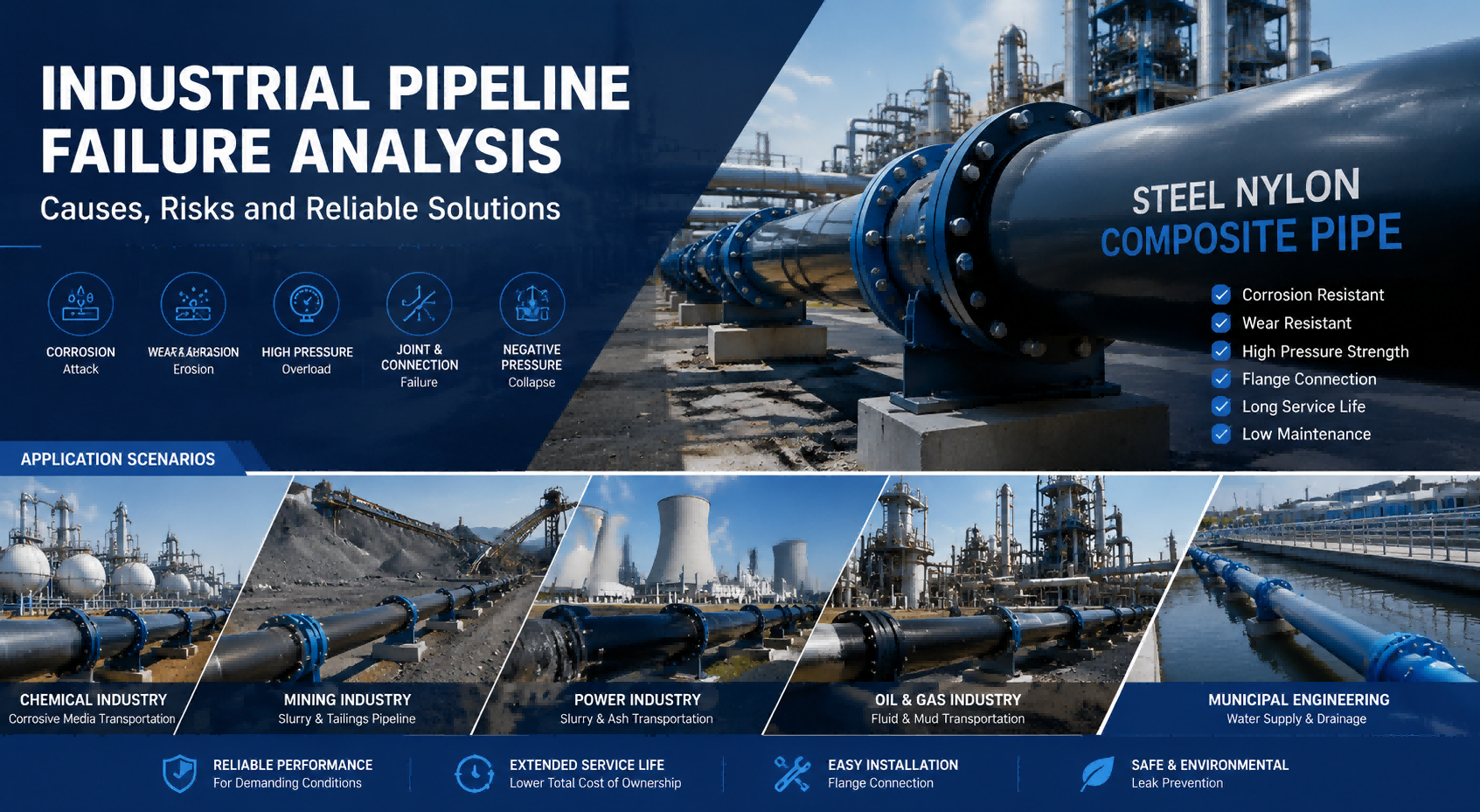
As a professional manufacturer of Steel Nylon Composite Pipes, we summarize the five most commonly overlooked issues in industrial pipeline purchasing and explain why more engineering projects are choosing advanced composite pipeline solutions.
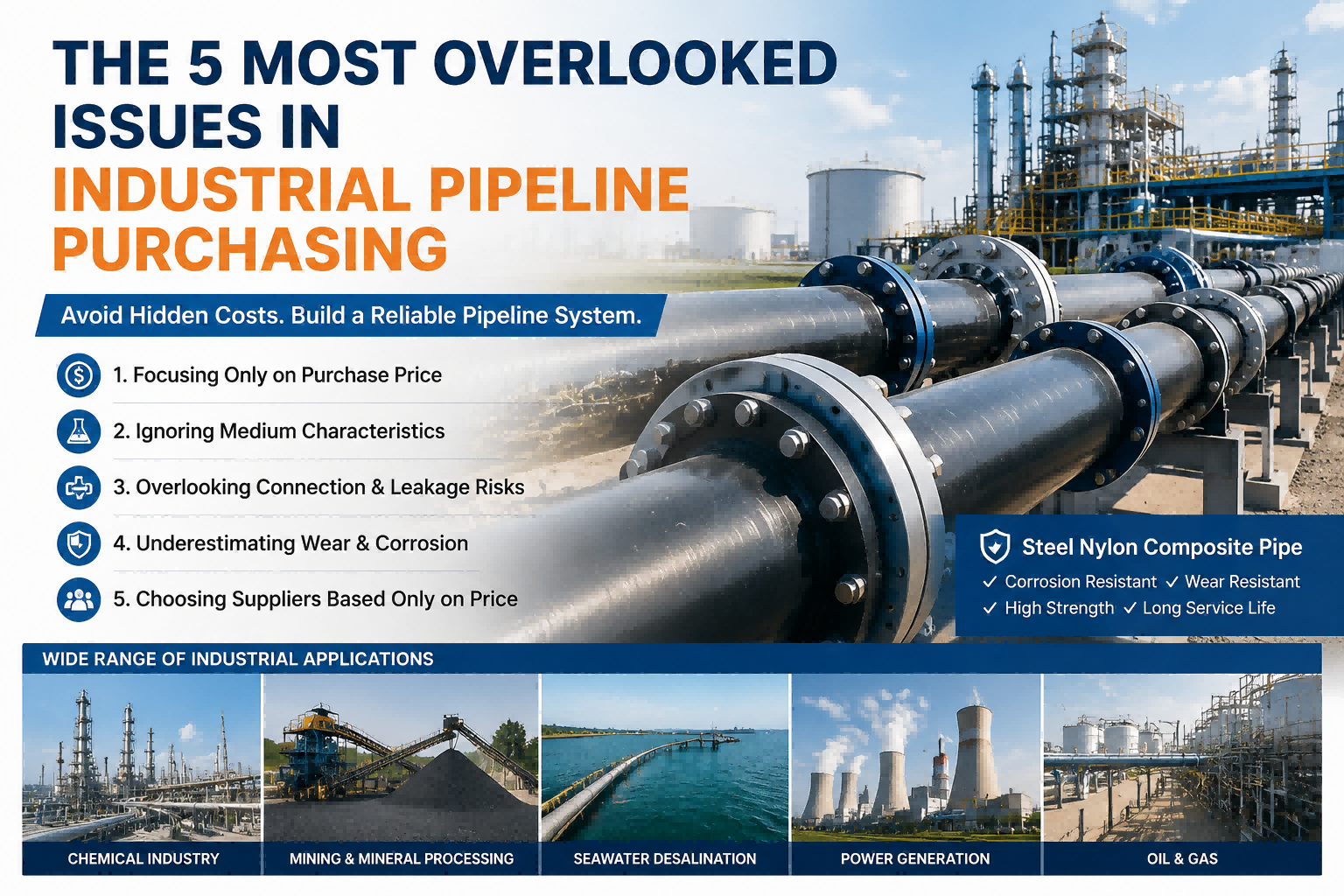
1. Focusing Only on Purchase Price While Ignoring Total Lifecycle Cost (TCO)
One of the most common mistakes in pipeline procurement is:
"Choose the pipe with the lowest unit price."
However, industrial pipelines are not disposable products. They are long-term operating assets.
For example:
-
Carbon steel pipes have low initial costs but are vulnerable to internal corrosion.
-
Stainless steel pipes offer corrosion resistance but come with high material costs and may still face limitations in strong alkaline or chloride environments.
-
FRP pipes are lightweight and corrosion-resistant but may suffer from delamination and impact damage.
-
PE/HDPE pipes provide good chemical resistance but have limitations under high temperature, high pressure, and large-diameter applications.
The real cost should include:
Pipeline Cost + Installation Cost + Maintenance Cost + Downtime Loss + Replacement Cost
This is known as:
Total Cost of Ownership (TCO).
How Steel Nylon Composite Pipes Reduce TCO
Steel Nylon Composite Pipes combine:
Outer Steel Structure + Inner Reinforced Nylon Protective Layer
This creates a pipeline system that combines:
-
The mechanical strength of steel
-
The corrosion and wear resistance of nylon
Compared with traditional pipeline materials, Steel Nylon Composite Pipes provide:
✅ Protection against corrosive media
✅ Excellent wear resistance
✅ Reduced maintenance frequency
✅ Longer service life
✅ Lower lifecycle operating costs
They are especially suitable for:
-
Highly corrosive environments
-
Slurry transportation
-
Abrasive materials
-
Long-distance industrial pipelines
2. Selecting Pipes Only Based on Pressure and Diameter While Ignoring Medium Characteristics
Another common mistake is:
"If the pressure rating meets requirements, the pipeline is suitable."
However, industrial operating conditions are much more complex than pressure and diameter.
Pipeline performance is affected by:
(1) Chemical Corrosion
Industrial media such as:
-
Chlorides
-
Salt water
-
Mother liquor
-
Acid and alkaline solutions
-
Chemical wastewater
can cause serious corrosion problems in conventional steel pipelines.
(2) Particle Abrasion
Mining slurry, coal slurry, salt slurry, and phosphate slurry contain solid particles that continuously impact the inner pipe wall.
Many pipelines fail not because of corrosion, but because:
The pipe wall is gradually worn through.
(3) Temperature Effects
Some plastic pipes experience:
-
Reduced mechanical strength at high temperatures
-
Long-term deformation
-
Pressure limitations
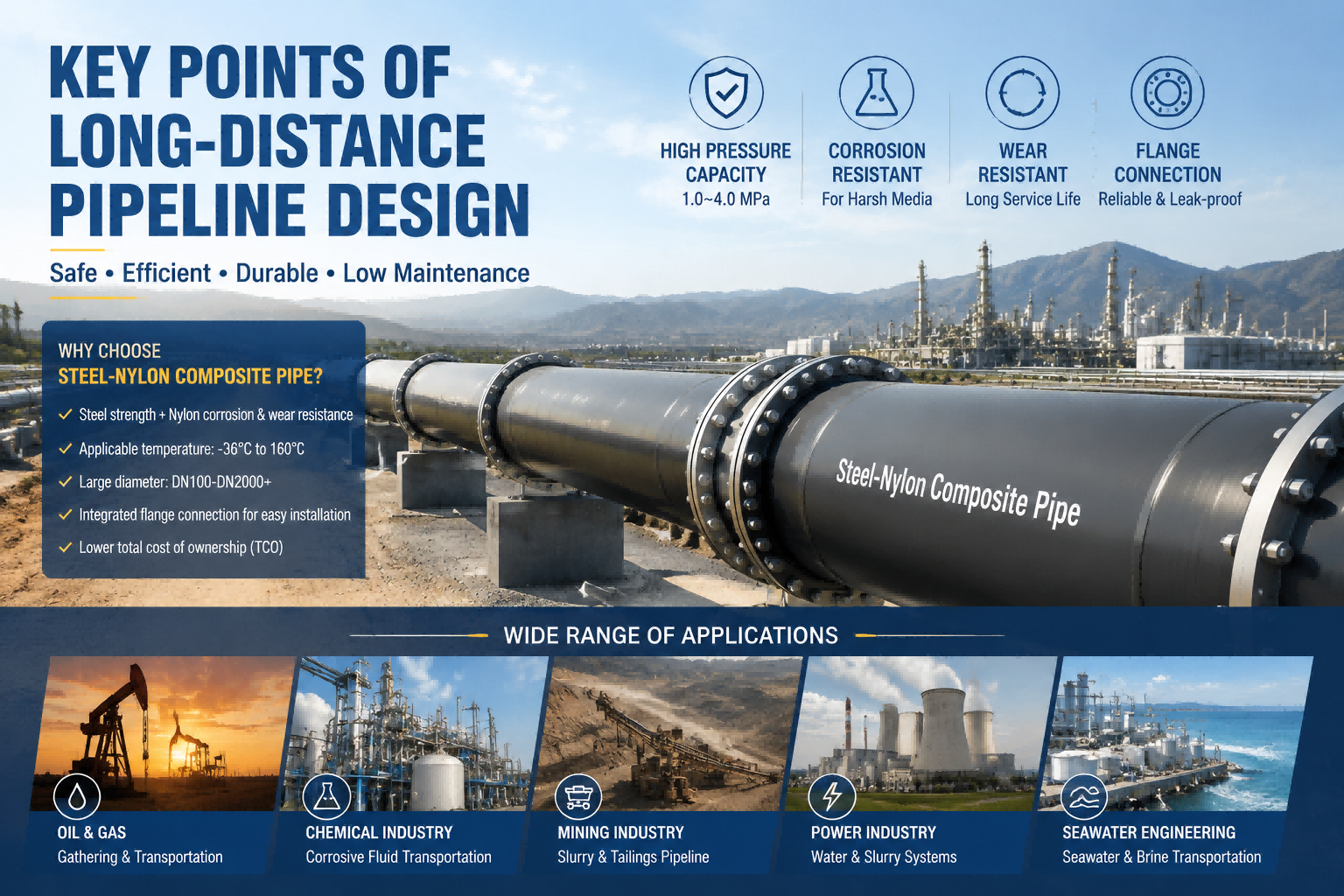
Steel Nylon Composite Pipes can operate reliably under temperatures from:
-36°C to 160°C
making them suitable for more challenging industrial environments.
3. Ignoring Pipeline Connection Design and Underestimating Leakage Risks
In many industrial pipeline failures, the problem does not occur in the pipe body itself.
It happens at:
Connection points.
Traditional pipeline installation often requires:
-
Welding
-
Threaded connections
-
Multiple joints
More connections mean more potential leakage risks.
This is especially important in:
-
Chemical plants
-
Chlor-alkali facilities
-
Oil & gas stations
where leakage can lead to:
-
Safety hazards
-
Production interruptions
-
High maintenance costs
Flange Integration Advantage of Steel Nylon Composite Pipes
Steel Nylon Composite Pipes feature:
Integrated flange forming technology
which reduces the need for extensive on-site welding.
Advantages include:
1. Reduced Welding Requirements
Lower:
-
Hot work risks
-
Installation time
-
Construction complexity
2. Lower Leakage Risk
Standardized flange connections provide:
-
Easier installation
-
Faster replacement
-
Convenient maintenance
3. Faster Installation for Large Industrial Projects
Especially suitable for:
-
Long-distance pipelines
-
Large-diameter systems
-
Pipeline renovation projects
Steel Nylon Composite Pipes can now cover:
DN100-DN2000+ large diameter applications.
4. Ignoring Long-Term Wear Resistance and Causing Frequent Replacement
Many companies only ask:
"Can the pipeline be used?"
But the more important question is:
"How long can it operate reliably?"
In industries such as:
-
Mining filling systems
-
Tailings transportation
-
Salt slurry transportation
solid particles create continuous mechanical wear.
Traditional pipelines may suffer from:
-
Severe elbow erosion
-
Wall thickness reduction
-
Frequent repairs
-
Production downtime
Wear Resistance Advantages of Steel Nylon Composite Pipes
Reinforced nylon provides:
-
High impact strength
-
Excellent abrasion resistance
-
Smooth inner surface
Benefits include:
-
Reduced particle erosion
-
Lower friction resistance
-
Reduced scaling problems
They are widely suitable for:
-
Mining pipelines
-
Soda ash production
-
Phosphate chemical industry
-
Power plant desulfurization systems
5. Choosing Suppliers Based Only on Price Instead of Engineering Capability
Industrial pipelines are not simple standard products.
A reliable supplier should provide more than just pipes.
They should provide:
Engineering Solution Capability
Including:
✔ Operating Condition Analysis
Based on:
-
Medium characteristics
-
Temperature
-
Pressure
-
Flow velocity
-
Solid content
to recommend the right pipeline material.
✔ Pipeline System Design
Including:
-
Diameter selection
-
Elbow optimization
-
Valve connections
-
Wear-prone area protection
✔ Proven Industrial Application Experience
Reliable pipeline solutions must be verified through real projects.
Steel Nylon Composite Pipes have been successfully applied in:
-
Oil & gas fields
-
Soda ash industry
-
Chlor-alkali industry
-
Mining
-
Power plants
-
Seawater desalination
-
Municipal infrastructure
Why More Industrial Projects Are Choosing Steel Nylon Composite Pipes
Different pipeline materials solve different problems:
| Pipeline Material | Main Advantages | Common Limitations |
|---|---|---|
| Carbon Steel Pipe | High strength, low cost | Poor corrosion resistance |
| Stainless Steel Pipe | Good corrosion resistance | High cost, limited in some aggressive media |
| FRP Pipe | Lightweight, corrosion-resistant | Delamination and impact issues |
| HDPE Pipe | Excellent chemical resistance | Limited pressure and temperature performance |
| Steel Nylon Composite Pipe | Strength + corrosion resistance + wear resistance | Comprehensive industrial solution |
The core advantage of Steel Nylon Composite Pipe is:
Steel provides structural strength, while nylon provides corrosion and abrasion protection.
It delivers:
"The strength of metal pipelines combined with the chemical resistance of non-metallic materials."
The Right Way to Purchase Industrial Pipelines: Buy Reliability, Not Just Pipes
A professional pipeline purchasing decision should not only compare:
❌ Price per meter
Instead, it should evaluate:
✅ Expected service life
✅ Maintenance frequency
✅ Downtime risks
✅ Installation efficiency
✅ Total lifecycle cost
For high-corrosion, high-abrasion, large-diameter industrial transportation systems, Steel Nylon Composite Pipes provide a more reliable and economical solution.
The future of industrial pipeline development is not simply choosing more expensive metals, but using advanced composite technology to achieve:
Longer service life, lower maintenance costs, and safer industrial transportation systems.
About Our Steel Nylon Composite Pipe Solutions
We specialize in manufacturing:
-
Enhanced Nylon Pipes
-
Steel Nylon Composite Pipes
Product advantages:
-
Large diameter capability up to DN2000+
-
Pressure rating: 1.0–4.0 MPa
-
Temperature resistance: -36°C to 160°C
-
Excellent corrosion resistance
-
Superior wear resistance
-
Integrated flange design
-
Suitable for demanding industrial applications
We provide reliable pipeline solutions for global industries including:
Chemical processing, mining, oil & gas, power generation, seawater desalination, and infrastructure projects.
How to Select Industrial Pipes for 1.0–4.0 MPa Pressure Systems? A Complete Guide for High-Pressure Pipeline Material Selection
Why Are More and More Projects Moving Away from Stainless Steel Pipes?