What Factors Affect Industrial Pipeline Service Life? A Complete Analysis from Material Selection to Operation Management

Introduction
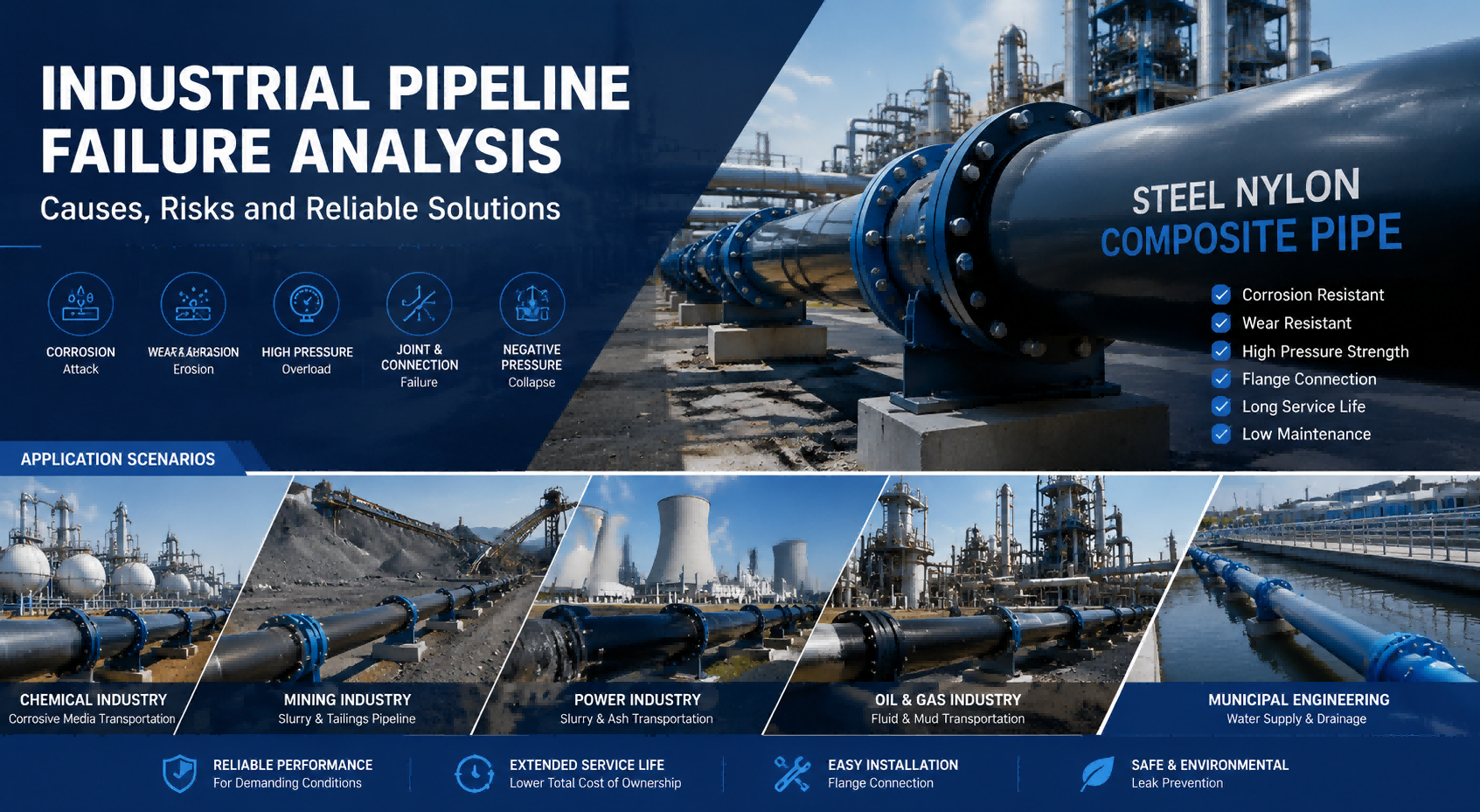
In industries such as oil & gas, chemical processing, mining, power generation, soda ash, and water treatment, pipeline systems play a critical role in continuously transporting corrosive chemicals, abrasive slurry, high-temperature fluids, and high-pressure media.
However, many companies focus only on the initial purchase cost when selecting pipelines while ignoring the key factors that determine long-term service life.
In reality, the lifespan of an industrial pipeline is not determined only by the pipe price. It is influenced by multiple factors, including:
-
Pipeline material performance;
-
Chemical properties of transported media;
-
Operating temperature and pressure;
-
Wear conditions;
-
Connection methods;
-
Maintenance management.
Pipeline failure can lead to:
-
Unexpected production shutdowns;
-
Leakage risks;
-
Safety issues;
-
Increased maintenance costs;
-
Reduced production efficiency.
Therefore, selecting the right pipeline material is essential for reducing total lifecycle costs and improving operational reliability.
This article explains the major factors affecting industrial pipeline service life and introduces why steel-nylon composite pipes are becoming a preferred solution for severe corrosion and high-wear applications.
1. Transported Media: The Primary Factor Affecting Pipeline Life
The first challenge faced by industrial pipelines is the internal operating environment.
Different media cause different types of damage.
1.1 Chemical Corrosion
Acids, alkalis, salts, and other chemical solutions can continuously attack pipeline walls.
Typical corrosive media include:
-
Hydrochloric acid (HCl);
-
Sulfuric acid (H₂SO₄);
-
Sodium hydroxide (NaOH);
-
Chloride solutions;
-
Seawater.
Traditional carbon steel pipelines may experience:
-
Internal corrosion;
-
Wall thickness reduction;
-
Pitting corrosion;
-
Weld corrosion;
-
Flange leakage.
Even stainless steel may face corrosion problems in strong alkaline or high-chloride environments.
1.2 Abrasive Wear Caused by Solid Particles
Many industrial fluids contain solid particles, such as:
-
Mining slurry;
-
Oilfield produced water;
-
Soda ash mother liquor.
During high-speed transportation, particles continuously impact the pipe wall, causing:
-
Elbow wear;
-
Pump outlet pipe damage;
-
Local wall thinning;
-
Shortened pipeline service life.
Although carbon steel has high mechanical strength, its wear resistance is often insufficient for severe abrasive conditions.
1.3 Temperature Effects
Operating temperature directly affects:
-
Material strength;
-
Creep resistance;
-
Chemical stability;
-
Long-term durability.
For example:
HDPE pipes may experience reduced stiffness and deformation under high-temperature conditions.
Traditional plastic-lined steel pipes may suffer from:
-
Aging;
-
Shrinkage;
-
Liner separation.
Therefore, high-temperature corrosive applications require a comprehensive material structure design rather than simply selecting a material based on temperature resistance.
2. Pipeline Material Performance: The Core Factor Determining Durability
The service life of industrial pipelines largely depends on material properties.
Common industrial pipeline materials include:
| Pipeline Type | Advantages | Common Problems |
|---|---|---|
| Carbon Steel Pipe | High strength, low cost | Severe corrosion |
| Stainless Steel Pipe | Good corrosion resistance | High cost, limited resistance in some chemicals |
| FRP Pipe | Excellent corrosion resistance | Poor impact resistance |
| HDPE Pipe | Good chemical resistance | Limited pressure and temperature capability |
| Plastic Lined Steel Pipe | Good overall performance | Risk of liner delamination |
| Steel-Nylon Composite Pipe | Strength + corrosion resistance + wear resistance | Excellent long-term reliability |
3. Pipeline Structure Design: Why Composite Pipes Are Becoming a Trend
Traditional pipelines usually solve only one problem:
-
Steel provides strength;
-
Plastic provides corrosion resistance;
-
Rubber provides wear protection.
However, modern industrial applications often require multiple properties simultaneously:
High strength + corrosion resistance + wear resistance + long service life
This is why steel-nylon composite pipe technology was developed.
How Steel-Nylon Composite Pipes Extend Industrial Pipeline Life
A steel-nylon composite pipe combines:
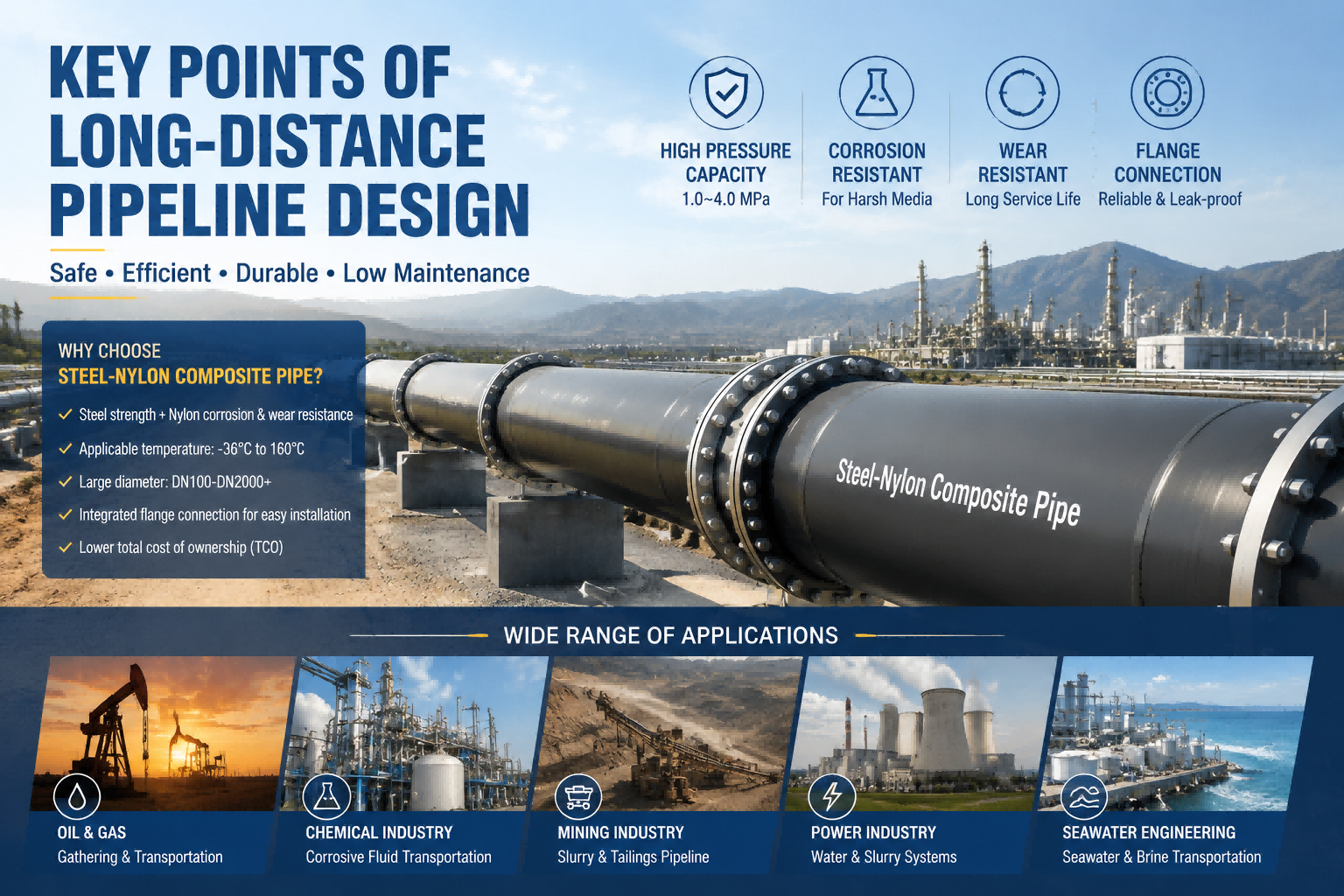
Outer steel layer for structural strength and pressure resistance + Inner reinforced nylon layer for corrosion and wear protection
This creates a dual-protection pipeline structure.
1. Steel Structure Provides High Pressure Capability
Compared with conventional plastic pipes, steel-nylon composite pipes provide higher mechanical strength.
Typical application range:
-
Diameter: DN100-DN2000;
-
Pressure rating: 1.0-4.0 MPa;
-
Long-distance industrial transportation systems.
Suitable applications include:
-
Oil and gas gathering pipelines;
-
Chemical transportation pipelines;
-
Mining slurry pipelines;
-
Power plant desulfurization systems.
2. Nylon Inner Layer Provides Excellent Corrosion Resistance
Reinforced nylon offers:
-
Excellent acid and alkali resistance;
-
Resistance to saltwater corrosion;
-
Smooth internal surface;
-
Reduced scaling.
Compared with carbon steel pipelines, steel-nylon composite pipes prevent:
-
Internal rust formation;
-
Corrosion products blocking pipelines;
-
Frequent repair and replacement.
They are especially suitable for:
-
Soda ash mother liquor transportation;
-
Chlor-alkali brine systems;
-
Chemical circulation pipelines.
3. Integrated Composite Structure Prevents Liner Separation
Traditional plastic-lined steel pipes may experience:
-
Liner blistering;
-
Delamination;
-
Corrosion of the steel substrate after media penetration.
Steel-nylon composite pipes use advanced composite manufacturing technology to achieve stable bonding between nylon and steel.
Advantages:
✔ No traditional liner peeling problems
✔ Long-term operational stability
✔ Reduced maintenance frequency
4. Built-In Flange Connection Reduces Leakage Risks
Many industrial pipeline failures occur at connection points.
Traditional welded pipelines may face:
-
Large amounts of field welding work;
-
Weld corrosion;
-
Longer installation time.
Steel-nylon composite pipes feature:
Factory-integrated flange connections
Advantages:
-
Faster installation;
-
Reduced welding requirements;
-
Fewer leakage points;
-
Easier maintenance and replacement.
4. Connection Method Directly Influences Pipeline Service Life
Many pipeline failures occur not because of pipe body damage, but because of connection failures.
Welded Connections
Potential problems:
-
Heat-affected zones;
-
Reduced corrosion resistance;
-
Difficult maintenance.
Flanged Connections
Advantages:
-
Easy installation;
-
Simple inspection;
-
Convenient replacement;
-
Suitable for large industrial projects.
Steel-nylon composite pipes use flange connection systems designed for industrial applications.
5. Operating Conditions and Maintenance Management Affect Final Service Life
Even high-quality pipelines may fail prematurely if system design and maintenance are inadequate.
Important factors include:
Flow Velocity Control
Excessive velocity can:
-
Increase erosion;
-
Accelerate elbow wear.
Pipeline Layout
Proper design can:
-
Reduce sharp bends;
-
Lower pressure losses;
-
Minimize local wear.
Regular Inspection
Recommended inspections include:
-
Wall thickness measurement;
-
Leakage monitoring;
-
Flange inspection.
6. The Future of Industrial Pipeline Selection: Lifecycle Cost Management
Traditional purchasing decisions often focus on:
"Which pipeline has the lowest initial cost?"
Modern industrial projects increasingly focus on:
"Which pipeline has the lowest total cost over its service life?"
Lifecycle costs include:
-
Initial investment;
-
Installation cost;
-
Downtime losses;
-
Replacement expenses;
-
Maintenance costs.
Although steel-nylon composite pipes may have a higher initial investment than carbon steel pipes, they provide significant economic advantages through:
-
Longer service life;
-
Reduced maintenance requirements;
-
Lower production interruption risks.
7. Typical Applications of Steel-Nylon Composite Pipes
Steel-nylon composite pipes are widely used in:
Oil & Gas Industry
-
Gathering pipelines;
-
Produced water transportation;
-
Process systems.
Chemical Industry
-
Corrosive chemical transportation;
-
Circulation systems.
Soda Ash Industry
-
Mother liquor pipelines;
-
Brine systems.
Chlor-Alkali Industry
-
Saltwater and chemical process pipelines.
Mining Industry
-
Slurry transportation;
-
Tailings pipelines.
Power Industry
-
Desulfurization slurry systems;
-
Circulating water pipelines.
Conclusion
Industrial pipeline service life is determined by multiple factors, including:
-
Transported media;
-
Material properties;
-
Temperature and pressure;
-
Wear conditions;
-
Connection design;
-
Maintenance strategy.
For severe industrial environments involving corrosion, abrasion, high pressure, and long-term operation, traditional carbon steel or ordinary plastic pipes may no longer provide sufficient reliability.
Steel-nylon composite pipes combine:
Steel structural strength + Nylon corrosion resistance and wear protection + Integrated composite technology + Flanged installation
to provide longer service life, lower maintenance costs, and improved reliability for oil & gas, chemical, mining, power, and water treatment industries.
How to Calculate the Total Cost of Ownership (TCO) of Industrial Piping Systems?
DN100-DN2000 Industrial Pipeline Selection Guide: Why Steel-Nylon Composite Pipes Are the Ideal Choice for Modern Industrial Transport Systems