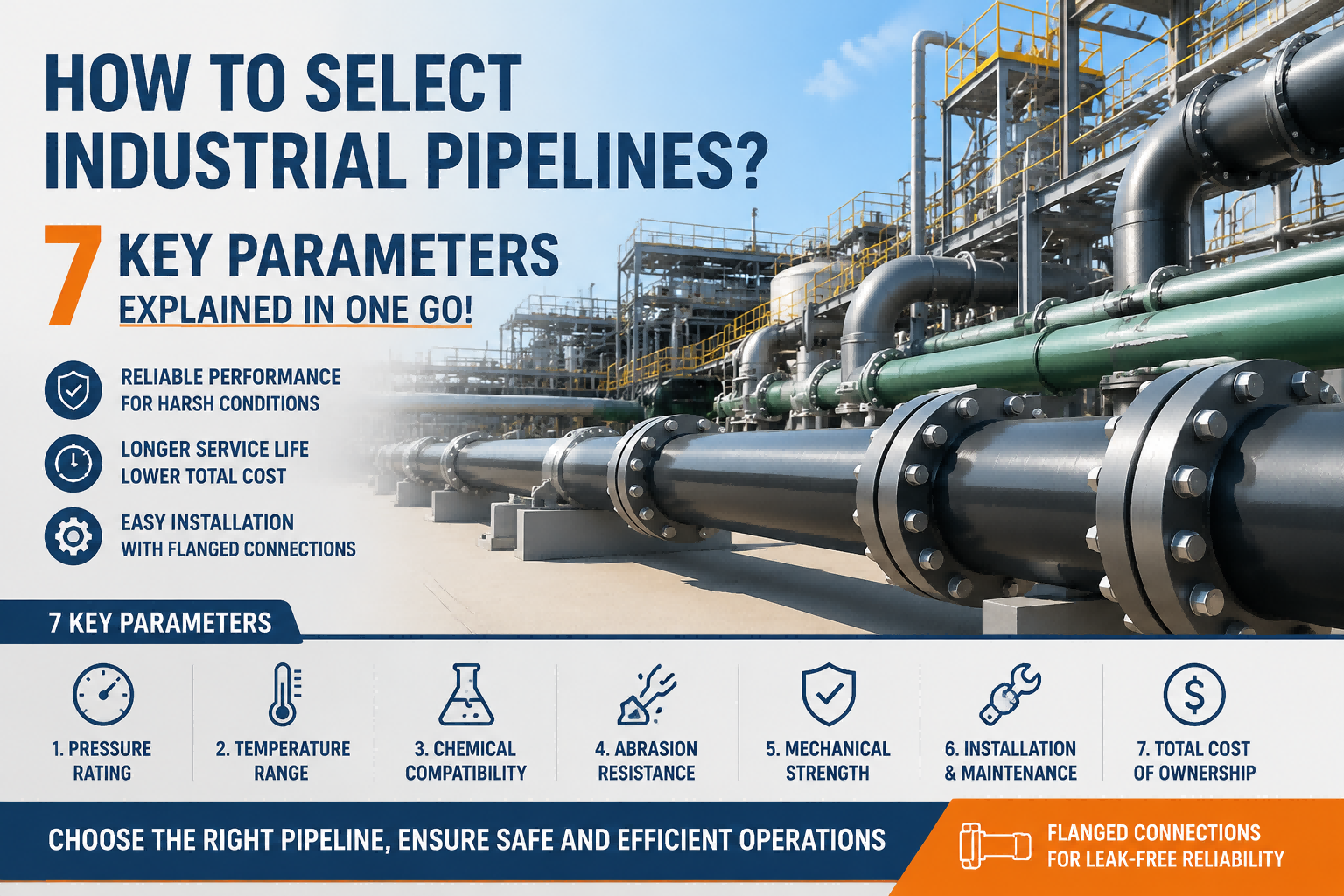
Industrial Pipeline Selection: 7 Key Parameters Explained in Depth
How to Choose the Right Industrial Piping System for Safety, Efficiency, and Long Service Life
In industrial systems—whether in chemical processing, oil & gas, mining, power plants, or wastewater treatment—pipeline selection is not a simple material choice. It is a system-level engineering decision that directly impacts safety, uptime, maintenance cost, and long-term operational stability.
A poor piping selection can lead to corrosion failures, leakage at joints, frequent shutdowns, or even catastrophic accidents. Conversely, a properly designed pipeline system can operate for years with minimal maintenance and predictable performance.
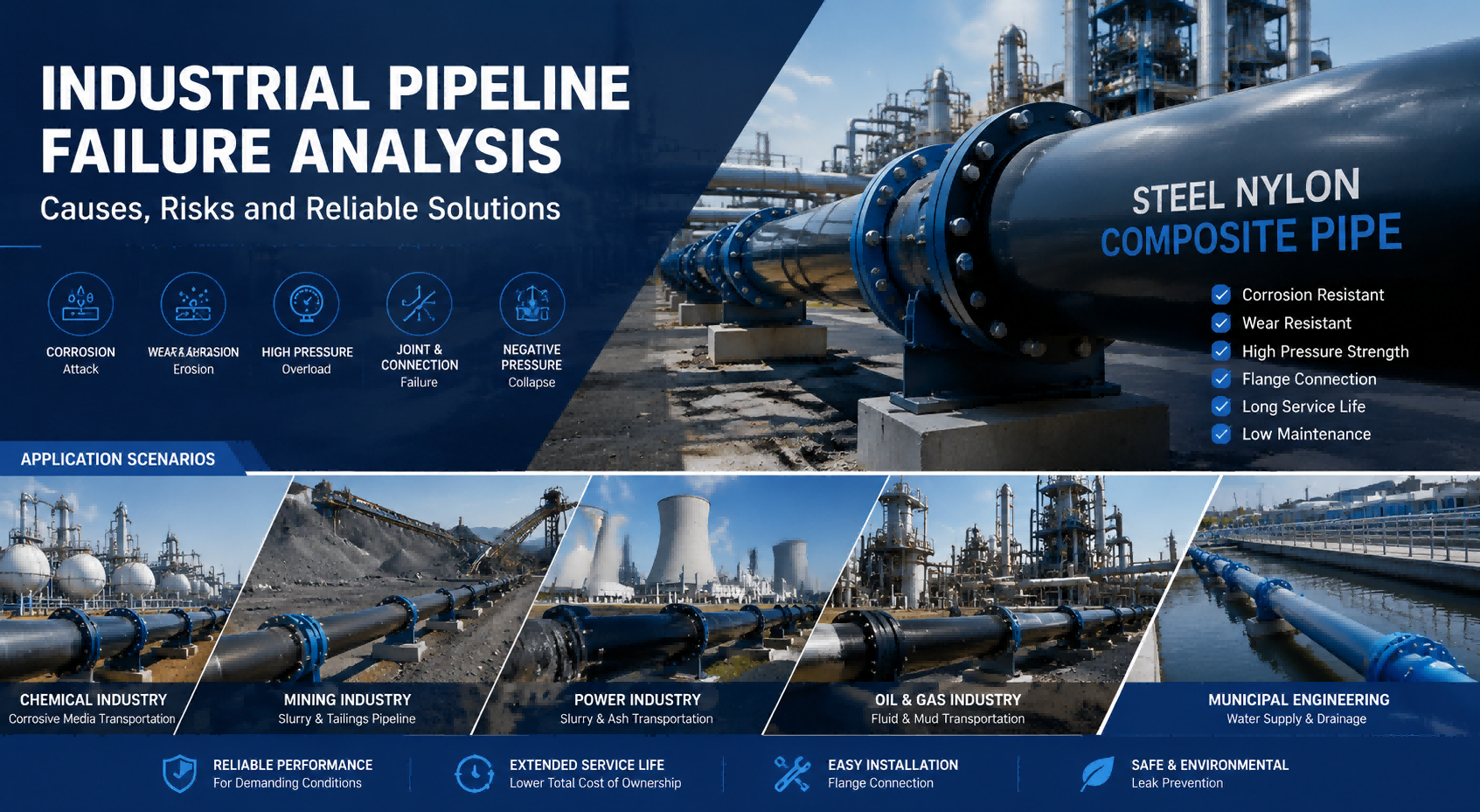
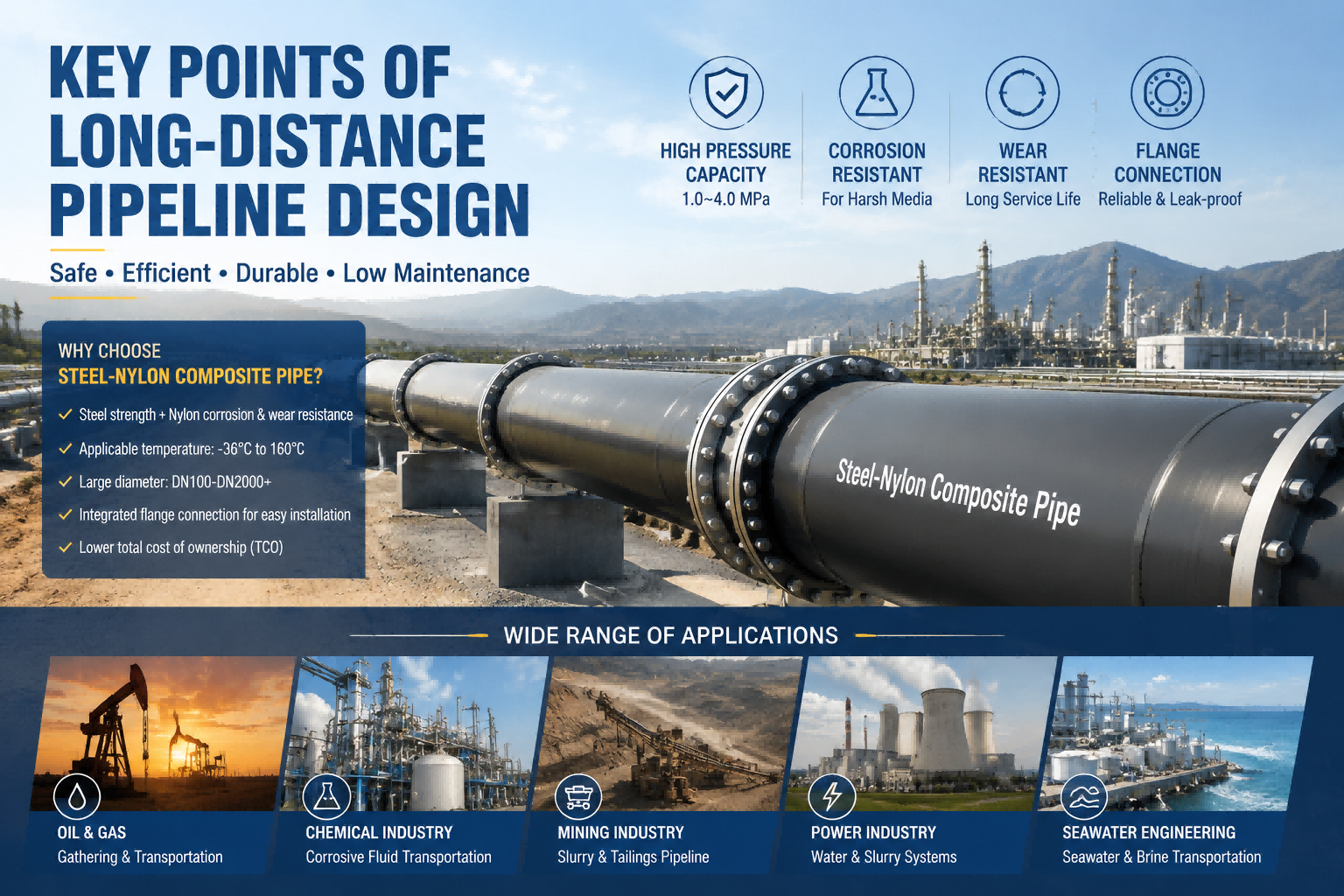
This article breaks down 7 key parameters for industrial pipeline selection, and explains why steel–nylon composite pipes with flanged connections are becoming a preferred solution in aggressive and high-demand environments.
1. Pressure Rating (Design & Operating Pressure)
Pressure is the most fundamental design parameter.
Industrial pipelines must withstand:
-
Continuous operating pressure
-
Pressure surges (water hammer)
-
Start-up and shutdown fluctuations
If the pipe cannot safely handle peak pressure conditions, deformation or burst failure may occur.
Why it matters:
Many traditional plastic pipelines (like HDPE) suffer from deformation under high pressure, while pure steel pipelines may require thicker walls and higher cost.
Advantage of steel–nylon composite pipes:
Steel reinforcement provides structural strength, while the nylon inner layer maintains smooth flow and corrosion resistance—allowing stable performance under medium-to-high pressure conditions.
2. Temperature Range
Temperature affects both mechanical strength and chemical stability of pipeline materials.
Industrial systems may experience:
-
High-temperature chemical fluids
-
Low-temperature outdoor environments
-
Thermal cycling (daily or seasonal variation)
Common failure risks:
-
Softening or creep deformation (plastics)
-
Thermal stress cracking
-
Seal failure at joints
Steel–nylon composite advantage:
Engineered nylon materials offer excellent temperature adaptability, while the steel layer prevents structural collapse. This combination allows stable operation across a wide industrial temperature range.
3. Chemical Compatibility (Corrosion Resistance)
This is one of the most critical factors in industrial environments.
Pipelines may carry:
-
Strong alkali (NaOH, ammonia water)
-
Acids (sulfuric, hydrochloric)
-
Saline wastewater
-
Organic solvents
Common problem:
Steel pipelines corrode internally, leading to:
-
Wall thinning
-
Rust contamination
-
Leakage and blockage
Why steel–nylon composite pipes stand out:
The nylon inner lining provides a chemically inert barrier, preventing direct contact between corrosive media and the steel structure. This significantly extends service life in:
-
Chlor-alkali industry
-
Chemical plants
-
Oilfield produced water systems
4. Abrasion Resistance
In mining, slurry transport, and solid-laden fluids, abrasion is a dominant failure mechanism.
Typical issues:
-
Inner wall wear
-
Increased roughness → flow efficiency loss
-
Frequent replacement of elbows and bends
Steel–nylon composite advantage:
Nylon materials have naturally low friction and high wear resistance. Compared with carbon steel or rubber-lined pipes, they provide:
-
Lower wear rate
-
Smoother flow
-
Longer service cycles in abrasive media
5. Mechanical Strength (Impact & Structural Load)
Industrial pipelines must resist:
-
External load (soil burial, equipment vibration)
-
Mechanical impact during installation
-
Long-term structural fatigue
Weak points of traditional systems:
-
Plastic pipes: low rigidity, deformation risk
-
Steel pipes: corrosion-driven weakening over time
Steel–nylon composite structure:
The steel layer provides:
-
High hoop strength
-
Impact resistance
-
Structural stability under load
This hybrid structure allows a balance between rigidity and durability.
6. Installation & Maintenance Efficiency
Installation cost is often underestimated in pipeline projects.
Key considerations include:
-
Welding requirements
-
Hot work permits
-
Alignment complexity
-
Downtime during replacement
Traditional issue:
Steel pipelines often require welding, which increases:
-
Installation time
-
Labor cost
-
Safety risk (hot work)
Key advantage: Flanged connection system
Steel–nylon composite pipes typically use flanged connections, offering:
-
Fast assembly and disassembly
-
No welding required
-
Reduced installation downtime
-
Easier maintenance and section replacement
This is especially valuable in retrofit projects and plant upgrades.
7. Total Cost of Ownership (TCO)
Many projects fail to evaluate lifecycle cost and focus only on initial price.
True cost includes:
-
Material procurement
-
Installation labor
-
Maintenance frequency
-
Downtime losses
-
Replacement cycles
Reality in harsh environments:
Low-cost materials often result in high long-term operational expenses.
Steel–nylon composite advantage:
Although initial investment may be moderate, the system delivers:
-
Longer service life
-
Lower maintenance frequency
-
Reduced shutdown time
-
Better corrosion and wear resistance
This leads to significantly lower total lifecycle cost.
Why Steel–Nylon Composite Pipes Are Gaining Adoption
Across chemical, mining, oil & gas, and power industries, engineers are shifting toward hybrid piping systems because they solve a fundamental contradiction:
Steel provides strength, but corrodes.
Plastic resists corrosion, but lacks strength.
Steel–nylon composite pipes combine both advantages in one system:
-
Steel skeleton → structural reliability
-
Nylon lining → corrosion + abrasion resistance
-
Flanged design → easy installation and maintenance
This makes them particularly suitable for:
-
Highly corrosive chemical transport
-
High-pressure industrial systems
-
Slurry and abrasive media pipelines
-
Retrofit replacement of aging steel pipelines
Typical Application Scenarios
Steel–nylon composite pipelines are widely used in:
Chemical Industry
-
Alkali solution transport
-
Acidic wastewater systems
-
Process fluid distribution
Oil & Gas
-
Produced water pipelines
-
Gathering and transportation systems
-
Corrosive well fluids
Mining Industry
-
Tailings slurry transport
-
Backfill systems
-
Abrasive material handling
Power & Desulfurization
-
Limestone slurry systems
-
Desulfurization circulation pipelines
Final Thoughts
Selecting an industrial pipeline system is not about choosing a material—it is about balancing pressure, temperature, corrosion, abrasion, strength, installation efficiency, and lifecycle cost.
Steel–nylon composite pipes with flanged connections provide a practical engineering solution that addresses the most common failure modes in industrial piping systems.
For industries facing corrosion, abrasion, and high maintenance costs, they represent not just an upgrade—but a long-term operational strategy.
Chemical Industry Pipeline Material Comparison | Selection Guide & Steel–Nylon Composite Pipe Advantages