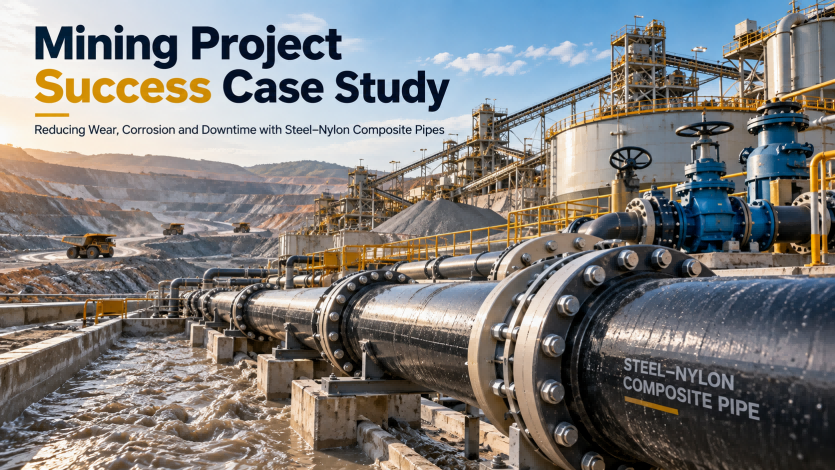
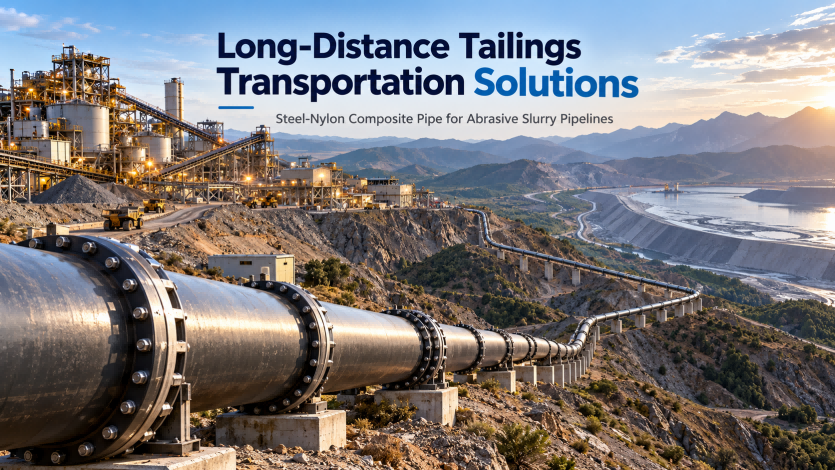
Iron Ore Slurry Transportation Solutions: How Steel-Nylon Composite Pipes Improve Wear Resistance and Pipeline Reliability
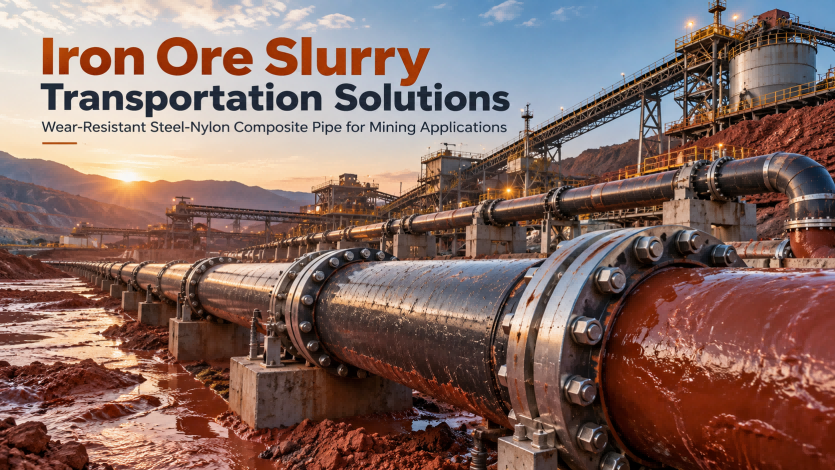
Introduction: Why Is Pipe Material Selection So Important for Iron Ore Slurry Transportation?
In modern iron ore mining and mineral processing operations, slurry pipelines play a critical role in connecting crushing, grinding, classification, magnetic separation, thickening, and tailings treatment processes.
As mining operations expand, processing capacities increase, and slurry transportation distances become longer, conventional pipeline materials face increasingly complex operating challenges.
Unlike ordinary industrial liquids, iron ore slurry typically contains a large proportion of high-density solid particles. During continuous transportation, these particles repeatedly contact, rub against, and impact the internal surfaces of pipelines, exposing them to abrasion, pressure fluctuations, and potential chemical corrosion.
Under operating conditions involving high solids concentrations, high flow velocities, and long-distance transportation, severe pipeline wear, blockage, or leakage can increase maintenance costs and potentially interrupt the entire mineral processing operation.
For large mining companies, pipeline selection is no longer simply a matter of initial procurement cost. It is an important engineering decision that directly affects production continuity, equipment reliability, and long-term operating expenses.
What type of pipeline material should mining companies choose to handle high abrasion, elevated pressure, and complex operating conditions?
As a manufacturer specializing in steel-nylon composite pipes, we believe that modern iron ore slurry transportation systems require a balance of wear resistance, structural strength, corrosion resistance, and long-term operational reliability.
By combining the structural advantages of steel with the wear-resistant and corrosion-resistant properties of nylon, steel-nylon composite pipes provide a promising alternative for demanding iron ore slurry transportation applications.
1. What Are the Main Technical Challenges in Iron Ore Slurry Transportation?
The complexity of iron ore slurry transportation primarily results from the physical properties of the slurry, transportation parameters, and operating environment.
Unlike clean water transportation, slurry pipeline design cannot be based solely on flow rate and operating pressure.
Engineers must also consider solid particle characteristics, slurry rheology, critical deposition velocity, and pipeline wear mechanisms.
1.1 High-Density Mineral Particles Cause Continuous Pipeline Wear
Iron ore slurry typically consists of iron ore particles, water, and other mineral impurities.
Minerals such as hematite and magnetite have relatively high densities, while some slurries may also contain abrasive minerals such as quartz.
During continuous transportation, solid particles generate repeated friction, erosion, and impact against the internal surfaces of pipelines.
Depending on operating conditions, different wear mechanisms may occur:
-
Localized wear along the bottom of pipelines due to particle settling and sliding.
-
Impact and erosion on the outer walls of pipe bends as particles change direction.
-
Concentrated wear at pipe reducers and connection points due to changes in local flow conditions.
-
Continuous abrasive erosion caused by solid particles under high-velocity flow conditions.
As wear progresses, the effective wall thickness of a pipeline may gradually decrease, eventually compromising its structural integrity and operational safety.
In addition, wear mechanisms in iron ore slurry pipelines may involve interactions between erosion and corrosion.
Therefore, the actual service life of a pipeline cannot be predicted solely from the static corrosion resistance of its material.
Mining companies require more than pipelines with sufficient pressure resistance. They need pipe materials capable of withstanding prolonged exposure to abrasive solid-liquid flow.
1.2 High Solids Concentrations Increase Flow Resistance and Blockage Risks
Increasing slurry solids concentration can reduce the amount of water required to transport a given quantity of ore under suitable conditions.
However, as solids concentration increases, slurry viscosity, yield stress, and overall flow behavior may change significantly.
For high-concentration iron ore slurry, pipeline design must balance transportation efficiency and operational stability.
If the flow velocity is too low, some solid particles may settle along the bottom of the pipeline, forming a sediment layer that can eventually cause blockage.
Conversely, excessively high flow velocities may increase pressure losses, pumping energy consumption, and abrasive wear.
The relationship between slurry concentration, flow velocity, and pipeline wear depends on several factors, including particle size distribution, solids density, slurry rheology, and pipeline diameter.
Therefore, high-concentration slurry transportation systems require comprehensive optimization of pipe diameter, flow velocity, internal lining materials, and pumping equipment.
1.3 Long-Distance Transportation Places Greater Demands on Pressure Resistance
In large iron ore mining projects, slurry may need to be transported over considerable distances between processing plants, thickening stations, tailings treatment facilities, and other production areas.
As transportation distance increases, frictional pressure losses, elevation differences, and local resistance affect pressure distribution throughout the system.
For slurry transportation systems with significant elevation changes or multiple pumping stations, pipeline designers must consider:
-
Normal operating pressure and maximum design pressure.
-
Pressure fluctuations during pump startup and shutdown.
-
Water hammer caused by valve operations or unexpected pump failure.
-
Thermal expansion, contraction, and axial restraint in long-distance pipelines.
-
Pipeline supports, connections, and localized mechanical loads.
If a pipeline lacks sufficient structural strength or its connections are not designed for actual operating pressures, deformation, joint failure, or leakage may occur during long-term operation.
Therefore, slurry pipeline selection must consider not only wear resistance but also the structural and pressure requirements of the entire transportation system.
1.4 Combined Erosion and Corrosion Can Shorten Pipeline Service Life
Iron ore slurry does not always have the same chemical characteristics.
Water quality can vary significantly between mining operations. Certain applications may involve changes in pH, dissolved salts, oxidizing substances, and mineral processing chemicals.
When the internal surfaces of metal pipelines are continuously exposed to abrasive particles, protective surface layers may be damaged, increasing the risk of localized corrosion.
For conventional carbon steel pipelines, mechanical erosion and electrochemical corrosion may jointly accelerate wall thickness reduction.
Therefore, when evaluating iron ore slurry transportation pipelines, engineers must consider both wear resistance and corrosion resistance under actual operating conditions.
2. What Are the Limitations of Conventional Iron Ore Slurry Pipelines?
Common pipeline solutions used in mining slurry transportation include carbon steel pipes, rubber-lined steel pipes, HDPE pipes, and various wear-resistant composite pipes.
Each material has its own advantages and suitable applications. However, each also has limitations under complex operating conditions.
| Pipeline Material | Main Advantages | Potential Limitations |
|---|---|---|
| Carbon Steel Pipe | High structural strength and extensive engineering experience | May experience wall thickness loss in highly abrasive or corrosive slurry environments |
| Rubber-Lined Steel Pipe | Rubber lining provides wear and corrosion protection under suitable conditions | Requires attention to particle impact, lining debonding, joint wear, and operating temperature |
| HDPE Pipe | Resistant to many corrosive media and relatively lightweight | Long-term strength and structural stability require careful evaluation in high-pressure, elevated-temperature, and large-diameter applications |
| Steel-Nylon Composite Pipe | Combines the structural strength of steel with the wear-resistant and corrosion-resistant properties of nylon | Requires verification of lining wear, interlayer bonding, pressure resistance, and temperature suitability under specific slurry conditions |
The actual service life of any pipeline material depends on slurry concentration, particle size, flow velocity, operating pressure, manufacturing quality, and other factors.
For iron ore slurry transportation projects involving both severe abrasion and relatively high operating pressure, the value of steel-nylon composite pipes lies in combining structural load-bearing capacity with internal surface protection within a single pipeline structure.
This composite design provides mining companies with an additional material option for improving pipeline durability and optimizing long-term maintenance costs.
3. Why Are Steel-Nylon Composite Pipes Suitable for Iron Ore Slurry Transportation?
Steel-nylon composite pipes combine steel and nylon materials in a composite structure, allowing the properties of each material to complement the limitations of the other.
The steel component primarily provides structural support and pressure resistance, while the nylon inner layer serves as the working surface in direct contact with the slurry.
For slurry transportation systems involving abrasion, corrosion, and elevated pressure, this composite structure offers several advantages.
3.1 Wear-Resistant Nylon Lining Protects the Steel Structure from Direct Slurry Erosion
During iron ore slurry transportation, the internal surfaces of pipelines must withstand continuous friction and impact from mineral particles.
Our steel-nylon composite pipes incorporate wear-resistant nylon materials as the inner lining.
Through material modification and structural optimization, the nylon layer can be tailored to suit specific abrasive operating conditions.
The slurry comes into direct contact with the nylon lining rather than the underlying carbon steel surface.
This design reduces direct contact between mineral particles and the steel substrate, providing a dedicated protective layer against abrasive wear.
Its engineering benefits can be summarized in three areas.
First, reducing the risk of direct erosion of the steel substrate.
The nylon lining separates the slurry from the steel structure, reducing direct particle erosion of the steel when the lining remains intact.
Second, reducing the combined effects of erosion and corrosion.
When the nylon lining remains intact and demonstrates suitable chemical compatibility with the transported slurry, it can reduce direct exposure of the steel substrate to corrosive media.
Third, providing a wear-resistant material option for long-term continuous operation.
By selecting appropriate nylon formulations, lining thicknesses, and composite structures according to slurry particle characteristics, pipeline design can be tailored to specific operating requirements.
However, nylon is not necessarily superior to all alternative materials under every slurry condition.
Applications involving large quantities of sharp, coarse particles, severe impact, or elevated temperatures require appropriate wear testing and engineering validation.
3.2 Steel Provides Structural Strength for Higher-Pressure Transportation
Slurry pipelines must withstand internal pressure, the weight of the transported slurry, and external installation loads.
In large iron ore mining projects, pipelines may also experience pressure fluctuations from pumping stations, support constraints, and localized mechanical loads.
Steel-nylon composite pipes divide these functions between two complementary materials.
The steel component provides structural support and serves as the primary pressure-bearing element.
The nylon inner layer provides a wear-resistant and corrosion-resistant surface in direct contact with the transported medium.
Compared with pipeline structures that rely primarily on polymer walls to carry the applied loads, steel-nylon composite pipes utilize the rigidity and structural design flexibility of steel to accommodate applications with relatively high pressure requirements.
Our company manufactures steel-nylon composite pipes in pressure-rating series ranging from 1.0 to 4.0 MPa, providing multiple options for industrial transportation projects with different pressure requirements.
For iron ore slurry transportation applications, the suitability of a specific pipe model must be determined according to pipe diameter, design temperature, pressure fluctuations, steel wall thickness, connection structure, and relevant testing results.
In long-distance slurry pipelines, maximum operating pressure must be verified through hydraulic calculations and transient pressure analysis.
Normal operating pressure alone should not be used as the sole basis for pipeline selection.
3.3 Corrosion-Resistant Lining Combined with Steel Supports Complex Slurry Applications
Mining slurry transportation systems may experience different levels of media-induced corrosion.
Conventional carbon steel pipelines can experience internal corrosion under certain chemical conditions, while continuous particle erosion may accelerate the deterioration of protective surface layers.
Steel-nylon composite pipes combine a nylon inner lining with a steel substrate, preventing direct contact between the transported slurry and the steel under normal operating conditions when the lining remains intact.
For slurry compositions that have been verified as chemically compatible with nylon, this structure can help reduce the risk of direct corrosion of the steel substrate.
However, if the slurry contains high concentrations of acids, strong oxidizing agents, or specific chemical additives, the long-term chemical compatibility of the nylon material must be evaluated separately.
Special attention should also be given to flange faces, sealing surfaces, and lining terminations to prevent corrosive media from reaching the steel substrate through connection points.
Reliable corrosion protection requires more than a suitable pipe lining. It also depends on maintaining protective continuity throughout the entire pipeline system, including all connection points.
3.4 Large-Diameter Manufacturing Capability Supports Large-Scale Mining Projects
As mineral processing capacities increase, mining companies may require larger-diameter slurry pipelines to meet higher flow requirements and system design objectives.
For large-diameter slurry pipelines, material selection involves more than wear resistance.
Important structural considerations include:
-
Hoop strength and overall pipe rigidity.
-
Pipeline self-weight and support requirements when filled with slurry.
-
Sealing performance and structural stability of large-diameter flange connections.
-
Long-term lining stability and interlayer bonding.
-
Installation and maintenance accessibility.
Our company has manufacturing capabilities for large-diameter steel-nylon composite pipes and can provide product solutions for different pipeline sizes and project requirements.
For ultra-large-diameter applications, we can also explore customized designs involving pipe structure, composite manufacturing processes, and connection methods.
It is important to note that the pressure rating of a large-diameter pipe cannot automatically be assumed to be identical to that of a smaller pipe.
The applicable pressure rating must be confirmed through specific design calculations, manufacturing requirements, and testing.
For large iron ore projects, customized manufacturing capabilities help align material performance with actual engineering requirements.
4. How Should Iron Ore Slurry Transportation Pipelines Be Selected?
Choosing a wear-resistant material is only one part of slurry pipeline design.
A reliable iron ore slurry transportation solution must also be based on slurry characterization, hydraulic calculations, and structural optimization.
4.1 Identify the Physical and Chemical Properties of the Slurry
Before determining pipeline materials and structures, engineers must first understand the actual characteristics of the transported slurry.
The following parameters should be collected during the initial design stage:
| Key Parameter | Impact on Pipeline Design |
|---|---|
| Solids Concentration and Operating Range | Influences slurry rheology, flow resistance, and deposition risk |
| Solid Particle Density | Affects particle settling behavior and solid-liquid flow characteristics |
| Particle Size Distribution | Influences critical deposition velocity and internal wear mechanisms |
| Mineral Hardness and Particle Shape | Affect the abrasive action of particles against the pipe wall |
| Slurry pH and Chemical Composition | Influence the chemical compatibility of the lining and sealing materials |
| Normal and Maximum Operating Temperature | Affect mechanical properties, thermal deformation, and long-term service life |
| Flow Rate and Operating Pressure | Determine pipe diameter, structural strength, and pumping energy requirements |
Particle size distribution is particularly important.
Even when two slurry pipelines operate at similar solids concentrations, their wear mechanisms may differ significantly if particle size, shape, or mineral hardness varies.
Therefore, we recommend obtaining representative slurry samples during the material selection stage.
Where necessary, application-specific wear tests and chemical compatibility evaluations should be conducted.
4.2 Optimize Slurry Transportation Velocity
Higher slurry transportation velocity does not necessarily mean better performance.
Likewise, lower velocity does not always result in lower overall costs.
When flow velocity falls below the critical deposition velocity for a particular slurry, some solid particles may begin to settle along the bottom of the pipeline.
During prolonged operation, these deposits can increase localized wear and create blockage risks.
On the other hand, excessively high flow velocities may increase internal erosion, pressure losses, and pumping energy consumption.
Critical deposition velocity depends on particle properties, solids concentration, pipe diameter, and slurry rheology.
It should therefore be determined through appropriate engineering calculations or testing for the specific application.
We recommend evaluating minimum, normal, and maximum flow conditions during pipeline design.
Special attention should be given to low-load operation, pumping station shutdown, pipeline restart, and sudden changes in slurry concentration.
Wear-resistant steel-nylon composite pipe selection should be integrated with flow velocity optimization rather than relying solely on improved material wear resistance to compensate for unsuitable transportation parameters.
4.3 Optimize Pipeline Diameter and Pressure According to Transportation Requirements
For a given volumetric flow rate, the average flow velocity can be estimated using the following equation:
Where:
-
vv = Average flow velocity (m/s)
-
QQ = Volumetric flow rate (m³/s)
-
DD = Actual internal pipe diameter (m)
This equation describes the geometric relationship between flow rate, internal diameter, and average velocity.
It does not directly predict slurry deposition, pressure losses, or material wear.
Slurry transportation systems require additional hydraulic calculations based on solids concentration, particle size distribution, and rheological properties.
When selecting steel-nylon composite pipe specifications, the actual internal diameter after accounting for the nylon lining should be used rather than relying solely on nominal diameter or outside diameter.
For long-distance transportation projects, pumping station pressure verification, maximum pipeline pressure assessment, and transient hydraulic analysis should also be performed.
4.4 Optimize Pipe Bends, Reducers, and Connection Points
Wear in iron ore slurry pipelines is often unevenly distributed.
Changes in flow direction and local velocity distribution at bends, reducers, valves, and pump outlets may cause concentrated particle erosion.
At pipe bends, changes in particle direction may expose localized sections of the pipe wall to significant impact wear.
Therefore, pipeline design must address not only straight pipe sections but also areas subject to concentrated abrasion.
For steel-nylon composite pipe systems, we recommend the following measures.
Optimize pipe bend geometry.
Evaluate suitable bend radii according to installation space, slurry velocity, and particle characteristics to avoid unnecessary sharp changes in flow direction.
Maintain smooth internal transitions at connection points.
Avoid significant internal misalignment, protruding structures, or exposed metal surfaces at flange connections.
Optimize lining design in high-wear areas.
For areas exposed to concentrated particle impact, consider application-specific wear-resistant structures or replaceable pipe sections.
Select appropriate sealing and connection methods.
Choose connection structures that facilitate installation, inspection, and replacement while meeting design pressure and sealing requirements.
These measures can help improve the operational reliability of the entire slurry pipeline network.
5. How Can Steel-Nylon Composite Pipes Help Mining Companies Reduce Long-Term Operating Costs?
For large iron ore projects, the initial purchase price of a pipeline represents only one component of its total lifecycle cost.
A pipe material may have a relatively low initial cost but require frequent repairs or replacement due to abrasive wear, leakage, or connection failures.
Over time, these additional expenses can significantly affect the economics of the transportation system.
Therefore, slurry pipeline selection should move beyond comparing initial procurement prices and instead focus on Total Cost of Ownership (TCO).
5.1 Reducing Maintenance Expenses Associated with Pipeline Failure
When slurry pipelines experience severe wear or failure, mining companies may need to perform several maintenance activities:
-
Pipeline leak detection and fault identification.
-
Removal and replacement of damaged pipe sections.
-
Site cleanup and equipment coordination during repairs.
-
Pipeline reinstallation, sealing inspection, and pressure testing.
-
Flushing and commissioning before restarting the transportation system.
If a pipeline can maintain reliable operation for a longer period under actual slurry conditions, it may reduce replacement frequency and associated maintenance requirements.
Steel-nylon composite pipes offer a material and structural approach to achieving this objective through the combination of a wear-resistant lining and a steel substrate.
However, actual maintenance cost savings should be calculated using project operating records or appropriately validated service-life estimates.
5.2 Minimizing Production Interruptions Caused by Unexpected Pipeline Failures
For continuously operating iron ore processing plants, pipeline leakage can affect the entire slurry transportation process.
If a failure occurs in a critical pipeline, related production operations may need to be temporarily suspended.
The economic impact of pipeline failure may therefore extend beyond material and repair costs to include lost production during unplanned shutdowns.
For example, a failure in a critical slurry transportation line may require coordination across upstream grinding and classification systems and downstream thickening operations.
In such situations, pipeline reliability becomes an important factor influencing the efficiency of the entire mineral processing system.
For mining projects with high downtime costs, selecting pipeline materials suited to actual abrasion and pressure conditions can help reduce the risk of production interruptions caused by pipeline failure.
5.3 Optimizing Long-Term Pipeline Replacement Costs
When evaluating slurry pipeline economics, comparing purchase prices per meter is not sufficient.
A more comprehensive approach is to evaluate procurement, installation, operation, maintenance, and replacement costs over a consistent assessment period.
A simplified lifecycle cost model can be expressed as:
Total Cost of Ownership = Initial Procurement Cost + Installation Cost + Operating Energy Cost + Maintenance Cost + Pipeline Replacement Cost + Downtime Losses + End-of-Life Disposal Cost
For example, if a pipeline solution achieves a lower wear rate under the same operating conditions and consequently requires fewer replacements, it may offer a lifecycle cost advantage.
For steel-nylon composite pipes, procurement costs should be evaluated together with expected maintenance frequency, verified operating life, hydraulic pressure losses, and downtime costs.
This provides a more objective basis for assessing the economic suitability of composite pipelines for a specific iron ore project.
6. Our Steel-Nylon Composite Pipe Solutions: From Manufacturing to Slurry Transportation System Compatibility
As a manufacturer specializing in wear-resistant and corrosion-resistant industrial pipelines, we focus not only on the performance of individual pipe products but also on their long-term reliability under actual operating conditions.
For iron ore slurry transportation projects, we can provide product and technical support in the following areas.
6.1 Material Selection Based on Specific Slurry Characteristics
Different iron ore projects may have significantly different slurry concentrations, particle compositions, corrosive properties, and operating temperatures.
Based on the operating parameters provided by our customers, we can evaluate suitable nylon lining materials and composite pipe structures.
For highly abrasive applications, we focus on lining wear resistance, lining thickness, and particle impact conditions.
For applications involving corrosive media, we emphasize chemical compatibility testing and the integrity of protective structures at pipeline connections.
By integrating material selection with actual slurry characteristics, we aim to develop pipeline solutions that better match specific engineering requirements.
6.2 Multiple Pressure Ratings and Pipe Diameter Options
Our steel-nylon composite pipes are available in pressure-rating series ranging from 1.0 to 4.0 MPa, providing different options for industrial transportation projects.
With our large-diameter composite pipe manufacturing capabilities, we can also provide product solutions for slurry transportation systems of different sizes.
For applications involving large diameters, high pressures, or special structural requirements, the pipe design and applicable pressure rating must be verified according to the specific engineering conditions.
Our manufacturing flexibility helps accommodate different mining projects with varying flow capacities, pipeline layouts, and operating pressure requirements.
6.3 Flanged Connection Structures for Convenient Installation and Maintenance
A reliable slurry transportation system requires not only appropriate pipe materials but also suitable connection structures.
We place particular emphasis on integrated molded flange technology and associated connection designs for steel-nylon composite pipes.
Through structural optimization, these designs enable effective integration between the pipe body and its connection components.
Under suitable engineering conditions, flanged connections can reduce the need for on-site welding during pipe assembly.
They can also facilitate the removal, replacement, and inspection of individual pipeline sections during maintenance.
For large iron ore processing plants, flanged connection structures can support sectional installation, equipment interface connections, and future maintenance operations.
However, flange connections used in high-pressure, large-diameter, or vibration-prone pipelines must undergo appropriate structural and sealing verification.
Selecting suitable flange ratings, sealing materials, and fastening arrangements is essential to ensuring long-term operational reliability.
6.4 Manufacturing Quality Control for Consistent Product Performance
Large mining pipeline projects often involve substantial quantities of pipes with different diameters, lengths, and specifications.
Under these circumstances, the performance of a single pipe cannot represent the quality of the entire project.
We emphasize quality management throughout the manufacturing process, from raw material selection and nylon modification to composite pipe forming and finished-product inspection.
For steel-nylon composite pipes, important quality control considerations include:
-
Steel substrate dimensions and structural quality.
-
Nylon lining formation and thickness uniformity.
-
Bonding integrity between the steel and nylon materials.
-
Dimensional accuracy and structural integrity of flange connections.
-
Pressure resistance and finished-product quality.
For iron ore slurry transportation projects, wear performance verification, pressure testing, and quality acceptance requirements should also be established according to the applicable project specifications.
Standardized manufacturing and inspection procedures provide an important foundation for reliable engineering applications.
7. Typical Applications: Which Iron Ore Projects Can Benefit from Steel-Nylon Composite Pipes?
Steel-nylon composite pipes can be considered for various iron ore slurry transportation applications.
However, the key design considerations differ depending on the operating environment.
Application 1: Slurry Transportation Within Mineral Processing Plants
Slurry must be continuously transported between grinding, classification, separation, and other mineral processing operations.
These pipelines require reliable performance, with particular attention to wear at bends, valves, and connection points.
For verified operating conditions, steel-nylon composite pipes can combine internal wear protection with the structural load-bearing capacity of steel.
This makes them a potential option for slurry transportation systems where both abrasion resistance and structural reliability are important.
Application 2: High-Concentration Iron Ore Concentrate Slurry Transportation
Iron ore concentrate slurry may contain a high proportion of solid particles.
Its rheological properties, deposition behavior, and pipeline pressure losses are key engineering considerations.
For these applications, the internal diameter, wear resistance, and pressure rating of steel-nylon composite pipes should be selected according to slurry concentration, particle size distribution, flow velocity, and operating temperature.
Before final material selection, the long-term wear performance of the nylon lining and the reliability of pipeline connections should be verified.
Application 3: Long-Distance Iron Ore Slurry Pipelines
Some large mining projects require long-distance slurry transportation between mining areas, centralized processing facilities, thickening stations, or other treatment facilities.
Such projects typically require comprehensive evaluation of hydraulic losses, pressure fluctuations, elevation differences, pipeline wear, and maintenance requirements.
Steel-nylon composite pipes can be considered as a candidate material for these applications.
However, specific pipe diameters and pressure ratings must undergo dedicated engineering design and validation.
Hydraulic calculations should also be performed to confirm structural and operational suitability under long-distance transportation conditions.
Application 4: Upgrading Pipeline Sections Subject to Severe Wear
In existing iron ore mining operations, certain pipeline sections may experience concentrated abrasion and require frequent replacement.
Typical examples include:
-
Pump discharge pipelines.
-
Localized high-velocity pipeline sections.
-
Pipe reducers and transition connections.
-
Pipeline sections near bends and other high-wear locations.
For these applications, mining companies can evaluate the feasibility of replacing existing pipe sections with steel-nylon composite pipes.
Under suitable operating conditions, targeted replacement with wear-resistant composite pipe sections can help reduce the risk of abrasion-related failures at critical locations.
8. How Should Mining Companies Evaluate the Return on Investment of Pipeline Upgrades?
For iron ore mining companies considering upgrades to existing slurry transportation systems, we recommend a phased evaluation process rather than immediately replacing the entire pipeline network.
Stage 1: Evaluate Existing Pipeline Performance
Collect information about existing pipeline materials, specifications, operating history, wear patterns, maintenance expenses, and downtime losses.
Identify areas where failures occur frequently and determine whether the primary causes are abrasion, corrosion, structural problems, or connection failures.
Stage 2: Evaluate the Suitability of Steel-Nylon Composite Pipes
Assess the material compatibility of steel-nylon composite pipes based on slurry concentration, particle size, flow velocity, operating temperature, and pressure conditions.
For high-risk applications or conditions without sufficient historical performance data, representative slurry wear testing, material compatibility testing, and appropriate pressure verification should be considered.
Stage 3: Conduct Application Trials on Representative Pipeline Sections
Select representative pipeline sections with clearly defined operating conditions, documented wear histories, and suitable monitoring access.
After completing the necessary engineering design and safety reviews, conduct application trials to evaluate actual lining wear, connection reliability, and maintenance requirements.
Stage 4: Evaluate Economic Performance Using Actual Operating Data
Compare the procurement and installation costs of steel-nylon composite pipes with the maintenance, replacement, and downtime costs of the existing pipeline system.
Once sufficient operating data has been collected, assess whether expanding the application to additional pipeline sections is economically justified.
This phased approach helps reduce uncertainty associated with adopting new pipeline materials and allows investment decisions to be supported by project-specific engineering data.
9. Frequently Asked Questions (FAQ)
Q1: What Is the Best Pipe Material for Iron Ore Slurry Transportation?
Iron ore slurry pipeline materials should be selected according to solids concentration, particle size, mineral hardness, flow velocity, operating pressure, and media corrosiveness.
Steel-nylon composite pipes, rubber-lined steel pipes, conventional steel pipes, and other wear-resistant composite pipes each have their own suitable applications.
For projects involving relatively high pressure, continuous abrasion, and corrosion requirements, steel-nylon composite pipes can be considered as one of the candidate materials.
Q2: Can Steel-Nylon Composite Pipes Be Used for High-Concentration Iron Ore Slurry Transportation?
Steel-nylon composite pipes have the potential to be used in high-concentration slurry transportation, but their suitability depends on actual operating conditions.
During material selection, key parameters such as solids concentration, maximum particle size, particle hardness, flow velocity, temperature, and pressure must be evaluated.
For highly abrasive applications or operating conditions without sufficient historical performance data, representative slurry testing is recommended to verify the long-term wear resistance of the nylon lining.
Q3: What Is the Difference Between Steel-Nylon Composite Pipes and Rubber-Lined Steel Pipes?
Both pipeline types utilize steel for structural support and an internal protective material to reduce direct contact between slurry and the steel substrate.
The primary difference lies in the lining material and its response to abrasion, chemical exposure, temperature, and structural loading.
Steel-nylon composite pipes use nylon as the internal lining, while rubber-lined steel pipes use specially formulated rubber materials.
The most suitable material should be determined by comparing actual particle impact conditions, abrasive wear, transportation pressure, and lifecycle costs.
Q4: Can Steel-Nylon Composite Pipes Be Used for Long-Distance Iron Ore Slurry Transportation?
Steel-nylon composite pipes can be considered as a candidate solution for long-distance slurry transportation projects.
However, project-specific hydraulic design, pressure-rating verification, material wear testing, and connection structure evaluation are required.
For long-distance, high-pressure slurry transportation systems, special attention should be given to transient pressure, pipeline supports, and deposition risks under different operating conditions.
Q5: How Can Mining Companies Determine Whether Steel-Nylon Composite Pipes Will Reduce Maintenance Costs?
Mining companies should compare total costs over the same operating conditions and evaluation period.
These costs include initial procurement, installation, operating energy, maintenance, replacement, and downtime losses.
For existing pipelines experiencing severe wear, frequent maintenance, and high downtime costs, representative pipeline sections can be selected for steel-nylon composite pipe trials.
Actual wear measurements and operating records can then provide a more objective basis for evaluating the economic benefits of the pipeline upgrade.
Conclusion: From Wear-Resistant Pipe Materials to More Reliable Iron Ore Slurry Transportation Systems
Iron ore slurry transportation systems face multiple challenges, including high solids concentrations, continuous particle abrasion, complex pressure conditions, and the need for long-term uninterrupted operation.
For mining companies, selecting suitable pipeline materials affects not only the service life of individual pipes but also maintenance requirements, production continuity, and long-term operating costs.
By combining the structural strength of steel with the wear-resistant and corrosion-resistant properties of a nylon inner lining, steel-nylon composite pipes provide a material solution that integrates structural load-bearing capacity with internal surface protection.
Unlike approaches that rely solely on increasing steel pipe wall thickness or frequently replacing worn pipeline sections, steel-nylon composite pipes emphasize composite structural design that allows different materials to contribute their respective performance advantages.
However, an effective iron ore slurry transportation solution depends not on the properties of a single material alone, but on the proper integration of material selection, pipe diameter, flow velocity, connection structures, and system maintenance.
Our goal is not simply to supply wear-resistant pipe products. Through material modification, composite structural design, and advanced manufacturing technology, we aim to provide more reliable and economically suitable pipeline solutions for demanding industrial transportation applications.
For large iron ore mining companies seeking to reduce pipeline maintenance costs and improve slurry transportation reliability, steel-nylon composite pipes are worth considering for pipeline upgrades and new construction projects, subject to appropriate engineering evaluation and application-specific validation.
Contact Us: Get a Customized Iron Ore Slurry Transportation Solution
Are you experiencing any of the following challenges in your iron ore mining project?
-
Severe internal pipeline wear requiring frequent replacement.
-
Increasing maintenance costs associated with high-concentration slurry transportation.
-
Existing pipelines that struggle to meet wear resistance, corrosion resistance, and pressure requirements simultaneously.
-
Large-diameter slurry transportation systems requiring customized pipeline products.
-
The need to reduce long-term operating costs through pipeline material upgrades.
Contact our technical team to discuss your iron ore slurry transportation requirements.
Based on your slurry characteristics, pipeline specifications, operating pressure, transportation temperature, and site conditions, we can help evaluate the suitability of steel-nylon composite pipes and provide corresponding product selection and customized manufacturing solutions.
Project Information Required for Initial Technical Evaluation
| Project Parameter | Customer Information |
|---|---|
| Transportation Medium | Iron Ore Concentrate Slurry / Raw Ore Slurry / Iron Ore Tailings Slurry / Other |
| Solids Concentration by Weight | % |
| Slurry Particle Size | D50, D90, Maximum Particle Size |
| Transportation Flow Rate | m³/h |
| Normal and Maximum Operating Pressure | MPa |
| Operating Temperature | °C |
| Nominal Pipe Diameter | DN |
| Total Pipeline Length | m / km |
| Existing Pipeline Material | |
| Main Pipeline Problems | Abrasion / Corrosion / Leakage / Blockage / Other |
Steel-Nylon Composite Pipes — Expanding the Possibilities for Reliable Industrial Slurry Transportation Under Highly Abrasive and Demanding Operating Conditions.
Copper Slurry Transportation Solutions: How to Address Abrasion, Corrosion, Sedimentation, and Long-Term Operating Challenges
How to Choose the Right Mining Tailings Pipeline: A Comprehensive Guide to Abrasion Resistance, Corrosion Protection, and Long-Term Reliability