Island Water Supply Case Study: Flanged PA6 Nylon Pipes
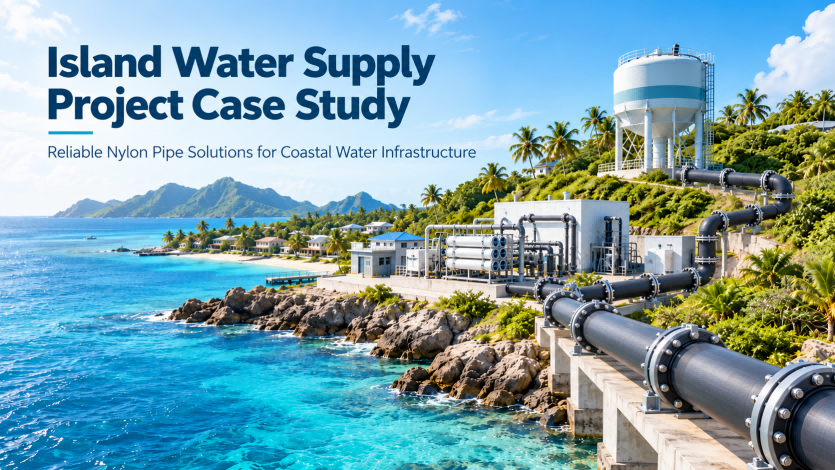
Island Water Supply Project Case Study: PA6 Nylon Pipe Solutions for Reliable Coastal Water Infrastructure
1. Introduction: Why Island Water Supply Projects Require Advanced Piping Solutions
Reliable freshwater supply is one of the most important infrastructure requirements for island communities. From residential water distribution and tourism facilities to industrial operations and coastal ports, stable water transmission systems are essential for economic development and everyday life.
However, island water supply projects face challenges that are often more demanding than those encountered in mainland infrastructure.
High humidity, salt-laden air, difficult terrain, limited transportation resources, and expensive maintenance operations create unique engineering requirements for water transmission pipelines.
Traditional carbon steel pipes can experience corrosion in marine environments, while other piping materials must be evaluated for mechanical performance, long-term pressure resistance, installation requirements, and environmental compatibility.
As a result, engineering contractors and water utility operators are increasingly interested in alternative piping materials that can balance durability, operational reliability, and lifecycle costs.
Nylon 6 (PA6) pipes offer a promising material option for selected island water supply applications, combining mechanical strength, toughness, wear resistance, and resistance to metallic rust corrosion.
When combined with properly engineered flanged connections, PA6 nylon piping systems can provide a practical solution for applications where corrosion management, installation efficiency, and long-term maintenance are important considerations.
This article examines a representative island water supply project and explains how PA6 nylon pipes can be evaluated to address challenging coastal infrastructure requirements.
2. Island Water Supply Project Overview
2.1 Project Background
Consider a representative tropical island where the freshwater supply depends primarily on seawater desalination and centralized water storage facilities.
The island requires a reliable pipeline network to transport treated freshwater from the desalination facility to residential communities, tourist resorts, and port service areas.
The transmission route passes through coastal environments, rocky terrain, and elevated ground.
Conventional metallic pipelines may require extensive corrosion protection, particularly in exposed coastal sections.
In addition, transporting and installing heavy piping materials can increase construction costs and project complexity.
For these reasons, the project engineering team considers PA6 nylon pipes with flanged connections as a potential alternative for suitable pipeline sections.
2.2 Illustrative Project Parameters
| Parameter | Project Description |
|---|---|
| Project Type | Island freshwater transmission system |
| Location | Representative tropical island |
| Water Source | Desalinated seawater |
| Design Water Supply Capacity | 1,200 m³/day |
| Main Pipeline Length | Approximately 5.5 km |
| Pipeline Material Under Evaluation | Nylon 6 (PA6) |
| Connection Method | Bolted flange connections |
| Transmission System | Pumping station and elevated water storage |
| Environmental Conditions | Salt spray, high humidity, and coastal exposure |
| Major Challenges | Corrosion, difficult installation, water supply reliability, and maintenance costs |
Case Study Disclaimer: This is an illustrative engineering scenario based on common island water supply conditions. It does not represent a verified completed customer project. Actual pipe dimensions, pressure ratings, material grades, and operating results must be determined from project-specific calculations and product documentation.
3. Major Challenges in Island Water Transmission Systems
3.1 Corrosion in Coastal Environments
Marine environments expose pipeline infrastructure to salt spray, moisture, and changing weather conditions.
For traditional carbon steel pipelines, these conditions can accelerate external corrosion when protective coatings are damaged or deteriorate.
Over time, corrosion may contribute to leakage, reduced pipeline reliability, and increased maintenance requirements.
In remote island locations, even minor pipeline failures can become expensive because maintenance personnel, replacement components, and specialized equipment may need to be transported from the mainland.
Therefore, selecting materials that reduce the risk of corrosion-related deterioration is an important engineering consideration.
3.2 Difficult Transportation and Installation Conditions
Island construction projects frequently involve complicated logistics.
Pipes may need to be transported by sea, unloaded at small ports, and delivered to construction sites through narrow roads or mountainous terrain.
Heavy piping materials can increase requirements for lifting equipment and transportation resources.
For certain installations, lighter piping alternatives may help simplify material handling and construction planning.
3.3 Pressure Fluctuations and Uneven Terrain
Island water transmission systems often connect low-elevation treatment facilities with elevated storage tanks and distribution networks.
Elevation differences, pump operation, and valve movements can create significant pressure variations.
Pipe materials and connections must therefore be selected based on both normal operating pressure and potential transient pressure conditions.
3.4 High Long-Term Maintenance Costs
Pipeline maintenance costs can be especially significant on islands with limited technical resources.
A pipeline failure may involve more than the replacement of a damaged pipe section.
Additional expenses may include emergency transportation, excavation, replacement fittings, operational interruptions, and temporary water supply arrangements.
Consequently, project owners must consider the total cost of pipeline ownership rather than focusing exclusively on the initial purchase price.
4. Why Nylon 6 (PA6) Is Worth Considering for Island Water Supply Projects
Nylon 6, also known as Polyamide 6 or PA6, is an engineering thermoplastic used in applications requiring a balance of mechanical strength, toughness, and wear resistance.
Unlike carbon steel, PA6 is a non-metallic material and does not undergo electrochemical rust corrosion.
These characteristics make PA6 an interesting candidate for selected water transmission and industrial piping applications.
However, PA6 is not automatically suitable for every water supply system. Its performance depends on formulation, manufacturing method, moisture conditioning, temperature, pressure, and operating environment.
4.1 Resistance to Metallic Corrosion
One of the most important material advantages of PA6 nylon pipes in coastal environments is that their polymer pipe walls do not rust like carbon steel.
In applications where external metallic corrosion is a significant maintenance concern, this property can reduce dependence on protective coatings for the pipe body.
Potential applications include:
-
Coastal freshwater transmission pipelines.
-
Island water treatment facilities.
-
Industrial water distribution networks.
-
Corrosion-sensitive pipeline sections near ports.
-
Selected desalination plant freshwater distribution systems.
However, PA6 chemical compatibility must still be verified for the actual transported water, including disinfectants, cleaning chemicals, temperature, and exposure duration.
Metallic flanges, bolts, valves, and other connected components also require appropriate corrosion protection.
4.2 Mechanical Strength and Toughness
PA6 is widely recognized for its useful combination of strength and toughness.
These characteristics can be valuable in demanding industrial environments where pipelines experience handling loads, installation stresses, and mechanical impacts.
Compared with brittle materials, appropriately formulated PA6 can provide a degree of toughness that helps accommodate certain mechanical loading conditions.
This may be beneficial during transportation and installation in remote island locations.
Nevertheless, the mechanical performance of a finished PA6 pipe depends on its manufacturing process, wall thickness, moisture condition, temperature, and structural design.
Engineering calculations should use verified pipe-specific data rather than relying solely on general resin properties.
4.3 Wear Resistance
PA6 is also valued for its wear and abrasion-related properties in many engineering applications.
Some island water systems, particularly raw water intake and industrial water transmission pipelines, may contain suspended sand or other abrasive particles.
Under suitable operating conditions, PA6 pipes may provide useful resistance to mechanical wear.
This can be particularly relevant in pipeline sections exposed to particle movement and localized abrasion.
However, wear resistance varies with particle concentration, particle hardness, flow velocity, pipe geometry, and material formulation.
For abrasive water applications, laboratory testing or representative service data should be used to confirm the expected performance.
4.4 Potential Advantages in Transportation and Installation
PA6 has a substantially lower material density than carbon steel.
Therefore, PA6 piping systems may offer handling and transportation advantages compared with certain equivalent metallic piping configurations.
In island infrastructure projects, this can be valuable where materials must be transported by vessel, transferred through ports, and delivered across difficult terrain.
Potential benefits include reduced handling requirements, greater logistical flexibility, and easier positioning of selected pipe sections.
However, the actual weight advantage must be calculated using complete piping systems designed for equivalent pressure, diameter, and structural requirements.
4.5 Reduced Corrosion-Related Maintenance Requirements
Because PA6 pipe walls do not experience metallic rust corrosion, certain coating-related maintenance operations may be avoided.
For projects where corrosion prevention represents a major operating expense, this characteristic may contribute to lower maintenance requirements.
The resulting economic benefits depend on the complete pipeline system, including connection reliability, environmental exposure, pressure performance, and inspection practices.
The engineering value of PA6 nylon pipes lies in combining material durability with appropriate system design—not in assuming that a polymer pipe is maintenance-free.
5. Flanged PA6 Nylon Pipes: An Important Feature of the Proposed System
The connection method is a critical part of pipeline reliability.
For the proposed island water supply application, the piping concept uses flange-connected Nylon 6 pipes, rather than the continuous heat-fused appearance commonly associated with many PE piping installations.
5.1 How Flanged PA6 Nylon Pipes Are Connected
A flanged piping system consists of pipe sections joined through engineered flange assemblies.
Depending on the approved pipe design, the connection assembly may include:
-
PA6 nylon pipe sections.
-
Compatible flange ends or flange adapters.
-
Metallic or otherwise engineered backing flanges.
-
Suitable sealing gaskets.
-
Bolts, nuts, and washers.
-
Properly designed pipe supports and anchors.
The flange design must provide adequate sealing and mechanical strength under the intended operating conditions.
5.2 Advantages of Flanged Connections
Convenient System Assembly
Flanged joints enable pipe sections to be connected using mechanical fasteners, provided compatible components are used.
This can be useful for installations where on-site joining space or specialized equipment is limited.
Accessibility for Inspection and Maintenance
Flanged connections can provide defined inspection and maintenance points.
Where system isolation and depressurization are possible, certain components may be disassembled without removing long sections of pipe.
Compatibility with Water Infrastructure Equipment
Properly designed flanged connections can facilitate integration with pumps, valves, filtration equipment, storage tanks, and other water supply infrastructure.
Adaptability for Engineered Pipeline Layouts
Flanged sections can be incorporated into pipeline layouts containing directional changes, equipment connections, and designated maintenance locations.
5.3 Engineering Requirements for PA6 Flanged Joints
Despite these advantages, flange connections require careful engineering.
PA6 exhibits moisture-dependent dimensional and mechanical behavior, while polymer materials may undergo time-dependent deformation under sustained loading.
Therefore, designers must consider flange face geometry, gasket compression, bolt loading, stress relaxation, and long-term sealing performance.
Bolting procedures should follow the approved connection design, including the specified tightening sequence and torque requirements.
Overtightening should be avoided because excessive localized stresses may damage polymer components.
Flange assemblies should also be evaluated for external bending loads, thermal movement, mechanical support, and hydraulic pressure fluctuations.
For coastal installations, metallic fasteners and flanges should receive suitable corrosion protection.
A properly engineered flange system is essential to achieving reliable performance from PA6 nylon pipelines.
6. An Important Technical Consideration: PA6 Moisture Absorption
Unlike some other engineering plastics, PA6 is a hygroscopic material, meaning it absorbs moisture from the surrounding environment.
This characteristic must be considered carefully when designing pipes for continuous water contact.
6.1 How Moisture Affects PA6 Properties
Moisture absorption can influence several material properties, including:
-
Dimensional stability.
-
Tensile stiffness and strength.
-
Impact behavior and toughness.
-
Long-term deformation characteristics.
-
Mechanical performance under sustained loads.
The degree of change depends on the PA6 formulation, moisture content, temperature, and test conditions.
For a water transmission pipeline, the design should consider the mechanical properties of the material in its expected long-term conditioned state.
6.2 Why This Matters for Island Water Infrastructure
Island water pipelines may experience continuous internal water contact and high external humidity.
These conditions make moisture-related material behavior particularly relevant.
Engineers should evaluate pipe dimensions, tolerances, support spacing, connection stresses, and long-term mechanical performance under representative wet operating conditions.
The use of PA6 in water infrastructure should therefore be supported by appropriate material data, finished-pipe testing, and design validation.
6.3 Long-Term Water Exposure and Chemical Compatibility
In addition to moisture absorption, chemical aging must be considered.
Water temperature, pH, disinfectant concentration, and prolonged exposure may influence the long-term performance of a PA6 piping system.
Hot water and aggressive chemical conditions can create additional degradation risks for polyamide materials.
For this reason, PA6 pipes intended for continuous water service require appropriate qualification for the specific medium and temperature.
Correct PA6 material selection is essential. General mechanical performance data alone cannot establish the long-term reliability of a water transmission pipeline.
7. PA6 Nylon Pipes vs. Traditional Pipeline Materials
Island water supply projects may consider several piping materials, including carbon steel, HDPE, stainless steel, and PA6 nylon.
Each material has specific advantages and design limitations.
| Evaluation Factor | Carbon Steel Pipe | HDPE Pipe | PA6 Nylon Pipe |
|---|---|---|---|
| Metallic Rust Corrosion | Requires protection | Not applicable | Not applicable |
| Mechanical Strength | High, grade-dependent | Grade-dependent | Good engineering-plastic strength, grade-dependent |
| Impact Performance | Generally good | Generally good | Favorable for suitable PA6 grades |
| Wear Resistance | Depends on steel and lining | Application-dependent | Favorable in selected wear applications |
| Material Weight | Relatively heavy | Lightweight | Relatively lightweight |
| Moisture Absorption | Not applicable to steel body | Generally low | Must be considered in design |
| Connection Options | Welding and flanges | Commonly fusion and mechanical joints | Engineered flanged connections |
| Long-Term Pressure Capability | Based on design code | Based on approved pipe ratings | Requires pipe-specific long-term validation |
| Marine Exposure | External corrosion protection important | Environmental compatibility required | No metallic pipe-wall rust; aging must be assessed |
| Potable Water Use | Compliance required | Compliance required | Specific product compliance required |
Which Material Is Better for Island Water Supply?
There is no universally superior material for every project.
HDPE is widely used in conventional water supply systems and benefits from established piping standards and installation practices.
Carbon steel remains relevant where specific structural requirements make metallic materials advantageous.
PA6 nylon pipes offer an alternative worth evaluating when corrosion resistance, mechanical toughness, wear characteristics, and flanged installation arrangements are important to the project.
The final choice should be based on tested performance, pressure requirements, regulatory compliance, installation conditions, and total lifecycle costs.
8. Proposed Engineering Solution for the Island Water Supply Project
A successful island water supply system requires more than selecting a suitable material.
The complete pipeline configuration must be designed around the operating environment, hydraulic requirements, and maintenance strategy.
Step 1: Collect Project Operating Data
The engineering process begins with a detailed assessment of:
-
Water transmission capacity.
-
Minimum and maximum flow rates.
-
Pipeline length and elevation profile.
-
Design and operating pressure.
-
Water chemistry and operating temperature.
-
Environmental conditions and UV exposure.
-
Expected service life.
-
Potable or non-potable water requirements.
This information establishes the basis for determining whether PA6 nylon pipes are suitable.
Step 2: Perform Hydraulic and Pressure Calculations
Engineers should calculate the required internal pipe diameter, operating flow velocity, friction losses, and pumping requirements.
The system must also be evaluated for potential pressure surges caused by pump operation and valve movements.
Hydraulic calculations should account for the complete pipeline configuration, including bends, valves, flanged joints, and elevation changes.
Step 3: Verify PA6 Material and Pipe Performance
The proposed PA6 piping system must be evaluated for:
-
Actual material formulation.
-
Wet-state mechanical properties.
-
Long-term hydrostatic pressure resistance.
-
Temperature-dependent behavior.
-
Chemical and disinfectant compatibility.
-
UV exposure and environmental aging.
-
Impact and abrasion performance.
-
Flange connection reliability.
Where applicable, long-term hydrostatic strength assessment may refer to internationally recognized methods such as ISO 9080.
Use of such a testing method does not itself establish certification or a particular pressure rating.
Step 4: Install Flanged PA6 Pipe Sections
Once material and design suitability have been established, pipe sections can be installed according to the approved construction plan.
Special attention should be given to pipe alignment, supports, flange assembly procedures, gasket selection, and bolt tightening requirements.
The installation process should also incorporate measures to limit excessive mechanical stress on flange connections.
Step 5: Conduct Testing and Commissioning
Before the system enters service, appropriate testing and commissioning procedures should be completed.
These may include pressure testing, leakage inspection, flushing, and verification of installed components.
Where the pipeline is intended for drinking water, applicable hygiene and water quality requirements must also be satisfied.
Step 6: Establish a Long-Term Monitoring Plan
Following commissioning, the operator should monitor pipeline performance using relevant operating data.
Key indicators may include pressure variations, leakage, flow stability, connection condition, and maintenance frequency.
This information can help evaluate the long-term performance of the PA6 piping system and support future infrastructure decisions.
9. Total Cost of Ownership: Evaluating the Long-Term Value of PA6 Nylon Pipes
For remote island infrastructure projects, pipeline procurement decisions should extend beyond the initial purchase price.
Transportation, installation, routine maintenance, emergency repairs, pumping energy, and service interruptions can significantly influence total project costs.
A Total Cost of Ownership (TCO) approach provides a more comprehensive basis for material selection.
9.1 Pipeline Lifecycle Cost Model
A simplified cost model is:
TCO = Material Cost + Transportation Cost + Installation Cost + Energy Cost + Maintenance Cost + Repair Cost + Downtime Cost
For formal financial analysis, future expenses should be discounted to a common present-value basis.
9.2 Where PA6 Pipes May Create Economic Benefits
Reduced Corrosion-Related Maintenance
PA6 pipe walls do not suffer metallic rust corrosion.
Where carbon steel corrosion would otherwise require frequent protective maintenance, this may provide an operational advantage.
Transportation and Handling Efficiency
The relatively low density of PA6 compared with steel may help reduce handling requirements for some equivalent piping designs.
Maintenance Accessibility
Flanged connections may facilitate inspection, component replacement, and integration with pumps and valves, provided appropriate isolation and maintenance procedures are available.
Potential Reduction in Operational Disruptions
If the complete PA6 piping system is properly designed and qualified for its operating conditions, avoiding certain corrosion-related failures may improve operational reliability.
However, any projected reduction in failures or costs should be supported by actual technical and financial evidence.
9.3 Why the Lowest Purchase Price Is Not Always the Best Choice
For island infrastructure, an initially inexpensive material may become costly if frequent repairs, complicated logistics, or repeated service interruptions occur.
Conversely, a piping system with a higher initial cost may provide better long-term value if it reduces relevant operating risks.
The correct procurement decision should compare materials under equivalent performance requirements, using consistent assumptions about service life, energy consumption, maintenance, and replacement costs.
10. How Our PA6 Nylon Pipe Solutions Support Overseas Water Infrastructure Projects
As a manufacturer specializing in nylon piping products, we focus on helping international customers evaluate practical pipe solutions for demanding engineering environments.
Our primary nylon material is Nylon 6 (PA6), an engineering polyamide recognized for its combination of mechanical strength, toughness, and wear-related properties.
For coastal water infrastructure applications, our product-focused approach emphasizes the following areas.
10.1 Corrosion-Resistant Pipe Material Options
PA6 pipe walls do not undergo metallic rust corrosion, making them an option worth evaluating in environments where carbon steel corrosion is a significant concern.
Our objective is to help customers assess how PA6 material characteristics align with their specific operating conditions.
10.2 Flanged Nylon Pipe Connection Solutions
We focus on nylon piping systems that use engineered flange connections.
This arrangement is particularly relevant where pipelines must connect to pumps, valves, storage facilities, and other industrial equipment.
Connection dimensions, flange configurations, gasket materials, and pressure suitability must be verified for each application.
10.3 Engineering-Oriented Material Selection
Every water infrastructure project has unique operating requirements.
For this reason, material selection should consider pipe diameter, pressure, transported medium, temperature, installation conditions, and long-term performance requirements.
Our goal is to support a technically informed selection process rather than recommend a single material for every operating environment.
10.4 Support for EPC Contractors and Industrial Buyers
International engineering and procurement projects often require clear technical communication.
We welcome discussions with EPC contractors, water supply engineering companies, industrial distributors, and infrastructure developers about pipe specifications, operating conditions, connection requirements, and available technical documentation.
Product-specific pressure ratings, test results, available dimensions, and certifications should be confirmed through the relevant manufacturing and qualification records.
10.5 Long-Term Value for Challenging Infrastructure
Our approach emphasizes more than material procurement.
We recognize the importance of installation conditions, maintenance requirements, pipeline reliability, and lifecycle costs, particularly for projects in remote or corrosive environments.
By considering these factors during technical evaluation, customers can make better-informed decisions about where PA6 nylon piping systems may be appropriate.
11. Frequently Asked Questions About PA6 Nylon Pipes for Island Water Supply
Q1: What is a PA6 nylon pipe?
A PA6 nylon pipe is a pipe manufactured using Nylon 6, also known as Polyamide 6.
PA6 is an engineering thermoplastic known for its mechanical strength, toughness, and wear-related properties.
The suitability of a finished PA6 pipe for pressure service depends on its material formulation, manufacturing process, dimensions, and verified performance.
Q2: Can PA6 nylon pipes be used for island water supply systems?
PA6 nylon pipes may be considered for selected island water supply applications when the finished piping system meets applicable requirements for water compatibility, pressure, temperature, long-term durability, and installation.
Potable water applications require additional product-specific hygiene and regulatory verification.
Q3: Are PA6 nylon pipes corrosion resistant?
PA6 pipe walls do not experience metallic rust corrosion like carbon steel.
However, PA6 can be affected by certain chemicals, prolonged water exposure, temperature, and environmental aging.
Material compatibility must therefore be evaluated for the intended service conditions.
Q4: Why use flanged connections for PA6 nylon pipes?
Flanged connections can provide practical assembly and maintenance access and allow integration with compatible valves, pumps, and other piping components.
However, flange joints must be designed to accommodate polymer material behavior, gasket compression, operating pressure, and external loads.
Q5: Do PA6 nylon pipes absorb water?
Yes. PA6 is a moisture-absorbing polymer.
Water absorption can affect its dimensions and mechanical properties.
For continuous water service, the pipeline should be designed using appropriate conditioned-material data and validated long-term performance information.
Q6: Can PA6 nylon pipes replace carbon steel pipelines?
PA6 pipes may replace carbon steel in selected applications if the alternative piping system meets the same required engineering, safety, pressure, and operational performance criteria.
A replacement decision should include hydraulic analysis, material compatibility evaluation, connection design, regulatory requirements, and lifecycle cost assessment.
Q7: Are PA6 nylon pipes suitable for desalination projects?
PA6 nylon pipes may be evaluated for certain desalination-related freshwater transmission or distribution applications.
Suitability depends on water chemistry, treatment chemicals, operating conditions, and the qualifications of the specific pipe system.
Applications involving concentrated brine, hot water, or chemically aggressive streams require separate compatibility evaluation.
Q8: What should EPC contractors check before purchasing PA6 nylon pipes?
Key procurement considerations include material specifications, pipe dimensions, pressure ratings, wet-state mechanical behavior, long-term hydrostatic performance, flange compatibility, environmental resistance, quality documentation, and applicable regulatory compliance.
12. Conclusion: PA6 Nylon Pipes as an Engineering Option for Reliable Island Water Supply
Island water supply projects present a unique combination of environmental, logistical, and operational challenges.
High salt-spray exposure, difficult transportation conditions, limited maintenance resources, and the importance of uninterrupted water delivery make pipeline material selection a critical engineering decision.
Nylon 6 (PA6) offers several material characteristics that make it worth considering for selected island water infrastructure applications.
Its resistance to metallic rust corrosion, useful mechanical strength, toughness, and wear-related properties can create engineering value when matched with suitable operating conditions.
Flanged PA6 nylon piping systems also provide a connection approach that can support integration with pumps, valves, treatment equipment, and other infrastructure components.
At the same time, PA6 moisture absorption, long-term pressure performance, chemical compatibility, weathering, and connection behavior must be carefully evaluated.
The best pipeline solution is therefore not determined by material properties alone.
It depends on the interaction between material selection, system design, installation quality, operational requirements, and lifecycle economics.
For island water utilities, EPC contractors, and international infrastructure developers, PA6 nylon pipes represent an alternative worth evaluating where corrosion management, mechanical performance, and long-term operational efficiency are important project objectives.
By combining appropriate PA6 material selection with reliable flanged connection design and project-specific engineering verification, water infrastructure developers can explore new options for building durable and cost-effective island water transmission systems.
Contact Us: Explore PA6 Nylon Pipe Solutions for Your Water Infrastructure Project
Are you planning an island water supply project, a coastal pipeline upgrade, a desalination-related water distribution system, or an industrial water transmission installation?
We welcome inquiries from water utility operators, EPC contractors, engineering consultants, project developers, and international distributors.
As a nylon pipe manufacturer focusing on PA6 material solutions, we are interested in understanding your operating conditions and helping you evaluate suitable piping options.
Share your project requirements, including pipe diameter, water chemistry, working pressure, temperature, installation conditions, and flange connection specifications.
Visit Our Website: www.nylonpipeline.com
Contact Us for PA6 Nylon Pipe Inquiries, Technical Specifications, and Project Discussions.
Choose piping solutions designed around engineering reliability, corrosion management, and long-term project value.
Technical References
-
Ensinger – PA6 / TECAMID 6 Material Information — PA6 mechanical properties, wear characteristics, and moisture-related considerations.
-
ISO 9080:2012 – Long-Term Hydrostatic Strength — Statistical extrapolation of long-term hydrostatic strength for thermoplastic pipe materials.
-
NSF – NSF/ANSI/CAN 61 Testing and Certification — Health-effects evaluation for drinking water contact products and materials.
Technical Notice: This article provides general engineering information and an illustrative case study. Product performance, drinking water compliance, pressure ratings, and expected service life must be verified for the specific PA6 pipe product and project conditions.
Seawater Corrosion Mechanisms: PA6 Nylon Pipe Solutions
Urban Drainage System Upgrades with Steel-Nylon Pipes