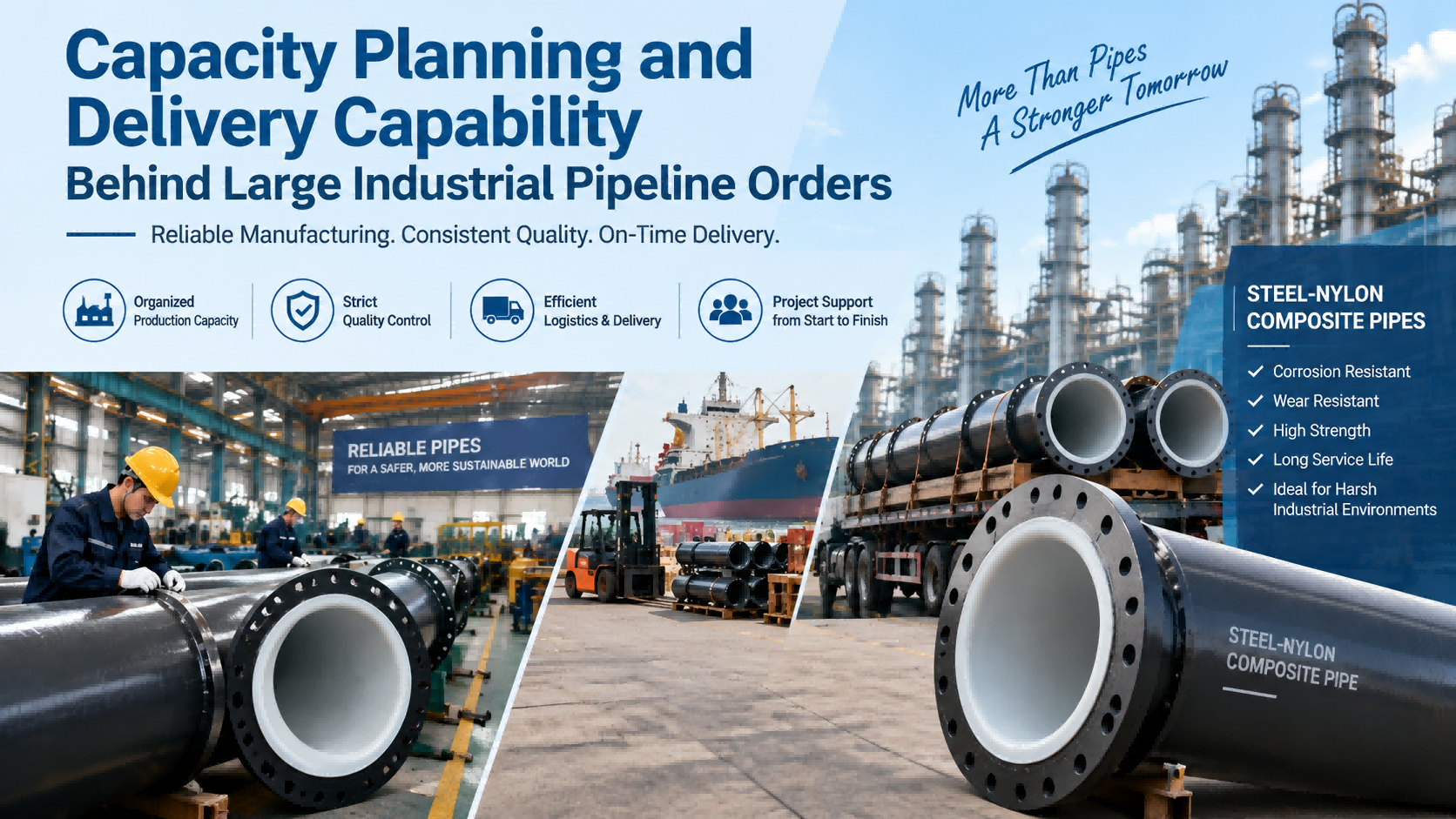
What Are the Technical Challenges in Manufacturing Large-Diameter Steel–Nylon Composite Pipes?

In chemical processing, oil and gas fields, mining, power generation, salt chemical industries, and large-scale industrial fluid transportation systems, the demand for large-diameter pipelines continues to grow. DN500, DN800, DN1000, and even DN2000-class industrial pipelines are increasingly being used in major projects.
However, manufacturing a larger pipe is not simply a matter of scaling up a smaller one.
For steel–nylon composite pipes, large-diameter manufacturing involves a series of technical challenges, including steel structural forming, nylon lining formation, dimensional stability, composite interface control, flange accuracy, pressure performance, thermal stress management, and manufacturing consistency.
If any of these factors are poorly controlled, problems such as deformation, leakage, lining failure, or connection instability may develop during long-term operation.
Therefore, what truly determines the performance of a large-diameter steel–nylon composite pipe is not simply the combination of two materials.
It is the systematic integration of materials, structural design, manufacturing technology, and engineering experience.
This article examines the key technical challenges involved in manufacturing large-diameter steel–nylon composite pipes and explains how these challenges can be addressed through mature composite-pipe manufacturing technology.
1. Why Are Large-Diameter Composite Pipes More Difficult to Manufacture?
For relatively small-diameter pipes, certain dimensional deviations can sometimes be compensated for by the inherent rigidity of the pipe or adjusted during installation.
As the diameter increases, however, manufacturing becomes significantly more demanding.
When a pipe diameter increases from DN200 to DN1200 or even DN2000, manufacturers must control far more than wall thickness.
Critical parameters include:
-
Roundness
-
Straightness
-
Concentricity
-
Flange flatness
-
Flange perpendicularity
-
Uniformity of the nylon layer
-
Structural rigidity
-
Thermal deformation
-
Dimensional compatibility between structural and functional layers
-
Long-term pressure stability
The challenge becomes even greater with a steel–nylon composite structure because steel and nylon belong to two very different material systems.
Steel provides high structural strength and rigidity, while nylon provides excellent corrosion resistance, wear resistance, and toughness.
The real technical challenge is therefore:
How can these two materials with very different physical properties be integrated into a stable piping structure capable of long-term industrial service?
2. Challenge One: Controlling the Roundness of the Large-Diameter Steel Structure
A large-diameter steel–nylon composite pipe first requires a stable structural framework.
The steel structure is primarily responsible for:
-
Overall pipe rigidity
-
Internal pressure resistance
-
External loads
-
Pipe support loads
-
Installation loads
-
Structural stresses in long-span piping systems
However, as the pipe diameter increases, the steel structure becomes more susceptible to manufacturing deviations such as:
-
Increased ovality
-
Local deformation
-
Welding shrinkage
-
Out-of-round pipe ends
-
Straightness deviations in long pipe sections
If the steel structure itself is not sufficiently round and dimensionally stable, maintaining a uniform nylon layer becomes much more difficult.
For example, the nylon layer may become thicker on one side and thinner on the other.
Over long-term operation, this unevenness may result in different stress distributions and different corrosion or wear allowances around the pipe circumference.
Therefore, the first challenge in manufacturing large-diameter steel–nylon composite pipes is achieving:
High-precision steel structural forming.
This requires systematic control of material preparation, plate forming, welding, roundness correction, dimensional calibration, and subsequent processing.
It cannot rely solely on final product inspection.
3. Challenge Two: Maintaining Uniform Nylon Layer Thickness
In DN100 or DN200 pipelines, the internal surface area is relatively limited.
When the diameter increases to DN1000 or above, however, the internal surface area that must be covered by the nylon functional layer increases dramatically.
This raises an important manufacturing question:
How can a consistent nylon layer thickness be maintained across the entire pipe circumference and length?
If the nylon layer becomes locally too thin, corrosion and wear resistance may be reduced in that area.
If it becomes excessively thick, other problems may occur, including:
-
Uneven cooling
-
Internal stress concentration
-
Differential shrinkage
-
Dimensional deviations
Large-diameter nylon layer manufacturing is therefore not simply a matter of using more material.
The entire forming process must carefully control:
Temperature distribution, material flow, processing pressure, cooling rate, and material shrinkage.
A mature large-diameter composite-pipe manufacturing process should create a stable, continuous, and relatively uniform nylon functional layer throughout the pipe.
4. Challenge Three: Managing Thermal Expansion Differences Between Steel and Nylon
This is one of the most important—and often underestimated—issues in composite piping design.
Steel and nylon have different thermal expansion characteristics.
When the operating temperature changes, the two materials do not expand or contract at the same rate.
This becomes particularly important in applications involving:
-
High-temperature media
-
Outdoor pipe racks with large day-night temperature variations
-
Desert environments
-
Cold-region oilfields
-
Chemical plants with frequent startup and shutdown cycles
Repeated temperature changes can continuously introduce thermal stresses into the composite structure.
In smaller pipes, these effects can often be easier to manage.
But as diameter increases, the total circumference becomes larger, meaning that even relatively small differences in unit thermal expansion can accumulate into much larger dimensional changes.
Large-diameter steel–nylon composite pipes must therefore take the following factors into account during structural design:
-
Differences in thermal expansion
-
Structural restraint
-
Forming stress
-
Cooling shrinkage
-
Long-term thermal cycling
Without proper control, interfacial stresses may gradually accumulate.
This is why a high-quality steel–nylon composite pipe should never be understood simply as:
“a steel pipe with plastic inside.”
It is fundamentally an engineered composite material piping system.
5. Challenge Four: Preventing Layer Separation and Long-Term Structural Failure
One of the most serious concerns with certain conventional lined piping systems is:
Delamination or lining separation.
In some rubber-lined, plastic-lined, or multilayer composite piping structures, long-term operation may result in lining deformation or separation due to:
-
Different thermal expansion rates
-
Negative pressure
-
Thermal cycling
-
Interface aging
-
Hydraulic impact
Possible consequences include blistering, separation, local collapse, or damage to the internal lining.
For large-diameter pipelines, such risks become particularly important because the lining surface area is much greater.
A local instability may eventually develop into a larger structural problem.
For this reason, our steel–nylon composite pipe design places strong emphasis on integrated structural stability.
Through appropriate structural design and manufacturing processes, the nylon functional layer and steel load-bearing structure are engineered to form a stable composite system rather than relying solely on conventional adhesive bonding for long-term performance.
This is particularly important in applications such as:
-
Large-diameter chemical pipelines
-
Oilfield produced-water systems
-
Salt chemical mother liquor transportation
-
Mining slurry pipelines
-
Flue gas desulfurization slurry systems
-
Industrial piping systems with significant pressure fluctuations
6. Challenge Five: Large-Diameter Flange Accuracy
When discussing large-diameter pipelines, engineers often focus on the pipe wall itself.
However, another critical area is frequently underestimated:
The flange connection.
In practice, many industrial pipeline leaks occur not in straight pipe sections but around:
-
Flanges
-
Valve connections
-
Elbows
-
Tees
-
Reducers
-
Pump discharge sections
For DN1000 and larger pipelines, flange diameters are substantial.
Even relatively small manufacturing deviations can result in:
-
Uneven sealing-surface loading
-
Uneven bolt preload
-
Insufficient local gasket compression
-
Forced alignment during installation
-
Increased long-term leakage risk
Therefore, large-diameter steel–nylon composite pipe manufacturing must control not only the pipe body but also:
Flange flatness, concentricity, perpendicularity, and sealing-face accuracy.
7. Why Do We Emphasize Integrated Flange Connections?
Our steel–nylon composite piping system uses flange connections, helping reduce the need for conventional field welding and complex hot-work procedures.
This can provide significant engineering value in large chemical plants, oil and gas facilities, and brownfield pipeline replacement projects.
Traditional steel pipeline installation often involves:
Cutting → Alignment → Welding → Weld Inspection → Anti-Corrosion Repair
In operating chemical or oil and gas facilities, especially those involving flammable or hazardous media, field welding may also require strict hot-work permits and additional safety controls.
Steel–nylon composite pipes connected through flanges can simplify parts of the installation process.
For large industrial projects, the benefits extend beyond installation speed.
Potential advantages include:
-
Reduced field hot work
-
Lower construction complexity
-
Lower risk of damaging corrosion-protection systems
-
Easier local maintenance and replacement
-
Potentially shorter shutdown periods during retrofit projects
Large-diameter steel–nylon composite piping is therefore not only a material solution.
It can also contribute to a more efficient industrial pipeline installation strategy.
8. Challenge Six: Balancing Rigidity and Weight in Large-Diameter Pipelines
This is an important issue in large-diameter industrial pipeline engineering.
If structural rigidity is achieved simply by increasing metal wall thickness, several consequences follow:
-
Increased pipe weight
-
Higher material cost
-
Greater support loads
-
More difficult lifting and installation
-
Higher structural and foundation costs
On the other hand, some fully non-metallic piping systems may require closer attention to:
-
Ring stiffness
-
Long-term creep
-
Large-diameter deformation
-
Support spacing
-
Structural stability under pressure and external loading
One of the core advantages of the steel–nylon composite structure is that different materials can perform different functions.
The Steel Structure Provides:
Mechanical strength and structural rigidity.
The Nylon Functional Layer Provides:
Corrosion resistance, wear resistance, and isolation between the transported medium and the steel structure.
This structural layer + functional layer philosophy reduces the need for a single material to satisfy every engineering requirement.
From an engineering-material perspective, this can be more rational than simply increasing the thickness of an expensive alloy or relying entirely on one material system.
9. Challenge Seven: Negative-Pressure Stability in Large-Diameter Pipes
Industrial pipelines do not always operate under positive pressure.
Temporary or transient negative pressure may occur due to:
-
Sudden pump shutdown
-
Rapid valve closure
-
Pipeline draining
-
Significant elevation differences
-
System startup and shutdown
-
Changes in fluid momentum
For certain flexible lining systems, negative pressure can cause:
Blistering, deformation, or inward collapse of the lining.
Because large-diameter pipelines have greater internal surface area and cross-sectional area, negative-pressure stability deserves particular attention.
The design of a large-diameter steel–nylon composite pipe should therefore consider both:
Positive-pressure performance and negative-pressure structural stability.
A single static working-pressure rating is not sufficient to describe the complete reliability of an industrial pipeline.
10. Challenge Eight: Corrosion and Wear Must Be Addressed Simultaneously
Many industrial media are not simply “corrosive.”
They often combine corrosion, abrasion, erosion, scaling, and solids.
For example:
Oilfield Produced Water
May contain:
-
High mineral content
-
CO₂
-
H₂S
-
Suspended solids
-
Sand particles
Soda Ash and Salt Chemical Mother Liquors
May contain:
-
High chloride concentrations
-
Dissolved salts
-
Chemically aggressive components
-
Crystalline particles
Mining Slurry and Desulfurization Slurry
May produce severe particle erosion and abrasive wear.
The real operating condition is therefore often:
Corrosion + erosion + abrasion + scaling.
Carbon steel is primarily challenged by corrosion.
Certain stainless steels may require careful evaluation for localized corrosion in chloride-containing environments.
Some non-metallic pipes provide excellent corrosion resistance but may require more detailed engineering assessment when used in high-pressure, large-diameter, or structurally demanding applications.
Steel–nylon composite pipes address the problem through a different design philosophy:
The steel structure handles mechanical loads, while the nylon layer manages contact with the process medium.
This division of functions is one of the key advantages of composite-material engineering.
11. Why Does a Smooth Inner Surface Matter in Large-Diameter Pipelines?
For high-flow industrial pipelines, internal surface condition can have a significant influence on long-term hydraulic performance.
In conventional steel pipes, long-term operation may produce:
-
Corrosion products
-
Rust layers
-
Salt deposits
-
Scaling
As deposits accumulate, the effective flow area may gradually decrease.
This means that maintaining the same flow rate may require higher pumping energy.
Nylon materials provide a relatively smooth internal surface.
Under suitable operating conditions, this can help reduce the tendency for certain deposits and scaling to accumulate and can contribute to more stable hydraulic performance over time.
For DN1000 and larger long-distance industrial pipelines, this characteristic can influence total lifecycle operating costs.
Therefore, industrial pipeline evaluation should not focus only on:
Initial cost per meter.
It should also consider:
Purchase cost + installation cost + energy consumption + maintenance + downtime + replacement cost.
This is why an increasing number of major industrial projects are applying Total Cost of Ownership (TCO) principles when selecting pipeline materials.
12. Challenge Nine: Maintaining Quality Consistency in Large-Diameter Production
Manufacturing one successful large-diameter composite pipe does not prove mature production capability.
The real challenge is:
Producing dozens, hundreds, or even several kilometers of pipe while maintaining consistent quality.
This requires a complete manufacturing and quality-control system.
Key control areas generally include:
Raw Material Stage
Inspection and verification of steel, nylon raw materials, and other relevant materials.
Steel Structure Manufacturing
Control of dimensions, welding quality, roundness, and structural accuracy.
Composite Forming Process
Control of temperature, pressure, material condition, and forming parameters.
Finished Product Inspection
Verification of dimensions, appearance, structural integrity, and relevant performance parameters.
Pre-Shipment Inspection
Appropriate quality checks and pressure testing according to project requirements.
Reliable large-diameter industrial piping should not simply be “tested into compliance” at the end of production.
Quality must be built into and controlled throughout the entire manufacturing process.
13. Why Does DN2000-Class Manufacturing Reflect a Manufacturer's True Capability?
As pipe diameter increases, requirements for equipment, molds, manufacturing processes, quality control, and handling systems all become significantly more demanding.
Manufacturing DN2000-class composite pipes involves much more than selecting the right material.
The manufacturer must also manage:
-
Large-scale forming equipment
-
Heavy-duty tooling
-
Mold accuracy
-
Temperature uniformity
-
Structural support
-
Lifting
-
Transportation
-
Large-diameter flange machining
-
Quality inspection
Therefore, a manufacturer's ability to consistently produce ultra-large-diameter composite piping is often a strong indicator of its overall capabilities in:
Materials, equipment, structural engineering, manufacturing processes, and industrial project experience.
Our steel–nylon composite pipe manufacturing capability covers large-diameter industrial piping requirements, including DN2000-class and larger specifications for appropriate projects.
This provides greater flexibility for applications in large chemical facilities, oil and gas fields, mining operations, and industrial water systems.
14. Why Are Steel–Nylon Composite Pipes Suitable for Complex Industrial Applications?
The core engineering concept of a steel–nylon composite pipe can be summarized very simply:
Steel for Strength
Nylon for Corrosion and Wear Resistance
In other words:
Steel addresses structural requirements, while nylon addresses medium-contact challenges.
This composite structure can combine:
-
High mechanical strength
-
Corrosion resistance
-
Wear resistance
-
Smooth internal surfaces
-
Reduced scaling tendency under suitable conditions
-
Wide temperature adaptability
-
Large-diameter manufacturing capability
-
Flange connections
-
Reduced need for conventional field welding
-
Lower long-term maintenance requirements
Depending on project requirements, our steel–nylon composite pipes can be supplied in different diameters and pressure classes.
Available product designs can cover working pressures of approximately 1.0–4.0 MPa and can be engineered for a wide range of demanding industrial transportation environments.
15. Typical Applications
Large-diameter steel–nylon composite pipes are particularly suitable for industrial applications such as:
Oil & Gas
-
Oil and gas gathering and transportation
-
Produced water
-
Water injection systems
-
Oilfield wastewater
Chlor-Alkali Industry
-
Caustic soda
-
Brine
-
Chemical circulation systems
Soda Ash Industry
-
Mother liquor
-
Brine
-
Process media
Mining
-
Mining slurry
-
Tailings
-
Mine backfilling pipelines
Power Plants
-
Flue gas desulfurization slurry
-
Industrial circulating water
Chemical Industry
-
Corrosive media
-
High-salinity fluids
-
Fluids containing suspended solids
Steel–nylon composite pipes are particularly worth evaluating in systems where conventional carbon steel pipelines frequently experience corrosion perforation, scaling, leakage, or repeated replacement.
In such applications, pipeline selection should be reconsidered from a total lifecycle cost perspective rather than initial purchase price alone.
16. What Should You Consider When Choosing a Large-Diameter Composite Pipe Manufacturer?
For major industrial projects, procurement teams should not focus only on the question:
“What is the price per meter for DN1000 pipe?”
More important questions include:
-
What is the manufacturer's maximum production diameter?
-
Does the manufacturer have long-term large-diameter project references?
-
What working pressure range can the system support?
-
Can materials and structures be adapted to the transported medium?
-
How are the flanges designed and manufactured?
-
How is nylon layer thickness consistency controlled?
-
How are roundness and concentricity controlled?
-
Has negative-pressure performance been considered?
-
Has thermal cycling been considered?
-
What quality-control procedures are applied before shipment?
-
Can the manufacturer supply elbows, tees, reducers, and customized fittings?
-
Can the manufacturer provide an integrated piping-system solution?
A mature large-diameter pipeline manufacturer should provide more than pipe products.
It should be capable of delivering:
Pipe + Fittings + Engineering + Application Experience
That means:
Piping products + fittings + engineering support + practical application expertise.
17. From Manufacturing Large Pipes to Solving Complex Industrial Problems
The real challenge in manufacturing large-diameter steel–nylon composite pipes is not simply producing DN1000, DN1600, or DN2000 diameters.
The real challenge is maintaining:
-
Structural stability
-
Uniform nylon layers
-
Accurate flange geometry
-
Reliable pressure performance
-
Long-term corrosion resistance
-
Long-term wear resistance
-
Stability under thermal cycling
-
Consistent manufacturing quality
Large-diameter composite piping is therefore a typical system-engineering product.
Its performance depends on the integration of:
Material Technology + Mechanical Design + Forming Process + Quality Control + Engineering Experience
Conclusion: Long-Term Reliability Is the Real Competitive Advantage of Large-Diameter Industrial Pipelines
The true value of an industrial pipeline is not determined when it leaves the factory.
It is demonstrated over ten years—or even longer—after the system is commissioned.
In large chemical, oil and gas, mining, and industrial transportation projects, a pipeline leak can generate costs far greater than the original price of the pipe.
These costs may include:
-
Production shutdowns
-
Maintenance
-
Labor
-
Environmental treatment
-
Safety risks
-
Replacement materials
-
Pipeline replacement
For this reason, large-diameter industrial pipeline selection is gradually shifting away from the traditional question:
“Which pipe has the lowest purchase price?”
Toward a more important question:
“Which piping system can operate reliably for a longer period?”
Steel–nylon composite piping has developed around this engineering principle.
The steel structure provides mechanical strength and rigidity.
The nylon functional layer addresses corrosion, wear, and scaling-related challenges.
Combined with large-diameter manufacturing capability, integrated structural design, and flange connection technology, steel–nylon composite pipes provide an alternative solution for industrial transportation systems requiring both mechanical performance and resistance to aggressive media.
For engineering companies planning DN500, DN800, DN1000, DN1600, or even DN2000-class pipelines for corrosive or abrasive media, material selection should not be based simply on material names.
Instead, the entire operating condition should be evaluated, including:
Medium + Temperature + Pressure + Flow Velocity + Solid Content + Installation Environment + Total Lifecycle Cost
That is the real foundation of reliable large-diameter industrial pipeline selection.
Need Help Selecting Large-Diameter Industrial Piping?
If your project involves corrosive, abrasive, high-salinity, or otherwise demanding industrial media, our engineering team can help evaluate the operating conditions and recommend an appropriate steel–nylon composite piping solution.
Please provide:
-
Transported medium
-
Operating temperature
-
Working pressure
-
Pipe diameter
-
Flow velocity
-
Solid content
-
Installation environment
-
Required service conditions
Based on these parameters, we can evaluate the piping system from the perspectives of material selection, diameter, pressure class, fittings, and connection design.
How Are Industrial Pipes Rated for 1.0–4.0 MPa Manufactured Consistently and Reliably?
From Raw Material Inspection to Final Delivery: The Complete Quality Control Process for Industrial Piping