Large-Diameter Water Supply Pipe Selection: How to Balance Pressure Resistance, Corrosion Protection, and Lifecycle Costs

Introduction: Why Is Large-Diameter Water Supply Pipe Selection Becoming Increasingly Important?
With the continued expansion of urban infrastructure, industrial parks, water treatment facilities, and long-distance water transmission projects, large-diameter water supply pipelines are becoming essential components of modern water infrastructure.
In municipal water transmission networks, industrial cooling water systems, raw water transportation projects, and large-scale water treatment plants, pipelines ranging from DN600 and DN800 to DN1200, DN1600, and even DN2000 are increasingly important.
Compared with smaller pipelines, large-diameter water supply pipes must handle greater flow volumes while overcoming several engineering challenges:
-
Pressure losses and pumping energy consumption during long-distance water transportation.
-
High operating pressures and water hammer caused by pump starts, stops, and valve operations.
-
Corrosion from soil conditions, moisture, and aggressive water chemistry.
-
External loads, pipe weight, and differential ground settlement.
-
Transportation, lifting, installation, and connection challenges.
-
Long-term maintenance expenses and economic losses caused by pipeline failures.
Therefore, selecting large-diameter water supply pipes is no longer simply a matter of comparing material prices. It requires a comprehensive evaluation of material properties, structural reliability, hydraulic efficiency, installation requirements, and total lifecycle costs.
Traditional materials such as carbon steel, ductile iron, HDPE, and fiberglass-reinforced plastic (FRP) each offer advantages. However, they may also face limitations under corrosive, high-pressure, or complex operating conditions.
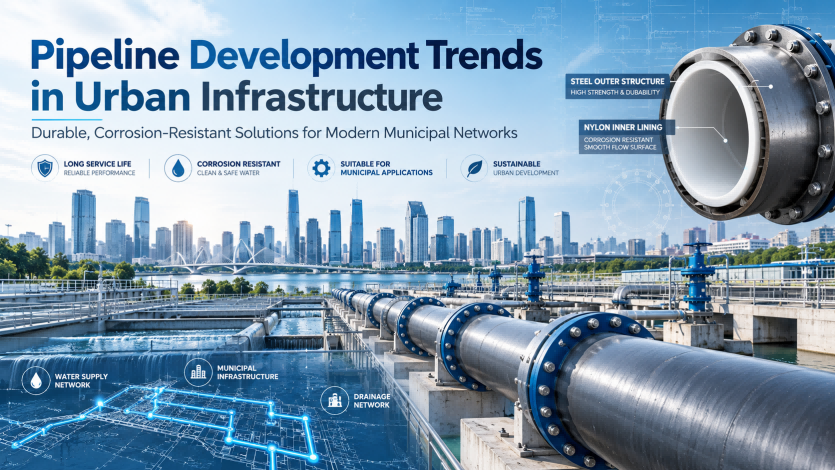
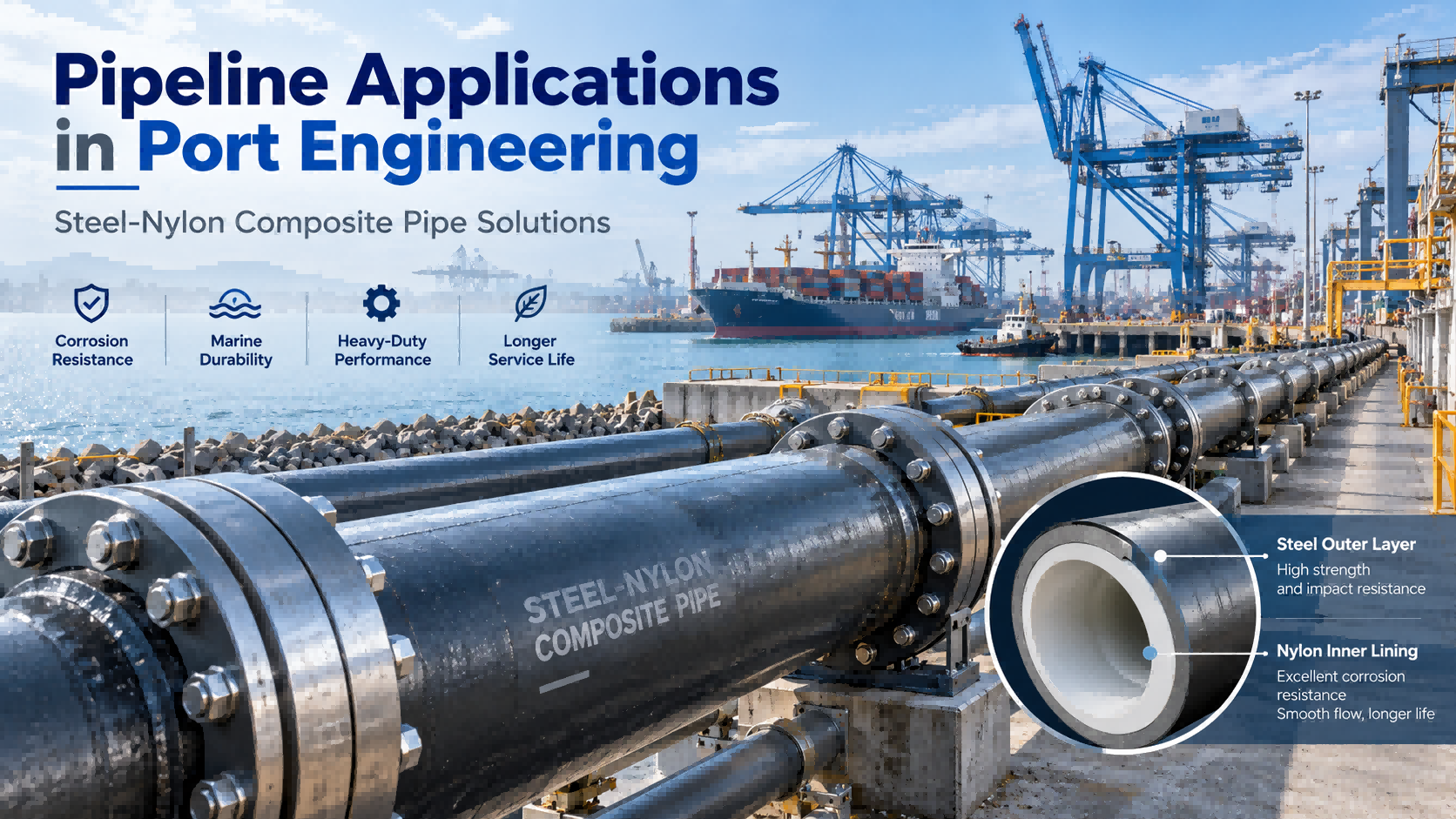
Steel–nylon composite pipes combine the structural characteristics of steel with the corrosion and abrasion resistance of engineering nylon, providing an alternative solution for demanding industrial water transmission applications.
This article explores the key considerations involved in selecting large-diameter water supply pipelines and explains the potential engineering advantages of steel–nylon composite pipes.
1. Five Major Challenges in Large-Diameter Water Supply Pipeline Systems
1.1 High Flow Requirements and Hydraulic Performance
Large-diameter water supply pipelines are designed to transport substantial volumes of water continuously.
For example, a large industrial park may require tens or hundreds of thousands of cubic meters of process water per day. Municipal water transmission networks must also accommodate increasing urban water demand.
The transportation capacity of a pipeline depends primarily on:
-
Actual internal pipe diameter.
-
Water flow velocity.
-
Internal surface roughness.
-
Pipeline length and local hydraulic resistance.
-
Elevation differences and pumping system configuration.
The basic flow equation is:
Q = (πD²/4) × V
Where:
-
Q = Volumetric flow rate (m³/s)
-
D = Actual internal pipe diameter (m)
-
V = Average flow velocity (m/s)
This equation demonstrates that, at the same flow velocity, transportation capacity increases with the square of the internal diameter.
Importantly, hydraulic calculations must use the actual internal diameter rather than simply substituting the nominal pipe diameter (DN).
Different wall thicknesses and structural designs in steel–nylon composite pipes, HDPE pipes, and other piping systems may result in different internal diameters, directly affecting hydraulic performance.
1.2 High Operating Pressure and Water Hammer
Large-scale water supply systems must withstand more than normal operating pressure.
Pressure fluctuations can occur when pumps start or stop, valves close rapidly, or flow conditions change unexpectedly.
These transient pressure variations are commonly known as water hammer.
For large-diameter, long-distance transmission pipelines, engineers should evaluate:
-
Maximum normal operating pressure.
-
Minimum system pressure and potential vacuum conditions.
-
Maximum transient pressure.
-
Pressure ratings of pipes and connections.
-
Pipe supports, restraints, and axial thrust forces.
-
Surge protection devices and air-release systems.
Selecting a pipeline based only on normal operating pressure may be insufficient to ensure long-term reliability.
Steel–nylon composite pipes combine a steel structural component with a nylon working layer, providing a potential solution for applications requiring both pressure resistance and corrosion protection.
However, actual pressure ratings must be verified according to pipe diameter, steel specifications, composite structure, joint configuration, and operating conditions.
A pressure rating achieved by one pipe size should not automatically be assumed to apply to all diameters.
1.3 Long-Term Corrosion and Pipeline Reliability
Corrosion is not limited to chemical processing facilities. It is also a significant concern in conventional water transportation systems.
Several operating environments can increase corrosion risks.
Underground installations
Soil moisture, salinity, electrical resistivity, and stray currents may contribute to external corrosion of metallic pipelines.
Industrial water transportation
Industrial cooling water, saline raw water, and certain types of reclaimed water may contain elevated concentrations of chlorides, dissolved salts, and other aggressive substances.
Coastal and seawater applications
Salt spray, high humidity, and chloride-containing water create challenging conditions for exposed metal components and protective coatings.
Unprotected carbon steel pipes may experience internal or external corrosion over time.
Steel–nylon composite pipes use a nylon working layer to separate the transported medium from the steel substrate, helping reduce direct exposure of the internal steel surface to corrosive water.
However, external steel surfaces, pipe ends, flanges, and other exposed metallic components still require appropriate corrosion protection.
1.4 Installation Complexity Increases with Pipe Diameter
For pipelines larger than DN1200, installation costs can become a major component of total project expenditure.
Typical challenges include:
-
Heavy lifting equipment requirements.
-
Transportation and on-site storage.
-
Welding and connection procedures.
-
Protective coating repairs at joints.
-
Trench excavation and backfilling.
-
Installation tolerances and alignment control.
In operating industrial facilities, on-site welding may also require additional safety procedures and production coordination.
Consequently, connection methods affect not only installation efficiency but also construction schedules and operational risks.
1.5 Maintenance and Water Supply Interruption Costs
For large industrial water supply systems, pipeline failures can generate costs far beyond the price of replacing a damaged section.
A major leakage incident may involve:
-
Pipe repair and replacement.
-
Excavation and surface restoration.
-
Emergency maintenance equipment and labor.
-
Production shutdowns.
-
Water supply interruptions.
-
Environmental remediation and potential liability.
These hidden expenses explain why more engineering projects are adopting lifecycle cost analysis when selecting large-diameter pipeline materials.
2. Comparison of Common Large-Diameter Water Supply Pipe Materials
Common materials used in large-diameter water supply projects include carbon steel, ductile iron, HDPE, fiberglass-reinforced plastic, and composite piping systems.
Each material offers different advantages and limitations.
| Pipe Material | Main Advantages | Limitations and Considerations | Typical Applications |
|---|---|---|---|
| Carbon Steel Pipe | High structural strength, flexible fabrication, suitable for large diameters | Requires appropriate internal and external corrosion protection | Major water transmission pipelines, pumping stations, long-distance water transportation |
| Ductile Iron Pipe | Good pressure resistance, standardized products, extensive application history | Internal and external protection must be selected according to water and soil conditions | Municipal water supply and urban distribution networks |
| HDPE Pipe | Resistance to many corrosive environments, relatively lightweight, reliable heat-fused joints | Temperature effects, long-term creep, deformation, and large-diameter pressure design require evaluation | Municipal water supply, buried pipelines, selected trenchless projects |
| FRP Pipe | Relatively lightweight, resistant to many corrosive water environments | Ring stiffness, impact resistance, point loading, joint integrity, and installation quality require attention | Water treatment plants, raw water pipelines, industrial cooling water systems |
| Steel–Nylon Composite Pipe | Combines steel structural capacity with nylon corrosion and abrasion resistance | Composite integrity, joint sealing, long-term performance, and project compliance must be verified | Industrial water supply, aggressive water environments, and combined corrosion-abrasion applications |
The comparison does not mean that one material is universally superior to all others.
For example, HDPE performs well in many low- and medium-pressure underground applications, while ductile iron has an established record in municipal water distribution networks.
Steel is widely used where high structural capacity and fabrication flexibility are required.
The main engineering advantage of steel–nylon composite pipes is their ability to combine structural strength, corrosion resistance, and abrasion protection within a single piping solution.
This makes them particularly relevant when multiple operating challenges must be addressed simultaneously.
3. Why Consider Steel–Nylon Composite Pipes for Large-Diameter Water Supply Projects?
For long-term water transportation systems, steel–nylon composite pipes offer several potential engineering benefits.
3.1 Combining Steel Structural Strength with Nylon Corrosion Protection
Conventional steel pipelines rely on metallic materials to provide structural strength, but they often require additional internal protection in corrosive environments.
Steel–nylon composite pipes integrate different materials within one structure.
The steel component provides structural support, while the nylon working layer comes into contact with the transported medium.
This design offers several potential benefits:
-
Steel provides the mechanical properties needed for the applicable structural design.
-
The nylon layer helps prevent direct contact between the transported medium and the internal steel surface.
-
Engineering nylon provides abrasion-resistant properties for certain particle-containing liquids.
-
The composite structure can be designed to address strength, corrosion protection, and hydraulic performance simultaneously.
For saline raw water, industrial reclaimed water, and environments involving both corrosion and abrasion, this combination can offer meaningful advantages.
However, nylon is not compatible with every oxidizing chemical, strong acid, or elevated-temperature environment.
Chemical compatibility should be verified using the actual nylon formulation, fluid composition, concentration, and operating temperature.
3.2 Smooth Internal Surfaces and Long-Term Hydraulic Efficiency
Hydraulic performance directly influences the energy consumption of large water transmission systems.
As water flows through a pipeline, friction between the fluid and the internal surface causes pressure loss.
At the same flow rate and effective internal diameter, a smoother internal surface generally helps reduce frictional resistance.
The nylon working layer of steel–nylon composite pipes provides a relatively smooth water-contact surface and helps limit corrosion-related roughening of the internal steel surface.
Potential long-term benefits include:
-
Reducing roughness increases associated with internal steel corrosion.
-
Helping maintain consistent hydraulic performance.
-
Potentially reducing certain deposits and cleaning requirements.
-
Limiting pressure-loss changes caused by corrosion products.
However, these advantages should be evaluated using measured surface roughness and project-specific hydraulic calculations.
Steel–nylon composite pipes should not automatically be assumed to have lower friction losses than HDPE or every other smooth-wall piping material.
3.3 Abrasion Resistance for Challenging Water Conditions
Not all large-diameter water pipelines transport clean drinking water.
Typical applications may involve:
-
River and reservoir raw water.
-
Industrial intake water containing suspended sediment.
-
Mining process water.
-
Cooling water containing suspended particles.
-
Water entering industrial treatment facilities.
These fluids may contain abrasive particles that gradually damage pipe bends, tees, and high-velocity sections.
Enhanced engineering nylon offers useful abrasion-resistant characteristics under suitable operating conditions.
For pipelines exposed to both corrosion and particle-related wear, steel–nylon composite pipes can provide an alternative material solution.
Actual wear resistance depends on particle hardness, concentration, size, fluid velocity, and impact angle.
Project-specific testing or relevant operating records should therefore support expected service-life evaluations.
3.4 Integral Molded Flanges for More Convenient Installation
Flanged connections are important components of many large-diameter industrial water transmission systems.
They are particularly useful at:
-
Pumping stations.
-
Valve chambers.
-
Equipment inlets and outlets.
-
Water treatment facilities.
-
Pipeline sections requiring periodic disassembly.
Our integral molded flange solutions can reduce certain on-site fabrication requirements when the product design and project specifications permit.
Reduced on-site hot work
Prefabricated flanged sections allow connections to be assembled using bolts instead of requiring welding at every connection point.
Improved installation efficiency
Factory-prefabricated pipe sections and matching flanges help reduce field fabrication activities.
Convenient maintenance
Properly designed flange connections allow selected sections to be disconnected for inspection, replacement, or equipment maintenance.
Compatibility with large industrial equipment
Custom flange designs can accommodate the interface requirements of pumps, valves, and industrial water treatment equipment.
Nevertheless, connection reliability still depends on gasket selection, bolt preload, flange flatness, and pipe support design.
For long-distance buried transmission mains, engineers should compare flanged connections with welded or other joint systems to determine the most suitable and economical solution.
3.5 Customized Solutions for Complex Engineering Requirements
Large water supply projects often require more than standardized pipe dimensions.
Examples include:
-
Special pipe diameters for industrial parks.
-
Higher transient pressure requirements at pumping stations.
-
Additional external corrosion protection for coastal installations.
-
Combined corrosion and abrasion resistance in mining operations.
-
Custom connections for existing pipeline rehabilitation projects.
We can work with project engineers to evaluate pipe dimensions, composite structures, flange configurations, fittings, and manufacturing requirements.
Developing a solution around actual operating conditions can improve compatibility with the overall water transportation system.
4. How to Select DN600–DN2000 Large-Diameter Water Supply Pipes
Large-diameter pipe selection should begin with hydraulic calculations, operating pressure, water quality, and installation conditions.
Pipe diameter alone is insufficient to determine the appropriate solution.
The following table provides an illustrative comparison of water transportation capacity at different flow velocities.
| Actual Internal Diameter | Flow at 1.0 m/s | Flow at 1.5 m/s | Flow at 2.0 m/s |
|---|---|---|---|
| 600 mm | 1,018 m³/h | 1,527 m³/h | 2,036 m³/h |
| 800 mm | 1,810 m³/h | 2,714 m³/h | 3,619 m³/h |
| 1000 mm | 2,827 m³/h | 4,241 m³/h | 5,655 m³/h |
| 1200 mm | 4,072 m³/h | 6,107 m³/h | 8,143 m³/h |
| 1600 mm | 7,238 m³/h | 10,857 m³/h | 14,476 m³/h |
| 2000 mm | 11,310 m³/h | 16,965 m³/h | 22,619 m³/h |
Note: These theoretical flow rates are calculated using the stated actual internal diameters. They do not represent guaranteed capacities or recommended design velocities for specific nominal pipe sizes.
Excessively high flow velocities may increase friction losses, pressure transients, and localized erosion.
Very low velocities may increase sedimentation risks and affect project economics.
Therefore, engineers should consider:
-
Design flow rate and peak demand.
-
Allowable head loss and pumping energy consumption.
-
Water chemistry and suspended particle content.
-
Pressure ratings and transient operating conditions.
-
Initial investment and long-term operating costs.
A larger pipe diameter generally reduces flow velocity and friction losses, but it does not necessarily result in the lowest total project cost.
The optimal diameter should be determined by balancing construction investment and long-term energy expenditure.
5. Engineering Example: How Pipe Diameter Affects 20-Year Operating Costs
For long-distance, large-diameter water pipelines, material purchase price represents only one part of the total cost.
Differences in flow velocity and friction losses can significantly influence pumping energy consumption over time.
5.1 Project Assumptions
Consider a hypothetical industrial water transmission project with the following design conditions:
| Parameter | Assumption |
|---|---|
| Pipeline Length | 2,000 m |
| Design Flow Rate | 1.2 m³/s |
| Internal Diameters Compared | 1,000 mm and 1,200 mm |
| Transported Fluid | Clean water at ambient temperature |
| Annual Operating Hours | 8,000 hours |
| Overall Pumping Efficiency | 75% |
| Assumed Darcy Friction Factor | 0.018 |
5.2 Hydraulic Performance Comparison
The Darcy–Weisbach equation can be used to estimate frictional head loss:
hf = f × (L/D) × (V²/2g)
Where:
-
hf = Frictional head loss (m)
-
f = Darcy friction factor
-
L = Pipeline length (m)
-
D = Actual internal diameter (m)
-
V = Average flow velocity (m/s)
-
g = Gravitational acceleration (m/s²)
Under these assumptions, the estimated performance is:
| Parameter | 1000 mm Internal Diameter | 1200 mm Internal Diameter |
|---|---|---|
| Flow Rate | 1.2 m³/s | 1.2 m³/s |
| Average Flow Velocity | 1.53 m/s | 1.06 m/s |
| Frictional Head Loss Over 2 km | Approximately 4.28 m | Approximately 1.72 m |
The estimated difference in frictional head loss is approximately 2.56 meters.
Using the pumping power equation:
ΔP = (ρ × g × Q × Δh) / η
The estimated pumping power difference is approximately 40.2 kW.
At 8,000 operating hours per year, this represents approximately 322,000 kWh of annual electricity consumption.
If electricity costs USD 0.12/kWh, the estimated annual cost difference is approximately:
USD 38,600 per year
Over 20 years, assuming unchanged operating conditions and electricity prices, the undiscounted electricity cost difference would be approximately:
USD 772,000
This calculation illustrates the economic importance of proper hydraulic design.
It does not imply that larger-diameter pipelines are always more economical or that the energy savings are attributable to a particular pipe material.
A complete evaluation should include actual internal diameters, pipe roughness, fitting losses, static head, pump performance, capital investment differences, and the time value of money.
5.3 Why Compare Steel–Nylon Composite Pipes?
The calculation above primarily demonstrates the influence of pipe diameter on hydraulic operating costs.
After determining an economically appropriate diameter, engineers must compare the long-term behavior of different pipe materials.
If a pipe experiences internal corrosion, roughness increases, or localized abrasion during operation, its maintenance requirements and hydraulic performance may change.
Steel–nylon composite pipes use a corrosion-resistant working layer to reduce direct interaction between the transported fluid and the internal steel surface.
This can support long-term operating stability under suitable conditions.
Therefore, material selection for DN1000, DN1200, and larger pipelines should consider hydraulic efficiency, structural reliability, and maintenance costs rather than purchase price alone.
6. How to Calculate Total Cost of Ownership (TCO) for Large-Diameter Water Supply Pipelines
Industrial water supply projects should increasingly evaluate pipeline materials based on total cost of ownership rather than initial purchase prices alone.
TCO includes several major cost categories:
TCO = C0 + Ci + Ce + Cm + Cr + Cd
Where:
-
C0 = Pipe and fitting procurement costs.
-
Ci = Transportation and installation costs.
-
Ce = Energy costs during operation.
-
Cm = Inspection, maintenance, and repair costs.
-
Cr = Replacement and rehabilitation costs.
-
Cd = Downtime and indirect economic losses.
For a rigorous economic evaluation, future cash flows should also be discounted to present value using an appropriate discount rate.
6.1 Carbon Steel Pipes
Conventional carbon steel pipelines may offer competitive initial material costs.
However, projects must account for protective coatings, internal linings, corrosion monitoring, and potential rehabilitation expenses.
6.2 HDPE Pipes
HDPE offers strong resistance to many corrosive environments and convenient installation characteristics.
However, large-diameter, higher-pressure applications require careful evaluation of wall thickness, actual internal diameter, support requirements, and connection costs.
6.3 Ductile Iron Pipes
Ductile iron has extensive application experience in water supply networks.
However, challenging soil and water conditions may require additional protective measures.
6.4 Steel–Nylon Composite Pipes
For suitable operating environments, combining steel structural capacity with nylon corrosion protection may help reduce certain corrosion-related maintenance, rehabilitation, and downtime expenses.
These potential benefits should be quantified using actual quotations, project-specific service-life assessments, and supporting operating data.
For continuously operating industrial water systems, the value of pipeline materials is determined not only by their purchase price but also by their ability to support reliable operation over many years.
7. Typical Applications of Large-Diameter Steel–Nylon Composite Pipes
7.1 Industrial Park Water Supply Systems
Large industrial parks require stable water supplies for manufacturing processes, cooling facilities, and water treatment equipment.
Steel–nylon composite pipes can be evaluated where both pressure resistance and corrosion protection are important.
Their composite structure provides an alternative to conventional steel or other piping materials for complex industrial water environments.
7.2 Power Plant Cooling Water and Make-Up Water Systems
Power plants often operate large-diameter cooling water pipelines continuously.
Pipe selection must account for:
-
High flow rates.
-
Hydraulic efficiency.
-
Corrosion and scaling.
-
Long-term operating reliability.
-
Maintenance and shutdown costs.
Steel–nylon composite pipes can be considered for industrial cooling water and make-up water applications when the fluid chemistry and operating conditions are compatible.
7.3 Coastal Water Transportation and Saline Raw Water Systems
Coastal infrastructure faces aggressive environments caused by salt spray, humidity, and chloride-containing water.
Potential applications include seawater pretreatment, saline raw water transportation, and coastal industrial water intake systems.
The nylon working layer helps limit direct exposure of internal steel surfaces to the transported medium, while suitable external protection addresses corrosion risks outside the pipe.
7.4 Mining Water Supply and Raw Water Transportation
Mining operations frequently require large quantities of water for mineral processing, equipment cooling, and general production.
Mining water systems may involve suspended sediment, challenging terrain, and long transmission distances.
For applications involving both corrosion and abrasion, steel–nylon composite pipes offer a material combination worth evaluating.
Important Consideration for Drinking Water Applications
Industrial water compatibility should not be confused with drinking water compliance.
Steel–nylon composite pipes should not automatically be considered suitable for potable water simply because nylon is described as non-toxic.
All water-contact materials, including the nylon working layer, seals, and other components, must satisfy applicable health and regulatory requirements in the destination market.
For example, NSF/ANSI/CAN 61 addresses health-related requirements for drinking water system components in applicable North American projects.
Separate structural, pressure, and long-term durability assessments are still required.
8. Eight Essential Technical Parameters for Large-Diameter Water Supply Pipe Procurement
Before requesting quotations, engineering contractors, EPC companies, consultants, and project owners should provide manufacturers with accurate operating information.
| Technical Parameter | Required Information | Influence on Pipe Selection |
|---|---|---|
| Pipe Diameter | Nominal diameter and required actual internal diameter | Flow capacity, wall thickness, hydraulic efficiency |
| Pressure | Normal, maximum, transient, and test pressures | Structural design and pressure rating |
| Water Quality | pH, chloride content, salinity, and other relevant constituents | Chemical compatibility and corrosion protection |
| Temperature | Normal, minimum, and maximum operating temperatures | Material properties and pressure suitability |
| Suspended Solids | Particle concentration, size, and hardness | Abrasion-resistant design |
| Installation Method | Underground, aboveground, pipe rack, or coastal installation | External loading, corrosion protection, and supports |
| Connection Type | Flanged, welded, mechanical, or other joints | Installation efficiency and joint reliability |
| Design Service Life | Target operating life and maintenance strategy | Lifecycle cost and validation requirements |
Engineering teams should also request supporting documentation from potential manufacturers.
Important documents may include:
-
Product structural drawings.
-
Material inspection reports.
-
Pressure test records.
-
Composite-layer quality inspection reports.
-
Dimensional tolerances.
-
Flange specifications.
-
Sealing system details.
-
Relevant compliance certificates.
For ultra-large-diameter projects, specialized structural verification, hydraulic analysis, and pilot section testing may also be necessary.
9. How to Determine Whether Steel–Nylon Composite Pipes Are Suitable for Your Project
Steel–nylon composite pipes are not intended to replace every traditional pipeline material.
Their value becomes especially relevant when projects must address several engineering challenges simultaneously.
Scenario 1: Frequent Corrosion of Conventional Steel Pipelines
If existing steel water pipelines experience recurring internal corrosion problems, steel–nylon composite pipes can be compared with internally lined steel and other corrosion-resistant alternatives.
The evaluation should consider maintenance frequency, protective layer reliability, and lifecycle costs.
Scenario 2: High Pressure Combined with Corrosive Water
Where projects require both structural capacity and internal corrosion protection, a steel–nylon composite structure may offer a suitable engineering approach.
Pipe pressure ratings and composite integrity must be verified for the intended diameter and operating conditions.
Scenario 3: Water Containing Abrasive Particles
Raw water, mining water, and certain industrial reclaimed water streams may contain suspended solids.
The abrasion-resistant characteristics of enhanced nylon make it relevant for evaluation in these applications.
Scenario 4: Prefabricated Installation and Reduced On-Site Welding
For industrial facilities where hot work is restricted, prefabricated pipe sections and integral molded flange connections may help reduce certain field installation activities.
This can be particularly useful near existing pumps, valves, and process equipment.
Scenario 5: High Maintenance and Downtime Costs
For continuously operating water transmission systems, avoiding unplanned failures can deliver considerable economic value.
A detailed TCO analysis can help determine whether investing in a more durable pipe solution provides an acceptable long-term return.
However, projects involving unverified oxidizing chemicals, extreme temperatures, special drinking water requirements, or pressure conditions beyond validated product capabilities should undergo additional testing and technical assessment before material selection.
10. How We Support Global Large-Diameter Water Supply Pipeline Projects
As a manufacturer specializing in enhanced MC nylon pipes and steel–nylon composite pipes, we focus on helping industrial customers address demanding transportation requirements.
Our solutions are developed for industrial applications where corrosion resistance, abrasion resistance, and structural performance are important considerations.
10.1 Large-Diameter Manufacturing and Customization
We can discuss project requirements involving DN600, DN800, DN1000, DN1200, DN1600, and larger pipeline sizes, with final manufacturing capabilities confirmed according to the specific product series and project specifications.
For large-scale projects, we can also evaluate:
-
Composite structure design.
-
Pipe diameter and length.
-
Flange configuration.
-
Connection requirements.
-
Transportation and installation constraints.
10.2 Corrosion-Resistant and Abrasion-Resistant Solutions
By combining enhanced engineering nylon with steel structural components, our products provide options for demanding industrial water transportation environments.
For specialized applications, material suitability can be evaluated based on:
-
Fluid composition.
-
Chemical concentration.
-
Operating pressure.
-
Operating temperature.
-
Suspended solid content.
-
Expected abrasion conditions.
This project-specific approach helps customers make more informed material selection decisions.
10.3 Integral Molded Flanges and Matching Fittings
We offer flange connection and fitting solutions designed to meet the installation requirements of large industrial pipelines.
Our engineering priorities include connection reliability, installation efficiency, and maintenance accessibility.
Prefabricated solutions can also help reduce certain on-site fabrication requirements.
10.4 Technical Support for Overseas Engineering Projects
We recognize that international EPC contractors, engineering companies, industrial project owners, and pipeline distributors need more than a basic product quotation.
Effective pipe selection begins with understanding the actual operating conditions.
From initial inquiries to engineering discussions, we work to evaluate:
-
Transported medium.
-
Operating pressure.
-
Temperature range.
-
Required flow capacity.
-
Pipeline diameter.
-
Installation environment.
-
Connection specifications.
-
Long-term operating expectations.
Our goal is not simply to supply a pipe product, but to help customers identify industrial piping solutions that balance reliability, durability, and lifecycle economics.
11. Frequently Asked Questions (FAQ)
Q1: Which is better for large-diameter water supply systems, steel pipes or composite pipes?
The answer depends on water chemistry, operating pressure, pipe diameter, installation conditions, and project budget.
Conventional steel pipes offer structural design advantages, while steel–nylon composite pipes are worth considering when internal corrosion protection and structural capacity must be addressed together.
The final decision should be supported by technical verification and lifecycle cost analysis.
Q2: Are steel–nylon composite pipes suitable for water supply pipelines larger than DN1000?
Steel–nylon composite pipes can be evaluated for large-diameter applications, but manufacturing capability, pressure ratings, structural calculations, and connection designs must be confirmed for each project.
For DN1000, DN1200, DN1600, and larger diameters, engineering verification should be performed rather than relying directly on smaller-pipe performance data.
Q3: Can steel–nylon composite pipes transport seawater and high-salinity raw water?
Steel–nylon composite structures may be suitable for certain saline water applications.
However, engineers must evaluate actual salinity, fluid chemistry, temperature, and long-term operating requirements.
External steel surfaces, pipe ends, and flange components also require appropriate corrosion protection.
Q4: What is the service life of large-diameter steel–nylon composite pipes?
Service life cannot be determined solely by the material name.
It depends on operating pressure, temperature, water chemistry, abrasion, connection design, installation quality, and maintenance conditions.
Expected performance should be assessed using relevant testing, operating records, and project-specific requirements.
Q5: How can long-term operating costs be reduced in large-diameter water supply pipelines?
Four key strategies include:
-
Selecting an economically appropriate internal diameter.
-
Minimizing unnecessary hydraulic losses.
-
Reducing corrosion- and abrasion-related maintenance.
-
Improving connection quality and installation reliability.
For continuously operating systems, a lifecycle cost model should include energy consumption, maintenance expenses, replacement costs, and the financial impact of water supply interruptions.
Conclusion: Large-Diameter Water Supply Pipe Selection Should Focus on Long-Term Value
In large industrial water supply and long-distance transmission projects, pipelines are more than simple water transportation components.
They are critical infrastructure assets that influence system reliability, energy efficiency, maintenance requirements, and long-term operating costs.
Traditional carbon steel, ductile iron, HDPE, and FRP pipes will continue to play important roles in different engineering applications.
However, for projects that must simultaneously address structural strength, corrosion resistance, abrasion protection, and installation efficiency, steel–nylon composite pipes offer an alternative material solution worth evaluating.
Their fundamental advantage comes from combining steel structural characteristics with the protective properties of an engineering nylon working layer.
This composite approach allows engineers to address multiple challenges within a single piping system.
As infrastructure owners increasingly prioritize operational reliability and lifecycle economics, large-diameter pipeline selection is moving beyond initial material price comparisons.
Future competitiveness will depend more heavily on:
-
Structural reliability.
-
Corrosion and abrasion performance.
-
Hydraulic efficiency.
-
Installation quality.
-
Maintenance requirements.
-
Total lifecycle costs.
For DN600–DN2000-class water transmission projects, careful material selection, thorough operating-condition analysis, and reliable manufacturing quality remain essential to successful long-term performance.
Looking for a Reliable Large-Diameter Water Supply Pipe Solution?
Are you planning a large industrial water supply, raw water transportation, cooling water, coastal intake, or mining water transmission project?
We can help evaluate steel–nylon composite pipe solutions based on your required diameter, operating pressure, flow rate, water chemistry, and installation conditions.
Our engineering team can also assist in comparing conventional materials with composite piping solutions in terms of corrosion resistance, abrasion protection, connection design, and total lifecycle costs.
Contact us to discuss a customized large-diameter industrial water supply pipeline solution for your next project.
Website: //www.nylonpipeline.com
Specializing in enhanced nylon pipes and steel–nylon composite pipes, providing corrosion-resistant, abrasion-resistant, and customized industrial piping solutions for global engineering projects.
Technical Note: Hydraulic calculations, energy consumption estimates, and cost comparisons in this article are illustrative engineering examples and do not constitute guaranteed product performance. Actual project designs should be supported by verified product specifications, applicable standards, testing, and engineering calculations.
Urban Drainage System Upgrades with Steel-Nylon Pipes
Municipal Water Supply Pipe Material Comparison: Ductile Iron, HDPE, PVC, Stainless Steel, and Steel–Nylon Composite Pipes