As Tailings Transport Distances Increase, What Are the New Requirements for Pipelines?

From Wear and Corrosion Resistance to Long-Term Reliability: How Steel–Nylon Composite Pipes Address the Challenges of Modern Tailings Transportation
As mining operations expand, mineral processing technologies advance, and tailings disposal requirements become increasingly stringent, tailings transportation systems are facing more complex engineering challenges.
In the past, tailings transportation distances were relatively short in some mining operations, with pipelines primarily transporting slurry from processing plants to nearby tailings storage facilities.
However, in some large-scale mining projects, changes in tailings storage locations, the development of centralized disposal facilities, and complex terrain conditions have resulted in transportation routes extending several kilometers or even tens of kilometers.
As transportation distances increase, pipelines must overcome not only greater hydraulic resistance but also continuous abrasion, pressure fluctuations, corrosion caused by complex media, sedimentation, blockage, and increasing maintenance difficulties.
For long-distance tailings transportation systems, pipelines are no longer simply conveying components. They are critical infrastructure that directly affects continuous mining operations, operating costs, and environmental safety.
So, what new requirements do increasing tailings transportation distances place on pipeline materials and transportation systems?
And how can steel–nylon composite pipes provide effective solutions for mining companies?
1. Why Are Tailings Transportation Distances Increasing?
Tailings are the residual materials generated after ore undergoes crushing, grinding, separation, and other mineral processing operations. They are typically transported as slurries containing large quantities of solid particles.
Changes in tailings transportation distances are closely related to mining conditions, production capacity, and tailings disposal strategies.
1.1 Increasing Demand for Centralized Transportation Systems in Large-Scale Mines
For large open-pit mines or mining operations with multiple extraction areas, mineral processing plants and tailings disposal facilities are not necessarily located in the same area.
Some projects require tailings generated from multiple production areas to be transported to a centralized disposal facility to meet operational and tailings management requirements.
This arrangement may require pipelines to cross mountains, hillsides, valleys, and other complex terrain.
As pipeline lengths increase, the requirements for pressure resistance, mechanical strength, and long-term reliability become more demanding.
1.2 More Constraints on Tailings Storage Facility Locations
The selection of tailings storage facilities requires comprehensive consideration of geological conditions, terrain, hydrology, environmental protection, and engineering safety.
In some projects, suitable tailings disposal locations may be far from the mineral processing plant.
Consequently, mining companies must construct longer pipeline transportation systems to connect processing plants with tailings disposal facilities.
When pipelines need to cross complex terrain, conventional short-distance pipeline design approaches may no longer satisfy all engineering requirements.
1.3 Greater Emphasis on Long-Term Operating Costs
Long-distance tailings transportation involves multiple cost factors, including pipeline procurement, pumping station construction, energy consumption, maintenance, and tailings disposal.
Mining projects typically have long operating lifecycles.
If pipelines frequently experience abrasion-related failures, leakage, or joint failures, maintenance expenses increase, and the entire tailings transportation system may need to be shut down.
Therefore, the focus of long-distance tailings pipeline selection is shifting from simply considering the initial purchase price to evaluating service life, transportation efficiency, maintenance costs, and overall system reliability.
2. Requirement One: Higher Wear Resistance to Reduce Pipeline Wall Loss During Long-Term Transportation
Tailings transportation differs significantly from ordinary clean-water transportation.
Tailings slurry typically contains solid particles of different sizes, potentially including quartz, metallic minerals, and other hard mineral particles.
As these particles continuously flow through the pipeline, they cause erosion and abrasive wear on the internal pipe wall.
2.1 Why Cumulative Wear Becomes More Important in Long-Distance Transportation
Pipeline wear is influenced not only by the wear resistance of the pipe material but also by several operating factors:
-
Hardness, shape, and particle size distribution of the solids.
-
Tailings slurry concentration and transportation velocity.
-
Wear resistance of the internal pipeline material.
-
Pipeline elbows, diameter transitions, and other local structural features.
-
Actual operating duration and frequency of system startup and shutdown.
In long-distance transportation systems, even when the wear rate of an individual pipe section is relatively low, continuous operation over an extended period can result in significant wall loss.
Wear risks may be particularly high at elbows, diameter transitions, and locations where flow conditions change significantly.
Once localized wear penetrates the pipe wall, it can result in tailings leakage, production interruptions, and environmental contamination.
Therefore, long-distance tailings pipelines require excellent wear resistance and appropriate engineering designs to minimize localized excessive wear.
2.2 How Do Steel–Nylon Composite Pipes Improve Wear Resistance?
Traditional steel pipes rely primarily on their metal walls to provide both transportation and pressure-bearing functions.
When continuously transporting slurry containing hard particles, the internal surfaces of steel pipes may experience abrasive wear and erosion.
Steel–nylon composite pipes combine a steel load-bearing structure with a reinforced nylon inner layer.
The reinforced nylon lining utilizes the wear-resistant characteristics of polymer materials while reducing direct contact between the transported medium and the steel pipe wall.
For tailings slurries that are compatible with the material, this structure can help reduce pipe wall wear and extend maintenance and replacement intervals.
Meanwhile, the steel structure provides the necessary mechanical support and pressure-bearing capacity, helping the pipeline maintain structural stability under demanding operating conditions.
The core advantage of steel–nylon composite pipes lies in combining the structural strength of steel with the wear resistance of reinforced nylon, providing an alternative solution for tailings transportation systems that require both pressure resistance and abrasion protection.
However, the hardness, particle size, and transportation velocity of different tailings slurries can vary considerably.
For highly abrasive media, wear testing and actual operating-condition assessments should be conducted to determine the appropriate lining material and thickness.
3. Requirement Two: Greater Pressure-Bearing Capability to Accommodate Long-Distance Transportation and Complex Terrain
As tailings transportation distances increase, pipeline systems must overcome greater frictional resistance.
For tailings transportation systems using pumps, transportation distance, slurry density, elevation differences, and internal pipeline resistance all affect pumping station configuration and pressure distribution.
3.1 More Pressure Factors Must Be Considered in Long-Distance Transportation
Pipeline design must comprehensively evaluate several important factors.
Frictional pressure loss: As tailings slurry flows through a pipeline, resistance generates pressure losses. When transportation distances increase, the accumulated frictional pressure loss must also be considered.
Elevation differences: When pipelines cross mountains and valleys, the static pressure at different locations may vary significantly.
Local pressure losses: Elbows, valves, reducers, and other pipeline components may increase flow resistance.
Transient pressure fluctuations: Pump startup, shutdown, valve operation, and unexpected power failures may cause transient pressure changes.
If the pressure-bearing capacity of the pipeline material does not match actual operating conditions, the risk of pipeline damage and leakage at connection points may increase.
Long-distance pipeline design should therefore verify not only normal operating pressure but also transient pressure conditions, including shutdown, restart, and other abnormal operating scenarios.
3.2 Structural Advantages of Steel–Nylon Composite Pipes
The pressure-bearing capacity of single-material nonmetallic pipes can be affected by material strength, temperature, pipe diameter, and long-term operating conditions.
Steel–nylon composite pipes use a steel structure to carry the primary mechanical loads, while the nylon inner layer provides media isolation and wear protection.
When properly designed, this composite structure combines mechanical strength with internal surface protection.
Our company manufactures steel–nylon composite pipes in pressure classes ranging from 1.0 to 4.0 MPa, providing various product options for different engineering requirements.
For long-distance tailings transportation projects, we can assist customers in selecting appropriate pipe specifications based on design pressure, pipe diameter, slurry characteristics, and connection methods.
It is important to note that long-distance transportation does not necessarily mean that the required pipeline pressure rating falls within the 1.0–4.0 MPa range.
For projects involving significant elevation differences, high pumping pressures, or substantial transient pressure fluctuations, hydraulic calculations and pressure verification must be completed before determining whether a specific product is suitable.
4. Requirement Three: Improved Corrosion Resistance to Handle Complex Tailings Slurries
Tailings slurries may be not only highly abrasive but also chemically corrosive.
Different mines have different ore compositions, mineral processing technologies, and chemical reagents.
Consequently, the chemical properties of tailings slurries can vary considerably.
For example, some tailings transportation media may contain high salt concentrations, while others may be acidic or alkaline. Certain slurries may also contain components that cause corrosion of metallic materials.
For ordinary carbon steel pipelines, corrosion can result in wall thinning and localized perforation.
When corrosion and abrasion occur simultaneously, pipe wall deterioration can become more complex.
4.1 Why Is Corrosion Resistance More Important in Long-Distance Transportation?
Long-distance pipelines often pass through multiple terrain and environmental zones.
If internal corrosion occurs, maintenance personnel may need to inspect numerous pipeline sections to identify the location of a failure.
Additionally, some pipelines are installed in remote mountainous areas or locations with limited accessibility, making maintenance and repairs more difficult.
Therefore, pipeline material selection should aim to minimize direct contact between the transported medium and corrosion-sensitive structural materials.
4.2 Corrosion Protection Through Steel–Nylon Composite Pipe Design
Steel–nylon composite pipes use reinforced nylon as the inner layer that comes into contact with the transported medium.
When the material is chemically compatible with the operating conditions, the nylon lining isolates the tailings slurry from the steel load-bearing structure, reducing the risk of direct corrosion of the steel pipe wall.
For tailings transportation applications involving both abrasion and corrosion, this composite structure offers potential advantages.
Compared with pipelines that rely entirely on a metal wall to perform all functions, steel–nylon composite pipes make use of the distinct characteristics of steel and nonmetallic materials.
However, nylon is not suitable for every chemical medium.
For strong acids, highly oxidizing media, and high-temperature operating conditions, material compatibility must be assessed based on the actual chemical composition, concentration, temperature, and exposure duration.
Material suitability should not be determined solely by the pH value of the slurry.
5. Requirement Four: Controlling Flow Resistance While Balancing Energy Consumption and Sedimentation Prevention
Long-distance tailings transportation systems often operate continuously for extended periods.
Under these conditions, pipeline flow resistance directly affects pumping energy consumption and overall operating costs.
However, lower transportation velocity does not necessarily result in lower overall energy consumption.
For slurries containing settleable solid particles, excessively low flow velocity can cause particles to accumulate along the bottom of the pipeline.
This can reduce the effective flow area and, in severe cases, cause pipeline blockage.
Conversely, excessively high flow velocity may increase pressure losses, pumping energy consumption, and pipe wall erosion.
Therefore, tailings transportation systems must operate within an appropriate range that balances sedimentation prevention, wear reduction, and energy efficiency.
The concentration, rheological properties, pipe diameter, and operating flow rate of tailings slurry can all influence sedimentation behavior, hydraulic resistance, and the final pipeline design.
5.1 How Does the Internal Pipe Surface Affect Transportation Efficiency?
The condition of the internal pipe surface is one of the factors influencing flow resistance.
Steel–nylon composite pipes feature a relatively smooth nylon inner surface.
Under appropriate operating conditions, a smooth internal surface can help control local flow resistance and reduce certain changes in the flow passage caused by internal surface damage or corrosion.
However, actual transportation resistance is also affected by slurry concentration, particle composition, flow velocity, pipe diameter, and rheological properties.
The hydraulic characteristics of clean-water transportation cannot be directly applied to high-concentration tailings slurries.
For specific projects, tailings sample testing and hydraulic calculations should be used to verify the suitability of the internal pipe diameter and operating velocity.
5.2 The Application Value of Large-Diameter Pipelines
For mining projects requiring high transportation capacity, properly designed large-diameter pipelines can help control flow velocity and frictional pressure loss while meeting the required throughput.
Our company has the manufacturing capability to produce large-diameter steel–nylon composite pipes and can supply different product specifications according to project requirements.
By appropriately matching pipe diameter, lining thickness, and pressure-bearing structure, large-diameter composite pipes can help meet the transportation capacity and mechanical performance requirements of major tailings transportation projects.
However, larger pipe diameters are not always better.
An excessively large diameter may result in insufficient flow velocity during low-load operation, increasing the risk of particle sedimentation.
Therefore, large-diameter pipeline selection must consider normal flow rates, minimum flow rates, slurry concentration, and actual transportation distance.
6. Requirement Five: More Reliable Pipeline Connections to Reduce Leakage Risks Along Long-Distance Routes
For long-distance tailings transportation systems, the reliability of pipeline connections is just as important as the performance of the pipe itself.
Even when a pipe has excellent wear resistance, corrosion resistance, and pressure-bearing capacity, poorly designed connections can still lead to leakage.
This is particularly important in complex terrain, where pipelines may be subjected to temperature changes, ground settlement, installation deviations, and operational vibration.
These factors can introduce additional loads at connection points.
6.1 Long-Distance Pipelines Require Reliable Connection Systems
Several factors should be considered during pipeline design and installation:
-
Whether the connection structure is compatible with the pipeline design pressure.
-
Whether the sealing materials are suitable for the transported medium.
-
Whether flange connections have sufficient structural strength.
-
Whether pipeline supports and anchoring arrangements are appropriate.
-
Whether temperature variations and ground settlement generate additional loads.
-
Whether connection points are accessible for subsequent inspection and maintenance.
For long-distance tailings transportation systems, properly designed connections help reduce the risk of joint failure and localized leakage.
6.2 Advantages of Integrally Molded Flange Connections
Our company places considerable emphasis on the overall performance of both the pipe body and its connection components when designing steel–nylon composite pipes.
Through structural designs such as integrally molded flanges, the pipeline connection ends can be coordinated with the internal protective structure, reducing potential failure risks associated with inadequate end-connection design.
Flange connections also facilitate pipeline installation, section removal, and localized maintenance.
For mining areas where on-site welding is undesirable, prefabricated flange connections can reduce the need for field welding operations, provided that the connections comply with engineering design requirements.
However, flange connections do not automatically eliminate leakage risks.
In practical engineering applications, flange structures, gaskets, and fasteners must be selected according to the transported medium, pressure class, and operating conditions.
Installation quality must also be strictly controlled.
For long-distance tailings transportation, reliable pipeline connection solutions can improve overall system sealing performance while reducing maintenance difficulties.
7. Requirement Six: Greater Operational Reliability in Complex Environments to Reduce Maintenance Difficulties
Tailings transportation routes may cross mountains, deserts, valleys, and other areas with limited transportation access.
Some pipeline sections may also be installed underground.
When failures occur in these areas, maintenance personnel and equipment may require considerable effort to reach the affected location.
If pipe wall penetration or major leakage occurs, the transportation system may need to be shut down, followed by extensive cleanup of the spilled material.
Therefore, mining companies must carefully consider maintenance accessibility and actual service environments when selecting pipeline materials.
7.1 Long-Term Structural Stability
Long-distance tailings pipelines require not only good internal wear resistance but also sufficient external mechanical strength to meet engineering requirements.
For example, buried pipeline projects must consider soil loads, foundation conditions, and external corrosion environments.
For aboveground pipelines, temperature fluctuations, pipeline supports, external impacts, and thermal expansion and contraction must also be evaluated.
Steel–nylon composite pipes use a steel structure to provide mechanical support, while the reinforced nylon inner layer performs the corresponding media protection functions.
This structure combines pressure-bearing and internal protection functions, offering additional material options for slurry transportation in complex environments.
For areas with significant geological activity, ground settlement, or substantial displacement, pipeline deformation capacity and connection structures must be evaluated separately.
Mechanical strength alone cannot solve all engineering challenges.
7.2 Shifting From Reactive Repairs to Preventive Maintenance
High-performance pipeline materials can help reduce certain failure risks, but stable operation of long-distance tailings transportation systems still requires effective maintenance management.
Elbows, low-lying pipeline sections, valves, and connection points should be inspected according to actual wear conditions and operating requirements.
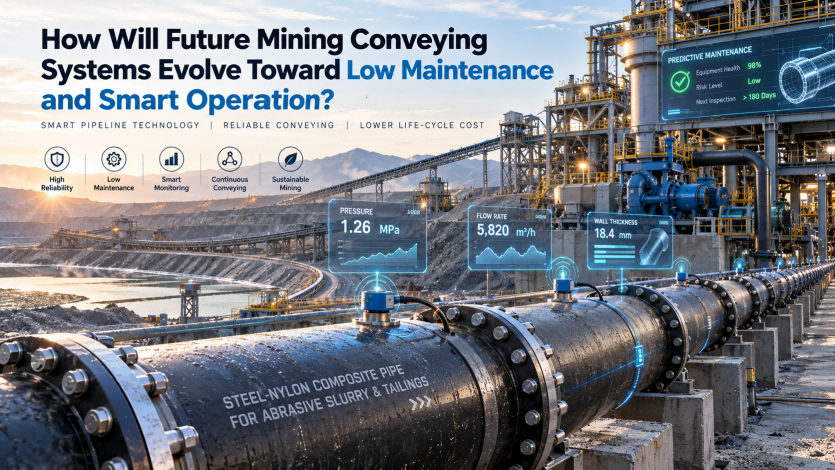
For critical pipeline sections, wall thickness testing, pressure monitoring, and flow monitoring can be used to assess operating conditions.
Combining durable pipeline materials with optimized maintenance management helps reduce unplanned downtime and extend the effective service life of the transportation system.
8. Requirement Seven: Adaptability to High-Concentration Tailings and Complex Startup and Shutdown Conditions
With advances in tailings thickening and water recovery technologies, some mining operations are transporting tailings slurries at higher solids concentrations.
High-concentration tailings transportation can help reduce the amount of transportation water required in certain projects, but it may also increase pipeline design complexity.
As slurry concentration increases, its viscosity, yield stress, and flow characteristics may change.
Some high-concentration tailings slurries exhibit non-Newtonian fluid behavior, meaning their transportation resistance cannot be calculated using conventional clean-water or low-concentration slurry models.
After pipeline shutdown, certain slurries may also experience particle sedimentation, structural rebuilding, or difficulties during system restart.
Therefore, long-distance high-concentration tailings transportation systems must be designed according to the actual rheological characteristics of the slurry and the expected operating conditions.
Application Considerations for Steel–Nylon Composite Pipes in High-Concentration Tailings Transportation
For compatible high-concentration tailings slurries, steel–nylon composite pipes can utilize the reinforced nylon inner layer to provide wear protection while relying on the steel structure to meet the required mechanical load-bearing requirements.
However, high-concentration transportation is not simply a matter of selecting an appropriate pipe material.
Engineering design must also consider:
-
Slurry rheological properties and sedimentation tendencies.
-
Internal pipe diameter and appropriate transportation velocity.
-
Minimum pipeline operating flow rate.
-
Sedimentation and restart conditions following pump shutdown.
-
Pipeline flushing and blockage removal procedures.
-
Pumping station pressure and pipeline pressure-bearing capacity.
For high-concentration, coarse-particle, or poorly flowing tailings slurries, appropriate transportation tests should be conducted before finalizing pipe materials and diameters.
Only by combining pipe material performance with proper hydraulic system design can the application value of composite pipelines be fully realized.
9. How Should Different Tailings Transportation Pipeline Materials Be Selected?
Common pipeline materials used in mining tailings transportation systems include carbon steel pipes, wear-resistant rubber-lined steel pipes, HDPE pipes, and other composite pipelines.
Different materials have distinct structural characteristics and operating limitations.
| Pipeline Material | Main Characteristics | Key Selection Considerations |
|---|---|---|
| Carbon steel pipe | High mechanical strength and well-established engineering applications | Particle abrasion, internal and external corrosion, and maintenance requirements |
| Rubber-lined steel pipe | Combines a steel structure with an elastic, wear-resistant lining | Rubber compatibility with the medium, lining aging, localized debonding, and joint sealing |
| HDPE pipe | Good corrosion resistance in suitable environments and relatively low weight | Temperature, pressure, pipe diameter, long-term creep, and external loads |
| FRP pipe | Relatively lightweight and offers corrosion resistance under suitable conditions | Internal wear under highly abrasive conditions, impact resistance, and connection design |
| Steel–nylon composite pipe | Combines a steel load-bearing structure with a reinforced nylon inner layer, providing mechanical strength and internal protection | Media compatibility, lining wear life, pressure rating, and connection structure |
For ordinary tailings slurries with relatively low abrasiveness, several pipeline materials may be suitable.
However, for transportation projects involving high mechanical loads, particle abrasion, and corrosion risks, steel–nylon composite pipes are worth considering as a potential material solution.
Their advantage lies in using a composite structure to provide mechanical support and internal protection separately, reducing the limitations associated with requiring a single material to perform multiple functions simultaneously.
Nevertheless, actual material selection should be based on project-specific operating conditions and testing data.
For projects involving extremely abrasive media, high temperatures, or complex chemical compositions, the performance and actual service life of different wear-resistant lining materials should be evaluated further.
10. From Initial Purchase Price to Total Cost of Ownership: How Can Long-Distance Tailings Pipelines Reduce Costs?
For short-distance pipeline projects, the initial material purchase price may be a major factor in pipeline selection.
However, when tailings transportation distances increase to several kilometers or even tens of kilometers, actual pipeline costs are influenced by many additional factors.
Beyond initial procurement expenses, companies must consider installation, pumping energy consumption, maintenance, production downtime, and pipeline replacement costs.
Therefore, mining companies should place greater emphasis on the Total Cost of Ownership (TCO) when selecting tailings transportation pipelines.
10.1 What Does the Total Cost of Ownership Include?
The following model can be used for a preliminary economic assessment:
Total Pipeline Cost of Ownership = Initial Procurement Cost + Installation Cost + Operating Energy Cost + Maintenance and Repair Cost + Pipeline Replacement Cost + Failure-Related Downtime Costs
Consider a mining project that needs to construct a long-distance tailings transportation pipeline.
Option A uses a pipeline material with a relatively low initial purchase price, but worn pipe sections may need to be replaced frequently during long-term operation.
Option B uses a composite pipeline designed with greater emphasis on wear protection and long-term reliability.
Although its initial procurement cost may differ, it may offer lower overall operating costs if it reduces pipeline replacement frequency and unplanned downtime.
For such projects, comparing only the purchase price per meter does not fully reflect the economic value of different pipeline solutions.
10.2 Long-Term Economic Value of Steel–Nylon Composite Pipes
Our company focuses on improving pipeline wear resistance, corrosion resistance, and reducing maintenance requirements as key directions in product development and application.
By combining a reinforced nylon inner layer with a steel structure, steel–nylon composite pipes can help reduce pipe wall abrasion and the risk of direct corrosion of the steel structure under suitable operating conditions.
For long-distance tailings transportation projects, if engineering verification demonstrates that the pipes can reduce wear rates, decrease maintenance frequency, and extend replacement intervals, they may deliver several economic benefits:
-
Fewer unplanned shutdowns caused by localized pipe wall penetration.
-
Lower material and labor costs associated with frequent pipe section replacement.
-
Reduced maintenance and construction-related costs in remote areas.
-
Lower material losses and cleanup expenses resulting from leakage.
-
Improved long-term operational reliability of the tailings transportation system.
It is important to emphasize that the economic benefits of different pipeline materials must be evaluated using actual operating data, expected service life, and cost calculations.
The most economically suitable pipeline solution is not necessarily the one with the lowest initial purchase price, but the one that achieves a reasonable total cost of ownership while meeting all necessary safety and engineering requirements.
11. How Do We Provide Steel–Nylon Composite Pipe Solutions for Long-Distance Tailings Transportation Projects?
As a professional industrial pipeline manufacturer, our company specializes in reinforced MC nylon pipes and steel–nylon composite pipes.
We are committed to providing wear-resistant and corrosion-resistant pipeline products for mining, chemical processing, and other industrial applications.
For long-distance tailings transportation projects, we focus on matching pipeline material performance with actual engineering requirements.
11.1 Selecting Appropriate Pipeline Structures Based on Tailings Characteristics
Tailings from different mining operations vary in particle composition, slurry concentration, chemical properties, and transportation temperature.
Based on the operating parameters provided by customers, we can evaluate the suitability of reinforced nylon linings and select appropriate product structures according to wear and corrosion conditions.
For applications involving higher levels of abrasion, lining thickness and maintenance strategies should be evaluated based on testing results and the expected service life.
11.2 Providing Different Diameters and Pressure Classes
Our company has the manufacturing capability to produce large-diameter steel–nylon composite pipes.
Our regular production range extends to DN1600, and we also possess the manufacturing and development capabilities required for larger-diameter products.
For mining projects with different transportation capacities, suitable pipe diameters and product specifications can be selected according to flow rate, slurry characteristics, operating pressure, and engineering design requirements.
We also offer pressure classes ranging from 1.0 to 4.0 MPa to meet the selection requirements of different industrial transportation applications.
The specific design pressure, operating temperature, diameter, and connection structure of each product should be determined according to the technical specifications and engineering verification results for the relevant product.
11.3 Connection Design and Installation Convenience
Long-distance tailings transportation systems involve numerous pipeline connections.
We place particular emphasis on the connection structure of steel–nylon composite pipes.
Through solutions such as integrally molded flanges, we provide customers with product options that facilitate installation and subsequent maintenance.
For projects requiring reduced on-site welding, prefabricated flange connection solutions can be evaluated according to pipeline layout and construction requirements.
11.4 From Pipe Manufacturing to Engineering Application Support
Selecting pipes for long-distance tailings transportation requires comprehensive consideration of material performance, slurry characteristics, pressure distribution, pipe diameter, connection structure, and operating environment.
Through material modification, composite structure optimization, and improvements in manufacturing technology, we aim to provide pipeline products that are better suited to different mining applications.
During the preliminary project stage, we can assist with material and connection selection based on the technical parameters provided by customers and support engineering verification in cooperation with project design teams.
12. What Key Parameters Should Be Confirmed Before Selecting Long-Distance Tailings Pipelines?
To improve pipeline selection accuracy, mining companies should provide comprehensive operating-condition information whenever possible before purchasing pipeline products.
| Key Parameter | Information to Confirm | Influence on Pipeline Selection |
|---|---|---|
| Transportation distance | Total pipeline length and individual section lengths | Affects frictional pressure loss and overall system layout |
| Transportation flow rate | Normal, maximum, and minimum operating flow rates | Affects pipe diameter, flow velocity, and sedimentation risk |
| Tailings concentration | Mass concentration, volume concentration, and variation range | Affects slurry flow characteristics and transportation resistance |
| Solid particle properties | Particle size distribution, maximum particle size, density, and hardness | Affects pipe wall wear and sedimentation risk |
| Chemical properties of the medium | pH, salinity, chemical reagents, and other corrosive components | Affects compatibility with the nylon lining and sealing materials |
| Transportation temperature | Normal, maximum, and minimum temperatures | Affects material performance and design pressure |
| Pipeline terrain | Elevation difference, high and low points along the route, and installation method | Affects static pressure distribution, support design, and transient conditions |
| Operating pressure | Normal operating pressure, maximum pressure, and transient pressure | Affects the pressure design of pipes and connections |
| Operating mode | Continuous or intermittent operation and startup/shutdown frequency | Affects sedimentation control and maintenance requirements |
| Design service life | Expected service life and maintenance accessibility | Affects lining thickness, maintenance strategy, and economic evaluation |
For long-distance, high-concentration, or highly abrasive tailings transportation projects, appropriate material compatibility, wear resistance, and rheological testing should be conducted using actual tailings samples.
Compared with selecting pipeline materials solely based on diameter and transportation distance, a comprehensive assessment of operating parameters helps improve the suitability and reliability of the final pipeline solution.
Conclusion: The Longer the Tailings Transportation Distance, the Greater the Importance of Overall Pipeline Performance
The challenges facing long-distance tailings transportation systems are no longer limited to whether slurry can be transported from a mineral processing plant to a tailings disposal facility.
As transportation distances increase, pipeline systems must simultaneously address particle abrasion, media corrosion, pressure fluctuations, slurry sedimentation, energy consumption, and maintenance management.
Therefore, mining companies should move beyond evaluating individual material properties and adopt a more comprehensive approach to pipeline selection.
Pipelines must not only possess sufficient mechanical strength to meet engineering requirements but also provide appropriate wear and corrosion resistance while remaining compatible with the actual slurry characteristics, transportation pressure, and connection methods.
By combining a steel structure with a reinforced nylon inner layer, steel–nylon composite pipes offer a pipeline solution that integrates mechanical load-bearing capacity, wear protection, and media isolation for long-distance tailings transportation systems.
For mining projects involving complex media, difficult maintenance conditions, and the need for continuous long-term operation, properly selected steel–nylon composite pipes, combined with sound hydraulic design and maintenance management, can help improve operational reliability and reduce certain costs associated with wear, corrosion, and unplanned downtime.
Looking ahead, we will continue developing our products through reinforced nylon material modification, steel–nylon composite structure optimization, large-diameter pipe manufacturing, and reliable connection technologies.
Our goal is to provide increasingly suitable pipeline products for mining tailings transportation and other demanding industrial conveying applications.
Contact Us | Find the Right Pipeline Solution for Your Tailings Transportation Project
If you are planning a new long-distance tailings transportation project, or if your existing pipelines are experiencing abrasion, corrosion, leakage, or high maintenance costs, we welcome you to contact us.
Based on your tailings characteristics, transportation distance, pipe diameter, operating pressure, and actual service environment, we can provide product selection support for steel–nylon composite pipes.
Contact us today to obtain product technical documentation, pipeline specifications, and a steel–nylon composite pipe selection solution tailored to your project requirements.
High-Solids Slurry Is Driving the Evolution of Wear-Resistant Pipeline Materials
Why Slurry Transportation Pipelines Are Becoming a Key Factor in Reducing Mining Costs