Marine Engineering Pipe Selection: PA6 Nylon Guide

Marine Engineering Pipe Selection Guide: Why PA6 Nylon Pipes Are Emerging as a Corrosion-Resistant Solution
As global offshore resource development, seawater desalination, marine energy projects, port construction, and coastal industrial infrastructure continue to expand, the performance requirements for marine engineering piping systems are becoming increasingly demanding.
In marine engineering projects, pipelines do much more than transport fluids. They directly affect operational safety, energy consumption, maintenance requirements, equipment reliability, and long-term operating costs.
Compared with conventional onshore industrial pipelines, marine piping systems must withstand challenging conditions, including high salinity, humidity, seawater corrosion, suspended particle abrasion, pressure fluctuations, and complex installation environments.
Traditional materials such as carbon steel, stainless steel, HDPE, and fiberglass-reinforced plastic (FRP/GRP) each offer specific engineering advantages. However, they also have limitations under certain operating conditions.
As a result, engineering companies and industrial buyers are increasingly moving beyond initial material prices and focusing on corrosion resistance, abrasion resistance, structural reliability, installation efficiency, and total cost of ownership (TCO).
Against this background, high-performance engineering nylon pipes manufactured from Polyamide 6 (PA6) are becoming an alternative worth evaluating for selected seawater transportation and coastal industrial applications.
This comprehensive guide examines the technical requirements of marine engineering pipelines, compares common piping materials, and explains the potential advantages and application limitations of PA6 nylon pipes in seawater environments.
It also provides practical selection guidance for EPC contractors, marine engineers, project developers, and industrial pipeline procurement specialists.
1. Why Do Marine Engineering Projects Require Higher-Performance Piping Materials?
Marine environments are among the most demanding operating conditions for industrial piping systems.
Unlike conventional freshwater pipelines, marine pipelines are exposed to multiple chemical, mechanical, and environmental factors that can significantly affect their performance and service life.
1.1 High Chloride Concentrations Increase Corrosion Risks
Natural seawater typically contains approximately 3.5% dissolved salts, with chloride ions playing a particularly important role in metal corrosion.
When transporting seawater over extended periods, metallic piping systems may experience several types of corrosion:
-
General and localized corrosion of carbon steel.
-
Pitting and crevice corrosion of stainless steel.
-
Galvanic corrosion between dissimilar metals.
-
Corrosion around welds, flanges, and sediment accumulation areas.
-
Internal deposits that reduce the effective flow area.
An important consideration is that conventional stainless steel grades such as 304 and 316 are not necessarily suitable for maintenance-free operation in seawater.
The corrosion performance of stainless steel depends heavily on alloy composition, operating temperature, chloride concentration, and local environmental conditions.
For this reason, marine pipeline material selection must consider not only initial mechanical strength but also long-term resistance to chloride-containing environments.
1.2 Suspended Sand and Solid Particles Accelerate Pipeline Wear
Marine pipelines do not always transport clean seawater.
In coastal intake systems, ports, estuaries, and desalination facilities, seawater may contain sand, shell fragments, sediment, and other suspended particles.
As these particles move through the pipeline, they continuously interact with the internal pipe surface.
Abrasion and erosion can become particularly severe in:
-
Pipeline elbows and bends.
-
Pipe fittings and transitions.
-
High-velocity flow sections.
-
Pump discharge pipelines.
-
Areas experiencing turbulent flow.
When mechanical wear and corrosion occur simultaneously, metallic pipelines may experience erosion-corrosion, a degradation mechanism that can accelerate material loss.
Therefore, abrasion resistance is often just as important as corrosion resistance when selecting pipelines for seawater containing suspended solids.
1.3 Salt Spray and Humidity Increase External Corrosion Risks
In coastal industrial facilities, even pipelines transporting freshwater can experience severe external environmental exposure.
Continuous contact with salt spray, humidity, condensation, and occasional seawater splashing can accelerate corrosion of exposed metallic surfaces.
Typical applications include:
-
Offshore platform utility water pipelines.
-
Island water supply systems.
-
Coastal power plant cooling water pipelines.
-
Port industrial piping networks.
-
Seawater desalination auxiliary systems.
Metal pipelines often require protective coatings, periodic inspection, and corrosion maintenance.
Damage to protective coatings, corrosion around flanges, and water accumulation near supports may increase long-term maintenance requirements.
Furthermore, offshore maintenance is considerably more complicated than maintenance at conventional industrial facilities.
Repairs may involve specialized lifting equipment, divers, marine vessels, shutdown procedures, and difficult working conditions.
Consequently, the actual cost of pipeline failure may significantly exceed the price of replacement pipe materials.
1.4 Waves, Currents, and Pressure Fluctuations Create Complex Mechanical Loads
Marine engineering pipelines may experience structural loads that are less common in conventional industrial installations.
Subsea pipelines can be subjected to external hydrostatic pressure, underwater currents, wave-induced movement, seabed erosion, and buoyancy forces.
Pipelines installed on offshore platforms or vessels may also experience equipment vibration, structural movement, pressure surges, and thermal expansion.
Therefore, a reliable marine piping system must satisfy two fundamental requirements:
The pipe material must be compatible with the transported fluid, and the complete piping system must withstand the mechanical loads associated with its operating environment.
Excellent seawater corrosion resistance alone does not guarantee suitability for every offshore or subsea application.
2. Common Marine Engineering Pipe Materials: Advantages and Limitations
Marine engineering projects typically use several major categories of piping materials, including carbon steel, stainless steel, copper-nickel alloys, HDPE, FRP/GRP, and engineering nylon.
Each material offers different performance characteristics, and the appropriate choice depends on operating pressure, temperature, installation conditions, fluid composition, and project requirements.
Comparison of Marine Engineering Piping Materials
| Pipe Material | Main Advantages | Main Limitations | Typical Applications |
|---|---|---|---|
| Carbon Steel | High structural strength, established engineering practices, relatively competitive initial cost | Vulnerable to seawater corrosion; requires effective corrosion protection | High-load pipelines and protected industrial transportation systems |
| Stainless Steel | Good strength, temperature resistance, and availability of corrosion-resistant alloy grades | Conventional grades may suffer chloride pitting and crevice corrosion; high-alloy grades can be expensive | Offshore equipment and specialized piping systems |
| Copper-Nickel Alloy | Established marine application history and good seawater corrosion resistance | Higher material cost; erosion and galvanic corrosion conditions require attention | Shipboard seawater cooling and auxiliary systems |
| HDPE | No metallic electrochemical corrosion, lightweight, mature installation technology | Long-term deformation, stiffness, temperature limitations, and support design require consideration | Seawater intake, discharge, and water transportation |
| FRP/GRP | Corrosion resistance, relatively low weight, configurable structural properties | Sensitivity to impact, localized loads, connection quality, and installation damage | Seawater cooling and industrial water systems |
| PA6 Nylon Pipe | No metallic electrochemical corrosion, good toughness, potential abrasion resistance, adaptable connection configurations | Moisture absorption, long-term pressure performance, temperature effects, and chemical compatibility must be verified | Selected seawater, brine, and particle-containing industrial water applications |
Note: This comparison represents general engineering characteristics. Actual performance varies depending on material grade, pipe construction, pressure rating, manufacturing process, and operating conditions.
There is no single piping material capable of replacing every alternative across all marine applications.
For example, high-pressure and high-temperature offshore oil and gas transportation may require specialized metallic or qualified composite pipeline systems.
However, for certain seawater and coastal industrial water applications, corrosion-resistant nonmetallic piping materials may offer practical alternatives.
In projects where corrosion resistance, abrasion performance, and maintenance efficiency are important, engineering nylon pipes deserve consideration during the material evaluation process.
3. Why Are PA6 Nylon Pipes Worth Considering for Marine Engineering?
Polyamide 6 (PA6), commonly known as Nylon 6, is an engineering thermoplastic recognized for its combination of mechanical strength, toughness, and wear-resistant characteristics.
Through appropriate material formulation, manufacturing technology, wall thickness design, and connection engineering, PA6 can be used to manufacture industrial piping products.
Unlike conventional polyethylene piping, engineering nylon pipes have distinct mechanical properties, processing characteristics, and long-term load behavior.
These characteristics can provide advantages in selected marine and coastal industrial applications.
3.1 Resistance to Metallic Electrochemical Corrosion
One of the most important characteristics of PA6 nylon is that it is a nonmetallic polymer.
Unlike carbon steel, PA6 does not undergo metallic electrochemical corrosion when exposed to seawater.
This offers meaningful advantages in saltwater environments.
Under suitable operating conditions, nylon pipes may help reduce problems associated with:
-
Corrosion-related wall thickness loss.
-
Internal rust accumulation.
-
Repairs caused by metallic pipe corrosion.
-
Maintenance associated with protective coatings against metallic corrosion.
-
Flow restrictions caused by internal corrosion products.
For coastal industrial water and seawater transportation systems, these characteristics can contribute to lower corrosion-related maintenance requirements.
However, one important distinction must be emphasized:
Resistance to metallic electrochemical corrosion does not mean complete immunity to material aging or chemical degradation.
PA6 is a moisture-absorbing polymer, and its long-term properties may be affected by temperature, oxidizing chemicals, prolonged water exposure, and sustained mechanical stress.
Therefore, marine engineering applications should use appropriately selected and validated engineering nylon piping products rather than assuming that all standard PA6 materials are automatically suitable for continuous seawater service.
3.2 Good Abrasion Resistance for Particle-Containing Fluids
Some marine pipelines operate in environments where corrosion and mechanical abrasion occur simultaneously.
For example:
-
Coastal seawater intake systems may contain fine sand.
-
Port dredging systems may transport sand-rich fluids.
-
Seawater pretreatment facilities may handle suspended solids.
-
Industrial cooling water systems may contain sediment.
-
Certain drainage systems may transport abrasive particles.
Engineering nylon materials can demonstrate good wear resistance under appropriate abrasion conditions.
This makes nylon pipes worth evaluating for applications where suspended particles repeatedly interact with the internal pipe surface.
Potential applications include seawater intake pipelines, sand-containing industrial water pipelines, sediment discharge systems, and abrasive fluid transportation.
However, abrasion performance must be evaluated according to actual service conditions.
Important factors include particle hardness, particle size, solids concentration, flow velocity, impact angle, and operating temperature.
For highly abrasive applications, material suitability should be verified through representative wear testing or relevant operating experience.
3.3 Internal Surface Characteristics Support Hydraulic Performance
Pipeline pressure losses depend on several factors, including internal diameter, flow rate, surface roughness, and localized flow resistance.
In metallic piping systems, corrosion can change the internal surface condition over time.
Because nylon does not form metallic rust products, properly designed nylon pipelines may avoid the corrosion-related internal roughness changes associated with conventional steel pipes.
This characteristic can be valuable in continuously operating systems, including seawater cooling, industrial circulation, and water intake or discharge pipelines.
Maintaining stable hydraulic performance is important because increasing pressure losses may raise pumping energy requirements.
Nevertheless, marine pipelines remain susceptible to biological fouling, mineral scaling, and sediment accumulation.
Therefore, nylon should not be described as permanently scale-free or immune to marine biofouling.
Actual hydraulic advantages should be evaluated through pipe roughness data, flow calculations, operating conditions, and maintenance records.
3.4 Mechanical Toughness Supports Flexible Engineering Design
Marine pipelines often require transportation, lifting, installation, and assembly under demanding site conditions.
Material toughness and resistance to localized mechanical damage are important considerations during these activities.
Engineering nylon offers useful toughness characteristics that can support industrial piping applications when incorporated into properly designed pipe structures.
However, large-diameter pipes require careful engineering evaluation of wall thickness, support spacing, and external loading.
Mechanical toughness does not eliminate the need to evaluate:
-
Pipe deflection and support spans.
-
Flange connection loads.
-
External pressure and buckling.
-
Fatigue and repeated pressure fluctuations.
-
Thermal expansion and moisture-related dimensional changes.
-
Concentrated loads during lifting and installation.
For successful marine engineering applications, material properties and complete system design must be considered together.
4. Marine Nylon Pipe Design: Why Are Flanged Connections Important?
Beyond the choice of material, connection technology plays an essential role in pipeline reliability.
Pipeline joints affect sealing performance, installation efficiency, inspection accessibility, and long-term maintenance.
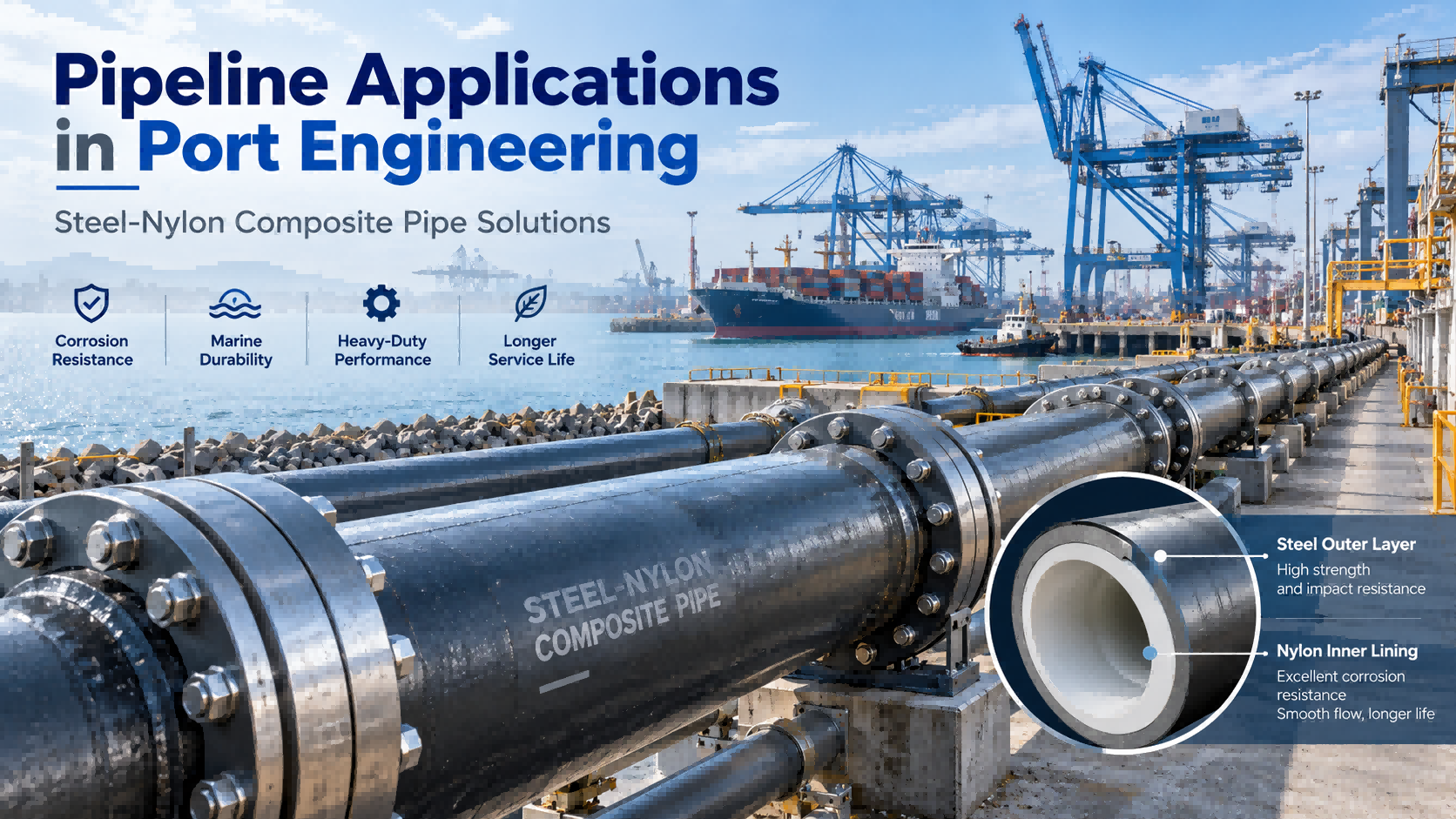
At Guangdong Kejin New Materials Co., Ltd. (GDKJ), our product portfolio includes engineering nylon pipes, reinforced nylon pipes, and steel-nylon composite piping solutions.
Depending on the product configuration and project requirements, customized pipe dimensions and integrated flange designs can be considered.
4.1 Flanged Connections Support Modular Installation
For nylon piping systems designed with flanged connections, individual pipe sections can be prefabricated according to project specifications.
These sections can then be assembled at the installation site using compatible flanges, gaskets, and fasteners.
This approach offers several practical advantages.
Reduced On-Site Welding Requirements
Compared with certain metallic piping arrangements, prefabricated flanged nylon pipe sections can reduce the need for some on-site welding operations.
Improved Installation Organization
Pipelines can be manufactured and delivered in predefined sections, supporting modular installation and potentially reducing site assembly activities.
Convenient Inspection and Replacement
Where the system allows safe isolation and disassembly, flanged connections can make inspection, maintenance, or pipe section replacement more manageable.
For islands, ports, and coastal industrial facilities located far from major maintenance centers, these characteristics may provide practical operational benefits.
4.2 Flange Reliability Requires Complete Connection Engineering
Flanged connections should not be considered automatically suitable for all marine environments.
Engineers must verify several important factors:
-
Flange strength and pressure ratings.
-
Gasket compatibility with seawater and operating temperatures.
-
Long-term creep and stress relaxation of nylon materials.
-
Corrosion protection for metallic bolts and accessories.
-
External loads, vibration, and thermal movement.
-
Pressure testing and long-term sealing performance.
Because PA6 is a thermoplastic material, its response to sustained compression differs from that of steel.
Therefore, marine nylon pipe flange systems should use validated combinations of pipe materials, flange designs, gaskets, and fasteners.
Installation procedures developed for conventional metallic flanges should not automatically be applied without considering the properties of nylon.
5. Five Potential Applications of PA6 Nylon Pipes in Marine Engineering
Application 1: Seawater Desalination Intake and Pretreatment Systems
Seawater desalination facilities continuously process substantial volumes of seawater.
Pipelines used in seawater intake, screening, pretreatment, and auxiliary systems are exposed to high-salinity environments.
These systems typically require:
-
Reliable corrosion resistance.
-
Stable operational performance.
-
Appropriate hydraulic efficiency.
-
Manageable maintenance requirements.
-
Long-term material compatibility.
Potential Advantages of Nylon Pipes
For pipeline sections operating within suitable pressure, temperature, and chemical conditions, PA6 nylon pipes can offer resistance to metallic electrochemical corrosion.
Their wear-resistant characteristics may also be useful when the transported seawater contains suspended particles.
However, seawater desalination facilities contain both low-pressure and high-pressure pipeline systems.
High-pressure reverse osmosis pipelines require separate engineering evaluation and should not be treated as equivalent to conventional seawater intake piping.
Application 2: Coastal Power Plant Cooling Water Systems
Coastal thermal power plants, nuclear power facilities, and large industrial energy installations often use seawater for cooling.
These systems may operate continuously and transport substantial volumes of water.
Key design considerations include corrosion resistance, hydraulic performance, structural reliability, and maintenance requirements.
Potential Advantages of Nylon Pipes
In suitable industrial cooling water branches or auxiliary pipelines, nylon pipes may help reduce metallic corrosion risks associated with seawater exposure.
For large-diameter cooling water pipelines, engineers must additionally evaluate long-term pipe stiffness, support spacing, operating pressure, and structural performance.
Material selection should be based on actual system requirements rather than corrosion resistance alone.
Application 3: Port and Island Water Supply and Drainage Systems
Ports and island infrastructure frequently operate under demanding environmental and logistical conditions.
Typical challenges include:
-
High salt spray exposure.
-
Limited access to replacement materials.
-
Complex transportation arrangements.
-
Restricted construction schedules.
-
Higher maintenance costs.
Potential Advantages of Nylon Pipes
For compatible industrial water supply and drainage systems, corrosion-resistant nylon pipes with prefabricated flanged connections can provide an alternative piping solution.
Modular pipe sections may help simplify installation and future replacement.
For drinking water applications, however, the complete pipe system must meet applicable potable water contact requirements in the destination market.
Application 4: Marine Aquaculture and Seawater Circulation Systems
Modern marine aquaculture facilities depend on reliable seawater transportation, filtration, and circulation.
Piping systems may remain in continuous contact with seawater and experience repeated cleaning operations.
Potential Advantages of Nylon Pipes
Properly selected PA6 nylon pipes may serve as corrosion-resistant alternatives for suitable seawater circulation applications.
However, engineers must also evaluate biological fouling, disinfectant compatibility, cleaning methods, and relevant water quality requirements.
Application 5: Selected Offshore Platform Auxiliary Water Pipelines
Offshore oil and gas platforms and other marine structures use various auxiliary piping systems, including noncritical industrial water and certain cooling or utility water services.
Material selection for these systems depends on operating pressure, temperature, fire safety requirements, and applicable marine regulations.
Potential Advantages of Nylon Pipes
Where engineering validation and required approvals are available, nylon pipes may be considered for selected noncritical auxiliary pipeline applications.
However, critical firefighting mains, essential safety systems, high-pressure oil and gas pipelines, and systems requiring specialized fire resistance must undergo separate material qualification.
Nylon should never be selected for such applications based solely on its resistance to seawater corrosion.
6. Important Technical Limitations of PA6 Nylon Pipes in Marine Applications
Professional pipeline selection requires a clear understanding of both material advantages and application limitations.
6.1 Moisture Absorption and Dimensional Stability
PA6 is a hygroscopic polymer, meaning it absorbs moisture from its surrounding environment.
Moisture absorption can affect:
-
Material dimensions.
-
Mechanical stiffness.
-
Tensile properties.
-
Toughness.
-
Long-term deformation behavior.
Technical data for PA6 materials show that mechanical properties can differ significantly between dry and moisture-conditioned states.
This does not mean every PA6 pipe experiences the same degree of property change.
However, it demonstrates why engineers should not rely exclusively on dry-state material properties when designing pipelines for continuous water exposure.
For marine applications, long-term performance and dimensional changes under moisture-equilibrium conditions should be evaluated.
6.2 Long-Term Pressure Resistance and Creep
PA6 is a thermoplastic material and may experience time-dependent deformation under sustained mechanical loads.
Therefore, the allowable working pressure of a nylon pipeline cannot be determined solely from the material's short-term tensile strength.
Appropriate pressure ratings should account for:
-
Long-term hydrostatic performance.
-
Operating temperature.
-
Required design life.
-
Safety factors.
-
Joint and connection performance.
-
Relevant material aging mechanisms.
These considerations are especially important for continuously pressurized seawater systems.
6.3 Temperature and Chemical Compatibility
Different PA6 formulations may respond differently to elevated water temperatures, oxidizing chemicals, and prolonged chemical exposure.
Seawater treatment facilities frequently use disinfectants and cleaning chemicals, such as sodium hypochlorite.
Before specifying PA6 piping, engineers should verify chemical compatibility according to concentration, temperature, and exposure duration.
The melting temperature or short-term heat resistance of PA6 must not be confused with the allowable long-term operating temperature of a pressurized pipe.
6.4 UV Resistance and Long-Term Outdoor Exposure
Marine pipe installations may experience extended exposure to sunlight and ultraviolet radiation.
Unprotected polymer materials can experience weathering over time.
Appropriate UV stabilization, shielding, or other protective measures may be required depending on material formulation and installation conditions.
The necessary protection should be determined through relevant material performance data.
6.5 Subsea and Shipboard Safety Requirements
Subsea piping requires additional engineering considerations, including:
-
External pressure resistance.
-
Buoyancy and pipeline stability.
-
Seabed scour.
-
Anchoring and mechanical damage.
-
Installation loads.
-
Long-term fatigue.
-
Joint integrity.
For shipboard and floating offshore installations, special fire resistance, smoke generation, flame spread, and certification requirements may also apply.
International Maritime Organization requirements, including IMO Resolution A.753(18) and applicable amendments, establish criteria for plastic piping systems on ships.
Consequently, successful use of nylon piping in an onshore coastal industrial water system does not automatically qualify the same product for critical shipboard or subsea applications.
7. Key Technical Parameters for Marine Engineering Pipe Selection
Before purchasing marine piping materials, engineers and procurement teams should establish a comprehensive technical evaluation checklist.
| Technical Parameter | Information to Confirm | Engineering Purpose |
|---|---|---|
| Transported Fluid | Seawater, brine, sand-containing water, chemicals, and concentrations | Evaluate chemical compatibility |
| Design Pressure | Normal operating pressure, maximum pressure, surges, and vacuum conditions | Verify pipe and joint strength |
| Design Temperature | Normal, maximum, and minimum temperatures | Assess long-term material performance |
| Design Life | Expected service period and maintenance strategy | Establish long-term performance requirements |
| Pipe Dimensions | Nominal diameter, wall thickness, length, and connection dimensions | Confirm manufacturing and installation feasibility |
| Suspended Solids | Particle concentration, size, hardness, and flow velocity | Evaluate erosion and abrasion |
| Installation Environment | Aboveground, buried, coastal, offshore, or subsea | Identify external mechanical loads |
| Connection Method | Flange specifications, gaskets, and fasteners | Reduce leakage and joint failure risks |
| Certification Requirements | Project specifications, classification requirements, and applicable regulations | Support engineering compliance |
Depending on the application, marine pipeline projects may need to consider relevant engineering standards.
For example:
DNV-ST-F101
Provides a structural integrity framework for subsea pipeline systems.
ISO 14692 Series
Addresses glass-reinforced plastics piping systems within its defined scope of application.
DNV-ST-F119
Provides requirements related to thermoplastic composite pipes for offshore applications.
These documents have different scopes and should not automatically be treated as direct product certification standards for conventional PA6 nylon pipes.
The correct engineering approach is to identify the specific piping application first, determine the applicable standards, and then establish the necessary material and system qualification procedures.
8. Why Is Total Cost of Ownership More Important Than Initial Pipe Price?
Traditional industrial pipe procurement often focuses heavily on the purchase price per meter.
However, in marine engineering, the initial price of the pipe material represents only one component of total project expenditure.
A more comprehensive assessment should consider the total cost of ownership.
TCO = Cₘ + Cᵢ + Cₑ + Cᵣ + C𝒹
Where:
-
Cₘ: Pipe materials and accessories.
-
Cᵢ: Transportation and installation.
-
Cₑ: Operating energy consumption.
-
Cᵣ: Inspection, maintenance, and replacement.
-
C𝒹: Downtime and associated economic losses.
For seawater transportation systems operating continuously over long periods, installation, maintenance, energy consumption, and downtime can significantly influence overall costs.
8.1 Potentially Lower Corrosion-Related Maintenance Costs
Under suitable seawater conditions, nylon pipes avoid the metallic electrochemical corrosion mechanisms associated with conventional steel pipes.
As a result, they may reduce certain maintenance activities related to pipe body corrosion.
This can be particularly relevant in coastal industrial environments where external and internal corrosion protection is an ongoing concern.
8.2 Reduced Risk of Corrosion-Related Unplanned Shutdowns
Pipeline failures can disrupt industrial production, cooling systems, water supply, and other essential operations.
If properly validated nylon pipes reduce corrosion-related or abrasion-related failures under specific conditions, they may help lower the frequency of unplanned maintenance.
However, any predicted reduction in failures should be supported by relevant operating data, engineering calculations, or comparative service experience.
8.3 Improved Installation and Replacement Efficiency
Prefabricated flanged nylon pipe sections may simplify certain installation activities.
In suitable applications, modular installation can reduce some field connection work.
For remote island facilities, ports, and coastal industrial projects, these advantages may contribute to more efficient construction planning.
8.4 Long-Term Hydraulic Performance and Energy Costs
Maintaining suitable internal pipe conditions helps control hydraulic losses.
Because nylon does not form metallic corrosion products, it may avoid some corrosion-related changes in pipe roughness.
However, marine biofouling, scaling, sediment accumulation, and overall pipeline design remain important factors.
Specific energy savings should be calculated from actual hydraulic data rather than assumed from material selection alone.
The economic value of nylon piping is therefore not necessarily based on having the lowest initial purchase price. It may result from an improved balance of corrosion control, installation requirements, maintenance needs, and long-term operational reliability.
For EPC contractors and industrial project owners, a lifecycle cost model is a more reliable basis for comparing candidate piping materials.
9. How Can Our Nylon Pipe Solutions Support Marine Engineering Projects?
At Guangdong Kejin New Materials Co., Ltd. (GDKJ), we focus on manufacturing engineering nylon pipes and composite piping products for demanding industrial applications.
Our product portfolio includes nylon pipes, reinforced nylon pipes, and steel-nylon composite pipes designed for different fluid transportation requirements.
For marine and coastal industrial projects, our product selection approach focuses on material compatibility, structural requirements, connection design, and practical installation conditions.
9.1 Corrosion-Resistant Engineering Nylon Pipe Solutions
Our engineering nylon pipe products provide nonmetallic alternatives for selected industrial fluid transportation applications.
For seawater, brine, and other saline fluids, appropriate PA6 piping solutions can be evaluated according to actual operating pressure, temperature, chemical composition, and installation environment.
Compared with conventional metallic piping, nylon does not experience metallic electrochemical corrosion, which is a significant potential advantage in suitable saltwater applications.
9.2 Combining Corrosion Resistance and Abrasion Performance
Industrial seawater systems may contain suspended solids and abrasive particles.
For such applications, our engineering approach considers both chemical compatibility and mechanical wear requirements.
This makes appropriately selected nylon piping worth evaluating for seawater intake, industrial circulation water, and other particle-containing fluid transportation systems.
9.3 Customized Manufacturing and Flanged Connections
Our nylon piping solutions can accommodate project-specific design discussions involving:
-
Pipe diameter.
-
Wall thickness.
-
Pipe section length.
-
Flange dimensions.
-
Connection configurations.
-
Installation requirements.
Integrated flange designs and prefabricated pipe sections can help engineering contractors organize modular installation according to project requirements.
Specific product configurations should be confirmed through technical drawings and manufacturing review.
9.4 Different Piping Solutions for Different Pressure Requirements
Different marine and industrial applications require different structural performance levels.
For suitable industrial water and brine transportation systems, engineering nylon pipes may provide an appropriate solution.
For projects requiring higher structural load-bearing capabilities, alternative products such as steel-nylon composite pipes can also be evaluated.
Pressure ratings, temperature limits, and long-term performance requirements must be verified separately for each product type.
9.5 Technical Communication for International Engineering Projects
For international project procurement, selecting the right piping supplier involves more than comparing product catalogs.
A reliable technical selection process begins with understanding the complete operating environment.
Our team can discuss important project parameters, including:
-
Transported fluid and chemical composition.
-
Operating and design pressure.
-
Working temperature.
-
Pipe diameter and required dimensions.
-
Connection method.
-
Installation environment.
-
Applicable testing and documentation requirements.
Through early technical communication, we aim to help EPC contractors, distributors, and industrial buyers identify suitable nylon piping applications and establish the parameters requiring further engineering verification.
Explore Our Nylon Pipe Products:
//www.nylonpipeline.com/nylon-pipe.html
10. Frequently Asked Questions About Marine Engineering Nylon Pipes
Q1: Can PA6 nylon pipes be used for long-term seawater transportation?
PA6 nylon pipes may be considered for selected seawater transportation systems when the material formulation, chemical compatibility, pressure design, and long-term performance have been appropriately verified.
However, suitability depends on operating temperature, pressure, seawater composition, chemical treatment, moisture absorption, aging behavior, and joint performance.
A guaranteed service life should not be assumed solely because PA6 offers resistance to metallic electrochemical corrosion.
Q2: Which is better for marine engineering, nylon pipe or HDPE pipe?
Both nylon and HDPE are nonmetallic piping materials, but their performance characteristics and application histories differ.
HDPE has a well-established role in seawater intake, discharge, long-distance water transportation, and certain submerged pipeline applications.
Engineering nylon pipes offer different mechanical characteristics, potential abrasion resistance, and opportunities for customized flanged designs.
The appropriate choice depends on pressure, temperature, dimensions, installation conditions, mechanical loads, and long-term operating requirements.
Neither material should be considered universally superior for every marine application.
Q3: Can nylon pipes be used in seawater desalination plants?
Nylon pipes may be evaluated for suitable seawater intake, pretreatment, and auxiliary water transportation applications.
However, desalination facilities include pipeline sections operating at very different pressures.
High-pressure reverse osmosis systems and pipelines exposed to aggressive chemical cleaning require separate material qualification and engineering design.
Q4: Do nylon pipes require additional corrosion protection?
The nylon pipe body does not require the same metallic corrosion protection methods used for carbon steel.
However, metallic bolts, flanges, supports, and other accessories may still require corrosion protection in marine environments.
Outdoor nylon pipes may also require UV protection and periodic inspection depending on installation conditions.
Q5: Are nylon pipes suitable for direct subsea installation?
Subsea suitability must be evaluated on a project-specific basis.
In addition to fluid compatibility, subsea pipelines require assessment of external pressure, buoyancy, structural stability, bending loads, connection integrity, and potential installation damage.
Performance data from conventional onshore nylon pipes cannot automatically replace the specialized design and qualification requirements of subsea pipeline systems.
11. Future Trends in Marine Engineering Piping Materials
The future development of marine engineering piping materials is likely to focus increasingly on balancing multiple performance requirements rather than maximizing a single property.
11.1 Corrosion Resistance Will Remain a Major Selection Factor
For pipelines continuously transporting seawater and brine, corrosion remains an important cause of maintenance and material degradation.
Reducing metallic corrosion risks can offer meaningful engineering and operational benefits.
As a result, corrosion-resistant nonmetallic and composite materials will continue to attract attention in suitable marine applications.
11.2 Lifecycle Cost Analysis Will Become More Important
Project owners and EPC contractors increasingly recognize that the lowest initial purchase price does not always produce the lowest overall project cost.
Future piping decisions are likely to place greater emphasis on:
-
Installation efficiency.
-
Long-term reliability.
-
Inspection requirements.
-
Maintenance frequency.
-
Energy consumption.
-
Replacement costs.
-
Production downtime.
This creates opportunities for piping solutions that offer a competitive combination of technical performance and lifecycle economics.
11.3 Nonmetallic and Composite Pipelines Will Gain More Engineering Attention
Advancements in polymer materials, manufacturing technology, structural design, testing, and qualification methods may support the wider evaluation of nonmetallic and composite piping solutions.
Different materials will continue to serve different applications according to their mechanical, chemical, and environmental performance.
PA6 nylon pipes can contribute to this development in suitable industrial water and coastal engineering systems.
11.4 Customized Pipe Manufacturing Will Support More Efficient Construction
Marine and remote industrial projects often face logistical limitations and complex installation requirements.
Piping systems manufactured in customized dimensions and delivered in prefabricated sections can help simplify certain construction activities.
Flanged connection designs may be especially useful where modular installation and future accessibility are important.
For suppliers, the ability to communicate with engineering teams and support project-specific manufacturing requirements will become increasingly valuable.
Conclusion: Marine Pipeline Selection Is Moving Toward System-Level Performance Optimization
Marine engineering pipelines face a combination of challenging conditions, including seawater corrosion, particle abrasion, mechanical loading, difficult installation environments, and potentially high maintenance costs.
Carbon steel, stainless steel, copper-nickel alloys, HDPE, FRP/GRP, and engineering nylon each have appropriate areas of application.
For selected seawater, brine, and particle-containing industrial water transportation systems, properly engineered PA6 nylon pipes may offer a valuable combination of resistance to metallic electrochemical corrosion, mechanical toughness, abrasion performance, and customizable flanged connection designs.
However, successful material selection must be supported by technical verification of operating pressure, temperature, chemical compatibility, long-term mechanical performance, installation conditions, and applicable project standards.
The objective is not simply to identify the least expensive pipe or the material with the longest list of advertised advantages.
Instead, the goal is to select a piping system that meets engineering requirements, manages operational risks, and delivers favorable long-term value.
This system-level approach will continue to shape the future of marine engineering pipeline selection.
Looking for a Reliable Nylon Pipe Solution for Your Marine Engineering Project?
Whether you are developing a seawater desalination facility, coastal industrial cooling water system, island infrastructure project, or another application involving seawater and brine transportation, our team welcomes the opportunity to discuss your piping requirements.
Provide us with your basic project information, including transported fluid, design pressure, operating temperature, pipe diameter, connection method, and installation environment.
Based on our available product range and manufacturing capabilities, we can assist with preliminary material selection and customized piping solution discussions.
Guangdong Kejin New Materials Co., Ltd. (GDKJ)
Industrial Nylon Pipe & Composite Pipeline Manufacturer
Website: //www.nylonpipeline.com
Email: lloyds.royqiu@gmail.com
Engineering Nylon Piping Solutions for Demanding Industrial Environments
Supporting corrosion-resistant fluid transportation through material selection, practical engineering design, and customized manufacturing.
Technical Note: The suitability of PA6 nylon piping for marine engineering depends on actual operating conditions and product-specific qualification. Claims regarding guaranteed service life, energy savings, corrosion performance, or abrasion resistance should be supported by appropriate testing, technical documentation, or verified field experience.
Seawater Aquaculture Piping: Nylon Pipe Selection Guide
Seawater Corrosion Mechanisms: PA6 Nylon Pipe Solutions