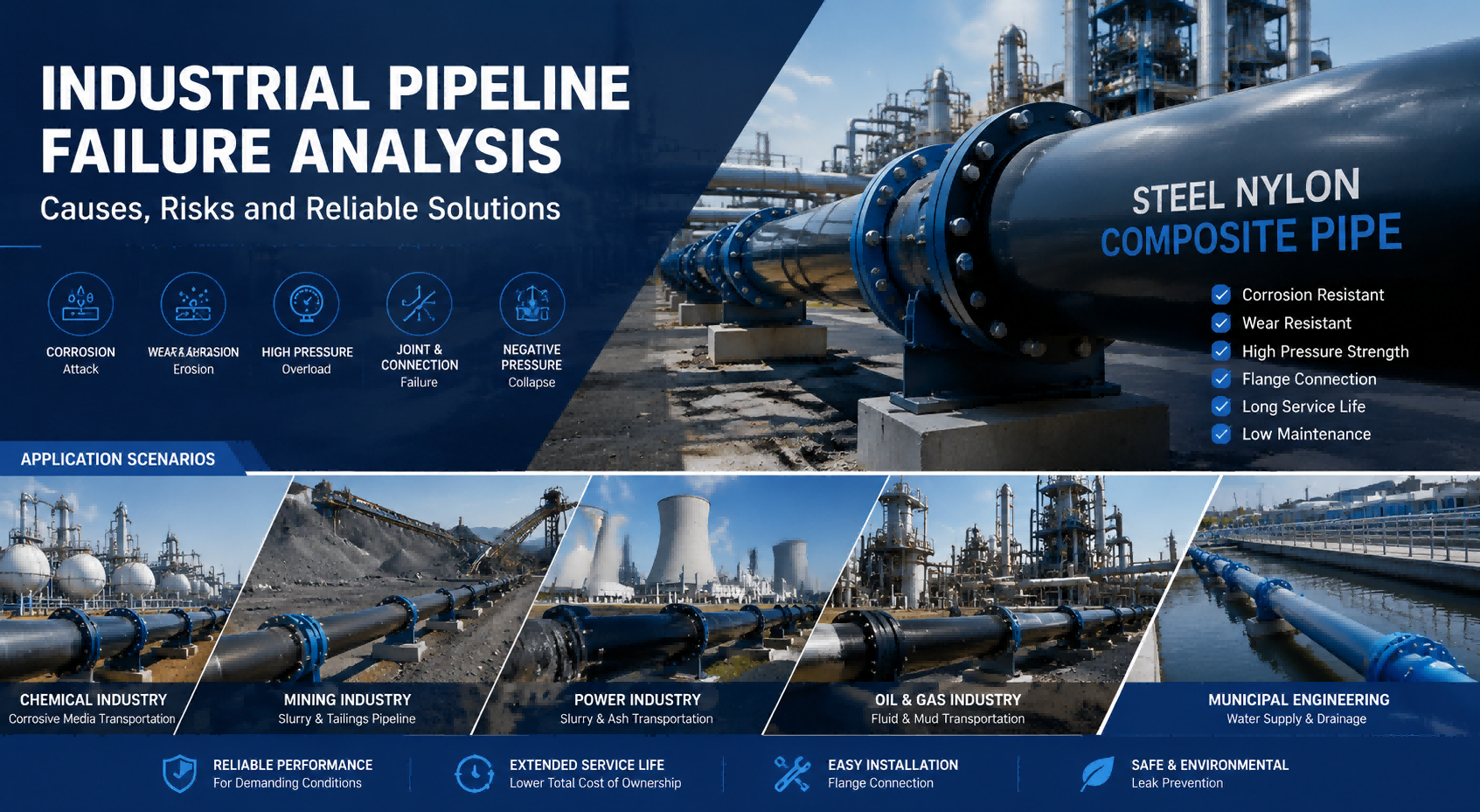
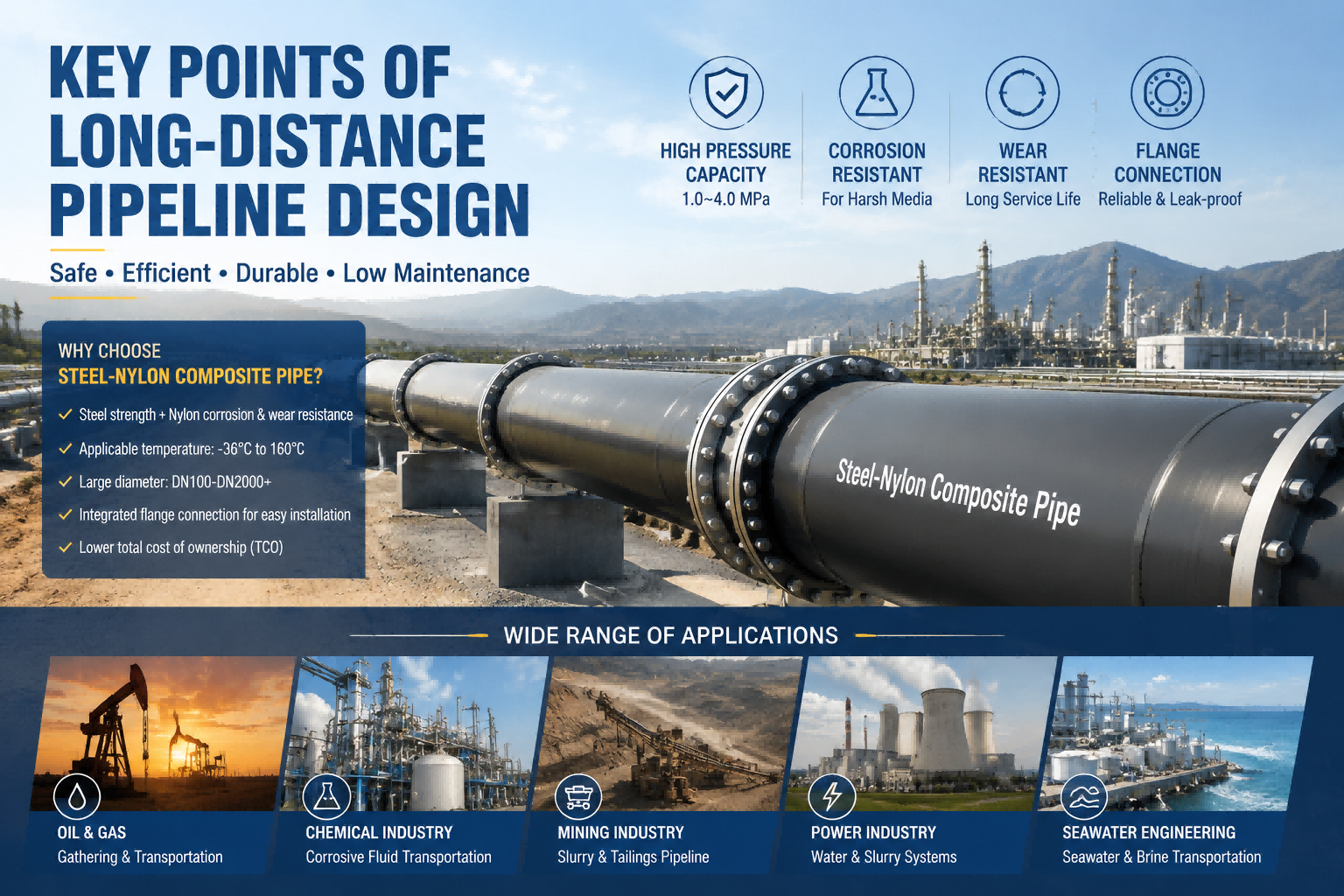
Metal Pipe vs Non-Metal Pipe: Fundamental Differences and Why Steel-Nylon Composite Pipe Is the Future of Industrial Pipeline Systems

In industries such as oil & gas, chemical processing, mining, power generation, and seawater desalination, pipelines do far more than simply transport fluids. They directly influence operational safety, production efficiency, maintenance frequency, and long-term operating costs.
For decades, metal pipes have dominated industrial pipeline systems due to their high mechanical strength, pressure resistance, and structural reliability. However, with increasing challenges from corrosion, abrasion, and maintenance costs, non-metal pipes have gained wider adoption because of their excellent corrosion resistance, low friction characteristics, and extended service life.
So, what is the fundamental difference between metal pipes and non-metal pipes?
The answer is not simply the difference in materials. The real differences lie in:
-
The source of their mechanical performance
-
Their corrosion resistance mechanisms
-
Their failure modes under complex operating conditions
-
Their lifecycle economic value
For modern industrial pipeline applications, the best solution is not always choosing between metal or non-metal materials, but combining their advantages.
This is exactly why steel-nylon composite pipe was developed.
1. Metal Pipes vs Non-Metal Pipes: Material Characteristics Determine Performance
1.1 Metal Pipes: Relying on Structural Strength for Pressure Resistance
Traditional metal pipes mainly include:
-
Carbon steel pipes
-
Stainless steel pipes
-
Alloy steel pipes
Their advantages come from the inherent properties of metals:
-
High elastic modulus
-
Excellent mechanical strength
-
High pressure resistance
-
Strong structural stability
Therefore, metal pipes remain widely used in:
-
High-pressure pipeline systems
-
Steam pipelines
-
Large industrial process facilities
-
Oil and gas transmission systems
However, metal materials also have natural limitations.
The Biggest Challenge: Corrosion
Metal pipes usually rely on external protection methods:
-
Anti-corrosion coatings
-
Plating
-
Internal lining systems
But during long-term operation, problems may occur:
-
Coating aging
-
Internal corrosion
-
Pitting corrosion
-
Weld corrosion
-
Wall thinning
These issues become more serious in harsh environments involving:
-
Saltwater
-
Strong acids and alkalis
-
Abrasive slurry containing solid particles
As a result, maintenance costs and downtime risks increase significantly.
2. Non-Metal Pipes: Corrosion Resistance Comes From the Material Itself
Common non-metal pipes include:
-
HDPE pipes
-
PVC pipes
-
FRP pipes
-
Nylon pipes
The biggest advantage of non-metal pipes is:
They do not depend on protective coatings — the material itself provides corrosion resistance.
HDPE Pipes
Advantages:
-
Excellent chemical resistance
-
Lightweight structure
-
Easy installation
Limitations:
-
Limited pressure capability
-
Reduced performance at high temperatures
-
Lower rigidity
-
Potential deformation in large-diameter applications
FRP Pipes
Advantages:
-
Excellent corrosion resistance
-
High strength-to-weight ratio
-
Lightweight
Limitations:
-
Possible delamination issues
-
Limited impact resistance
-
Long-term structural reliability concerns
Nylon Pipes
Advantages:
-
Extremely low friction coefficient
-
Excellent wear resistance
-
Superior corrosion resistance
-
High impact resistance
Nylon pipes are especially suitable for:
-
Mining slurry transportation
-
Chemical mother liquor systems
-
Salt chemical industries
-
Abrasive and corrosive media transportation
3. The Core Difference Between Metal and Non-Metal Pipes: Different Failure Mechanisms
When selecting industrial pipelines, initial performance is not enough.
The most important question is:
"How will the pipeline eventually fail?"
Common Failure Modes of Metal Pipes
1. Corrosion Wall Thinning
Long-term chemical exposure causes:
↓
Pipe wall reduction
↓
Lower pressure capacity
↓
Leakage or pipeline failure
2. Weld Failure
Many metal pipelines rely heavily on welding.
Potential problems include:
-
Large numbers of weld joints
-
High inspection requirements
-
Dependence on installation quality
Weld areas often become weak points in pipeline systems.
Common Failure Modes of Traditional Non-Metal Pipes
1. Insufficient Mechanical Strength
Some plastic pipes may face limitations in:
-
High-pressure applications
-
Large-diameter systems
-
Heavy-duty industrial environments
2. Temperature Limitations
Certain plastic materials may experience:
-
Softening at elevated temperatures
-
Reduced stiffness
-
Dimensional instability
4. Steel-Nylon Composite Pipe: Combining the Advantages of Metal and Non-Metal Materials
To overcome the limitations of traditional pipelines, steel-nylon composite pipe combines:
Outer steel structure + inner reinforced nylon layer
Creating a unique combination:
"Steel strength + nylon corrosion and wear resistance"
5. Key Advantages of Steel-Nylon Composite Pipe
5.1 Solving Both Pressure and Corrosion Challenges
Traditional plastic pipes:
Excellent corrosion resistance but limited pressure capability
Traditional steel pipes:
High strength but vulnerable to corrosion
Steel-nylon composite pipes:
Steel structure provides mechanical strength
Nylon lining provides long-term corrosion and wear protection
Typical performance range:
-
Large diameter applications: DN100-DN2000
-
Pressure ratings: 1.0-4.0 MPa
Suitable for demanding industrial pipeline systems.
5.2 Integrated Composite Structure Eliminates Lining Failure Risks
Traditional steel lined plastic pipes consist of:
Steel pipe + adhesive layer + plastic lining
During long-term operation, problems may occur:
-
Delamination
-
Lining separation
-
Bulging
-
Blockage
Steel-nylon composite pipe adopts advanced composite manufacturing technology:
-
Strong bonding between layers
-
No simple adhesive dependency
-
Higher long-term reliability
Especially suitable for:
-
Chemical mother liquor transportation
-
Brine systems
-
Mining slurry pipelines
-
Corrosive industrial media
5.3 Integrated Flange Design Improves Installation Reliability
Traditional steel pipelines require:
-
Extensive welding work
-
Complex corrosion protection repairs
-
Longer installation periods
Steel-nylon composite pipes feature:
Factory-integrated flange forming technology
Benefits:
-
Reduced field welding
-
Fewer leakage points
-
Faster installation
-
Easier maintenance
Ideal for:
-
Chemical plant upgrades
-
Projects requiring minimum shutdown time
5.4 Superior Wear Resistance Extends Maintenance Cycles
In mining, power plants, and chemical industries, pipelines face not only corrosion but also:
-
Solid particle impact
-
High-speed slurry erosion
-
Continuous friction wear
The excellent wear resistance of nylon helps reduce:
-
Elbow wear
-
Internal erosion
-
Frequent replacement requirements
Result:
Longer service intervals and improved operational reliability.
6. Performance Comparison: Metal Pipe vs Non-Metal Pipe vs Steel-Nylon Composite Pipe
| Performance | Metal Pipe | Traditional Non-Metal Pipe | Steel-Nylon Composite Pipe |
|---|---|---|---|
| Pressure Resistance | ★★★★★ | ★★★ | ★★★★★ |
| Corrosion Resistance | ★★ | ★★★★★ | ★★★★★ |
| Wear Resistance | ★★★ | ★★★★ | ★★★★★ |
| High Temperature Stability | ★★★★★ | ★★★ | ★★★★ |
| Impact Resistance | ★★★★ | ★★★ | ★★★★★ |
| Large Diameter Application | ★★★★★ | ★★★ | ★★★★★ |
| Service Life | Medium | Long | Extended |
| Lifecycle Cost | Higher | Medium | More Competitive |
7. Industries Where Steel-Nylon Composite Pipe Provides Superior Value
Chemical Industry
Applications:
-
Chlor-alkali production
-
Soda ash production
-
Phosphate chemical processes
Challenges solved:
-
Strong alkali corrosion
-
Saltwater corrosion
-
Particle erosion
Oil & Gas Industry
Applications:
-
Oil gathering systems
-
Produced water pipelines
-
Well site pipelines
Challenges solved:
-
High water-cut corrosion
-
Sand erosion
-
Long-term operation requirements
Mining Industry
Applications:
-
Tailings transportation
-
Backfilling pipelines
Challenges solved:
-
Severe abrasion
-
Frequent maintenance problems
Power Generation Industry
Applications:
-
Flue gas desulfurization systems
-
Slurry transportation
Challenges solved:
-
Corrosion
-
Scaling
-
Abrasion
8. Future Pipeline Development: From Material Selection to Lifecycle Value
In the past:
Pipeline selection focused mainly on purchase price.
Today:
Pipeline selection focuses on total lifecycle cost (TCO).
The real cost factors include:
-
Replacement frequency
-
Production downtime
-
Maintenance labor
-
Leakage risks
-
Safety costs
Although steel-nylon composite pipes may have a higher initial investment compared with ordinary carbon steel pipes, they provide better long-term economic benefits through:
-
Longer service life
-
Reduced maintenance
-
Lower downtime risks
Conclusion
The fundamental difference between metal pipes and non-metal pipes is essentially:
"Using structural strength to solve problems" versus "using material performance to solve problems."
Metal pipes provide excellent mechanical strength but face challenges in corrosive environments.
Non-metal pipes provide outstanding corrosion resistance but may have limitations in pressure and structural stability.
Steel-nylon composite pipe combines:
Steel’s mechanical strength + nylon’s corrosion resistance, wear resistance, and self-lubricating properties
creating a new generation of industrial pipeline solutions for harsh operating conditions.
For industries requiring safe, reliable, and low-maintenance pipeline systems, steel-nylon composite pipe is becoming an important direction for future pipeline material upgrades.
Why Are More and More Projects Moving Away from Stainless Steel Pipes?
How to Calculate the Total Cost of Ownership (TCO) of Industrial Piping Systems?