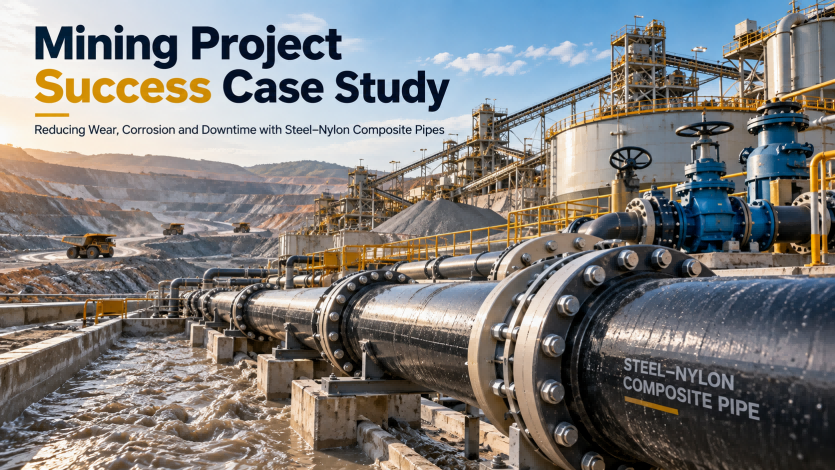
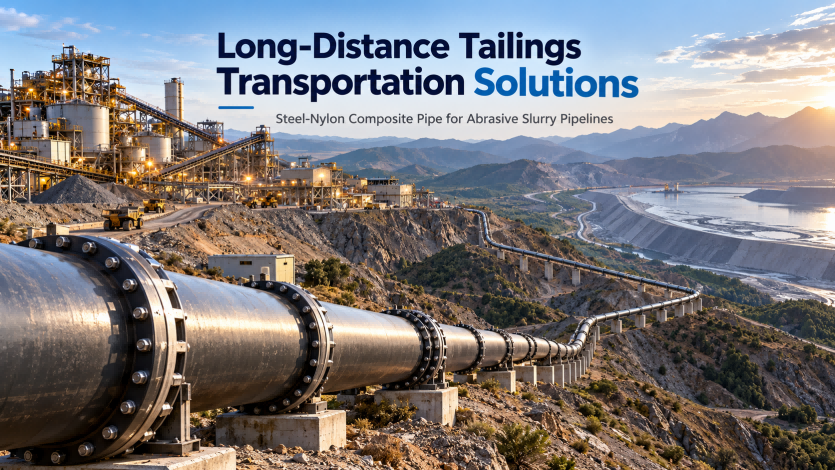
How to Select Pipes for Mine Backfill Systems: Balancing Abrasion Resistance, Pressure Capacity, and Long-Term Reliability
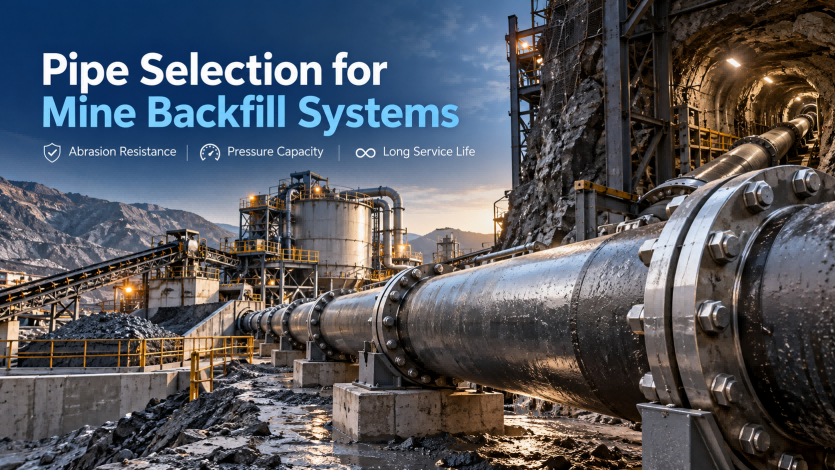
Mine backfill systems are evolving from conventional low-concentration, short-distance transportation toward higher solids concentrations, larger flow rates, longer conveying distances, and continuous operation.
As backfill pipeline lengths increase, slurry concentrations rise, and pipe diameters become larger, operating conditions become increasingly demanding.
For mining companies, the pipeline is no longer simply a means of transporting slurry. It is a critical component that directly affects the reliability of the backfill system, production continuity, maintenance frequency, and total operating cost.
When a backfill pipeline experiences severe abrasion, localized wall penetration, pipe rupture, or joint leakage, the consequences may include:
-
Backfill system shutdowns;
-
Slurry leakage;
-
Disruption of underground mining operations;
-
Frequent pipe replacement;
-
Higher labor and maintenance costs;
-
Interruptions to production schedules.
Therefore, selecting pipes for mine backfill systems should not be based solely on the initial purchase price.
A proper evaluation should consider:
abrasion resistance, corrosion resistance, pressure rating, impact resistance, joint reliability, structural stability, and total life-cycle cost.
1. Why Are Mine Backfill Systems Becoming More Demanding on Pipelines?
Mine backfill systems typically transport mixtures of tailings, cement, fly ash, slag, and other solid materials combined with water into underground stopes or mined-out areas.
These materials have one important characteristic:
They are neither conventional liquids nor purely solid materials. They are solid-liquid slurries capable of causing severe abrasive wear.
As a result, backfill pipelines are continuously exposed to multiple degradation mechanisms.
High-Solids Slurry Causes Continuous Abrasive Wear
Solid particles such as tailings and mineral aggregates continuously slide against and impact the internal pipe wall during transportation.
Wear is often particularly severe at:
-
Bends and elbows;
-
Tees;
-
Reducers;
-
Vertical sections;
-
High-velocity sections;
-
Pump discharge areas.
Conventional carbon steel pipes may gradually lose wall thickness under continuous slurry abrasion.
Simply increasing the steel wall thickness does not necessarily solve the fundamental problem of long-term abrasive wear.
2. Higher Backfill Concentration Means Pipe Selection Cannot Focus on Abrasion Alone
Many modern mining operations are moving toward high-density and even paste backfill systems.
Increasing slurry concentration can reduce water separation and improve filling efficiency, but it also increases pipeline resistance.
As a result, the pipeline must provide three key properties simultaneously:
Abrasion Resistance + Pressure Capacity + Structural Stability
A pipe material may offer excellent abrasion resistance, but if it lacks sufficient structural stiffness, it can still experience deformation, support problems, or joint instability in large-diameter or high-pressure systems.
Conversely, a pipe with excellent pressure resistance may still have a short service life if its internal surface is rapidly worn away.
Therefore, the objective should not be to select a pipe with the strongest individual property.
The real goal is to achieve the right balance among multiple engineering properties.
3. Key Parameters for Mine Backfill Pipeline Selection
3.1 Slurry Solids Concentration
As solids concentration increases, several operating characteristics may change:
-
Slurry viscosity increases;
-
Hydraulic resistance increases;
-
Abrasive wear may become more severe;
-
Risk of sedimentation and blockage may increase.
High-concentration slurry transportation therefore places greater demands on the abrasion resistance of the pipe's internal surface.
3.2 Solid Particle Size
Larger particles can cause greater localized impact on the internal pipe wall.
When coarse tailings, slag, or other large particles are present, the wear mechanism may gradually shift from simple sliding abrasion to a combination of:
Sliding Abrasion + Impact Wear
Under these conditions, the pipe material should provide not only sufficient hardness or wear resistance, but also adequate toughness and impact resistance.
3.3 Slurry Velocity
Pipeline wear is closely related to slurry velocity.
If the velocity is too low, solids may settle and eventually cause blockage.
If the velocity is too high, abrasive wear on the internal pipe wall can increase significantly.
Engineering design therefore needs to find an appropriate balance between:
the minimum velocity required to prevent sedimentation
and
a reasonable maximum velocity for controlling abrasion.
The selected pipe material must also be capable of withstanding long-term slurry erosion under the designed operating velocity.
3.4 System Pressure
Mine backfill pipelines often experience considerable elevation differences.
As conveying distance and vertical elevation increase, both static and dynamic pressures can increase significantly.
Pipeline design should therefore consider more than normal operating pressure.
Potential pressure conditions include:
-
Start-up and shutdown pressure fluctuations;
-
Valve switching;
-
Pressure rise during partial blockage;
-
Water hammer;
-
Localized pressure surges.
A pipe that provides abrasion resistance but lacks sufficient structural strength may still create long-term reliability risks.
4. Comparison of Common Pipe Materials for Mine Backfill Systems
4.1 Carbon Steel Pipe
Carbon steel pipe has good mechanical strength and a well-established installation system, which explains its traditional use in many mine backfill applications.
However, its limitations may include:
-
Limited resistance to severe slurry abrasion;
-
Progressive wall-thickness loss;
-
Internal corrosion in wet or chemically aggressive slurry environments;
-
High pipe weight;
-
Higher workload during replacement and maintenance.
Under highly abrasive conditions, simply increasing the steel wall thickness can increase material and installation costs without fundamentally eliminating the wear mechanism.
4.2 HDPE Pipe
HDPE provides excellent corrosion resistance and relatively low weight.
However, for certain high-pressure, high-temperature, large-diameter, or mechanically demanding applications, engineers should carefully evaluate:
-
Ring stiffness;
-
Long-term creep;
-
Pipe support spacing;
-
Temperature-related pressure derating;
-
Joint reliability.
For high-pressure mine backfill systems, structural design therefore requires careful engineering assessment.
4.3 Rubber-Lined Steel Pipe
Rubber-lined steel pipe combines the structural strength of steel with the wear and corrosion resistance of an internal rubber lining.
However, long-term operation may present challenges such as:
-
Rubber aging;
-
Lining delamination;
-
Localized lining damage;
-
Vulnerable areas near joints and fittings.
Once the lining becomes damaged, the transported slurry may directly contact the steel substrate.
4.4 Ceramic-Lined Wear-Resistant Pipe
Ceramic materials have high hardness and can provide excellent wear resistance in certain applications.
However, ceramic materials are also relatively brittle.
Special consideration is therefore required where pipelines are exposed to:
-
Transportation impacts;
-
Installation collisions;
-
Ground movement;
-
Frequent vibration;
-
Large-particle impact.
Under these conditions, cracking or detachment of the ceramic lining may become an important engineering concern.
5. Why Steel-Nylon Composite Pipe Is Suitable for Complex Mine Backfill Conditions
An effective mine backfill pipeline system generally needs to solve two different engineering problems.
First, the external structural layer must provide sufficient strength.
Second, the internal surface in contact with the slurry must resist abrasion and corrosion.
Steel-nylon composite pipe is designed around this principle by combining the advantages of two different materials.
The Steel Structure Provides:
-
Pressure resistance;
-
Structural support;
-
Large-diameter dimensional stability;
-
Resistance to external mechanical loads.
The Nylon Layer Provides:
-
Abrasion resistance;
-
Corrosion resistance;
-
Reduced internal friction;
-
Isolation of the transported medium from the steel structure.
This design concept — steel for structural strength and nylon for media resistance — can offer significant engineering value in complex solid-liquid slurry transportation systems.
6. Key Advantages of Steel-Nylon Composite Pipe in Mine Backfill Systems
6.1 Suitable for Long-Term Abrasive Slurry Transportation
Modified nylon materials can provide excellent abrasion resistance combined with good toughness.
Unlike wear-resistant solutions that rely primarily on material hardness, nylon can use its toughness and impact absorption characteristics to reduce damage caused by repeated particle impact and sliding abrasion.
This makes it particularly relevant for media such as:
-
Tailings slurry;
-
Cementitious backfill slurry;
-
Mineral slurry;
-
Slag slurry;
-
Other solids-containing industrial slurries.
6.2 Combines Abrasion and Corrosion Resistance
Mine slurry does not necessarily create only abrasive wear.
Some mine backfill media may also contain:
-
Chloride ions;
-
Sulfates;
-
Dissolved salts;
-
Acidic components;
-
Alkaline components.
Under these conditions, conventional steel pipe may be exposed to a combination of:
Corrosion + Abrasion
This combined mechanism can sometimes cause faster deterioration than abrasion alone.
In a steel-nylon composite pipe, the internal nylon layer separates the transported medium from the steel structural layer, helping reduce direct internal corrosion of the steel.
6.3 Steel Structure Provides Stable Pressure-Bearing Capability
For long-distance or high-elevation mine backfill systems, pressure resistance is a critical selection factor.
Because steel-nylon composite pipe retains a steel structural layer, it can provide a combination of:
-
Mechanical strength;
-
Impact resistance;
-
Pipe stiffness;
-
Stable pressure-bearing performance.
These characteristics become increasingly important in large-diameter and higher-pressure pipeline systems.
7. Why Structural Stability Becomes More Important for Large-Diameter Mine Backfill Pipelines
As pipeline sizes increase from DN100 and DN200 to DN500, DN800, and even larger diameters, many structural challenges become more significant.
These may include:
-
Increased pipe self-weight;
-
Changes in required support spacing;
-
Greater sensitivity to installation tolerances;
-
Increased loading on flange connections;
-
More demanding pipe roundness and dimensional control.
The reliability of a large-diameter pipeline therefore depends not only on material selection but also on the overall structural design and manufacturing accuracy.
Our steel-nylon composite pipes can be manufactured in a wide range of sizes and pressure classes according to project requirements.
For large mining projects, pipeline structures can be engineered based on parameters such as:
Pipe Diameter + Working Pressure + Slurry Concentration + Flow Velocity + Site Conditions
This allows the pipe structure to be optimized for the specific operating environment.
8. Why Are Flanged Connections Valuable in Mine Backfill Systems?
Mine backfill pipelines often require:
-
Section-by-section installation;
-
Local maintenance;
-
Pipeline modifications;
-
Equipment connections;
-
Replacement of bends, valves, or individual pipe sections.
The connection method therefore has a major impact on long-term maintenance efficiency.
Steel-nylon composite pipes can be designed with flanged connections.
Compared with extensive field welding, flange connections can offer several advantages in suitable applications:
-
Easier installation;
-
Easier disassembly;
-
Faster maintenance;
-
Convenient replacement of individual pipe sections.
This can be especially valuable in underground mining environments where maintenance space is limited and reducing repair time is important.
9. Where Does Wear Usually Occur First in a Mine Backfill Pipeline?
Wear is rarely uniform throughout an entire pipeline.
Several locations generally require additional attention.
Elbows and Bends
When slurry changes direction, particles tend to impact the outer radius of the bend more intensively.
This can create localized accelerated wear.
Tees
Complex flow patterns inside tee fittings can create localized turbulence and increased erosion.
Reducers
Changes in pipe diameter alter slurry velocity and flow behavior, which may increase local turbulence and wear.
Vertical Drop Sections
Significant elevation changes can cause changes in pressure, velocity, and particle impact.
Pump Discharge Sections
These sections often operate at relatively high pressure and velocity and therefore deserve special attention during design.
For this reason, mine backfill pipelines should not necessarily be designed with exactly the same material configuration throughout the entire system.
A more effective approach is:
Divide the pipeline into different wear-risk zones and design each section according to its actual operating conditions.
10. Do Not Compare Pipes Only by Price per Meter
One of the most common mistakes in mine pipeline procurement is comparing only the initial price per meter.
However, the true economic impact of a pipeline is determined by its total life-cycle cost.
A simplified model can be expressed as:
Pipeline TCO = Initial Purchase Cost + Installation Cost + Replacement Cost + Maintenance Cost + Production Downtime Loss
A pipe with a lower initial purchase price may become significantly more expensive over time if it requires frequent replacement.
This is particularly important in underground mining projects.
Replacing a pipeline can involve far more than simply purchasing another section of pipe.
Additional costs may include:
-
Labor;
-
Transportation;
-
Lifting and handling;
-
Production shutdown;
-
Pipeline flushing;
-
Slurry removal;
-
Safety management.
Therefore, mine backfill pipeline selection should move from a purchase-price mindset toward a life-cycle cost mindset.
11. How to Build a Mine Backfill Pipeline Selection Data Sheet
Before selecting a pipe material, the following project parameters should normally be confirmed:
| Parameter | Information Required |
|---|---|
| Transport Medium | Tailings, cement slurry, mineral slurry, backfill slurry |
| Solids Concentration | Weight concentration / volume concentration |
| Maximum Particle Size | mm |
| Slurry Density | kg/m³ |
| Design Flow Rate | m³/h |
| Design Velocity | m/s |
| Working Pressure | MPa |
| Maximum Pressure | MPa |
| Conveying Distance | m / km |
| Elevation Difference | m |
| Pipe Diameter | DN |
| Temperature | °C |
| pH | Acidic / alkaline |
| Corrosive Ions | Cl⁻, SO₄²⁻, etc. |
| Installation Method | Aboveground / underground / mine shaft |
| Design Service Life | Years |
Only after these parameters have been established can engineers properly evaluate the pipe material, wall thickness, pressure rating, and structural configuration.
12. Pilot Pipeline Sections Can Reduce Material Replacement Risk
For large mining projects that have traditionally used steel pipe, HDPE, or other wear-resistant piping systems, replacing the entire pipeline with a new material at once may create unnecessary project risk.
A practical alternative is to begin with a:
100–500 Meter Pilot Pipeline Section
During the pilot operation, the project team can monitor:
-
Pipe wall-thickness changes;
-
Pressure performance;
-
Flow performance;
-
Joint stability;
-
Elbow wear;
-
Actual operating service period.
Verifying performance under real operating conditions can be more valuable than relying solely on theoretical material data.
Once the pilot section demonstrates stable performance, the new pipe material can gradually be expanded to larger sections of the system.
This approach can significantly reduce the engineering risk associated with material replacement.
13. Which Mine Backfill Applications Are Suitable for Steel-Nylon Composite Pipe?
Steel-nylon composite pipe can be particularly suitable for applications involving:
-
High-concentration tailings backfill;
-
Cementitious backfill slurry;
-
Long-distance backfill transportation;
-
High-elevation backfill systems;
-
Medium- and high-pressure slurry transportation;
-
Combined abrasion and corrosion;
-
Large-diameter slurry pipelines;
-
Mining operations seeking to reduce pipe replacement frequency;
-
Continuous production systems where downtime is costly.
The composite structure becomes particularly attractive when a pipeline must simultaneously satisfy three major requirements:
Abrasion Resistance + Corrosion Resistance + Pressure Capacity
14. The Best Mine Pipeline Is More Than Just a “Wear-Resistant Pipe”
The direction of mine backfill technology is becoming increasingly clear:
Higher Concentration + Larger Flow Rates + Longer Distances + Lower Maintenance
As a result, mine pipeline materials must evolve beyond simply providing wear resistance.
Future systems increasingly require a combination of:
Abrasion Resistance + Corrosion Resistance + Pressure Capacity + Long Service Life + Low Maintenance
Steel-nylon composite pipe is based on this multi-performance design philosophy.
The steel structure provides pressure-bearing capability and mechanical strength, while the nylon layer provides abrasion and corrosion resistance.
This makes steel-nylon composite pipe an important alternative worth evaluating for demanding mine backfill and slurry transportation systems.
Conclusion
Selecting a pipeline for a mine backfill system is not simply about finding the hardest material or the lowest-priced pipe.
The objective is to identify a pipeline solution capable of operating reliably under the actual project conditions for an extended period.
In high-concentration, highly abrasive, high-pressure, and long-distance transportation systems, a single material may struggle to satisfy every performance requirement simultaneously.
For this reason, mine pipeline design is increasingly moving toward:
Composite Material Structures + Application-Specific Engineering + Life-Cycle Cost Analysis
For mining projects seeking to reduce pipe replacement frequency, minimize downtime, and improve long-term backfill system reliability, steel-nylon composite pipe is worth considering as a technically viable pipeline option.
Before selecting the final pipeline configuration, it is recommended to provide the following basic operating data:
Transport medium, slurry concentration, particle size, flow rate, velocity, working pressure, maximum pressure, pipe diameter, conveying distance, and elevation difference.
Based on these parameters, the pipe diameter, pressure class, wall thickness, and composite structure can be engineered according to the actual operating conditions.
How to Reduce Maintenance Costs in High-Abrasion Slurry Pipelines
Recommended Pipeline Solutions for Gold Mine Tailings Transportation: How to Select a More Reliable Pipeline for Highly Abrasive and Corrosive Conditions