Why Are Mining Companies Paying Increasing Attention to Pipeline Downtime Costs?
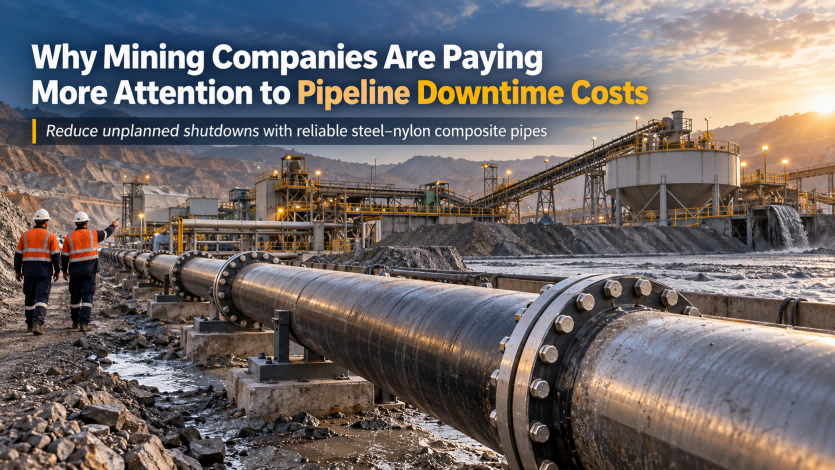
From Pipeline Maintenance Costs to Production Continuity: How Steel–Nylon Composite Pipes Help Mining Companies Reduce Downtime Risks
In modern mining operations, pipelines may appear to be auxiliary facilities connecting mining, mineral processing, and tailings management systems. In reality, they play a critical role in maintaining the continuity and stability of the entire production process.
Whether transporting mineral slurry, discharging tailings, supplying process water, or handling mining wastewater, pipelines are essential for the continuous transportation of industrial fluids.
For large mining operations, a leak or blockage in a critical pipeline may involve far more than replacing a damaged pipe section. It can interrupt mineral processing, disrupt slurry transportation, restrict tailings disposal capacity, and potentially affect the entire production system.
As a result, mining companies are increasingly focusing on a question that has traditionally received insufficient attention:
How much does a mining company actually lose when a critical pipeline fails?
Compared with the initial purchase price of a pipeline, unplanned downtime costs are often more difficult to predict and may have a much greater impact on overall mining profitability.
This is gradually shifting pipeline selection away from a narrow focus on initial procurement costs toward a comprehensive evaluation of wear resistance, corrosion resistance, operational reliability, and total cost of ownership.
As a manufacturer specializing in wear-resistant and corrosion-resistant industrial pipelines, we focus on the development and production of steel–nylon composite pipes.
By combining the structural strength of steel with the functional properties of nylon, we aim to provide reliable pipeline solutions for demanding mining applications.
1. Why Can a Single Pipeline Failure Disrupt an Entire Mining Operation?
Modern mining operations are characterized by continuous production, large-scale processing, and close coordination between multiple production stages.
From crushing, grinding, classification, and flotation to concentrate transportation and tailings management, different production processes are closely interconnected.
Although pipelines represent only one component of this complex system, they serve as critical connections between individual production units.
1.1 Slurry Transportation Interruptions Can Shut Down Mineral Processing Systems
In mineral processing plants, slurry must be continuously transported between grinding, classification, flotation, and downstream processing equipment.
If a critical pipeline is taken out of service due to abrasive wear, corrosion-related leakage, or flange connection failure, several problems may occur:
-
Upstream equipment may be unable to discharge slurry and may need to reduce production or shut down.
-
Downstream processing equipment may experience interruptions due to insufficient slurry supply.
-
Slurry remaining inside the pipeline may settle, increasing the difficulty of restarting the system.
-
Flow rates, slurry concentrations, and operating pressures may need to be stabilized before normal production can resume.
When a transportation system lacks sufficient backup pipelines or buffer capacity, a localized pipeline failure can affect multiple production stages.
For large mineral processing plants operating continuously, pipeline reliability is therefore not merely a maintenance concern.
It is an essential part of production management.
1.2 Tailings Pipeline Failures Can Restrict Overall Mining Capacity
Tailings pipelines transport the waste slurry generated during mineral processing to designated tailings treatment or disposal facilities.
When these pipelines experience leakage, blockage, or severe abrasive wear, tailings cannot be discharged at the required rate.
If the available tailings storage or buffer capacity is insufficient, the processing plant may be forced to reduce production or temporarily suspend certain operations.
The consequences can be particularly serious in long-distance tailings transportation systems.
Pipeline repairs may be complicated by difficult terrain, long transportation distances, limited site access, and challenging construction conditions.
Even a relatively small defect may require considerable time for fault identification, pipeline isolation, drainage, repair, inspection, and system restart.
Consequently, the service life and operational reliability of tailings pipelines can directly affect the continuity of mining production.
1.3 Pipeline Leakage Can Generate Additional Environmental Management Costs
Mining slurry and tailings typically contain substantial quantities of solid particles. Some transportation media may also be corrosive or contain chemical substances requiring strict environmental management.
When a pipeline leaks, the operator may need to undertake additional activities beyond repairing the damaged section.
These activities may include:
-
Collecting leaked materials and cleaning the affected area.
-
Isolating contaminated areas and conducting environmental monitoring.
-
Investigating the cause of the leakage and inspecting related equipment.
-
Restoring affected production facilities and restarting operations.
The actual response requirements depend on the composition of the transported medium, the location of the leakage, its environmental impact, and applicable regulations.
This means that the economic consequences of a pipeline failure can extend far beyond the direct cost of repairing or replacing the damaged pipe.
2. Why Have Mining Companies Traditionally Underestimated Pipeline Downtime Costs?
Under conventional procurement practices, pipeline costs are often evaluated primarily in terms of material prices, cost per meter, or initial project investment.
For example, purchasing departments may focus on questions such as:
Which pipeline material has the lowest price for the same specifications?
How much will installation cost?
Can the supplier meet the required delivery schedule?
Although these questions are important, procurement decisions based primarily on initial purchase prices can overlook the actual economic performance of a pipeline after installation.
For mining companies, the true cost of a pipeline system consists of four major components.
2.1 Initial Procurement and Installation Costs
These include the costs of pipes, fittings, flanges, gaskets, transportation, installation, and commissioning.
Initial costs are generally the easiest to calculate and compare.
They also tend to receive the greatest attention during traditional procurement decisions.
2.2 Routine Operation and Maintenance Costs
These include regular inspections, wear monitoring, gasket replacement, localized repairs, and periodic pipe replacement.
In highly abrasive slurry transportation systems, elbows, reducers, and areas exposed to locally elevated flow velocities may require more frequent inspection and maintenance.
2.3 Unplanned Downtime Losses
When a pipeline fails unexpectedly, the mining company may incur production losses, emergency repair expenses, and system restart costs.
Production losses are typically related to the duration of the shutdown, the production capacity affected, and the economic contribution of each unit of production.
2.4 Environmental, Safety, and Management Costs
These may include spill cleanup, emergency response, safety management, and other indirect costs associated with equipment failures.
Therefore, the pipeline with the lowest initial purchase price does not necessarily offer the lowest total cost of ownership over the lifetime of a mining project.
For critical transportation pipelines, extending effective service life and reducing unexpected failures may generate greater economic value than simply minimizing procurement costs.
3. How Much Can a Single Pipeline Shutdown Actually Cost?
To understand the economic value of pipeline reliability, mining companies need to convert downtime into measurable financial indicators.
A simplified calculation model is:
Total Pipeline Downtime Cost = Lost Production Contribution + Repair Costs + Restart Costs + Other Related Losses
Lost production contribution can be calculated as:
Lost Production Contribution = Affected Production Capacity per Hour × Contribution Margin per Unit × Actual Downtime
Here, contribution margin refers to the revenue generated per unit of production minus the variable costs directly associated with producing that unit.
It should not be confused with the product's selling price.
Example: Estimating Pipeline Downtime Costs at a Mineral Processing Plant
Consider a hypothetical mineral processing plant operating under the following conditions:
| Parameter | Assumed Value |
|---|---|
| Normal ore processing capacity | 1,000 tonnes/hour |
| Contribution margin per tonne processed | RMB 40/tonne |
| Downtime caused by a critical pipeline failure | 12 hours |
| Pipeline repair and associated labor costs | RMB 30,000 |
| Restart and other additional expenses | RMB 20,000 |
Assume that the pipeline failure interrupts the plant's entire production capacity and that the lost production cannot be fully recovered later.
The resulting lost production contribution is:
1,000 × 40 × 12 = RMB 480,000
After including repair and restart expenses:
RMB 480,000 + RMB 30,000 + RMB 20,000 = RMB 530,000
Under these assumptions, a single 12-hour pipeline failure could result in approximately RMB 530,000 in direct economic losses.
This example is intended solely to demonstrate the calculation method. It does not represent actual operating data from a specific mining project.
Actual losses depend on factors such as standby pipelines, available buffer capacity, production recovery, the ability to make up lost output, and whether certain costs overlap.
Nevertheless, the calculation illustrates an important point:
For critical production pipelines, preventing a single unplanned shutdown may generate economic benefits that exceed the savings achieved by purchasing lower-cost pipe materials.
4. Why Are Mining Pipelines Vulnerable to Wear, Leakage, and Unplanned Downtime?
Mining transportation conditions are generally more demanding than ordinary clean-water transportation.
In high-solids slurry, tailings, and sand-containing wastewater systems, pipelines must withstand not only internal pressure but also continuous particle abrasion, localized erosion, and potentially corrosive chemical environments.
4.1 High-Solids Slurry Continuously Wears Pipeline Inner Surfaces
Mining slurry typically consists of water, mineral particles, and other solid materials.
During transportation, particles continuously interact with the pipe wall, potentially causing sliding abrasion, impact wear, and localized erosive damage.
The severity of pipeline wear depends on several factors:
-
Slurry solids concentration.
-
Particle size, shape, and hardness.
-
Internal flow velocity and flow characteristics.
-
Temperature and chemical properties of the transported medium.
-
Wear resistance of the pipeline's inner surface material.
When slurry contains highly abrasive mineral particles, the pipeline wall may gradually become thinner.
Localized wear can eventually develop into perforation or leakage.
If these problems are not detected in time, progressive material loss may ultimately result in an unexpected pipeline failure.
4.2 Elbows and Reducers Are Particularly Vulnerable to Localized Wear
In straight pipeline sections, slurry flow conditions are generally more uniform.
However, when slurry passes through elbows, tees, reducers, or other changes in pipeline geometry, the flow direction and velocity distribution change.
Solid particles may become concentrated against particular areas of the inner wall, producing localized regions of accelerated wear.
In long-distance slurry transportation systems, even if most straight pipe sections remain in good condition, severe localized wear at a single critical elbow may force the entire pipeline to shut down.
Therefore, improving mining pipeline reliability requires more than selecting wear-resistant straight pipes.
It also requires careful consideration of elbows, fittings, and connection structures.
4.3 Corrosion and Abrasion Can Act Together
Some mining transportation media are acidic or alkaline and may contain elevated concentrations of dissolved salts and other corrosive substances.
In inadequately protected metallic pipelines, corrosion can progressively remove material from the internal surface.
At the same time, solid particles may remove protective surface films, repeatedly exposing fresh metal to the corrosive environment.
Under certain operating conditions, the combined effects of corrosion and abrasion can accelerate pipeline deterioration.
For mining pipelines exposed to both solid particles and corrosive media, focusing exclusively on either wear resistance or corrosion resistance may therefore be insufficient.
A more appropriate material selection process should evaluate both failure mechanisms and their potential interactions.
4.4 Pipeline Connections Can Become Leakage Points
Mining pipelines often extend over considerable distances and require numerous pipe connections.
If connection structures are poorly designed, gasket materials are unsuitable, or flange bolts are tightened unevenly, leakage may occur at the joints.
Vibration, temperature fluctuations, pressure variations, and inadequate pipeline support can also affect the long-term sealing performance of connection points.
Consequently, overall pipeline reliability depends not only on the pipe material itself but also on connection design, sealing performance, and installation quality.
5. How Can Steel–Nylon Composite Pipes Help Mining Companies Reduce Pipeline Downtime Risks?
For mining transportation systems exposed to abrasion, corrosion, and demanding pressure requirements, steel–nylon composite pipes offer a technical approach that combines the structural properties of steel with the functional advantages of engineering polymers.
Unlike single-material pipelines, steel–nylon composite pipes use a composite structure in which different materials perform different functions.
The steel component primarily provides structural support and pressure-bearing capability, while the nylon inner layer is in direct contact with the transported medium and provides wear resistance and corrosion protection under suitable operating conditions.
This structural design helps address the combined performance requirements of demanding industrial transportation applications.
5.1 Wear-Resistant Nylon Inner Layer: Reducing the Risk of Abrasion-Related Pipe Failure
One of the primary failure mechanisms in slurry transportation pipelines is the gradual reduction of wall thickness caused by continuous abrasion.
Steel–nylon composite pipes incorporate a nylon inner layer that utilizes the wear-resistant properties of appropriately formulated nylon materials to protect the pipe against abrasive transportation media.
Through material modification and structural optimization for specific operating conditions, the performance of the inner layer can be further improved for particular wear environments.
In slurry transportation systems operating within suitable design parameters, a wear-resistant inner layer may help reduce the risk of pipeline failure caused by progressive internal abrasion.
However, the actual wear rate of nylon depends on mineral hardness, particle size, flow velocity, solids concentration, operating temperature, and other factors.
For highly abrasive slurry applications, laboratory wear testing or field trials are recommended to compare the performance of steel–nylon composite pipes with other candidate materials.
The key to selecting wear-resistant pipelines is not simply choosing the hardest material. It is selecting a material and structural design that match the actual wear mechanisms of the application.
5.2 Corrosion-Resistant Inner Layer: Reducing Failures Caused by Combined Corrosion and Abrasion
Some mining transportation media contain both substantial quantities of solid particles and corrosive chemical components.
When conventional carbon steel pipes are used, internal linings, protective coatings, or other corrosion protection measures may be required.
Steel–nylon composite pipes use a nylon inner layer to separate the transported medium from the steel structure.
Under suitable operating conditions, this design helps reduce direct corrosion of the steel component.
The composite structure may offer application potential in certain saline-water, alkaline-water, and chemically demanding slurry transportation systems.
However, nylon is not suitable for every corrosive medium.
Strong acids, powerful oxidizing agents, and certain chemicals under specific concentration and temperature conditions may adversely affect nylon materials.
Therefore, for mining applications involving chemically aggressive media, material compatibility should be verified according to the actual chemical composition, concentration, operating temperature, and expected exposure duration.
5.3 Steel Reinforcement: Meeting Industrial Pipeline Pressure Requirements
In long-distance slurry transportation systems, pipelines must withstand not only internal abrasion but also operating pressure, pressure fluctuations, and external mechanical loads.
The steel–nylon composite structure combines the rigidity and pressure-bearing characteristics of steel with the functional advantages of a nylon inner layer.
Our steel–nylon composite pipe portfolio includes product series with nominal pressure ratings ranging from 1.0 to 4.0 MPa.
Pipe specifications and structural configurations can be developed according to the requirements of individual projects.
During the selection process, several factors should be evaluated:
Design pressure, maximum operating pressure, pressure fluctuations caused by pump startup and shutdown, water hammer risks, pipeline support arrangements, and temperature variations.
It is important to recognize that a product's nominal pressure rating does not replace project-specific engineering verification.
The actual allowable operating pressure should be determined according to the technical specifications, testing results, connection performance, and engineering requirements applicable to the selected product size.
5.4 Flanged Connections: Improving Installation and Localized Maintenance Efficiency
Mining pipelines are often installed across extensive areas, including mountainous terrain, sloped surfaces, and equipment-intensive industrial sites.
These conditions can make pipeline installation complicated.
Conventional field welding may require additional construction preparation, specialized personnel, and site-specific safety measures.
For different engineering applications, our steel–nylon composite pipes can be supplied with flanged connection solutions incorporating integrated molded flange technology.
This connection approach offers several potential advantages.
Convenient installation
When the pipeline sections are properly prefabricated, flanged connections can reduce the need for on-site pipe-body welding and help improve installation efficiency.
Simplified sectional maintenance
When an individual pipe section reaches its replacement condition, it can be removed by dismantling the relevant connections.
This reduces the need for extensive cutting and rewelding during localized maintenance.
Flexible pipeline system design
By combining straight pipe sections, elbows, tees, and flanged fittings, pipeline layouts can be developed according to the specific requirements of the mining site.
However, flanged connections do not eliminate leakage risks.
Appropriate gasket materials must still be selected according to the transported medium, pressure, and temperature, and correct installation and bolt-tightening procedures must be followed.
5.5 Large-Diameter Manufacturing Capability: Supporting Large-Scale Mining Transportation
As mining operations expand, tailings transportation, process water supply, and wastewater treatment systems may require increasingly large pipeline diameters.
For these applications, pipelines must provide sufficient transportation capacity while maintaining structural stability, wear resistance, and installation practicality.
We manufacture industrial pipes with diameters up to DN1600 and possess manufacturing development capabilities for ultra-large-diameter products of DN2000 and above.
For large mining projects, pipe specifications and structural configurations can be developed according to transportation flow rates, design pressure, medium characteristics, and installation requirements.
The suitability of any particular product for a project must be determined according to the manufacturing, testing, and engineering validation results applicable to the required diameter and operating conditions.
6. The Economic Value of Steel–Nylon Composite Pipes Goes Beyond Reducing Replacement Frequency
For mining companies, evaluating a pipeline upgrade should involve more than comparing the purchase prices of two different pipe materials.
A more important question is whether the upgraded pipeline can generate measurable economic benefits throughout the project lifecycle.
The following hypothetical example illustrates this approach.
Example: A Mining Company Plans to Upgrade a Critical Slurry Transportation Pipeline
Assume that a mining company currently operates a conventional slurry transportation pipeline and is considering replacing it with steel–nylon composite pipes.
The company needs to evaluate two alternatives:
Option A: Continue using the existing pipeline material.
Option B: Install steel–nylon composite pipes that have been verified as suitable for the operating conditions.
Assume the following cost estimates:
| Evaluation Item | Option A: Existing Pipeline | Option B: Steel–Nylon Composite Pipe |
|---|---|---|
| Initial procurement and installation investment | RMB 1,000,000 | RMB 1,400,000 |
| Average annual maintenance costs | RMB 200,000 | RMB 100,000 |
| Average annual unplanned downtime losses | RMB 400,000 | RMB 150,000 |
| Evaluation period | 5 years | 5 years |
These figures are illustrative assumptions only.
They do not indicate that steel–nylon composite pipes will necessarily achieve the same service-life improvements or cost reductions in actual mining applications.
Under a simplified calculation that excludes discounting, residual value, and other cost differences:
Option A: Five-Year Total Cost
RMB 1,000,000 + (RMB 200,000 + RMB 400,000) × 5
= RMB 4,000,000
Option B: Five-Year Total Cost
RMB 1,400,000 + (RMB 100,000 + RMB 150,000) × 5
= RMB 2,650,000
The difference between the two alternatives is:
RMB 4,000,000 − RMB 2,650,000 = RMB 1,350,000
In this hypothetical scenario, Option B requires an additional initial investment of RMB 400,000.
However, the projected reductions in maintenance expenses and downtime losses result in a total five-year cost reduction of RMB 1,350,000.
This demonstrates an important principle:
For critical mining transportation pipelines, the initial purchase price is not the only factor determining project economics. Operational reliability and downtime losses can have a much greater influence on long-term financial performance.
Actual project evaluations should also consider expected service life, replacement intervals, energy consumption, spare parts, financial discounting, and the probability of different failure scenarios.
7. How Should Mining Companies Evaluate Steel–Nylon Composite Pipeline Upgrades?
Although steel–nylon composite pipes offer advantages through their combination of different materials and structural properties, no single pipeline material is suitable for every mining transportation environment.
Achieving lower maintenance costs and reduced downtime risks requires a systematic evaluation of the transported medium, pipeline structure, operating conditions, and project economics.
Before implementing a pipeline upgrade, mining companies should focus on six key areas.
| Evaluation Category | Key Factors to Consider |
|---|---|
| Medium characteristics | Slurry concentration, particle size, particle hardness, chemical composition, and corrosiveness |
| Hydraulic conditions | Design flow rate, normal flow velocity, minimum operating velocity, and local flow characteristics |
| Pressure conditions | Operating pressure, design pressure, pump startup and shutdown fluctuations, and water hammer risks |
| Pipeline structure | Pipe diameter, wall thickness, composite structure, elbows, and flange connection design |
| Operating environment | Temperature, external loads, vibration, pipeline support, and installation conditions |
| Economic performance | Initial investment, expected service life, maintenance costs, and downtime losses |
Among these factors, flow velocity deserves particular attention.
Excessively high flow velocity can accelerate particle-related abrasion, while insufficient velocity may cause slurry settling and pipeline blockage.
An appropriate design should establish a suitable operating velocity based on slurry properties and system conditions rather than attempting to reduce abrasion simply by minimizing flow velocity.
For mining applications involving severe abrasion, companies can also combine internal wear measurements, critical-location inspections, and operating data analysis to establish more effective maintenance schedules.
Material upgrades and improved operational management should work together to reduce the risk of unplanned downtime.
8. Mining Pipeline Management Is Shifting from Reactive Repairs to Preventive Maintenance
Traditional mining pipeline maintenance has often relied heavily on operational experience.
Repairs or replacements may only be scheduled after visible leakage, wall perforation, or a significant reduction in transportation capacity occurs.
Although this approach addresses existing problems, it does not effectively control the production losses associated with unexpected failures.
For critical transportation pipelines, a more effective management strategy combines appropriate material selection, condition monitoring, and preventive maintenance.
Stage 1: Identify Critical Pipelines
The first step is to identify which pipelines could directly affect the entire production system if they fail.
Examples include:
Main slurry transportation pipelines in mineral processing plants, primary tailings transportation lines, major process water pipelines, and critical pipe sections that cannot be quickly restored through backup systems.
These pipelines should receive priority during reliability assessments.
Stage 2: Analyze Existing Pipeline Failure Mechanisms
Historical maintenance records, operating hours, wear measurements, and failure-location statistics can be used to identify the primary causes of pipeline deterioration.
If failures are mainly caused by particle abrasion, wear-resistant materials and localized structural improvements should be prioritized for evaluation.
If corrosion and abrasion are acting together, both chemical compatibility and wear resistance need to be considered.
If failures are concentrated at flanges, elbows, or pipe support locations, connection design and pipeline layout should also be reviewed.
Stage 3: Implement Targeted Pipeline Upgrades
For transportation conditions where steel–nylon composite pipes have been technically verified as suitable, companies can prioritize trial installations in pipeline sections that experience frequent failures and have a significant impact on production.
By comparing wear conditions, maintenance frequency, leakage records, and operating costs before and after the upgrade, the company can assess the actual performance of the new material.
Stage 4: Establish Long-Term Operating Records
After the pipeline upgrade, companies should regularly record operating information such as:
Operating hours, transportation flow rates, medium concentration, pipeline pressure, wear conditions at critical locations, maintenance frequency, and downtime duration.
Long-term operating data enables companies to develop a more accurate understanding of actual pipeline service life and improve spare parts planning and preventive maintenance schedules.
High-quality pipeline materials and effective maintenance management are not substitutes for one another. They are complementary elements of a comprehensive strategy for reducing mining pipeline downtime risks.
9. Why Should Mining Companies Reconsider Their Pipeline Procurement Standards?
When a mining operation is relatively small, pipeline replacement is straightforward, and sufficient backup capacity is available, initial investment may be a primary consideration.
However, for continuous production facilities, long-distance transportation systems, and projects with high downtime costs, procurement standards need to become more comprehensive.
The purchase price of a pipeline can be compared directly through supplier quotations.
Its long-term operational value, however, can only be fully evaluated by considering performance throughout the service life of the system.
For large mining projects, we recommend incorporating the following criteria into the technical evaluation of pipeline suppliers.
1. Is the material suitable for the actual transportation medium?
The compatibility of the pipe material with the slurry particles, chemical composition, and operating temperature must be established.
2. Does the pipeline provide appropriate pressure-bearing and structural performance?
The actual pipe diameter, pressure rating, wall thickness, fittings, and connection structures should be verified against project requirements.
3. Does the supplier have the manufacturing capability required for large-diameter and demanding operating conditions?
For major tailings transportation projects, product size coverage, manufacturing consistency, and large-volume delivery capacity are important considerations.
4. Can the supplier provide a complete pipeline connection and installation solution?
In addition to straight pipes, the reliability of elbows, tees, flanges, gaskets, and other supporting components should be evaluated.
5. Can the supplier provide verifiable technical evidence?
This may include product testing data, operating condition specifications, quality inspection documentation, and relevant engineering application records.
By incorporating these criteria, mining companies can evaluate the actual value of different pipeline solutions more objectively and reduce the risk of overlooking long-term operational requirements during procurement.
10. Our Solution: Steel–Nylon Composite Pipes for Long-Term Mining Pipeline Reliability
For mining companies, an ideal transportation pipeline should do more than simply move materials from one location to another.
Under appropriate design and operating conditions, it should also help minimize maintenance requirements and reduce the risk of operational failures.
Our steel–nylon composite pipes are designed around the combination of steel and nylon, with the objective of integrating structural support, pressure-bearing capability, wear resistance, and corrosion resistance in a single industrial pipeline solution.
For different mining projects, we focus on the following application areas.
Slurry Transportation Systems
We evaluate the potential benefits of wear-resistant nylon inner layers according to particle characteristics, solids concentration, and flow velocity.
Our objective is to help customers identify suitable solutions for reducing abrasion-related pipeline failures.
Tailings Transportation Systems
Based on transportation distance, pipe diameter, pressure requirements, and localized wear conditions, we develop appropriate composite pipeline configurations and connection solutions.
Mining Process Water Systems
For process water containing dissolved salts, sand, or specific corrosive components, we evaluate material compatibility and long-term operating requirements.
Mining Wastewater Treatment Systems
By considering the chemical composition, temperature, and pressure of the transported medium, we provide pipeline selection recommendations tailored to project requirements.
For projects involving a combination of severe abrasion, corrosion, and demanding pressure conditions, we can evaluate the suitability of steel–nylon composite pipes based on customer-supplied operating parameters.
We can also assist with determining appropriate pipe diameters, pressure ratings, connection structures, and related technical specifications.
Our objective is not simply to supply pipeline products.
Through appropriate material selection and structural design, we aim to help customers reduce unplanned downtime risks, optimize long-term maintenance costs, and improve the operational reliability of critical transportation systems.
Conclusion: The Real Cost Mining Companies Need to Control Goes Beyond Pipeline Procurement
In mining operations, the true value of a pipeline is not necessarily reflected in its purchase price.
Instead, its value is demonstrated through the production continuity and operational reliability it helps maintain over time.
A low-cost pipeline that fails frequently may generate recurring maintenance expenses and disrupt the overall productivity of a mining operation.
By contrast, a pipeline system that has been properly selected, verified for its intended operating conditions, and equipped with reliable connection structures may help reduce failures, extend maintenance intervals, and lower long-term operating costs.
By combining the structural and pressure-bearing characteristics of steel with the functional advantages of nylon, steel–nylon composite pipes provide a material option worth evaluating for mining transportation systems exposed to abrasion, corrosion, and complex pressure conditions.
As mining companies place greater emphasis on production continuity and lifecycle economics, the central question in pipeline selection is shifting from "How much does one meter of pipe cost?" to "How long can this pipeline system support reliable operation?"
For mining companies, reducing unplanned downtime through appropriate pipeline selection, sound structural design, and effective maintenance management is an important part of improving long-term production efficiency.
Contact Us: Find the Right Steel–Nylon Composite Pipeline Solution for Your Mining Project
Are you experiencing any of the following problems?
-
Excessive wear in slurry transportation pipelines.
-
Frequent leakage in tailings transportation systems.
-
Repeated production interruptions caused by critical pipeline repairs.
-
Increasing maintenance expenses associated with existing pipeline infrastructure.
We can provide technical consultation and pipe selection support based on your specific transportation conditions.
To help us evaluate your project, please provide information about the transported medium, solids concentration, particle size, operating pressure, operating temperature, pipe diameter, transportation distance, and the primary failure mechanisms affecting your existing pipelines.
Contact us to explore how upgrading to wear-resistant and corrosion-resistant steel–nylon composite pipes can help reduce maintenance costs and unplanned downtime risks in your mining transportation system.
Pipeline Challenges as Mine Backfill Systems Move Toward High-Flow Conveying
High-Solids Slurry Is Driving the Evolution of Wear-Resistant Pipeline Materials