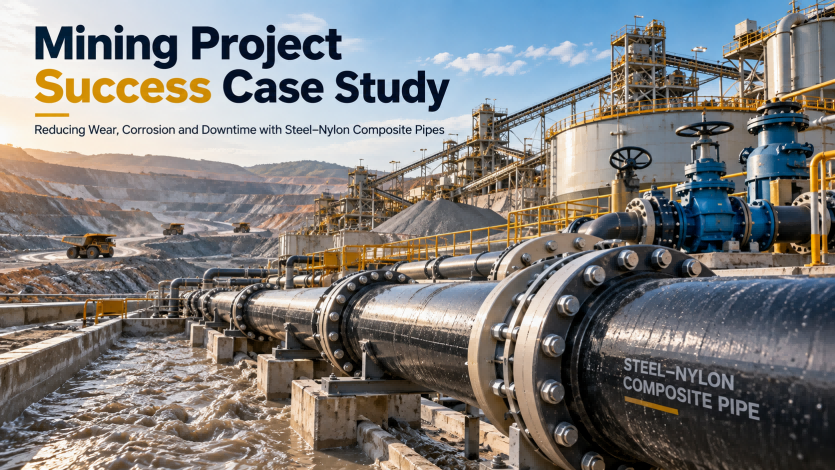
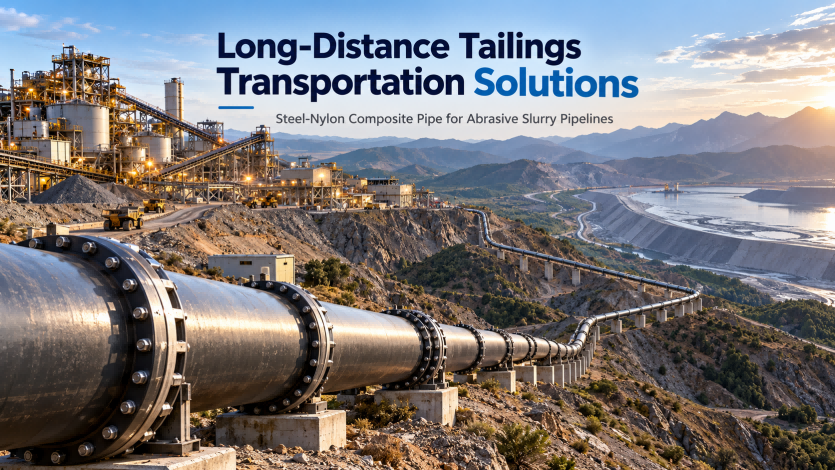
How to Choose the Right Mining Tailings Pipeline: A Comprehensive Guide to Abrasion Resistance, Corrosion Protection, and Long-Term Reliability
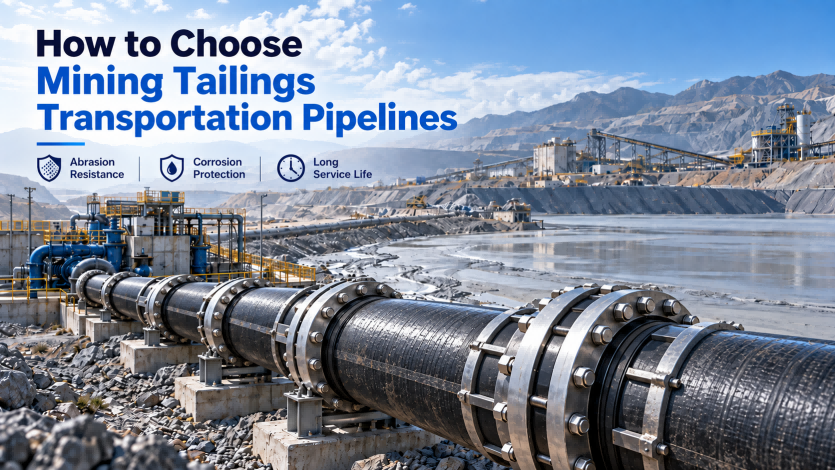
Mining Tailings Pipeline Selection Guide: Discover How Steel-Nylon Composite Pipes Improve Wear Resistance, Corrosion Protection, and Pressure Performance in Demanding Mining Applications
Introduction: Why Is Selecting the Right Tailings Pipeline Becoming Increasingly Important?
In modern mining operations, tailings transportation is a critical process connecting mineral processing plants, tailings treatment facilities, and tailings storage facilities.
As mining operations expand, mineral processing technologies advance, and tailings transportation distances increase, pipeline systems face increasingly demanding operating conditions.
Unlike conventional industrial water pipelines, tailings transportation pipelines must withstand continuous internal pressure, abrasive solid particles, potentially corrosive media, pressure fluctuations, and mechanical loads caused by complex terrain.
During operation, pipeline wear, leakage, or blockage can result in production interruptions, increased maintenance costs, environmental contamination, and potential safety risks.
Therefore, selecting a suitable tailings pipeline requires mining companies to consider more than the initial purchase price.
Several important questions must be addressed:
-
Does the pipeline provide sufficient abrasion resistance?
-
Can it withstand the chemical properties of the tailings slurry?
-
Can it handle the operating pressure required for long-distance transportation?
-
Are the pipeline connections reliable under demanding operating conditions?
-
What are the long-term maintenance and replacement costs?
-
Can the pipeline be customized for different mining environments?
Among the available material solutions, steel-nylon composite pipes combine structural strength, abrasion resistance, and corrosion protection, making them a promising option for certain demanding tailings transportation applications.
This article explores the major challenges of mining tailings transportation, explains how to select suitable pipeline materials, and examines how steel-nylon composite pipes can help mining companies improve long-term pipeline reliability and operational efficiency.
1. What Are the Main Challenges Facing Mining Tailings Pipelines?
Mining tailings are not simply industrial wastewater.
They are complex mixtures of solid mineral particles, water, and residual processing chemicals.
The physical and chemical characteristics of tailings vary significantly between mining operations. Even tailings from the same mineral deposit can exhibit different transportation characteristics depending on the processing method, particle size distribution, and slurry concentration.
Consequently, selecting a tailings pipeline requires a thorough understanding of the actual operating conditions.
1.1 Continuous Abrasion Caused by High-Solids Tailings Slurry
Tailings slurry typically contains a substantial proportion of solid mineral particles.
As the slurry moves through a pipeline, these particles may slide, rub, and collide against the internal pipe surface.
Over time, repeated particle contact can gradually reduce the thickness of the pipe wall. In severe cases, localized wear may eventually lead to perforation and leakage.
Several factors influence the abrasion rate of tailings pipelines.
| Influencing Factor | Impact on Pipeline Performance |
|---|---|
| Solid particle concentration | Influences slurry flow characteristics and particle interaction with the pipe wall |
| Particle hardness | Affects the cutting and abrasive action of mineral particles |
| Particle size and shape | Influences particle settlement, sliding abrasion, and impact wear |
| Slurry velocity | Affects particle movement, impact intensity, and transportation energy consumption |
| Pipeline geometry | Elbows, tees, and diameter transitions may experience concentrated wear |
| Internal lining material | Determines how effectively the pipe surface withstands friction and particle impact |
Tailings containing a high proportion of quartz, sharp-edged particles, or relatively large mineral fragments can create particularly demanding abrasive conditions.
In these applications, the wear resistance of the internal pipe material becomes an important consideration.
However, pipeline wear does not necessarily occur uniformly.
Depending on the slurry flow regime, localized abrasion may develop along the bottom of horizontal pipelines, on the outer surfaces of elbows, near diameter transitions, and in other areas exposed to concentrated particle impact.
Therefore, pipeline selection should consider not only the abrasion resistance of straight pipe sections but also the wear characteristics of the entire transportation system.
1.2 Combined Corrosion and Abrasion
Some mining tailings contain chemically aggressive components in addition to abrasive solid particles.
Potential corrosive constituents include:
-
Acidic or alkaline substances released from mineral processing;
-
High concentrations of dissolved salts;
-
Residual chemical reagents used during mineral processing;
-
Industrial recycled water containing chloride ions or other corrosive components.
For conventional carbon steel pipelines, corrosion can cause gradual metal loss.
At the same time, abrasive particles may continuously remove corrosion products or protective surface layers.
When corrosion and abrasion occur simultaneously, pipeline deterioration can become more complex.
Under certain corrosive tailings transportation conditions, simply increasing the thickness of a conventional steel pipe may not adequately address the underlying corrosion problem.
A composite pipeline with a corrosion-resistant internal lining can separate the steel pressure-bearing structure from the transported slurry, reducing direct exposure to corrosive media.
However, the suitability of any lining material must be verified according to the actual chemical composition, concentration, operating temperature, and long-term exposure conditions.
1.3 Pressure and Structural Requirements for Long-Distance Transportation
Large open-pit mines, mountainous mining areas, and remote tailings disposal facilities often require pipelines extending several kilometers or more.
As transportation distances increase, pipeline systems must address several critical engineering challenges.
First: Frictional pressure losses.
Tailings slurry has different density and rheological characteristics from clean water.
As pipeline length increases, cumulative frictional losses may require additional pumping capacity or intermediate pumping stations.
Second: Elevation differences.
Mining operations located in mountainous terrain often experience significant elevation changes.
Different pipeline sections may therefore be exposed to different static and operating pressures.
Third: Transient pressure fluctuations.
Sudden pump shutdowns, rapid valve closures, or significant changes in system flow can create transient pressure fluctuations within the pipeline.
If the pipe material, flanges, and other connecting components are not adequately designed for these conditions, the risk of joint failure, leakage, or localized structural damage may increase.
For these reasons, selecting a long-distance tailings pipeline requires more than checking its normal operating pressure.
Appropriate hydraulic calculations and transient pressure analysis should be incorporated into the engineering design process.
1.4 Tailings Sedimentation and Pipeline Blockage
Tailings slurry may contain particles that tend to settle under certain flow conditions.
In heterogeneous slurry transportation, when the internal flow velocity falls below the critical deposition velocity for a particular operating condition, solid particles may gradually accumulate along the bottom of the pipeline.
This can increase transportation resistance and potentially result in pipeline blockage.
However, increasing slurry velocity is not always the solution.
Excessively high flow velocities may increase pumping energy consumption and accelerate abrasive wear under certain operating conditions.
Pipeline design must therefore balance three important objectives:
-
Preventing excessive particle deposition;
-
Controlling pipeline abrasion;
-
Maintaining reasonable pumping energy consumption.
Critical deposition velocity depends on multiple factors, including particle size, particle density, slurry concentration, pipe diameter, and rheological properties.
A single fixed velocity cannot be applied universally to every mining tailings transportation project.
2. What Pipeline Materials Are Commonly Used for Mining Tailings Transportation?
Common materials used in mining tailings transportation include carbon steel, HDPE, rubber-lined steel, ceramic-lined composite pipes, and other abrasion-resistant composite pipeline systems.
Each material has distinct mechanical properties, chemical resistance characteristics, installation requirements, and operating limitations.
Understanding these differences is essential when developing an appropriate pipeline solution.
2.1 Conventional Carbon Steel Pipes
Carbon steel pipes offer established manufacturing and installation methods.
They can provide high structural strength and pressure capacity when appropriately designed.
However, the internal steel surface is directly exposed to the transported tailings slurry.
Under highly abrasive or corrosive operating conditions, unprotected carbon steel may experience significant wall-thickness loss.
For continuous tailings transportation applications, mining operators should evaluate whether internal linings, abrasion-resistant layers, or other protective measures are necessary.
2.2 HDPE Pipes
High-density polyethylene (HDPE) pipes provide resistance to many chemical substances, relatively low weight, and flexible installation options.
They can be used in tailings transportation systems when operating pressure, temperature, and slurry characteristics are compatible with the material.
However, projects involving relatively high operating pressures, elevated temperatures, or demanding structural stiffness requirements require additional engineering evaluation.
Particular attention should be paid to the long-term pressure capacity of HDPE, temperature-related pressure derating, and pipeline support conditions.
Furthermore, the abrasion resistance of HDPE depends on particle characteristics and flow conditions.
Its service life should not be assumed to be superior or inferior to that of other materials without relevant comparative test data.
2.3 Rubber-Lined Steel Pipes
Rubber-lined steel pipes use an external steel structure to provide mechanical strength and an internal rubber lining to protect the pipe against contact with the transported medium.
Under certain fine-particle slurry conditions and impact wear environments, properly selected rubber linings can provide favorable operating performance.
However, rubber temperature resistance, chemical compatibility, lining adhesion, and resistance to localized damage must be considered.
If the internal rubber lining becomes detached, torn, or excessively worn, continued pipeline operation may be affected.
2.4 Ceramic-Lined Composite Pipes
Ceramic-lined composite pipes use the high hardness of ceramic materials to improve abrasion resistance under suitable operating conditions.
They can be valuable in certain highly abrasive applications.
However, projects involving substantial mechanical impact, complicated field modifications, or significant structural deformation should carefully evaluate the impact resistance of the ceramic lining, its attachment method, and the reliability of the pipe connections.
2.5 Steel-Nylon Composite Pipes
Steel-nylon composite pipes combine the mechanical strength of steel with the abrasion resistance and corrosion protection provided by nylon materials.
Their fundamental design principle is straightforward:
The steel structure provides mechanical strength and pressure-bearing capacity, while the nylon lining forms the internal surface in direct contact with the transported slurry.
Compared with conventional single-material pipes, this composite structure allows the pressure-bearing component and the medium-contact layer to be designed and optimized according to their respective operating requirements.
For tailings transportation applications involving elevated operating pressures, particle abrasion, and chemical corrosion, steel-nylon composite pipes represent an alternative worth evaluating.
3. Why Are Steel-Nylon Composite Pipes Suitable for Certain Demanding Tailings Transportation Applications?
The value of steel-nylon composite pipes lies not simply in combining two materials, but in assigning different engineering functions to each component.
The steel structure provides mechanical support and pressure resistance, while the nylon lining protects the internal surface from direct exposure to the transported medium.
For mining operations facing demanding transportation conditions, this structural approach offers several potential advantages.
3.1 Abrasion-Resistant Nylon Lining Reduces Direct Wear on the Steel Structure
The abrasion resistance of the internal pipe surface is an important factor affecting the service life of tailings pipelines.
Steel-nylon composite pipes use nylon as the primary medium-contact layer.
Properly formulated and manufactured reinforced MC nylon materials provide a combination of toughness, friction resistance, and mechanical wear resistance.
Under suitable slurry transportation conditions, the nylon lining reduces direct contact between abrasive mineral particles and the steel pressure-bearing structure.
For pipeline sections where particle sliding and continuous abrasive contact are the dominant wear mechanisms, selecting a suitable nylon formulation and lining thickness can help improve resistance to internal wear.
Compared with unprotected carbon steel pipes directly exposed to abrasive slurry, this composite structure can reduce the risk of wall-thickness loss in the steel pressure-bearing component.
However, nylon linings do not automatically provide a longer service life under every slurry transportation condition.
When tailings contain large, sharp, or highly abrasive particles, or when pipelines are exposed to sustained high-velocity particle impact, abrasion testing using representative slurry conditions is recommended.
Comparative testing can help determine the appropriate lining material and thickness for a specific mining application.
For demanding tailings transportation projects, actual material performance data provides a more reliable basis for selection than generalized claims about abrasion resistance.
3.2 Steel Structure Provides Pressure-Bearing Capacity for Demanding Transportation Systems
Some tailings transportation projects require both abrasion resistance and relatively high pressure-bearing capacity.
This is particularly important for long-distance pipelines, mining operations with significant elevation changes, and transportation systems using multiple pumping stations.
Guangdong Kejin New Materials Co., Ltd. manufactures steel-nylon composite pipes using a combination of steel structures and reinforced nylon materials.
The steel component primarily carries pressure and structural loads, while the nylon lining provides medium isolation and internal wear protection.
Our product portfolio includes steel-nylon composite pipe series with pressure ratings ranging from 1.0 to 4.0 MPa, allowing us to evaluate different product configurations according to specific industrial transportation requirements.
For mining tailings transportation, this composite structure offers several potential advantages:
-
Steel provides the mechanical strength and structural stiffness required for suitable operating conditions.
-
The nylon lining reduces direct contact between the transported slurry and the steel pressure-bearing layer.
-
Pipe dimensions, pressure ratings, and composite structures can be evaluated according to project requirements.
-
The steel structure provides additional design options for applications requiring relatively high structural stiffness.
It is important to note that the 1.0–4.0 MPa range describes the available pressure-rating series.
It does not mean every product within this range is suitable for every tailings transportation application.
The allowable working pressure of a specific pipeline system must be verified according to pipe dimensions, design temperature, transient pressure, fatigue loads, and connection details.
For applications involving transient pressures beyond the applicable product limits, additional engineering design is necessary.
3.3 Nylon Lining Provides Corrosion Protection for Suitable Tailings Slurries
The chemical characteristics of tailings water vary considerably between mining operations.
Some tailings slurries contain dissolved salts, alkaline substances, or other components capable of accelerating corrosion in conventional carbon steel pipelines.
Steel-nylon composite pipes use an internal nylon lining to separate the transported medium from the steel pressure-bearing structure.
This can help reduce direct exposure of the steel to corrosive slurry.
Reinforced MC nylon offers resistance to various chemical substances and may be suitable for certain alkaline and saline transportation conditions.
However, material compatibility cannot be determined from general corrosion-resistance characteristics alone.
Strong acids, high-temperature alkaline solutions, specific solvents, and complex chemical mixtures may affect nylon performance.
The chemical compatibility of nylon depends on its formulation, the transported medium, chemical concentration, operating temperature, and exposure duration.
Consequently, a detailed evaluation based on the actual tailings water chemistry is necessary before selecting the lining material.
Corrosion protection of the external pipe surface, flange sealing surfaces, and any other potentially exposed steel components should also be considered during pipeline design.
3.4 Large-Diameter Manufacturing Capability Supports High-Capacity Mining Projects
Large mining operations often generate substantial volumes of tailings.
As slurry transportation requirements increase, pipe diameter and overall pipeline configuration become important factors affecting system performance.
For high-flow applications, increasing the pipe diameter may reduce frictional resistance under certain conditions.
However, increasing the diameter also reduces flow velocity at a given volumetric flow rate, which may increase the risk of particle sedimentation.
Therefore, large-diameter tailings pipeline design must balance transportation capacity, slurry velocity, pressure losses, sedimentation risk, and pumping energy consumption.
Guangdong Kejin New Materials Co., Ltd. has developed manufacturing capabilities for large-diameter reinforced MC nylon pipes and steel-nylon composite pipes.
Our manufacturing experience includes pipe sizes up to DN1600, with technical capabilities being developed and extended toward ultra-large-diameter products of DN2000 and above.
For large-scale mining applications, suitable large-diameter steel-nylon composite pipe configurations can be evaluated according to transportation capacity, design pressure, and installation requirements.
Large-diameter manufacturing capability does not mean that every available diameter has the same pressure rating.
The structural design, wall thickness, manufacturing feasibility, and pressure-bearing capacity of each product configuration must be confirmed according to the requirements of the individual project.
4. How Should Mining Companies Select the Right Tailings Pipeline?
Selecting a mining tailings pipeline requires a systematic engineering approach.
Rather than focusing exclusively on the initial purchase price of different pipe materials, mining companies should evaluate the actual transportation conditions and select a pipeline system accordingly.
Six key factors should be considered.
4.1 Select Pipeline Materials According to Tailings Slurry Characteristics
The first step is to obtain comprehensive physical and chemical data for the transported tailings slurry.
The following parameters should be carefully evaluated.
| Key Parameter | Engineering Considerations |
|---|---|
| Solid concentration | Determines particle loading and influences slurry transportation characteristics |
| Slurry density | Required for hydraulic calculations and pressure-loss analysis |
| Particle size distribution | Influences sedimentation behavior and abrasive wear mechanisms |
| Maximum particle size | Helps assess impact wear and blockage risks |
| Particle hardness | Influences the abrasive action of mineral particles on the internal lining |
| pH and chemical composition | Determines corrosion potential and lining compatibility |
| Operating temperature | Must be considered when assessing long-term material performance |
| Slurry rheology | Required for evaluating flow resistance, sedimentation, and startup conditions |
For high-concentration tailings, paste tailings, and slurries exhibiting significant non-Newtonian behavior, rheological testing may be necessary to establish an appropriate transportation model.
Material selection should then compare the suitability of carbon steel, HDPE, rubber-lined steel, ceramic-lined composite pipes, and steel-nylon composite pipes.
No single material should be assumed to be universally suitable for every mining application.
4.2 Determine Pipe Diameter Based on Flow Rate and Critical Deposition Velocity
The internal diameter of a tailings pipeline should be selected according to the required transportation capacity.
For a given volumetric flow rate, average internal flow velocity can be calculated using the following equation:
Where:
-
vv = Average flow velocity, in m/s;
-
QQ = Volumetric slurry flow rate, in m³/s;
-
DD = Actual internal pipe diameter, in m.
For composite pipelines, the actual internal diameter may differ from the nominal pipe diameter.
This is particularly important for pipelines with relatively thick abrasion-resistant linings.
Hydraulic calculations should always use the actual effective internal diameter.
After determining the pipe diameter, the operating conditions should be evaluated at minimum, normal, and maximum transportation flow rates.
For slurries susceptible to particle deposition, the critical deposition velocity should be calculated according to the actual slurry properties.
The selected operating velocity must provide an appropriate margin for reliable solids transportation.
For highly concentrated non-Newtonian slurries, a hydraulic model reflecting their actual rheological characteristics should be used instead of directly applying calculations developed for clean water or dilute slurries.
4.3 Select Pressure Ratings Based on Hydraulic Losses and Transient Pressure
The design pressure of a tailings transportation system should account for normal operating pressure, frictional pressure losses, elevation differences, pumping configurations, and transient pressure conditions.
For long-distance pipelines, additional analysis should be performed to evaluate pressure changes during pump startup, shutdown, valve operation, and abnormal operating events.
Steel-nylon composite pipes can be selected according to the specific design requirements of the project.
However, pipes, flanges, gaskets, valves, and other connecting components must all satisfy the pressure requirements of the complete pipeline system.
The pressure rating of a straight pipe section alone cannot establish the pressure-bearing capacity of the entire transportation system.
4.4 Optimize Pipeline Design According to Abrasion Characteristics
Tailings pipeline design should extend beyond straight pipe sections.
Elbows, tees, reducers, pump outlets, and other components exposed to concentrated particle impact require particular attention.
Depending on the operating conditions, possible design measures include:
-
Using larger-radius elbows where appropriate;
-
Reducing unnecessary abrupt diameter transitions and sharp changes in flow direction;
-
Selecting suitable lining structures and thicknesses according to anticipated wear;
-
Designing replaceable pipe sections in areas exposed to severe abrasion;
-
Establishing appropriate wall-thickness inspection locations based on operating experience.
For steel-nylon composite pipelines, additional wear-protection measures can be evaluated for high-abrasion sections.
A targeted approach to individual pipeline sections helps avoid unnecessary material consumption while addressing areas requiring greater wear protection.
4.5 Select Appropriate Pipeline Connection Methods
Mining tailings pipelines often extend over long distances and must be installed in demanding environments.
Construction accessibility, installation requirements, and future maintenance needs should therefore be considered when selecting a connection method.
Guangdong Kejin New Materials Co., Ltd. emphasizes the development of integrated flange structures and connection solutions that can reduce the need for on-site welding.
For tailings transportation systems suitable for flange connections, prefabricated pipe sections can be assembled on-site using appropriately designed flanged joints.
This approach offers several potential advantages.
Reduced on-site hot work
Under suitable construction conditions, prefabricated flange connections can reduce the amount of welding required during pipeline installation.
Convenient replacement of individual pipe sections
For pipeline sections exposed to concentrated abrasion, removable connections can facilitate inspection, maintenance, and replacement.
Greater opportunities for prefabricated installation
Factory-prefabricated pipe sections can reduce certain on-site fabrication activities and simplify installation planning.
However, flange connections do not eliminate leakage risks.
Flange sealing surfaces, gasket selection, bolt preload, and pipeline support arrangements must be designed according to the transported medium and operating pressure.
For mining projects involving frequent pressure fluctuations or significant external loads, the structural strength and sealing reliability of the connections should be verified.
4.6 Evaluate Total Cost of Ownership Instead of Purchase Price Alone
Traditional pipeline procurement often focuses primarily on the price per meter of pipe.
However, mining tailings pipelines may operate continuously for many years.
For these systems, the initial procurement cost represents only one component of the total investment.
The more relevant question is:
Which pipeline solution can provide an appropriate balance of safety, environmental protection, transportation performance, and long-term operating costs?
This requires a total cost of ownership analysis.
5. How Can Steel-Nylon Composite Pipes Help Reduce Long-Term Mining Operating Costs?
For large mining operations, tailings transportation systems are often expected to operate continuously over extended periods.
If pipelines experience frequent leakage caused by abrasion or corrosion, the resulting costs can extend far beyond the price of replacement pipes.
Additional expenses may include emergency repairs, production interruptions, maintenance labor, tailings cleanup, and environmental remediation.
Therefore, pipeline economics should be evaluated using a life cycle cost (LCC) or total cost of ownership (TCO) approach.
5.1 How Is Pipeline Total Cost of Ownership Calculated?
A simplified TCO model can be expressed as follows:
TCO=Cp+Ci+Ce+Cm+Cr+CdTCO=C_p+C_i+C_e+C_m+C_r+C_dWhere:
| Cost Component | Description |
|---|---|
| Cp: Procurement cost | Cost of pipes, fittings, and connecting components |
| Ci: Installation cost | Transportation, lifting, connection, and on-site construction |
| Ce: Operating cost | Pumping energy consumption and other operating expenses |
| Cm: Maintenance cost | Routine inspection, localized repairs, and failure management |
| Cr: Replacement cost | Pipe replacement, dismantling, reinstallation, and associated production interruptions |
| Cd: Decommissioning cost | Pipeline removal, disposal, and other end-of-service expenses |
For tailings transportation projects in environmentally sensitive areas, the potential costs associated with pipeline leakage, environmental remediation, and regulatory compliance should also be evaluated.
A practical TCO analysis should establish a defined evaluation period and discount future expenses to a consistent reference date.
5.2 Where Does the Long-Term Economic Value of Steel-Nylon Composite Pipes Come From?
The potential economic value of steel-nylon composite pipes comes from their ability to combine pressure-bearing capacity, internal corrosion protection, and abrasion resistance within a single composite structure.
When properly matched to the operating conditions, the nylon lining reduces direct contact between the steel pressure-bearing structure and the tailings slurry.
This can reduce the risk of structural deterioration caused by direct internal abrasion and corrosion.
If engineering testing and operating experience demonstrate that the composite pipeline can extend replacement intervals, mining companies may be able to reduce replacement material costs, maintenance labor, and unplanned production interruptions.
In addition, properly designed prefabricated flange connections may simplify the removal and replacement of individual pipe sections.
However, these potential economic advantages must be verified using project-specific data.
Steel-nylon composite pipes should not automatically be assumed to have lower total operating costs than every alternative material.
For example, if the slurry produces exceptionally severe impact wear or the nylon lining is chemically incompatible with the transported medium, maintenance requirements may increase.
A reliable economic assessment should therefore combine actual operating conditions, comparable material test results, and realistic maintenance assumptions.
6. How Should Steel-Nylon Composite Pipes Be Evaluated for Different Mining Applications?
Tailings transportation conditions vary significantly between mining operations.
The selection of steel-nylon composite pipes should focus on the dominant failure risks of each project rather than applying an identical product configuration to every application.
The following four scenarios illustrate important selection considerations.
Scenario 1: High-Concentration, Highly Abrasive Tailings Transportation
Typical operating conditions:
The transported tailings contain relatively hard mineral particles, and the pipeline is exposed to continuous abrasive wear during long-term operation.
Primary engineering challenge:
How can the transportation system maintain the required flow capacity while controlling internal wear and the risk of localized perforation?
Steel-nylon composite pipe solution:
The reinforced MC nylon lining separates abrasive mineral particles from the steel pressure-bearing structure.
The lining thickness and composite pipe configuration can be evaluated according to particle size, hardness, slurry velocity, and other relevant operating parameters.
For elbows and other areas exposed to concentrated abrasion, additional wear-resistance evaluation may be required.
For applications involving coarse particles and severe high-velocity impact wear, representative slurry testing should be performed to determine whether the nylon lining can meet the expected service-life requirements.
Scenario 2: Corrosive Tailings Slurry Transportation
Typical operating conditions:
The transported tailings contain dissolved salts or other corrosive substances that may accelerate the internal corrosion of conventional carbon steel pipes.
Primary engineering challenge:
How can direct contact between corrosive slurry and the steel pressure-bearing structure be reduced?
Steel-nylon composite pipe solution:
The internal nylon lining provides a barrier between the transported medium and the steel structure.
For chemical environments compatible with the selected nylon formulation, the composite structure can be evaluated as a potential long-term transportation solution.
For highly acidic, chemically complex, or elevated-temperature slurries, specialized material compatibility testing should be prioritized.
This helps reduce the risk of selecting a lining material that may deteriorate under the actual operating conditions.
Scenario 3: Long-Distance, High-Pressure Tailings Transportation
Typical operating conditions:
Tailings must be transported through a relatively long pipeline to a remote treatment or storage facility.
The transportation route includes elevation changes and requires pressurized pumping.
Primary engineering challenge:
How can the pipeline simultaneously provide adequate pressure-bearing capacity, internal abrasion resistance, and reliable connections?
Steel-nylon composite pipe solution:
The steel structure provides mechanical strength, while the nylon lining protects the internal surface from direct exposure to the slurry.
Suitable pipe dimensions and pressure ratings can be evaluated according to the requirements of individual pipeline sections.
Transient pressure, localized abrasion, pipeline supports, and flange connections must also be incorporated into the engineering design.
For conditions exceeding standard product specifications, project-specific engineering analysis and design are necessary.
Scenario 4: Large-Scale, High-Flow Mining Tailings Transportation
Typical operating conditions:
A large mineral processing plant generates substantial quantities of tailings and requires a high-capacity pipeline system.
Primary engineering challenge:
How can the pipeline provide sufficient transportation capacity while maintaining structural reliability and manageable long-term maintenance requirements?
Steel-nylon composite pipe solution:
The appropriate internal pipe diameter should be determined according to volumetric flow rate, critical deposition velocity, and hydraulic pressure losses.
The selected diameter, design pressure, and installation requirements can then be used to evaluate a suitable large-diameter steel-nylon composite pipe configuration.
For ultra-large-diameter composite pipelines, particular attention should be paid to steel structure design, lining manufacturing quality, connection reliability, and on-site installation conditions.
7. What Should Mining Companies Look for in a Steel-Nylon Composite Pipe Manufacturer?
For mining companies, the performance of the selected pipe material is important, but the manufacturing capabilities, quality control procedures, and technical support provided by the supplier can also influence project outcomes.
Large tailings transportation projects may require substantial quantities of pipes with different dimensions, connection configurations, and performance requirements.
These projects place significant demands on manufacturing consistency, production organization, and delivery capabilities.
Guangdong Kejin New Materials Co., Ltd. specializes in the research, development, and manufacturing of reinforced MC nylon pipes and steel-nylon composite pipes.
Our product development focuses on industrial applications involving corrosive media, abrasive slurry, and other demanding operating environments.
In the mining tailings transportation sector, we emphasize four important areas.
7.1 Customized Pipeline Design Based on Actual Operating Conditions
Different mining operations produce tailings with different particle characteristics, solid concentrations, and chemical compositions.
We emphasize collecting comprehensive operating data before selecting a pipeline solution.
Based on the actual transportation requirements, suitable pipe dimensions, pressure ratings, lining structures, and connection methods can be evaluated.
For applications involving severe abrasion or unusual chemical conditions, material testing can support further optimization of the product configuration.
7.2 Large-Diameter Composite Pipe Manufacturing Capabilities
As large-scale mining operations increase their transportation capacity, demand for large-diameter industrial pipelines continues to create new manufacturing and engineering requirements.
Large-diameter composite pipes require careful attention to structural design, manufacturing processes, and quality control.
Our company continues to develop manufacturing technologies for large-diameter reinforced nylon pipes and steel-nylon composite pipes.
By evaluating the manufacturing feasibility and engineering suitability of different product dimensions, we aim to provide additional pipeline options for large industrial projects.
7.3 Reliable Pipeline Connection Design
For mining tailings transportation systems, the reliability of pipeline connections is an important part of overall system performance.
Our company emphasizes the development of integrated flange technology and connection solutions that can reduce the need for on-site welding.
Through appropriate connection design, we aim to improve installation convenience and facilitate subsequent pipeline maintenance.
Connection strength, sealing performance, and applicable pressure ratings must be verified according to individual project requirements.
7.4 Manufacturing Quality Control for Long-Term Pipeline Reliability
For tailings transportation systems intended for long-term operation, consistent manufacturing quality is essential.
Material selection, composite pipe manufacturing, and finished-product inspection should all address the factors that influence long-term pipeline performance.
Depending on the project specifications, quality control procedures may include dimensional inspection, material property testing, pressure testing, and other necessary verification activities.
For mining projects with demanding abrasion and corrosion requirements, additional material testing and engineering suitability assessments may be incorporated into the selection process.
Our objective is not simply to supply individual pipe products, but to develop industrial pipeline solutions that address the combined requirements of abrasion resistance, corrosion protection, and pressure-bearing performance.
8. Frequently Asked Questions About Mining Tailings Pipeline Selection
Q1: Should abrasion resistance or pressure-bearing capacity be the main priority when selecting a tailings pipeline?
Both are essential, but their relative importance depends on the actual operating conditions.
For low-pressure tailings transportation systems exposed to severe abrasion, the wear resistance of the internal pipe material may be a major selection factor.
For long-distance, high-pressure transportation projects, pressure-bearing capacity, internal abrasion resistance, pressure fluctuations, and connection reliability must be considered together.
Steel-nylon composite pipes combine a steel pressure-bearing structure with an internal nylon lining, providing an alternative for projects requiring these performance characteristics.
Q2: Can steel-nylon composite pipes be used for high-concentration tailings transportation?
Steel-nylon composite pipes can be evaluated for high-concentration tailings transportation applications.
However, solid concentration alone is insufficient to determine whether a particular pipe configuration is suitable.
Selection must also consider particle characteristics, slurry rheology, operating pressure, flow velocity, and the dominant abrasion mechanism.
For highly concentrated paste tailings, particular attention should be paid to startup pressure, slurry behavior during shutdown, and operating conditions during system restart.
Representative slurry testing and appropriate engineering calculations are recommended before finalizing the pipeline design.
Q3: Are steel-nylon composite pipes more abrasion-resistant than conventional steel pipes?
Under suitable particle and flow conditions, a nylon lining can reduce direct abrasion of the steel pressure-bearing structure and may improve the pipeline's overall resistance to internal wear.
However, the actual performance depends on the nylon formulation, lining thickness, particle characteristics, and transportation conditions.
Comparisons of service life should be based on test results obtained under equivalent slurry and operating conditions.
Unverified claims that one material provides a fixed multiple of another material's service life should not be used as the sole basis for engineering selection.
Q4: Are steel-nylon composite pipes suitable for long-distance tailings transportation?
Steel-nylon composite pipes can be considered for long-distance tailings transportation when the pressure rating, material compatibility, and structural design meet the project requirements.
Important engineering considerations include hydraulic pressure losses, elevation differences, transient pressure, pipeline support arrangements, connection methods, and localized abrasion.
Additional engineering verification may be required depending on the operating conditions.
Q5: How can I determine whether steel-nylon composite pipes are suitable for my mining project?
The first step is to provide the pipeline supplier with comprehensive operating data.
Important information includes:
-
Tailings slurry concentration;
-
Particle size distribution;
-
Mineral composition;
-
Chemical composition of the transported medium;
-
Operating temperature;
-
Required transportation capacity;
-
Pipeline length;
-
Elevation differences;
-
Design pressure.
Based on these conditions, the supplier can evaluate material compatibility, hydraulic performance, structural design, and the need for additional abrasion testing.
For particularly demanding mining applications, specialized testing should be completed before finalizing the procurement specifications.
Conclusion: Mining Tailings Pipeline Selection Requires an Integrated Engineering Approach
For mining companies, tailings transportation pipelines are more than simple material-handling equipment.
They are critical infrastructure that can influence mineral processing continuity, tailings management, environmental protection, and long-term operating costs.
As mining operations face increasingly demanding conditions involving abrasive particles, corrosive media, long-distance transportation, and complex terrain, pipeline selection must extend beyond conventional single-material comparisons.
A comprehensive selection strategy should consider material compatibility, structural reliability, localized abrasion protection, connection performance, and total cost of ownership.
Steel-nylon composite pipes combine the structural strength of steel with the abrasion resistance and corrosion protection provided by reinforced nylon materials, offering an integrated approach to pipeline pressure performance and internal surface protection.
For mining projects requiring continuous long-term operation, where maintenance costs are significant and abrasion and corrosion occur simultaneously, properly designed and verified steel-nylon composite pipes may help reduce pipeline failure risks and improve long-term transportation reliability.
However, the final material selection must always be based on actual slurry characteristics, design pressure, material testing, and engineering suitability assessments.
By combining appropriate pipeline materials with comprehensive transportation system design, mining companies can develop safer, more reliable, and more cost-effective tailings transportation solutions.
Looking for a Reliable Abrasion-Resistant Pipeline for Your Mining Project?
Guangdong Kejin New Materials Co., Ltd. specializes in the research, development, and manufacturing of reinforced MC nylon pipes and steel-nylon composite pipes.
We provide abrasion-resistant and corrosion-resistant industrial pipeline products for mining, chemical processing, and other demanding industrial applications.
If your mining operation is experiencing frequent pipeline wear, corrosion, leakage, or premature pipe replacement, our technical team can help evaluate suitable steel-nylon composite pipeline solutions.
To assess the suitability of our products for your project, we recommend providing the following information.
| Project Parameter | Required Information |
|---|---|
| Mining application | Iron ore, copper, gold, phosphate, or other mineral operations |
| Transported medium | Main constituents and chemical properties of the tailings slurry |
| Solid concentration | Mass concentration or volume concentration |
| Particle characteristics | Particle size distribution, maximum particle size, and mineral hardness |
| Transportation capacity | Required flow rate or hourly tailings throughput |
| Pipeline dimensions | Estimated pipe diameter or actual transportation flow rate |
| Operating conditions | Pipeline length, elevation differences, working pressure, and temperature |
| Project objectives | Improve abrasion resistance, enhance corrosion protection, reduce maintenance costs, or extend pipeline service life |
Based on your actual operating requirements, we can work with your engineering team to evaluate suitable pipe dimensions, composite structures, pressure ratings, and connection configurations.
Combine abrasion resistance, corrosion protection, and structural strength to develop a more reliable pipeline solution for your mining tailings transportation system.
Iron Ore Slurry Transportation Solutions: How Steel-Nylon Composite Pipes Improve Wear Resistance and Pipeline Reliability